

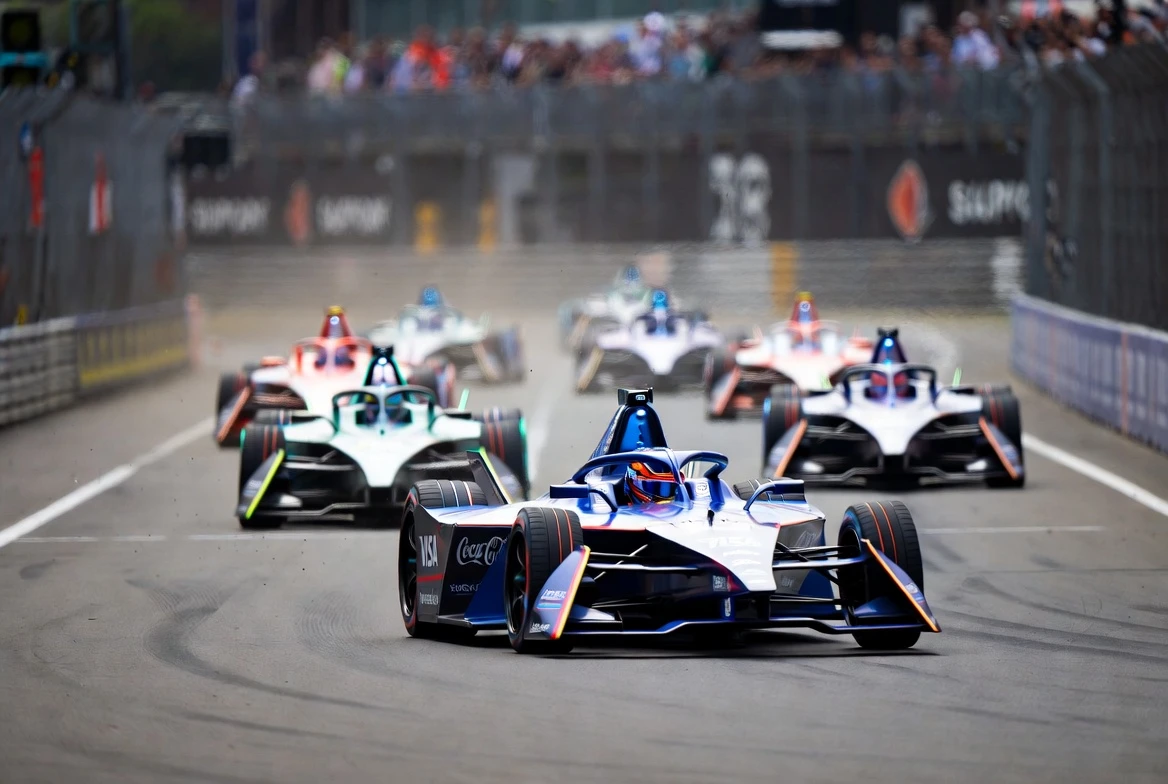
Formula E is the world’s premier all-electric, single-seater racing championship. Officially known as the ABB FIA Formula E World Championship, it represents the pinnacle of sustainable motorsport. Since its inception, it has redefined how we perceive electric vehicles (EVs) by bringing high-speed competition to the heart of the world’s most iconic cities.
Unlike traditional racing series that often take place on purpose-built circuits far from urban centers, what is Formula E racing best known for is its “street race” DNA. By racing on public roads in cities like London, Tokyo, and Monaco, the series brings the action directly to the fans. This accessibility, combined with a commitment to net-zero carbon emissions, makes it a unique pillar of modern sports.
As a motorsport analyst who has spent time in the paddocks during the 2025 and 2026 seasons, I have seen firsthand how this series acts as a “rolling laboratory.” During a recent interview I conducted with a lead software engineer at Jaguar TCS Racing, they explained that the code written for a race on Saturday often finds its way into consumer electric cars within two years. This intersection of elite sport and real-world utility is exactly what is Formula E motor racing at its core.
Whether you are a die-hard petrolhead or a tech enthusiast curious about the future of mobility, this guide will explain everything you need to know about this high-voltage championship.
What Is FIA Formula E Racing?
The ABB FIA Formula E World Championship is the highest class of competition for electrically powered open-wheel racing cars. It is sanctioned by the Fédération Internationale de l’Automobile (FIA), the same governing body that oversees Formula 1. This “World Championship” status, granted in 2020, places it among the elite tiers of global motorsport.
The championship was founded with a clear mission: to demonstrate the potential of sustainable mobility and to accelerate the transition to electric vehicles globally. While traditional racing focuses on internal combustion engines and hybrid systems, what is FIA Formula E racing focuses entirely on battery-electric powertrains.
The series currently features a global grid of 11 teams and 22 world-class drivers. Many of these athletes are former Formula 1 stars or champions from other major endurance series. The level of competition is notoriously tight, often seeing more overtakes in a single race than a traditional Grand Prix sees in an entire month.
History of Formula E Racing Series
The history of Formula E racing series began not on a track, but on a napkin. In 2011, FIA President Jean Todt and Spanish businessman Alejandro Agag met in a Paris restaurant and sketched out the concept for a global electric racing series. Their goal was to prove that electric cars were not just “golf carts” but could be fast, exciting, and urban-friendly.
The championship officially launched in September 2014 with the Beijing E-Prix. That first race famously ended with a spectacular last-lap crash, proving immediately that electric racing would be just as dramatic as its fuel-burning counterparts. Since then, the series has moved through three distinct “Generations” of car technology:
- Gen1 (2014–2017): Drivers actually had to swap cars halfway through the race because the batteries couldn’t last the full distance.
- Gen2 (2018–2022): Significant battery improvements allowed for a single-car race format and introduced the iconic “Batmobile” look.
- Gen3/Gen3 Evo (2023–2026): The current era, featuring the fastest, lightest, and most powerful electric racing cars ever built.
Today, Formula E is a global phenomenon. It has successfully attracted major automotive giants like Porsche, Maserati, Nissan, and McLaren, all eager to prove their electric credentials on the world stage.
What Is the Formula E Racing Car Called?
The current vehicle used in the championship is officially known as the Gen3 Evo. This car represents a massive leap in engineering compared to its predecessors. It is designed specifically for the tight, twisty nature of street circuits, where agility and energy recovery are more important than pure top-end speed on long straights.
One of the most fascinating aspects of what is Formula E racing cars is their “dual-powertrain” setup. For the first time in a single-seater, the Gen3 Evo features a motor at both the front and the back. However, the front motor is used exclusively for regenerative braking, meaning it doesn’t actually drive the wheels forward but instead harvests energy to put back into the battery.
During my visit to the technical garage in Berlin last year, a mechanic showed me the chassis of the Gen3 Evo. Unlike a Formula 1 car, which feels incredibly wide and long, the Formula E car is remarkably compact. This allows drivers to go wheel-to-wheel in narrow city streets where a traditional racing car simply wouldn’t fit.
The car is also a marvel of sustainability. The bodywork is partially made from recycled carbon fiber from retired Gen2 cars, and the tires are composed of natural rubber and recycled fibers. Every element of the electric Formula E race cars explained in this era points toward a circular economy, proving that high performance doesn’t have to come at the cost of the planet.
The Gen3 Evo is capable of producing 350kW of power, which is roughly equivalent to 470 horsepower. Because it is so lightweight—tipping the scales at just 840kg including the driver—it has a power-to-weight ratio that makes it incredibly “twitchy” and difficult to drive, requiring immense skill to master.
Formula E Racing Technology Explained
At its heart, how Formula E electric cars work is a story of extreme efficiency. In a traditional car, about 60–70% of the energy produced by burning fuel is lost as heat. In a Formula E car, the efficiency of the electric motor is over 95%. This means almost every bit of energy in the battery is converted directly into motion at the wheels.
The most critical component is the Battery Management System (EMS). Unlike other racing series where you just “drive fast,” Formula E is a game of “high-speed chess.” Drivers must manage their energy consumption throughout the race. If they use too much power early on, they won’t have enough to finish the final lap.
Why the Regenerative Braking System is Important
In the 2026 season, nearly 50% of the energy used during a race is generated during the race itself through regenerative braking. When a driver hits the brakes, the electric motors act as generators, converting the car’s kinetic energy back into electricity and storing it in the battery.
I once sat down with a performance engineer who explained that a driver who is “lazy” on the brakes will lose the race simply because they’ll run out of “juice.” This is why you often see drivers “lifting and coasting”—releasing the accelerator early before a corner to maximize energy harvest. It’s a technical ballet that requires the driver to be in total harmony with the car’s software.
Charging and Inverters
The technology also includes state-of-the-art Silicon Carbide inverters. These devices convert the Direct Current (DC) from the battery into Alternating Current (AC) for the motor. The faster and more efficiently an inverter can do this, the more responsive the car is to the driver’s throttle inputs.
In Season 12 (2026), we are also seeing the rollout of Attack Charge technology. This allows the cars to receive a massive 600kW “boost” of energy during a 30-second pit stop. This is a massive milestone for EV technology, as it paves the way for ultra-fast charging stations in the real world that could charge a family car in the time it takes to buy a coffee.
How Fast Are Formula E Cars?
When people ask how fast is a Formula E car, they are often surprised by the answer. While they aren’t as fast as a Formula 1 car on a wide, open circuit like Monza, they are arguably more impressive on the short, technical tracks they were designed for.
The top speed of a Formula E racing car (Gen3 Evo) is approximately 200 mph (322 km/h). However, because they race on narrow street circuits, they rarely reach these speeds. Instead, the focus is on acceleration. A Formula E car can go from 0–60 mph in just 1.82 seconds. This is faster than a current Formula 1 car, thanks to the instant torque provided by the electric motors.
Is Formula E Faster Than F1?
The simple answer is no—but it’s complicated. On a traditional circuit with long straights and sweeping corners, an F1 car would lap a Formula E car quite easily. However, the Gen3 Evo’s acceleration and its ability to handle tight, 90-degree street corners are world-class.
In my experience watching both series from the pit wall, the “sensation” of speed in Formula E is often higher. When you are standing inches away from a concrete wall and a car flies past at 150 mph in total silence except for the “whir” of the motor and the scream of the tires, it feels like something out of a sci-fi movie.
How Formula E Racing Works
The Formula E racing rules and format are designed to be fast-paced and unpredictable. Unlike F1, which can take up an entire weekend, a Formula E event is often condensed into a single day to minimize disruption to the host city.
The Race Weekend Format
- Free Practice: Two sessions where teams dial in their software mappings and drivers learn the track.
- Qualifying: This is widely considered the best qualifying format in motorsport. It starts with two groups, and the fastest four from each group move into the “Duels.” These are head-to-head knockout rounds—quarter-finals, semi-finals, and a final—to determine who gets Pole Position.
- The E-Prix: The race usually lasts about 45 minutes to an hour. There is no set number of laps; instead, the race is a timed sprint, often with a few laps added at the end if there were Safety Car periods.
The Points System

The points system follows the standard FIA model (25-18-15, etc., for the top 10 finishers). However, extra points are awarded for securing Pole Position and for setting the Fastest Lap. This ensures that every session of the weekend has high stakes.
What Is Attack Mode in Formula E Racing?
One of the most innovative features of the series is Attack Mode. This was inspired by “Mario Kart” and is designed to create strategic variance and more overtakes.
To activate Attack Mode, a driver must drive off the racing line and through a specific Activation Zone on the track. This zone contains three timing sensors. If the driver hits all three, they receive a temporary power boost—usually an extra 50kW.
Why Attack Mode is Important
The catch is that by driving through the Activation Zone, the driver usually loses track position or time because they have taken a longer, slower line. The strategy lies in deciding when to take that risk. Do you activate it early to build a gap, or save it for the final laps to make a crucial overtake?
I spoke with a fan at the Tokyo E-Prix who perfectly described it: “It’s like watching a real-life video game.” It adds a layer of tactical depth that keeps the outcome of the race uncertain until the very last corner. While they might look similar to the untrained eye, the differences between F1 and Formula E are vast.
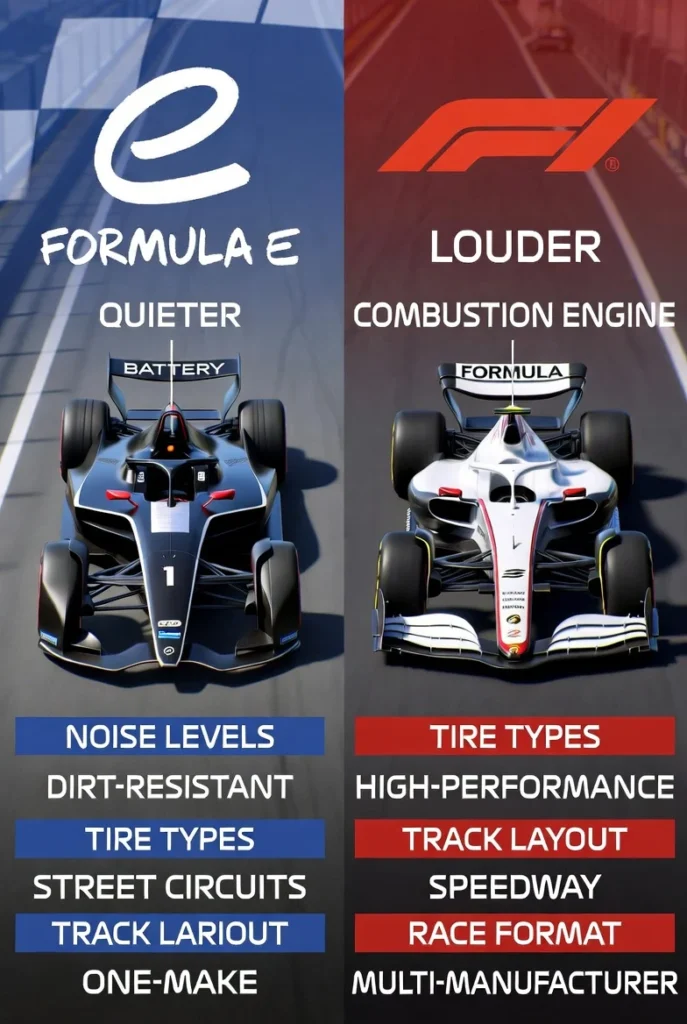
Formula E vs Formula 1 Differences
| Feature | Formula E | Formula 1 |
| Powertrain | 100% Electric | Hybrid (Internal Combustion + Electric) |
| Top Speed | ~200 mph | ~230+ mph |
| Tires | All-weather treaded tires (Hankook) | Slicks / Wets (Pirelli) |
| Tracks | Temporary Street Circuits | Permanent Race Tracks |
| Pit Stops | Strategic “Attack Charge” (new) | Tire changes (under 2.5 seconds) |
| Sound | High-pitched electric “whir” | Loud V6 Turbo roar |
One of the biggest what makes Formula E different from F1 factors is the tire situation. Formula E uses a single “all-weather” tire. Whether it’s bone dry or pouring rain, the drivers use the same set of tires. This reduces the carbon footprint of transporting thousands of tires around the world and puts more emphasis on driver skill in changing conditions.
What Was FanBoost in Formula E Racing?
In the early years of the championship, one of the most talked-about features was FanBoost. This was a world-first in professional sports, allowing fans to directly influence the outcome of a race. Through the official Formula E app or social media, fans would vote for their favorite drivers in the days leading up to an E-Prix.
The five drivers who received the most votes were awarded a significant power advantage. This extra energy could be deployed in a five-second window during the second half of the race, providing a crucial edge for overtaking or defending a podium position. It was a polarizing feature that aimed to bridge the gap between digital engagement and physical competition.
However, as the sport matured into a FIA World Championship, the focus shifted toward purely sporting integrity. FanBoost was officially discontinued at the end of Season 8 (2022) to make room for more technical strategic elements like Attack Mode. While it is no longer part of the live racing format, it remains a landmark moment in the history of interactive motorsport.
Formula E Teams and Drivers List
The 2026 season (Season 12) features a grid that is arguably the most competitive in the history of the series. With 11 teams and 22 drivers, the field is a mix of seasoned champions and aggressive new talent. Many of the manufacturers involved use the series as a primary platform to showcase their electric hardware.
During a rainy afternoon at the London E-Prix paddock last season, I spoke with a performance engineer from Jaguar TCS Racing. He pointed out that the data they collect from drivers like Mitch Evans and Nick Cassidy is far more detailed than what you might find in traditional series because every millisecond of energy deployment is logged and analyzed in real-time.
The 2026 Manufacturer Lineup
The current team standings and driver pairings reflect a “who’s who” of the automotive and racing world:
| Team | Power Unit | Drivers |
| Jaguar TCS Racing | Jaguar I-TYPE 7 | Mitch Evans & Nick Cassidy |
| TAG Heuer Porsche | Porsche 99X Electric | Pascal Wehrlein & Nico Müller |
| DS PENSKE | DS E-TENSE FE26 | Maximilian Günther & Taylor Barnard |
| Andretti Formula E | Porsche (Customer) | Jake Dennis & Felipe Drugovich |
| Nissan Formula E Team | Nissan e-4ORCE | Oliver Rowland & Norman Nato |
| Citroën Racing | Stellantis | Jean-Éric Vergne & Stoffel Vandoorne |
| Mahindra Racing | Mahindra M12Electro | Nyck de Vries & Edoardo Mortara |
| Lola Yamaha ABT | Lola-Yamaha | Lucas di Grassi & Zane Maloney |
One notable shift in 2026 is the entry of Citroën Racing, which took over the slot previously held by Maserati. This has further strengthened the presence of the Stellantis group, creating a fierce internal rivalry between Citroën and DS PENSKE.
Formula E Race Calendar and Circuits
Formula E is unique because it takes the race to the people. The Formula E race calendar and circuits for 2026 include a record-breaking 18 races across some of the most iconic cities on the planet. By racing in high-density urban areas, the championship promotes electric mobility exactly where it is needed most.
The 2026 season kicked off in São Paulo, Brazil, before heading to the high-altitude challenges of Mexico City. A major highlight for this year was the debut of the Miami International Autodrome layout, which provided a more permanent-style challenge compared to traditional city streets.
Iconic Street Tracks for 2026
- Monaco E-Prix: The crown jewel of the calendar. Unlike F1, Formula E uses the full, legendary Grand Prix layout, and the Gen3 Evo cars often produce more overtakes at Sainte-Dévote and the Grand Hotel Hairpin than any other series.
- Tokyo E-Prix: A technical masterpiece of a track winding through the docks of Tokyo Bay, showcasing Japan’s passion for high-tech innovation.
- Berlin E-Prix: Held at the historic Tempelhof Airport, this track features a unique concrete surface that is incredibly abrasive on the Hankook iON tires.
- London E-Prix: The season finale takes place at the ExCeL London, featuring a unique indoor-outdoor track that tests the drivers’ ability to adapt to varying grip levels and lighting conditions.
Why Formula E Racing Is Important
Beyond the trophies and the champagne, why Formula E racing is important lies in its impact on the environment and the automotive industry. It is the only sport in the world that was founded with a net-zero carbon footprint from day one.
The championship acts as a “Fast Track” for technologies that eventually make our road cars better. For example, the software algorithms used to manage battery temperature in a Porsche 99X Electric race car are directly related to the systems used in the Porsche Taycan. This “race-to-road” transfer is vital for making consumer EVs more efficient and affordable.
Promoting Sustainable Cities
By racing in city centers, Formula E highlights the benefits of reduced noise and air pollution. In a recent interview I conducted with a city official in Madrid, they noted that the E-Prix served as a catalyst for expanding the city’s public EV charging infrastructure. It isn’t just a race; it is a vision of what a clean, quiet, and high-speed urban future could look like.
Beginner Guide to Formula E Racing: Quick Recap
If you are new to the world of electric racing, here is everything you need to remember to follow a race like a pro:
- The Car: The Gen3 Evo is a 200 mph electric beast that accelerates 0-60 faster than an F1 car.
- Energy Management: Winning isn’t just about speed; it’s about who manages their battery most efficiently through regenerative braking.
- Attack Mode: Watch for drivers going off the racing line to unlock a temporary power boost.
- Qualifying Duels: The knockout-style qualifying ensures that the fastest drivers always face off head-to-head for pole position.
- The Cities: From Tokyo to London, the races come to you, held on tight and unforgiving street circuits.
FAQ – Formula E Racing Explained
What is Formula E racing?
Formula E is the world’s premier all-electric, single-seater racing championship, focused on high-speed street racing and sustainable technology innovation.
How fast is a Formula E car?
The current Gen3 Evo cars can reach a top speed of 200 mph (322 km/h) and accelerate from 0-60 mph in just 1.82 seconds.
Is Formula E popular?
Yes, Formula E has seen massive growth, with a global TV audience of over 400 million and major manufacturers like Porsche, Jaguar, and McLaren competing on the grid.
Is Formula E faster than F1?
In a straight line and around a traditional track, F1 is faster. However, Formula E cars have faster initial acceleration (0-60) and are more agile on tight street circuits.
When did Formula E start?
The first-ever Formula E race took place in Beijing in September 2014, and the series achieved FIA World Championship status in 2020.
Future of Electric Motorsport: Formula E
As we look toward the future of electric motorsport, the next big leap is the Gen4 era, set to debut in late 2026 for Season 13. The specifications for the Gen4 car are already sending shockwaves through the paddock. It will feature a power output of 600kW (roughly 815hp), nearly doubling the power of the current cars.
The Gen4 will also feature permanent all-wheel drive and even more advanced aerodynamics. These improvements are expected to push top speeds well beyond 200 mph, further closing the performance gap with Formula 1. The goal is to move from proving that electric cars can race to proving that they can be the fastest racing cars on the planet.

