
What causes crashes in motor racing serves as the central inquiry for engineers, drivers, and safety delegates who strive to make motorsports safer every year. Most motor racing crashes occur due to a sophisticated interplay between human error, loss of mechanical traction, sudden mechanical failure, and aerodynamic instability. In professional environments like Formula 1, the vast majority of incidents stem from drivers operating at the absolute limit of grip rather than random component failures.
Consequently, safety systems prioritize energy dissipation and driver cell integrity to ensure survival during high-velocity impacts. At 300 km/h, even a one-degree steering mistake or a slight drop in tire temperature determines whether a car stays on track or ends up in the barriers. Engineering perspectives suggest that racing is essentially a state of controlled instability where vehicles operate constantly at the friction limit.
Therefore, when we analyze what causes crashes in motor racing, we must look at the convergence of physics, human reaction times, and extreme mechanical stress. I recently spoke with a senior track marshal at the Silverstone Circuit who has witnessed decades of motorsport evolution. He noted that while the speed of the cars has increased, the predictability of crash outcomes has improved significantly due to better engineering analysis.
Furthermore, he emphasized that understanding what causes crashes in motor racing allows track designers to create better runoff areas and barrier systems. This article explores the technical nuances of racing accidents and the miraculous safety systems that protect the modern driver.
What Causes Crashes in Motor Racing?
To understand what causes crashes in motor racing, one must first acknowledge the four primary pillars of racing accidents: driver error, loss of grip, mechanical failure, and aerodynamic loss. Specifically, driver error remains the most frequent factor, as pilots often push beyond the car’s physical capabilities during intense wheel-to-wheel combat. Braking a mere meter too late or applying the throttle too aggressively on a corner exit can trigger a spin.
Furthermore, loss of grip frequently explains what causes crashes in motor racing during changing weather conditions. Cold tires do not provide the necessary chemical adhesion to the asphalt, leading to “snap oversteer” that even professionals cannot catch. Additionally, dirty air turbulence from a leading car can strip the following car of its front-end downforce, causing it to understeer off the track.
Mechanical failure, though rarer in the modern era, still significantly contributes to what causes crashes in motor racing. A sudden suspension breakage or a brake line failure at high speed leaves the driver as a mere passenger. Moreover, aerodynamic instability, such as a DRS (Drag Reduction System) failure, can cause a car to lose rear-end stability at the worst possible moment. Consequently, teams spend millions on simulation to predict these failure modes.
The Role of Driver Error and Racing at the Limit
When people ask what causes 90% of accidents, racing analysis almost always points to human error at the limit. Unlike road driving, where accidents often involve distraction, racing errors occur because the driver is intentionally dancing on the edge of a physics-defying cliff. Therefore, a slight misjudgment of a competitor’s position frequently determines what causes crashes in motor racing during the opening lap.
Specifically, Formula 1 teams measure the margin for error in the cockpit in millimeters and milliseconds. If a driver hits a “sausage curb” at the wrong angle, the car can become airborne, losing all steering and braking authority. Many discussions about what causes crashes in motor racing that Reddit users participate in highlight that these “at-limit” mistakes are simply a byproduct of elite competition.
Are Most Racing Accidents Caused by Human Error?
Statistical data from various motorsport governing bodies suggests that driver-at-limit mistakes constitute the majority of racing incidents. When engineering studies investigate what causes 90% of accidents, they find that random mechanical failure occurs surprisingly infrequently. Instead, the pressure of competition forces drivers into high-risk decisions that result in contact or loss of control.
Consequently, we must view the driver as the most critical variable in the safety equation. While a car is a predictable machine, the human mind must process immense sensory input under high loads. This mental fatigue can lead to a “lapse in concentration”, which is a primary factor in what causes crashes in motor racing. Therefore, fitness and mental prep are just as vital as the car’s aerodynamic package.
Engine Failure in Motorsport Crashes
Engine failure remains a dramatic and dangerous contributor to what causes crashes in motor racing in 2026. Modern F1 power units are complex hybrid turbo systems that operate at extreme thermal loads. Specifically, a sudden “thermal runaway” or a turbocharger explosion can leak oil onto the rear tires, instantly removing all traction.
Furthermore, hydraulic system loss often accompanies an engine failure, which can leave a driver without power steering or gear-shifting capabilities. This mechanical catastrophe often explains what causes crashes in motor racing on high-speed straights. Moreover, modern racing teams push components to 99.9% of their fatigue life due to tight reliability margins, which increases the risk of a catastrophic “blow-up.”
What Race is Most Likely to See Crashes?
If you ask what race is most likely to crash a car, street circuits like the Monaco Grand Prix or the Baku City Circuit lead the list. These tracks feature narrow corridors with unforgiving concrete walls and zero runoff. Consequently, even a minor mistake results in a heavy impact rather than a simple spin into the gravel.
Specifically, street circuits increase the probability of motor vehicle accidents within the racing context because the proximity of the walls leaves no room for recovery. Furthermore, wet-weather races significantly elevate the risk profile. Hydroplaning occurs when the tire’s tread cannot displace enough water, leading to a total loss of steering—a common answer to what causes crashes in motor racing.
How Do F1 Drivers Not Get Hurt in Crashes?
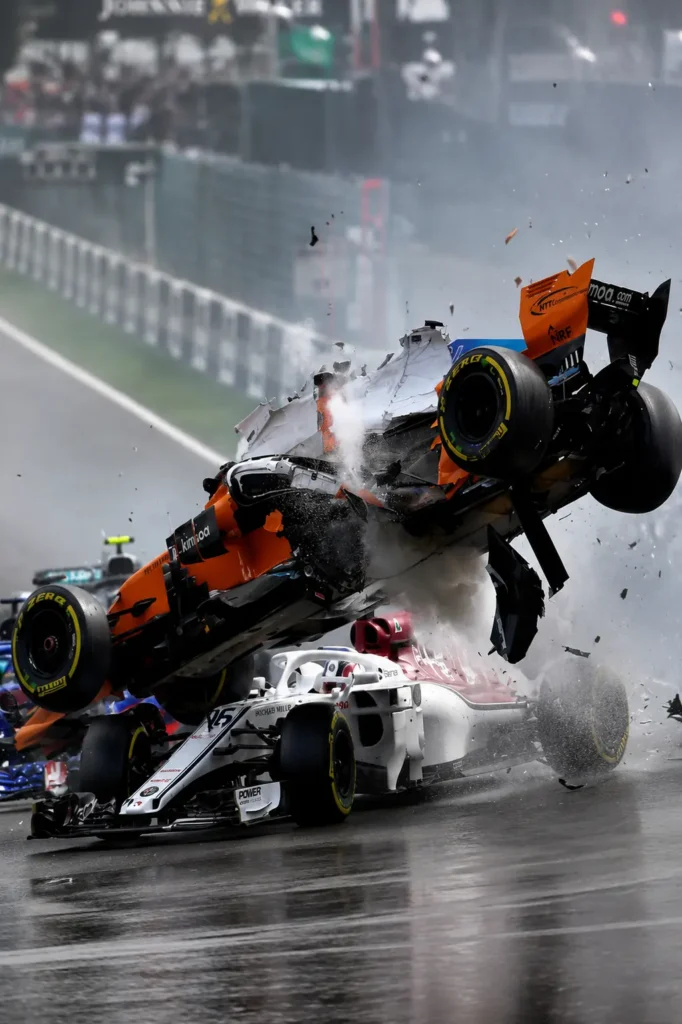
A common question among casual viewers is how F1 drivers avoid serious injury when they crash, despite the violent appearance of the impact. The answer lies in the engineering of the carbon fiber survival cell, also known as the monocoque. Engineers design this “safety tub” to be virtually indestructible so it protects the driver while the rest of the car disintegrates to absorb energy.
Specifically, the kinetic energy of a crash follows the formula:
To prevent injury, engineers design the car to shed parts, which effectively extends the duration of the impact and lowers the forces felt by the driver. This dissipation of energy is fundamental to what causes crashes in motor racing being survivable today. Furthermore, the HANS (Head and Neck Support) device prevents “basilar skull fractures” by tethering the helmet to the seat, ensuring the head does not whip forward during deceleration.
The Halo and Advanced Protection Systems
The Halo system is perhaps the most visible answer to how F1 drivers do not get hurt when they crash. This titanium structure can support the weight of a double-decker bus and deflects large debris, such as wheels or other cars, away from the driver’s head. Moreover, energy-absorbing crash structures at the front, rear, and sides of the car serve as crumple zones.
These structures are designed to crush at a specific rate to manage deceleration. Consequently, even when a car hits a wall at 200 km/h, the driver often walks away because the car’s “skin” took the brunt of the force. Understanding these systems helps us appreciate what causes crashes in motor racing and why they are no longer as fatal as they were in the 1970s.
Motorsport Safety Evolution and Car Accidents
The history of car accidents in motorsports is a story of continuous learning and regulation. Following tragic incidents in the 1990s, the FIA implemented rigorous crash-testing protocols that every chassis must pass. Therefore, modern racing is an environment where safety is “baked in” from the initial CAD drawings.
Furthermore, barrier technology has evolved from simple hay bales to TecPro and SAFER barriers. These barriers move upon impact, absorbing a significant portion of the car’s kinetic energy. Specifically, this engineering shift has changed the narrative of what causes crashes in motor racing, moving the focus from “will the driver survive” to “how quickly can we restart the race.”
Motorcycle Racing Crash Risks
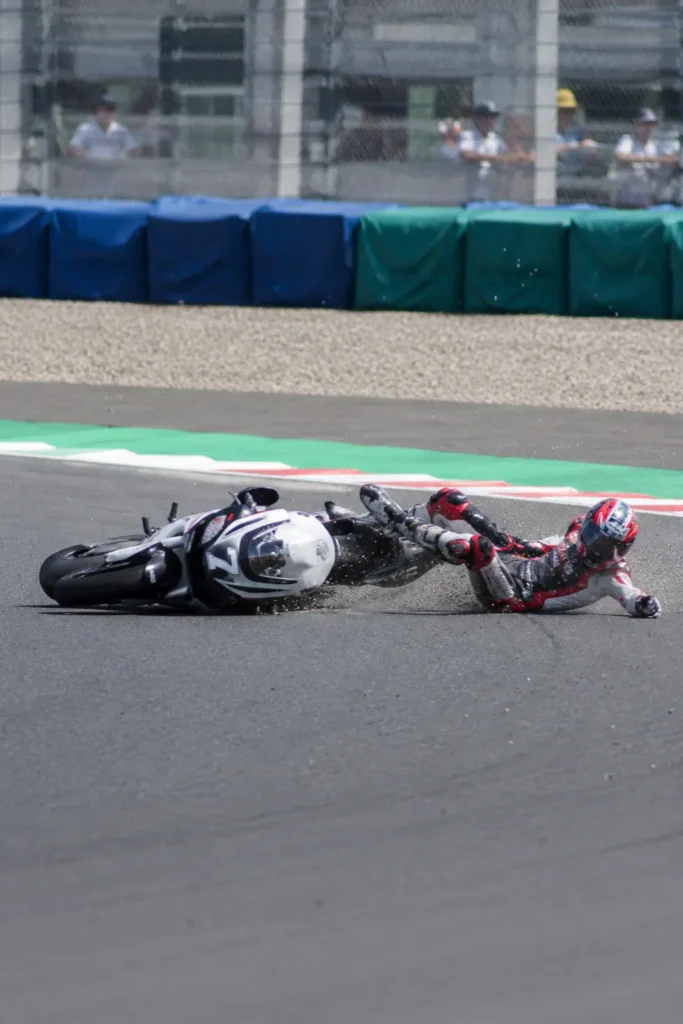
Unlike cars, motorcycle racing involves a much higher level of rider exposure. When analyzing what causes crashes in motor racing for bikes, we look at “high-sides” and “low-sides.” A low-side occurs when the tires lose grip and the bike slides away, while a high-side happens when the rear tire regains grip suddenly, launching the rider into the air.
Riders rely on leather suits equipped with sophisticated airbag systems that deploy in milliseconds. These airbags protect the collarbone, ribs, and spine during a tumble. Therefore, while the risks are different, the engineering goal remains the same: managing the deceleration of the human body. This exposure makes what causes crashes in motor racing for motorcycles a unique study in physics and leather technology.
Motor Vehicle Accidents vs Motorsport Crashes
There is a stark difference between standard motor vehicle accidents on public roads and racing crashes. Public road accidents involve random speed variations, mixed traffic, and often, a lack of specialized safety gear. In contrast, motorsport crashes happen in a highly regulated environment where every participant is wearing fireproof clothing and a helmet.
Furthermore, race tracks are designed with “one-way” traffic and predictable cornering lines. Consequently, the “unpredictability” factor is much lower on a track than on a highway. Therefore, when we study what causes crashes in motor racing, we are looking at a controlled environment where the safety systems are specifically tuned for high-speed impact.
What Are the 90% Accident Types in Racing?
When analysts look at what 90% of accidents are caused by, they categorize them into corner entry mistakes, braking instability, and tire overheating. Specifically, “locking a wheel” under braking is a major factor in what causes crashes in motor racing. A locked wheel does not turn, meaning the driver loses the ability to steer away from trouble.
Moreover, tire overheating can lead to a sudden “delamination” or blowout. If a tire fails at the end of a long straight, the resulting accident is often severe. Therefore, managing tire temperatures is a critical skill for avoiding what causes crashes in motor racing.
Motorsport Safety Data and Statistics
The FIA and other bodies maintain a list of historical incidents to improve future safety. While we avoid sensationalizing the topic, it is important to note that fatalities have dropped by over 80% since the 1970s. This progress is a direct result of analyzing what causes crashes in motor racing and implementing technical solutions like the HANS device and improved circuit runoff.
Furthermore, the data shows that high-speed “T-bone” impacts are the most dangerous. Therefore, modern cars feature reinforced side-impact structures that are tested to withstand forces exceeding. This data-driven approach ensures that the question of what causes crashes in motor racing is always met with an engineering answer.
Motorsport Safety Discussions: Engineering Over Opinion
If you browse what causes crashes in motor racing reddit threads, you will find many opinions on driver aggression. However, professional analysis focuses on the data: telemetry, force sensors, and high-speed camera footage. Misconceptions often arise when fans oversimplify complex physics into “he just didn’t turn.”
In reality, what causes crashes in motor racing is usually a chain of events—a small loss of downforce leads to a slight slide, which overheats the tire surface, leading to a loss of grip three corners later. Consequently, engineering analysis is the only way to truly understand and prevent future incidents. Therefore, we must prioritize the data over the drama.
Frequently Asked Questions
What causes crashes in motor racing?
The primary causes include human error at the limit of grip, sudden mechanical failure (like brake or suspension issues), aerodynamic loss in “dirty air,” and environmental factors like rain or oil on the track.
Are most racing accidents caused by drivers?
Yes, statistical evidence shows that the majority of accidents are caused by driver-at-limit mistakes or misjudgments during wheel-to-wheel combat. Human error is the leading factor when cars are pushed to their physical boundaries.
How do F1 drivers survive crashes?
Drivers survive due to the carbon fiber survival cell, the HANS device for neck protection, the Halo for head protection, and fire-resistant suits. The cars are also designed to shatter to dissipate kinetic energy.
What is the biggest cause of motorsport crashes?
While it varies by series, the “biggest” cause is generally identified as a loss of traction due to driver error, specifically under braking or through high-speed cornering where the margin for error is razor-thin.
Are racing crashes more dangerous than road crashes?
In terms of raw speed and kinetic energy, yes. However, because of the specialized safety equipment, professional drivers are often safer in a 200 km/h track crash than a road driver is in a 100 km/h highway accident.
Conclusion
In summary, what causes crashes in motor racing is a multifaceted problem involving human psychology, fluid dynamics, and mechanical endurance. By studying these factors, engineers have created a sport that balances extreme speed with incredible survivability.
Furthermore, the constant evolution of safety tech ensures that drivers can continue to push the limits of human achievement. Ultimately, knowing what causes crashes in motor racing is the key to preserving the thrill of the race while protecting the lives of the athletes.