
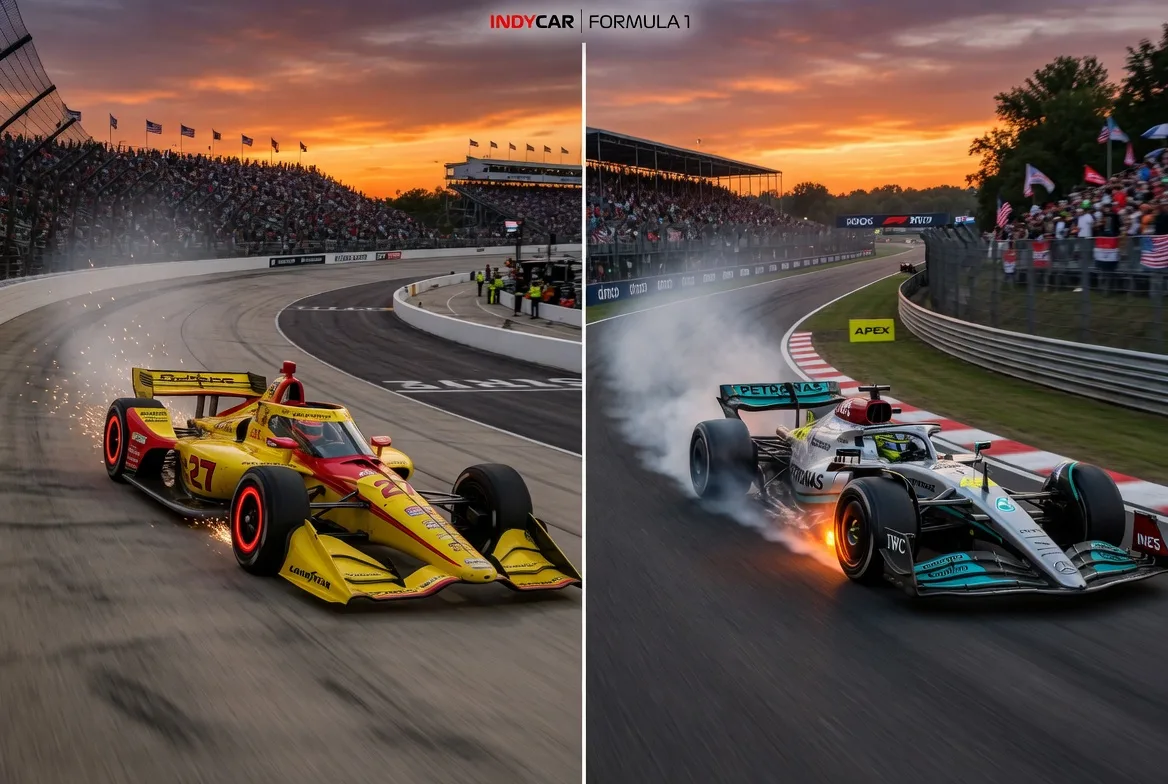
The ongoing debate surrounding IndyCar vs F1 captivates motorsport enthusiasts across the globe every single racing season. While both categories showcase premier open-wheel racing action, they follow entirely different engineering philosophies and sporting regulations. Therefore, casual viewers often struggle to identify the underlying differences between these elite single-seater machines. This comprehensive analytical breakdown clears up the confusion regarding IndyCar vs F1 by highlighting their performance traits and technical specs.
What Is the Difference Between IndyCar and Formula 1?
To understand the baseline IndyCar vs F1 dynamic, you must first evaluate how each series designs and builds its race cars. Formula 1 operates as a strict constructors’ championship where every team must engineer and build its own bespoke chassis from scratch. Consequently, wealthy operations like Ferrari and Mercedes invest hundreds of millions of dollars to gain a tiny fraction of a second.
On the other hand, IndyCar functions primarily as a spec racing series where all teams utilize the identical Dallara chassis. Therefore, the American series emphasizes driver skill and tactical strategy over pure, raw engineering budgets. This operational variance shifts the focus away from a direct IndyCar vs F1 budget race and onto driver talent.
Uniquely, Formula 1 maintains a deeply global footprint, traveling across Europe, Asia, the Americas, and the Middle East. Meanwhile, IndyCar focuses its championship schedule primarily within North America, utilizing a mix of iconic permanent road courses, temporary street circuits, and high-speed oval tracks.
Speed Comparison: Is IndyCar Faster Than F1?
When evaluating an explicit IndyCar vs F1 speed and acceleration comparison, track layout changes everything. Specifically, an IndyCar chassis achieves a higher absolute top speed on a massive superspeedway oval like Indianapolis. During qualifying trim, these machines regularly cross the 240 mph barrier down the long, sweeping straights.
However, a Formula 1 car dominates any traditional road course or twisty street circuit by a massive margin. The advanced hybrid power units allow F1 cars to completely dominate any road course IndyCar vs F1 matchup. For instance, when both series raced at the Circuit of the Americas, the F1 cars generated lap times nearly 14 seconds faster.
| Performance Metric | Formula 1 (F1) | IndyCar Series |
| Top Speed | 230+ mph (Road Course) | 240+ mph (Oval Circuit) |
| Cornering Speed | Extreme / Unmatched | Moderate / High |
| Acceleration (0-60 mph) | ~2.6 Seconds | ~3.0 Seconds |
| Average Horsepower | ~1,000 hp (Hybrid) | ~750 hp (Push-to-Pass) |
Furthermore, the IndyCar vs F1 acceleration data reveals that F1 cars jump off the line with greater initial urgency. The instant torque from the F1 hybrid energy recovery system provides a clear advantage out of slow corners. Conversely, IndyCar relies on traditional twin-turbocharged engines that take slightly longer to build maximum boost pressure.
IndyCar vs F1 Cars & Technology Explained
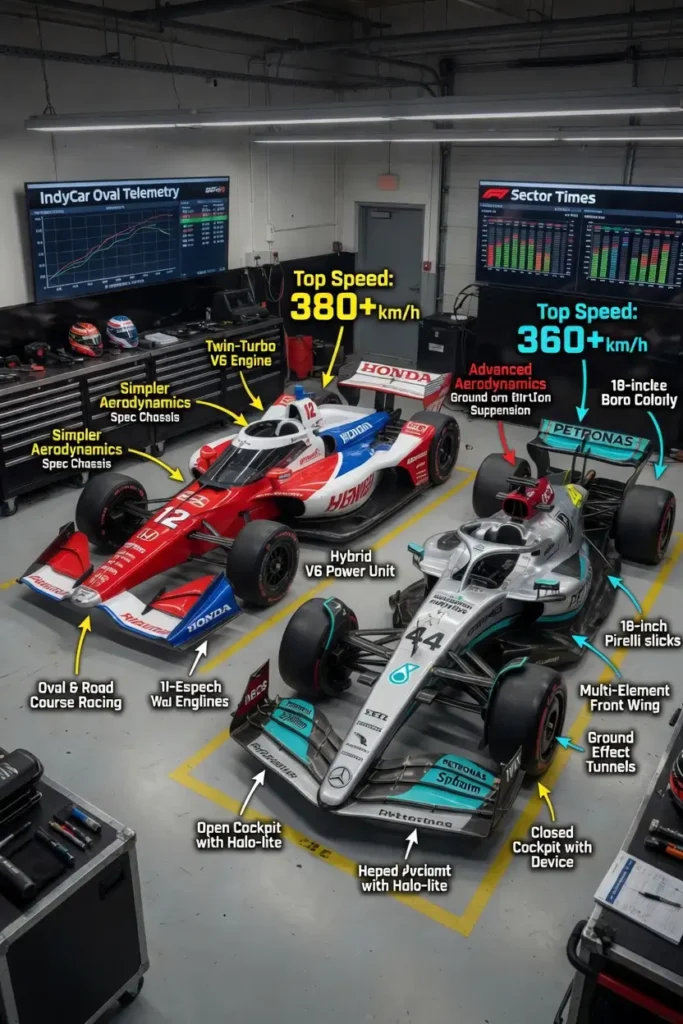
Diving deeper into the IndyCar vs F1 technology comparison highlights two completely distinct paths toward high-speed automotive engineering. Formula 1 utilizes a highly complex 1.6-liter V6 turbocharged hybrid power unit that extracts energy from exhaust gases and braking forces. This intricate setup produces around 1,000 horsepower while maintaining incredible thermal efficiency standards.
In contrast, the IndyCar vs F1 engine specs explained manuals show that IndyCar favors a robust twin-turbo layout. IndyCar power units produce roughly 700 to 750 horsepower depending on the current turbo boost configuration. Moreover, IndyCar drivers can deploy a temporary “Push-to-Pass” button to gain an extra 60 horsepower for short overtaking windows.
Aerodynamic design also represents a massive point of divergence within any detailed open-wheel racing analysis. Formula 1 teams spend millions of hours in wind tunnels refining intricate bargeboards, wings, and floor venturi tunnels. Uniquely, this hyper-focused engineering creates an immense level of downforce that glues the tires directly to the asphalt.
Meanwhile, the IndyCar vs F1 aerodynamics explained technical briefs reveal that IndyCar utilizes standardized packages. Teams switch between a high-downforce road course package and a low-drag, low-downforce oval kit depending on the weekend schedule. This mechanical simplicity reduces overall development costs while producing incredibly close, slipstream-heavy racing action.
Furthermore, looking at the IndyCar vs F1 steering wheel comparison shows how much information each driver handles. An F1 steering wheel looks like a complex supercomputer screen featuring dozens of rotaries, dials, and a bright LCD display. On the flip side, the IndyCar steering wheel focuses purely on essential functions like radio, pit speed limits, and weight jackers.
Why Formula 1 Cars Are Faster Than IndyCar
Many casual fans wonder exactly why Formula 1 cars win an IndyCar vs F1 road course comparison. The primary answer lies in the sheer scale of investment allowed by the respective technical regulations. F1 design rules grant structural engineers immense freedom to innovate unique carbon fiber monocoque shapes every single season.
Consequently, this design freedom optimizes the IndyCar vs F1 braking performance differential significantly. Formula 1 cars use advanced carbon-composite brake materials that can withstand operating temperatures exceeding 1,000 degrees Celsius. Therefore, an F1 driver can wait until the absolute last millisecond to mash the brake pedal before a tight hairpin corner.
Similarly, the IndyCar vs F1 cornering speed comparison reveals that F1 cars carry far more momentum through turns. The combination of wide, sticky Pirelli tires and bespoke team-designed suspension geometry keeps the car incredibly stable. As a result, F1 remains the fastest open wheel racing series in terms of absolute lateral G-force generation.
IndyCar vs F1 Track Profiles and Circuit Types
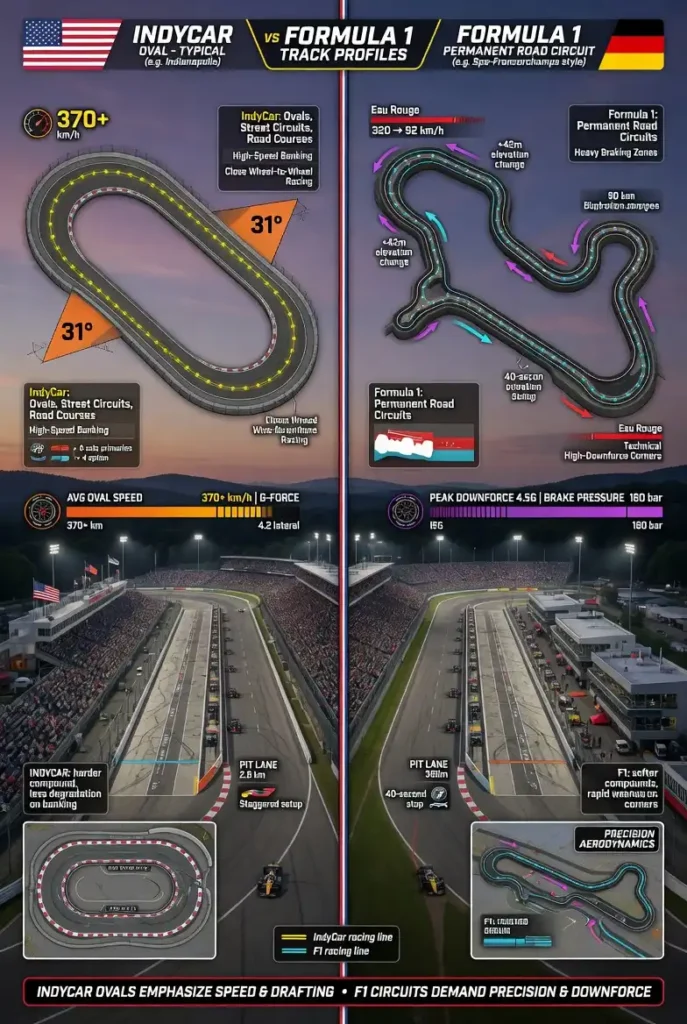
Evaluating track configurations provides deep insight into motorsport engineering strategies, especially when studying the IndyCar vs F1 track types explained documents. Formula 1 travels exclusively to custom-built road courses and tight city street circuits across its international calendar. Consequently, drivers must adapt to heavy braking zones, elevation changes, and complex sequences of fast, sweeping corners.
Conversely, the American open-wheel championship introduces a completely unique challenge that highlights a distinct IndyCar vs F1 oval racing variation. IndyCar drivers compete on massive superspeedways, short ovals, traditional road courses, and unforgiving temporary street circuits. Therefore, teams must develop entirely different vehicle setups and aerodynamic configurations to handle these completely diverse environments.
Uniquely, the crown jewel events of each series best illustrate this structural and cultural sporting divergence. The legendary Indianapolis 500 demands sustained flat-out speeds, high-risk drafting lines, and intense bravery inside heavy pack traffic. Meanwhile, the prestigious Monaco Grand Prix prioritizes mechanical downforce, ultra-precise steering inputs, and mistake-free positioning along narrow, barrier-lined city streets.
IndyCar vs F1 Rules, Qualifying & Championship Format
The underlying regulatory frameworks dictate how teams approach strategic planning over a competitive grand prix or oval weekend, as detailed in the IndyCar vs F1 rules explained handbook. Formula 1 features a highly standardized system comprising three distinct practice sessions, an intense three-part knockout qualifying hour, and a full Sunday race. Uniquely, certain weekends integrate a short Sprint race to offer fans extra entertainment value and additional championship points.
Alternatively, IndyCar utilizes a completely different group-based qualifying system on road courses, which culminates in a dramatic Fast Six shootout. This distinct approach heavily shapes the overall IndyCar vs F1 race weekend format differences. Furthermore, IndyCar allows mid-race refueling during routine pit stops, which introduces an extra layer of complexity to modern fuel-saving strategies.
This divergence significantly influences the IndyCar vs F1 points system comparison across both international paddocks. Formula 1 rewards only the top ten finishers with points, offering a maximum of 25 points to the grand prix victor. Conversely, IndyCar awards points to every single driver on the starting grid, while granting bonus tallies for leading the most race laps.
IndyCar vs F1 Safety Protocols and Driver Protection
Both elite series prioritize driver safety through continuous research, resulting in monumental structural advancements over the past decade, as highlighted in any modern IndyCar vs F1 safety comparison report. Both categories utilize a rigid carbon fiber monocoque survival cell designed to withstand immense kinetic impacts. Furthermore, both series successfully introduced dedicated cockpit protection systems to shield a driver’s head from flying track debris.
Specifically, Formula 1 developed the titanium Halo device, which sweeps over the top of the open cockpit. Meanwhile, IndyCar implemented a unique hybrid solution called the Aeroscreen, which combines a reinforced titanium halo with a ballistic windscreen. This innovative structural piece shields drivers from tiny fragments and other IndyCar vs F1 safety features explained rules on oval circuits.
IndyCar vs F1 Driver Crossovers and License Requirements
Transitioning between these two pinnacle tiers of open-wheel racing requires unique physical preparation and strict international regulatory approvals. The FIA manages this pathway using a strict Super License points system, which compares the IndyCar vs F1 driver training comparison guides. Consequently, an IndyCar champion receives the necessary forty points to enter F1, but lower-tier frontrunners often face significant eligibility barriers.
Furthermore, rookies must adapt to completely different vehicle handling traits to understand IndyCar vs F1 which is harder to drive. An F1 car relies heavily on complex power steering systems, allowing drivers to manipulate the car with immense physical precision. Conversely, IndyCar deliberately excludes power steering entirely, requiring immense upper-body strength to wrestle the steering wheel around heavy road courses.
IndyCar vs F1 Financial Budgets and Team Expenses
Analyzing the financial foundations of these global operations reveals a massive gap in the IndyCar vs F1 driver salary comparison. Top Formula 1 superstars easily earn tens of millions of dollars annually due to global corporate backing. Conversely, leading IndyCar drivers typically secure salaries ranging between two and five million dollars per season.
Similarly, overall team operating budgets showcase a staggering difference in absolute fiscal scale. Formula 1 implements a strict cost cap of roughly 135 million dollars to level the engineering playing field. However, an elite multi-car IndyCar operation functions comfortably on a fraction of that amount, usually spending around fifteen million dollars per entry.
IndyCar vs F1 Popularity and Global Fanbases
The dramatic explosion of digital media access drives the entire IndyCar vs F1 fanbase comparison trend across multiple generations. Formula 1 captured a massive global audience through highly targeted docuseries like Netflix’s Drive to Survive. Consequently, this media push unlocked immense popularity in America, attracting younger demographics and high-profile international sponsors.
Meanwhile, IndyCar maintains an exceptionally loyal and deeply rooted fanbase centered primarily around historic North American sporting traditions. The series offers fans unparalleled paddock access, affordable race tickets, and highly unpredictable on-track passing action. Therefore, while F1 leads in global television ratings, IndyCar continues to dominate in terms of pure fan accessibility.
IndyCar vs NASCAR vs F1
Expanding the motorsport horizon requires a quick look at how stock cars contrast with elite open-wheel machinery. NASCAR utilizes heavy, full-fendered vehicles engineered primarily for close, high-impact door-to-door racing on oval tracks. Consequently, this creates a completely different strategic environment compared to the lightweight, downforce-reliant engineering seen in both F1 and IndyCar.
Frequently Asked Questions
Is IndyCar faster than Formula 1?
IndyCar machinery achieves a higher absolute top speed on oval superspeedways, reaching up to 240 mph. However, Formula 1 cars are significantly faster around traditional road courses and street circuits. This advantage stems from advanced F1 aerodynamics and superior cornering downforce.
What is the primary difference between IndyCar and Formula 1?
Formula 1 is a constructors’ championship where each team designs and builds its own unique car chassis. Conversely, IndyCar is primarily a spec series where all teams use a standard chassis built by Dallara. This approach keeps team operational costs lower and places a greater emphasis on driver talent.
Which is more dangerous, IndyCar or Formula 1?
Both racing series feature exceptional safety protocols, including carbon fiber survival cells and cockpit halos. However, IndyCar oval racing introduces unique risks due to sustained speeds above 220 mph next to concrete walls. Consequently, small mistakes on ovals can lead to massive multi-car accidents.
Why is Formula 1 more popular than IndyCar globally?
Formula 1 enjoys a broader global audience because it travels to multiple continents and countries every single season. Furthermore, aggressive digital marketing campaigns and successful streaming docuseries have expanded its international reach. Meanwhile, IndyCar focuses its marketing and race calendar primarily within the North American market.
Can an IndyCar driver transition directly into Formula 1?
An IndyCar driver can transition to Formula 1 if they accumulate enough points to earn an FIA Super License. Winning the IndyCar championship grants the full forty points required for eligibility. However, finishing lower in the standings makes the qualification pathway much more difficult for prospective drivers.
Conclusion
Ultimately, examining every major performance metric provides the definitive conclusion to the IndyCar vs F1 debate. Formula 1 remains the absolute pinnacle of technological innovation, cornering speeds, and global cultural reach. Meanwhile, IndyCar offers pure, wheel-to-wheel spec racing competition where driver skill directly determines the final podium results.