

In Formula 1, every single point can ultimately decide a world championship. As a result, as the sport enters a revolutionary new era in 2026—complete with lighter car profiles, active aerodynamics, and sustainable power unit architectures—the mathematics behind the standings remains the ultimate metric of success. In fact, the difference between a world championship crown and a mid-field heartbreak often comes down to a single point gained or lost under the checkered flag. Therefore, for both die-hard enthusiasts and new fans alike, understanding the intricacies of the grand prix scoring system is absolutely crucial for following the intense weekly narrative unfolding in the paddock.
Moreover, the current F1 championship points system actively balances rewards for dominant race victories while also incentivizing consistent mid-field performance. At the same time, teams actively invest massive technical resources to develop next-generation machinery under a strict cost cap, making it more critical than ever to maximize points on every race weekend. Consequently, even small strategic decisions—such as tire timing, pit-stop execution, or qualifying position—actively shape championship outcomes in real time.
Ultimately, this comprehensive guide actively breaks down the core mechanics of how drivers earn points, how the sprint weekend format actively reshapes championship trajectories, how FIA regulations actively resolve ties, and what key rules actively shape the 2026 Formula 1 season.
How Does the F1 Points System Work? The F1 Points System Explained
At its fundamental level, the Formula 1 points system operates on a simple principle: the top ten drivers who successfully cross the finish line at the end of a full-distance Grand Prix on Sunday earn points. These points then actively shape the entire championship narrative from the very first race to the final round.
As a result, every race directly feeds into two parallel battles. First, drivers actively accumulate points that determine the individual Driver Standings, ultimately crowning the World Drivers’ Champion at the end of the season. Second, teams combine the points scored by both of their cars, which actively form the foundation of the Constructors’ Championship standings.
- Sunday Grand Prix
Top 10 drivers score points (25 → 1) - Saturday Sprint Race
Top 8 drivers score points (8 → 1) - Driver Total Points
Accumulate toward the World Drivers’ Championship - Combined Team Points
Contribute to the Constructors’ Championship standings
While individual drivers battle for global prestige and historical legacy, teams keep their eyes on the financial rewards linked to the constructor standings. Higher placement translates directly to a larger share of Formula 1’s multi-million dollar prize-money pool. Conversely, scoring more points increases a team’s official FIA entry fee for the following season. This unique framework ensures that every position change on track carries deep financial and sporting implications.
F1 Race Points Breakdown by Position
The modern grand prix scoring system uses a progressive points scale designed to reward a podium finish heavily, with a particular premium placed on winning. This format ensures that an outright race victory is worth significantly more than a safe, conservative drive to second place.
The Official 2026 F1 Race Points Chart
| Finishing Position | Points Awarded | Championship Value |
| 1st (Winner) | 25 | Maximum haul, key for title momentum |
| 2nd | 18 | Strong podium reward, limits damage to leader |
| 3rd | 15 | Final step on the physical podium |
| 4th | 12 | Strong haul just outside the trophies |
| 5th | 10 | Mid-field anchor point |
| 6th | 8 | Crucial points for upper mid-field |
| 7th | 6 | Steady points accumulation |
| 8th | 4 | Minor points tier |
| 9th | 2 | Crucial defensive scrap target |
| 10th | 1 | The final point scoring threshold |
| 11th to 22nd | 0 | No points awarded |
One overtake can completely change a championship battle. The gap between first and second place is seven points ($25 \text{ vs } 18$). This delta forces title contenders to take high-stakes risks late in a race rather than settling for a comfortable runner-up spot, keeping the competitive product intense.
F1 Sprint Race Points Explained
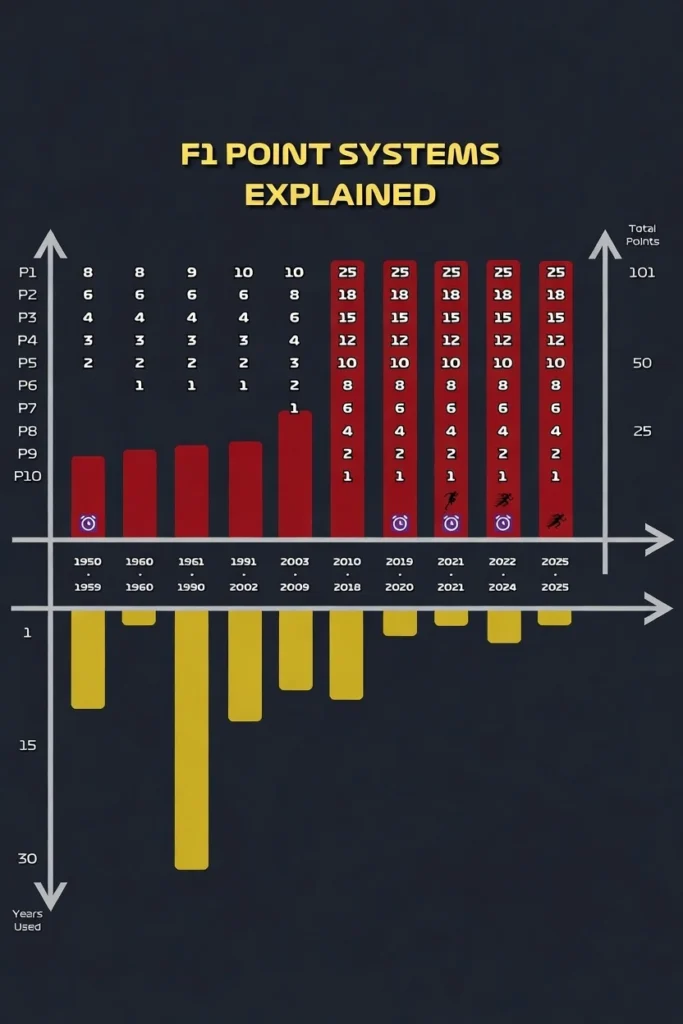
Introduced as an experimental shakeup and now solidified as an integral element of select race weekends, the f1 sprint race points explained via a condensed scoring architecture. Sprints are short, 100-kilometer dash events held on Saturday afternoons without mandatory tire pit stops, delivering pure wheel-to-wheel aggression.
Sprint Points Distribution
- 1st — 8 pts
- 2nd — 7 pts
- 3rd — 6 pts
- 4th — 5 pts
- 5th — 4 pts
- 6th — 3 pts
- 7th — 2 pts
- 8th — 1 pts
Because sprint races cover roughly one-third of a conventional Grand Prix distance, the points allocation scales down accordingly. Only the top eight finishers secure points, starting with eight points for the winner down to a single point for eighth place. While individual sprint hauls may appear small, their cumulative impact across the calendar introduces a massive variable into the world championship fight. A dominant driver can leverage a sprint weekend to secure a maximum of 33 individual points ($25 + 8$), turning these events into high-pressure focal points for the entire grid.
Formula 1 Fastest Lap Point Explained
For several years, the race weekend format featured a popular bonus point awarded to the driver who recorded the single fastest lap time during Sunday’s Grand Prix, provided they finished within the top ten. However, following key sporting updates implemented by the FIA, the formula 1 fastest lap point explained by its formal abolition.
The bonus point system was officially scrapped to protect the integrity of late-race tactics. Toward the end of a Grand Prix, teams outside the top ten—with nothing to lose—would frequently execute free pit stops for fresh, soft-compound tires solely to set the fastest lap. While this added late-stage theater, it frequently stripped a legitimate bonus point away from the frontrunners based on team political alliances rather than organic pace. In the current 2026 framework, a driver who sets the fastest lap earns immense praise and statistical prestige, but receives zero additional championship points.
Do Drivers Get Points for Pole Position?
Securing pole position during Friday or Saturday’s traditional three-stage knockout qualifying remains one of the ultimate displays of a driver’s raw, single-lap speed. However, despite its prestige, pole position awards zero official championship points in Formula 1.
Qualifying Format
- Qualifying Session
Awards pole position (starting grid placement)
0 championship points awarded
The historical and contemporary philosophy of Formula 1 dictates that points are purely a Sunday commodity (or Saturday in the case of a Sprint). Qualifying exists strictly to determine the physical order of the starting grid. While starting from the front row gives a driver the best statistical odds of winning a Grand Prix, they must still execute a clean start, manage their race pace, and survive pit stop strategies to actually get points on the board.
F1 Constructor Points Explained
The battle for the World Constructors’ Championship represents the true financial lifeblood of the paddock. While fans naturally focus on the individual drivers, team principals look at the f1 constructor points explained by simple addition: a team’s total score on any weekend is the combined haul of both its cars.
Constructors’ Points Calculation
- Car #1 Points
- Car #2 Points
= Weekly Team Constructor Total
If a team executes a flawless weekend, securing a 1-2 finish on Sunday, they earn a combined 43 constructor points ($25 + 18$). If that occurs during a sprint race weekend and they secure a 1-2 finish there as well, they pick up an additional 15 points ($8 + 7$), bringing their maximum possible weekend haul to 58 points.
Because teams actively tie hundreds of millions of dollars in aerodynamic development funds and future commercial revenue to these constructor standings, they frequently issue compliance-based “team orders.” In these situations, race engineers actively instruct drivers to hold position or swap places late in a race in order to secure the maximum possible points yield for the organization.
Why Only the Top 10 Drivers Get Points in F1
A common question among casual viewers is why Formula 1 restricts points scoring to the top ten finishers, especially when compared to other sports that reward the entire field. This structural decision is deeply rooted in the historical evolution of the sport’s identity.
Points Field Evolution:
1950s: Top 5 scored ➔ 1960s: Top 6 scored ➔ 2003: Top 8 scored ➔ 2010-Present: Top 10 score
Limiting points to the top ten actively maintains an elite standard, where scoring even a single World Championship point represents a genuine, hard-earned achievement. If the system distributed points all the way down to the final position, it would actively dilute the value of exceptional mid-field drives and could potentially warp the competitive balance across the grid.
Under the current format, lower-tier teams actively celebrate a ninth or tenth-place finish almost like an outright victory. As a result, this structure consistently generates high-stakes drama throughout the mid-field battle, keeping competition alive long after the front-runners have crossed the finish line.
What Happens If F1 Drivers Tie on Points?
With seasons regularly extending across more than twenty races, the championship mathematics can occasionally lead to an absolute tie in the standings. If two or more drivers finish a championship tier with identical point counts, the FIA resolves the deadlock using a strict “countback” system.
The FIA Countback Protocol
- Compare Total Victories: The driver with the highest number of 1st-place race finishes is awarded the higher position.
- Compare Second-Place Finishes: If wins are tied, the FIA counts who achieved the most 2nd-place finishes.
- Step-Down Analysis: This logic scales down through 3rd, 4th, 5th, and lower positions until a statistical point of difference is found.
- FIA Nomination: In the incredibly remote scenario where two drivers possess identical finishing records across the entire season, the FIA retains the authority to nominate the champion based on criteria it deems fit.
This countback methodology underscores the absolute importance of individual race victories. A driver who secures three wins and several retirements will beat a driver who scored zero wins but secured highly consistent, conservative mid-field placements, keeping the emphasis on winning.
F1 Points System vs MotoGP Points System
To better appreciate the unique structure of Formula 1’s scoring rules, it is helpful to look at how it compares to its two-wheeled counterpart, MotoGP. Both series represent the absolute pinacle of their respective disciplines, yet they approach championship point distribution differently.
Scoring Structure Comparison
| Metric / Feature | Formula 1 Format | MotoGP Format |
| Winner Points | 25 Points | 25 Points |
| Scoring Field Depth | Top 10 Positions Only | Top 15 Positions |
| 2nd Place Points Yield | 18 Points | 20 Points |
| Sprint Race Winner | 8 Points | 12 Points |
| Constructor Tally Method | Combined scores of both entries | Only the highest-placing single bike scores |
The main structural difference lies in the scoring depth and the calculation of team points. MotoGP rewards deep field consistency by paying points down to 15th place, and its constructors’ championship only counts the single highest-finishing bike from each manufacturer. Formula 1, by contrast, demands that both factory entries perform at an elite level to climb the constructor standings, placing a much higher premium on multi-car team execution.
Biggest Championship Battles Decided by Points
Throughout the rich history of grand prix racing, the design of the points system has directly shaped historic title fights and iconic final-race moments.
Famous Title Deciders:
1984: Lauda beats Prost by 0.5 points ➔ 2007: Räikkönen wins by 1 point ➔ 2008: Hamilton wins by 1 point
- 1984 (The Closest Margin): Niki Lauda clinched the World Championship over his McLaren teammate Alain Prost by a mere 0.5 points. This fractional score occurred because the Monaco Grand Prix was stopped early due to heavy rain, triggering half-points under the FIA regulations of the era.
- 2007 (The Three-Way Thriller): Kimi Räikkönen staged a spectacular late-season comeback to win the world title by a single point over both Lewis Hamilton and Fernando Alonso, proving that every single lower-tier points placement matters across a long season.
- 2008 (Interlagos Drama): Lewis Hamilton secured his maiden world title on the final corner of the final lap in Brazil. By passing a car on a damp track to finish fifth, he claimed the exact number of points required to edge out local hero Felipe Massa by a single point.
F1 Points Rules 2026 and Future Changes
As Formula 1 embraces its next-generation technical era, the basic layout of the 25-point scale remains stable, but the rules governing shortened or interrupted races have become highly exact. Following past controversies regarding weather-shortened events, the FIA enforces a strict sliding scale for points if a Grand Prix cannot go its full scheduled distance.
Shortened Race Points Allocation:
- Under 25% Distance Completed: Minimal points awarded to the top 5 finishers.
- 25% to 50% Distance Completed: Scaled points distributed to the top 9 finishers.
- 50% to 75% Distance Completed: Partial points distributed to the top 10 finishers.
- Over 75% Distance Completed: Full 100% points allocation applied across the field.
Furthermore, while team principals occasionally float proposals to expand points scoring down to 12th or 15th place to accommodate an expanding grid, the FIA has held firm on the top-10 format for 2026. This dynamic preserves the high pressure of the mid-field battle, requiring teams to deliver faultless strategic executions to walk away from a weekend with a change in the standings.
FAQ Section
How does the F1 points system work?
F1 points are awarded to the top 10 drivers who cross the finish line on Sunday. First place receives 25 points, scaling down to a single point for tenth place. These individual scores also combine to form the Constructors’ Championship standings.
How many points does an F1 race winner receive?
An outright Grand Prix winner receives 25 points. If the driver also wins a Saturday Sprint race on a sprint weekend, they can secure an additional eight points, bringing their maximum possible weekend yield to 33 points.
Do F1 drivers get points for pole position?
No. Qualifying sessions determine the physical order of the starting grid for the race, but scoring pole position does not award any official points toward either championship.
How are sprint race points awarded in Formula 1?
Sprint races award points to the top eight finishers. The winner receives eight points, second place gets seven, third gets six, scaling down sequentially to a single point for the eighth-place finisher.
Why do only the top 10 drivers score points?
Limiting points to the top 10 preserves an elite competitive baseline, ensuring that scoring a point remains a significant milestone that accurately rewards exceptional reliability and mid-field pace.
How do constructor points work in Formula 1?
Constructor points are the combined scores of both cars run by a team. For example, if a team’s drivers finish first and second on Sunday, the constructor receives a total of 43 points ($25 + 18$) toward the team standings.
What happens if two F1 drivers finish tied on points?
The FIA invokes a countback protocol. The tie is broken by awarding the higher position to the driver with the most race victories. If those are equal, the count checks second-place finishes, third-place finishes, and so on.
Conclusion
Mastering the mechanics of the F1 points system explained above elevates how you watch a race weekend unfold. The scoring system is more than a simple table of numbers; it is a strategic framework that shapes pit lane decisions, team orders, and high-stakes driver risk management. From the premium placed on a Sunday victory to the calculated risks of a Saturday Sprint, the point distribution system ensures that every sector time and positional battle carries genuine championship weight.
As the grid actively adapts to the competitive variables of the 2026 rules reset, drivers and teams actively build championships point by point, lap by lap, and often decide them by the smallest margins imaginable. When the red lights go out, you actively look beyond simple track positions and actively track the live championship mathematics—because that is where the sport actively writes its real history.
Authoritative Reference Guides
- Formula 1 Official Sporting Regulations and Standings Primer
- RacingNews365 Comprehensive Historical and Financial Analysis of F1 Scoring
- Autosport Technical Archive of Grand Prix Points Systems
- McLaren Racing Insights into Sprint Weekend Formats and Point Allocation
- Wikipedia Collective Archive of Formula One Points Allocation History

