GT3 Race Car: Diagram, Specs,
Horsepower & Full Cost Guide
A factory GT3 racer produces 500–600 hp, weighs around 1,250 kg, and costs $400,000–$600,000 before you turn a wheel. Here is everything else you need to know — from full anatomy to running costs.
GT3 Race Car: Diagram,
Specs, HP & Cost
Full anatomy, horsepower figures, model comparison, and exactly what it costs to go racing in one.
GT3 is the most successful customer racing category on the planet. On any given weekend, these production-based supercars race simultaneously on four continents — from the Nürburgring 24 Hours to IMSA in America to the WEC’s LMGT3 class at Le Mans. From the iconic Porsche 911 GT3 R to factory-backed machines from Ferrari, BMW, and the new Ford Mustang GT3, this category blends extreme performance with strict, cost-conscious regulation in a way no other class quite manages.
This guide breaks down the GT3 race car anatomy diagram in full, explains every technical specification, puts the horsepower figures in context, and answers the question everyone eventually asks: what does it actually cost to go racing in one of these things?
What Is a GT3 Race Car?
GT3 — Grand Touring 3 — is an FIA-regulated racing category built on one core principle: take a production supercar and transform it for the track, within rules that every participating manufacturer must follow equally. The regulations were codified by the SRO Motorsports Group in 2005 with full FIA endorsement, and the class was deliberately designed as a cost-effective alternative to the far more expensive GT1 and GT2 classes that preceded it.
The entry mechanism is homologation. Before a manufacturer can race a GT3 car, it must first build and certify a minimum number of road-going versions — at least ten units in year one, rising progressively, with most manufacturers targeting around 300 units annually. That production requirement is the reason every GT3 racer still looks unmistakably like the road car it came from, even after engineers have gutted the cabin, rebuilt the suspension from scratch, and transformed the aerodynamics into something a road car regulator would never approve.
GT3 stands for Grand Touring 3 — the third tier of the FIA’s Grand Touring classification. Unlike open-wheel formula cars, GT racing focuses entirely on production-based sports cars. The “3” denotes the class level within the broader GT hierarchy, with GT4 sitting below it as a more entry-level alternative.
The mechanism that makes the class function globally is the Balance of Performance (BoP). The FIA adjusts minimum weight, engine restrictor sizes, and sometimes aerodynamic configurations across all GT3 cars to equalise performance between manufacturers. A front-engine V8 Ford Mustang can race door-to-door with a rear-engine flat-six Porsche 911 because BoP closes the gap that engineering alone would open. The best drivers and teams make the difference — not the biggest budget.
GT3 Race Car Anatomy Diagram
A GT3 car is a production supercar transformed by a strict set of mandated modifications. The diagram below identifies the twelve key systems that separate a racing GT3 from the road car it began as — and explains why each one matters on track.
Key Component Breakdown
01 — Fixed Rear Wing
Multi-element wing on structural pylons that generates rear downforce, pressing the car into the track at speed. Adjustable angle of attack allows engineers to tune the downforce/drag balance per circuit — high-downforce for Spa, lower drag for high-speed circuits.
02 — Engine Bay
Derived from the production unit but rebuilt for sustained racing — dry-sump lubrication (consistent oil supply under lateral G-forces), forged internals, race-spec valvetrain and exhaust. Engine position must stay as per the road car under FIA homologation rules.
06 — Full Roll Cage
Multi-point welded high-tensile steel cage running through the entire cabin. Simultaneously protects the driver in impacts and massively stiffens the chassis — improved torsional rigidity means more accurate, consistent aerodynamic and suspension behavior every lap.
07 — Carbon Racing Seat & Harness
The road car interior is stripped to bare shell. An FIA-certified carbon-fibre bucket seat keeps the driver rigidly located under high lateral G-forces. A six-point harness and mandatory quick-release steering wheel (for rapid extraction) are standard.
09 — Front Splitter
Wide flat blade beneath the front bumper generates front-axle downforce and reduces lift. Works in concert with the rear wing and rear diffuser to create a balanced aerodynamic package — critical for braking stability and high-speed cornering confidence.
10 — Racing Brake System
Monobloc aluminium calipers — typically six-piston front, four-piston rear — grip carbon-ceramic or steel rotors up to 380 mm across. Rotor temperatures exceed 700°C under heavy braking. No road car brake system can survive this workload for more than a handful of laps.
11 — Racing Slick Tyres
No tread. Zero. The entire contact patch transfers mechanical grip to the tarmac. At operating temperature (80–100°C), slick tyres generate levels of grip that make the road-car experience feel like driving on ice by comparison. Rain tyres with deep channels are mandatory for wet conditions.
05 — Rear Diffuser
The sculpted underfloor diffuser accelerates airflow underneath the car, creating a low-pressure zone that generates suction-effect downforce. FIA rules mandate a minimum ride height of 50 mm — the diffuser must work within that constraint across all conditions.
Full Technical Specifications
| Specification | Class Regulation / Typical Range | Notes |
|---|---|---|
| Power Output | 500–600 hp | Final figure set per car by FIA BoP |
| Minimum Weight | ~1,250 kg | BoP can add ballast to faster baseline cars |
| Engine Architecture | Derived from road car unit | Flat-6, V6, V8, V10, V12 — varies by manufacturer |
| Induction | Naturally aspirated or turbocharged | Must match road car configuration |
| Lubrication | Dry-sump | Consistent oil supply through high-G cornering |
| Gearbox | 6-speed sequential | Dog-engagement, paddle-shift, straight-cut gears standard |
| Drivetrain | Rear-wheel drive | Standard across the entire class |
| Suspension — Front | Double wishbone | Fully adjustable — bump, rebound, ride height, camber |
| Suspension — Rear | Double wishbone | Bespoke geometry vs road car; separate setup per circuit |
| Brakes — Front | Steel or carbon-ceramic rotors | Up to 380 mm; 6-piston monobloc aluminium calipers |
| Brakes — Rear | Steel or carbon-ceramic rotors | 4-piston monobloc calipers |
| Aerodynamics | Fixed rear wing + front splitter + rear diffuser | Moveable aero devices banned; FIA limits wing width |
| Minimum Ride Height | 50 mm (FIA minimum) | LMGT3 technical regulation 2026 |
| Fuel Cell | FIA-approved safety cell | Puncture and fire resistant; mandatory for all GT3 cars |
| Roll Cage | FIA-approved full cage | Welded multi-point high-tensile steel throughout cabin |
| Fire Suppression | Plumbed-in system | Cockpit and engine bay; FIA mandatory |
| Windows | Polycarbonate panels | Lighter and shatter-resistant vs road car glass |
| Tyres — Dry | Racing slicks (no tread) | Michelin, Goodyear, or Pirelli depending on the series |
| Top Speed | 290–310 km/h | Circuit-dependent; unlimited on long straights |
| 0–100 km/h | ~3.5 seconds | Varies by power-to-weight ratio post-BoP |
A GT3 car begins life as a road car chassis. What changes: the interior is gutted to bare metal and a full roll cage is welded in; the suspension is replaced entirely with bespoke racing geometry; the brakes are upgraded to racing-spec monobloc calipers; polycarbonate replaces glass throughout; and an FIA safety fuel cell replaces the standard tank. The engine position stays fixed — but virtually everything inside it that touches a moving part is replaced with race-spec components designed to survive sustained high-RPM abuse.
GT3 Horsepower Explained
Ask “how much horsepower does a GT3 car have?” and you will get a different number depending on when and where the question is asked. That is not a flaw in the answer — it is the entire point of the category’s design philosophy.
Most GT3 cars leave their factories producing somewhere between 500 and 600 hp in unrestricted form. The Ford Mustang GT3 runs a Ford Coyote 5.4-litre V8 rated at 550 hp. The Porsche 911 GT3 R (992 generation) uses an enlarged 4.2-litre flat-six producing 565 bhp. The BMW M4 GT3 draws around 590 hp from its twin-turbocharged 3.0-litre inline-six. But none of those figures necessarily represent what the cars produce on the starting grid.
The Balance of Performance can reduce power via air restrictors, mandate additional ballast, or adjust aerodynamic configurations. Talent, strategy, and execution decide the results — not raw engineering spend.
The FIA publishes updated BoP tables at regular intervals throughout the season. A car that wins three consecutive races may carry an extra 15–20 kg of ballast before the next round, or find its intake restrictor tightened by a millimetre. This is not punishment — it is the mechanism that keeps the racing close without requiring every manufacturer to spend identically on development.
The Architecture Constraint Nobody Talks About
One important nuance: because each GT3 car must keep its engine in the same position as the road car, different architectures produce fundamentally different handling characteristics even when BoP brings their lap times into line. A front-engine car like the BMW M4 GT3 or Ford Mustang GT3 behaves entirely differently from the mid-engine Ferrari 296 GT3 or the legendary rear-engine Porsche 911 GT3 R. BoP can equalise the lap times. It cannot equalise the experience of driving them — or the different skills each layout demands.
The Porsche 911’s rear-engine layout places the heaviest mass directly over the rear drive wheels. This gives the car extraordinary traction exiting slow corners — the weight presses the tyres into the surface precisely when acceleration forces are trying to spin them. Combined with decades of endurance racing refinement, it makes the 911 GT3 R one of the most consistently competitive cars in the class globally, and — importantly for customer racing — one of the more forgiving to drive quickly for amateur or gentleman drivers.
Current GT3 Models Compared — 2026
The variety of machinery on the grid is the biggest visual draw of GT3 racing. The following cars represent the current competitive field in 2026, spanning endurance racing in the WEC and IMSA through to the GT World Challenge global series.
| Manufacturer / Model | Engine | Layout | Factory HP | Notable Series | Status |
|---|---|---|---|---|---|
| Porsche 911 GT3 R (992) | 4.2L Flat-6 NA | Rear-engine RWD | 565 bhp | WEC, IMSA, GTWC | Updated ’25 |
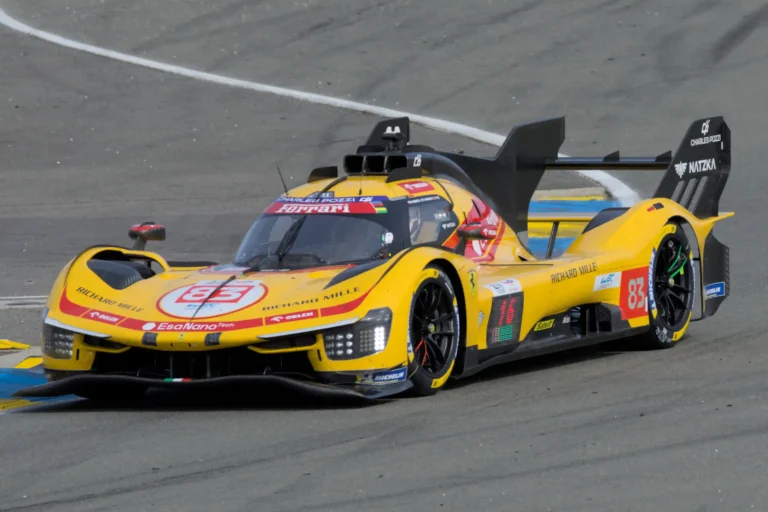
| Ferrari 296 GT3 | 3.0L Twin-Turbo V6 | Mid-engine RWD | ~600 hp | WEC, IMSA, GTWC | Active |
| Ford Mustang GT3 | 5.4L V8 Coyote NA | Front-engine RWD | 550 hp | WEC, IMSA, GTWC | 2024 Debut |
| BMW M4 GT3 | 3.0L Twin-Turbo I6 | Front-engine RWD | ~590 hp | WEC, IMSA, GTWC | Active |
| Mercedes-AMG GT3 Evo | 6.3L NA V8 | Front-engine RWD | ~570 hp | WEC, IMSA, GTWC | Active |
| Lamborghini Huracán GT3 EVO2 | 5.2L NA V10 | Mid-engine RWD | ~620 hp | GTWC, IMSA | Active |
| Aston Martin Vantage GT3 | 4.0L Twin-Turbo V8 | Front-engine RWD | ~550 hp | WEC, GTWC | Active |
| McLaren 720S GT3 Evo | 4.0L Twin-Turbo V8 | Mid-engine RWD | ~540 hp | IMSA, GTWC | Active |
| Audi R8 LMS GT3 EVO II | 5.2L NA V10 | Mid-engine RWD | ~585 hp | GTWC, ADAC GT | Active |
Where Do GT3 Cars Race Globally?
| Series | Region | Organiser | Flagship Event |
|---|---|---|---|
| FIA WEC — LMGT3 Class | Global | FIA / ACO | 24 Hours of Le Mans |
| GT World Challenge Europe | Europe | SRO | Total 24H of Spa |
| IMSA WeatherTech (GTD Pro / GTD) | North America | IMSA | 24H Daytona · 12H Sebring |
| GT World Challenge America | USA | SRO | Sonoma / Road America |
| GT World Challenge Asia | Asia-Pacific | SRO | Circuit Park Zandvoort |
| ADAC GT Masters | Germany / Europe | ADAC | Hockenheim |
| Intercontinental GT Challenge | Global | SRO | Bathurst 12 Hour |
How Much Does a GT3 Race Car Cost?
This is the question every aspiring gentleman driver eventually searches for. The answer has two parts — and neither is small.
Purchase Price
A brand-new, factory-built GT3 car costs between $400,000 and $600,000 depending on the manufacturer and specification. Porsche and Ferrari tend to sit at the upper end of that range. Used examples from two or three seasons ago can be found from $200,000 to $350,000, though they require careful scrutiny — crash history, engine hours against rebuild intervals, and homologation expiry dates all affect their value and eligibility.
Annual Running Costs
The car purchase is only the beginning. In a full competitive season, running costs — tyres, fuel, mechanical labour, engine rebuilds, entry fees, transport, and personnel — regularly equal or exceed the purchase price of the car itself. A competitive, professionally-operated GT World Challenge or IMSA season typically demands $500,000 to over $1 million in annual operational budget. For the FIA WEC and the 24 Hours of Le Mans, expectations are higher again.
Tyres are one of the largest single variables. Racing slicks degrade rapidly, and a single endurance race weekend can require eight or more full tyre sets. Engine rebuilds — which GT3 engines require after a defined number of running hours — cost tens of thousands of dollars each. Crash damage, which is statistically inevitable across a full season, adds another unpredictable line to the budget.
Most amateur and gentleman drivers do not buy a car outright. Instead, they purchase a race seat with a professional GT team — where the team provides the car, race engineers, mechanics, logistics, and data analysis. Seat prices vary significantly by championship level and team, but broadly run from $150,000 to $400,000 for a full season in a top-level series. The team handles everything; the driver shows up, drives, and pays. It is the standard model for Pro-Am GT3 racing globally.
For drivers without experience in professional racing, the GT4 category directly below GT3 is a far more sensible entry point. GT4 cars are available new for around $150,000 and offer a similar production-based racing experience at roughly half the total seasonal cost of GT3. Many of today’s GT3 gentlemen drivers built their race craft in GT4 first — and the engineering data they gathered there was genuinely useful preparation for the step up.
Frequently Asked Questions
Why GT3 Matters More Than Any Other Motorsport Category Right Now
If you want to understand why GT3 has become the dominant global motorsport platform, look at what it solved. It created a class where manufacturers could invest in producing real cars that real teams could buy and run competitively without factory support. It gave wealthy amateur drivers a genuine ladder into high-level endurance racing. And it gave fans nine or more different manufacturer liveries battling side by side at Le Mans, Spa, Daytona, and Bathurst — simultaneously, in the same season.
No other technical platform does all of that. The Balance of Performance keeps the racing close enough to matter, while the variety of architectures — flat-sixes, V8s, V10s, turbocharged V6s, rear-engine, mid-engine, front-engine — keeps it technically fascinating. Whether you are watching a Porsche defend its rear tyres into the final stints of the Nürburgring 24 Hours, or a Ferrari 296 threading through traffic at Daytona, you are watching the same technical regulations produce completely different driving experiences. That tension is what makes GT3 the best spectacle in endurance racing today.
Full GT3 race results, analysis, and driver profiles are updated continuously at worldofspeed.org/gt3.