

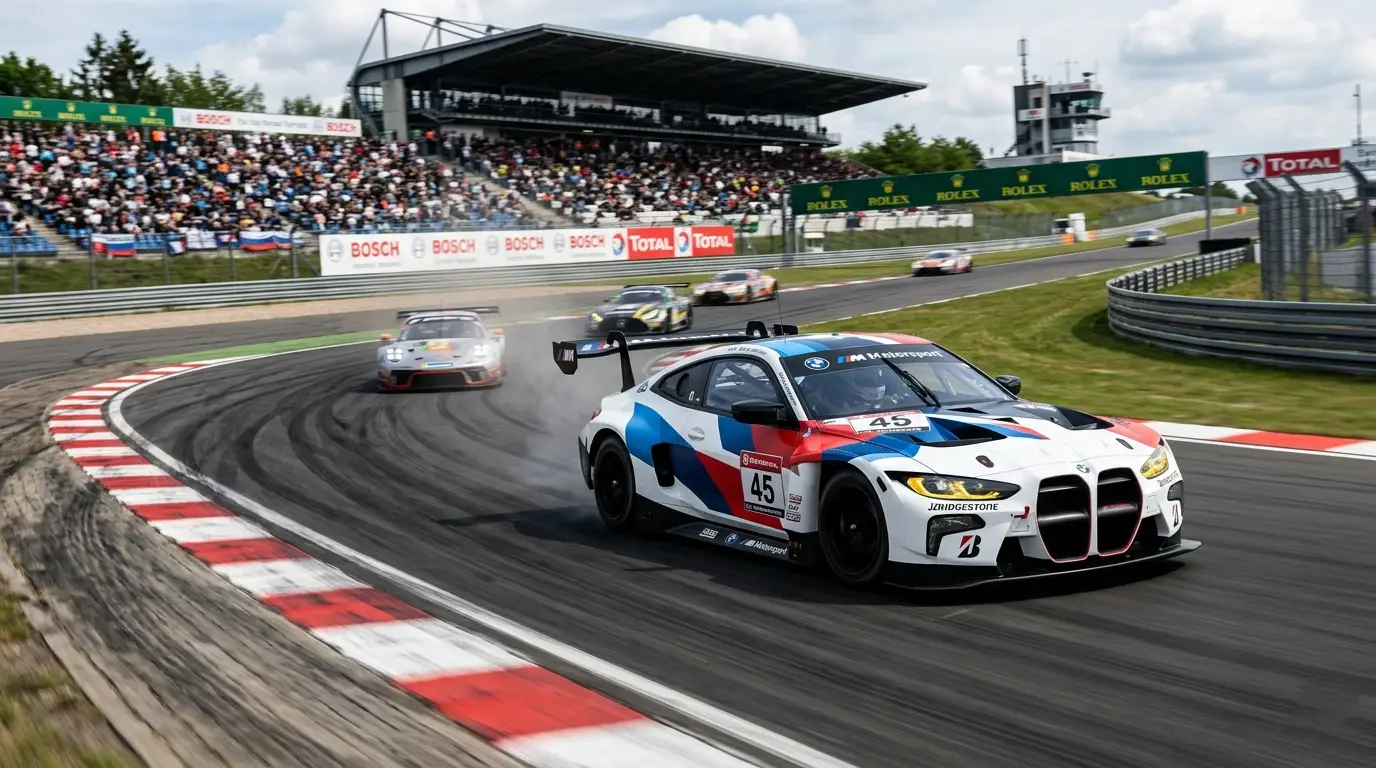
When automotive enthusiasts hear the roar of a high-performance engine echoing off track walls, BMW Race Car one brand consistently comes to mind. BMW has long been a dominant force in global motorsport, combining precision engineering with relentless track performance. From its early beginnings in touring car competition to its modern success in GT and endurance racing, the brand’s presence on the track is undeniable.
Whether you are a casual fan wondering, “Does BMW have a racing car?” or a privateer team looking to purchase a track weapon, this guide covers it all. We will explore everything from the cutting-edge technology of the modern motorsport BMW lineup to the rich heritage of their historic F1 involvement.
Expect a deep dive into iconic models, exact pricing for customer teams, historic legends, and where to find a BMW race car for sale. Get ready to discover the speed, design, and engineering that make BMW a true titan of the track.
Does BMW Have a Racing Car?
A question frequently asked by newcomers to the sport is, “Does BMW have a racing car?” The answer is a resounding yes. BMW doesn’t just have one racing car; it has an entire ecosystem dedicated to dominating various motorsport disciplines across the globe. This operation is spearheaded by BMW Motorsport, deeply intertwined with the famous BMW M division.
Their factory teams compete at the highest echelons of racing, but they also offer a highly successful BMW Customer Racing program. This program allows private teams and wealthy enthusiasts to purchase factory-built race cars directly from the manufacturer. The current motorsport BMW portfolio spans multiple competitive categories. In the fiercely contested GT racing world, the flagship BMW M4 GT3 leads the charge.
For those entering the sport, touring cars like the newly released 2026 BMW M2 Racing provide an accessible yet thrilling entry point. Historically, the brand has also left its mark on open-wheel racing, most notably with the BMW Sauber F1 team in the 2000s. Whether it is an endurance race at Le Mans or a sprint around the Nürburgring, there is almost always a BMW on the grid fighting for a podium finish.
BMW Race Car Models Overview
To truly understand the brand’s track dominance, we need to break down the major BMW race car models available today and from the past. The lineup is incredibly diverse, catering to different racing series, driver skill levels, and budgets. The crown jewel of the modern era is undoubtedly the BMW M4 GT3 race car. It is the brand’s flagship GT racing vehicle, designed to compete in major endurance events and sprint series worldwide.
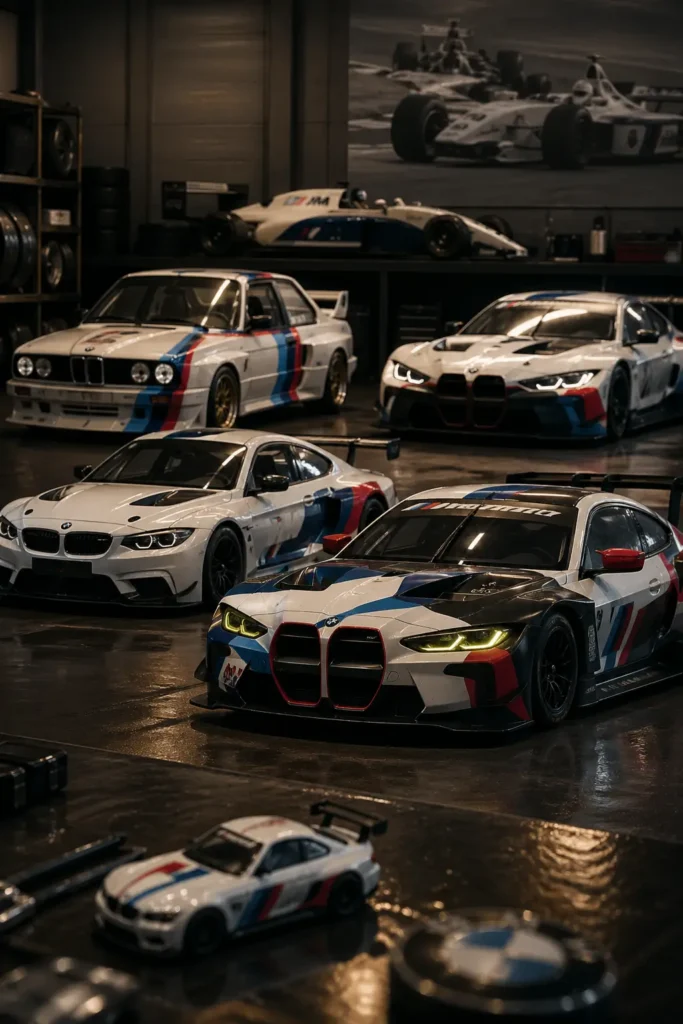
As a result, it replaces the M6 GT3 while offering better drivability, lower running costs, and significantly improved aerodynamics. Meanwhile, for those looking for an entry-level customer racing experience, the new BMW M2 racing car stands out as the weapon of choice. Interestingly, the 2026 iteration controversially swapped the classic inline-six engine for a lighter, turbocharged 2.0-liter four-cylinder.
Because of this change, the car shed nearly 500 pounds, making it incredibly nimble for grassroots racing. Looking back, the BMW M3 E30 DTM remains a historic legend and is often regarded as one of the most successful touring cars ever built. On the other hand, in the high-stakes world of endurance racing, the mighty BMW M8 GTE recently dominated the GTLM class with its massive footprint and roaring V8.
We must also acknowledge the historic Formula 1 era with the screeching V10 and V8 engines of the BMW Sauber F1 cars. Occasionally, the brand even develops rare concept builds, like experimental BMW 7 series race car prototypes, to test new technologies under extreme stress.
The cultural impact of these vehicles is so vast that even a simple BMW race car Hot Wheels toy is highly sought after. Collectors and kids alike clamor for a miniature BMW gt race car, proving the brand’s design language transcends the actual racetrack.
Old BMW Race Cars & Vintage Legends
There is a distinct magic surrounding an old bmw race car that modern vehicles struggle to replicate. The raw, mechanical connection between the driver and the machine defines the golden era of motorsport. When discussing vintage legends, the conversation always begins with the iconic BMW E30 M3.
During the late 1980s and early 1990s, the E30 M3 dominated the Deutsche Tourenwagen Meisterschaft (DTM). With its aggressively flared fenders and high-revving four-cylinder engine, it secured countless victories. Today, an authentic E30 BMW race car is considered the holy grail for collectors. Another unforgettable classic bmw race car is the 3.0 CSL, affectionately known as the “Batmobile.” Racing heavily in the 1970s, this vintage BMW race car featured massive aerodynamic fins and wings.
It crushed the European Touring Car Championship and established BMW’s reputation in IMSA racing in North America. Finding a genuine old BMW race car model is incredibly rare today. These vehicles have transitioned from track weapons to multi-million-dollar museum pieces and auction headliners.
During a vintage racing festival at Laguna Seca last year, I interviewed a mechanic actively restoring an original 1975 CSL. He noted that sourcing authentic parts for an old racing BMW takes years of networking, as these cars represent a bygone era of analog perfection. Their legacy cemented the foundation for the M division we know today.
New BMW Race Cars
The transition from analog classics to modern technological marvels brings us to the new BMW race car lineup. Today’s track vehicles are rolling supercomputers, utilizing advanced aerodynamics, carbon fiber construction, and complex telemetry systems. The undisputed leader of this new generation is the BMW M4 GT3. Unveiled as the successor to the M6, it was built from the ground up to be more forgiving for amateur drivers while remaining blisteringly fast for factory pros.
Every inch of the BMW M4 GT3 race car is optimized for airflow and downforce. It features a lightweight carbon body, a heavily modified P58 twin-turbo inline-six engine, and an aggressively wide stance. This BMW GT race car currently competes in the GT World Challenge and the IMSA WeatherTech SportsCar Championship.
Through the BMW Customer Racing program, private teams can purchase these state-of-the-art machines directly. The focus on the new lineup is not just raw speed but also tire management and ease of maintenance during grueling 24-hour endurance races.
BMW M4 GT3 Deep Dive
To truly appreciate modern engineering, we must take a deep dive into the BMW M4 GT3. This is not just a modified street car; it is a purpose-built racing machine engineered for absolute track supremacy. Under the hood, the BMW M4 GT3 race car houses the P58 3.0-liter straight-six engine with M TwinPower Turbo technology. It generates up to 590 horsepower, depending on the Balance of Performance (BoP) regulations of the specific racing series.
The chassis is a masterclass in rigidity and weight savings. The transmission is a sequential six-speed Xtrac gearbox, mounted at the rear for optimal weight distribution. Its motorsport achievements speak for themselves, with the M4 GT3 already securing major class victories at events like the 24 Hours of Spa and the Bathurst 12 Hour. But how much does a M4 GT3 cost? Operating at this level requires a massive budget.
A brand-new BMW M4 GT3 has a net price of roughly €578,000, which translates to about $625,000 at current exchange rates. When you factor in spare parts, tires, track support, and travel logistics, a single season of racing easily pushes the budget well over a million dollars. Despite the staggering cost, it remains BMW’s flagship GT racing car and a highly coveted asset for elite privateer teams.
BMW Race Car Price & For Sale Guide
Purchasing a track-ready machine is drastically different from walking into a local dealership. If you are looking for a BMW race car for sale, you need to understand the specialized market, the specific models available, and the staggering costs involved. For grassroots teams, the new 2026 BMW M2 Racing is the most accessible option. It is priced around €98,000 (roughly $111,000), offering a turnkey, FIA-compliant vehicle right out of the box.
As mentioned earlier, stepping up to a top-tier GT3 vehicle like the M4 drastically changes the BMW race car price. A new M4 GT3 demands over $625,000. However, the used market offers slightly more affordable options. You might find a previous-generation M4 GT4 or an older M2 CS Racing variant for anywhere between $100,000 and $200,000. Historic models exist in an entirely different financial stratosphere.
A pristine E30 M3 DTM car or a vintage 3.0 CSL can command anywhere from $500,000 to over $2 million at prestigious auction houses like RM Sotheby’s or Gooding & Company. Whether you are searching for a modern Bmw race car for sale or a vintage classic, these transactions usually happen directly through BMW Motorsport, specialized racing brokers, or high-end private collector auctions. The BMW customer racing portal is the official starting point for purchasing a new, factory-backed vehicle.
BMW Race Car Livery & Design
The visual identity of a track vehicle is almost as important as its engine. A striking BMW race car livery instantly communicates heritage, speed, and corporate backing. The most iconic design element is undoubtedly the classic M stripes: light blue, dark blue, and red. These tricolor stripes have adorned BMW vehicles since the 1970s, symbolizing the partnership between BMW (blue) and Texaco (red), with the middle color representing the blend of the two.
Today, modern designs often incorporate massive, sponsor-based graphics featuring brands like Shell, Akrapovič, or Red Bull. However, fan culture has also heavily embraced the minimalist, aggressive look of an all-black test vehicle. A completely black bmw race car, often seen during pre-season carbon-fiber testing before the official paint is applied, exudes a menacing, stealthy aesthetic. Many private owners replicate this bare-carbon or matte-black look for their own custom track day builds.
BMW Race Car Performance & Fastest Models
When debating the fastest bmw race car, you must distinguish between straight-line top speed and lap-time capability. If we measure absolute performance, the historic open-wheel cars are unmatched. The screaming V10 engines of the early 2000s Williams-BMW and later BMW Sauber F1 vehicles remain the fastest track machines the brand ever engineered.
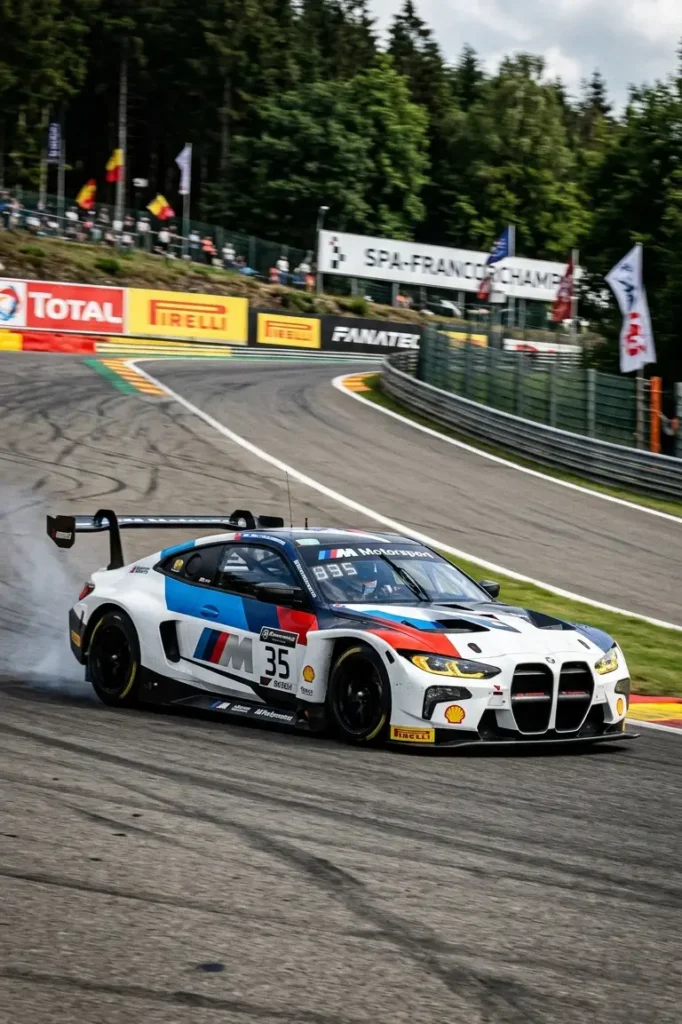
In the modern enclosed-wheel era, the BMW M4 GT3 race car wears the performance crown. However, its top speed is heavily dictated by track-specific aerodynamic setups and series regulations. While attending the 24 Hours of Daytona last year, I spoke with a telemetry engineer for a BMW customer team.
He explained that endurance racing setups prioritize cornering grip and fuel efficiency over raw straight-line speed. Conversely, a track with massive straights like Le Mans allows teams to trim the rear wing, pushing the car well past 180 mph.
BMW in Formula 1 History
You cannot discuss motorsport without acknowledging the pinnacle of open-wheel racing. The brand’s journey as a constructor is defined by the BMW Sauber F1 era. From 2006 to 2009, BMW took full ownership of the Sauber team, fielding a highly competitive grid. The defining moment of this BMW race car F1 project occurred at the 2008 Canadian Grand Prix. Driver Robert Kubica secured a spectacular maiden victory for the team, with his teammate Nick Heidfeld finishing second.
This 1-2 finish proved that BMW could engineer an aerodynamic package capable of beating Ferrari and McLaren. Despite this monumental success, the global financial crisis of 2009 forced the board of directors to reevaluate their motorsport investments. BMW abruptly exited Formula 1 at the end of that season. They chose to pivot their massive R&D budget toward developing sustainable road-car technologies and dominating GT and endurance racing series instead.
BMW Racing Events & Success
The manufacturer’s trophy cabinet is overflowing with global accolades. When looking at BMW’s most successful racing events, the brand has essentially conquered every major endurance and touring car challenge in the world. Their legacy in the Deutsche Tourenwagen Masters (DTM) is legendary, with multiple manufacturer and driver championships spanning from the E30 era to modern M4 entries. Touring car dominance is deeply woven into the DNA of motorsport BMW.
In the grueling realm of endurance racing, BMW is a terrifying competitor. They have secured multiple overall and class victories at the grueling 24 Hours of Nürburgring and the Spa 24 Hours. Across the Atlantic, their IMSA endurance racing wins at Daytona and Sebring have firmly cemented their reputation for building bulletproof, high-performance engines that can survive 24 hours of constant redline abuse.
BMW Race Car Culture & Collectibles
The influence of BMW motorsport extends far beyond the grandstands and into everyday pop culture. Generations of automotive enthusiasts have grown up idolizing these track machines, sparking a massive market for collectibles. For many kids, a diecast BMW race car toy is their very first introduction to the brand. Scale models from Hot Wheels, intricate LEGO Technic sets, and expensive resin models from AutoArt capture the imagination of fans globally.
The digital and artistic spaces are equally saturated. A quick online search reveals thousands of fan-made BMW race car drawing tutorials, digital renderings, and printable BMW race car coloring pages. Adult enthusiasts frequently use high-resolution BMW race car wallpaper designs for their multi-monitor simulator rigs. Even children’s bedroom decor has been influenced by this racing heritage, with the classic M-striped BMW race car bed remaining a popular centerpiece for young aspiring drivers.
BMW Race Car Kits & Custom Builds
Not every track weapon comes directly from a factory assembly line. A massive subculture exists around the custom BMW race car kit market. Enthusiasts purchase standard road cars and strip them down to the bare chassis to create their own bespoke track-day monsters. Companies produce extensive aftermarket racing conversion kits for popular chassis like the E36, E46, and E92.
These kits usually include widebody fiberglass overfenders, roll cages, polycarbonate windows, and aggressive aerodynamic splitters. The most popular platform for custom builds remains the E30. Because genuine M3s are too expensive to cut up, builders often buy base-model 325i chassis and install dedicated E30 build kits. By swapping in modern engines and racing suspensions, grassroots drivers can achieve blistering track times on a fraction of a factory budget.
Frequently Asked Questions
Does BMW have a racing car?
Yes, BMW boasts an extensive lineup of dedicated racing vehicles. Through their BMW Motorsport division, they produce cutting-edge track weapons like the M4 GT3, M4 GT4, and the entry-level M2 Racing, alongside hypercar prototypes for endurance series.
How much does an M4 GT3 cost?
A brand-new BMW M4 GT3 carries a base price of roughly $625,000 (€578,000). However, running a full competitive season requires millions of dollars for spare carbon fiber body panels, custom engine mapping support, specialized track tires, and travel logistics.
What car did James Bond drive in Tomorrow Never Dies?
While not a tracked vehicle, the brand’s pop-culture dominance includes the famous 1997 James Bond film Tomorrow Never Dies. Agent 007 drove a heavily modified, remote-controlled BMW 750iL, packed with missiles and tear gas, cementing BMW’s cool factor globally.
What’s faster, BMW M4 or M3?
In street-legal forms, their performance is nearly identical because they share the same twin-turbo inline-six engine and chassis architecture. However, in a track application, the M4 coupe is slightly more aerodynamic and boasts a lower center of gravity than the M3 sedan, making it the preferred platform for the brand’s official GT3 racing program.
Conclusion: The Ultimate Racing Heritage
From the screeching V10 engines of the Formula 1 era to the high-tech carbon fiber chassis of the modern M4 GT3, BMW has firmly cemented its legacy in motorsport history. The brand’s relentless pursuit of engineering perfection ensures that whether you are watching a 24-hour endurance race or attending a local track day, a BMW is usually leading the pack.
Owning a piece of this racing heritage is a dream for automotive enthusiasts globally. Whether you are piecing together an affordable E30 custom kit in your garage or signing a massive contract for a factory-backed GT campaign, the thrill of piloting a dedicated track weapon remains unparalleled. The brand’s customer racing program continues to perfectly bridge the gap between passionate fan and competitive driver.
Ultimately, those iconic M stripes represent much more than just corporate branding; they signify an unwavering commitment to speed, precision, and a winning culture. As the motorsport landscape continues to evolve into new technological eras, one thing remains absolutely certain: BMW will continue to build the ultimate driving machines for the track.

