

Formula 1 represents the absolute pinnacle of automotive engineering and human performance. For many fans, the most captivating aspect of the sport is the sheer, raw velocity these machines achieve. How fast do formula 1 cars go is a question with a multi-layered answer that involves top speeds, acceleration, and lateral grip.
In a standard Grand Prix environment, Formula 1 cars can comfortably exceed 350 km/h (217 mph). During the 2016 Mexican Grand Prix, Valtteri Bottas hit a staggering 372.5 km/h (231.4 mph), setting the official record for the fastest f1 speed record in a race session. While top speeds are impressive, the average race speed typically fluctuates between 220–250 km/h depending on the track layout.
Acceleration is equally mind-bending, as these cars are designed to launch from a standstill with violent efficiency. To understand the true capability of an F1 car, one must look beyond the straight-line numbers and consider how they maintain these speeds through corners. This guide will break down the technical reality of F1 speed, from the starting lights to the checkered flag.
Formula 1 Car Top Speed (Current and Historical)
The formula 1 car top speed is not a static number but a variable controlled by aerodynamic setup and circuit characteristics. On a high-speed track like Monza, teams strip away as much wing as possible to reduce drag. This allows the cars to reach their maximum potential on the long “Strettilineo.”
Modern Formula 1 cars generally peak between 340 and 360 km/h (211–223 mph) during a typical race weekend. I remember standing in the paddock at Monza last season, speaking with a lead performance engineer about this very topic. He noted that while they could technically gear the car to go faster, they would lose too much time in the corners.
The trade-off between downforce and drag is a constant battle for engineers. A car set for a “high-downforce” circuit like Monaco will have a much lower top speed because the massive wings act like parachutes on the straights. Conversely, “low-drag” setups prioritize formula 1 car speed mph to gain time on straights.
Historical top speeds have fluctuated with regulation changes. In the early 2000s, V10 engines allowed for incredible straight-line speed. However, modern hybrid power units produce more total torque, allowing for faster exits out of corners, which often leads to higher speeds at the end of shorter straights.
Fastest F1 Speed Record in History
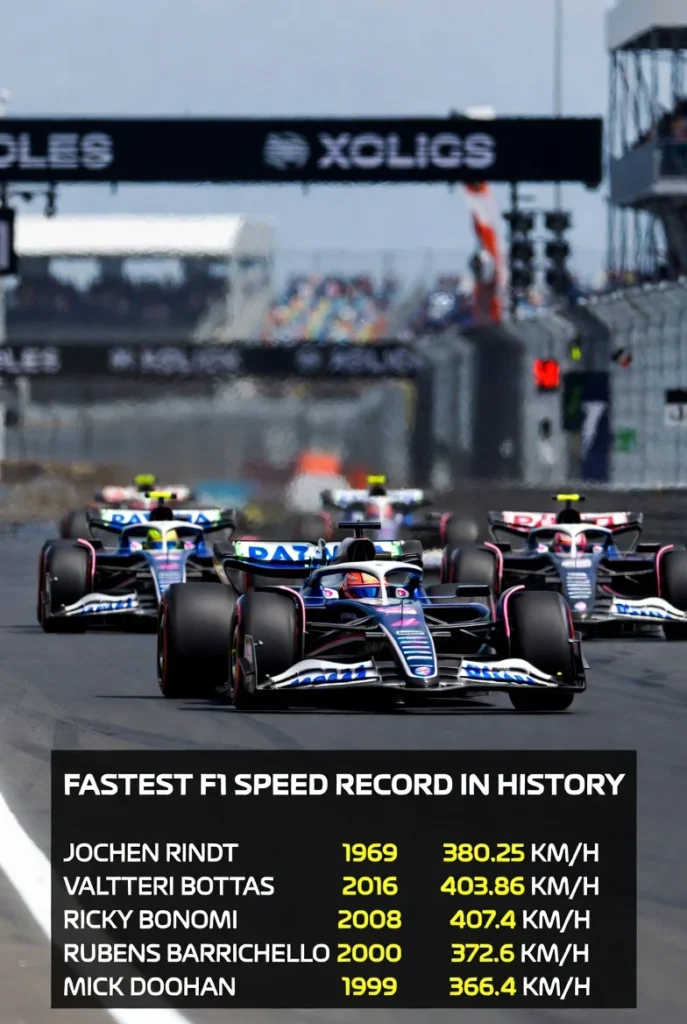
While Valtteri Bottas holds the record for a race weekend, there are unofficial runs that pushed the boundaries even further. The fastest formula 1 car speed ever recorded in a semi-official capacity occurred when BAR Honda took a modified car to the Bonneville Salt Flats.
They managed to exceed 400 km/h (248 mph) during experimental runs, proving that the engine was capable of much more if not restricted by track regulations. In a competitive setting, Bottas’s 372.5 km/h remains the benchmark. This record was set with the help of a “tow” or slipstream from another car, which significantly reduces air resistance.
Another notable mention is the 2005 Italian Grand Prix, where Kimi Räikkönen was clocked at 370.1 km/h. These records highlight that while modern cars are faster over a whole lap, the fastest f1 speed in history often comes down to specific moments of low drag and perfect engine deployment.
It is worth noting that the formula 1 car top speed record is often dictated by the “Density Altitude” of a track. Mexico City, situated at high altitude, has thinner air. This thin air offers less resistance, allowing cars to punch through the atmosphere and reach higher top speeds than they would at sea level.
Formula 1 Acceleration (0–60 and 0–100)
Acceleration is where the Formula 1 car truly separates itself from almost every other racing machine. A modern F1 car can reach formula 1 0 to 60 mph in approximately 2.4 to 2.6 seconds. The jump to 100 km/h is equally fast, usually clocked around 2.5 seconds.
The acceleration from 0–200 km/h (124 mph) is perhaps more impressive, taking only about 4 to 5 seconds. This violent thrust is made possible by the hybrid power unit, which combines the instant torque of an electric motor with the high-end power of a turbocharged V6 engine.
Traction control is banned in F1, so this acceleration is a testament to the driver’s throttle control and the mechanical grip of the wide Pirelli tires. If a driver is too aggressive, the tires will simply spin, wasting energy and overheating the rubber.
The lightweight design, using carbon fiber for almost every component, ensures that the power-to-weight ratio is nearly 1:1. This means every bit of horsepower is pushing very little mass, resulting in the how fast do f1 cars accelerate figures that seem to defy physics.
How Fast Do Formula 1 Cars Go During a Race?
During a race, the average speed of formula 1 cars is significantly lower than the maximum speed. This is because a race includes heavy braking zones, tight hairpins, and fuel management phases. In a 300 km race, maintaining a consistent pace is more important than hitting a single high speed.
At the Italian Grand Prix, the “Temple of Speed,” average speeds often exceed 250 km/h over the course of a lap. This is the highest average on the calendar. In contrast, the Monaco Grand Prix sees average speeds drop to around 160 km/h due to its narrow, winding street layout.
On the long straights of circuits like Spa-Francorchamps or Baku, you will consistently see how fast do formula 1 cars go on straights reach the 330–350 km/h range. Drivers must also manage their Energy Recovery System (ERS), deciding when to deploy the extra 160 horsepower for a pass.
Environmental factors like wind direction can also play a major role. A strong headwind can shave 10 km/h off a car’s top speed, while a tailwind can help a driver reach their highest formula 1 car speed km/h of the entire weekend.
How Fast Do Formula 1 Cars Go Around Corners?
The true secret of F1 speed lies in cornering. While a supercar might be fast on a straight, it cannot compete with an F1 car’s lateral grip. This grip is generated by “downforce,” which effectively glues the car to the road using air pressure.
In slow corners, like the Fairmont Hairpin in Monaco, cars navigate at speeds of 80–120 km/h. Here, the grip is purely mechanical, relying on the suspension and tire compounds. As the speed increases, the aerodynamic wings start to “wake up.”
In medium-speed corners, F1 cars fly through at 160–220 km/h. However, it is the high-speed corners that are truly legendary. At Silverstone, corners like Maggotts and Becketts are taken at speeds between 250 and 300 km/h. The drivers experience lateral forces up to 5 or 6G.
To put how fast do formula 1 cars go around corners mph into perspective, imagine taking a 90-degree turn on a highway at 150 mph. For a normal car, this is impossible; for an F1 car, it is a standard Sunday afternoon.
F1 Car Speed Chart (Top Speed, Acceleration, Cornering)
To visualize the incredible performance of these machines, we can look at a summary of their capabilities across different metrics. The following chart highlights the formula 1 car speed mph and km/h across various phases of a race.
| Metric | Speed (Metric) | Speed (Imperial) |
| Top Speed (Race) | 350–360 km/h | 217–223 mph |
| Average Race Speed | 220–250 km/h | 136–155 mph |
| 0–60 mph Acceleration | ~2.5 seconds | ~2.5 seconds |
| 0–124 mph Acceleration | ~4.5 seconds | ~4.5 seconds |
| Fast Corner Speed | 250–300 km/h | 155–186 mph |
| Slow Corner Speed | 80–120 km/h | 50–75 mph |
This f1 car speed chart demonstrates that F1 cars are not just “fast” in one category. They are designed to be the fastest possible vehicles that can navigate a diverse range of turns and straights within a single lap.
Fastest F1 Car in the World
Choosing the fastest f1 car ever made depends on whether you measure top speed or lap time. The Williams FW38 is often cited for its incredible straight-line performance, as it was the car Bottas used to set the 372.5 km/h record.
However, many experts consider the Mercedes F1 W11 from the 2020 season to be the fastest f1 car in the world in terms of overall lap time. This car shattered lap records at almost every track it visited, thanks to its “Dual Axis Steering” (DAS) and perfect aerodynamic balance.
Modern cars like the Red Bull RB19 and RB20 have pushed the boundaries of efficiency. While they might not always hit the highest fastest speed of an f1 car, their ability to maintain speed through a corner and their DRS (Drag Reduction System) efficiency make them lethal on track.
In my discussions with technical directors, they often point out that the “fastest” car is the one that manages its tire temperatures best. A car that is fast for one lap but overheats its tires will lose the race. Therefore, the which f1 car is the fastest debate usually lands on the most well-rounded machine.
How Fast Are F1 Cars in 2026?
The 2026 season brings a seismic shift in regulations. The current formula 1 car speed limits are being redefined by a move toward even more electrical power. The new power units will split the power roughly 50/50 between the internal combustion engine and the electric battery.
Early simulations suggest that the top speed of modern formula 1 cars in 2026 might be slightly lower on the longest straights due to increased drag from active aero components. However, the acceleration out of corners is expected to be even more violent because of the increased electrical torque.
The Fédération Internationale de l’Automobile (FIA) has designed these rules to improve racing and sustainability. While fans worry about speed drops, F1 has a history of engineers finding loopholes to make cars faster than intended. How fast are f1 cars in 2026 will likely surprise us once the cars hit the track.
The introduction of “Active Aerodynamics” will allow cars to change their wing angles during the lap. This will help maintain high cornering speeds while minimizing drag on the straights, potentially keeping how fast do formula 1 cars go numbers near their historical peaks.
F1 Car Speed vs Other Racing Series
Formula 1 is often compared to other elite series like NASCAR and IndyCar. While they all involve racing, the way they achieve their speeds is fundamentally different.
Is Formula 1 Faster Than NASCAR?
When asking is formula 1 faster than nascar, the answer is yes on almost every metric. NASCAR Cup Series cars are much heavier and designed primarily for oval racing. They typically peak at around 320 km/h (200 mph) on superspeedways like Daytona or Talladega.
An F1 car would easily out-accelerate and out-corner a NASCAR vehicle. The lightweight carbon fiber of an F1 car allows it to change direction with an agility that a heavy stock car cannot match. While NASCAR is a test of drafting and endurance, F1 is a test of pure mechanical and aero efficiency.
Which Is Faster, F1 or IndyCar?
The debate over which is faster f1 or indycar is more nuanced. On an oval track like the Indianapolis 500, an IndyCar is actually faster than an F1 car. IndyCars can reach speeds up to 380 km/h (236 mph) because they are designed for sustained high-speed oval running.
However, on a road or street course, F1 is significantly faster. An F1 car has much higher downforce and more advanced braking systems, allowing it to take corners and stop much faster than an IndyCar. In a direct lap-time comparison at a road course like COTA, an F1 car is usually 10 to 15 seconds faster per lap.
How Fast Do Formula 4 and F1 Academy Cars Go?
Developmental series like Formula 4 and the F1 Academy are the stepping stones to the top. These cars are much slower by design to help young drivers learn. How fast do formula 4 cars go? They usually peak at around 210–240 km/h.
F1 Academy cars, which focus on developing female talent, have similar performance profiles. While these speeds seem low compared to F1, they are still faster than most high-performance road cars on a track, providing the necessary training for the next generation of stars.
How Fast Do F1 Cars Go Compared to Normal Cars?
Comparing an F1 car to a normal road car is like comparing a sprinter to a toddler. Most road cars have a top speed between 160 and 200 km/h. High-end supercars might reach 300 km/h. Even a Bugatti Chiron Super Sport 300+, which can hit 490 km/h, would be beaten by an F1 car on a race track.
This is because how fast do f1 cars go compared to normal cars isn’t just about top speed; it’s about the rate of change. An F1 car can go from 0 to 160 km/h and back to 0 in less time than a normal car takes to reach 60 mph.
The braking force in an F1 car is so high that it can make a driver’s eyes bulge. They can decelerate from 330 km/h to 80 km/h in a matter of seconds. A normal car’s brakes would overheat and fail almost instantly under those conditions.
Do F1 Cars Go 300 MPH?
A common myth among casual viewers is that these cars hit 300 mph. To be clear: do f1 cars go 300 mph? No. There has never been an official race speed recorded anywhere near 300 mph (482 km/h).
The aerodynamic drag at 300 mph is exponentially higher than at 200 mph. To reach that speed, an F1 car would need significantly more horsepower and a completely different wing configuration. While land speed record cars hit these marks, F1 cars are restricted by the need to turn corners and follow FIA regulations.
Most F1 cars peak around 360–370 km/h. Going much faster would require tires that can withstand incredible centrifugal forces, which are not currently used in the sport.
Why Formula 1 Cars Are So Fast
The speed of an F1 car is the result of four main pillars: Aerodynamics, Lightweighting, the Power Unit, and Tires. The Fédération Internationale de l’Automobile (FIA) sets the box within which engineers must work, and they push those rules to the absolute limit.
- Aerodynamics: Front and rear wings, along with the floor, create thousands of pounds of downforce.
- Lightweighting: The chassis is made of carbon fiber and titanium, keeping the weight around 798 kg (including the driver).
- Hybrid Power Units: The 1.6L V6 turbo works in tandem with the MGU-K and MGU-H to provide instantaneous power.
- Tires: Pirelli’s bespoke compounds are designed to provide maximum grip for short bursts of extreme performance.
Frequently Asked Questions (FAQ)
What is the top speed of F1 cars?
The typical top speed is between 340 and 360 km/h (211–223 mph), though records in specific conditions have reached over 370 km/h.
How fast do Formula 1 cars go in mph?
On straights, they hit 210–230 mph. Their average race speed is usually between 130 and 150 mph depending on the circuit.
How fast do F1 cars accelerate?
F1 cars accelerate from 0–60 mph in about 2.5 seconds and can reach 124 mph (200 km/h) in under 5 seconds.
How fast do Formula 1 cars go on straights?
Depending on the length of the straight and the DRS usage, cars typically reach between 310 km/h and 350 km/h.
How fast do electric Formula 1 cars go?
While F1 is a hybrid, the all-electric “Formula E” cars reach top speeds of around 322 km/h (200 mph) with their latest Gen3 Evo models.
Conclusion
When asking how fast do formula 1 cars go, the answer is a testament to the limits of modern physics. These cars are not just fast on a speedometer; they are fast in every dimension of movement. With top speeds exceeding 350 km/h and acceleration that rivals a jet fighter, they remain the undisputed kings of the race track.
As we look toward the 2026 season and beyond, the pursuit of speed will continue. Whether through active aerodynamics or more efficient hybrid power, the goal remains the same: to shave off every possible millisecond. For the drivers and engineers, speed is not just a number—it is a way of life.

