When you stand near the catch fence at a superspeedway, the first thing you notice—if you’ve ever wondered how fast do NASCAR cars go—isn’t the sound; it’s the physical wall of air that hits you a split second before the cars roar past. The short answer is that they are engineered to flirt with the 200 mph (322 km/h) mark.
However, speed in NASCAR isn’t a single, static number. It is a calculated dance between engine displacement, aerodynamic drag, and the specific geometry of the track. While the top speed of NASCAR vehicles can technically exceed 210 mph in a vacuum, modern safety regulations and “tapered spacers” usually cap them around the 190–200 mph range during a typical race weekend.
The average speed of NASCAR cars during a full event is often lower, typically landing between 150 and 180 mph (240–290 km/h). This takes into account pit stops, yellow-flag caution periods, and the necessary braking for corners on shorter tracks. Whether it’s the high-banked turns of Talladega or the flat asphalt of Phoenix, speed is the currency of the sport, but safety is the bank that regulates it.
How Fast Do NASCAR Cars Go on Average?
Understanding how fast do NASCAR cars go on average requires looking at the “race pace” rather than just a qualifying lap. During a 500-mile race, the average speed is a composite of green-flag racing, slow-speed caution laps, and stationary time in the pits. On a fast 1.5-mile “intermediate” track, you can expect an average speed of NASCAR cars to hover around 150 to 170 mph.
During a recent trip to the garage area at Charlotte Motor Speedway, I had the chance to chat with a veteran tire specialist. He explained that “average speed” is often a misleading metric for fans. “A car might be averaging 180 mph over a lap,” he told me, “but that includes a spike to 195 on the straight and a drop to 165 in the center of the turn. It’s that delta—the difference between the high and low—that kills the tires.”
Several factors dictate these averages:
- Track Length: Longer tracks allow for higher sustained throttle time.
- Banking: Steeper turns allow cars to carry more speed through the corners without sliding.
- Caution Periods: Every time a yellow flag flies, the field drops to roughly 55–70 mph, which drags the total race average down significantly.
In the modern era, how fast do nascar cars go during a race is also influenced by the “Next Gen” car’s aerodynamic package. NASCAR frequently tweaks the rear spoiler height and underbody aero to ensure cars stay bunched up, which prioritizes “pack racing” over raw, unchecked velocity.
NASCAR Top Speed – How Fast Can They Really Go?
If we removed the rules, the restrictors, and the safety concerns, the top speed of NASCAR would be terrifying. In its current “Next Gen” configuration, the car is powered by a 5.86-liter V8 engine producing roughly 670 horsepower (on most tracks). In this state, the NASCAR top speed km h equivalent is roughly 322 km/h (200 mph).
However, the engine is capable of much more. Before the introduction of the tapered spacer (a device that limits air intake to the engine), these cars pushed over 800 or even 900 horsepower. In “unrestricted” testing, a NASCAR stock car has been clocked at over 225 mph. The reason we don’t see those speeds on Sunday is simple: physics.
When a 3,400-pound car gets sideways at 210 mph, it effectively becomes an airplane wing. NASCAR limits the top speed to ensure that if a car spins, it stays on the ground rather than lifting into the grandstands. So, when people ask how fast do nascar cars go km/h, the 320 km/h mark is the “sweet spot” where the racing remains competitive but the cars remain (mostly) earthbound.
Fastest NASCAR Speed Ever Recorded
To find the fastest NASCAR speed ever recorded, we have to go back to 1987, an era before modern speed-dampening rules. At Talladega Superspeedway, Bill Elliott—often called “Awesome Bill from Dawsonville”—clocked a qualifying lap of 212.809 mph.
This remains the highest speed in NASCAR history for an official session. Shortly after this record was set, Bobby Allison had a horrific crash at Talladega where his car became airborne and tore into the catch fence. This incident changed the sport forever, leading to the immediate implementation of restrictor plates to keep cars below the 200 mph threshold for safety.
While Elliott’s fastest NASCAR lap ever is a point of pride for historical buffs, modern drivers rarely get close to it. Today’s qualifying laps at Talladega usually top out around 180–190 mph because the cars are tuned for drafting in a pack rather than solo speed. The 212 mph record stands as a ghost of a “wild west” era that the sport has moved past in favor of driver survival.
How Fast Do NASCAR Cars Go at Daytona?
The Daytona 500 is the “Super Bowl” of stock car racing, and how fast do nascar cars go at daytona is a question of “drafting.” At Daytona International Speedway, a single car driving alone might only hit 182 mph. However, when 40 cars line up nose-to-tail, they create a vacuum that pulls the entire line forward.
In the “draft,” how fast do nascar cars go daytona 500 speeds frequently reach 195 to 200 mph. The air is pushed over the lead car and flows smoothly over the following cars, allowing the entire pack to travel faster than any individual car could alone. This is why the Daytona 500 looks like a high-speed freight train.
How fast do cars go at the Daytona 500?
- Qualifying: 180–185 mph (Single car).
- Race Pace: 190–198 mph (In a pack).
- Pit Road: 55 mph (Strictly enforced).
The banking at Daytona is 31 degrees, which is so steep you can barely stand on it. This banking is what allows the cars to maintain these massive speeds through the turns without flying off the track.
NASCAR Speeds by Track – Detailed Breakdown
NASCAR races on everything from massive 2.6-mile ovals to tiny quarter-mile “bullrings.” Consequently, the answer to how fast do nascar cars go changes every single week.
Bristol Motor Speedway
Known as the “World’s Fastest Half-Mile,” Bristol is a high-banked pressure cooker. While the straights are short, the 36-degree banking allows cars to haul mail.
- How fast do nascar cars go at bristol? The top speed on the straights hits about 125–130 mph, but the average speed is usually around 115–120 mph. Because the lap is so short (roughly 15 seconds), it feels much faster than it is.
Charlotte Motor Speedway
Charlotte is the quintessential “Intermediate” track. It’s 1.5 miles long and serves as the home base for most teams.
- How fast do nascar cars go at charlotte? On the “Quad-oval” layout, cars reach 180–190 mph on the straights. The racing here is a mix of high-speed aero-handling and raw horsepower.
Phoenix Raceway
Phoenix is a one-mile, low-banked tri-oval. It’s much flatter than Daytona or Bristol, which means drivers have to use their brakes heavily.
- How fast do NASCAR cars go at Phoenix Raceway? Drivers usually hit 130–140 mph on the backstretch but have to slow down to roughly 90–100 mph to make the flat turns. It is a technical track where “handling” beats “raw speed.”
Bowman Gray Stadium
This is the shortest and slowest track NASCAR visits. It is a flat, quarter-mile oval that circles a football field.
- How fast do nascar cars go at bowman gray? Speeds here are incredibly low, often averaging only 70–90 mph. It’s less about aerodynamics and more about “beating and banging” your way to the front.
How Fast Do NASCAR Cars Go Around Turns?
One of the most misunderstood aspects of stock car racing is the speed maintained during cornering. When you ask how fast do NASCAR cars go around turns, the answer is entirely dependent on the “banking.” At a superspeedway like Talladega, the banking is 33 degrees—so steep that the cars don’t actually have to slow down much.
They carry nearly 190 mph through the center of the turn, relying on centrifugal force to “glue” the tires to the asphalt. On the other hand, at a short track like Martinsville, which has very little banking (only 12 degrees), the story is different. Drivers have to stand on the brakes, dropping from 120 mph on the straight to a crawl of roughly 60–70 mph in the center of the turn.
This “corner exit” speed is where the 2026 horsepower boost really shines. With 750 HP under the hood for short tracks, drivers must carefully control their right foot to keep the rear tires from spinning out as they accelerate back toward the straightaway.
During a technical briefing I attended at the NASCAR Research and Development Center in Concord, an engineer pointed out that the Next Gen car’s independent rear suspension has fundamentally changed cornering. “In the old days, the car would ‘hop’ over bumps in the turn,” he explained. “Now, they stay flat, allowing for higher mid-corner speeds but making it much harder for drivers to ‘feel’ when they are about to lose grip.”
How Fast Do NASCAR Cars Go Under Caution?
The pace car is the “speed governor” of the field during a yellow flag. Typically, how fast do NASCAR cars go under caution depends on the length of the track and the pit road speed limit. On a large 2.5-mile track, the caution speed is usually around 70 mph. On a tiny short track, it might drop to 45 or 55 mph.
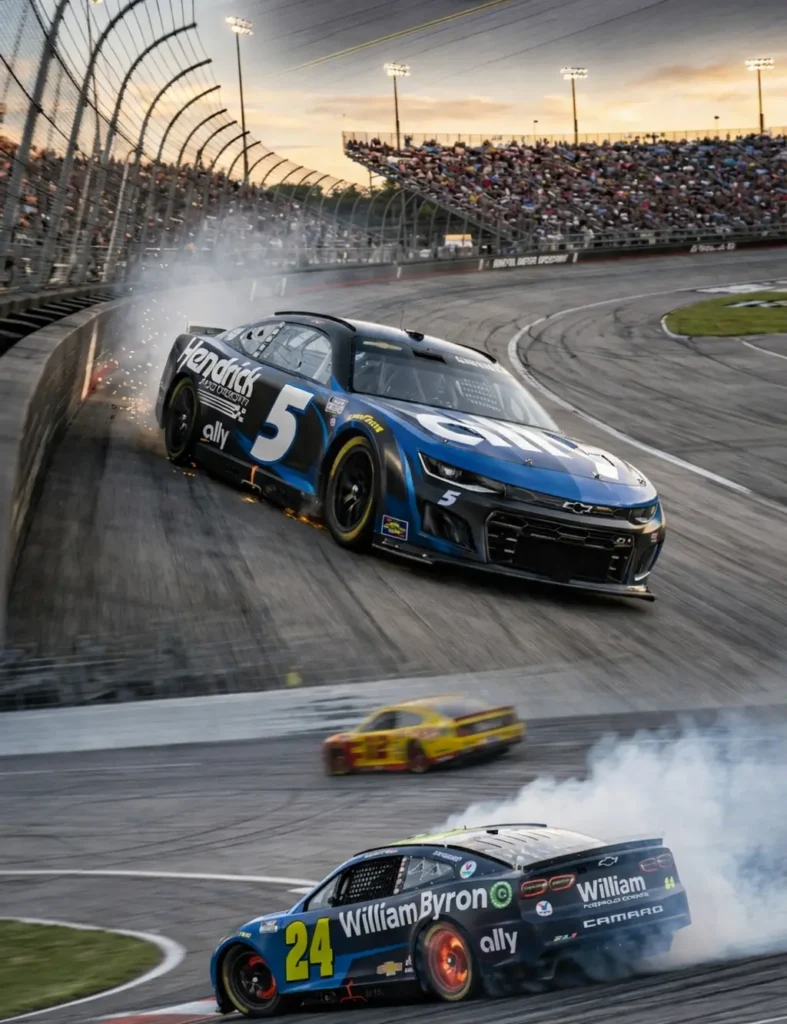
This speed is critical for two reasons: engine cooling and tire temperature. At caution speeds, the lack of airflow can cause the 750 HP engines to overheat quickly. Drivers will often “weave” back and forth to maintain heat in their tires, though 2026 rules now strictly prohibit weaving once the field reaches the “one-to-go” signal before a restart.
Officials regulate pit road speed even more strictly. If a driver exceeds the limit—even by 0.1 mph—they issue a “pass-through” penalty. In 2026, officials set most pit road speeds between 35 mph and 55 mph, depending on the safety layout of the facility.
NASCAR Acceleration – 0–60 Speed
While NASCAR is built for top-end endurance, its “launch” performance is surprisingly respectable. So, how fast do NASCAR cars go 0–60? On a prepped surface with fresh Goodyear slicks, a Cup Series car can hit 60 mph in approximately 3.4 to 3.7 seconds.
While this is slower than a Formula 1 car (which does it in ~2.6s), it’s important to remember that a NASCAR vehicle weighs 3,400 pounds—nearly double an F1 car.
The acceleration is limited primarily by traction. Because these cars are rear-wheel drive and carry a massive amount of weight, they struggle to put all 750 horses to the ground from a standing start without turning the tires into a cloud of blue smoke.
How Fast Can NASCAR Cars Go Without Restrictor Plates?
The “restrictor plate”—or the modern “tapered spacer”—is the only thing standing between a NASCAR driver and 230 mph. If you wonder how fast can NASCAR cars go without restrictor plates, the answer is “fast enough to take flight.”
In 2004, Rusty Wallace conducted an “unrestricted” test at Talladega. He reached a top speed of 228 mph on the backstretch. However, the car felt unstable, and the tires weren’t designed to handle the heat generated by those sustained velocities. NASCAR maintains the current 200 mph cap because it is the physical limit at which the current aerodynamic flaps can still keep a spinning car on the ground.
NASCAR vs Formula 1 Speed Comparison
The Formula 1 vs NASCAR speed debate is a clash of philosophies. One is a lightweight scalpel; the other is a heavy sledgehammer.
Speed Comparison Table (2026 Data)
| Metric | NASCAR (Cup Series) | Formula 1 |
| Top Race Speed | ~200 mph (322 km/h) | ~220 mph (354 km/h) |
| 0–60 mph Acceleration | ~3.4 Seconds | ~2.6 Seconds |
| Braking (200-0 mph) | High Distance | Low (Carbon Brakes) |
| Cornering G-Force | 2.5 – 3.0 G | 5.0 – 6.0 G |
| Horsepower | 670 – 750 HP | ~1,000 HP (Hybrid) |
When people ask is F1 faster than NASCAR?, the answer is yes, in every measurable category. However, NASCAR fans often argue that the “slower” speeds of stock cars lead to better racing because the cars aren’t as aerodynamically sensitive, allowing for the “bump-and-run” style that F1 drivers wouldn’t dare attempt.
NASCAR vs Formula E
For topical authority, we must briefly look at the electric side. While NASCAR is loud and heavy, Formula E is silent and agile. How fast does a NASCAR car go compared to an electric racer?
Formula E’s Gen3 Evo cars actually beat NASCAR in a 0–60 mph sprint, clocking in at under 2.0 seconds. However, on a long oval, the NASCAR would eventually fly past, as Formula E cars are capped at about 200 mph and struggle to maintain that speed for long durations due to battery heat management.
How Fast Do NASCAR Cars Go? (Reddit & Fan Perspective)
If you browse how fast do NASCAR cars go Reddit threads, you’ll find a common theme: “It doesn’t look that fast on TV.” This is a side effect of high-definition cameras and wide-angle lenses.
In person, the speed is visceral. I spoke with a fan at the Chicago Street Race who had only ever watched on TV. “When they came down Columbus Drive,” he said, “I finally understood. The ground literally shakes. You don’t see the speed; you feel it in your chest.” The real-world perception of NASCAR speed is tied to the displacement of air—a 3,400lb car moving at 190 mph creates a “wake” similar to a small airplane.
Are There Any LGBTQ NASCAR Drivers?
As of 2026, NASCAR has continued its push for inclusivity, though the driver roster remains predominantly heteronormative. Fans often ask, are there any LGBTQ NASCAR drivers? The most notable recent figure is Zach Herrin, who has competed in the ARCA Menards Series (a NASCAR feeder series) and has been open about his identity as a gay man.
NASCAR has partnered with the LGBTQ+ Chamber of Commerce for diversity training and has a strict code of conduct regarding inclusive language. This was put to the test in early 2026 when driver Daniel Dye was indefinitely suspended for mocking a fellow competitor with homophobic stereotypes. The message from the sanctioning body was clear: the sport is for everyone, regardless of who they love.
Why NASCAR Speeds Vary So Much
The reason how fast do NASCAR cars go changes so wildly is the “Technical Package.” NASCAR uses different configurations for:
- Superspeedways: Restricted power (670 HP) and high-drag spoilers to keep the pack together.
- Short Tracks/Road Courses: Higher power (750 HP) and smaller spoilers to allow for more passing and driver skill.
- Intermediate Tracks: A balance of the two, focusing on “aerodynamic efficiency.”
By changing the amount of air that enters the engine and the amount of “wing” on the back of the car, NASCAR can artificially dial the speed up or down to provide the best entertainment for that specific track layout.
FAQ Section
How fast do NASCAR cars go?
Top speeds currently reach 200 mph (322 km/h), though average race speeds are typically between 150 and 180 mph.
How fast do NASCAR cars go at Daytona?
In a drafting pack, cars hit between 190 and 198 mph. Qualifying speeds for a single car are slightly lower, around 182 mph.
How fast do NASCAR cars go around turns?
On superspeedways, they maintain almost 190 mph in turns. On short tracks like Martinsville, they slow down to 60–80 mph.
Is F1 faster than NASCAR?
Yes. Formula 1 cars have higher top speeds (~220 mph), faster acceleration, and significantly higher cornering speeds due to superior aerodynamics.
What is the fastest NASCAR speed ever recorded?
The official record is 212.809 mph, set by Bill Elliott at Talladega in 1987. Unofficial tests have surpassed 225 mph.
Final Verdict – How Fast Are NASCAR Cars Really?
In the end, how fast do NASCAR cars go? They go exactly as fast as the rules allow them to. At 200 mph, a NASCAR stock car is at the absolute peak of its safety and performance envelope.
While other series like F1 might have higher top speeds, few can match the raw, heavy-metal intensity of 40 stock cars screaming into a turn at three miles per minute. Whether it’s 75 mph at Bowman Gray or 200 mph at Daytona, the speed is only one part of the story—the real magic is what the drivers do with it.