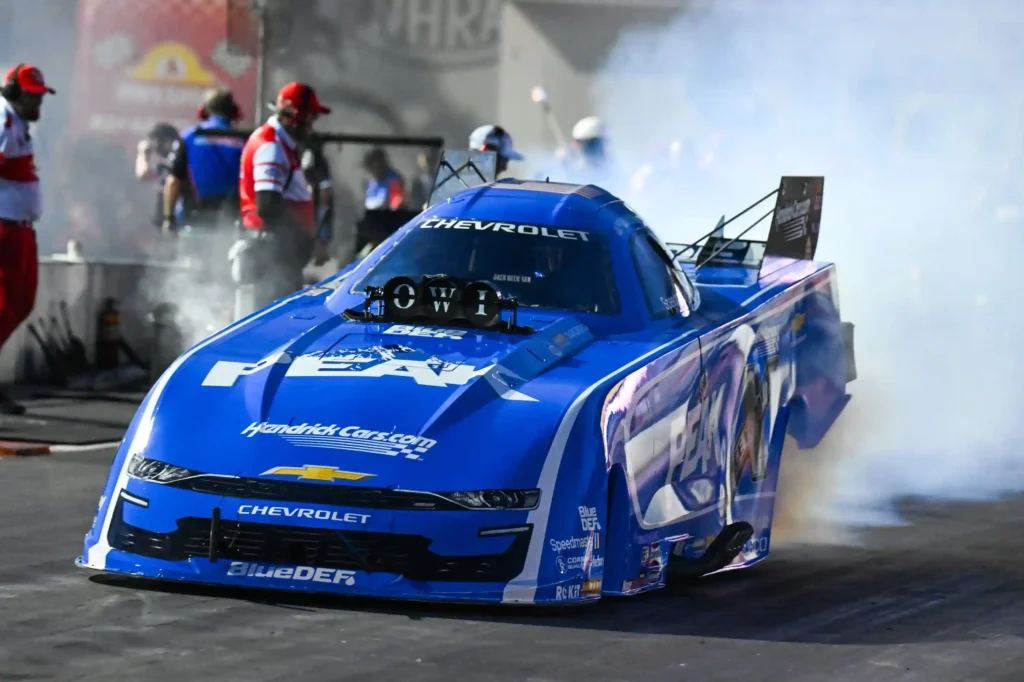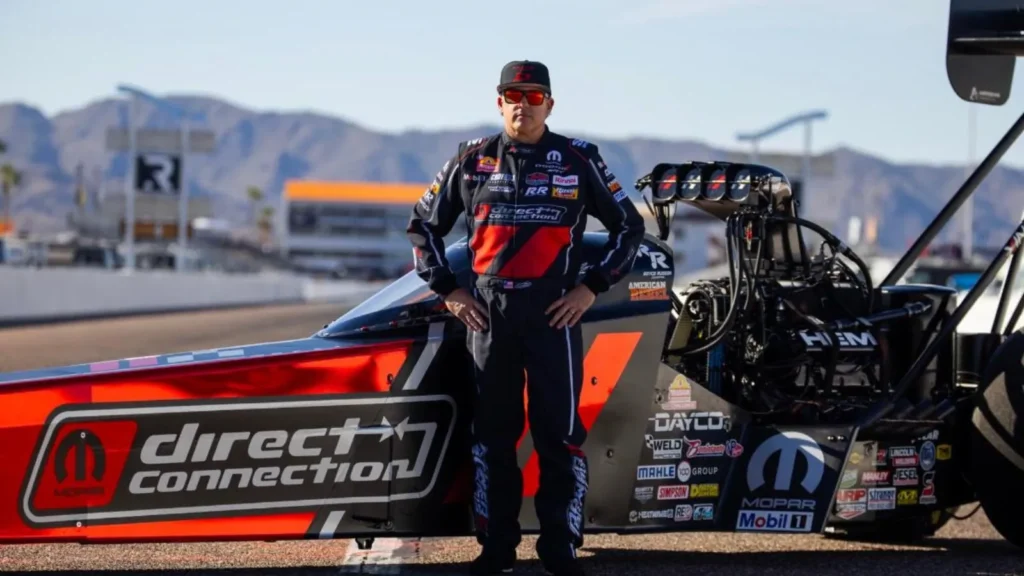
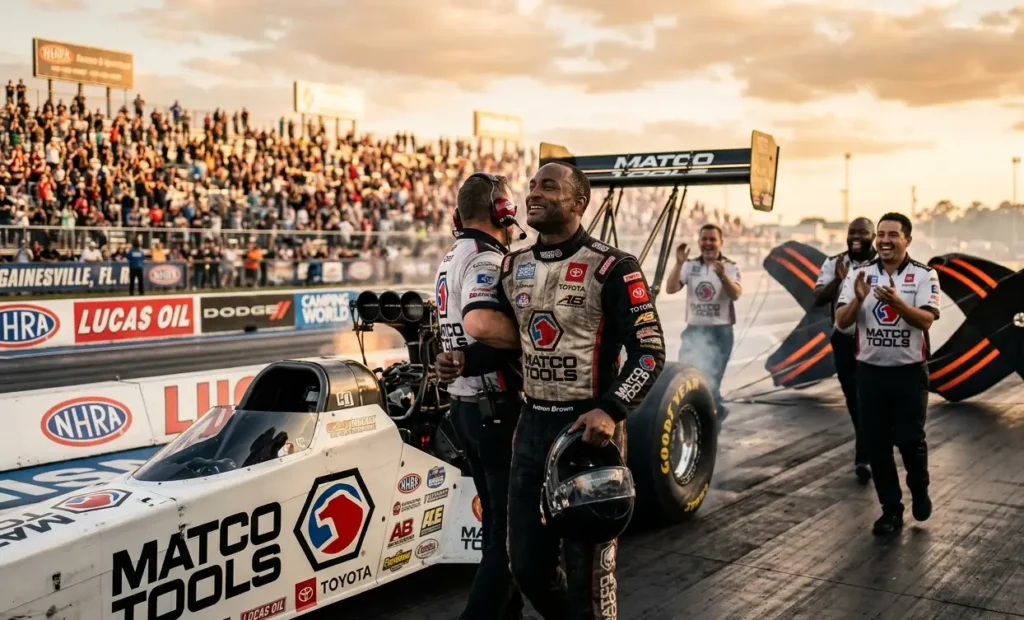
NHRA Top Fuel dragsters are undeniably the fastest accelerating vehicles on Earth. The sheer violence of their launch creates a seismic event you can feel deep in your chest. When the green light flashes, these machines go from 0 to 100 mph in less than a single second.
By the time they cross the finish line, they are traveling well over 330 mph. For new fans and motorsport veterans alike, the most common question is: how far do NHRA Top Fuel cars race?
In this comprehensive guide, we will break down the exact distances, mind-bending speeds, and raw horsepower that define the sport. You will learn the history of the track length and the engineering behind these 11,000-horsepower monsters.
How Far Do NHRA Top Fuel Cars Race? (Direct Answer Section)
Top Fuel dragsters race exactly 1000 feet (304.8 meters) in modern NHRA competition. While drag racing traditionally used a 1/4 mile (1320 feet) standard, the NHRA shortened Top Fuel and Funny Car races to 1000 feet in 2008.
This change was implemented specifically for driver safety after several high-speed incidents. Today, the NHRA 1000 feet distance is the absolute standard for the nitro-burning professional classes.
Fans watching an NHRA 1000 ft finish still witness the same incredible side-by-side action. The 1000 ft NHRA drag strip allows drivers ample room to deploy their parachutes safely.
Why Is NHRA Racing 1000 Feet Instead of 1/4 Mile?
The shift to NHRA drag strips 1000 feet long was born out of absolute necessity. In 2008, the drag racing community suffered a tragic loss when driver Scott Kalitta passed away. His fatal crash occurred during a high-speed qualifying run in New Jersey.
Kalitta’s engine exploded near the finish line, causing catastrophic damage to his parachutes. Traveling at over 300 mph, his car failed to stop within the designated shutdown area. Following this tragedy, the NHRA immediately evaluated track safety protocols.
They concluded that modern Top Fuel dragsters had simply outgrown traditional drag strips. By shortening the race distance to 1000 feet, the NHRA dramatically increased the shutdown area. This extra real estate provides a much better braking margin for cars traveling at 330+ mph.
Top Fuel Dragster Track Length (Then vs Now)
Understanding the top fuel dragster track length requires a brief look into motorsports history. The distance has evolved specifically to keep drivers safe while maintaining the ultimate speed spectacle.
Traditional Distance
For decades, the standard measurement for all drag racing was exactly 1/4 mile. This equals 1320 feet, a distance deeply rooted in American car culture. During this era, drivers routinely pushed the limits of early mechanical engineering.
The 1/4 mile distance tested both the raw power of the engine and its durability. If a motor was going to violently explode, it usually happened in the final 300 feet.
Modern Distance
Today, the modern NHRA standard for nitro classes is strictly 1000 feet. If you ask how far do NHRA top fuel cars race 2021 or today, the answer remains 1000 feet. This distance applies exclusively to the Top Fuel and Funny Car divisions.
Other lower-tier classes and amateur events still utilize the traditional 1/4 mile. The shorter track for nitro cars ensures engines are under extreme stress for a slightly shorter duration.
How Fast Does a Top Fuel Dragster Go in 1000 Feet?
When you ask how fast does a Top Fuel dragster go in 1000 feet, the numbers are staggering. A perfectly tuned dragster will cross the finish line traveling between 330 and 338 mph.
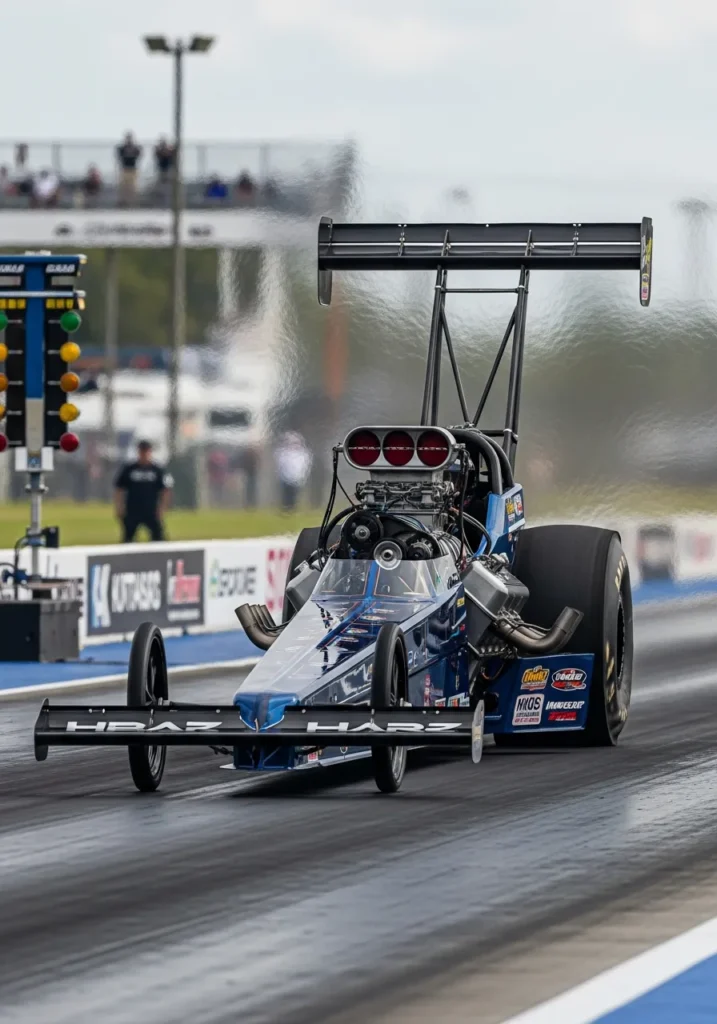
During a conversation with veteran track marshals in Pomona, they emphasized that the acceleration never actually tapers off. The cars are still violently pulling forward as they trigger the timing lights. Drivers experience an incredible acceleration force of up to 5 Gs during the run.
Incredibly, they cover the entire 1000-foot distance in just 3.6 to 3.8 seconds. At these immense speeds, aerodynamic downforce is the only thing keeping the tires attached to the track surface.
Top Fuel Dragster Acceleration (0–60, 0–100 Explained)
The launch sequence of a nitro dragster defies traditional automotive physics. The top fuel dragster 0-60 time is estimated at an unbelievable 0.8 seconds. However, this metric is almost impossible to measure perfectly due to extreme tire slippage.
How long does it take a Top Fuel dragster to get to 100 mph? It takes less than one second, usually clocking in around 0.8 to 1.0 seconds. The massive rear tires physically expand and stretch to grip the prepared concrete.
To put this into perspective, these cars accelerate faster than modern fighter jets launching from an aircraft carrier. By the time you blink your eyes, the dragster is already past the 100 mph mark.
Top Fuel Dragster Horsepower (HP Breakdown)
The secret to this earth-shattering acceleration is the top fuel dragster hp output. These incredible machines generate approximately 11,000 horsepower. They are powered by massive, custom-built supercharged V8 engines.
These engines do not use traditional gasoline; they run on a highly volatile mixture of nitromethane. For context, a modern Formula 1 car produces roughly 1000 horsepower. A high-end street-legal supercar generates around 700 to 800 horsepower.
A single Top Fuel engine produces more power than the first four rows of the Daytona 500 combined. The sheer force generated inside the engine block routinely bends solid steel components.
Top Fuel Dragster Distance Chart (Speed vs Distance)
To truly visualize this performance, we must look at speed relative to track position. This top fuel dragster distance chart highlights the brutal acceleration curve during a standard run.
| Distance | Speed |
| 60 ft | ~100 mph |
| 330 ft | ~260 mph |
| 660 ft | ~300 mph |
| 1000 ft | 330+ mph |
As the chart shows, the car gains almost 160 mph in just 270 feet of track. This massive mid-track acceleration is what presses the drivers firmly against their custom-molded seats.
Top Fuel Dragster 1/4 Mile Time (Historical Context)
Before the safety changes in 2008, the top fuel dragster 1/4 mile time was the ultimate benchmark. In the late 2000s, drivers were consistently running the 1320-foot distance in about 4.4 seconds. They were crossing the finish line at speeds approaching 340 mph.
Engineers realized that tires and safety barriers could no longer handle those terminal velocities. The 1/4 mile is no longer used for nitro classes specifically because the final 320 feet is incredibly dangerous.
Today, a 1000 ft pass takes around 3.7 seconds. If a modern dragster were allowed to run a full 1/4 mile today, experts estimate the time would drop to 4.2 seconds at over 350 mph.
How Long Is a Top Fuel Dragster?
When you see these vehicles in the staging lanes, their sheer size is surprising. How long is a Top Fuel Dragster exactly? A standard car measures roughly 25 feet from the front wing to the rear wing.
The chassis features an ultra-long wheelbase of exactly 300 inches. This extended length provides crucial straight-line stability at 300 mph.
Despite their massive length, these vehicles only weigh around 2,300 pounds including the driver. The chassis is constructed entirely from lightweight aerospace-grade chromoly steel tubing.
Funny Car vs Top Fuel (Key Differences)
While they race at the same events, Top Fuel dragsters and Funny Cars are distinctly different machines. Both utilize the exact same 11,000-horsepower nitromethane engines. However, their chassis design and aerodynamic properties change how they perform.
| Feature | Top Fuel | Funny Car |
| Body | Open wheel, long rail | Closed carbon-fiber replica body |
| Speed | Slightly Faster (338 mph) | Slightly Slower (335 mph) |
| Handling | Stable, straight-line focused | Short wheelbase, very unpredictable |
Because Funny Cars have a shorter wheelbase, they are notoriously difficult to drive. Drivers constantly wrestle the steering wheel to keep the car centered in the groove.
NHRA Classes Explained
The National Hot Rod Association features several distinct tiers of professional racing. The NHRA classes cater to different engine types, vehicle bodies, and fuel mixtures.
Top Fuel is the undisputed king, featuring the long rail dragsters. Next is Funny Car, which features tilting carbon-fiber bodies resembling production street cars.
Pro Stock operates completely differently, using highly modified gasoline engines without superchargers. Finally, Pro Stock Motorcycle brings two-wheeled racing to the national stage at speeds exceeding 200 mph.
NHRA Drag Racing Qualification & Rounds
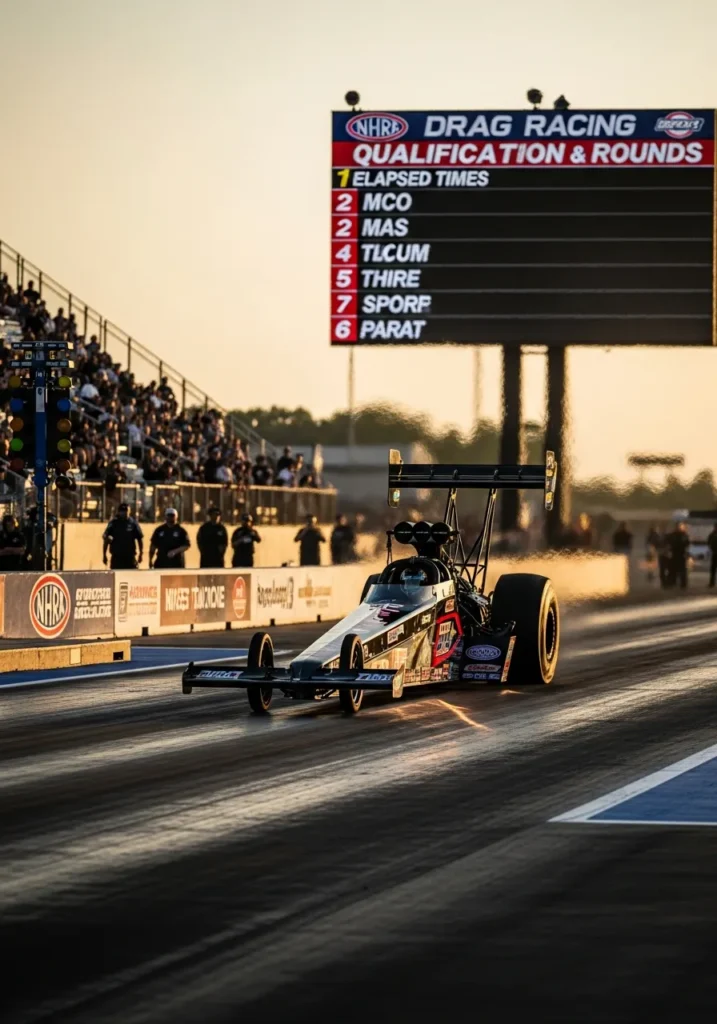
A professional race weekend is broken down into structured competitive phases. The NHRA drag racing qualification process typically spans Friday and Saturday. Drivers make up to four separate runs to clock their absolute fastest elapsed time.
The fastest 16 cars from the qualifying sessions advance to Sunday’s main event. During the NHRA qualifying rounds, consistency is just as important as raw speed.
On Sunday, drivers compete in a strict elimination bracket. It takes exactly four successful rounds of racing to win the overall event championship.
What Fuel Do Top Fuel Dragsters Use?
The secret sauce behind the sport’s massive power output is the racing fuel. Top Fuel dragsters run on a specialized mixture containing 90% nitromethane and 10% methanol.
Nitromethane carries its own oxygen molecule, allowing the engine to burn massive amounts of fuel instantly. The fuel pump on a Top Fuel car flows at roughly 100 gallons per minute.
At wide-open throttle, the engine essentially hydro-locks, forcing the explosive liquid through the cylinders. This creates the signature eye-watering, throat-burning exhaust fumes famous at NHRA events.
Why Was Dodge Banned from NHRA? (Clarification Section)
There is a long-standing automotive myth surrounding specific manufacturers being kicked out of the sport. Why was Dodge banned from NHRA? The truth is, Dodge was never permanently banned from the entire organization.
In the 1970s, the legendary 426 HEMI engine was so incredibly dominant that the NHRA heavily adjusted the rulebook. They imposed strict weight penalties and aerodynamic restrictions to maintain competitive balance, especially as fans and competitors closely followed performance benchmarks like How Far Do NHRA Top Fuel Cars Race? to better understand the sport’s evolving standards.
More recently, participation changes are usually due to manufacturer funding decisions, not outright bans. Dodge remains deeply ingrained in the sport’s history and various sportsman classes today, with enthusiasts still asking key questions such as How Far Do NHRA Top Fuel Cars Race? as they engage with the sport’s technical and competitive aspects.
Who Was the NHRA Driver Killed by Tire Shake?
Drag racing carries inherent risks, and high-speed vibrations are incredibly dangerous. When a massive slick tire loses traction and aggressively hops, it causes violent tire shake.
Who was the NHRA driver killed by tire shake? In 2007, beloved Funny Car driver Eric Medlen died following a horrific crash during a testing session. The severe tire shake caused severe head trauma and rendered him unconscious before the vehicle impacted the retaining wall.
His tragic death completely revolutionized driver safety. The incident led directly to padded roll cages and advanced head-and-neck restraint systems.
NHRA Schedule & Events Overview
The professional drag racing circuit operates a grueling, cross-country tour. The annual NHRA schedule typically kicks off in early spring and concludes in late autumn.
The tour visits legendary tracks like Gainesville, Indianapolis, and Pomona. Events run year-round, requiring massive logistical coordination from the racing teams.
Each weekend draws tens of thousands of fans who camp trackside for the four-day speed festivals. The season culminates in a dramatic playoff system known as the Countdown to the Championship.
What Is NHRA Drag Racing? (Beginner Section)
For absolute newcomers, NHRA drag racing is the ultimate test of acceleration. Two high-powered vehicles line up side-by-side at a starting line known as the “Christmas Tree.”
The goal is simple: accelerate in a perfectly straight line and cross the finish line first. The winner is determined by a combination of the driver’s reaction time and the car’s elapsed time.
Every single NHRA drag racing car requires a perfectly prepared track surface sprayed with custom traction compound. Without this sticky resin, the cars would simply spin their tires endlessly.
Why Top Fuel Dragsters Have the Worst MPG Ever
While modern commuters search for the highest mpg cars, dragsters represent the exact opposite of efficiency. A Top Fuel car gets roughly 0.1 miles per gallon.
The fuel consumption is so extreme that a car burns over 15 gallons of nitromethane during a single warmup and pass. The fuel lines look like massive garden hoses designed strictly for maximum flow.
If you compare this to the highest mpg cars on the highway achieving 60+ mpg, the contrast is hilarious. However, efficiency is totally irrelevant when the sole goal is covering 1000 feet in 3.6 seconds.
Safety Innovations in NHRA
Driving a bomb on wheels requires state-of-the-art safety engineering. Modern chassis are constructed with specific crumple zones designed to absorb wall impacts.
Dual parachutes deploy automatically if the engine violently backfires or the driver lifts off the throttle. Furthermore, massive fire suppression systems bathe the driver in specialized foam during an emergency.
Drivers wear custom-fitted, multi-layer fire suits and carbon fiber helmets. These innovations ensure that drivers routinely walk away from horrific 300 mph collisions.
Frequently Asked Questions
How far do NHRA Top Fuel cars race?
Top Fuel dragsters race exactly 1000 feet (304.8 meters) in modern NHRA competition. This distance ensures drivers have enough track remaining to deploy parachutes and stop safely.
How fast is a Top Fuel dragster?
A perfectly tuned Top Fuel dragster will cross the 1000-foot finish line at speeds exceeding 330 mph. The current official national speed record sits just over 338 mph.
What is the acceleration of a Top Fuel dragster?
These machines accelerate from 0 to 100 mph in under 1 second. The launch generates up to 5 Gs of force on the driver’s body.
Why is the race only 1000 feet?
The NHRA shortened the distance from a 1/4 mile to 1000 feet in 2008 strictly for safety reasons. It provides a much longer, safer shutdown area to slow the cars from 330 mph.
How much horsepower does a dragster have?
A modern Top Fuel dragster generates roughly 11,000 horsepower. They utilize supercharged, nitromethane-fueled V8 engines to achieve this incredible power output.
Checkered Flag Conclusion
Understanding how far do NHRA Top Fuel cars race gives you a true appreciation for the sport. The modern 1000-foot distance is the perfect balance between mind-boggling speed and necessary driver safety.
These 11,000-horsepower machines continue to push the absolute boundaries of mechanical engineering and human reaction times. Traveling at 330+ mph in under four seconds is an engineering marvel that must be seen to be believed. Want to see one live? Check the latest NHRA schedule and experience the ground-pounding power for yourself.
Evidence-Based References:
- Autoweek: Why an NHRA Drag Strip is 1,000 Feet
- Jalopnik: Why Drag Races Were Always A Quarter Mile (And When That Changed)
- Hagerty: What It’s Like to Race an NHRA Funny Car
- The Drive: Watch Courtney Force Walk Away After Her Funny Car Blows Up
- Motor1: This Is How You Drive A Nitro Funny Car At 330 MPH