The roar of nitromethane-burning engines is often described as a sensory assault, but for Tony Stewart, a Sunday afternoon at Maple Grove Raceway in September 2025 brought a silence he never expected. The Tony Stewart NHRA crash became an instant flashpoint in motorsports history, marking the most significant accident of the NASCAR legend’s drag racing career.
As Stewart transitioned from the heavy stock cars of NASCAR to the 11,000-horsepower “land-locked missiles” known as Top Fuel dragsters, fans understood the risks were high. However, few expected the violent collision he later experienced with fellow champion Doug Kalitta.
This incident, which took place during the 40th annual NHRA Reading Nationals, drew global attention not just because of Stewart’s celebrity status, but because of the sheer physics involved in a 330 mph collision.
Despite the severity of the wreck, which saw Stewart’s car flip on its side and slide hundreds of feet, the survival of both drivers stood as a testament to modern NHRA safety systems. Today, we break down every aspect of the accident, the technical failures involved, and the aftermath of the crash that shook the NHRA Countdown to the Championship.
What Happened in the Tony Stewart NHRA Crash?
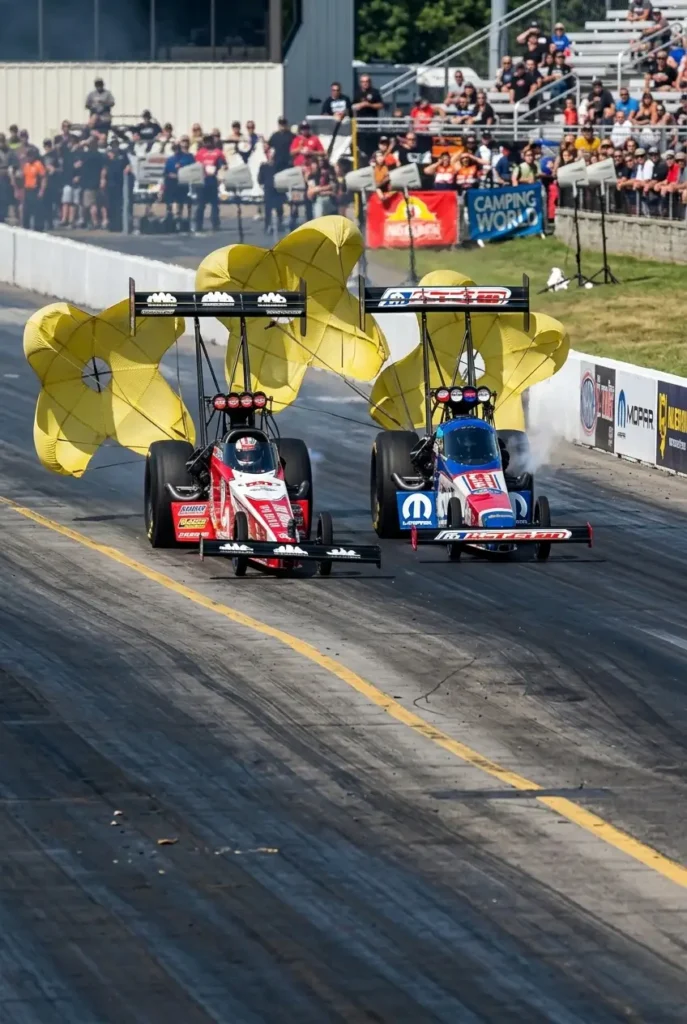
The Tony Stewart NHRA accident occurred during the second round of eliminations on September 14, 2025. Stewart, driving the Direct Connection/Dodge Top Fuel dragster, was paired against veteran Doug Kalitta.
The run began as a clean, high-speed battle. Kalitta took the win light with a blistering 3.787-second pass at 335.73 mph, while Stewart followed closely with a 3.82-second run at 326.71 mph.
However, the disaster began just as the parachutes were deployed. According to telemetry and visual replays, the front-left wheel of Kalitta’s Mac Tools dragster collapsed. This mechanical failure caused Kalitta’s car to veer sharply across the center line, crossing into Stewart’s lane.
At speeds exceeding 325 mph, there was no time for evasive maneuvers. Kalitta’s car side-slammed Stewart’s machine, the force of which flipped Stewart’s dragster onto its left side.
Stewart’s car slid on its side for a significant distance before striking the left-side concrete guard wall. The impact with the wall eventually righted the car back onto all four wheels, where it ground to a halt amidst a cloud of dust and debris. The NHRA Safety Safari—regarded as the best emergency response team in motorsports—arrived at the scene within seconds.
Tony Stewart vs. Doug Kalitta: The Run Before the Crash
To understand the Tony Stewart Doug Kalitta crash, one must look at the competitive stakes. This wasn’t just a random qualifying lap; it was the opening race of the NHRA Countdown to the Championship, the six-race playoff system that determines the world champion. Stewart entered the weekend as the points leader, a remarkable feat for a driver in only his second full year of Top Fuel competition.
The track at Maple Grove Raceway, often called “The House of Chaos,” was providing record-setting “mineshaft” air conditions (low density altitude), which allowed the engines to produce maximum horsepower. Both teams were “leaning on” their equipment to gain every possible advantage.
- Stewart’s Speed: 326.71 mph
- Kalitta’s Speed: 335.73 mph
- Impact Delta: The relative speed between the two cars was minimal, but the lateral force of the collision at those velocities was catastrophic for the aerodynamic stability of the long-wheelbase dragsters.
The collision was particularly “ugly” because it was a side-to-side impact. Top Fuel dragsters are designed to handle incredible longitudinal (front-to-back) forces, but lateral impacts can easily compromise the narrow, spindly chassis.
Tony Stewart Crash Video, Replay & FOX Sports Coverage
The Tony Stewart crash video immediately went viral, largely due to the shocking footage captured by the high-speed cameras used in FOX Sports NHRA coverage. The replay showed the exact moment Kalitta’s front suspension failed, sending his car into a slide.
Fans watching the live broadcast saw a terrifying sequence:
- The Collapse: Kalitta’s front-left wheel disappears under the chassis.
- The Cross: The Mac Tools car darts left like a magnet.
- The Impact: A massive shower of sparks as the two cars collide.
- The Slide: Stewart’s car on its side, the carbon-fiber body panels disintegrating against the asphalt.
FOX Sports analyst and former Funny Car champion Tony Pedregon noted that Stewart was a “passenger” the moment the cars touched. The replay analysis highlighted that if the crash had happened 100 feet earlier—before the parachutes had begun to slow the cars—the outcome could have been significantly worse. The drag of the parachutes actually helped stabilize the cars’ trajectories after the initial hit.
Did Tony Stewart Suffer Injuries?
Perhaps the most harrowing detail of the Tony Stewart NHRA wreck was Stewart’s initial condition inside the cockpit. While Doug Kalitta exited his car almost immediately, Stewart remained inside for several minutes. When he finally emerged with the help of the Safety Safari, he appeared dazed and was moving slowly.
In post-race interviews and a later appearance on the Dale Jr. Download, Stewart admitted to a terrifying reality: he had no memory of the crash.
“I don’t have a damn clue, honestly. I don’t remember any of it,” Stewart told reporters. “The first thing I remember, they were waking me up [in the car].”
Despite being momentarily knocked unconscious, Stewart’s medical evaluation revealed he had escaped serious harm. His injuries included:
- A Concussion: Stewart reported a “massive headache” that lasted for several hours.
- Hand Injury: His left hand was “banged up” from the steering wheel’s violent movement during the impact.
- General Soreness: Stewart described feeling like a “telephone pole,” with his entire body feeling stiff and sore from the G-forces of the flip.
Dr. Phil Surface, the NHRA Chief Medical Officer, cleared Stewart to return to competition the following weekend, noting that the driver’s safety equipment had functioned perfectly to prevent a life-threatening injury.
Understanding Top Fuel Drag Racing Speeds
To grasp why a Tony Stewart massive NHRA crash is so significant, one must understand the physics of Top Fuel racing. These machines are the most extreme vehicles in the world.
A Top Fuel dragster is powered by a 500-cubic-inch V8 engine that produces approximately 11,000 to 12,000 horsepower. This is more power than the first eight rows of a NASCAR starting grid combined.
The acceleration is staggering. A Top Fuel car reaches 100 mph in approximately 0.8 seconds. By the time you finish reading this sentence, the car is already traveling at over 300 mph. The G-forces experienced by the driver during a normal run are around under acceleration and negative when the parachutes deploy.
When a crash occurs at these speeds, the kinetic energy is immense. Using the formula:
The kinetic energy at the time of Stewart’s impact was roughly 11.5 million Joules. For comparison, that is equivalent to being hit by a mid-sized car traveling at nearly 180 mph.
How NHRA Safety Systems Work
The fact that Stewart walked away from an 11.5 million Joule impact is not a miracle—it is engineering. NHRA crash safety technology has evolved through decades of trial and error. Several key systems saved Stewart’s life:
- The Roll Cage (Chassis): Stewart’s car was built by Precision Built Race Cars (PBRC). The chassis is constructed from chromoly steel tubing. When the car flipped on its side, the roll cage maintained the “survival cell” around Stewart, preventing the engine or the ground from crushing him.
- The Carbon-Fiber Seat: Drivers sit in custom-molded carbon-fiber seats that absorb energy. Unlike a standard car seat, these are rigid and designed to keep the driver’s spine perfectly aligned.
- The HANS Device: The Head and Neck Support (HANS) device prevented Stewart’s head from snapping forward or sideways during the collision, which is the primary cause of basilar skull fractures.
- Seven-Point Harness: Stewart was strapped in so tightly that he and the seat essentially became one unit. This prevented him from being tossed around inside the cockpit as the car tumbled.
- SAFER Barriers: While Stewart hit the wall, the “Steel and Foam Energy Reduction” (SAFER) barriers at Maple Grove Raceway absorbed a significant portion of the impact energy, rather than reflecting it back into the car.
Why NHRA Crashes Happen at Extreme Speeds
Even with the best drivers, the NHRA Top Fuel accident rate is never zero. The environment of a drag strip is inherently unstable. Several factors can cause a “massive” crash:
- Tire Shake: If the tires lose and regain traction rapidly, it can vibrate the car so violently that it breaks the chassis or knocks the driver unconscious.
- Engine Explosions: A “boomed” engine can blow the rear wing off or coat the rear tires in oil, causing an immediate loss of control.
- Aerodynamic Instability: At 330 mph, the front wings are the only things keeping the nose on the ground. If the nose lifts even an inch, air gets under the car and can flip it (a “blowover”).
- Mechanical Failure: In the case of the Stewart-Kalitta incident, it was a suspension failure. When a wheel collapses at 300 mph, the aerodynamic drag on that side of the car creates an immediate “hook” that pulls the car across the track.
Tony Stewart’s Transition From NASCAR Legend to NHRA Driver
The Tony Stewart NHRA news cycle has focused on his career pivot, as he became a three-time NASCAR Cup Series champion, an IndyCar champion, and an SRX champion. However, he made his move to NHRA Top Fuel in 2024, which many people saw as his boldest decision yet.
He took over the seat of the TSR (Tony Stewart Racing) dragster from his wife, Leah Pruett, who stepped away to start a family. Stewart’s adaptation was rapid. Despite the vastly different driving styles—NASCAR requires endurance and cornering, while NHRA requires millisecond reaction times and high-speed “pedaling”—Stewart found success almost immediately.
Some skeptics questioned his NHRA debut, but he proved his “race craft” transfers across disciplines when he led the points standings during the 2025 season. At Maple Grove, he experienced a “welcome to the club” moment that many veteran drag racers already know well.
Tony Stewart NHRA Results & 2025/2026 Season Recap
The crash at Maple Grove had a significant impact on the NHRA points standings. Stewart entered the race in 1st place but left in 2nd, trailing Doug Kalitta by 18 points.
Summary of Stewart’s 2025/2026 Campaign:
- Wins: 2 (Gatornationals, Four-Wide Nationals)
- Final Rounds: 5
- Qualifying: Consistently in the Top 5
- Championship Finish: Stewart ultimately finished 3rd in the 2025 standings, a remarkable “rookie” performance in the Top Fuel class.
Heading into the 2026 NHRA season, Stewart has announced this will be his final year in the cockpit before Leah Pruett returns to the seat. This “farewell tour” has seen Stewart focused more than ever on safety and consistency, often referencing the Maple Grove crash as the moment that gave him a new perspective on the dangers of nitro racing.
Latest NHRA News, TV Schedule & Live Updates
To stay updated on NHRA news today and follow Stewart’s final season, fans should keep a close eye on the NHRA TV schedule this weekend. Most events are broadcast on FS1 or FOX, with live streaming available via NHRA.tv.
The NHRA live updates during the “Countdown to the Championship” are particularly crucial, as the points are reset, making every round win worth roughly 20 points. As Stewart prepares for the 2026 playoffs, the memory of the 2025 crash serves as a reminder that in drag racing, the winner isn’t just the fastest—it’s the one who makes it to the finish line safely.
FAQ Section
What happened in the Tony Stewart NHRA crash?
Tony Stewart and Doug Kalitta collided at over 325 mph after Kalitta’s front-left wheel collapsed, causing his car to cross the center line and side-swipe Stewart’s dragster.
How fast was Tony Stewart going?
At the time of the collision, Stewart was traveling at approximately 326.71 mph, while Kalitta was moving at 335.73 mph.
Was Tony Stewart injured in the crash?
Stewart suffered a concussion, a “banged up” left hand, and significant muscle soreness. He was briefly knocked unconscious and had no memory of the actual impact.
Where did the Tony Stewart crash happen?
The crash occurred at Maple Grove Raceway in Reading, Pennsylvania, during the 2025 NHRA Reading Nationals.
Did Tony Stewart flip during the NHRA crash?
Yes, Stewart’s dragster landed on its left side, slid for over 100 feet, hit the wall, and then rolled back onto its wheels.
What are the fastest NHRA crashes ever recorded?
While Stewart’s crash was among the fastest collisions, speeds in Top Fuel often exceed 330 mph. Crashes at these speeds are rare but are usually the result of mechanical failure or aerodynamic “blowovers.”
Conclusion
The Tony Stewart NHRA crash was a terrifying reminder of the thin line between victory and disaster in the world’s fastest sport. While the 335 mph collision at Maple Grove Raceway could have ended in tragedy, the triumph of engineering and safety protocols allowed a racing legend to return to the cockpit just days later. Stewart’s resilience, combined with the professionalism of the NHRA Safety Safari, continues to inspire fans. As Stewart wraps up his Top Fuel career in 2026, the Reading Nationals incident will remain a defining chapter in the legacy of a driver who has truly done it all.
Authoritative References
- NHRA Official News: Stewart and Kalitta Released After Reading Collision
- Autoweek: Tony Stewart, Doug Kalitta Collide at 325-Plus MPH
- Motorsport.com: Tony Stewart Walks Away From Scary NHRA Crash
- Competition Plus: Stewart Bears Brunt of Rare Top Fuel Collision
- The SportsRush: Tony Stewart Gives Candid Update After Massive NHRA Crash