
Formula 1 weekends are a whirlwind of speed, How Does F1 Qualifying Work?, but nothing matches the raw intensity of Saturday afternoon. While the race decides the champion, qualifying sets the stage for victory or defeat. If you are a new fan, the terminology can feel like a completely foreign language. You hear commentators frantically shouting about Q1 drop zones, parc fermé, and flying laps.
So, how does F1 qualifying work exactly? In short, it puts both the driver and the machine through the ultimate test against the clock. After recently speaking with a trackside engineer at the 2026 Miami Grand Prix, I learned firsthand that the new active aerodynamics and battery boost regulations make it harder than ever to deliver a perfect lap.
In this comprehensive guide, we will break down exactly how F1 qualifying works in 2026, from the standard knockout sessions to the complex sprint weekends.
What Is F1 Qualifying?
At its core, F1 qualifying is the dedicated session that sets the starting grid for Sunday’s main race. Unlike other sports where officials may draw starting positions at random, Formula 1 determines grid purely on merit and speed. Drivers push circuit at absolute maximum capacity, pushing track limits as they aim to set fastest possible single-lap time.
Understanding what happens in F1 qualifying is essential because track position is often king. For those wanting Formula 1 qualifying explained simply: the fastest driver starts first (pole position), and the slowest starts last.
How Does F1 Qualifying Work?
If you are asking how F1 qualifying works, the process revolves around a thrilling knockout format. All cars begin the session, but only the fastest survive to the very end.
F1 qualifying works through three knockout sessions—Q1, Q2, and Q3—where drivers set their fastest lap times.In Q1 and Q2, Formula 1 eliminates the slowest five drivers in each session, while Q3 features the top 10 drivers battling for pole position.
Drivers do not race each other side-by-side during this time. Instead, they are racing the stopwatch. When people ask how does qualifying work in F1, it is crucial to note that the goal is the single fastest lap, not the most laps completed. If you are wondering how F1 qualifying work regarding tyres, drivers use the softest, grippiest compounds available to maximise speed.
How Many Laps Do You Get in F1 Qualifying?
New fans often ask how many laps drivers can complete in F1 qualifying. The answer may surprise you— the FIA does not impose any fixed lap limit. Instead, teams must manage their running based on the session timer, tyre degradation, and fuel loads. If you ask how many laps you get in qualifying for F1 practically, a driver usually completes 1 to 3 “flying laps” per session.
A flying lap is preceded by an “out lap” (warming up the tyres) and followed by an “in lap” (returning to the pits to cool down).
F1 Qualifying Rules Explained
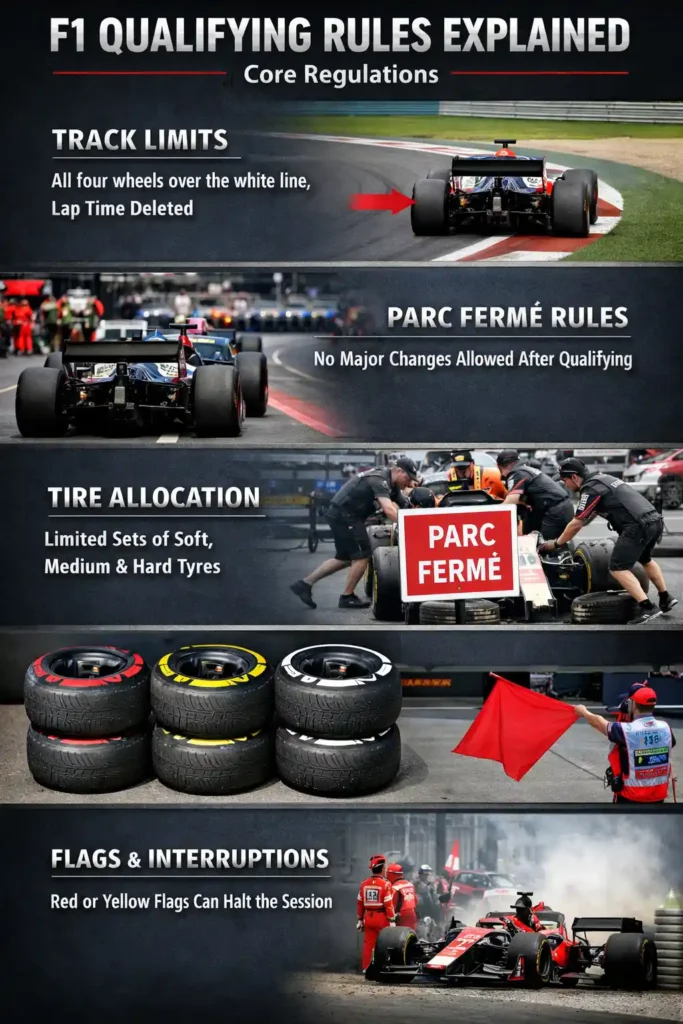
The format is straightforward, but the Formula 1 qualifying rules contain critical nuances that can strip a driver of their pole position. F1 qualifying rules explained properly must include track limits. If all four wheels cross the solid white line, the lap time is instantly deleted.
Another major rule is “parc fermé” (closed park). Once a car leaves the pit lane in qualifying, teams cannot make major mechanical changes to the car before the race. Tire usage is also strictly regulated. Drivers are given a specific allocation of soft, medium, and hard tyres for the entire weekend.
Finally, yellow or red flags heavily impact the session. If a driver crashes and causes a red flag, the session is halted, often ruining other drivers’ flying laps.
What Is the Elimination Zone in F1 Qualifying?
During the broadcast, commentators constantly talk about the “drop zone”. What is an elimination zone in F1 qualifying? It refers to the bottom five positions on the timing tower during Q1 and Q2.
Because this is a knockout system, anyone sitting in the elimination zone when the timer hits zero is out of the session. Drivers will often frantically ask their engineers via team radio if they are safe from the elimination zone.
How Does F1 Qualifying Work in 2026?
With the arrival of the new regulation era, fans want to know how F1 qualifying works in 2026 compared to previous years. The fundamental Q1, Q2, and Q3 knockout structure remains exactly the same. However, how does qualifying works in F1 2026 from a technical standpoint has changed dramatically due to the new engine and aerodynamic rules.
The 2026 power units feature a 50-50 split between electrical and internal combustion power. During my conversations with paddock insiders, they highlighted that managing the battery “boost” button is now the hardest part of a qualifying lap.
Furthermore, active aero devices now close on straights to reduce drag, meaning drivers must execute perfect “lift and coast” regeneration strategies even while trying to set the fastest time.
How Has F1 Qualifying Changed Over Time? (2020–2025)
To understand the current format, it helps to see the evolution of the sport. If you look back at how F1 qualifying work 2020 or how does f1 qualifying work 2021, a major difference was the “Q2 tire rule.” Back then, drivers who reached Q3 had to start the Sunday race on the exact set of tyres they used to set their fastest Q2 time.
When asking how F1 qualifying work 2022 and how does f1 qualifying work 2023, we see the complete removal of this tyre rule, allowing free tyre choice on Sunday. By the time we compare how F1 qualifying works in 2024 and 2025, Formula 1 will refine and standardize the Sprint Shootout format.
The core knockout DNA has survived, but the FIA constantly tweaks tyre allocations and sprint integrations.
How Does F1 Sprint Qualifying Work?
Six times a year, the standard weekend schedule is disrupted. Fans frequently ask how F1 sprint qualifying works and what changes during these special events. Sprint weekends feature a separate, shorter race on Saturday, requiring an entirely different qualifying approach.
Sprint Weekend Format
If you wonder how F1 sprint weekend qualifying works, the schedule changes a lot. Formula 1 runs Q1, Q2, and Q3 on Friday afternoon to set Sunday’s Grand Prix grid, then holds sprint qualifying and a 100 km sprint race on Saturday.
Sprint Shootout Format (Newer System)
To answer how sprint qualifying works in F1, we look at the Sprint Shootout (often referred to as SQ1, SQ2, and SQ3). This is a condensed version of standard qualifying, with shorter sessions (12, 10, and 8 minutes). To make how F1 qualifying works with sprint events fair, the FIA mandates specific tyre compounds.
For example, teams might be forced to use medium tyres in SQ1 and SQ2, saving the soft tyres exclusively for SQ3.
How Does F1 Qualifying Work With 22 Drivers?
In 2026, the Formula 1 grid expanded to 11 teams with the highly anticipated entry of Cadillac. This leads to the question: how does F1 qualifying work with 22 drivers instead of the traditional 20? The knockout system easily scales to accommodate the extra cars.
Instead of eliminating the bottom five in Q1 and Q2, the session adjusts to drop the bottom six, or the sessions are lengthened slightly to manage traffic. The biggest impact of 22 drivers is traffic. Finding a clean piece of track without encountering a slower car has become a massive strategic headache for engineers.
How Important Are F1 Qualifying Results?
You might wonder how important F1 qualifying results are if the main race is hundreds of kilometres long. The reality is that qualifying is arguably the most critical session of the weekend. On tight street circuits like Monaco or Singapore, overtaking is incredibly difficult, making track position paramount.
Statistically, a massive percentage of race winners start from pole position or the front row. Starting further back increases the risk that a driver gets caught in midfield crashes and has to deal with turbulent “dirty air” from cars ahead.
How Does Qualifying Work in F2 and F1 Academy?
Formula 1 sits at the pinnacle of motorsport, but a structured ladder of feeder series supports it. It becomes fascinating to compare the premier class with junior categories to see how teams develop talent.
F2 Qualifying
If you want to know how qualifying works IN F2, it is much simpler than F1. Formula 2 utilises a single 30-minute session rather than a knockout format. The fastest driver takes pole for Sunday’s Feature Race, but interestingly, Formula 1 reverses the top 10 to set the grid for Saturday’s Sprint Race.
F1 Academy Qualifying
For those asking how F1 Academy qualifying works, this all-female development series relies on a pure time-based system. Drivers get one or two qualifying sessions to set their fastest laps. A driver’s absolute fastest lap sets the grid for Race 1, while their second-fastest lap determines their starting spot for Race 2.
What Is an F1 Qualifying Race?
Sometimes terminology gets tangled, leading fans to search for how an F1 qualifying race works. In modern Formula 1, there is technically no such thing as a “qualifying race”. When people use this term, they are almost always referring to the Saturday sprint race.
Historically, briefly in 2021, the sprint race actually set the grid for Sunday’s main event, functioning as a true qualifying race. Today, the sprint is a standalone event for championship points, and Friday’s traditional time trials set the Sunday grid.
What Fans Say
To get a true feel for the sport, it helps to look at how F1 qualifying works on Reddit discussions. Fans on community boards frequently highlight that qualifying is often more thrilling than the race itself. Many users point out that the final two minutes of Q3 are pure adrenaline, as the timing screens light up with purple (fastest) and green (personal best) micro-sectors.
Redditors also deeply analyse team radio communications during Q1, noting how stressful it is for drivers trying to escape the drop zone while dealing with heavily congested traffic.
Are Any F1 Drivers LGBTQ?
When looking at the demographics and history of the drivers pushing these cars to the limit, questions about representation often arise, such as Are any F1 drivers LGBTQ?. Yes, there have been LGBTQ drivers in Formula 1, though the number is statistically very small. In the 75-year history of the sport, only four drivers have publicly come out.
These trailblazers are Mike Beuttler, Mário de Araújo Cabral, Lella Lombardi, and most recently, Ralf Schumacher. Ralf Schumacher, a multiple race winner and brother of Michael Schumacher, made global headlines when he came out in June 2024.
The sport continues to launch inclusivity initiatives, with current drivers actively using their platforms to support LGBTQ rights in the paddock and beyond.
Frequently Asked Questions
How exactly does qualifying work in F1?
Formula 1 qualifying uses a knockout system divided into three parts: Q1, Q2, and Q3. Drivers aim to set the fastest single lap time, with the slowest cars being eliminated in the first two sessions until the top 10 fight for pole.
How does qualifying work for F1?
It works by sending all cars out in Q1, eliminating the slowest group, and resetting the times. The remaining drivers advance to Q2, where the process repeats, leaving only the fastest 10 drivers to battle in Q3 for the first starting position.
How does the qualifying work in F1?
The session relies strictly on lap times rather than racing position. Drivers manage tyre grip, battery deployment, and track traffic to ensure they cross the finish line with the lowest possible time on the stopwatch.
How does qualifying in F1 work?
Qualifying works as a trial of pure speed. Under strict Parc Fermé rules, drivers get 18 minutes in Q1, 15 minutes in Q2, and 12 minutes in Q3 to push their cars to the absolute aerodynamic and mechanical limits.
What happens if two drivers set the exact same time?
If two drivers record the exact same lap time down to the thousandth of a second, the driver who set the time first is awarded the higher position on the grid.
Final Thoughts: Why F1 Qualifying Is So Exciting
Understanding how F1 qualifying works transforms a confusing Saturday broadcast into a high-stakes thriller. The knockout format ensures that the pressure never drops. A single lock-up under braking or a poorly timed battery boost can send a world champion to the back of the grid.
With the 2026 regulations introducing complex active aero and electric power management, the skill required to extract a perfect lap has never been higher.

