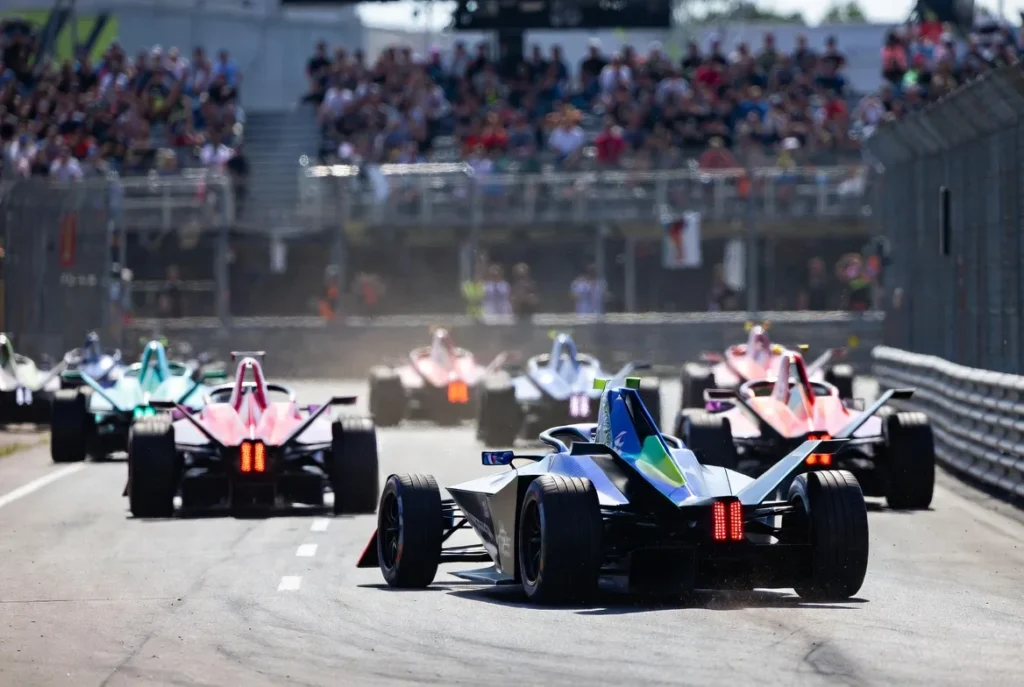
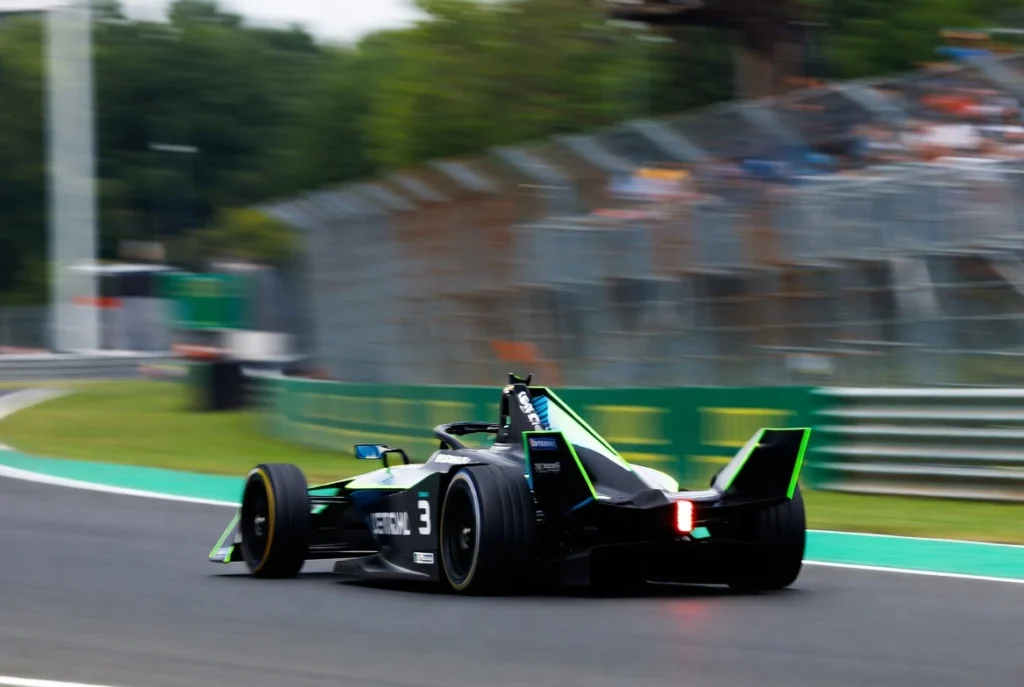
Formula E has revolutionized motorsport by blending high-speed electric innovation with gaming-inspired tactics. One of the most polarizing and exciting features of this series is “Attack Mode.” This system offers a temporary power boost to drivers, forcing them to make difficult strategic choices in real-time.
Unlike traditional racing, where the car’s power remains constant, the ABB FIA Formula E World Championship uses Attack Mode to ensure the “peloton” effect is broken. The Fédération Internationale de l’Automobile (FIA) introduced this rule to increase overtaking and prevent races from becoming stagnant processions.
In Formula E, what is attack mode really? Think of it as a tactical gamble. To gain a massive speed advantage, a driver must first lose time by taking a slower line. This “risk vs. reward” dynamic is what makes electric racing a game of high-speed chess.
While Formula One uses DRS (Drag Reduction System) to aid overtaking, Formula E’s boost system is far more complex. It doesn’t just open a wing; it fundamentally changes the power output of the electric motor. In this guide, we will break down the mechanics, the rules, and the tactical genius behind this unique feature.
What Is Attack Mode in Formula E Racing?
In the context of what is attack mode in formula e racing, the definition is a temporary software-unlocked power increase. During the Gen3 and Gen3 Evo eras, cars typically race at a base power of 300kW. Activating Attack Mode bumps this output to 350kW, providing an immediate edge in acceleration and top speed.
Last month, while standing in the pit lane at the Tokyo E-Prix, I spoke with a lead strategist from Jaguar TCS Racing. He explained that Attack Mode is the primary tool used to “undercut” opponents. Even a few seconds of extra power can be the difference between a podium and a mid-pack finish.
The attack mode meaning is rooted in strategic aggression. It isn’t just a button on the steering wheel that drivers can press whenever they want. Instead, it is a physical location on the track that must be navigated, often at the cost of track position.
This tactical element forces teams to simulate thousands of scenarios before the race starts. They have to decide if they should “attack” early to build a gap or save their boost to defend against a rival in the final laps. It is this layer of depth that separates elite drivers from the rest of the grid.
How Does Attack Mode in Formula E Work?
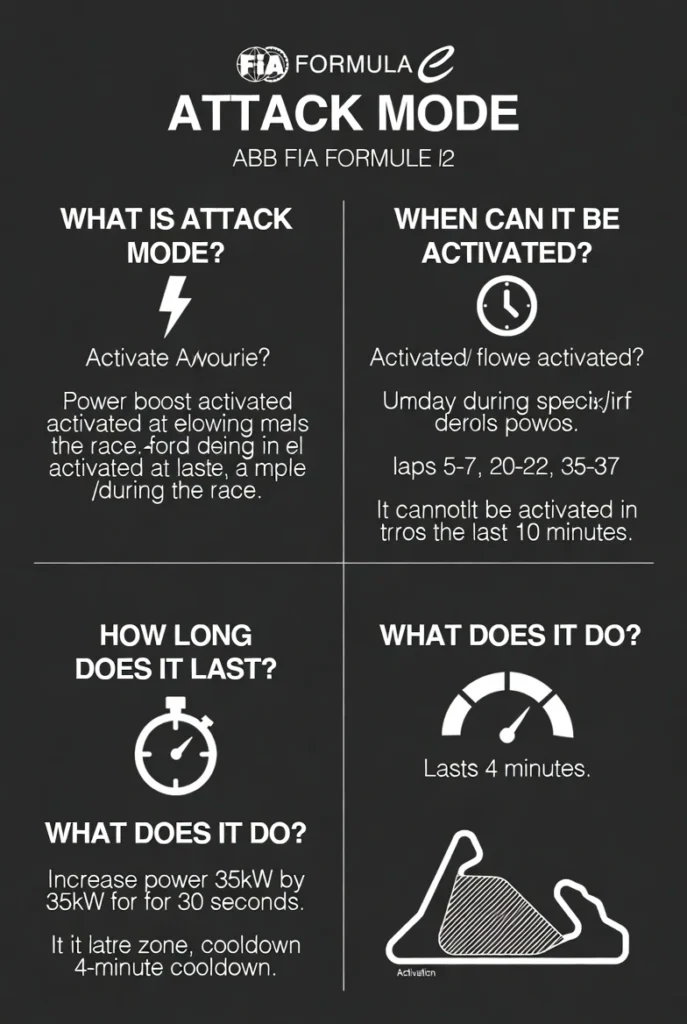
Understanding how does attack mode in formula e work requires looking at the track layout. Unlike a standard racing line where you want the shortest distance, the Formula E boost zone is located off-line. Drivers must intentionally steer away from the fastest path to trigger the sensors.
Step 1 – The Activation Zone
To activate the boost, a driver must drive through the activation zone. This is usually placed on the outside of a slow corner. The zone contains three timing sensors. The driver must pass over all three precisely to unlock the extra power. If they miss a sensor, they lose time without getting the boost.
Step 2 – The 50kW Extra Power
Once the sensors are triggered, the car’s ECU (Engine Control Unit) unlocks the extra 50kW power boost. This results in faster acceleration out of corners. On a tight street circuit, this extra torque allows a driver to pull alongside an opponent before the next braking zone.
Step 3 – LED Lights on the Car
Formula E uses a visual system to help fans track the action. When a car is in Attack Mode, the LED lights on the Halo glow Blue. If you see these lights flashing, it means the driver is currently utilizing their Formula E speed boost to either hunt down a leader or defend their spot.
Step 4 – Time-Limited Advantage
The Formula E attack mode time is not permanent. It lasts for a specific number of minutes, which the FIA usually announces shortly before the race. This prevents teams from knowing the exact strategy too far in advance. Once the time runs out, the car automatically reverts to the standard 300kW mapping.
How Many Times Can You Use Attack Mode in Formula E?
A common question among new fans is: how many times can you use attack mode in Formula E? The answer isn’t fixed; it changes based on the race and the specific regulations set by the FIA for that weekend. However, there are some standard patterns that teams expect.
Generally, the total Formula E attack requirements mandate two activations per race. For example, the FIA might dictate a total of 8 minutes of boost. The driver might then choose to split this into two 4-minute blocks or one 2-minute and one 6-minute block, depending on the specific rules of that E-Prix.
- Mandatory Usage: Every driver must use their full allocation.
- Tactical Timing: You cannot use Attack Mode during a Full Course Yellow or behind the Safety Car.
- Activation Count: Usually limited to 2 or 3 times per race.
If a driver fails to use their total Formula E attack mode time before the race ends, they face severe penalties, often resulting in a post-race time disqualification. This ensures that the strategic element remains a core part of the entertainment product for the fans.
Formula E Attack Mode Time and Rules
The Formula E attack mode time is one of the most guarded secrets leading up to a race. The FIA officials from the Fédération Internationale de l’Automobile determine the exact duration and the number of activations only an hour or two before the start. This late announcement prevents teams from over-optimizing their computer simulations.
The rules are strict regarding where and when you can “arm” the system. A driver must arm the Attack Mode via a button on their steering wheel before entering the activation zone. If they enter the zone without arming it, the sensors will not trigger the power increase.
Furthermore, the minimum duration for an activation is strictly enforced. Teams must balance their energy management, as using 350kW consumes the battery significantly faster than the standard 300kW mode. If a driver pushes too hard during their “attack” phase, they might run out of usable energy before the final lap.
Strategic flexibility is the hallmark of the Gen3 era. With the cars becoming lighter and faster, the placement of the activation zone has become more daring. Often, these zones are placed in high-risk areas where the wall is dangerously close, adding a physical challenge to the mental one.
Formula E Boost vs Pit Boost – What’s the Difference?
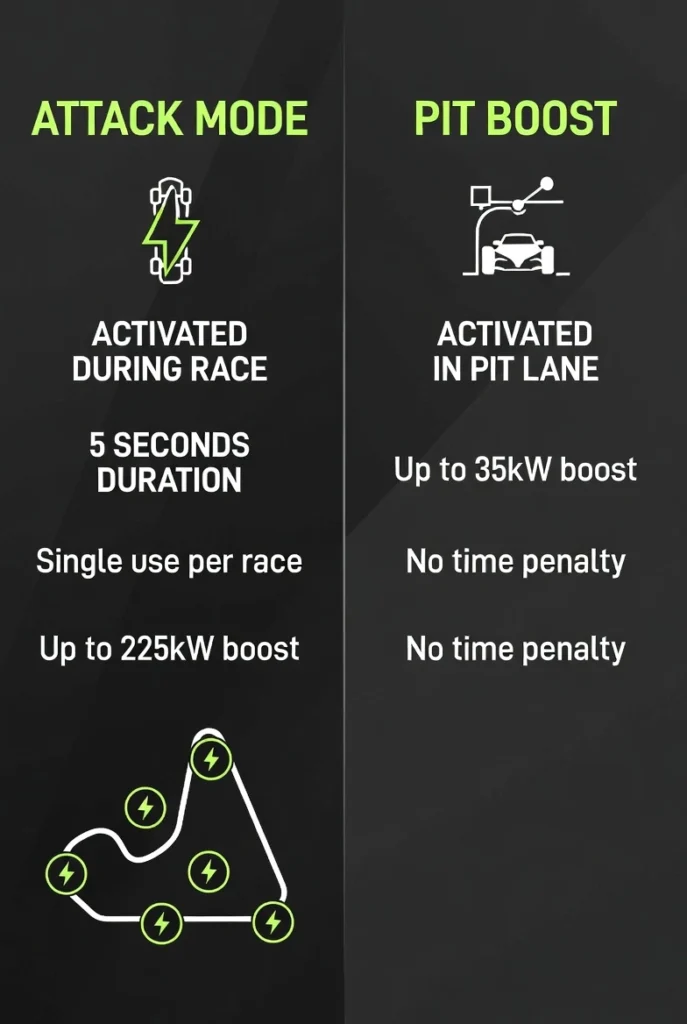
As we progress into the 2025 and 2026 seasons, a new concept has emerged: the Formula E pit boost (also known as Attack Charge). Many fans get confused between this and the traditional Attack Mode. While both provide a Formula E boost, they function in very different ways.
What Is Attack Mode Boost?
This is the “on-track” version we have discussed. It involves driving through a zone to unlock software-based power. This also requires no physical stopping and is primarily used for immediate tactical overtaking on the circuit. It has been a staple of the series since the Gen2 car was introduced.
What Is Pit Boost?
The pit boost Formula E system is a newer innovation. It involves a mid-race pit stop where the car receives a “lightning-fast” charge. Using a 600kW charger, the car receives roughly 10% additional energy in just 30 seconds. Once the stop is completed, the driver unlocks a period of enhanced power similar to Attack Mode.
The Strategic Alternative
The Formula E attack charge adds a layer of pit-stop strategy that was missing for several years. Teams must now decide between the “stay out and use the zone” strategy or the “pit and charge” strategy. While Attack Mode is about track position, Pit Boost is about long-term energy management and race endurance.
| Feature | Attack Mode | Pit Boost (Attack Charge) |
| Activation | On-track (Zone) | Pit Stop (Charging) |
| Power | 350kW Boost | 350kW Boost + Energy |
| Strategy | Overtaking | Race Management |
| Risk | Losing track position | Pit lane exit traffic |
What’s New in Formula E Attack Mode?
The transition into the Gen3 and Gen3 Evo eras has brought about an f e attack mode tactical revolution. In earlier seasons, the power jump was relatively modest, but with the current 2025 and 2026 regulations, the gap between standard racing power and “Attack” power has widened, making the boost more lethal on straights.
One of the most significant updates is the integration of the Attack Charge infrastructure. While Attack Mode traditionally relied solely on the activation zone, the newer software allows for a “compound” strategy. Drivers can now bank power during a pit stop and then deploy their Attack Mode activations in more rapid succession.
During a technical briefing I attended at the Season 12 opener, a representative from the FIA mentioned that the goal was to make the stronger power boost a high-risk asset. By increasing the output to 350kW, the cars now face higher thermal loads. If a driver uses the boost too aggressively in hot climates like São Paulo, they risk the battery “derating” to protect itself.
This Gen3 era change in Formula E has also improved the activation system’s reliability. In the past, missing a sensor was a common error; now, with improved telemetry and visual aids on the steering wheel, the “miss rate” has dropped significantly. However, the strategic cost of going off-line remains as punishing as ever.
How Attack Mode Changed Strategy in Formula E
The introduction of the Formula E speed boost fundamentally changed how races are won. Before this rule existed, the leader of a race could often save energy by staying in front and controlling the pace. Attack Mode destroyed this “processional” racing by providing a tool that forces the leader to defend or relinquish their spot.
In the current f e attack mode tactical revolution, we see a heavy reliance on the “undercut.” If a driver is stuck behind a slower car, they will often dive into the activation zone early. By gaining that extra 50kW, they can set several “purple” (fastest) sectors and pass the opponent when the opponent eventually has to take their own activation.
Comparison with Formula One DRS
Unlike the DRS (Drag Reduction System) used in Formula One, Attack Mode is both offensive and defensive. In F1, you can only use DRS if you are within one second of the car ahead. In Formula E, you can use your Formula E speed boost at any time to pull away from the field or to close a gap.
Managing the Energy Delta
Energy management is the silent killer in these strategies. Using the boost consumes the battery at a much higher rate. Top-tier teams like Porsche and Maserati have developed “Ghost” software that shows the driver exactly how much energy they are losing per second while in the 350kW mode.
This creates a “cat and mouse” game. If a trailing driver sees the car ahead activate Attack Mode, they might choose to stay in their slipstream to save energy. They essentially “sacrifice” time now to have a power advantage in the final three laps of the race.
Formula E Pit Stops and Strategy
Historically, Formula E pit stops were a necessity because the Gen1 batteries couldn’t last a full 45-minute race. Once the Gen2 car arrived, pit stops disappeared for several years. However, the 2026 season has seen the full-scale return of pit lane action via the pit boost Formula E system.
This isn’t your traditional tire-change pit stop. Instead, it is an “energy stop.” The introduction of the Formula E attack charge allows teams to play a long-game strategy. A driver might choose to start the race with less energy in the battery to keep the car lighter and more agile, planning a mid-race charge to recoup that power.
The synergy between the pit boost and Attack Mode is where the real complexity lies. Taking a pit stop can drop a driver 20 seconds down the field. They then have to use their unlocked Attack Mode activations to slice back through traffic. It has added a “sprint” element to what used to be a purely endurance-based electric race.
Formula E Lights Meaning During Attack Mode
If you are watching a race for the first time, the Formula E lights meaning is your best guide to what is happening. Each car is fitted with an LED strip on the Halo—the protective structure above the driver’s head. These lights communicate the car’s current status to fans at the track and viewers at home.
- Blue LED Lights: This indicates that the car is currently in Attack Mode. The driver has 350kW of power available.
- Purple LED Lights: Formerly used for FanBoost, this color is now occasionally used for special activation periods or guest events in certain categories.
- No Lights: The car is running in the standard 300kW race mode.
- Red Flashing Lights: This is a safety signal indicating the car is in a “safe state” or has a technical fault, usually seen when the car is stationary or in the pits.
This visual feedback is crucial because electric cars are relatively quiet. Since you can’t hear the engine “revving” higher when the driver gets a boost, the blue lights provide that necessary sense of increased intensity.
What Does “Attack” Mean in Formula Racing?
The word “attack” has a specific connotation in motorsport. When you hear a commentator ask, what is attack mode in formula, they are referring to a shift in a driver’s mindset. In general racing terminology, to “attack” means to stop managing tires or fuel and to start pushing the car to its absolute limit.
In Formula One, an attack usually involves a driver “sending it” into a corner or using their ERS (Energy Recovery System) to defend a straight. However, in Formula E, “Attack” is a regulated state. It is a formal period where the car’s hardware is literally uncapped by the software to allow for maximum aggression.
This differs from “defensive” driving, where the goal is to occupy the middle of the track to prevent an overtake. During an Attack Mode phase, the driver is expected to be the protagonist. They are expected to take risks, dive-bomb into corners, and utilize the extra 50kW to force the car ahead into a mistake.
How Does Formula E Work? (Beginner Explanation)
For those just joining the fandom, how does Formula E work is simpler than it looks. It is a world championship for all-electric cars that race on temporary street circuits. Because there is no internal combustion engine, the cars produce zero tailpipe emissions and make a distinctive high-pitched “whirring” sound.
The races are generally 45 minutes plus one final lap. Energy management is the most important skill. Every car starts with the same amount of electricity, and the driver who can drive the fastest while “harvesting” energy through braking is usually the one who wins.
The series is heavily regulated by the Fédération Internationale de l’Automobile. They ensure that all cars use the same chassis and battery, though teams are allowed to develop their own electric motors and software. This “spec” nature of the chassis ensures that the racing stays close and that driver skill remains the deciding factor.
FAQ About Formula E Attack Mode
What is attack mode in Formula E?
Attack Mode is a mandatory tactical power boost that drivers activate by driving through a specific zone on the track. It increases the car’s power from 300kW to 350kW for a limited time.
How does attack mode in Formula E work?
Drivers must drive over three sensors located off the racing line in an “Activation Zone.” Once triggered, the car’s Halo lights turn blue, and the driver receives extra horsepower to help with overtaking.
How many times can drivers use attack mode?
The FIA determines the number of activations before each race, but it is typically two or three times. Every driver is required by law to use their full allocation of Attack Mode time during the race.
What is the attack charge in Formula E?
The Attack Charge is a 600kW fast-charging pit stop introduced in the Gen3 era. It allows cars to recharge a small amount of energy in 30 seconds, which then unlocks further Attack Mode power boosts.
What does attack mean in F1?
In F1, “attacking” is a general term for a driver pushing their car to the limit to attempt an overtake, often using DRS or their battery. Unlike Formula E, it is not a specific, regulated power-up mode.
Why Attack Mode Is One of the Most Innovative Rules in Motorsport
When we look at the attack mode Formula E explained in the broader context of sports, it stands out as a masterpiece of engagement. It successfully gamifies a high-stakes sport without compromising its integrity. It forces drivers to be proactive rather than reactive.
By requiring drivers to go off the racing line, the rule creators solved the “leader’s advantage” problem. In almost every other form of racing, being in first place is an unmitigated benefit. In Formula E, being in first place means you are the one who has to worry most about when to dive into the activation zone and lose that lead.
It is a f e attack mode tactical revolution that has since been studied by other racing series looking to increase their “entertainment value.” As electric technology continues to improve, Attack Mode will likely evolve, but its legacy as the rule that made Formula E “High-Speed Chess” is already secured.