
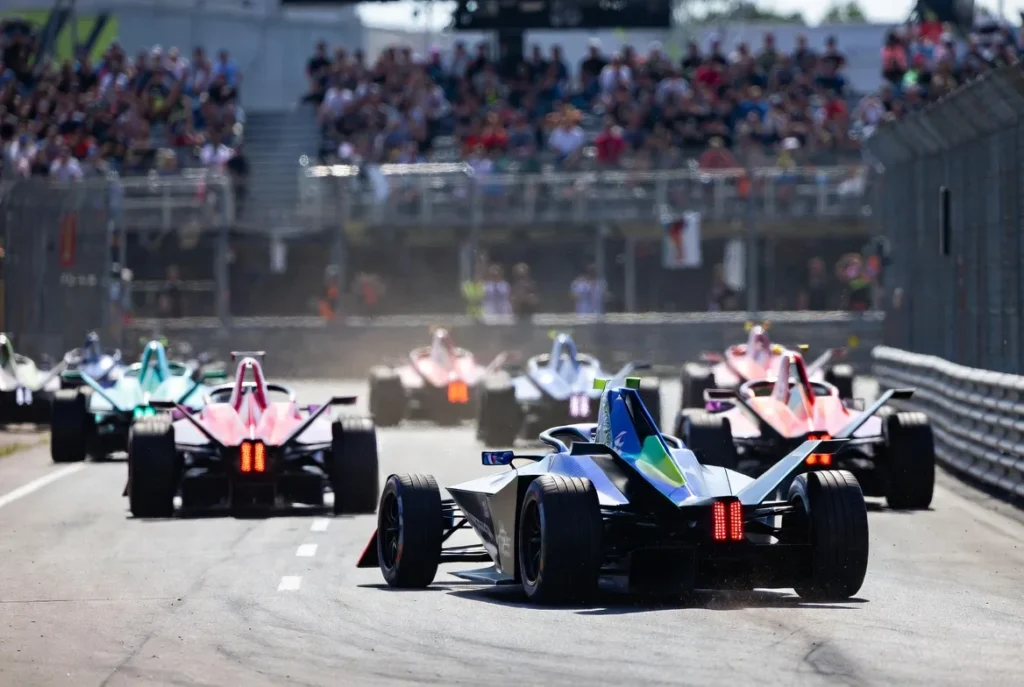
Formula E represents the pinnacle of electric motorsport, a visionary championship founded by the FIA in 2014 to prove that sustainability and high-speed racing are not mutually exclusive. Unlike traditional series, Formula E brings the race to the people, utilizing temporary street circuits in the heart of global hubs like Tokyo, London, and Monaco.
The series serves as a high-stakes laboratory for the world’s leading automotive manufacturers. Brands like Porsche, Jaguar, and Nissan compete not just for trophies, but to develop the inverters, motors, and software that will eventually power the electric vehicles in your own driveway.
As of the 2026 season, the performance of these electric “monopostos” has reached staggering levels. If you are wondering how fast Formula E race cars actually are, the answer lies in their unique power-to-weight ratio. A modern Gen3 Evo car can reach a theoretical top speed of roughly 200 mph (322 km/h).
While the top speed is impressive, the acceleration is what truly defines the electric experience. These cars can sprint from 0 to 100 km/h (0–62 mph) in approximately 2.4 seconds. This explosive launch is made possible by the instant torque inherent in electric powertrains, providing a “kick” that few internal combustion engines can match.
How Fast Do Formula E Cars Go? (Top Speed Explained)
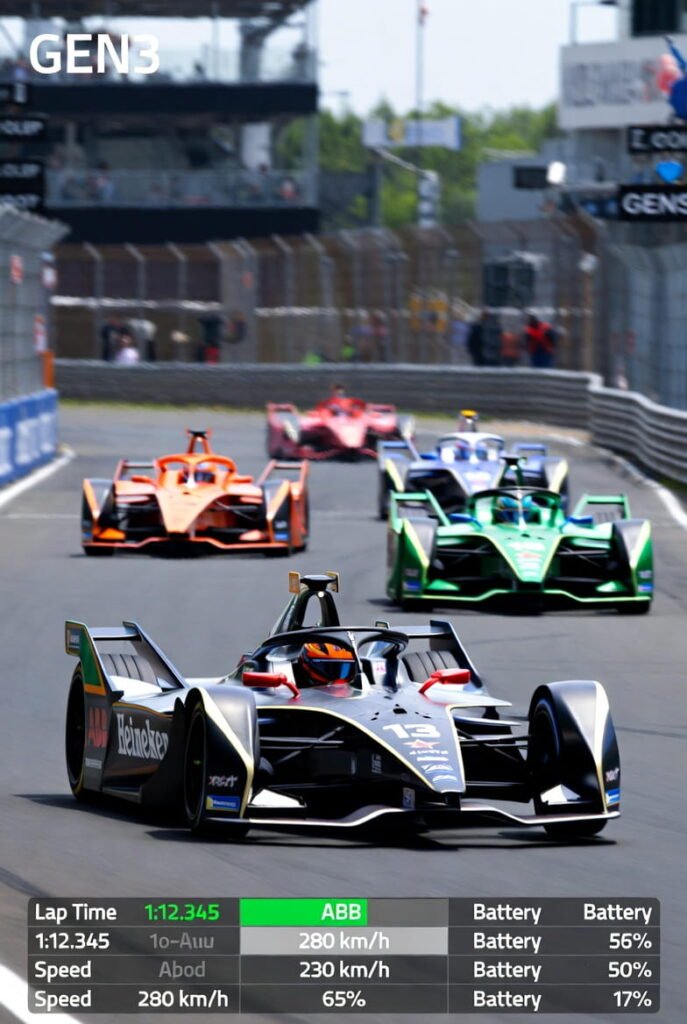
When discussing the top speed of an electric racer, we have to distinguish between theoretical maximums and practical race speeds. In a controlled environment, the Gen3 Evo chassis is capable of hitting 200 mph (322 km/h). However, you will rarely see these numbers on a Sunday afternoon.
The primary reason for this is the nature of the tracks. Formula E specializes in tight, twisty street circuits where long straights are a luxury. In most race scenarios, drivers reach peak speeds of about 174 mph (280 km/h) before they have to stand on the brakes for a narrow chicane or a 90-degree turn.
During a recent technical briefing I attended with a lead engineer from the Jaguar TCS Racing team, he explained that speed in Formula E is a game of “energy math.” The car could go faster, but doing so would deplete the battery too early in the race.
Consequently, the “maximum speed” is often a software-limited figure designed to maximize efficiency. It is also important to note the impact of regenerative braking. Modern Formula E cars produce nearly 40% of the energy they use during a race through “regen,” pulling up to 600 kW of power back into the battery during deceleration.
This means that for a driver, the sensation of speed is intrinsically linked to how well they can manage their energy. They are not just driving as fast as possible; they are driving as fast as the battery’s thermal and chemical limits allow, which creates a fascinating tactical layer for the fans.
Formula E Gen3 Cars – Performance Specs
The current Gen3 and Gen3 Evo cars are the most efficient racing machines ever built. To understand the “how fast” of Formula E, we must look at the technical architecture that allows these cars to thrive in urban environments.
| Metric | Spec Value |
| Top Speed | 200 mph (322 km/h) |
| Max Power Output | 350 kW (approx. 470 hp) |
| Acceleration (0-100 km/h) | 2.4 Seconds |
| Regenerative Braking Power | 600 kW |
| Minimum Weight | 840 kg (including driver) |
| Drive Type | Rear-wheel drive (AWD for Gen3 Evo starts) |
The Gen3 era introduced a dual-powertrain setup. While the rear motor provides the 350 kW of propulsion, a front-mounted motor acts exclusively as a generator for braking. This eliminated the need for hydraulic rear brakes, a first for any world-class formula series.
In my experience interviewing drivers like Mitch Evans, they often highlight the “darty” nature of these specs. Because the car is smaller and lighter than its Gen2 predecessor, the 350 kW of power feels significantly more aggressive.
The tires also play a massive role. The Hankook iON tires are designed to work in both wet and dry conditions, meaning they have less raw grip than a racing slick but allow for more sliding and wheel-to-wheel action. This lack of “glued-to-the-track” grip makes the 174 mph race speeds feel much more perilous than they would in a car with massive downforce.
Formula E Gen4 Top Speed – Future of Electric Racing
The roadmap for the future suggests that the performance gap between electric and traditional racing is closing rapidly. With the Gen4 regulations slated to take full effect later this decade, the FIA has laid out ambitious targets for speed and power.
The Gen4 cars are expected to push the power output to a massive 600 kW. This is nearly double the current power of the Gen3 cars. With this increase, the theoretical top speed is expected to climb well past the 210 mph mark, potentially reaching 220 mph on tracks with sufficient straightaways.
Furthermore, the regenerative capacity is expected to hit 700 kW or higher. This will require a new generation of battery chemistry that can handle massive surges of electricity without overheating.
As an analyst who has followed the sport since its inception in 2014, I find the transition to Gen4 to be the “tipping point.” At 600 kW of power, Formula E will no longer be seen as a “slower” alternative to other series. It will possess the raw acceleration necessary to challenge the lap times of some of the fastest racing series in the world.
Formula E vs Formula 1 Speed – Which Is Faster?
The most frequent question asked by motorsport newcomers is how these electric machines stack up against the titans of Formula 1. To be direct: Formula 1 is currently much faster in terms of both top speed and lap times, but the context matters.
Formula 1 cars regularly hit speeds of 215–233 mph (345–375 km/h) depending on the circuit and aerodynamic setup. They benefit from highly developed hybrid turbo V6 engines and massive levels of aerodynamic downforce that allow them to take corners at speeds that would send a Formula E car flying off the track.
| Series | Top Speed (Approx.) | 0-100 km/h |
| Formula E | 200 mph | 2.4 Seconds |
| Formula 1 | 233 mph | 2.6 Seconds |
Interestingly, the gap in standing-start acceleration is almost non-existent. In fact, due to the instant torque of the electric motor and the 4WD engagement of the Gen3 Evo cars during the start, a Formula E car can actually get off the line as fast as, or faster than, a Red Bull or a Ferrari F1 car.
However, once the cars reach 100 mph, the F1 car’s aerodynamics and sustained power take over. Formula E is designed for the “sprint” and the “jostle” of the city, whereas F1 is designed for the high-speed sweepers of Silverstone or Spa.
I once spoke with a driver who had tested both, and he noted that the F1 car feels like a jet fighter, while the Formula E car feels like a high-performance rally car on asphalt. The sensation of speed in Formula E is amplified by the proximity of the walls on street tracks; 150 mph in a narrow tunnel in Rome feels much faster than 200 mph on a wide-open runway.
The Great Divider: Formula E vs. IndyCar Performance
If Formula E is a high-tech scalpel designed for the narrow streets of London and Tokyo, IndyCar is a sledgehammer built for the high-speed ovals of Indianapolis and the sweeping road courses of Laguna Seca. The two series represent fundamentally different philosophies of speed.
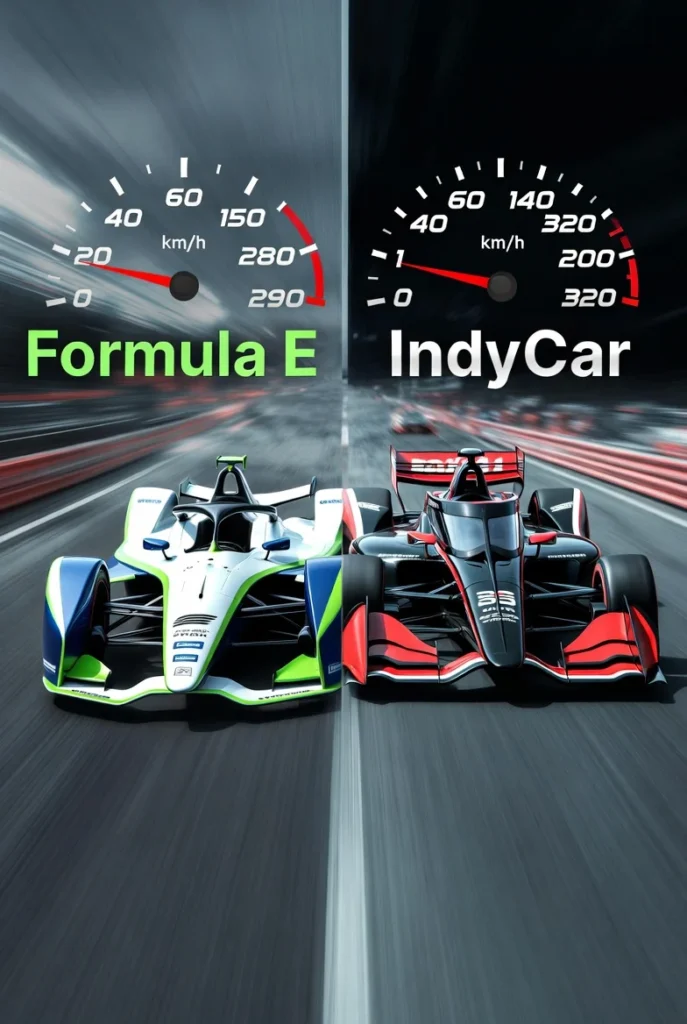
Performance Breakdown: Gen3 Evo vs. Dallara DW12
| Feature | Formula E (Gen3 Evo) | IndyCar (Dallara DW12) |
| Top Speed | ~200 mph (322 km/h) | ~240 mph (380 km/h) |
| 0-60 mph | 1.82 seconds | ~2.3 – 2.5 seconds |
| Power Output | 350 kW (470 bhp) | 550 – 700+ bhp (depending on boost) |
| Weight | 840 kg (inc. driver) | ~730 kg (road course) |
| Propulsion | Dual Motor (AWD) | 2.2L Twin-Turbo V6 Hybrid |
The Speed Paradox: On a standing start, the Formula E Gen3 Evo will leave an IndyCar in its wake. The instant torque of electric motors, combined with the new All-Wheel Drive (AWD) system available during starts and Attack Mode, allows the FE car to hit 60 mph in a blistering 1.82 seconds. For context, that is nearly a full second faster than an IndyCar and roughly 30% faster than a current Formula 1 car.
However, once the cars exceed 100 mph, the IndyCar’s aerodynamic efficiency and raw horsepower take over. On an oval like Indianapolis, an IndyCar maintains speeds that a Formula E car simply cannot reach due to battery thermal management and gearing limitations.
The 2026 Grid: Manufacturers and Team Dynamics
The 2025/26 season (Season 12) marks a high-water mark for manufacturer involvement. For years, skeptics claimed the “silent” series wouldn’t last; in 2026, the grid is more crowded and competitive than ever.
Major Players and New Entrants
- Porsche & Jaguar: The “Big Two” continue their dominance. Porsche’s powertrain remains the gold standard for efficiency, while Jaguar TCS Racing has mastered the art of race-day strategy.
- Lola Yamaha ABT: One of the most romantic stories in 2026 is the return of the Lola name to top-tier motorsport, partnered with the technical might of Yamaha.
- Citroën Racing: Stepping into the shoes of the former DS partnership, Citroën brings a legacy of rally-bred engineering to the grid, retaining heavy hitters like Jean-Éric Vergne.
- Andretti Global: Led by Season 10 champion Jake Dennis and the addition of Brazilian star Felipe Drugovich, the American outfit remains a constant threat for the title.
The 2026 Calendar & New Regulations: “Pit Boost” Strategy
The most significant shift in 2026 isn’t just the speed of the cars, but how they are refueled. The introduction of “Pit Boost” has fundamentally changed the “sprint” nature of the races.
What is Pit Boost?
Mandated for double-header events (Jeddah, Berlin, Monaco, Shanghai, Tokyo, and London), Pit Boost is a mandatory 30-second pit stop where the car receives an ultra-fast 600 kW charge.
Technical Insight: This 30-second stop injects approximately 3.85 kWh (roughly 10% of the total battery capacity) into the car.
Strategic Impact:
- The Window: Drivers can only pit when their State of Charge (SoC) is between 40% and 60%. This prevents teams from “parking the bus” or charging too early.
- Attack Mode Synergy: In Pit Boost races, the number of Attack Mode activations is reduced to one. This forces teams to choose between using their extra energy for a defensive undercut or an aggressive late-race surge.
- No Double-Stacking: Since each team is only provided with one charging rig, teammates cannot pit on the same lap, creating high-stakes tension on the pit wall if a Full Course Yellow is deployed.
The Economics of Speed: How Much Does a 2026 Formula E Car Cost?
Speed in the electric era is expensive, yet Formula E remains significantly more cost-effective than Formula 1. The FIA enforces a strict cost cap (currently around €13-15 million per season for teams) to prevent a spending war.
Estimated Component Breakdown
A race-ready Gen3 Evo car is valued at approximately $1.1 million to $1.2 million.
- Chassis (Spark Racing Technology): ~$400,000. A spec-part used by all teams to ensure aerodynamic parity.
- Battery (WAE/Fortescue): ~$250,000. A standardized 47 kWh unit designed to withstand the violent 600 kW regeneration cycles.
- Powertrain (Manufacturer-Developed): ~$350,000+. This is where the magic happens. Teams like Nissan, Jaguar, and Porsche spend millions in R&D to develop the most efficient inverter and motor-generator unit (MGU).
- Tires (Hankook iON): ~$2,500 per set. These are unique “all-weather” tires with 30% sustainable materials, designed to last an entire race weekend.
Final Verdict: Is Formula E Fast Enough?
In 2014, Formula E was a curiosity. In 2026, it is a technical powerhouse. While it still lacks the 230 mph top-end scream of an F1 car, it has mastered the “street fight.” If you value 0-60 mph acceleration that defies physics and a racing format where ten different drivers can win on any given Sunday, then Formula E is arguably the most “exciting” speed in the world. As we look toward the Gen4 era (2027+), which promises 600 kW of power (800+ hp), the gap between “electric” and “fast” will vanish entirely.
Frequently Asked Questions (FAQ)
1. Can a Formula E car beat a Tesla Model S Plaid?
Yes. While the Plaid is a marvel of road-car engineering, the Gen3 Evo’s 1.82s 0-60 mph time and its purpose-built racing slicks give it a massive advantage in both acceleration and cornering.
2. Why don’t they use slick tires?
To maintain the series’ sustainability goals. The Hankook iON tires are designed to work in both wet and dry conditions, reducing the number of tires produced, transported, and discarded per weekend.
3. How loud is a 2026 Formula E car?
They produce about 80 decibels—similar to a loud vacuum or a busy street. The sound isn’t from an exhaust, but from the high-pitched whine of the straight-cut gears and the electric motor spinning at 19,500 RPM.
4. Do the cars have “fake” noise?
No. There is a persistent rumor that Formula E adds artificial sound, but the noise you hear is 100% mechanical.
5. What happens if the battery runs out?
The car enters “turtle mode” to limp back to the pits or is forced to retire. Managing the energy “buffer” is arguably the hardest part of a driver’s job.
References:
Official FIA Formula E World Championship: https://www.fiaformulae.com
Fédération Internationale de l’Automobile (FIA): https://www.fia.com
Jaguar TCS Racing (Team Insights): https://www.jaguarracing.com
ABB – Global Sustainability & Formula E Partnership: https://global.abb/group/en/about/events/formula-e
Motorsport.com (Formula E Section): https://www.motorsport.com/formula-e/

