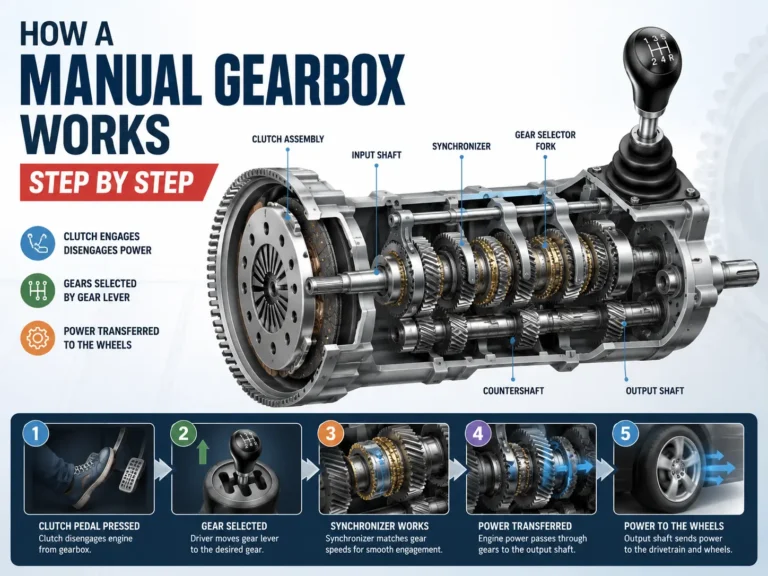
A car engine is far more than just a machine that makes a vehicle move — it is a high-speed energy conversion system engineered to transform controlled explosions into usable motion. Hidden beneath the complexity of metal components, sensors, wiring, and fluid systems lies one of the most refined mechanical inventions ever created: the internal combustion engine.
At its core, an engine works by igniting a compressed mixture of air and fuel inside sealed combustion chambers. The resulting explosion generates extreme pressure and heat, forcing pistons downward inside cylinders. This linear piston movement is then converted by the crankshaft into rotational torque, the force that ultimately drives the transmission and turns the wheels.
Although modern engines appear overwhelmingly advanced, their fundamental operating principle has remained remarkably consistent for over a century — converting chemical energy into thermal energy, and then into mechanical power with maximum efficiency and precision.
Today’s engines are no longer purely mechanical devices. They are electronically managed systems that rely on advanced fuel injection, ignition timing, airflow control, variable valve timing, turbocharging, and real-time sensor feedback to optimize performance, fuel economy, emissions, and reliability simultaneously.
Every time the driver presses the accelerator, thousands of microscopic processes occur in perfect synchronization: air is measured, fuel is atomized, combustion timing is calculated, pressure is controlled, and rotational force is delivered through the drivetrain — all within milliseconds.
Understanding how an engine works is not just about knowing what happens under the hood. It is about understanding the physics, thermodynamics, and engineering precision that allow a machine to survive millions of controlled combustion cycles while delivering smooth, reliable power every single day.
The Core Principle: Internal Combustion
To understand how a car engine works, we first need to understand the type of machine it is: an Internal Combustion Engine (ICE).
The name itself explains the idea:
- Combustion means burning.
- Internal means the burning happens inside the engine, not outside it.
Unlike old steam engines that burned fuel outside the machine to create steam, a car engine creates power directly inside its cylinders through controlled fuel combustion.
At its core, an engine works using a simple scientific principle: when gases become very hot, they expand and create pressure.
PV=nRT
You do not need to memorize the formula above — it simply represents the relationship between heat, pressure, and gas behavior. In simple terms, when air and fuel are trapped in a small space and ignited, the heat causes the gases to expand violently. Because the gases cannot escape instantly, pressure builds up very quickly.
The engine is designed to use this pressure as force.
Inside the engine are metal tubes called cylinders, each containing a moving part called a piston. When the fuel-air mixture burns, the expanding gases push the piston downward with great force.
The engine then converts this up-and-down movement into rotational motion using a component called the crankshaft. That rotational force eventually turns the wheels of the car.
This process happens continuously and extremely fast — thousands of times every minute.
Modern engines may look complicated because they include electronics, sensors, cooling systems, fuel injection systems, and many moving parts. But underneath all that complexity, the basic idea is surprisingly simple:
The engine creates tiny controlled explosions, uses the resulting pressure to move pistons, and converts that movement into the power that drives the vehicle.
The Main Anatomy of an Engine
Before looking at how an engine moves, let’s meet the key components that make it up. Think of these parts like the bones and muscles of the machine.
1.The Cylinder and Piston
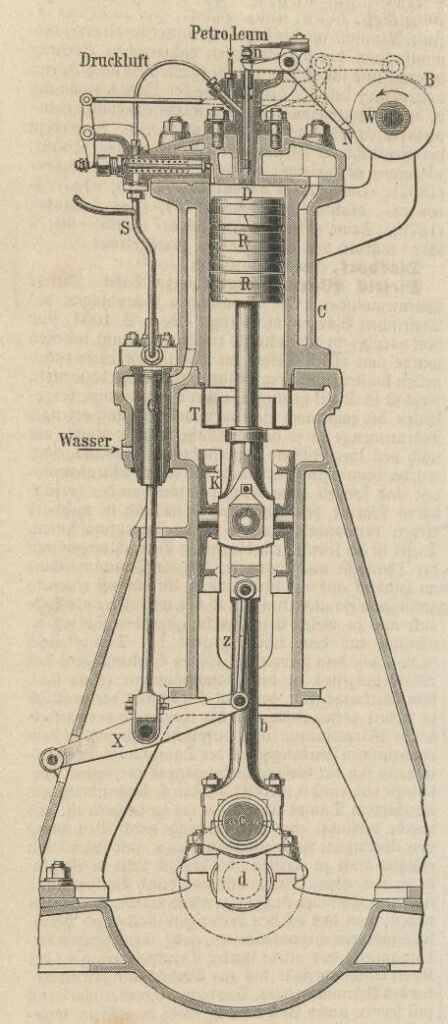
At the center of every engine is a component called the cylinder — a strong, precisely machined metal chamber where power is created. You can think of it as a heavy-duty tube designed to handle extreme heat and pressure during combustion.
Inside the cylinder is the piston, a solid metal part that fits very tightly inside the cylinder walls, almost like a syringe moving inside a tube. The fit is carefully engineered: tight enough to trap pressure, but smooth enough to move freely up and down at very high speed.
The piston’s job is simple but extremely important. When fuel and air burn inside the cylinder, the explosion creates hot, expanding gases. These gases push the piston downward with tremendous force.
The piston then moves back upward again to prepare for the next combustion cycle. This constant up-and-down motion happens thousands of times every minute while the engine is running.
Around the piston are small metal rings called piston rings. These rings seal the tiny gap between the piston and cylinder wall so pressure cannot leak out during combustion. They also help control engine oil and reduce friction between moving metal surfaces.
The inside surface of the cylinder is polished and hardened so the piston can move smoothly while withstanding continuous heat, friction, and pressure.
In modern engines, temperatures inside the combustion chamber can exceed hundreds of degrees Celsius, and the piston itself may travel up and down more than 100 times every second at high engine speeds.
Together, the cylinder and piston form the engine’s basic power-producing unit — the place where combustion pressure is converted into mechanical movement.
1.The Connecting Rod and Crankshaft
The piston inside the engine moves only in a straight line — up and down inside the cylinder. Engineers call this reciprocating motion. But a car cannot move using up-and-down motion alone because the wheels need continuous spinning motion, called rotational motion.
To solve this problem, the engine uses two important components: the connecting rod and the crankshaft.
The bottom of the piston is attached to a strong forged steel arm called the connecting rod. This rod acts like a bridge between the piston and the crankshaft. As the piston moves up and down from combustion pressure, the connecting rod transfers that force downward.
At the other end, the connecting rod is attached to the crankshaft, which is one of the heaviest and most important moving parts inside the engine. The crankshaft is a long rotating metal shaft with offset mounting points called crank journals. These offset sections are what allow straight-line piston movement to be converted into circular rotation.
A simple way to imagine it is a bicycle pedal:
- Your leg moves mostly up and down.
- But the pedal and crank convert that movement into spinning motion that turns the bicycle wheel.
An engine works in a very similar way.
When combustion pushes the piston downward, the connecting rod pushes against the offset section of the crankshaft. Because the crankshaft cannot move straight down, it begins to rotate instead. As this process repeats in multiple cylinders thousands of times every minute, the crankshaft spins continuously and produces the rotational force needed to drive the transmission and wheels.
The crankshaft must be extremely strong and precisely balanced because it handles enormous forces, high rotational speeds, vibration, and constant stress. In many engines, it rotates several thousand times per minute while maintaining smooth operation.
In simple terms:
- The piston creates force from combustion.
- The connecting rod transfers that force.
- The crankshaft converts the force into spinning motion that powers the car.
2.The Bicycle Analogy:
Think of riding a bicycle. Your legs move mostly up and down, but the wheels spin in circles. The bicycle converts your straight-line leg movement into rotational motion using the pedals and crank arms.
An engine works almost the same way — just far more powerfully, precisely, and at extremely high speed.
Inside the engine, the piston moves straight up and down inside the cylinder after being pushed by combustion pressure. Attached to the piston is the connecting rod, a strong steel link that transfers this force downward.
The connecting rod is connected to the crankshaft, which acts like the engine’s rotating backbone. Unlike a perfectly straight shaft, the crankshaft has offset sections positioned away from its centerline. These offsets are critical because they allow vertical piston movement to be transformed into circular rotation.
Here is where the engineering becomes clever:
As the piston moves downward, the connecting rod pushes on the crankshaft at an angle rather than straight down. Because the crankshaft is mounted to rotate freely inside bearings, this angled force causes it to spin instead of move vertically.
The same thing happens continuously in reverse:
- As the crankshaft keeps rotating,
- it pulls the piston back upward,
- then another combustion event pushes it down again.
This repeating cycle creates continuous rotational energy.
In a multi-cylinder engine, several pistons operate in carefully timed sequences so the crankshaft receives nearly constant force rather than individual jerks. The result is smooth, powerful rotation capable of driving the transmission and spinning the wheels.
In simple terms:
- The piston creates movement from combustion.
- The connecting rod transfers the force.
- The crankshaft converts that force into spinning motion.
Without the crankshaft, the engine would only create shaking up-and-down movement. The crankshaft is what transforms combustion into usable rotational power that can actually move a car.
3. The Cylinder Head, Valves, and Spark Plug
Capping off the top of the cylinder is the cylinder head. This component creates a sealed combustion chamber and houses three critical actors:
- Intake Valve: A mechanical door that opens to let fresh air and fuel into the cylinder.
- Exhaust Valve: A mechanical door that opens to let spent exhaust gases out.
- Spark Plug: A tiny electrical device that delivers a high-voltage spark to ignite the air-fuel mixture at the exact microsecond required. (Note: Diesel engines do not have spark plugs; they rely on extreme compression to heat the air enough to ignite the fuel automatically).
The Heart of the Process: The 4-Stroke Cycle
Almost every modern gasoline car on the road runs on a four-stroke cycle, also known scientifically as the Otto Cycle (named after Nikolaus Otto, who invented it in 1876).
A “stroke” is simply the movement of the piston from its highest point in the cylinder (Top Dead Center, or TDC) to its lowest point (Bottom Dead Center, or BDC), or vice versa. One full four-stroke cycle requires the piston to go up and down twice, turning the crankshaft exactly two full rotations.
Let’s walk through the four distinct steps that repeat thousands of times every minute while you drive.

Step 1: Intake Stroke — The Engine Breathes In
The cycle begins with the piston positioned at the very top of the cylinder.
As the crankshaft rotates, it pulls the piston downward. At the same time, the intake valve opens electronically and mechanically through the valve train system.
The downward-moving piston increases the volume inside the cylinder, creating a low-pressure area — similar to how a syringe pulls liquid when its plunger is pulled back. Because outside air is now at higher pressure, fresh air rushes into the cylinder through the intake system. In modern gasoline engines, fuel is either mixed with this incoming air before entering or sprayed directly into the cylinder through fuel injectors as an ultra-fine mist.
This incoming mixture is called the air-fuel charge.
By the time the piston reaches the bottom:
- the cylinder is filled with a measured amount of air and fuel,
- and the intake valve closes tightly to seal the combustion chamber.
The engine now has everything needed to create power.
Step 2: Compression Stroke — Concentrating Energy
With both intake and exhaust valves fully closed, the crankshaft continues rotating and forces the piston back upward.
Now the trapped air-fuel mixture has nowhere to escape.
As the piston rises, it compresses the mixture into a much smaller space called the combustion chamber. In many engines, the mixture may be compressed to roughly one-tenth of its original volume.
This compression is extremely important because it:
- packs the fuel and oxygen molecules closer together,
- increases combustion efficiency,
- raises temperature and pressure,
- and allows the fuel to burn faster and more completely.
A compressed mixture releases far more energy than an uncompressed one. This is why engine compression ratio plays a major role in power and efficiency.
At this point, the piston is approaching the very top of the cylinder, an engine position known as Top Dead Center (TDC).
Step 3: Power Stroke — Combustion Creates Force
This is the moment where the engine actually produces usable power.
Just before the piston reaches Top Dead Center, the spark plug generates a high-voltage electrical arc across its tip. That spark ignites the compressed air-fuel mixture.
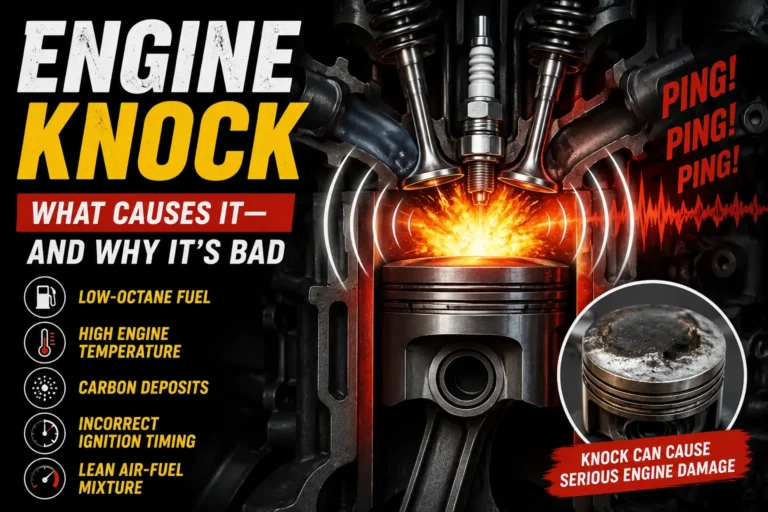
The combustion spreads rapidly across the chamber in a controlled flame front. This is very different from uncontrolled explosion or detonation, which can damage the engine. Proper combustion is carefully timed and controlled by the engine’s computer system.
The burning fuel instantly creates extremely high temperatures and rapidly expanding gases.
Because:
- the piston is trapped below,
- and both valves are sealed shut,
the expanding gases have only one direction to move — downward.
The pressure forcefully drives the piston down the cylinder with tremendous energy. This is called the power stroke, because it is the only stroke that actually produces driving power.
The downward piston movement rotates the crankshaft through the connecting rod, creating torque that eventually travels through the transmission to the wheels.
Inside a running engine, this happens continuously thousands of times every minute across multiple cylinders.
Step 4: Exhaust Stroke — Clearing the Cylinder
After the power stroke ends, the piston reaches the bottom of the cylinder again.
But the combustion process has now left behind hot burnt gases called exhaust gases. These gases must be removed before the next cycle can begin.
As the crankshaft continues spinning from its own momentum and from power produced by other cylinders, it pushes the piston upward once more.
At the same time, the exhaust valve opens.
The rising piston now acts like a pump, forcing the burnt gases out of the cylinder and into the exhaust manifold and exhaust system.
This process clears the combustion chamber for the next fresh air-fuel charge.
Once the piston reaches the top:
- the exhaust valve closes,
- the intake valve opens again,
- and the entire cycle repeats.
The Process Never Stops
In a modern engine, this four-stroke cycle happens incredibly fast and with extraordinary precision.
At 3,000 RPM:
- the crankshaft spins 3,000 times every minute,
- each piston completes hundreds of cycles per minute,
- and the engine constantly repeats intake, compression, combustion, and exhaust in perfect synchronization.
All of this is controlled by:
- the crankshaft,
- camshaft,
- valves,
- fuel injectors,
- spark plugs,
- sensors,
- and the Engine Control Unit (ECU).
Together, these systems transform tiny controlled combustion events into smooth, continuous rotational power capable of moving an entire vehicle
Engine Layouts: Inline, V, and Flat
A single cylinder cannot produce enough smooth power to move a multi-ton vehicle comfortably. To create continuous power, cars use multiple cylinders firing at offset times. How these cylinders are arranged drastically alters the shape, sound, and balance of the vehicle.
Inline (or Straight) Engines
In an inline configuration, all cylinders are lined up in a single straight row, like soldiers standing in a line.
- Common uses: 4-cylinder engines found in everyday commuter cars (e.g., Honda Civic, Toyota Camry).
- Pros: Simple to manufacture, inexpensive to repair, and fits neatly into small, front-wheel-drive engine bays.
V-Engines
A V-engine splits the cylinders into two rows (or “banks”) that angle away from each other, connecting to a single crankshaft at the bottom to form a “V” shape. A V6 has six cylinders, while a V8 has eight.
- Common uses: Trucks, SUVs, and high-performance sports cars.
- Pros: Compact lengthwise. A V8 can fit into the same length engine bay as a traditional inline-4 engine while offering double the displacement and power.
Flat (or Boxer) Engines
In a flat layout, the cylinders lie horizontally on their sides, pushing directly toward and away from each other like two prize fighters punching their gloves together before a match (hence the name “Boxer”).
- Common uses: Famously utilized by Subaru and Porsche.
- Pros: Extremely low profile. Keeping the weight of the heavy engine block low to the ground lowers the car’s center of gravity, significantly improving cornering and handling.
Key Metrics: Engine Displacement, Horsepower, and Torque
When reading car specifications, you will encounter three primary metrics used to measure an engine’s capabilities.
Engine Displacement (Liters and CCs)
Displacement measures the total volume of all the cylinders in the engine combined. It is usually calculated in liters (e.g., a “2.0-liter engine”) or cubic centimeters (e.g., “2000 cc”).
If you were to pull all the pistons to their lowest point and fill the cylinders with liquid, the total volume of that liquid equals the engine’s displacement. Generally speaking, a larger displacement means an engine can draw in more air and burn more fuel, creating more potential power.
Torque vs. Horsepower
These two terms are constantly confused, but they represent very different physical properties:
- Torque (Measured in lb-ft or Nm): This is the raw rotational force or twisting power an engine produces. Torque is what does the heavy lifting. It’s the muscle that launches a vehicle from a dead stop or allows a heavy truck to tow a massive trailer up a steep hill.
- Horsepower (HP): This is a measurement of how quickly the engine can apply that torque over time. If torque is the heavy lifter lifting a boulder, horsepower is how fast that lifter can sprint up a hill while carrying it.
Horsepower = Torque x RPM / 5252
Vital Supporting Systems
The basic mechanics of internal combustion cannot function without a team of supporting systems working in perfect harmony to protect and optimize the engine.
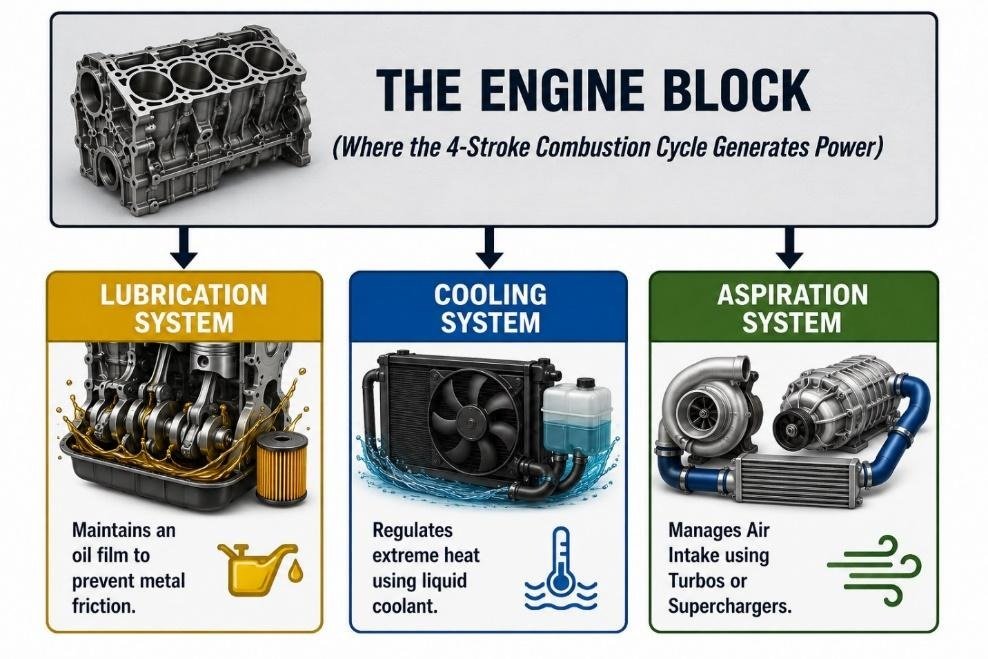
The Lubrication System (Engine Oil)
Inside an engine running at around 3,000 RPM, internal components are moving and sliding against each other thousands of times per minute under heavy load, high temperature, and extreme pressure.
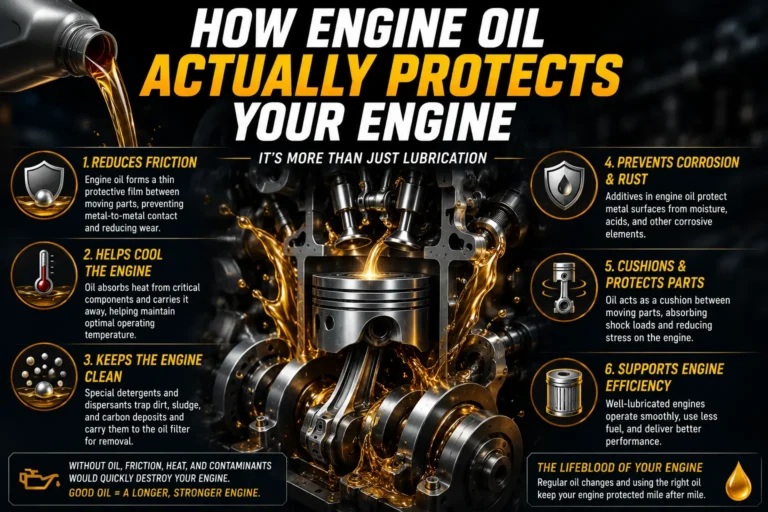
Without lubrication, this direct metal-to-metal contact would create intense friction almost instantly, generating heat so rapidly that components like bearings, pistons, and crankshaft journals would overheat, expand, and weld themselves together — a failure known as engine seizure.
To prevent this, the lubrication system continuously pumps engine oil through narrow internal oil passages under pressure. This oil is not just a simple liquid; it is an engineered fluid designed to maintain strength under heat and pressure.
As it flows between moving parts, it forms a thin protective film, often only a few microns thick, that separates metal surfaces completely.
Instead of metal rubbing on metal, the parts actually glide on this pressurized oil layer. This process is called hydrodynamic lubrication, where the motion of the parts themselves helps maintain the oil film, allowing smooth rotation and movement even under extreme mechanical stress.
In simple terms, engine oil acts like a constantly renewed microscopic cushion that prevents direct contact between metal components, reduces friction, controls heat, and ensures the engine can survive continuous high-speed operation without self-destruction.
The Cooling System
Only about 30% of the energy produced by burning gasoline is turned into motion; the remaining 70% is lost as waste heat.
To prevent the metal block from warping under this thermal stress, a mixture of water and antifreeze (coolant) is pumped through passages inside the engine walls. The fluid absorbs the heat, travels out to the radiator at the front of the car where oncoming air cools it down, and loops back into the block to repeat the process.
Forced Induction: Turbos and Superchargers
Naturally aspirated engines rely on the vacuum created by the piston to pull air into the cylinder. However, to make an engine more efficient, engineers use forced induction to pack more air into the cylinders than normal.
- Turbochargers: Use a turbine driven by the hot gases escaping out the exhaust pipe to spin a compressor wheel, forcing dense air into the engine intake. It harvests free, wasted energy.
- Superchargers: Mechanically driven directly by a belt connected to the engine’s crankshaft. Because it is connected directly to the spinning engine, it provides instant power boost without the slight delay (“lag”) common to turbochargers.
Conclusion:
Pop the hood of a modern car, and what once looked like a confusing collection of metal, wires, and plastic becomes something far more fascinating: a precisely engineered energy-conversion system operating with extraordinary coordination and accuracy.
At the heart of the machine is the internal combustion engine, a device built to transform the chemical energy stored in fuel into usable mechanical power through the continuous four-stroke combustion cycle.
Every second the engine is running, it draws in air and fuel, compresses the mixture, ignites it with carefully timed combustion, converts expanding gas pressure into piston movement, and transforms that movement into rotational torque through the crankshaft.
Supporting systems such as lubrication, liquid cooling, fuel injection, electronic engine management, and turbocharging work constantly in the background to maximize performance, efficiency, durability, and emissions control.
Understanding this process also changes the way vehicle performance is viewed, because power is no longer just a number on a specification sheet.
Torque represents the engine’s raw twisting force, while horsepower measures how quickly that force can continue to be delivered as engine speed rises. Together, they define how a vehicle accelerates, responds, and performs under load.
The next time you press the accelerator or hear the sharp mechanical growl of an engine climbing through the RPM range, you are not simply driving a car — you are operating a highly refined thermodynamic machine capable of surviving millions of precisely controlled combustion events while delivering smooth, reliable power through an extraordinary combination of physics, chemistry, electronics, and mechanical engineering.
Here’s a polished “References & Further Reading” section you can add at the end of your article with authoritative external sources:
References & Further Reading
- How Car Engines Work – Explain That Stuff
- Internal Combustion Engine – Encyclopaedia Britannica
- How Car Engines Work – HowStuffWorks
- Four-Stroke Engine Cycle Explained – Energy Education
- Internal Combustion Engine Basics – MIT
- Turbochargers Explained – Garrett Motion
- Engine Lubrication System Basics – TotalEnergies
- Cooling System Operation – Haynes Manuals