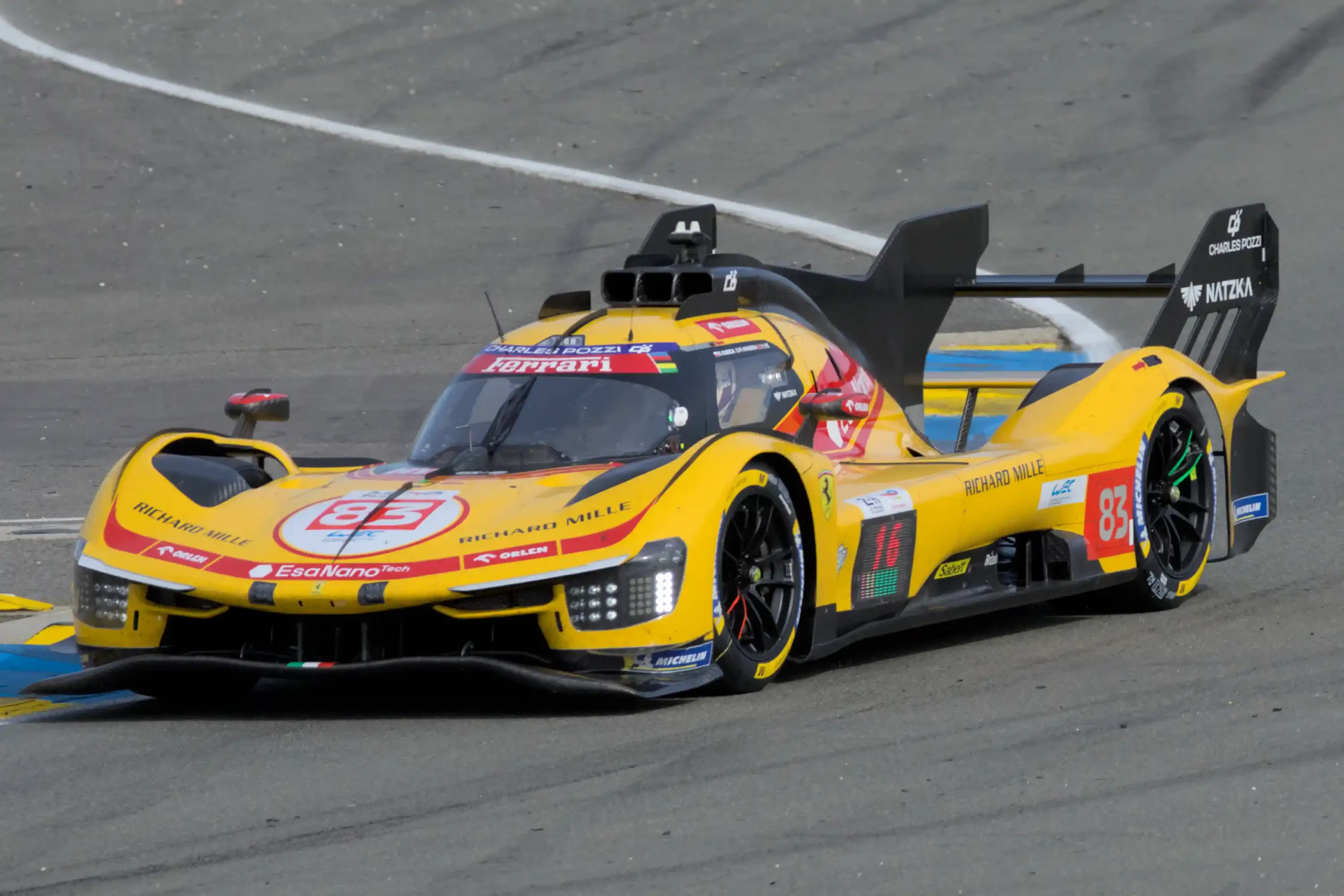
F1 vs Le Mans: Racing Formats, Cars and Strategy Compared
Formula 1 searches for the fastest possible Grand Prix lap. Le Mans asks a multi-driver car to survive traffic, darkness, weather and 24 hours of relentless competition.
Formula 1 is a single-class Grand Prix championship built around maximum lap performance. The 24 Hours of Le Mans is a multi-class endurance race where teams share cars, refuel, manage repairs and compete through day, night and changing conditions.
The F1 vs Le Mans comparison is not simply a contest between two fast race cars. It is a comparison between a sprinting engineering championship and motorsport’s most famous survival test.
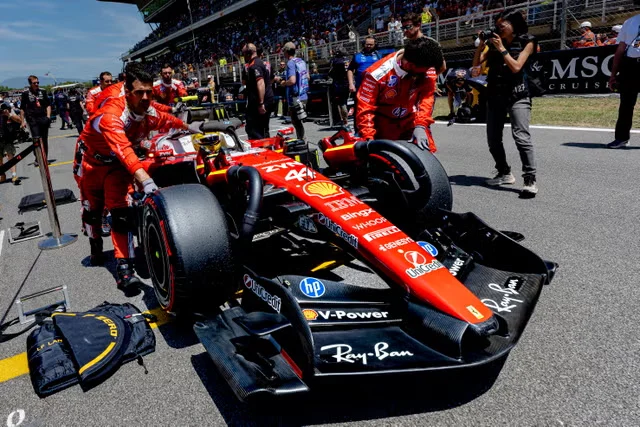
An F1 car attacks a Grand Prix with one driver. The race usually lasts less than two hours, and every tenth of a second matters.
A Le Mans entry uses three drivers. The same car must remain competitive for 24 hours while faster and slower classes share a 13.626-kilometer circuit.
Therefore, the fastest machine is not automatically the better endurance machine. Formula 1 wins almost every pure lap-time comparison.
Meanwhile, a Hypercar must preserve brakes, bodywork, cooling systems and drivetrain components. It must also be quick enough to defeat rivals through hundreds of traffic encounters.
The 2026 rules sharpened the contrast. F1 introduced smaller 770-kilogram cars, Active Aero and a 350kW MGU-K.
Le Mans Hypercars remained at a 1,030-kilogram minimum and 500kW maximum output. Balance of Performance kept different LMH and LMDh concepts within a controlled window.
The latest race also provided a powerful case study. Toyota’s #7 GR010 Hybrid won the 2026 24 Hours with Mike Conway, Kamui Kobayashi and Nyck de Vries.
Inter Europol Competition won LMP2 with the #43 Oreca 07-Gibson. TF Sport’s #33 Corvette earned the LMGT3 victory from 17th on its class grid.
This guide explains F1 vs Le Mans cars, speed, race formats, Hyperpole, pit stops, refueling, driver changes, multi-class traffic, safety procedures and strategy.
The Quick Answer: F1 Is Faster, Le Mans Is the Deeper Endurance Test
An F1 car is faster over one lap because it is lighter, more powerful and produces greater downforce. A Le Mans Hypercar is slower by design, but it can maintain competitive speed for 24 hours while refueling, changing drivers and negotiating multi-class traffic.
Formula 1 builds the superior qualifying tool. The car can exceed 370 km/h at suitable venues and changes four tires in less than two seconds.
However, Le Mans asks a much wider engineering question. Can the car remain fast after sunset, repeated curb strikes, dozens of pit stops and thousands of gear changes?
The F1 driver attacks almost every lap within a narrow performance plan. Tire temperatures, battery deployment and track position shape the race.
By contrast, a Le Mans crew changes its approach every few hours. The team may protect the car at dusk, double stint tires at night and release its quickest driver near sunrise.
Consequently, F1 has the more intense short-form performance battle. Le Mans has the broader strategic workload.
Readers new to the championship can begin with the Formula 1 beginner’s guide.
F1’s Core Question
How quickly can one driver and one constructor complete a Grand Prix within strict technical and tire rules?
Le Mans’ Core Question
How quickly can three drivers and a complete team keep one car moving for an entire day and night?
The Key Difference
F1 optimizes peak performance. Le Mans balances pace, traffic, fuel, maintenance and survival.
Formula 1 rewards the team that extracts the last fraction of performance. Le Mans rewards the team that knows when that last fraction is not worth the risk.
F1 vs Le Mans Comparison Table
| Category | Formula 1 in 2026 | 24 Hours of Le Mans in 2026 | Practical Difference |
|---|---|---|---|
| Competition type | Season-long single-class Grand Prix championship | One 24-hour round within the FIA World Endurance Championship | F1 awards a season title; Le Mans is a singular endurance prize |
| Primary car | Open-wheel constructor-built single-seater | Closed-cockpit Hypercar, plus LMP2 and LMGT3 classes | Le Mans combines three performance levels |
| Drivers per car | One | Usually three | Le Mans requires rotations and shared setup compromises |
| Race duration | Usually 90 minutes to two hours | 24 hours | Le Mans strategy changes through several track phases |
| Race distance | Normally the least laps exceeding 305km | As many laps as possible before the 24-hour finish | Le Mans distance depends on pace and interruptions |
| Car weight | 770kg published minimum | 1,030kg Hypercar minimum before BoP | F1 has the stronger power-to-weight ratio |
| Power | Turbo V6 plus 350kW MGU-K; around 1,000hp combined potential | Hypercar maximum of 500kW, around 680hp, subject to BoP | F1 has more peak output |
| Start | Standing start for most Grands Prix | Rolling start | F1 emphasizes launch; Le Mans organizes a large multi-class field |
| Refueling | Prohibited during the race | Central to every fuel window | Le Mans strategy is built around energy per stint |
| Tire strategy | Compound choice and undercut timing | Double or triple stints, temperature changes and puncture risk | Le Mans values tire life as much as peak grip |
| Qualifying | Q1, Q2 and Q3 knockout sessions | Qualifying followed by class-based Hyperpole stages | Le Mans shares qualifying responsibility across a crew |
| Repairs | Limited trackside fixes; major garage work usually ends the result | Extensive garage repairs can return a car to the race | Recovery is part of endurance competition |
| Traffic | Cars have broadly similar speed | Hypercars, LMP2s and LMGT3s share the circuit | Closing-speed judgment is a core Le Mans skill |
| Night racing | Some night Grands Prix under floodlights | Several hours in natural darkness with headlights | Le Mans visibility changes constantly |
| Primary engineering goal | Maximum legal lap performance | Repeatable speed, serviceability and 24-hour reliability | Different definitions of the fastest package |
F1 Grand Prix vs the 24 Hours of Le Mans
An F1 Grand Prix is a fixed-distance race for one class of car. Le Mans runs against a 24-hour clock, uses three categories, rotates drivers and permits refueling, repairs and class-specific battles.
Formula 1 Compresses the Contest
A standard Grand Prix covers the least number of laps exceeding 305 kilometers. Monaco uses a shorter distance because its average speed is lower.
Most races begin from a standing start after one formation lap. The event then develops through tires, traffic, energy deployment and neutralizations.
There is little time to recover from a poor first stint. A ten-second loss can decide the result because the total race is short.
Le Mans Runs Until the Clock Expires
The 24 Hours begins on Saturday afternoon and finishes on Sunday afternoon. The leader must cross the line after the clock reaches 24 hours to complete the race.
Total distance changes each year. Safety Cars, Slow Zones, rain and race pace all influence the lap count.
Moreover, every class has its own race. A Hypercar may finish behind another Hypercar yet still be far ahead of the LMGT3 leader.
One Bad Hour Does Not Always End Le Mans
An F1 driver who loses several laps usually has no realistic route back. At Le Mans, a repaired car can continue and benefit from later incidents.
That possibility changes decision-making. A team may spend 20 minutes replacing bodywork because a class podium remains possible.
The fundamentals of timed and lap-based events still apply, but the 24-hour clock changes every strategic calculation.
F1 Car vs Le Mans Hypercar: Different Engineering Priorities
An F1 car is a lightweight open-wheel single-seater built for maximum downforce and lap speed. A Le Mans Hypercar is a heavier closed-cockpit prototype designed for high efficiency, long stints, headlights, traffic visibility and rapid service.
F1 Teams Build Bespoke Constructors’ Cars
Every Formula 1 team designs its own chassis and aerodynamic package. The floor, wings, sidepods, cooling layout and suspension packaging are central competitive tools.
That freedom creates distinct cars. One team may gain through low-speed traction, while another builds a more efficient high-speed package.
The car is narrow inside because only one driver needs to fit. Engineers package everything around performance and FIA safety tests.
Hypercars Use Closed Bodywork and Wider Cockpits
A Hypercar covers its wheels and surrounds the drivers with a roof and windscreen. It also carries headlights, wipers and systems needed for day-to-night racing.
LMH rules allow a manufacturer to develop a more bespoke car. LMDh combines manufacturer engines and bodywork with one of four approved chassis spines and a common hybrid system.
Both concepts compete in the same Hypercar class through Balance of Performance. Therefore, different engine sizes, body shapes and hybrid layouts can race together.
Serviceability Is Part of the Design
Le Mans bodywork must come off quickly. A damaged nose, rear deck or door can cost time, but it should not automatically end the race.
F1 parts are also designed for rapid replacement. However, a Grand Prix rarely provides enough time for a major repair to regain position.
For a closer look at the open-wheel side, read how a Formula 1 race car is built.
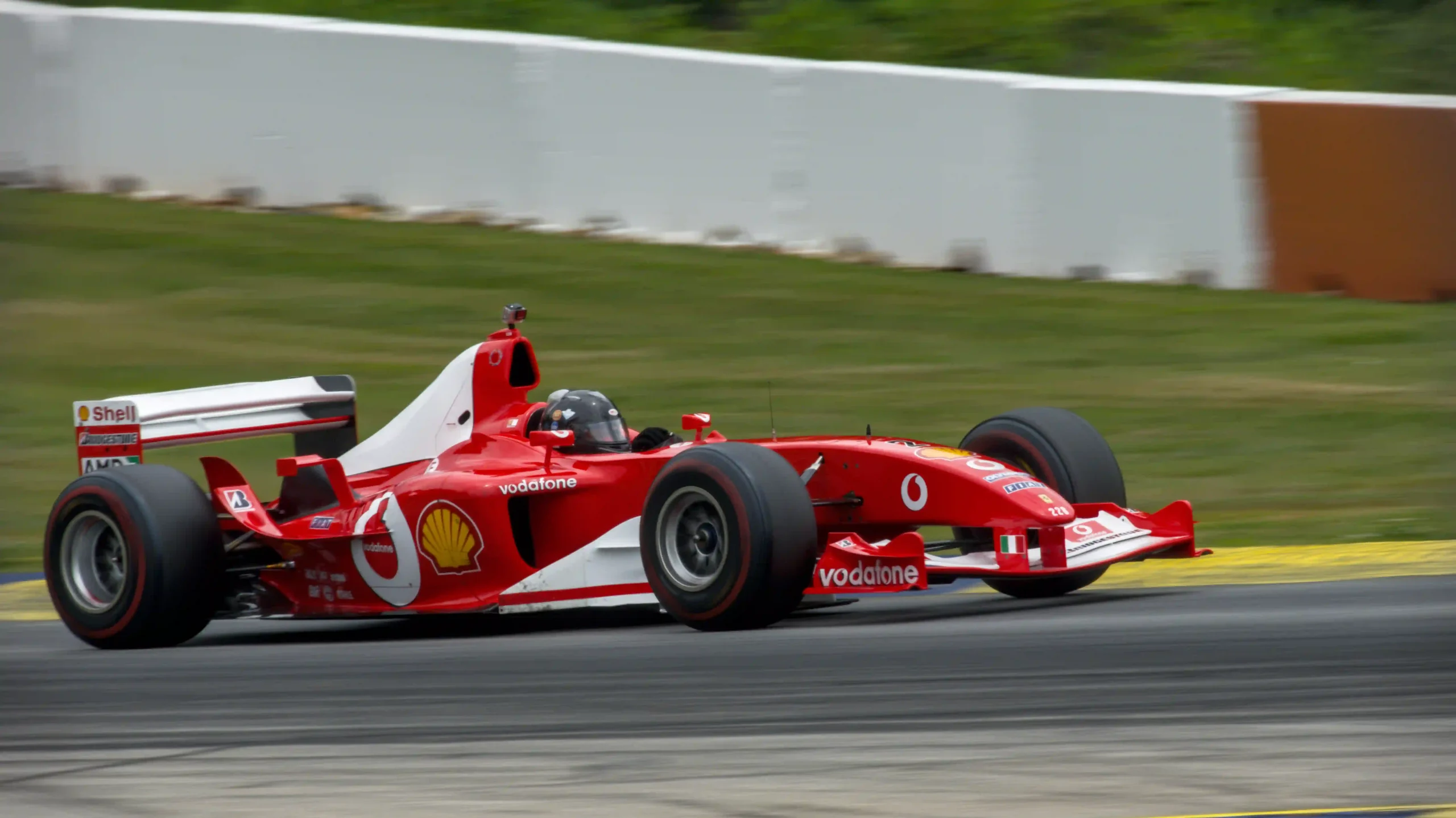
Hypercar, LMP2 and LMGT3: Why Le Mans Has Three Races at Once
The 2026 race used Hypercar, LMP2 and LMGT3. Hypercar competes for the overall victory, LMP2 is an independent-team prototype class, and LMGT3 uses production-based GT3 machinery with professional and amateur drivers.
Hypercar Fights for the Overall Win
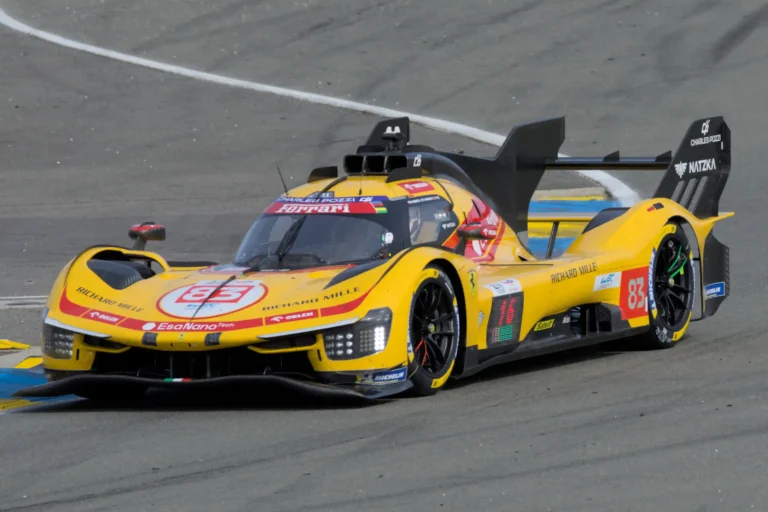
Hypercar is the top category. Cars can use LMH or LMDh regulations, and they may be hybrid or non-hybrid under the current framework.
The published baseline is 1,030 kilograms and 500kW. Michelin supplies the class, while Balance of Performance manages the field.
In 2026, Toyota defeated rivals from Alpine, Aston Martin, BMW, Cadillac, Ferrari, Genesis and Peugeot. That manufacturer range gives the category several engine sounds and design identities.
LMP2 Is a Pure Prototype Class for Independent Teams
LMP2 cars are closed-cockpit prototypes using the Oreca 07-Gibson platform at the current race. Their speed sits between Hypercar and LMGT3.
Driver lineups combine professionals with categorized drivers. That requirement keeps team selection and driver development important.
Inter Europol Competition finished first and second in the 2026 class. The #43 car took its second consecutive Le Mans LMP2 victory.
LMGT3 Connects Le Mans With Road-Car Brands
LMGT3 is based on the global FIA GT3 platform. Cars resemble production models from brands such as Corvette, Aston Martin, BMW, Ferrari, Ford, Lexus, McLaren, Mercedes-AMG and Porsche.
Balance of Performance controls power and weight. Lineups include professional and amateur-rated drivers, which creates another strategic layer.
TF Sport’s Corvette climbed from 17th in class to win in 2026. The result gave Corvette its first LMGT3 victory and tenth Le Mans class win.
A separate technical comparison covers Ferrari, Toyota and Porsche WEC Hypercars.
Which Is Faster: F1 or a Le Mans Hypercar?
Yes. F1 has the stronger power-to-weight ratio, more peak downforce and shorter braking distances. Hypercars can reach about 330 km/h at Le Mans, but they are optimized for efficiency and repeatable endurance pace.
F1 Wins the Complete Lap
Formula 1’s own current overview describes cars running beyond 370 km/h. Track layout and aerodynamic settings determine the actual maximum.
More importantly, the car brakes and corners at a much higher level. Its 770-kilogram minimum is 260 kilograms below the Hypercar baseline.
The F1 power unit also has around 1,000 horsepower of combined potential. Therefore, the car accelerates harder once traction is established.
Le Mans Rewards Low Drag
Circuit de la Sarthe contains long full-throttle sections. Hypercars use efficient bodywork to approach 330 km/h without consuming unnecessary energy.
The closed wheels reduce drag compared with open-wheel machinery. However, the car also carries a larger cockpit, lights and endurance cooling requirements.
A lower-drag Le Mans car may look competitive on one straight. The F1 car gains the time back under braking and through high-speed corners.
Could an F1 Car Race for 24 Hours?
An F1 car could circulate quickly at Le Mans in theory. It would not be configured to complete the event under standard Grand Prix preparation.
The power-unit allocation, cooling package, suspension life, bodywork vulnerability and lack of headlights create obvious obstacles. Refueling equipment and driver-change provisions would also require a different design.
Therefore, the thought experiment proves the point. A Le Mans Hypercar sacrifices lap time to become a complete 24-hour machine.
See how fast F1 cars go for the difference between speed-trap and lap performance.
F1 Hybrid Power Unit vs Le Mans Hybrid Systems
Every F1 car uses a 1.6-liter turbocharged V6 hybrid with a 350kW MGU-K. Le Mans Hypercars use several manufacturer-specific engines, including turbocharged V6s, turbo V8s and naturally aspirated V12s, with both hybrid and non-hybrid entries allowed.
Formula 1 Uses One Architecture
F1’s 2026 power unit retains the 1.6-liter turbo V6. The combustion side produces roughly 400kW, while the MGU-K can provide up to 350kW.
The MGU-H disappeared. Drivers now manage a much larger electrical contribution through Recharge, Boost Mode and Overtake Mode.
All teams use advanced sustainable fuel. The tight architecture keeps the competition focused on efficiency, combustion design and electrical control.
Le Mans Encourages Engine Variety
Hypercar manufacturers choose engines that fit their brand and vehicle concept. Aston Martin’s Valkyrie uses a naturally aspirated V12, while other cars use turbocharged V6 or V8 power.
LMH may use a front-axle hybrid. LMDh uses a standardized rear-axle hybrid package around a manufacturer engine and approved chassis.
However, maximum combined output remains controlled. Balance of Performance can adjust power and energy to manage competition.
Endurance Engines Need a Different Safety Margin
F1 components must survive several events within a season allocation. Yet one race lasts only a fraction of Le Mans.
A Hypercar engine must run through 24 hours of full-throttle use, heat cycles and pit-lane restarts. The team also needs consistent fuel consumption across long stints.
Consequently, Le Mans engineers may avoid a setting that gains one tenth but raises thermal risk. The fastest engine is the one that reaches Sunday afternoon.
F1 Active Aero vs Le Mans Low-Drag Aerodynamics
F1 uses the floor, diffuser and movable front and rear wing elements to create large downforce while reducing drag on straights. Le Mans bodywork targets a narrower performance window with strong efficiency, stability in traffic and reliable cooling.
F1 Generates More Downforce
The 2026 car uses Corner Mode and Straight Mode. Movable front and rear wing elements change their angle in designated high-speed sections.
Corner Mode restores aerodynamic load. Straight Mode lowers drag and helps the car use its electrical power more effectively.
The floor remains a major performance area. Every constructor develops airflow around the front tires, floor edges and diffuser.
Hypercars Need Predictability for Hours
A Le Mans car must remain stable behind slower traffic, over bumps and through crosswinds on public-road sections. Sudden aero balance changes create fatigue and accident risk.
Covered wheels reduce open-wheel turbulence. A central fin improves yaw stability when the car spins at high speed.
Moreover, cooling openings must protect brakes, engine and hybrid systems through changing temperatures. Extra cooling costs drag, but insufficient cooling can end the race.
Traffic Changes the Ideal Setup
An F1 driver follows cars with similar braking points and corner speeds. A Hypercar repeatedly catches LMGT3 machinery traveling much more slowly.
The prototype must remain controllable while leaving the clean line. That requirement can be worth more than a tiny qualifying gain.
For the basic physics, read the downforce explainer and the slipstream guide.
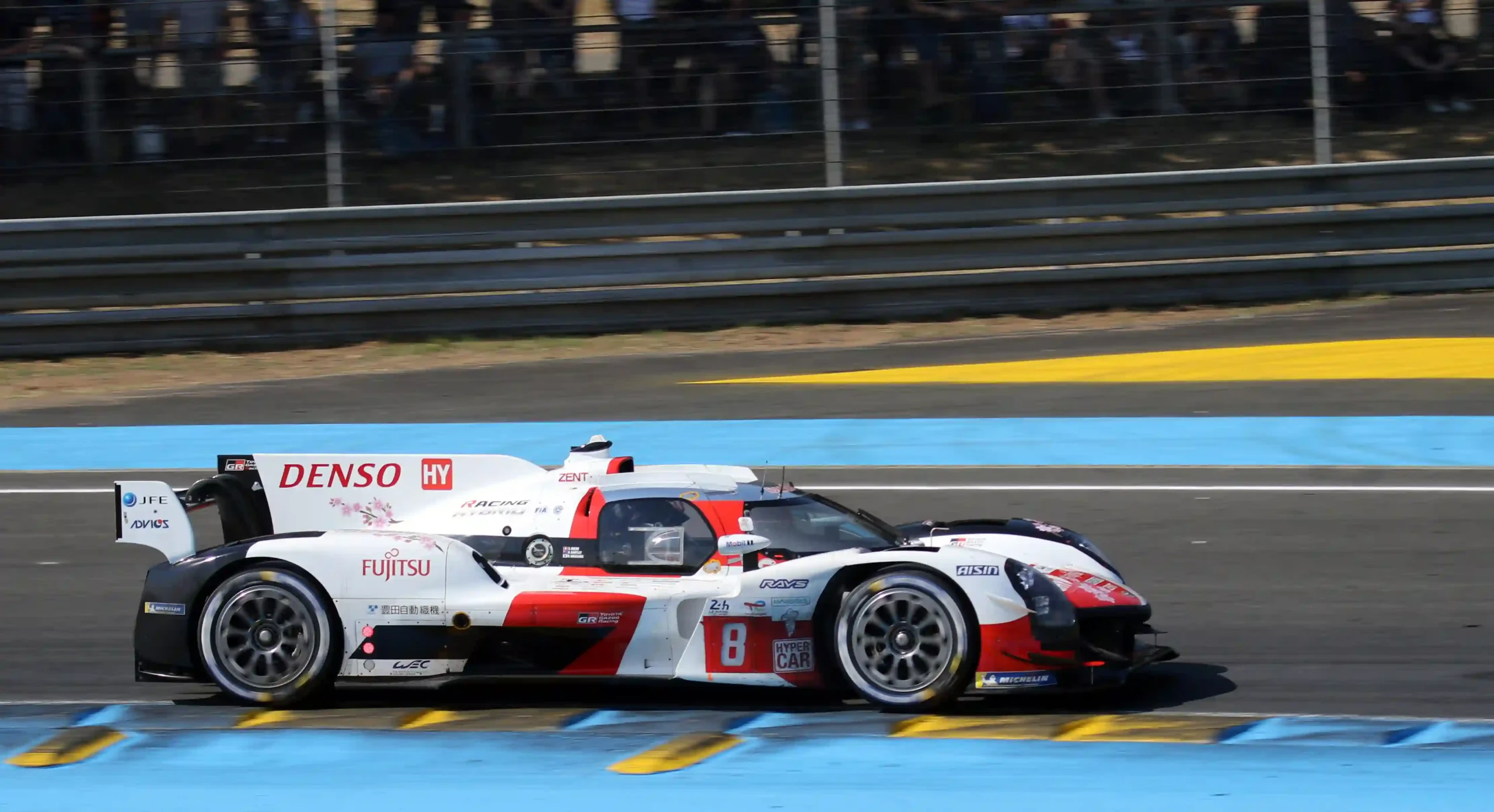
F1 Q1, Q2 and Q3 vs Le Mans Hyperpole
F1 uses three knockout sessions in one qualifying hour. Le Mans first filters each class through qualifying, then uses Hyperpole stages to decide the front positions while involving the drivers across each car’s three-person crew.
Formula 1 Qualifying Rewards Repeated Maximum Laps
The full grid competes in Q1. The slowest six cars are eliminated in the current 22-car field.
Q2 removes another six, leaving ten for Q3. Each driver manages tire preparation, traffic and track evolution alone.
Because the car is designed for one driver, the qualifying setup reflects that driver’s preferences. Teammates use separate cars and can choose different approaches.
The 2026 Le Mans Format Shared the Pressure
Initial qualifying selected the top 15 cars in each category. Hyperpole 1 then reduced the field before Hyperpole 2 decided the leading grid places.
The revised format required all three drivers to contribute across the progression. That structure tested the complete crew rather than one dedicated qualifier.
BMW ultimately took the 2026 Hypercar pole after the fastest Cadillac received a penalty. Forestier Racing by Panis led LMP2, while Heart of Racing topped LMGT3.
Traffic Is a Bigger Le Mans Problem
A Formula 1 driver may encounter another car on a flying lap. At Le Mans, three classes and a 13.626-kilometer circuit create more varied closing speeds.
One slower car at Indianapolis or the Porsche Curves can ruin a lap. Drivers need a clean gap but also benefit from a useful slipstream on long straights.
Learn the underlying principles through the F1 qualifying guide and the wider motorsport qualifying explainer.
Standing Start vs Rolling Start
F1’s smaller, single-class grid can launch safely from marked boxes. Le Mans uses a rolling start to organize a much larger multi-class field and reduce the immediate speed differences between prototypes and GT cars.
The F1 Start Is a Performance Event
Drivers stop in individual grid boxes. When the lights go out, clutch control and rear-tire grip decide the launch.
The first corner often creates the race’s largest concentration of risk. Cars arrive side by side with cold tires and heavy fuel.
Le Mans Builds Speed Behind the Pace Car
The field completes formation running before the race begins. Drivers then accelerate across the line in organized groups.
A rolling start reduces the need to launch 62 cars from rest. It also lets the field approach the opening corners with some tire and brake temperature.
However, the opening lap remains intense. Hypercars fight for overall position while every class begins its own contest.
F1 Pit Stops vs Le Mans Refueling and Service
F1 stops mainly to change tires, often in less than two seconds, and race refueling is banned. Le Mans stops combine fuel, tires, driver changes, cleaning, adjustments and repairs under limits on crew numbers and overlapping work.
F1 Measures Stationary Time in Tenths
Each wheel has dedicated crew members. Front and rear jacks lift the car while four wheel guns release single nuts.
The driver remains inside, and no fuel enters the car. A front-wing adjustment or nose replacement adds time.
Therefore, F1 strategy separates tire performance from fuel. The car starts with enough fuel to finish.
Le Mans Stops Serve the Whole Vehicle
Refueling determines the basic stint length. Teams may then change tires, rotate drivers, clean lights and windscreen, or inspect bodywork.
Regulations restrict how many people work on the car. They also define which procedures can occur together.
The slowest-looking stop can still be the fastest strategy. Keeping a durable tire set saves wheel-change time and lets the car leave after refueling.
Repairs Can Preserve a Result
Le Mans mechanics prepare complete replacement sections. A nose or rear body panel can be changed within minutes.
More serious work may require the garage. The clock never stops, so every repair decision compares likely gain with lost laps.
F1 teams would usually retire after equivalent damage. A 90-minute race offers no time to recover ten garage laps.
See how pit stops work across racing and why F1 banned race refueling.
F1 Strategy vs Le Mans Endurance Strategy
Le Mans contains more strategic variables across 24 hours, including fuel, tires, drivers, traffic, repairs, weather and reliability. F1 strategy is more compressed, so one mistimed stop or Safety Car can have a larger immediate effect.
Formula 1 Strategy Is a Short Tactical Fight
F1 teams predict tire degradation and pit-lane loss. They then decide whether to undercut, overcut or extend a stint.
A Virtual Safety Car can reduce pit-stop loss. A late Safety Car may create a free tire change or destroy an earlier advantage.
Energy deployment now adds another layer. Drivers balance Recharge, Boost and Overtake Mode under the 2026 rules.
Le Mans Strategy Begins With Fuel Windows
A full tank defines the basic stint. The team calculates laps per fill and watches the energy remaining as the driver approaches pit entry.
One extra lap per stint can remove a final splash of fuel. However, aggressive saving may cost track position or increase traffic exposure.
The team also decides whether to double stint or triple stint tires. Track temperature, rubber buildup and driver confidence influence that choice.
Driver Rotation Is a Competitive Tool
Not every driver has the same strength. One may be best at night, while another manages tires or traffic more effectively.
Teams schedule rest, meals, debriefs and preparation around future stints. A driver awakened too late may not be physically ready.
Consequently, strategy links human performance with fuel and tire cycles. The car cannot be planned without the crew.
The Final Hour Can Become a Sprint
After 23 hours, reliability margins may disappear. Teams release their fastest driver and use every remaining tire advantage.
A small fuel shortfall creates a splash-and-dash stop. A late Safety Car can compress hours of work into a final restart.
That contrast defines Le Mans. The race is an endurance calculation until it suddenly becomes a qualifying fight.
One F1 Driver vs Three Le Mans Drivers
Le Mans requires a team of drivers because the race lasts 24 hours and regulations limit individual driving time. Rotations manage fatigue, darkness, heat and changing conditions while keeping the car competitive.
F1 Builds the Car Around One Driver
One driver completes qualifying and the Grand Prix. The seat, pedals, steering wheel and control preferences are highly personalized.
The teammate has another chassis. Therefore, neither driver compromises cockpit fit or setup for the other.
Le Mans Drivers Share One Cockpit
Three drivers use the same steering position, pedal system and mirrors. Seat inserts and padding help different body sizes fit safely.
The compromise extends to setup. One driver may prefer oversteer, while another needs a stable rear axle during night traffic.
A great endurance setup is not always perfect for one driver. It must give every driver enough confidence to avoid mistakes.
Rest Is Part of Race Performance
Drivers leave the car, debrief engineers, eat, hydrate and attempt to sleep. Noise and adrenaline make proper recovery difficult.
They may return several hours later to a different track. Temperature can fall, rain may arrive and rubber levels can change.
This ability to reset is a specialist skill. Former F1 drivers often need time to learn it, as explored in the 2026 former-F1-driver Le Mans report.
Multi-Class Traffic: The Skill F1 Does Not Replicate
Hypercars, LMP2s and LMGT3s race simultaneously but compete for separate class results. Faster prototypes must pass responsibly, while slower cars hold predictable lines and continue their own battles.
Closing Speed Can Be Enormous
A Hypercar can approach an LMGT3 car rapidly on the Mulsanne Straight. At night, the GT driver sees bright headlights before identifying the exact gap.
The prototype driver chooses whether to pass before the braking zone or wait. A poor decision can cost several seconds or cause a major crash.
Slower Cars Are Not Passive Obstacles
An LMGT3 driver may be fighting for a class lead. Moving off line can cost tire temperature or position.
Therefore, the faster car carries much of the passing responsibility. Predictability matters more than courtesy that changes at the last moment.
Traffic Luck Changes Lap Time
One Hypercar may clear three GT cars before the Porsche Curves. Its rival may catch the same group at the corner entry.
The difference can reach several seconds without either driver making an error. Over 24 hours, luck tends to move between teams but never disappears.
2026 Produced 29,446 Overtakes
Official post-race statistics counted 29,446 overtakes in the 2026 event. Of those, 101 changed the overall lead.
The figure reflects 62 cars sharing the circuit. Traffic is not a side effect at Le Mans; it is one of the race’s defining performance variables.
Reliability: Why Le Mans Cars Cannot Chase F1 Pace
A Le Mans car runs continuously for 24 hours, so every component needs a larger durability margin and quick service access. F1 components also face strict life requirements, but each race is much shorter and the car is optimized for higher peak performance.
Heat Is the Constant Enemy
Engines, gearboxes, brakes and hybrid systems produce heat. Cooling must remain effective in traffic and during hot afternoon conditions.
Night air may lower temperatures, yet it can also change tire behavior and windscreen fogging risk. Engineers monitor trends rather than one reading.
Small Problems Become Large Failures
A vibration may signal a wheel bearing, driveshaft or body panel problem. Continuing for another stint could turn a quick repair into retirement.
Teams use telemetry and driver reports to decide when to intervene. The safest repair time may coincide with a scheduled fuel stop.
Repairability Can Beat Perfect Reliability
No team can guarantee an incident-free day. A winning design must allow mechanics to reach common failure points quickly.
Connectors, body fasteners and modular assemblies save minutes. Those details rarely appear in a specification table, but they decide endurance races.
Formula 1 values the same discipline, although the shorter event changes the return. A part that takes 15 minutes to replace has little Grand Prix value.
Safety Car, Virtual Safety Car, Full Course Yellow and Slow Zones
An F1 Virtual Safety Car reduces speed around the entire circuit through a delta time. A Le Mans Slow Zone limits speed only in a defined section, allowing the rest of the 13.626-kilometer lap to remain under normal racing conditions.
F1 Uses Whole-Circuit Neutralization
A Safety Car gathers the field behind one physical car. The Virtual Safety Car instead gives every driver a target time delta.
Both procedures change pit-stop economics. A driver loses less relative time when the field is moving slowly.
Le Mans Needs More Local Tools
The circuit is too long to neutralize every minor incident efficiently. A Slow Zone protects marshals in one section while racing continues elsewhere.
Full Course Yellow slows the entire field without grouping every car. A major incident can still trigger Safety Cars and a complex restart process.
In 2026, the official statistics recorded two Safety Car interventions. The race also used local procedures to keep recovery work safe.
Neutralization Can Split Strategies
A car near pit entry may stop immediately. Another may need to complete almost a full lap at reduced speed before reaching fuel.
Class position and Safety Car placement can magnify the effect. Endurance teams therefore model several restart scenarios.
Compare the concepts with the motorsport Safety Car guide and the racing-flags explainer.
Night Racing, Weather and the Changing Circuit
Drivers depend on headlights while judging closing speed, traffic and braking points above 300 km/h. Temperatures fall, visibility changes and fatigue grows, so the same setup can feel very different after sunset.
Headlights Create Information and Confusion
Prototype drivers flash lights to announce an overtake. LMGT3 drivers still need to identify where the faster car will go.
Mirrors fill with glare, especially in spray or dust. The safest pass may require patience even when the car behind is much faster.
Track Temperature Changes Tire Strategy
Afternoon heat can overwork a soft tire. The same compound may become ideal after midnight.
Teams watch surface temperature, wind and humidity. They also consider which driver has the strongest confidence in cold conditions.
Rain Rarely Falls Everywhere at Once
Circuit de la Sarthe is long enough for one section to be wet while another remains dry. Public-road surfaces also drain differently.
A driver may leave the pits on slicks and encounter rain at Mulsanne. Another may accept a slow first sector on wets because heavier rain is approaching.
Formula 1 faces similar crossover decisions. However, a Grand Prix has fewer hours for weather patterns to reverse repeatedly.
F1 Tire Compounds vs Le Mans Double Stints
F1 strategy often chooses between nominated compounds and the timing of an undercut. Le Mans strategy asks whether a tire can survive two or three fuel stints without losing more time than a wheel change would cost.
F1 Tires Create Planned Performance Phases
Pirelli nominates three dry compounds for each weekend. Drivers normally must use two different slick compounds in a dry Grand Prix.
The softer tire produces stronger short-run grip. The harder tire usually provides longer life and more strategic flexibility.
Le Mans Tires Must Work Across Hours
Michelin supplies Hypercar, while other categories use their designated suppliers. Teams judge tire life through fuel cycles rather than a simple lap target.
Keeping one set for a second stint saves pit time. However, the driver must manage reduced grip and changing temperature.
Punctures Carry Greater Consequences
A puncture near pit exit can force almost a full 13.626-kilometer lap at low speed. The damaged tire may also destroy bodywork.
Drivers avoid debris when possible, but multi-class traffic spreads rubber and carbon across the circuit. Risk grows through the night.
F1 also suffers punctures, yet the shorter lap usually reduces the distance back to the pits. Le Mans turns location into part of tire risk.
F1 Halo vs the Le Mans Closed Cockpit
Both use carbon-fiber survival cells, HANS, fire-resistant equipment and strict FIA crash standards. F1 adds the open-cockpit Halo, while Le Mans prototypes use a roof, windscreen, doors and rollover structures suited to enclosed endurance cars.
Formula 1 Protects an Open Cockpit
The Halo diverts large debris and another car away from the driver’s head. Front, rear and side crash structures absorb energy around the monocoque.
Wheel tethers reduce detached-wheel risk. The driver remains secured by a six-point harness and HANS.
Le Mans Adds Enclosed-Cockpit Risks
A roof protects against debris and weather. However, doors and extraction routes must remain usable after a crash.
Teams also manage windscreen damage, cockpit heat and visibility. Hybrid cars require high-voltage isolation procedures for marshals.
Traffic Creates Unique Accident Scenarios
F1 crashes usually involve vehicles with similar speed. Le Mans accidents can begin with a prototype closing rapidly on a GT car.
Night, spray and class battles can reduce reaction time. Therefore, driver cooperation and predictable lines become safety systems.
The wider causes are explained in the motor-racing crash guide.
Costs and Team Scale
Formula 1 generally requires the larger annual budget because each team designs and develops a unique car across a long global season. A factory Hypercar program is still extremely expensive, but cost controls, homologation and shared LMDh components reduce continuous development.
F1 Funds a Permanent Development Race
A constructor operates design offices, manufacturing, simulation, wind tunnels and a traveling race team. New parts arrive throughout the season.
The cost cap controls defined spending, but several major areas remain outside it. Power-unit programs follow separate financial rules.
Le Mans Programs Concentrate Resources
An LMH manufacturer can design a bespoke prototype. An LMDh manufacturer uses an approved chassis spine and common hybrid hardware.
Both routes require testing, engines, software, spares and a large endurance crew. However, homologation restricts constant performance changes.
One Le Mans Entry Still Needs Depth
The pit crew works through the night. Engineers rotate, mechanics prepare replacement parts and strategists monitor three classes.
A single car also needs three drivers, seat systems and personal equipment. The event is one race, but it demands a complete temporary organization.
History, Prestige and the Triple Crown
An F1 World Championship is the broader season-long achievement. An overall Le Mans victory is one of motorsport’s greatest individual race wins. Their prestige is different rather than directly rankable.
Formula 1 Rewards a Full Season
A champion must score across many circuits and conditions. Driver and constructor standings measure consistency through the entire year.
One Grand Prix victory matters, but it does not equal the title. The championship remains Formula 1’s defining prize.
Le Mans Creates a Once-a-Year Test
The race began in 1923 and has grown into an international engineering landmark. Manufacturers build programs specifically to win it.
Porsche leads the all-time manufacturer victory list. Ferrari, Audi, Toyota, Jaguar, Bentley and Ford also carry defining Le Mans histories.
The Triple Crown Links F1 and Le Mans
The unofficial Triple Crown combines the Monaco Grand Prix, Indianapolis 500 and 24 Hours of Le Mans. Graham Hill remains the only driver to complete it.
Several F1 champions have won Le Mans, including Fernando Alonso. Mario Andretti’s career across disciplines remains another reminder that great drivers can master very different forms of racing.
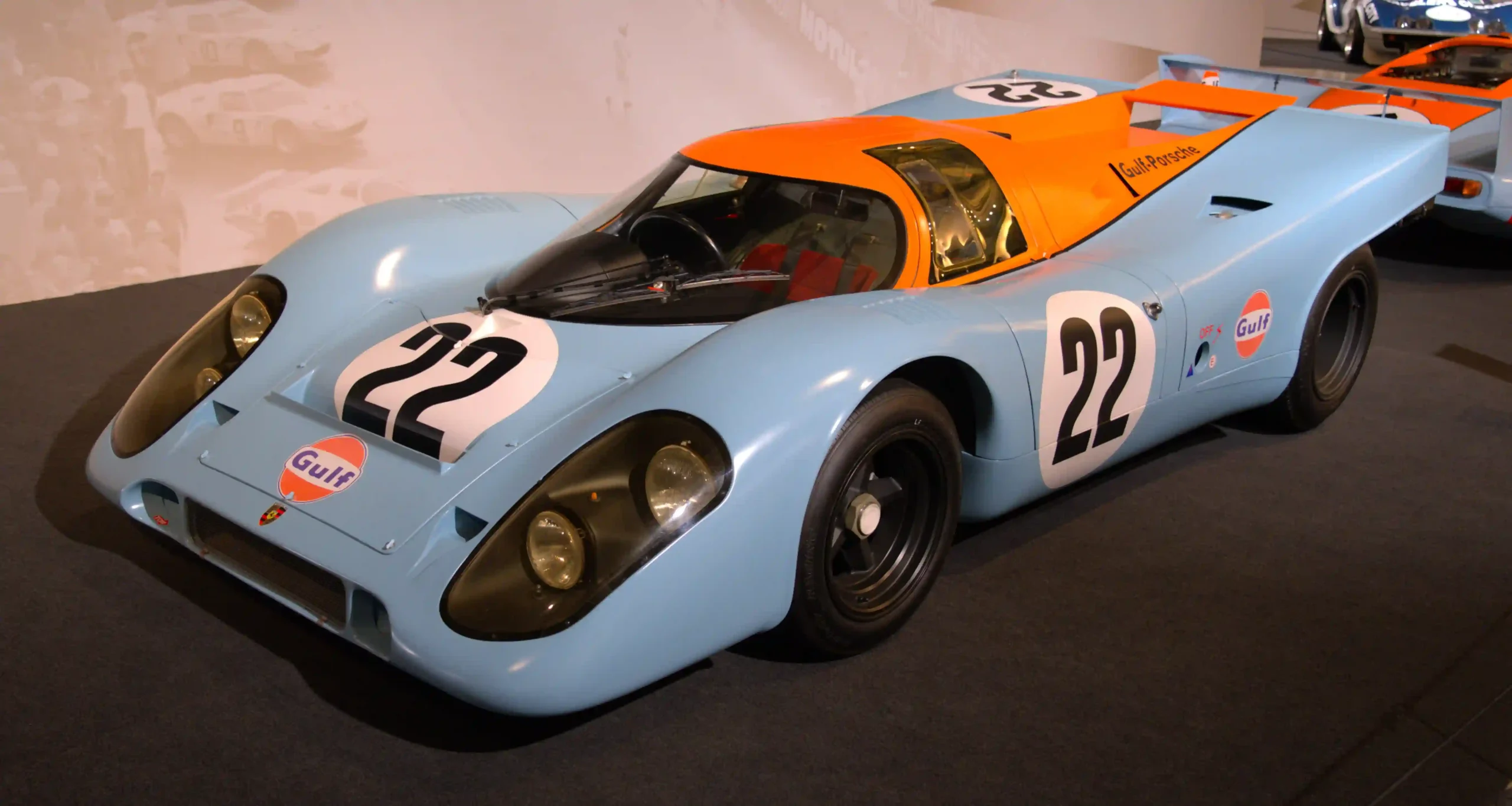
What the 2026 Season Changed
Formula 1 Entered Its Active-Aero Era
The 2026 chassis became shorter and narrower. Minimum weight fell to 770 kilograms, while drag dropped substantially.
Active front and rear wings introduced Corner and Straight modes. Overtake Mode replaced the old DRS advantage for a following driver within one second.
The MGU-K rose from 120kW to 350kW, creating a near-even split between combustion and electrical power. Drivers now manage energy more visibly throughout the lap.
Toyota Returned to the Top at Le Mans
The #7 Toyota GR010 Hybrid won the 94th running on June 14, 2026. Mike Conway, Kamui Kobayashi and Nyck de Vries delivered Toyota’s sixth overall victory.
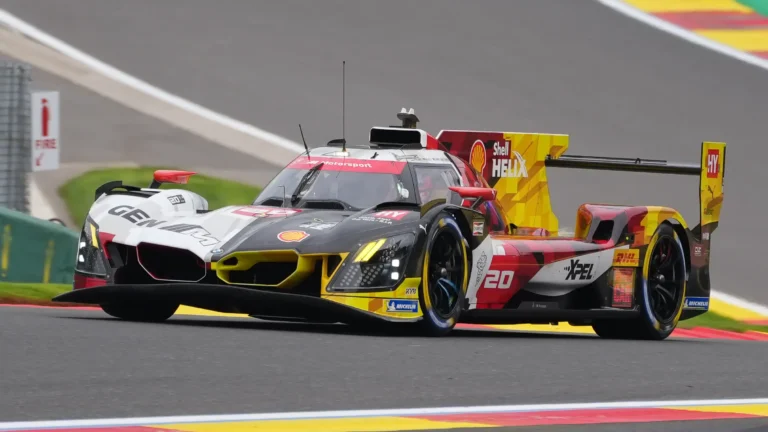
The sister #8 Toyota finished second. BMW’s #20 completed the overall podium, while Cadillac remained part of the final multi-manufacturer fight.
World of Speed’s full account is available in the 2026 Le Mans results report.
Inter Europol and Corvette Won Their Classes
Inter Europol Competition’s #43 Oreca won LMP2. The team also finished second with the #343 entry.
TF Sport’s #33 Corvette Z06 LMGT3.R won LMGT3. Nicky Catsburg, Jonny Edgar and Ben Keating recovered from 17th on the class grid.
The Numbers Showed the Scale
The 2026 field contained 62 cars and 186 drivers. Official statistics counted 1,963 marshals around the 13.626-kilometer circuit.
The race produced 29,446 overtakes and two Safety Car interventions. Those figures explain why Le Mans strategy cannot be reduced to one fuel calculation.
Final Score: Which Wins Each Category?
Formula 1 wins when the comparison asks for the fastest complete circuit car. It has the stronger power-to-weight ratio and greater aerodynamic load.
Le Mans wins when the comparison asks for strategic breadth. The event combines three classes, three-driver crews, fuel stops and full garage repairs.
Neither discipline is a lesser version of the other. F1 concentrates engineering into a short, precise Grand Prix.
Le Mans stretches engineering across day, darkness and fatigue. The final result depends on how well every department manages risk.
F1 vs Le Mans FAQs
Which is faster, an F1 car or a Le Mans Hypercar?
An F1 car is faster over a circuit lap because it is lighter, more powerful and produces more downforce. A Hypercar is designed to sustain competitive pace for 24 hours.
How is an F1 Grand Prix different from the 24 Hours of Le Mans?
An F1 Grand Prix usually runs just over 305 kilometers with one driver per car. Le Mans runs for 24 hours with three drivers, three classes, refueling and extensive service.
Why do Le Mans cars change drivers?
The race is too long for one person to complete safely or legally. Three drivers rotate to manage fatigue, night conditions, weather and regulated driving-time limits.
Which requires more strategy, F1 or Le Mans?
Le Mans has more total variables across 24 hours. F1 strategy is more compressed, so one tire decision or Safety Car can create a larger immediate swing.
Conclusion: F1 Chases the Fastest Lap, Le Mans Chases the Complete Day
The F1 vs Le Mans argument begins with speed. Formula 1 wins that measurement clearly.
A 2026 F1 car weighs 770 kilograms and combines a turbo V6 with a 350kW MGU-K. Its total potential sits around 1,000 horsepower.
A Le Mans Hypercar starts from a 1,030-kilogram minimum and 500kW maximum output. Balance of Performance can further shape its event specification.
Therefore, the F1 car accelerates, brakes and corners harder. It is the more extreme lap-time machine.
However, Le Mans does not ask for one qualifying lap. It asks for a complete day of useful performance.
The car must cross hot afternoon asphalt, cold night air and a changing Sunday morning circuit. It also needs lights, wipers and a closed cockpit.
Formula 1 teams build bespoke constructors’ cars. Every floor, wing and cooling package forms part of the competition.
Le Mans combines LMH and LMDh in Hypercar. It also places LMP2 and LMGT3 machinery on the same track.
That multi-class structure changes racecraft. A Hypercar driver may complete several passes within one sector.
None of those passes is routine. A GT car could be fighting for its class lead while the prototype approaches at a much higher speed.
The 2026 race produced 29,446 overtakes. That statistic captures the density of the challenge.
Qualifying also reflects each championship’s character. F1 uses Q1, Q2 and Q3 for one driver in one car.
Le Mans uses qualifying and Hyperpole across classes. The 2026 format required all three crew members to contribute.
Pit stops create an even larger contrast. F1 changes four tires in less than two seconds and never refuels during the race.
Le Mans stops for fuel throughout the event. Teams also change tires, rotate drivers, clean lights and repair damage.
A fast Le Mans stop does not always include new tires. Double stinting can save more time than fresh rubber gains.
Strategy therefore develops across several time scales. F1 calculates laps and seconds.
Le Mans calculates laps, hours and the condition of the machine at sunrise. Reliability becomes part of performance.
Driver skill also changes. F1 creates greater peak g-force and demands immediate precision.
Le Mans adds traffic, darkness and repeated stints. A driver must return after rest and adapt to a different circuit.
Safety systems share a strong FIA foundation. Both use survival cells, HANS and fire-resistant equipment.
F1 protects an open cockpit with Halo. Le Mans prototypes use roofs, windscreens, doors and high-voltage procedures.
Prestige cannot be settled by one ranking. An F1 World Championship measures excellence across a season.
An overall Le Mans victory measures whether a manufacturer, team and three drivers mastered motorsport’s most famous endurance race.
The latest result showed the formula. Toyota won in 2026 through pace, execution and reliability.
Inter Europol repeated its LMP2 success. TF Sport’s Corvette recovered from 17th in class to win LMGT3.
Those results came from different cars and different races happening at the same time. That complexity is Le Mans.
Formula 1 remains the faster technical sprint. Le Mans remains the more complete endurance examination.
Together, they show that motorsport can define excellence in more than one way.
Sources and Fact-Checking
This article was checked on July 31, 2026 against current Formula 1, FIA WEC and Automobile Club de l’Ouest material. The 2026 Le Mans winners and statistics describe the completed race held on June 13–14, 2026.
- Formula 1: 2026 Active Aero, Overtake Mode, dimensions and power-unit terminology
- 24 Hours of Le Mans: 2026 Hypercar weight, power, manufacturers and class overview
- 24 Hours of Le Mans: Toyota’s official 2026 overall victory report
- 24 Hours of Le Mans: Official 2026 race statistics, overtakes and safety-car interventions