What Is a Slow Pit Stop in F1? Causes and Impact Explained
There is no official “slow” cutoff in Formula 1. But when elite crews live near two seconds, one extra second can change track position, ruin an undercut or drop a driver into traffic.
Formula 1 has no official time that defines a slow pit stop. However, modern elite tyre-only stops are commonly around 2.0–2.3 seconds, so a stop above roughly three seconds is noticeably slow by current competitive standards. Four or five seconds can seriously damage track position, while much longer stops usually involve a major problem, penalty, traffic hold or extra repair work.
A three-second pit stop sounds impossibly fast. In modern Formula 1, it can still be a disappointing one.
That is the strange reality of F1 pit-stop performance. The benchmark is not what an ordinary person considers fast. The benchmark is what rival crews can do under the same race conditions.
Formula 1’s technical breakdown describes a solid modern stop at roughly 2.2 seconds, while McLaren’s 1.80-second Qatar 2023 stop remains the world record. Therefore, a delay of eight or nine tenths is not a small percentage change. It can be almost half the normal stationary time.
The 2026 DHL Fastest Pit Stop results make the current standard easy to see. Through the Hungarian Grand Prix, the 11 race-winning fastest-stop times ranged from 1.99 to 2.30 seconds. Their average is 2.14 seconds by World of Speed calculation.
However, stationary time is only one part of a pit stop. Drivers also lose time entering the lane, respecting the pit-lane speed limit and accelerating back onto the circuit.
This guide explains what is a slow pit stop in F1, why stops become slow, and how one lost second can affect an undercut, track position and the rest of a race.
There Is No Official F1 Definition of a “Slow Pit Stop”
The first point matters because it prevents a common mistake. Neither Formula 1 nor the FIA publishes a rule saying that 3.0 seconds, 3.5 seconds or any other figure automatically counts as a slow pit stop.
Instead, pit-stop speed is judged relative to what competitive crews can achieve. Formula 1’s own technical feature uses a solid 2.2-second stop as its working example.
The sport’s fastest teams regularly sit close to two seconds when the stop involves a straightforward four-tyre change. Therefore, a three-second stop is still objectively quick in everyday terms but slow compared with the front of the F1 pit lane.
This is why TV commentators may describe a 2.8-second or 3.1-second service as “slow.” They are comparing it with the expected two-second rhythm, not with a regulation.
For a broader explanation of the process, see our guide to how pit stops work in racing.
| Stationary Time | Modern Interpretation | Likely Race Effect |
|---|---|---|
| Under 2.3s | Elite modern tyre-only territory. | Usually protects the planned strategy if release is safe. |
| 2.3–2.9s | Still competitive, but slower than the best crews. | May cost a few tenths without changing position. |
| 3.0–3.9s | Noticeably slow by modern elite standards. | Can erase a small undercut margin or rejoin gap. |
| 4.0–5.9s | Significant delay for a normal tyre-only stop. | Often risks losing track position or clean air. |
| 6.0s+ | Usually points to a major issue, a hold, a penalty or extra work. | Can transform the driver’s race completely. |
Important: The table above is a World of Speed analytical benchmark based on modern competitive performance. It is not an FIA classification or sporting regulation.
What the 2026 Fastest Pit Stop Data Says
The cleanest way to understand modern expectations is to look at actual race-winning pit-stop data.
Through the 2026 Hungarian Grand Prix, Formula 1’s official DHL Fastest Pit Stop Award lists 11 winning times. Every one sits between 1.99 and 2.30 seconds.
That does not mean every stop by every team lands in that range. The award records the fastest stop at each Grand Prix. Still, the list shows what a properly executed modern stop can look like under race conditions.
| Grand Prix | Team | Winning Stop |
|---|---|---|
| Australia | Mercedes | 2.17s |
| China | Ferrari | 2.29s |
| Japan | Ferrari | 2.00s |
| Miami | Racing Bulls | 2.08s |
| Canada | Racing Bulls | 2.20s |
| Monaco | Mercedes | 2.17s |
| Barcelona-Catalunya | McLaren | 2.13s |
| Austria | Racing Bulls | 2.03s |
| Great Britain | Mercedes | 2.18s |
| Belgium | Ferrari | 2.30s |
| Hungary | Racing Bulls | 1.99s |
The average of those 11 winning times is exactly 2.14 seconds. Again, that is a World of Speed calculation of race-winning stops, not the average of every stop completed in the season.
That distinction matters for SEO and for readers. Calling 2.14 seconds “the average F1 pit stop” would be misleading because the data set contains only each race’s winning stop.
However, the figure is useful as a front-running benchmark. A three-second stop is 0.86 seconds slower than that 2.14-second average. In Formula 1 strategy, 0.86 seconds can be enormous.
Is a 3-Second Pit Stop Slow in F1?
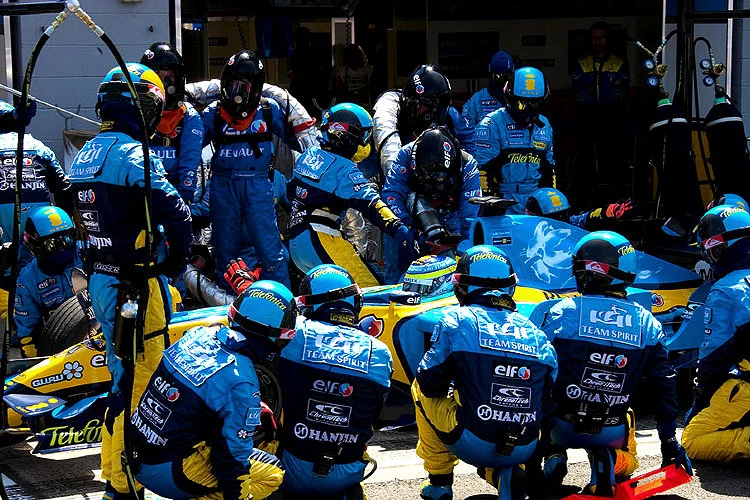
There is no official three-second cutoff. However, a three-second tyre-only stop is slow relative to modern elite F1 performance. When race-winning stops frequently sit near two seconds, a three-second service can give away roughly a second compared with a leading crew.
One second rarely sounds dramatic to a casual viewer. On track, it can decide whether a driver rejoins in front of a rival or directly behind them.
Suppose Driver A enters the pits with a 0.7-second effective margin over Driver B after accounting for the normal stop. If Driver A’s crew loses another second, the strategic position can flip.
That is why a stop does not need to last 10 seconds before it becomes damaging. A 3.1-second service can be enough to lose an undercut battle.
Meanwhile, a 2.7-second stop may be perfectly acceptable if the car has a safe gap. Context always matters.
For more on track-position value, see our grid position explainer.
What Causes a Slow F1 Pit Stop?
Slow F1 pit stops can come from wheel-gun problems, stuck or cross-threaded wheel nuts, a wheel that will not seat correctly, missed jack points, inaccurate driver positioning, late pit calls, pit-lane traffic or extra repair work. Because all four wheel crews operate together, one unfinished task can hold the entire car.
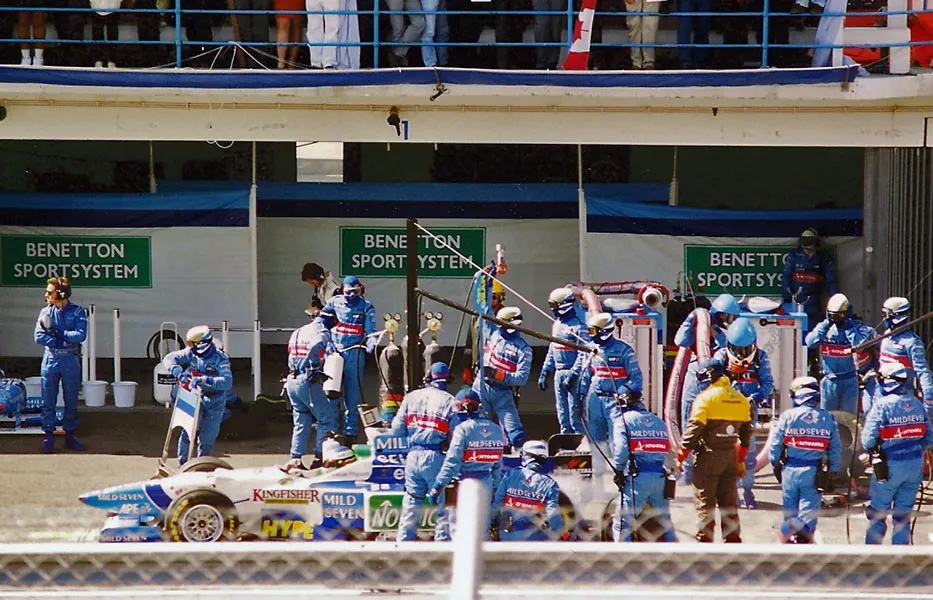
A Formula 1 stop is fast because most of the work happens in parallel. The four wheel crews operate at the same time while front and rear jacks raise the car.
That parallel structure creates a simple rule: the whole car waits for the slowest essential task.
Three wheels can be fully fitted, but the driver cannot leave if the fourth nut is not secure. The rear jack can be ready, but the car cannot drop if one corner still needs work.
Formula 1’s technical breakdown specifically mentions a misfiring gun, a stuck nut and a car stopping out of position as abnormal situations crews train to handle.
Those are the classic mechanical and human causes. Strategy and traffic create another group of delays.
Wheel-Gun Problems Add Time Immediately
The wheel gun has one of the highest-pressure jobs in the entire stop. Its operator must hit the center-lock nut cleanly, release it, manage the wheel change and secure the replacement.
In a clean stop, Formula 1 says the wheel sequence can sound like two synchronized bursts. The first releases the nuts. The second secures the replacements.
If one gun misfires or comes off the nut, that corner falls behind the other three. The gunner may need to reseat the tool and try again.
A second attempt might add only a few tenths. However, that is already enough to turn a 2.1-second stop into a 2.7-second or three-second stop.
If the tool or nut is damaged, the delay becomes much larger. The crew may need backup equipment or a more careful recovery process.
This is why teams focus on repeatability, not simply maximum gun speed. A slightly controlled first engagement beats a faster movement that misses.
Our pit-stop practice guide explains why teams rehearse these movements repeatedly.
Wheel-Nut Problems Can Turn Seconds Into a Minute
Modern F1 wheels use a single center-lock nut. The system makes a clean stop extremely fast, but the nut becomes a critical single point of failure.
A cross-threaded nut engages incorrectly with the axle thread. It may refuse to move normally or may not tighten as expected.
When that happens, the mechanic cannot simply wave the car away. The wheel must be made safe before release.
Bottas: 52.4 seconds stationary in Bahrain 2024
Valtteri Bottas provided one of the clearest modern examples at the 2024 Bahrain Grand Prix. Formula 1 reported that a cross-threaded wheel nut left his Kick Sauber stationary for 52.4 seconds.
That single problem destroyed any realistic chance of recovering track position. Bottas eventually finished 19th.
The number is useful because it shows the difference between an ordinary slow stop and a mechanical failure. A four-second stop is poor by F1 standards. A 52-second stop is an emergency recovery.
Kick Sauber then suffered another cross-threaded wheel-nut problem with Zhou Guanyu at the following Saudi Arabian Grand Prix. That repetition showed why teams investigate process and hardware, not just the mechanic involved.
Driver Positioning Can Make Every Mechanic Slower
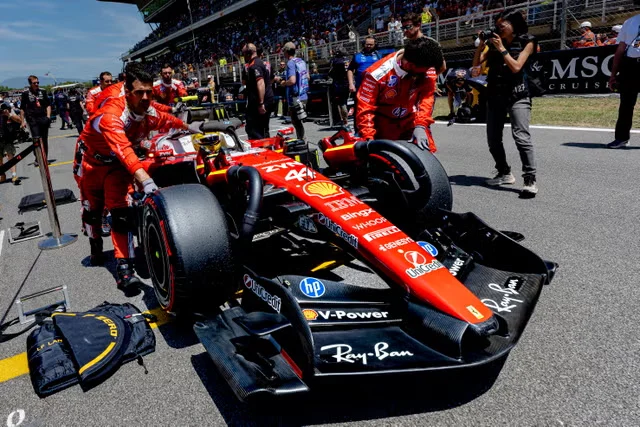
The driver is part of the pit crew even though they never leave the cockpit.
Mechanics arrange themselves around a precise stopping point. If the driver lands exactly on the marks, each wheel stops where the gunner and tyre carriers expect.
If the car stops long, short or at an angle, several people may have to move. The jack operators also lose their ideal geometry.
Formula 1 identifies a car out of position as one of the abnormal situations a wheel gunner may need to handle.
The delay may be only two or three tenths. However, that can turn a top stop into one commentators describe as slow.
Our guide to why F1 drivers lose time in pit lane covers the driver’s side of the equation.
Jack Delays Can Hold All Four Corners
The four wheel crews cannot complete their normal sequence until the car is lifted. Therefore, front and rear jack timing is foundational.
Formula 1’s reference sequence places the front jack fully engaged around 0.3 seconds into a solid stop. The rear jack follows at roughly 0.4 seconds.
The rear operator has a particularly difficult movement. They cannot stand directly behind the arriving car, so they move into place once it passes.
A missed lifting point can delay every wheel crew. That makes a jack error more expensive than a small issue at one corner.
Teams keep backup jack operators for precisely this reason. The recovery still costs time, but it prevents a broken primary jack from ending the stop completely.
Late Pit Calls Can Make the Crew Look Slow Before the Car Arrives
Sometimes the crew’s stopwatch problem starts in the strategy room.
Tyres need to be selected and moved into position. Gunners, jack operators and wheel handlers must leave the garage and arrange themselves safely around the pit box.
If the stop is called late, that preparation window shrinks.
Carlos Sainz: 12.7 seconds at Zandvoort in 2022
Ferrari’s Dutch Grand Prix stop for Carlos Sainz is a textbook example. Sainz was stationary for 12.7 seconds because the rear-left tyre was not ready when he reached the box.
Ferrari later explained that its crew normally received around 23 to 24 seconds of warning. In Sainz’s case, the team gave the crew only about 17 seconds because it reacted late to Sergio Perez’s stop.
Zandvoort’s narrow pit lane made matters worse. Ferrari said the rear-left tyre fitter could not move directly through the normal route and had to go around the other crew members.
That context matters. The stop was not simply “a mechanic forgot a tyre.” It was a chain of strategic timing, reduced preparation and pit-lane geometry.
The case also shows why a slow stop can be a team-level problem rather than one person’s mistake.
Pit Stop Time and Total Pit-Lane Time Loss Are Not the Same Thing
A two-second F1 pit stop refers mainly to the time the car is stationary in its box. The driver also loses time slowing for pit entry, travelling through the lane under the speed limit and accelerating back onto the circuit. Total pit loss is therefore much larger than the tyre-change time alone.
This distinction is one of the most important concepts in pit strategy.
The DHL Fastest Pit Stop Award focuses on stationary time. Strategy engineers care about the complete pit delta from leaving the racing line to returning to representative speed.
Therefore, a 2.1-second stop does not mean the driver loses only 2.1 seconds to a car that stays on track.
The exact total varies by circuit because pit lanes have different lengths, entry designs and exits.
A long pit lane creates a larger normal loss. A short lane creates a smaller one. Safety Car and Virtual Safety Car conditions can also change the relative cost because cars on track are travelling more slowly.
For more detail, see our F1 pit-lane speed-limit guide and Safety Car and VSC explainer.
How Much Can a Slow Pit Stop Cost?
The answer depends on the gap to surrounding cars.
If a driver has a 15-second cushion, an extra second may be frustrating but harmless. If the gap is only half a second, the same delay can change the race order.
That is why pit-stop performance must be read together with timing data.
Imagine a driver entering the stop with a projected 0.4-second advantage over a rival. A clean 2.2-second service keeps the driver ahead.
Now add one second. The car may rejoin 0.6 seconds behind instead.
The cost then grows beyond the original one second. The driver may have to overtake, run in dirty air or wait for another strategic opportunity.
Our race-timing guide explains how small gaps turn into major strategic decisions.
A Slow Pit Stop Can Ruin an Undercut
Yes. An undercut depends on pitting earlier than a rival, fitting fresher tyres and using the extra grip to gain enough time to jump that rival when they stop. Extra stationary time reduces or removes that advantage.
The undercut works because fresh tyres can deliver a faster out-lap than the rival’s worn tyres can manage on track.
However, the tyre advantage is not unlimited. If the new tyres gain 0.8 seconds but the crew loses 1.0 second, the undercut can fail before the driver leaves pit lane.
This is where the difference between a 2.1-second and 3.1-second stop becomes strategically important.
The driver can also emerge behind slower traffic. That may prevent them from using the fresh tyre advantage at all.
Consequently, pit crews are not simply trying to win a stopwatch contest. Their job protects the strategy department’s calculations.
Double-stacking adds even more pressure. Our double-stack explainer shows why a slow first stop can also delay the team’s second car.
Pit-Lane Traffic Can Make a Good Mechanical Stop Look Slow
A pit stop may be mechanically complete while the car remains stationary.
If another car is approaching in the fast lane, the release controller may hold the driver to avoid an unsafe release.
That extra time appears on the stationary clock. However, it should not automatically be blamed on the tyre crew.
The same applies when many cars pit under a Safety Car. Traffic compresses, teams double-stack and release gaps disappear.
A safe half-second hold may be much better than a penalty or collision.
Our unsafe release guide explains why the fastest mechanical stop is not always the fastest safe departure.
When race-control conditions change suddenly, crews also react to signals covered in our F1 flags explainer.
A Long Stationary Time Is Not Always a Slow Pit Crew
This is another important distinction for viewers.
If a driver must serve a five-second penalty during a pit stop, the car can sit stationary before the mechanics are allowed to work. That can make the total stop look extremely slow even when the tyre change itself is excellent.
Likewise, crews may replace a damaged front wing, remove debris or inspect a puncture. Those are additional tasks, not failed tyre changes.
A 7.5-second stationary visit that includes a five-second penalty and a 2.5-second tyre change is completely different from a 7.5-second tyre stop caused by a wheel problem.
Therefore, race analysis should separate the mechanical service time from penalty time, traffic holds and repairs whenever the data allows.
For the wider racing context, see our how car racing works guide.
Damage can also turn a routine tyre stop into a repair stop; our motorsport crash-cause guide explains why teams sometimes need extra pit-lane work after contact.
Historical Pit Stops Make Modern “Slow” Stops Look Absurdly Fast
Modern Formula 1 has trained fans to think in two-second increments. Historically, pit stops often involved very different jobs.
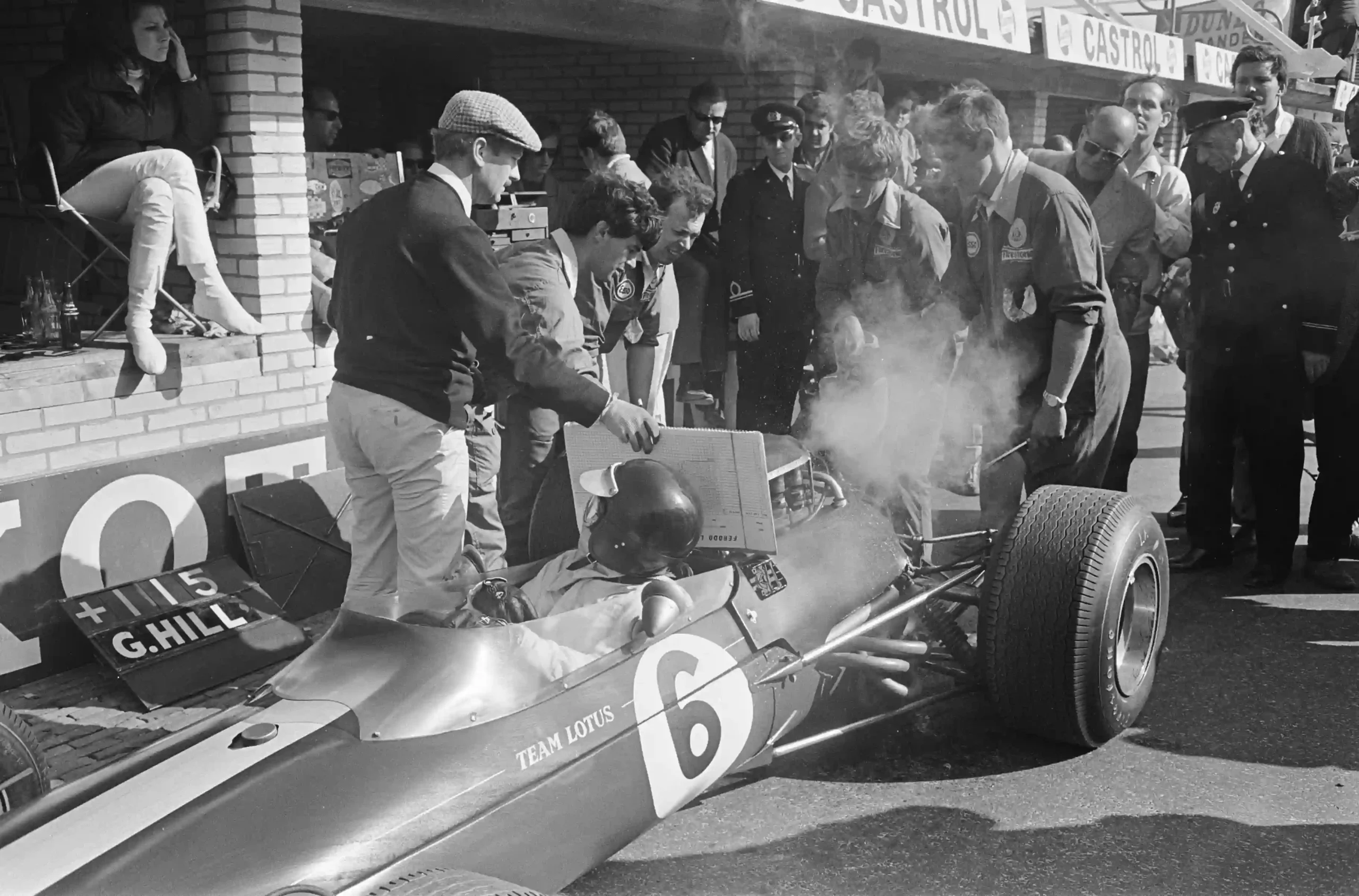
The Jim Clark image in this article shows him stopping for cooling water during the 1966 Dutch Grand Prix. That is a completely different operation from a modern four-tyre sprint.
Later eras included race refuelling, which made fuel transfer a major part of stationary time.
Today’s stops focus primarily on tyres, allowed adjustments and repairs. That narrow task lets crews optimize every movement.
Therefore, comparing a 2026 tyre-only stop directly with a historical fuel or repair stop is not meaningful.
The useful comparison is within the same rules and operational era.
For more historical context on race operations and changing procedures, see our guide to how laps are counted in racing.
Consistency Matters More Than One Record Stop
A team does not win races by setting a personal-best pit stop once every six months.
Strategists need a reliable expected stop time. That allows them to calculate pit windows with confidence.
A crew that produces 2.2, 2.3 and 2.2 seconds is often more valuable than a crew that produces 1.9, 3.7 and 2.8.
The first group gives the strategy team a predictable number. The second forces engineers to build more safety margin into every call.
Formula 1’s pit-stop analysis emphasizes repeated practice and crew rotation because fatigue and inconsistency create errors.
Fast pit stops are therefore a reliability problem as much as a speed problem.
Real F1 Slow Pit Stop Examples
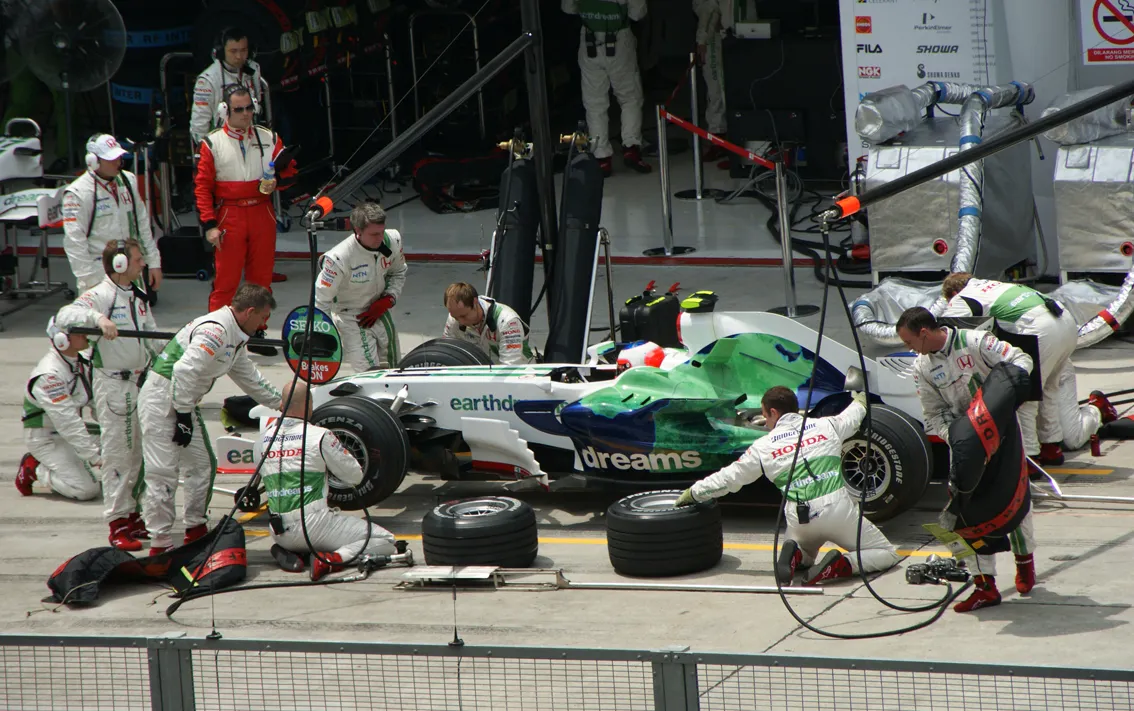
Real incidents show why the stopwatch alone does not tell the full story.
| Race / Benchmark | Time | Reason | What It Teaches |
|---|---|---|---|
| 2023 Qatar GP — McLaren record | 1.80s | Perfect four-tyre service. | Shows the absolute modern benchmark. |
| 2026 Hungary — Racing Bulls | 1.99s | Fastest DHL race-winning stop of 2026 through Hungary. | Shows sub-two-second stops remain achievable in current F1. |
| 2022 Dutch GP — Carlos Sainz | 12.7s | Rear-left tyre not ready after a late pit call. | Strategy and preparation can create a slow stop before the car arrives. |
| 2024 Bahrain GP — Valtteri Bottas | 52.4s | Cross-threaded wheel nut. | A hardware problem can turn a normal stop into a race-ending delay. |
These examples cover four very different levels of performance. The first two show what elite modern execution looks like.
Sainz’s Zandvoort stop shows a logistical failure. Bottas’s Bahrain stop shows a severe mechanical failure.
That is why “slow pit stop” should be treated as a spectrum rather than one exact number.
How Teams Reduce Slow Pit Stops
Practice the normal stop
Repetition makes each movement automatic. Crews refine foot position, wheel angles, gun approach and jack timing.
Practice abnormal stops
Teams also rehearse misfiring guns, backup jacks and other failures. The goal is to recover without panic.
Train the driver
A precise stop on the marks protects every mechanic’s working position.
Inspect hardware
Wheel nuts, guns, sockets and jacks are checked for wear because one damaged part can ruin a race.
Improve pit-call communication
The strategy team must give the crew enough warning to prepare the correct tyres and positions.
Measure consistency
Teams look beyond the fastest time. A stable pit-stop distribution is more useful to strategy than one spectacular outlier.
This is why the pit crew is part of race performance, not merely a support function.
Slow F1 Pit Stop FAQs
What is a slow pit stop in F1?
F1 has no official slow-stop cutoff. However, elite modern tyre-only stops are usually in the low-two-second range, so a stop above roughly three seconds is noticeably slow compared with front-running pit-stop performance.
Is a 3-second pit stop slow in F1?
There is no official three-second rule, but yes, three seconds is slow relative to modern elite performance. Through Hungary in 2026, the 11 DHL Fastest Pit Stop winning times ranged from 1.99 to 2.30 seconds.
What causes a slow F1 pit stop?
Common causes include wheel-gun problems, stuck or cross-threaded wheel nuts, poorly seated wheels, jack delays, driver positioning errors, late pit calls, pit-lane traffic and additional repair work.
Can a slow pit stop ruin an F1 undercut?
Yes. An undercut depends on gaining time with fresh tyres before the rival pits. Extra stationary time can erase that advantage and leave the driver behind the rival or trapped in traffic.
Conclusion: A Slow F1 Pit Stop Is Slow Relative to the Race Around It
The best answer to what is a slow pit stop in F1 starts with one important fact: there is no official FIA cutoff.
Modern performance gives us the practical benchmark instead. Formula 1 uses roughly 2.2 seconds as an example of a solid stop, and 2026’s first 11 DHL race-winning stops average 2.14 seconds.
Against that background, a three-second tyre-only stop is noticeably slow. Four or five seconds can be strategically painful. Ten seconds or more usually points to a serious problem, additional work or an intentional hold.
The cause matters just as much as the number. Wheel guns, wheel nuts, driver positioning and jacks can create mechanical delays.
Meanwhile, late strategy calls, double-stacking and pit-lane traffic can make a crew look slow even when its physical tyre change is fine.
The impact depends on gaps. One second can mean nothing with a large cushion. The same second can ruin an undercut when two cars are fighting for the same piece of track.
That is why Formula 1 teams obsess over consistency. A pit stop is not just four tyres and a stopwatch. It is a strategic transfer of track position, and the margin is often measured in tenths.
Sources
Current benchmarks and historical examples were checked against official Formula 1 reporting and results.