What Is the Pit Lane Speed Limit in F1?
The 80 km/h rule, Monaco’s lower limit, how drivers use the pit limiter, and why being 0.1 km/h too fast can change a race result.
The standard F1 pit lane speed limit is 80 km/h, or about 49.7 mph, throughout a Grand Prix weekend. However, the Race Director can lower it for safety. Monaco used a 60 km/h limit in 2026 because its pit lane is narrow, curved, and heavily congested.
An F1 car can exceed 200 mph on the circuit. Yet the same car must slow to suburban-road speed before crossing the pit lane line.
That change happens in seconds. The driver brakes hard, selects the pit limiter, and aims to cross the speed-limit line without wasting time.
The limit protects mechanics, officials, photographers, and other drivers. It also creates a precise sporting test. A driver must reach the line as fast as possible, but not too fast.
There is no generous margin. During the 2026 Canadian Grand Prix, Valtteri Bottas was measured at 80.1 km/h. The FIA issued a five-second penalty.
Monaco provided an even stronger lesson. Several drivers were measured at 60.1 km/h during the 2026 race. Those tiny excesses still produced sporting penalties.
This guide explains the current rule, the pit limiter, timing loops, penalties, and strategy. It also separates common myths from the FIA’s actual wording.
How Fast Can F1 Cars Drive in the Pit Lane?
F1 cars can normally travel at up to 80 km/h, or 49.7 mph, between the official pit lane entry and exit lines. The limit applies during practice, Sprint Qualifying, qualifying, the Sprint, and the Grand Prix. A lower event-specific limit can be imposed for safety.
Article B1.6.3 of the 2026 FIA Formula 1 Sporting Regulations sets the baseline. It imposes 80 km/h during the whole competition.
The phrase “whole competition” matters. The rule does not disappear during practice or qualifying. It applies whenever the official pit speed zone is active.
Drivers therefore use the limiter during installation laps, qualifying runs, race stops, and trips back to the garage. The sporting consequence changes by session, but the speed rule remains.
The Race Director can amend the limit. That authority allows the FIA to respond to narrow lanes, unusual corners, construction, weather, or crowded working areas.
Teams receive the applicable figure in the event notes. Engineers then program the correct target into the car’s control systems.
Drivers also see signs at pit entry. However, they are expected to know the limit before leaving the garage.
What Is the F1 Pit Lane Speed Limit in MPH?
The standard 80 km/h limit equals about 49.7 mph. Most broadcasts round that figure to 50 mph for U.S. viewers.
A 60 km/h limit equals about 37.3 mph. That lower speed feels particularly slow in an F1 car, where the cockpit is close to the ground.
| Metric Limit | U.S. Conversion | Typical Use | Driver Challenge |
|---|---|---|---|
| 80 km/h | 49.7 mph | Standard 2026 Formula 1 competition limit | Maximize braking and activation without crossing too fast |
| 60 km/h | 37.3 mph | Lower safety limit used at selected events such as Monaco | More pit-lane time loss and a longer low-speed transit |
| 80.1 km/h | 49.8 mph | Recorded Bottas speed in Canada 2026 | Only 0.1 km/h over, but still penalized |
| 60.1 km/h | 37.3 mph | Recorded in several Monaco 2026 infringements | Shows that the system has no sporting “free” margin |
The car’s displayed target may include engineering safeguards. Teams do not want the limiter operating exactly on the legal edge under every condition.
Tire circumference, wheel-speed readings, and surface changes can affect calculated speed. Therefore, engineers build a small operational buffer into the system.
That buffer costs a fraction of a second. However, a five-second penalty is far more damaging than a cautious limiter setting.
Pit entry rewards precision, not bravery alone. The quickest driver reaches the legal speed at the line. A driver who crosses faster has not gained a brilliant tenth; that driver has created a penalty risk.
Is the F1 Pit Lane Speed Limit the Same at Every Track?
No. The standard 2026 limit is 80 km/h, but the Race Director may reduce it to protect people and cars. Monaco used 60 km/h in 2026 because its pit lane is tight, curved, and crowded. The applicable limit is confirmed in the event notes.
Most circuits use 80 km/h. Their pit lanes are relatively straight and provide adequate separation between the fast lane and team working areas.
Street circuits can present different problems. Space is limited, walls are close, and the pit lane may bend sharply.
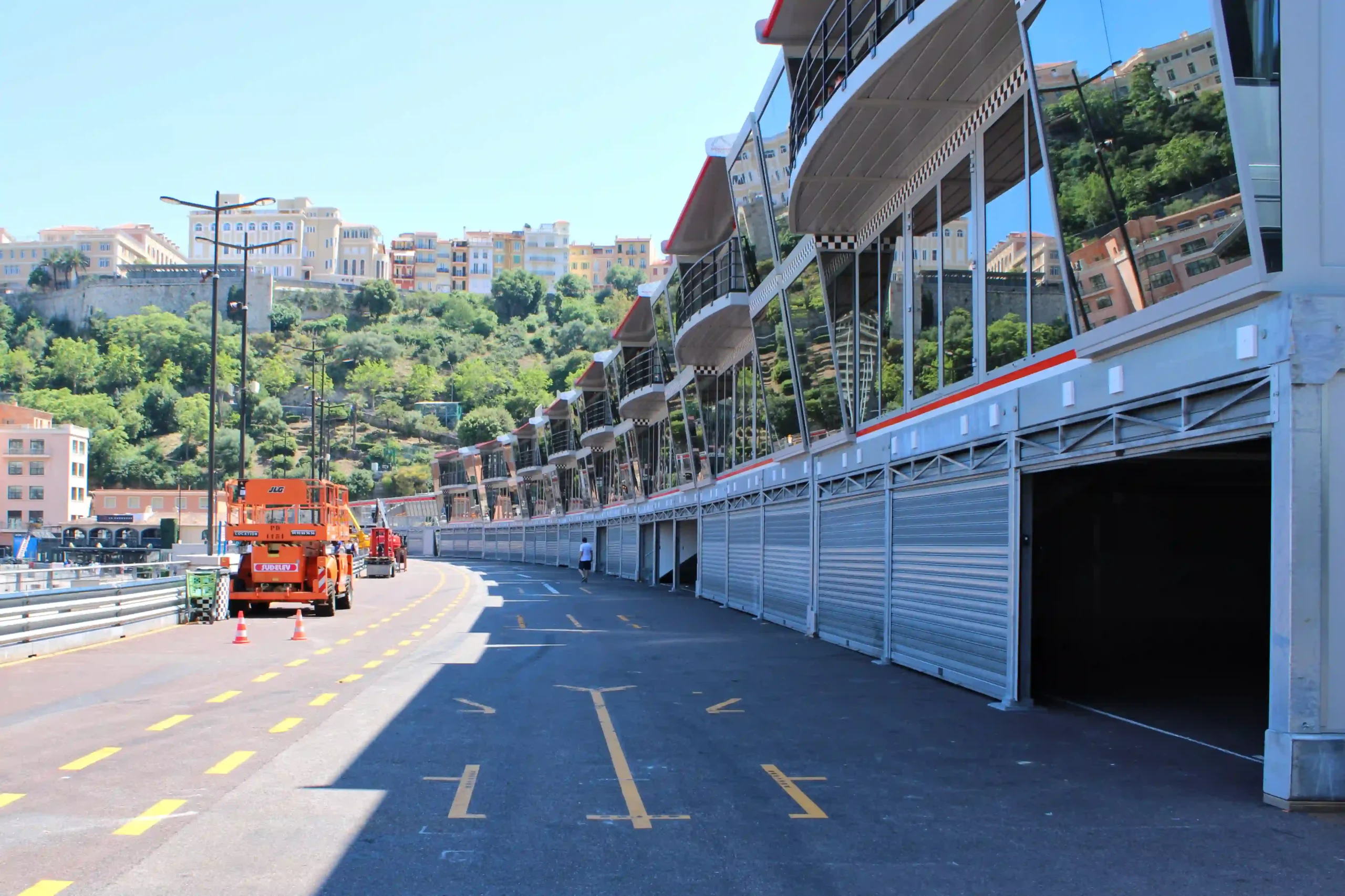
Monaco is the clearest modern example. Drivers enter before the final corner, turn through the pit lane, and face another kink near the exit.
The 2026 field also included the new Cadillac team. That additional garage increased congestion in an already restricted area.
Consequently, the Race Director used 60 km/h. The slower figure applied across the full event, not only the race.
What Is the Pit Lane Speed Limit at Monaco?
Monaco’s 2026 pit lane speed limit was 60 km/h, or about 37.3 mph. The lower figure reflected the lane’s physical shape and limited working space.
The change had a strategic effect. Every stop required more time at limited speed than an 80 km/h stop over the same distance.
That extra loss encouraged teams to avoid unnecessary stops. It also made drive-through penalties especially expensive.
Meanwhile, the curved lane complicated measurement. A driver taking a slightly shorter path between timing loops could record a higher calculated average speed.
Formula 1’s official 2026 explanation noted that five of six race infringements at Monaco were measured at 60.1 km/h. That detail shows how exact the enforcement became.
Can the Limit Change in Wet Weather?
Yes, the regulations allow the Race Director to amend the limit for safe and orderly conduct. That power is broad enough to address weather-related danger.
However, rain does not automatically change the figure. Teams follow the officially communicated limit until Race Control issues another instruction.
A wet pit lane can be slippery because rubber, painted lines, and concrete provide different grip. Drivers still must slow before the entry line.
Therefore, a driver may brake earlier even when the legal limit remains unchanged. The sporting maximum and the safe approach speed are not always identical.
Why Does Formula 1 Have a Pit Lane Speed Limit?
The limit separates racing speed from a working environment filled with mechanics, officials, tools, tires, and stationary cars. It gives drivers a predictable maximum speed and gives pit crews a safer window to work. Formula 1 introduced formal limits during the 1994 season after growing safety concerns.
Early Formula 1 pit areas looked very different. Some were barely separated from the racing surface, and cars entered at high speed.
As pit strategy became more important, drivers visited the lane more often. Cars also became quicker and braking performance improved.
That combination increased risk. Mechanics worked only feet from moving cars, while drivers searched for every possible fraction of a second.
Formula 1 introduced pit lane speed limits during the 1994 season. The exact figures and enforcement methods evolved afterward.
The principle has remained stable. Pit lanes are active workplaces, not extensions of the racetrack.
Modern safety equipment has improved greatly. Mechanics wear helmets and eye protection, while lanes are divided into working and fast areas.
However, technology has not removed the danger. A car traveling at 50 mph still carries enormous energy near exposed people.
Why 80 km/h Became the Standard
The limit must balance safety and race operation. A very low figure would make every pit stop excessively costly and lengthen the time cars spend near working crews.
A very high figure would reduce strategy loss but increase stopping distance and collision severity. Therefore, 80 km/h became a practical standard for many modern circuits.
The number is not a claim that every pit lane is equally safe. That is why the Race Director retains authority to reduce it.
Monaco’s 60 km/h rule demonstrates that flexibility. The regulation supplies a baseline, while event notes address the circuit.
Who Sets the Pit Lane Speed Limit in Formula 1?
The FIA regulations set the standard limit. The Race Director can amend it to protect safe and orderly competition.
Teams receive the final number before running. The limit is then programmed into the electronic control systems and included in operational plans.
Stewards do not normally choose the event limit after an infringement. They enforce the figure already established for that competition.
Race Control can also communicate changes. However, any amendment must be clear because every team relies on the same target.

Where Does the F1 Pit Lane Speed Limit Begin and End?
The limit applies between the official pit lane entry line and exit line. A sign near the entry shows the permitted speed. The driver must already be at or below that speed when crossing the entry line and must remain compliant until passing the exit line.
The most important point is the start line. Drivers cannot cross it too quickly and rely on the limiter to reduce speed afterward.
The car must be legal at the line. Therefore, the driver brakes on the pit entry road before activating the limiter.
The exact layout changes by circuit. Some entries are straight, while others involve sharp turns or downhill braking.
A painted line and roadside sign identify the start of the controlled zone. Timing equipment then monitors the car inside the lane.
At the far end, the driver remains limited until crossing the official exit line. Accelerating a fraction early can create the same problem as entering too fast.
After the line, the driver releases the limiter and accelerates toward the track. Blue lights or flags may warn of approaching traffic.
What Is the Pit Lane Speed-Limit Line?
It is the legal boundary where controlled speed begins or ends. It is separate from the pit entry commitment line used for track-position rules.
The driver learns its location during track walks, simulator work, and practice laps. Engineers also mark braking references on maps and steering-wheel notes.
The entry line may be difficult to see at racing speed. Consequently, drivers use boards, barriers, buildings, or surface changes as references.
A missed reference can be costly. Braking too early wastes race time, while braking too late risks a penalty.
Why Drivers Practice Pit Entry
Practice starts and qualifying laps attract attention, but pit entry practice matters too. Drivers test the braking point with different fuel loads and tire conditions.
A heavy car needs more distance to slow. Worn tires can also lock under aggressive braking.
Meanwhile, a wet line changes grip. Drivers must understand those differences before the race.
Teams compare the entry time with rivals. A driver can gain several tenths through a sharp but legal approach.
However, that gain disappears if the speed trace crosses the line above the limit. Pit entry is therefore an exercise in controlled risk.
How Does the F1 Pit Limiter Work?
The driver brakes to the legal speed before the entry line, then presses a steering-wheel button. The car’s electronic controls restrict torque and engine output to hold a programmed target. The limiter prevents acceleration beyond that target, but it does not brake the car or correct a late entry.
The pit limiter is an electronic control mode. It manages power so the car does not continue accelerating through the lane.
The driver activates it with a steering-wheel control. A dashboard message or light confirms that the mode is active.
However, the system is not an automatic braking device. The driver must slow the car before pressing the button.
If the car is traveling too fast, limiter activation alone cannot guarantee legal speed at the line. The brakes still do the main work.
Once active, the control unit restricts power delivery. The exact method depends on the power-unit and software architecture.
The engine note changes because the system repeatedly limits available torque. Fans often hear a flat, pulsing sound as the car travels past the garages.
When Do F1 Drivers Activate the Pit Limiter?
Drivers normally press the button shortly before crossing the official entry line. They aim to finish braking at the same moment.
Activating too early costs time. Activating too late can leave the car above the legal speed.
The ideal sequence is smooth. The driver brakes hard, downshifts, reaches the target, presses the limiter, and crosses the line.
At pit exit, the driver keeps the mode active until the official line. Then the driver releases it and accelerates.
Some steering wheels require a single press to toggle the mode. Others use control logic tailored to the team.
Regardless of interface, the driver remains responsible for the recorded speed.
Does the Pit Limiter Control the Brakes?
No. The limiter controls power delivery, not braking force. It cannot rescue a car that reaches the line too quickly.
This distinction explains many infringements. A driver may press the correct button but still carry excess speed from the braking zone.
Similarly, locking a wheel can complicate the reading. The car’s actual average speed remains the standard used by FIA timing.
The safest technique is to build a small margin. Drivers dislike giving away time, but a penalty costs much more.
Why Do F1 Cars Sound Different With the Limiter Active?
The control system repeatedly restricts torque to maintain the target. That produces the familiar uneven engine note.
Older cars often sounded more dramatic because of their engine designs and control strategies. Modern hybrid cars still produce a clear change.
The sound does not prove the car is legally below the limit. It only shows that the limiter mode is influencing power.
Therefore, officials rely on timing loops rather than audio, television images, or driver claims.
How Do FIA Officials Measure Pit Lane Speed?
FIA transponders and electronic timing loops measure each car’s average speed across several pit-lane segments. The system calculates the time taken between loops and converts it into speed. It does not rely on roadside radar guns or television cameras.
Every F1 car carries an official timing transponder. The circuit contains electronic loops at known positions.
As the car passes each loop, the timing system records a precise timestamp. The distance between loops is already known.
Officials calculate average speed across that segment. Multiple segments help identify where an infringement occurred.
This method is repeatable and objective. It also works in darkness, rain, and heavy traffic.
The system does not need to estimate speed from video. Television footage may explain the incident, but it is not the primary measurement.
Why Monaco Produced So Many 60.1 km/h Readings
Monaco’s pit lane does not form one straight corridor. Drivers turn shortly after entry and again near exit.
The timing system calculates speed from time between fixed loops. A tighter path can slightly shorten the distance actually driven.
Consequently, a car’s calculated average may move above the limit even when the dashboard target appears correct.
Teams therefore need more margin at curved venues. A limiter setting that works on a straight pit lane may be too aggressive at Monaco.
The 2026 race exposed that sensitivity. Several drivers exceeded the limit by only 0.1 km/h.
Is There a Tolerance for Pit Lane Speeding?
Fans often ask whether officials allow a small tolerance. Sporting decisions show that drivers should not expect one.
The FIA penalized 80.1 km/h at the 2026 Canadian Grand Prix. Monaco also produced penalties at 60.1 km/h.
Measurement systems have technical accuracy standards. However, teams cannot treat that as a usable racing margin.
The legal approach is simple: set and drive the car below the published maximum.
Key point: The pit limiter is a team tool, while the FIA timing loops are the official judge. A dashboard that says 60 or 80 does not override the measured segment speed.
What Is the Penalty for Speeding in the F1 Pit Lane?
Practice, qualifying, and Sprint Qualifying infringements bring a team fine of €100 per km/h over the limit, capped at €1,000. During a Sprint or Grand Prix, stewards may issue five seconds, 10 seconds, a drive-through, or a stop-and-go penalty.
The session determines the basic penalty framework. A race result can be changed directly, while a practice result usually cannot.
During free practice, qualifying, and Sprint Qualifying, the competitor receives a financial sanction. The driver’s team pays the fine.
The 2026 rule sets €100 for every km/h above the limit. The maximum standard fine is €1,000.
Stewards can add another penalty if they suspect the driver sped to gain an advantage. That clause prevents deliberate abuse.
During a Sprint or Grand Prix, the options become sporting penalties. The stewards can choose five seconds, 10 seconds, a drive-through, or a stop-and-go.
Severity depends on the excess, circumstances, and possible advantage. Recent small infringements have normally produced five seconds.
| Session | Standard 2026 Consequence | Who Feels It? | Possible Escalation |
|---|---|---|---|
| Free Practice | €100 per km/h over, capped at €1,000 | Competitor pays the fine | Additional sanction if advantage was sought |
| Sprint Qualifying | €100 per km/h over, capped at €1,000 | Competitor pays the fine | Stewards retain wider authority |
| Qualifying | €100 per km/h over, capped at €1,000 | Competitor pays the fine | Additional sporting penalty possible |
| Sprint | Five seconds, 10 seconds, drive-through, or stop-and-go | Driver’s result | Penalty severity can rise with the offence |
| Grand Prix | Five seconds, 10 seconds, drive-through, or stop-and-go | Driver’s result | Incorrect service can create a stronger penalty |
How Is a Five-Second Penalty Served?
If the driver makes another pit stop, the car must remain stationary for five seconds before mechanics begin work.
The crew cannot touch the car during that period. After five seconds, normal service can start.
If no further stop occurs, the time is added after the finish. That can change points and podium positions.
Timing matters. A driver who builds a gap may keep the position, while a tightly packed field can turn five seconds into several lost places.
Can Pit Lane Speeding Cause a Drive-Through?
Yes. The regulations list a drive-through as an available Sprint or race penalty.
A drive-through requires the driver to enter the lane, obey the speed limit, and continue without stopping.
It usually costs far more than five seconds. The exact loss depends on pit-lane length and the event limit.
A driver can also receive a drive-through after serving another penalty incorrectly. George Russell’s 2026 Monaco race provided that lesson.
Can Pit Lane Speeding Cause Disqualification?
Disqualification is not the standard penalty listed for ordinary speeding. The regulation specifies time, drive-through, and stop-and-go options.
However, stewards retain broad authority for serious conduct. Deliberate disregard, repeated non-compliance, or related offences could create a larger case.
For normal small excesses, fans should expect the published penalty scale rather than automatic disqualification.
Verified 2026 F1 Pit Lane Speeding Cases
The 2026 season produced several clear examples. They show how the rule works in real competition and why tiny excesses matter.
Valtteri Bottas — 2026 Canadian Grand Prix
The FIA measured Valtteri Bottas at 80.1 km/h during the Canadian Grand Prix. The event limit was 80 km/h.
The stewards issued a five-second time penalty. Their decision stated that Car 77 exceeded the limit by 0.1 km/h.
This case is important because it came from an official one-page steward document. There was no debate about television interpretation.
The timing system recorded the excess. Therefore, the standard race sanction followed.
Pierre Gasly — 2026 Monaco Grand Prix
Pierre Gasly crossed the line in a podium position at Monaco. However, two pit lane speeding penalties changed the result.
The combined 10 seconds dropped him to seventh. Alpine then requested a Right of Review.
Gasly said the team had set the limiter correctly and that he activated it before the line. Yet the official timing recorded infringements.
The dispute showed the gap between driver procedure and measured outcome. Correct button use does not automatically prove legal speed.
Hamilton, Piastri, and the Monaco Penalty Pattern
Lewis Hamilton and Oscar Piastri also received five-second penalties during the 2026 Monaco race.
Both served their sanctions during later pit stops. The cars had to remain untouched for five seconds before service began.
Formula 1 reported that five of the six in-race speeding cases were measured at 60.1 km/h. The pattern pointed to Monaco’s unusual geometry and tight operating margins.
Nevertheless, every team faced the same published limit. Stewards applied the rule to the measured speed.
George Russell — Incorrectly Serving the Penalty
Russell’s Monaco incident added another layer. Mercedes brought him into the box after a five-second sanction.
The crew began servicing the car before the full penalty time had been served. As a result, the original sanction was not completed correctly.
The five-second penalty was replaced by a drive-through. Russell served it before the end of the race.
This sequence shows that penalty procedure matters as much as the initial decision. A minor speeding offence can become a major race loss through an operational mistake.
| 2026 Event | Driver or Situation | Recorded Issue | Outcome |
|---|---|---|---|
| Canadian Grand Prix | Valtteri Bottas | 80.1 km/h in an 80 km/h zone | Five-second time penalty |
| Monaco Grand Prix | Pierre Gasly | Two pit lane speeding infringements | Combined 10 seconds; fell from podium place to P7 |
| Monaco Grand Prix | Lewis Hamilton | Race speeding infringement | Five seconds served during a later stop |
| Monaco Grand Prix | Oscar Piastri | Race speeding infringement | Five seconds served during a later stop |
| Monaco Grand Prix | George Russell and Mercedes | Original five seconds not served correctly | Penalty superseded by a drive-through |
The 2026 cases prove that pit lane speeding is not a theoretical rule. One tenth of a kilometer per hour can cost five seconds, while a procedural error can turn that sanction into a drive-through.
How Does the Pit Lane Speed Limit Affect F1 Strategy?
Teams calculate the full pit loss from entry braking, limited-speed travel, stationary service, and pit exit acceleration. A longer lane or lower limit increases that loss. Consequently, circuits with slow or lengthy pit lanes often favor fewer stops unless tire performance justifies the extra time.
A pit stop is not only the two seconds spent changing tires. Most of the loss occurs while the car travels below racing speed.
Strategists therefore calculate a circuit-specific pit delta. It includes entry, lane transit, stationary time, and exit.
Reducing the limit from 80 to 60 km/h increases transit time. The exact increase depends on the controlled distance.
For illustration, a 400-meter limited section takes 18 seconds at 80 km/h. The same distance takes 24 seconds at 60 km/h.
That is a six-second difference before adding braking, acceleration, or the tire change. Therefore, a lower limit can reshape the preferred strategy.
Why a Lower Limit Can Encourage One Stop
Every additional stop repeats the lane loss. A lower limit makes that repeated cost larger.
If tire degradation is modest, teams may extend stints and choose one stop. The slower pit lane makes a second stop harder to recover.
However, tire performance can outweigh the transit loss. A fresh set that gains one second per lap can repay a longer stop over enough laps.
The pit wall compares those curves continuously. Safety Cars and weather can change the calculation instantly.
Why Pit Entry Performance Still Matters
The legal limit starts at the line, not earlier. Drivers can attack the approach while the car remains on the track side.
A strong entry gains time before the limited zone. A cautious entry gives that time away.
Yet the difference between excellent and illegal is small. Drivers therefore practice the braking point throughout the weekend.
Teams also monitor tire temperatures and brake condition. Cold brakes or worn tires may require a safer reference.
How a Speeding Penalty Changes Tire Strategy
A five-second penalty can be served at the next stop. That may encourage the team to pit earlier than planned.
However, serving the sanction delays the tire service. Rivals can undercut while the car remains stationary.
If the driver stays out, the penalty may be added after the finish. The team then needs a five-second gap to the car behind.
Consequently, race engineers begin managing the classification, not only track position.
Our guide to the undercut and overcut in F1 explains how pit timing changes those gaps.
Does the Safety Car Change the Pit Lane Speed Limit?
No. A Safety Car or Virtual Safety Car changes the speed requirements on the circuit, but the published pit lane limit remains in force unless Race Control specifically amends it. Drivers must obey both the track delta and the pit speed zone.
Safety Car periods make pit stops cheaper because cars on the circuit travel more slowly. However, they do not normally cancel the pit lane rule.
The driver follows the Safety Car or VSC delta before pit entry. Then the normal pit speed applies after crossing the line.
At pit exit, the driver returns to the relevant track procedure. That may involve a VSC delta or catching the Safety Car queue.
The combination can be complex. Drivers must switch between control targets while handling traffic and radio instructions.
Can the Pit Lane Close?
Yes. The 2026 regulations allow the Race Director to close pit entry in exceptional circumstances for safety.
When closed, drivers may enter only for essential and clearly evident repairs. Entering for another reason can produce a serious penalty.
A closed pit lane is separate from the speed limit. If a driver is permitted to enter, the published speed still applies.
Can Drivers Overtake in the Pit Lane?
Cars can change relative position in the pit lane, particularly when one leaves a box or another is delayed.
However, every move must respect the speed limit, lane markings, and safety rules. Drivers cannot use the working area as an unrestricted passing lane.
At the pit exit queue before certain starts or restarts, cars generally leave in the order they arrived unless one is unduly delayed.
Therefore, “overtaking is always banned” is too simple. The decisive questions are location, procedure, and safety.
What Happens if the F1 Pit Limiter Fails?
The driver must still obey the speed limit. The team may instruct a manual throttle target, change settings, replace a steering wheel, or retire the car if reliable control is impossible. A technical fault can explain an infringement, but it does not automatically remove the measured penalty.
The pit limiter depends on sensors, software, steering-wheel controls, and the car’s electronic system. Any of those elements can fail.
A damaged wheel-speed sensor may produce unreliable information. A button or steering wheel can also malfunction.
If the team identifies a problem, engineers warn the driver. The car may need a more conservative manual speed.
That solution is difficult because the cockpit speed display is not as simple as a road-car speedometer. The driver also needs to manage gears, traffic, and pit instructions.
Replacing the steering wheel can solve a control fault. However, software or sensor damage may remain.
The regulations judge the car’s measured speed. Therefore, a fault is not a guaranteed defense.
Can a Driver Accidentally Disable the Limiter?
Yes, incorrect button use or a setting change can deactivate the mode. Drivers train to avoid that mistake.
The dashboard usually gives a clear status indication. Engineers can also see telemetry and call the driver immediately.
Still, the lane is short. A warning may arrive after the timing loop has already recorded excess speed.
Consequently, teams design controls to reduce accidental presses. Drivers also confirm limiter status through routine.
Can a Driver Be Penalized When the Limiter Was Set Correctly?
Yes. The limiter target and measured average are not necessarily identical.
A driver can enter too fast before the control takes effect. Curved geometry can also influence the segment calculation.
Tire size, sensor behavior, and path length may create small differences. Monaco’s 2026 penalties highlighted those margins.
Therefore, the team must set a safe target rather than merely typing the published maximum.
F1 Pit Lane Speeding vs. an Unsafe Release
These are separate offences. Speeding concerns how fast the car travels through the controlled zone.
An unsafe release concerns the team sending a car into danger or releasing it in an unsafe condition.
A driver can remain below 80 km/h and still be released into another car. Likewise, a perfectly safe release can be followed by speeding.
The same pit visit can produce both infringements. Stewards assess each rule independently.
Our full unsafe release guide explains the difference between traffic danger and mechanical danger.
F1 Pit Lane Speeding vs. a Drive-Through Penalty
Pit lane speeding is an offence. A drive-through is one possible punishment for an offence.
The driver enters the lane and passes through without stopping. The speed limit must be obeyed during the penalty.
Speeding while serving a drive-through can create another sanction. Therefore, the driver cannot recover lost time by attacking the lane.
Our guide to drive-through penalties in F1 covers the complete procedure.
Common F1 Pit Lane Speed Limit Misunderstandings
“The Limit Is Always 80 km/h”
No. That is the 2026 default. The Race Director can lower it, as Monaco’s 60 km/h rule demonstrated.
“The Pit Limiter Brakes the Car”
No. The driver brakes before the line. The limiter restricts power after activation.
“A Tiny Excess Is Ignored”
No. Official 2026 decisions penalized 80.1 km/h and 60.1 km/h readings.
“Practice Speeding Changes the Race Result”
Normally, practice and qualifying speeding bring financial fines. Stewards can escalate if a driver sought an advantage.
“The Safety Car Removes the Pit Limit”
No. The track procedure changes, but the published pit lane speed remains unless Race Control amends it.
“The Team Pays Every Penalty”
The team pays practice and qualifying fines. Race penalties affect the driver’s time and classification.
F1 Pit Lane Speed Limit FAQs
What is the pit lane speed limit in F1?
The standard 2026 limit is 80 km/h, or 49.7 mph. The Race Director can lower it for safety, and Monaco used 60 km/h.
What is the penalty for speeding in the F1 pit lane?
Practice and qualifying bring fines of €100 per km/h over, capped at €1,000. Sprint and race offences can bring time, drive-through, or stop-and-go penalties.
How does the F1 pit limiter work?
The driver brakes before the line and presses a steering-wheel control. The electronic system then restricts power to maintain a programmed target speed.
Is the F1 pit lane speed limit the same at every track?
No. The default is 80 km/h, but the Race Director can reduce it. Monaco used a 60 km/h limit during the 2026 event.
Conclusion: Why the F1 Pit Lane Speed Limit Matters
The F1 pit lane speed limit turns one of racing’s busiest spaces into a controlled working environment.
For 2026, the standard is 80 km/h, or about 49.7 mph. However, the Race Director can lower it when a circuit demands more caution.
Monaco used 60 km/h because its lane is narrow, curved, and congested. That lower figure also increased the strategic cost of every stop.
The driver must slow before the entry line. The pit limiter restricts power, but it does not operate the brakes.
FIA transponders and timing loops measure average speed through several segments. Consequently, enforcement does not depend on television pictures or roadside radar.
Practice and qualifying infringements usually create team fines. Sprint and race offences can directly change the result.
The 2026 season showed how strict that system is. Bottas received five seconds for 80.1 km/h in Canada.
Monaco produced several 60.1 km/h readings. Gasly’s two penalties removed a podium result, while Russell’s incorrectly served sanction became a drive-through.
Therefore, the limit is more than a safety sign. It affects pit entry technique, tire strategy, penalty service, and championship points.
The fastest pit lane performance is not the highest speed. It is the quickest legal journey from entry line to exit line.
Sources and Verification
This article was checked against official FIA and Formula 1 material available on July 19, 2026. The latest FIA regulation issue, Race Director notes, and event-specific steward decisions remain controlling.