Why Do F1 Pit Stops Sometimes Go Wrong?
A two-second tyre change leaves almost no room for recovery. One mistimed gun, one damaged wheel nut, one missed jack point or one late call can turn a clean stop into a race-changing delay.
F1 pit stops go wrong when one part of a tightly synchronized process fails. Common causes include wheel-gun faults, stuck or cross-threaded wheel nuts, missed pit-box marks, jack problems, late pit calls, tyres arriving late and unsafe-release traffic. Because all four corners work simultaneously, one problem can hold the whole car.
The fastest pit stops in Formula 1 look effortless. The bad ones reveal just how many things have to go right at the same time.
A normal competitive stop can sit in the low-two-second range. Formula 1’s own technical analysis says a strong stop is roughly 2.2 seconds down to the 1.80-second world-record benchmark. That leaves almost no spare time for a mechanic to correct a mistake.
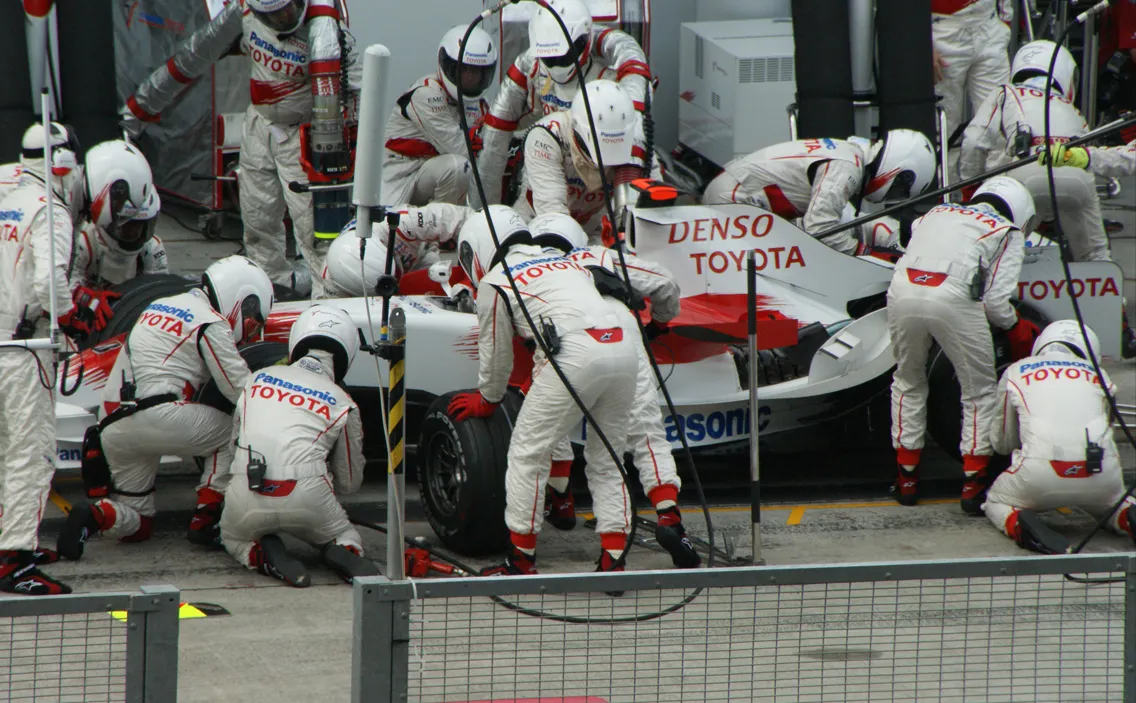
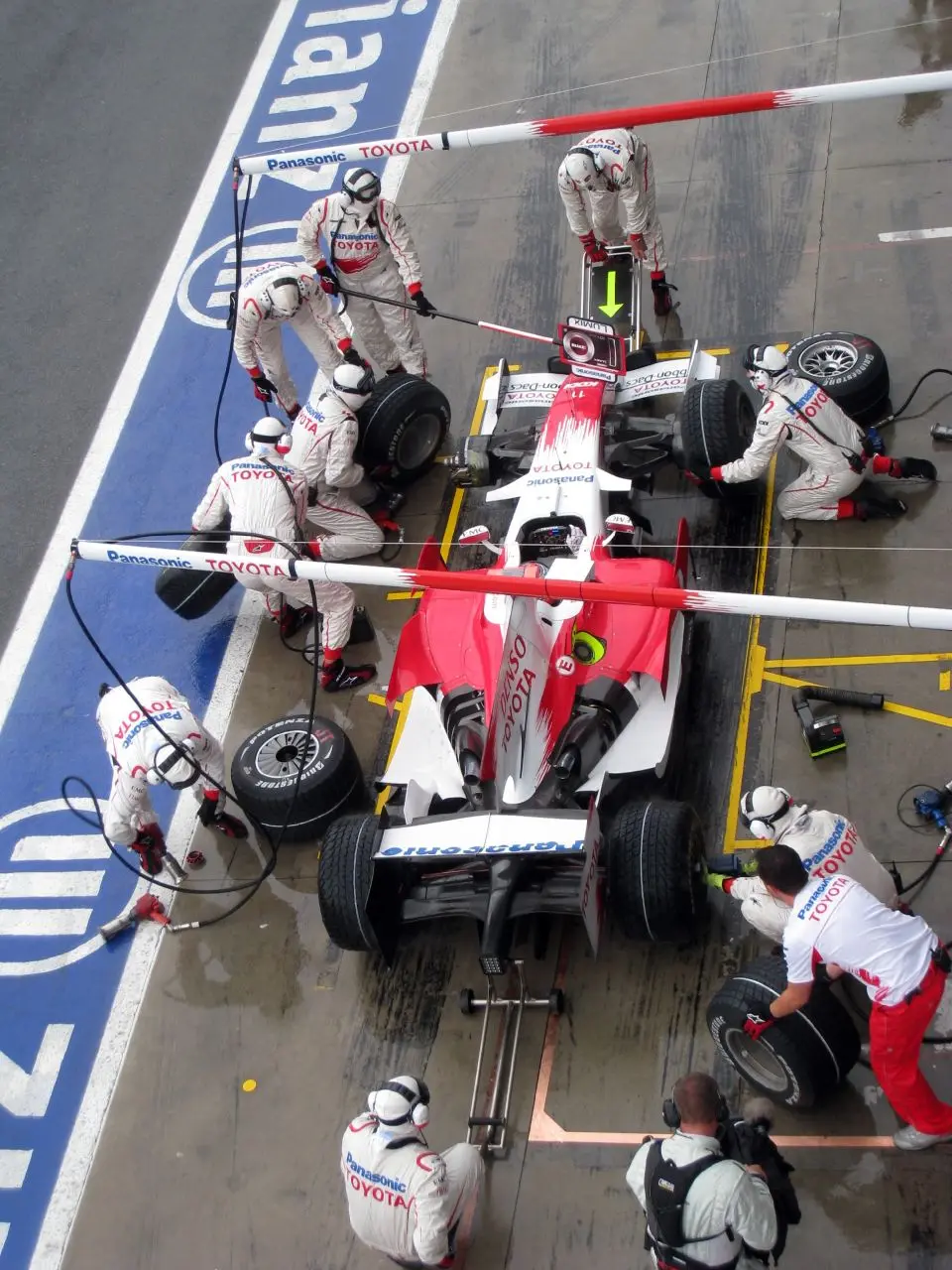
When everything works, the wheel guns fire almost in unison. The used wheels are already moving away as the replacements arrive. Meanwhile, the jacks lift and drop the car in one smooth sequence.
However, one corner can ruin the rhythm. A misfiring gun may need another attempt. A damaged nut may refuse to move. A driver who stops off the marks can force several crew members to reposition at once.
Strategy can cause trouble too. A late pit call may leave the crew scrambling for tyres. Pit-lane traffic can force a team to hold a car even after the mechanical work is complete.
This guide explains the most common F1 pit stop mistakes with real examples. It also separates genuine crew errors from long stops caused by damage, strategy or safety.
Why One Small Pit Stop Error Can Cost So Much Time
The main reason F1 pit stop problems become expensive is that the normal sequence is extremely short. Formula 1 describes a good modern stop as roughly 2.2 seconds down to McLaren’s 1.80-second record.
In that reference sequence, the old wheels can be clear around 0.6 seconds. Replacement wheels can be fitted around 1.2 seconds, with the guns back on the captive nuts around 1.4 seconds.
That timing leaves no recovery phase. If a gunner misses the nut, the other three corners may finish before the problem corner gets a second clean attempt.
The car cannot leave just because three wheels are secure. Therefore, the stop time immediately becomes the time required by the slowest critical task.
Formula 1 specifically says wheel-gun operators must be ready for unexpected events such as a car out of position, a misfiring gun or a stuck nut. Those are not theoretical problems. Each has happened in real races.
Our guide to how pit stops work in racing explains why Formula 1’s parallel crew structure is so fast when every role works correctly.
Clean F1 stop
- Driver hits the marks accurately.
- Four wheel guns engage on the first attempt.
- Old and new wheel movements overlap.
- Front and rear jacks connect immediately.
- All completion signals arrive together.
Problem F1 stop
- One mechanic has to reposition or retry.
- A nut jams, cross-threads or refuses to release.
- A jack misses its lifting point.
- One tyre reaches the box late.
- The car is held for traffic or safety.
Wheel-Gun Problems Can Break the Two-Second Rhythm
If an F1 wheel gun does not engage, misfires or comes off the nut too early, the gunner must correct the problem before the car can leave. The other three corners may already be complete, so one wheel-gun issue can add several seconds to the stop.
The wheel gun is designed for speed, but the operator still has to place it correctly. Formula 1 describes a clean stop as producing two synchronized gun sounds: one to release the nuts and one to fasten them.
When the sounds fall out of sync, it often signals trouble. The gunner may need to reseat the tool, reverse again or deal with a nut that has not moved as expected.
A famous technical example came with Mercedes and Valtteri Bottas in Bahrain in 2021. Mercedes later explained that the gun began loosening the nut, but the operator withdrew slightly too soon. The gun then reversed as if the nut had been removed, damaging the normal sequence.
The lesson is simple: the gun is powerful, but it is not magic. The tool depends on correct alignment and timing from the operator.
That is why pit crews practice hand position and approach angle as much as raw speed. Our pit-stop practice guide explains how repetition reduces those tiny errors.
Stuck and Cross-Threaded Wheel Nuts Are Among the Worst Problems
Modern F1 cars use a single captive center-lock wheel nut at each corner. That system makes normal changes extremely fast. However, it also creates a single critical fastening point.
If the nut damages its thread or engages incorrectly, the wheel crew can lose far more than a few tenths. The car may sit in the box while mechanics change tools or attempt to recover the hardware.
A cross-threaded wheel nut engages the axle thread incorrectly rather than following it cleanly. The nut can then resist removal or tightening. That prevents the crew from completing the normal wheel-change sequence until the damaged engagement is corrected.
Kick Sauber’s 2024 Bahrain disaster
Valtteri Bottas suffered one of the clearest modern examples at the 2024 Bahrain Grand Prix. Formula 1 reported that a cross-threaded wheel nut kept him stationary for 52.4 seconds.
That is an enormous loss in a sport where a normal tyre change is measured in tenths. Bottas finished 19th after a race already compromised by first-lap contact.
The problem returned one week later
At the following Saudi Arabian Grand Prix, Zhou Guanyu suffered another cross-threaded wheel nut. Formula 1 described it as the team’s second consecutive pit-stop problem.
Zhou had run close to the points before the stop. The delay dropped him to the back, turning a potentially useful race into another example of how one wheel can erase an entire strategy.
The repeated nature of the issue made it more serious. It suggested a process or component problem rather than one isolated mechanic mistake.
For the broader timing consequences, see how race timing works. A 50-second stationary delay can effectively end a competitive race even when the car itself still has pace.
A Driver Who Misses the Pit Box Can Slow Several Crew Members at Once
If the driver stops long, short or off-center, the jack operators, wheel-gun operators and tyre carriers must move away from their rehearsed positions. That extra movement can turn a normally clean two-second stop into a much slower one.
The driver is part of the pit-stop choreography. Crew members place their feet, hands, jacks and guns around a precise target where the four wheels are expected to stop.
Formula 1 explains that teams can even use visual scales and laser references to judge driver accuracy during practice. A clean stop starts with the car landing in the correct place.
If the car stops long, the front jack operator may have to chase the nose. Wheel crews may have to move sideways or reach farther than expected.
If the driver stops short, the same problem happens in reverse. Meanwhile, a slightly angled car changes the geometry on both sides at once.
That does not always produce a dramatic ten-second delay. More often, it adds a few tenths. Yet those tenths can decide an undercut or whether the car rejoins ahead of traffic.
Our pit-lane time-loss explainer shows why driver execution affects more than the stationary stopwatch.
Jack Problems Can Delay All Four Wheels
A wheel problem affects one corner. A lifting problem can delay the entire car.
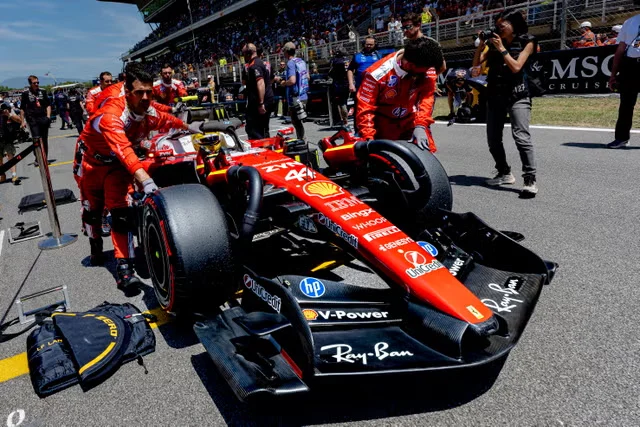
The front jack operator waits in the car’s path and can begin lifting almost immediately. The rear jack operator has a harder job because they must move into position after the car passes.
Formula 1 says getting the rear jack cup onto its lifting point on the first attempt is critical to a good stop. Modern cars are heavy and sit very low, so the operator has little time and limited leverage.
If either main jack misses, the four wheel crews may be unable to remove or fit tyres normally. That can turn a single human positioning error into a delay across every corner.
Teams therefore keep backup jack operators ready. If the primary tool breaks or slips, the reserve operator can step in rather than abandoning the stop.
The backup still costs time. However, losing several seconds is better than leaving the car stranded in the box.
A slow wheel corner creates one bottleneck. A missed lift creates four bottlenecks at once because every tyre change depends on the car being raised safely.
Late Pit Calls Can Leave the Crew Without Enough Preparation Time
Not every bad pit stop begins with a mechanic. Sometimes the strategy call itself creates the problem.
Tyres have to be identified, moved from the garage and carried into the correct corner. Gunners and jack operators also need enough warning to leave their normal garage positions and arrange themselves safely around the box.
Carlos Sainz at Zandvoort in 2022
Ferrari’s 2022 Dutch Grand Prix stop for Carlos Sainz became one of the most recognizable modern pit-stop mistakes. Sainz sat stationary for 12.7 seconds because the rear-left tyre was not ready when he arrived.
Ferrari later gave a detailed explanation. Strategy chief Inaki Rueda said the crew normally received around 23 to 24 seconds of warning before a stop.
In this case, Ferrari reacted late to Sergio Perez’s stop. The pit crew received only about 17 seconds to prepare.
Zandvoort’s narrow pit lane made the situation worse. Ferrari said the rear-left tyre fitter could not reach the corner directly and had to move around the other crew members.
That context matters. Headlines often reduced the incident to “Ferrari forgot a tyre.” The team’s explanation showed a chain reaction: late strategy call, reduced preparation time and difficult pit-lane geometry.
Read more about race-call pressure in our car racing explainer.
Unsafe Releases Can Turn a Fast Stop Into a Penalty — or Worse
An unsafe release occurs when a car leaves its pit box in an unsafe condition or into the path of another competitor. A team can complete the tyre change quickly and still lose time through a penalty if the release itself is unsafe.
Modern F1 teams use traffic-light release systems, but the final decision still involves human oversight. The car must be mechanically ready, and the lane must be clear enough for a safe exit.
A mechanically complete stop can therefore include a deliberate hold. That hold may look slow on television, but it can be the correct choice.
Ferrari’s Bahrain 2018 sensor failure
The dangers became painfully clear during the 2018 Bahrain Grand Prix. Kimi Räikkönen stopped for tyres, but Ferrari had trouble removing the left-rear wheel.
Mechanic Francesco Cigarini had not completed the change when the release system showed green. Räikkönen moved away and struck Cigarini, who suffered a double leg fracture.
Ferrari’s investigation later identified a sensor problem in the release process. Formula 1 reported that the team received a €50,000 fine for the unsafe release.
The incident showed why release systems need multiple safeguards. Saving a tenth is never worth sending a car before the work is complete.
Our dedicated unsafe release guide explains the sporting and safety consequences in more detail.
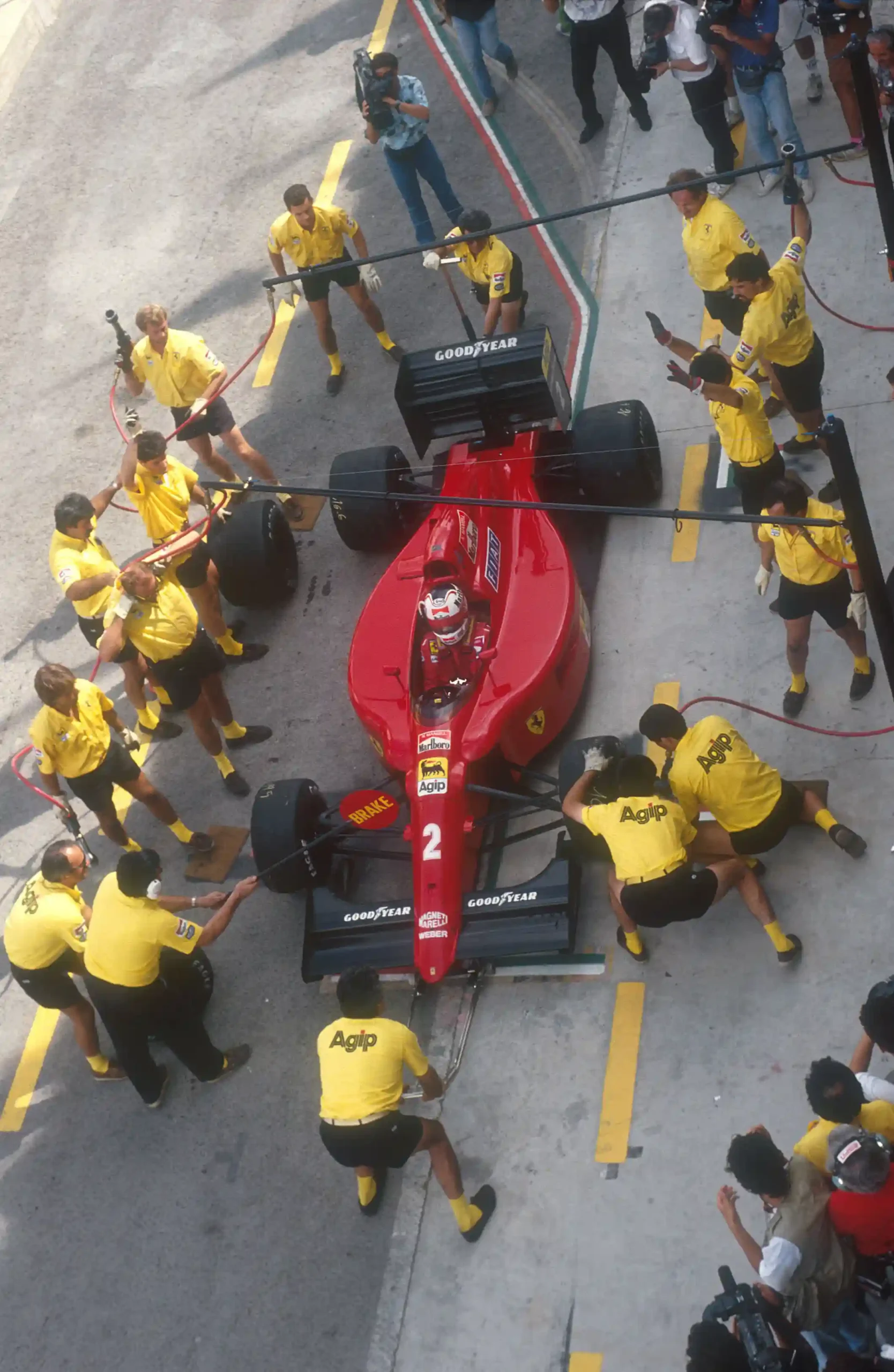
Pit-Lane Traffic Can Make a Perfect Mechanical Stop Look Slow
Sometimes the tyre change is finished, but the car cannot leave. Another competitor may be approaching the box at pit-lane speed.
The crew chief or release controller then has to choose between waiting and risking an unsafe release. In a crowded lane, holding the car is often the correct decision.
That becomes particularly important during Safety Car periods. Many teams may stop on the same lap, compressing traffic into a short section of pit lane.
The mechanical stop could still be two seconds. However, the official stationary time may grow because the team waits for a safe gap.
This is why analysts should not label every long stationary time as a crew mistake. Some delays are intentional safety decisions.
For the speed rules inside the lane, see our F1 pit-lane speed-limit guide. Our Safety Car and VSC explainer covers why traffic often becomes worse during neutralized races.
Double-Stacking Can Create a Delay Without Any Mechanical Failure
Teams sometimes bring both cars into the same pit box one after the other. This is called double-stacking.
The first car receives service normally. The second car may have to wait behind it, even if every mechanic and tyre is ready.
That waiting time can make the second driver’s stop look disastrous. However, the delay may be a strategic compromise rather than an error.
Double-stacking is common when a Safety Car suddenly makes stopping attractive for both drivers. Teams often prefer losing a few seconds in the queue rather than leaving one car on unsuitable tyres.
The risk increases if the first stop has even a small problem. A 0.7-second delay on the first car can become 0.7 seconds of extra waiting for the second before its own service even begins.
Our double-stack guide explains when teams accept that tradeoff.
Not Every Long F1 Pit Stop Is a Mistake
One of the biggest analytical errors is assuming every stop longer than three seconds went wrong. Sometimes the team is deliberately doing more work.
Front-wing adjustment
Small flap changes can happen during a normal tyre stop. If the mechanics finish before the wheels, the adjustment adds little or no extra stationary time.
Front-wing replacement
A damaged nose is different. Replacing the entire front-wing assembly requires more people and a longer sequence.
Puncture or damaged wheel
A deflated tyre can distort the car’s ride height or make the wheel harder to handle. Damage around the axle can also complicate removal.
Debris removal
Crews sometimes clear radiator inlets, brake ducts or other openings while the car is stopped. That extra work may prevent overheating later.
Therefore, the right question is not only “how long was the stop?” It is “what work was the team trying to complete?”
Our guide to what causes crashes in motor racing explains why damage can create unusual pit-stop procedures.
Human Error Is Real, but F1 Pit Stops Are Designed to Catch It
Pit crews are made from the team’s mechanics and technicians. They are highly trained, but they are still working under extreme time pressure.
Formula 1 notes that different roles favor different traits. Jack operators need explosive movement. Gunners need calm precision when the sequence becomes abnormal.
That matters because the worst response to a problem is often panic. A gunner who immediately recognizes a misfire can reset faster than someone who keeps forcing the same incorrect movement.
Teams also train backups. Spare jack operators, alternative tools and safety personnel exist because not every failure can be prevented.
Video analysis helps as well. Teams review whether a mechanic’s stance, hand position or approach path created unnecessary risk.
The goal is not to eliminate humans. The goal is to make human actions consistent enough that a problem is rare and recoverable.
Four Real F1 Pit Stop Failures and What They Teach
| Race | Driver / Team | Problem | What It Shows |
|---|---|---|---|
| 2024 Bahrain GP | Valtteri Bottas / Kick Sauber | Cross-threaded wheel nut; 52.4s stationary. | One fastening problem can destroy an otherwise normal tyre stop. |
| 2024 Saudi Arabian GP | Zhou Guanyu / Kick Sauber | Another cross-threaded wheel nut. | A repeated hardware or process issue is more serious than one isolated mistake. |
| 2022 Dutch GP | Carlos Sainz / Ferrari | Rear-left tyre arrived late; 12.7s stationary. | Late strategy calls can leave the pit crew without enough preparation time. |
| 2018 Bahrain GP | Kimi Räikkönen / Ferrari | Release system showed green before the left-rear change was complete. | Electronic confirmation must never replace safety awareness. |
These incidents look different, but they share the same structure. A normal stop has many parallel actions. One failed action then becomes the new critical path.
The Bottas and Zhou cases show how hardware can dominate the outcome. The Sainz case shows that strategy and logistics can create a crew problem before the car even arrives.
Ferrari’s 2018 Bahrain incident shows why pit-stop analysis cannot focus only on time. The consequences of a bad release can be much more serious than losing track position.
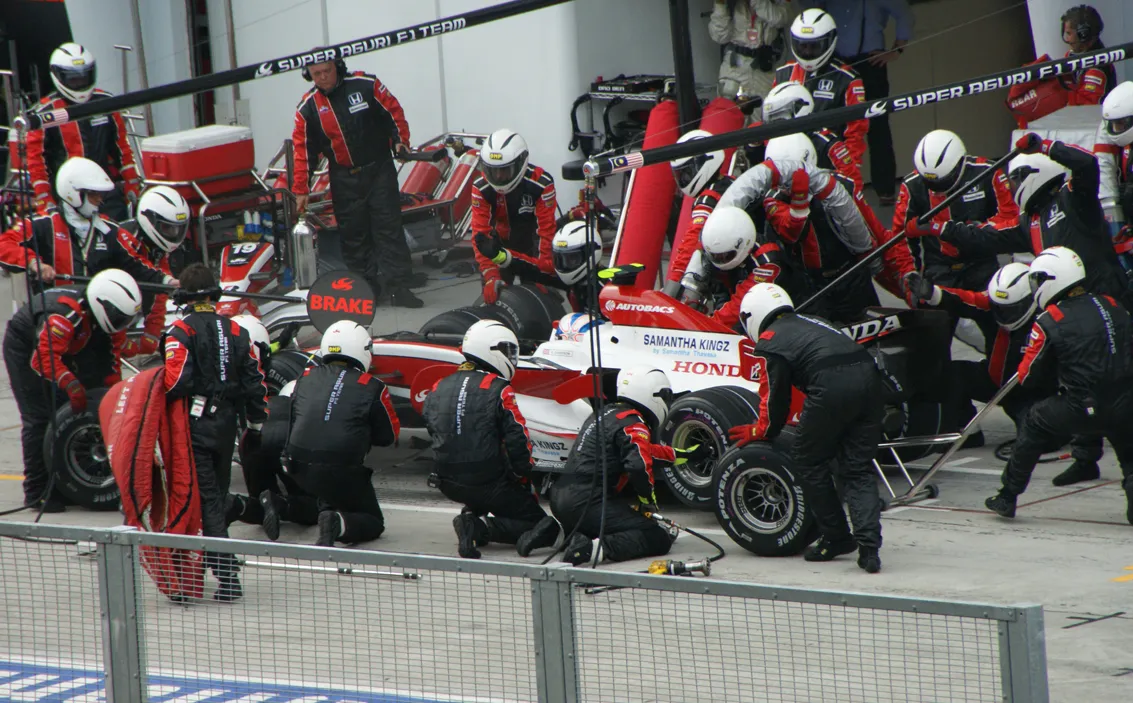
How F1 Teams Try to Prevent Pit Stop Mistakes
Teams cannot remove every risk, but they can reduce how often errors happen and how expensive they become.
Repeated pit-stop practice
Crews rehearse normal stops and abnormal scenarios. The goal is muscle memory without creating fatigue.
Driver accuracy training
Drivers practice hitting exact stopping marks. A predictable car position protects every other mechanic’s geometry.
Tool and hardware checks
Wheel guns, nuts, jacks and retaining systems are inspected carefully. Teams look for wear before it becomes a race failure.
Backup equipment
Spare jacks and alternative tools are positioned close enough to recover from a primary equipment problem.
Clear pit-call procedures
Strategy teams must give the crew enough warning. Ferrari’s Zandvoort example shows what happens when that window shrinks.
Release safeguards
Wheel confirmation, car status and pit-lane traffic all need to agree before the driver leaves.
Teams also study stop-to-stop consistency, not only personal-best times. A reliable sequence gives strategists confidence when planning an undercut.
For more context on track position, see our grid position guide. The difference between a 2.1-second stop and a 3.0-second stop can decide which car reaches the next corner first.
A Pit Stop Can Go “Wrong” Even When the Crew Does Everything Right
Sometimes the tyres are changed perfectly, but the strategic outcome is still bad. The driver may rejoin in traffic or lose more tyre temperature than expected.
A Safety Car can also change the value of stopping halfway through the process. Race control decisions, competitor timing and pit-lane congestion can alter the result.
That is why teams separate mechanical stop time from total pit-loss time. A fast stationary stop does not guarantee a good strategic stop.
Conversely, a slightly slow stationary stop may still produce the correct race outcome if the driver rejoins in clean air.
Our Safety Car explainer covers why neutralized races create unusual pit windows. The racing flags guide explains the signals that can trigger rapid strategic changes.
F1 Pit Stop Problems FAQs
Why do F1 pit stops sometimes go wrong?
F1 pit stops can go wrong because of wheel-gun faults, stuck or cross-threaded wheel nuts, inaccurate driver positioning, jack problems, late pit calls, tyre delays or unsafe-release traffic. Since all four corners work simultaneously, one failed task can hold the whole car.
What is a cross-threaded wheel nut in F1?
A cross-threaded wheel nut engages the axle thread incorrectly instead of following it cleanly. It can resist removal or tightening and force the crew to abandon the normal two-second sequence while they recover the wheel.
What happens if an F1 driver misses the pit box?
If the driver stops long, short or off-center, jack operators and wheel crews must move away from their rehearsed positions. That extra movement can add several tenths or more to the stop.
What is an unsafe release in F1?
An unsafe release happens when a car leaves its pit box in an unsafe condition or into another competitor’s path. Teams can receive penalties even when the tyre change itself was fast.
Conclusion: F1 Pit Stops Go Wrong Because the Margin for Recovery Is Tiny
The answer to why do F1 pit stops sometimes go wrong is not that the crews are careless. The opposite is usually true.
Modern stops are so optimized that almost every task happens simultaneously. That makes the process incredibly fast when it works and surprisingly fragile when one task fails.
A wheel gun can misfire. A wheel nut can cross-thread. A driver can miss the marks. A rear jack can fail to engage on the first attempt.
Strategy can create problems before the car arrives. Ferrari’s 2022 Zandvoort stop showed how a late call and a narrow pit lane left one tyre fitter without enough time to reach position.
Hardware failures can be even more destructive. Kick Sauber’s 2024 Bahrain stop kept Bottas stationary for 52.4 seconds because of a cross-threaded nut.
Safety adds another layer. Ferrari’s 2018 Bahrain incident showed that a release system must never signal the driver to leave before the car and crew are safe.
Therefore, the best pit crews are not simply the crews that can produce one record stop. They are the crews that repeat clean, predictable stops and recover quickly when something unexpected happens.
In Formula 1, two seconds is enough time to change four tyres. It is also short enough for one tiny error to reshape an entire race.
Sources
Technical details and race examples were checked against official Formula 1 material. The article distinguishes normal pit-stop failures from strategic, traffic and damage-related delays.