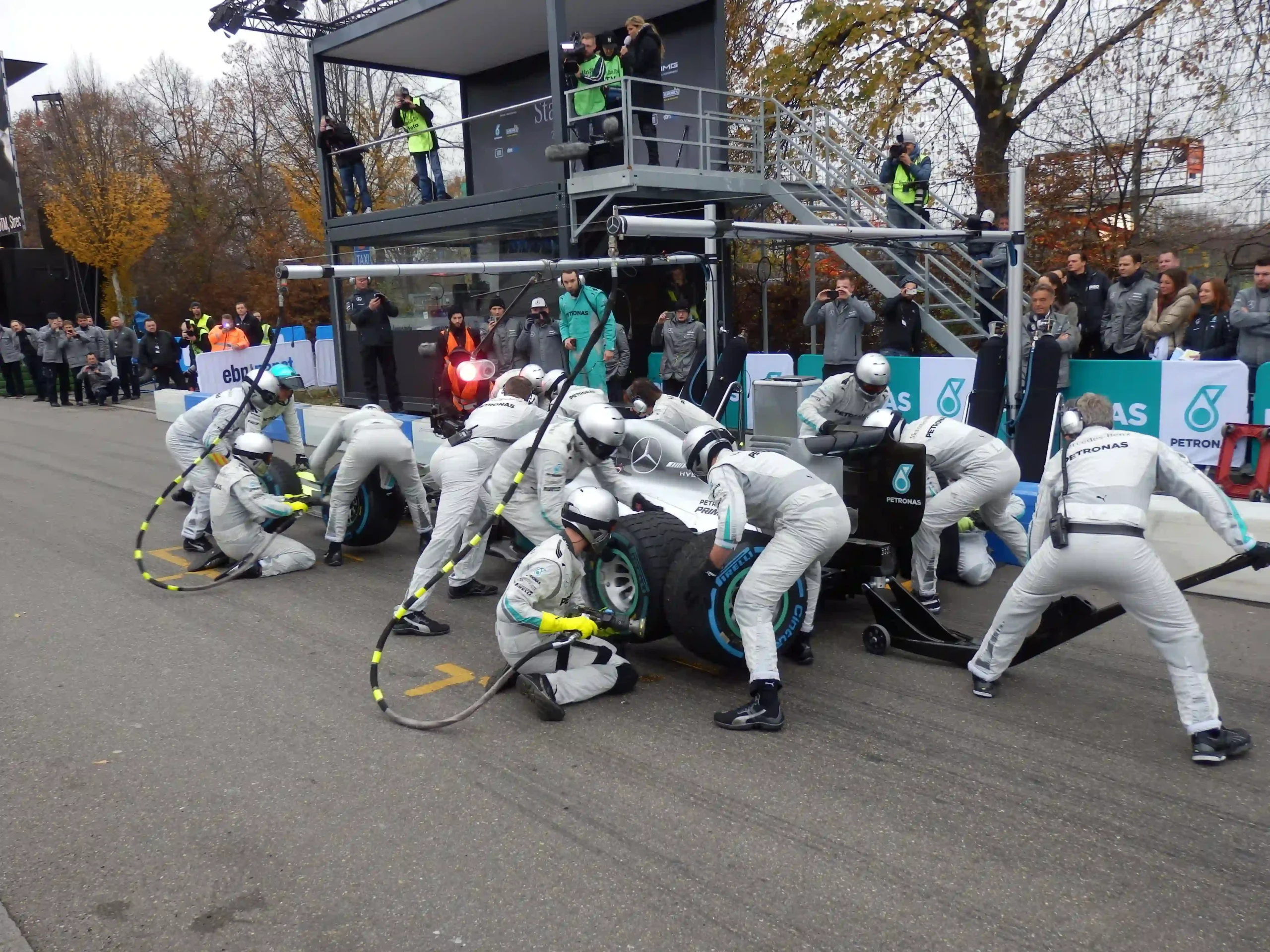
Why Do F1 Teams Double Stack Cars in the Pit Lane?
How one crew services two teammates on the same lap, why Safety Cars and rain trigger the call, and when a double stack saves a race or destroys it.
An F1 double stack pit stop happens when a team calls both cars into the pits on the same lap and services them one immediately after the other. The first car uses the team’s designated pit box, then leaves as the second arrives. If the gap is too small, the second driver waits.
Double stacking looks chaotic because it compresses two complete Formula 1 pit stops into one narrow window. Yet teams use it for a simple reason: sometimes both cars must stop now.
A Safety Car can make a pit stop far cheaper. Rain can make the current tires unusable within one lap. Meanwhile, a red flag threat or puncture can remove every safer option.
In those moments, leaving one driver on track may cost more than queuing that driver behind a teammate. Therefore, the pit wall accepts a controlled delay and protects both cars.
However, an F1 Double Stack Pit Stop is never automatic. The crew must prepare two tire sets, reset every tool, release the first car safely, and receive the second without confusion.
The strategy can produce a perfect two-car result. It can also cost ten seconds, trigger a penalty, or send one teammate from the podium fight into traffic.
This guide explains why F1 teams double stack, who receives priority, how the crew resets, and why changing weather creates the hardest decisions. It also uses verified examples through the 2026 season.
Why Do F1 Teams Double Stack Cars?
F1 teams double stack when both drivers need a pit stop during the same narrow strategic window. This usually happens under a Safety Car, Virtual Safety Car, or sudden weather change. The second car may lose time waiting, but staying on the wrong tires can cost far more.
Formula 1 defines a double stack as both team cars stopping at nearly the same time. One car is serviced immediately after the other.
The first car should leave just as the second reaches the pit box. When that choreography works, neither driver suffers a major delay.
Teams do not double stack simply because both cars are due for routine service. They usually prefer to separate normal stops by several laps.
Separation gives the crew more preparation time. It also avoids forcing one driver to wait and reduces pit-lane traffic risk.
However, racing can remove that freedom. A Safety Car closes the field. A rain shower changes the best tire. A puncture or damaged wing creates an urgent stop.
As a result, the team compares two losses. The first is the expected queue behind the teammate. The second is the loss from staying out.
If staying out is worse, the team orders an F1 double stack pit stop. It accepts the queue because the alternative is strategically damaging.
The central calculation: Double stacking is worthwhile when the second car’s expected waiting time is smaller than the track-position loss from delaying its tire change.
Why Does Each F1 Team Use One Pit Box?
The FIA allocates each competitor one designated pit-stop position within its garage area. Both team cars therefore use the same race-service location. This creates equal pit-lane space and prevents teams from gaining an advantage by operating two independent stopping positions.
The 2026 Sporting Regulations state that each competitor receives one designated pit-stop position. Every racing stop for both drivers happens at that point.
A Formula 1 team enters two cars, but the competitor is one organization. Therefore, it does not receive a separate race pit box for each driver.
The team may have separate working bays inside the garage. Those bays are used for setup work, repairs, and preparation between sessions.
During the race, however, both cars must stop at the designated position. That physical rule creates the double-stack concept.
Teams also use one active pit crew for live stops. The wider race team includes substitutes, engineers, and spare equipment, but one working group surrounds the car.
Using two full crews simultaneously would require much more pit-lane space. It would also place extra people and equipment beside moving cars.
The current structure keeps the lane organized. Moreover, it makes crew performance part of the Constructors’ Championship battle.
Inside the Garage
- Each car has its own working bay
- Engineers prepare individual setups
- Repairs can happen away from the pit box
- Different tire sets are assigned to each driver
- Cars can be worked on between sessions
During a Race Stop
- Both cars use one designated stop position
- One active crew services each car
- The cars must arrive one after another
- The first release must clear the second arrival
- Traffic management becomes critical
The same pit-lane safety rules apply during a double stack. The first car cannot be released into another driver or neighboring mechanics.
Therefore, a fast wheel change may still become a slow stop. The crew chief can hold the release until the fast lane is safe.
Our guide to an unsafe release in F1 explains how the FIA judges those incidents.
How Does an F1 Double Stack Pit Stop Work?
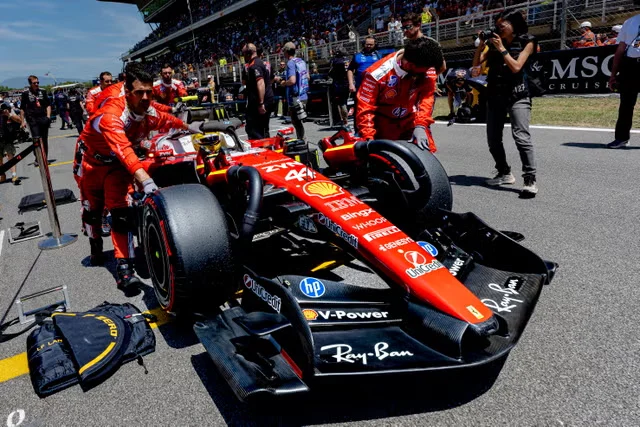
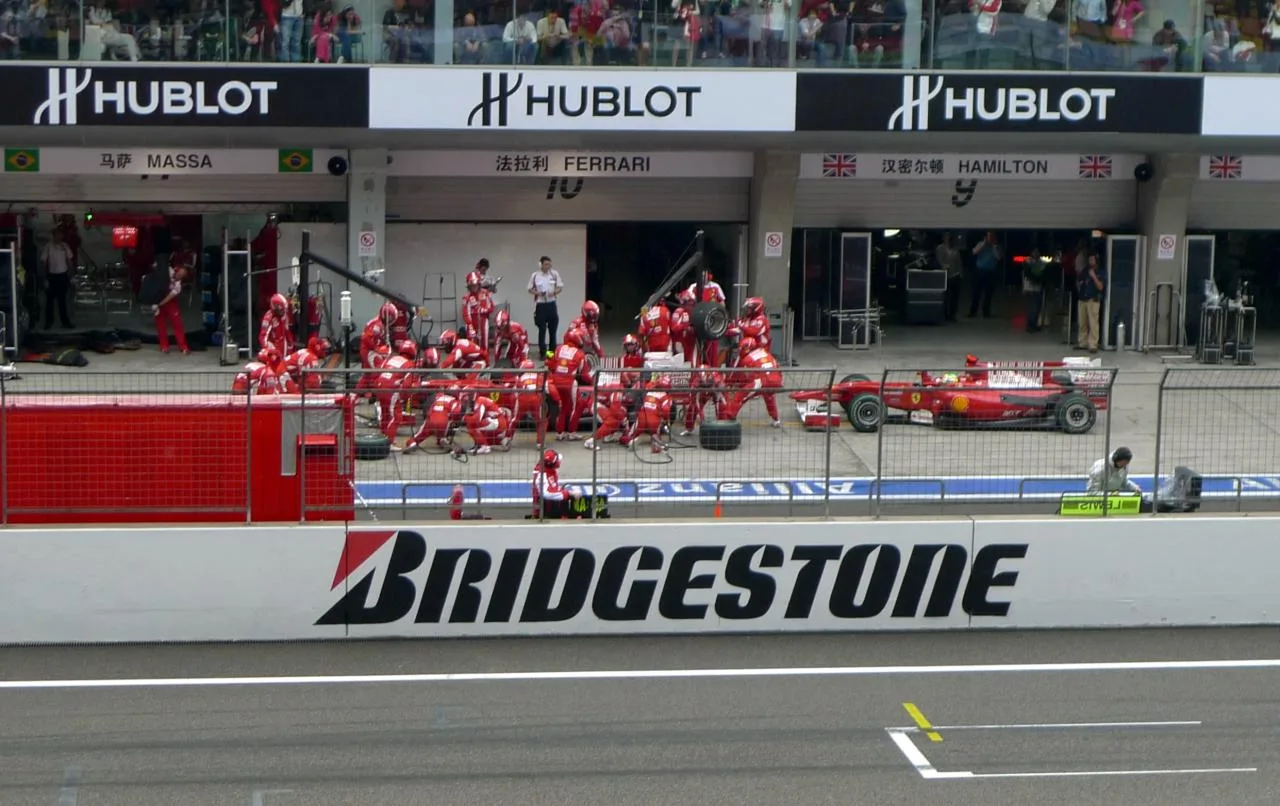
The lead car enters the shared pit box first. The crew changes its tires and releases it. Mechanics then clear the first tire set, reposition the guns, prepare the second set, and receive the teammate. The second driver either arrives as the box clears or waits behind the first car.
An F1 Double Stack Pit Stop begins before either driver reaches pit entry. The pit wall confirms the call, tire compounds, front-wing adjustments, and stopping order.
The crew normally moves into position 15 to 20 seconds before the first arrival. For a double stack, extra mechanics stage the second driver’s tire set nearby.
The first driver must stop accurately. A car parked too far forward or sideways slows the first service and blocks the second arrival.
Once the car stops, front and rear jack operators lift it. Four wheel-gun operators remove and refit the wheels.
Modern crews can complete a clean stationary stop in roughly two seconds. However, the double stack requires more than repeating that number.
After the first car drops, the release controller checks pit-lane traffic. The car leaves only when the lane is safe.
Meanwhile, the crew removes the first driver’s used tires. The second set moves into the four corners, and the guns reset.
The second driver then hits the same marks. If the spacing is perfect, the car stops after the crew has fully reset.
The First Car’s Sequence
- The driver enters the pit lane and obeys the speed limit.
- The car stops on the marks at the designated position.
- Both jacks lift the car while four wheels are changed.
- The crew confirms each wheel and any front-wing adjustment.
- The car drops, then waits for a safe release signal.
- The first driver accelerates into the fast lane.
The Crew Reset
The reset is the hidden part of the strategy. Used tires must leave the working area. Fresh tires must arrive in the correct order.
Wheel guns must be ready immediately. The front jack operator also needs room to catch the second car.
Every tire belongs to a specific driver’s allocation. Therefore, color coding, labels, and radio confirmation prevent the wrong set from reaching the car.
The reset can happen while the first car is still leaving. However, no mechanic can move carelessly into the path of that car.
The Second Car’s Sequence
The second driver approaches at pit-lane speed. The driver can see the teammate ahead but cannot always judge when the box will clear.
If the first car remains on the jacks, the second stops behind it. The driver must leave enough room for the first car to turn out.
When the box clears, the second driver moves onto the marks. That movement itself adds time before the stationary stop begins.
A perfect gap removes the queue. A poor gap creates a full stop behind the teammate.
The second car’s loss is not only the first car’s stationary time. It can include stopping behind the box, restarting, moving forward, waiting for equipment, and then waiting again for a safe release.
Do F1 Teams Have One Pit Crew for Both Cars?
Yes, one active crew normally services both cars during race stops. The crew is selected from mechanics and technicians who already work across the team.
A modern stop uses wheel changers, gun operators, jack operators, stabilizers, front-wing adjusters, and release personnel. Backup crew members also stand ready.
During an F1 double stack pit stop, those same specialists complete both services. The second tire set is prepared by supporting personnel, but the active positions remain consistent.
This consistency matters. Pit stops rely on muscle memory and precise movement. Replacing the full crew between cars would create extra confusion.
Teams train repeated back-to-back stops at the factory. They practice smooth resets, failed guns, damaged noses, and cars arriving too close together.
The goal is not only speed. Repeatability matters more. A crew that produces two safe 2.4-second stops may beat one that achieves 1.9 seconds followed by a mistake.
Our detailed guide to how pit stops work in racing explains every crew position.
Why Do F1 Teams Double Stack During a Safety Car?
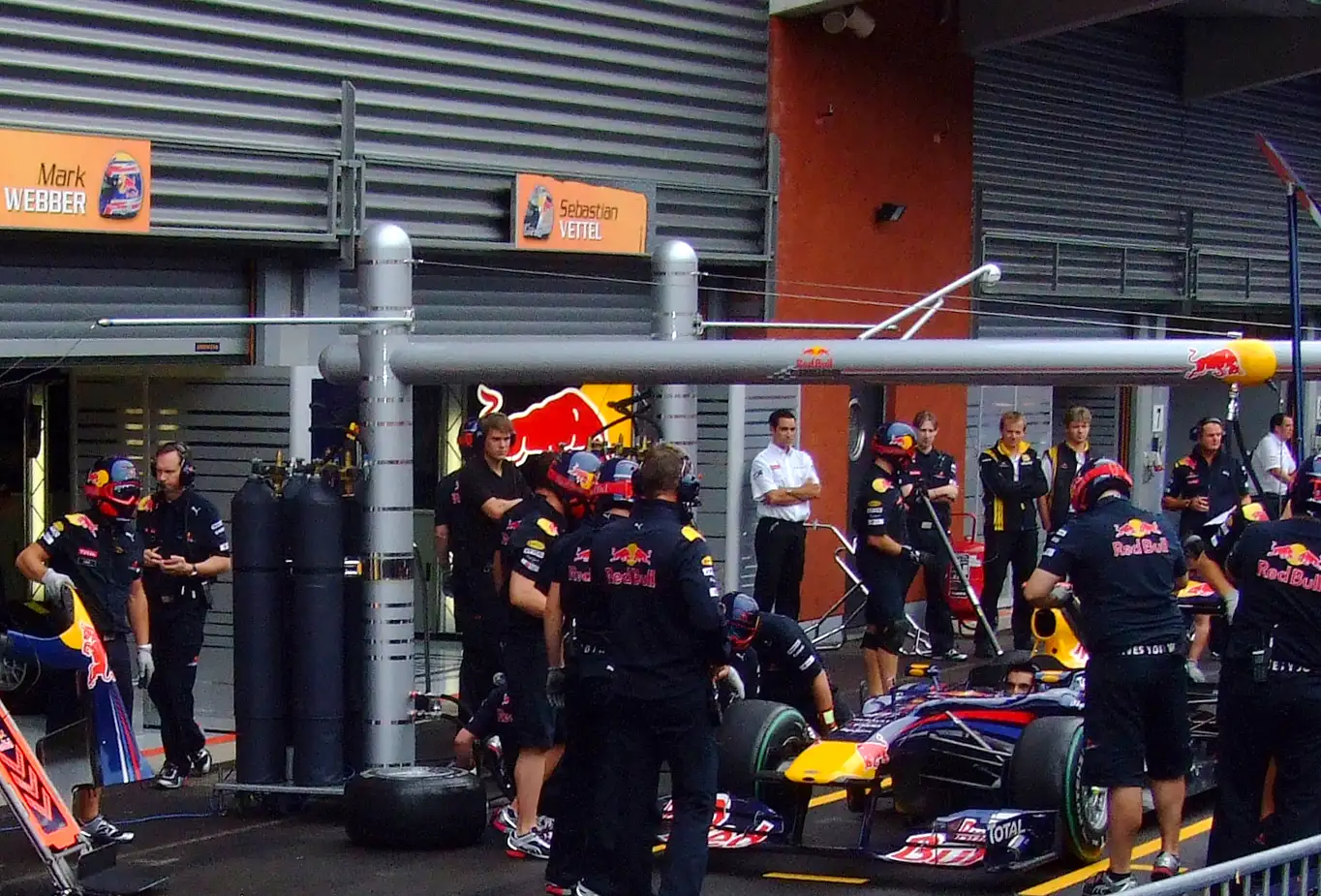
A Safety Car slows and bunches the field, reducing the relative cost of a pit stop. Most drivers also want fresh tires at the same moment. If a team leaves one car out, that driver may lose many positions when racing resumes, so both cars are often double stacked.
The Safety Car creates the classic double-stack window. Drivers on track must reduce speed and follow a controlled pace.
A car entering the pits therefore loses less time relative to cars remaining on the circuit. This is often called a cheap or discounted pit stop.
The field also bunches together. Consequently, a driver who stays out on worn tires may restart ahead but face faster cars immediately behind.
If both teammates need tires, the team cannot safely delay the second car for several laps. The race may restart before another cheap opportunity appears.
Therefore, the second driver often accepts a short queue. Even five seconds may be better than a later green-flag stop.
The pit wall also considers tire age. A driver with nearly new tires may stay out while the teammate stops.
Track position matters too. At Monaco, staying ahead can be worth more than fresh rubber. At a high-degradation circuit, the new tires may be essential.
Virtual Safety Car Double Stacks
A Virtual Safety Car does not bunch cars into one physical queue. Instead, every driver follows a minimum time delta.
However, it still slows the cars on track. A pit stop therefore costs less relative time than it would under full racing conditions.
Mercedes used this opportunity at the 2026 Australian Grand Prix. A VSC appeared on Lap 14, and the team called George Russell and Kimi Antonelli together.
The double stack returned them to the track in third and fifth. Russell’s stop also earned the event’s fastest-pit-stop recognition.
This example shows a well-spaced F1 Double Stack Pit Stop. Both drivers used the same strategic window without a damaging queue.
Why Pit-Lane Traffic Becomes Dangerous
The same Safety Car that improves strategy also crowds the pit lane. Several teams may call both cars together.
Drivers pass active pit boxes while mechanics handle tires and jacks. The release controller must watch traffic from both directions.
A first car held for safety can block the second teammate. An aggressive release can cause contact or a penalty.
Therefore, teams calculate traffic before committing. They use GPS data to predict which rivals will pass the box.
Our guide to the Safety Car in racing explains why pit-stop windows change under neutralization.
Why Do F1 Teams Double Stack When It Rains?
Rain can make the current tire several seconds slower within one lap. When the crossover point arrives, both teammates may need intermediates, wets, or slicks immediately. A brief queue behind the first car can be far cheaper than completing another lap on the wrong tire.
Weather creates the hardest double-stack decisions because the correct tire can change before the cars return to pit entry.
A dry track may become slippery in one sector. The lead driver reports the grip level, while the trailing driver reaches the same rain later.
The team must decide whether both drivers should stop. It may have only seconds before the first car passes pit entry.
When rain is heavy enough, staying on slicks can cost many seconds per lap. Therefore, waiting behind a teammate becomes the smaller loss.
The opposite transition also matters. A drying track can make slick tires much faster than intermediates. The first drivers to switch may gain positions rapidly.
However, double stacking both cars onto slicks carries risk. One driver may arrive while the box is still occupied, and cold slicks are difficult in a damp pit lane.
The 2024 British Grand Prix Lesson
McLaren led with Lando Norris and Oscar Piastri as rain intensified at Silverstone. The team stopped Norris but left Piastri out for another lap.
McLaren later acknowledged that a double stack would probably have cost Piastri about five seconds. However, the extra lap on worsening conditions cost him more.
Piastri fell from the victory fight and finished fourth. The case became a textbook example of why a planned queue can be better than the wrong tire.
The lesson is not that teams should always double stack in rain. It is that tire crossover losses can become larger than pit-box delays very quickly.
Why the Lead Driver Becomes the Weather Reference
The leading teammate reaches the weather first. That driver reports whether the tire still works.
The trailing driver receives more information but has less freedom. If the first car stops, the second may have to queue.
This creates an unavoidable sporting tension. The lead driver gains first choice, while the second driver may make the better-informed decision.
Teams try to offset that problem with radar and trackside observers. Still, the driver’s grip report often remains decisive.
Which Driver Pits First During a Double Stack?
The driver leading on track usually pits first because that car reaches pit entry first and holds the stronger race position. However, teams may reverse priority when the trailing driver has damage, a puncture, a critical tire problem, or a championship reason that outweighs the normal order.
There is no FIA rule stating that the lead driver must receive priority. It is a team strategy decision.
In most cases, track order decides naturally. The leading car arrives first, and asking it to slow behind the teammate would be inefficient.
The leading driver also has more position to protect. Holding that car can expose it to an undercut or traffic.
However, exceptions happen. A trailing driver with a puncture may need immediate service. A damaged front wing can also force the priority call.
Championship context may influence the choice. A title contender may receive strategic preference late in the season.
Teams can also split the drivers before pit entry. The car needing urgent service may be instructed to pass its teammate on track.
Does the Lead Driver Always Get Priority?
No. Lead-car priority is common, not guaranteed. Teams consider tire condition, race position, damage, championship goals, and the size of the gap.
When both cars have equal need, the lead driver usually stops first. This preserves sporting order and reduces internal conflict.
When the trailing car has a much greater need, the team may reverse them. The radio instructions must be clear before pit entry.
A late reversal is dangerous. Drivers may reach the speed-limit line side by side or enter the pit lane in the wrong order.
Can the Second Driver Refuse to Double Stack?
A driver can question the call over radio. However, the pit wall usually has broader timing and traffic information.
Ignoring the instruction may leave the driver on the wrong tire. It may also disrupt the team’s plan for both cars.
Experienced drivers sometimes choose their own wet-weather stop because they feel the grip directly. Formula 1’s official pit-stop guide notes that drivers may make the call in low-grip conditions.
Still, a double-stack order involves two cars and one crew. Therefore, unilateral decisions can create severe confusion.
Why Does the Second Driver Wait During a Double Stack?
The second driver waits because the shared pit box remains occupied. The crew cannot safely service two cars in one position at the same time.
The first car may still be on the jacks. It may also be held because another car is passing in the fast lane.
Even after release, the crew needs a moment to clear used tires and prepare the second set. The second driver should not enter before the equipment is ready.
The waiting position must also leave an escape path for the first car. Parking too close can trap both teammates.
Once the first car leaves, the second driver moves forward. That short movement adds time and requires another precise stop.
This is why teammate spacing matters. A gap of several seconds may eliminate the queue while keeping both cars inside the same strategic window.
How Do Drivers Create Space Before the Stop?
The trailing driver can manage pace before pit entry, but the driver must obey race-control rules. Safety Car and VSC deltas limit how slowly a car can travel.
Teams may ask for a small legal gap. The driver can avoid unnecessary acceleration while remaining above the required minimum speed.
However, deliberately backing up rivals can be punished. Lando Norris received a five-second penalty at the 2023 Canadian Grand Prix for slowing under the Safety Car to create double-stack space.
The stewards called the conduct unsportsmanlike. His penalty dropped him from the points.
Therefore, gap creation must remain within sporting expectations. A team cannot manufacture a pit advantage by obstructing the field.
How Much Time Does Double Stacking Cost in F1?
A perfect double stack can cost the second driver almost no extra waiting time when the teammate leaves as that driver arrives. In a poor sequence, the second car may lose five to 10 seconds or more through queuing, crew reset, traffic, a slow first stop, or a front-wing change.
There is no fixed double-stack penalty. The cost depends on the gap between cars and the quality of the first stop.
If the teammates are four seconds apart and the first stationary stop lasts two seconds, the second car may arrive after the box clears.
If the gap is one second, the second driver must stop behind. The queue can exceed the first car’s stationary time because the driver must move forward afterward.
A slow release creates another delay. The first car may be ready mechanically but held for pit-lane traffic.
The second stop can also be slower if mechanics are still moving tires or resetting guns. Fatigue and rushed positioning increase error risk.
Measured Example: Japan 2022
Mercedes double stacked Lewis Hamilton and George Russell for intermediate tires on Lap 7 at Suzuka.
Official Formula 1 analysis recorded 25 seconds in the pit lane for Hamilton and 28.7 seconds for Russell. Therefore, Russell lost nearly four seconds in the lane.
The analysis estimated another six seconds were lost because rivals switched earlier to the faster intermediate tire. His combined strategic loss approached ten seconds.
This case demonstrates two separate costs. The first was the queue. The second was delaying the tire decision until both cars could stop together.
Estimated Example: Silverstone 2024
McLaren estimated that double stacking Norris and Piastri would have cost the second car around five seconds.
The team avoided that planned loss by leaving Piastri out. However, the deteriorating wet track created a larger unplanned loss.
Therefore, the correct comparison is not “five seconds versus zero.” It is “five seconds in the pits versus the expected loss on track.”
| Double-Stack Situation | Likely Second-Car Effect | Main Cause | Strategic Meaning |
|---|---|---|---|
| Perfect teammate gap | Little or no queue | First car leaves before second arrives | Both cars capture the same window |
| Cars arrive nose to tail | Several seconds waiting | Shared pit box remains occupied | Still worthwhile if tires are urgent |
| First car has a slow wheel change | Delay grows rapidly | Stuck nut, poor stop position, gun problem | Can ruin the second driver’s race |
| First car needs a front wing | Large queue | Nose replacement takes much longer | Teams may reverse order or split strategy |
| Unsafe-release hold | Unpredictable queue | Traffic passes the pit box | Safety takes priority over pit time |
| Wrong tire crossover call | Track loss exceeds pit delay | Car stays out on unsuitable tires | Double stacking would have been better |
What Are the Risks of Double Stacking in F1?
An F1 Double Stack Pit Stop places every weakness in the pit process under maximum pressure. One small problem affects two cars.
A Slow First Stop Blocks Both Drivers
A cross-threaded wheel nut can add several seconds. The first driver loses time, while the second remains stationary behind.
A poor stop position creates the same chain reaction. Mechanics need extra movement, and the second arrival may become awkward.
A Front-Wing Change Can Destroy the Sequence
A nose replacement takes much longer than a normal tire stop. If the first driver needs a wing, the second car can lose a full pit-lane queue.
Teams may therefore service the undamaged car first. Alternatively, they may leave one driver on track and split the stop.
Wrong Tires Can Reach the Wrong Car
Each driver has individually allocated tire sets. During a rushed reset, the crew must ensure the second car receives its own set.
Teams use clear labels and color codes. Radio calls also identify the driver and compound.
If the wrong set is fitted, the driver may need to return immediately. That destroys the strategy and can create a sporting penalty if not corrected.
Pit-Lane Traffic Can Cause an Unsafe Release
The first car must leave before the second stops. However, cars from other teams may be passing in the fast lane.
The release controller may hold the first driver. That safe decision increases the second car’s queue.
Releasing too early can cause contact or a time penalty. Therefore, the team cannot trade safety for a cleaner double stack.
The Second Driver Can Lose Track Position
A five-second queue may drop the second car behind several rivals. Modern Formula 1 fields often contain many cars within one pit window.
The driver then returns in traffic. Dirty air and overtaking difficulty can magnify the original delay.
One Error Can Create Internal Conflict
Drivers remember lost positions. If one teammate repeatedly receives priority, the second driver may question the team’s fairness.
Teams need transparent rules. Track order, championship position, and tire need should be discussed before the race.
Clear principles reduce emotional radio exchanges. They also help the pit wall make decisions quickly.
A double stack concentrates risk. Instead of two independent stops, the second driver inherits every delay from the first. The strategy only works when the urgency of stopping both cars outweighs that linked risk.
When Should an F1 Team Avoid Double Stacking?
A team should avoid double stacking when the second driver can stay out without losing the strategic window.
Fresh tires may allow that car to continue safely. Clean air may also create an overcut opportunity.
A large queue is another warning. If teammates are nose to tail and the first car needs repairs, splitting the stops is often safer.
Pit-lane traffic also matters. A crowded lane may delay both cars and create release risk.
The team may keep one driver out to gain track position during the Safety Car. That driver can restart near the front on older tires.
This gamble works best at circuits where overtaking is difficult. It works less well when tire degradation is high.
Double Stack vs. Split Strategy
Double Stack Both Cars
- Protects both drivers from a sudden tire crossover
- Captures one Safety Car or VSC window
- Uses the same compound for predictable pace
- Risks a queue for the second driver
- Links both results to one crew sequence
Split the Strategies
- One car keeps track position
- The second car gains fresh tires
- Creates two tactical options
- Exposes one driver to the wrong tire
- Can create difficult internal priority later
Split strategy is valuable when the correct choice remains uncertain. One driver stops, while the other stays out as insurance.
However, the team must accept that one car may lose heavily. The strategy protects the constructor’s overall chance, not necessarily both drivers equally.
Our guide to the undercut and overcut explains why track position and fresh tires pull strategy in opposite directions.
Famous and Recent F1 Double Stack Pit Stop Examples
Double-stack results range from flawless championship-level execution to obvious strategic regret. The best examples show why context matters more than the queue itself.
| Event | Team | Double-Stack Outcome | Main Lesson |
|---|---|---|---|
| 2026 Australian GP | Mercedes | Russell and Antonelli stopped under Lap 14 VSC and rejoined P3 and P5 | Good spacing can capture a cheap stop for both cars |
| 2026 Chinese GP | Ferrari | Hamilton received a 2.29-second stop before Leclerc followed | The first stop must be fast enough to clear the second arrival |
| 2024 British GP | McLaren | Team avoided stacking Piastri, but the extra wet lap cost more | A planned queue can be cheaper than the wrong tire |
| 2024 Canadian GP | Aston Martin | Solid double stack onto dry tires helped secure P6 and P7 | Wet-to-dry timing can reward both cars |
| 2023 Canadian GP | McLaren | Norris slowed to create space and received a five-second penalty | Drivers cannot manipulate the field unsportingly |
| 2022 Japanese GP | Mercedes | Russell lost nearly four seconds in the pits and more on strategy | A late crossover plus queue can compound losses |
| 2019 Chinese GP | Mercedes | Hamilton and Bottas retained a one-two through a risky double stack | Perfect crew execution protects both lead cars |
Mercedes, Australia 2026: Modern Double-Stack Execution
The first Grand Prix of 2026 delivered a current example. A VSC arrived on Lap 14, giving Mercedes a discounted stop.
George Russell led Kimi Antonelli into the pits. The crew serviced both and returned them in third and fifth.
Russell’s service was also the fastest stop of the event. Therefore, the first car cleared the working area without trapping Antonelli.
This was the ideal pattern. The strategic window was clear, the teammate gap worked, and the first stop remained clean.
Ferrari, China 2026: Speed Before the Reset
Ferrari earned the fastest-pit-stop award in Shanghai with Lewis Hamilton’s 2.29-second service.
Charles Leclerc then followed in the same double-stack sequence. The example shows why the first stop sets the whole rhythm.
A two-tenth delay for Hamilton would also affect Leclerc. By completing the first service quickly, Ferrari protected both stops.
McLaren, Silverstone 2024: The Double Stack That Did Not Happen
Sometimes the most important example is a rejected double stack. McLaren stopped Norris for intermediates and left Piastri on slicks.
The pit wall feared the queue would cost roughly five seconds. Yet Piastri’s additional lap on the wet track cost more.
McLaren later admitted the decision was wrong. Both cars had been in contention for victory.
The case changed public understanding of the strategy. Waiting behind a teammate is visible, but staying out can create a larger hidden loss.
Mercedes, Japan 2022: Queue Plus Late Tire Change
Hamilton and Russell entered together for intermediates in a shortened wet race. Russell sat behind Hamilton and lost nearly four pit-lane seconds.
He also lost time because other drivers switched earlier. Formula 1’s data analysis estimated the combined loss near ten seconds.
Therefore, the queue was only part of the problem. The timing of the strategic decision mattered just as much.
Mercedes, China 2019: Protecting a One-Two
Mercedes led with Hamilton and Bottas in Formula 1’s 1,000th World Championship event. The team stacked both cars during the second stop phase.
The move was risky because any slow first stop could damage both lead positions. However, the crew executed cleanly.
Hamilton and Bottas finished first and second. The stop became one of the clearest examples of a team trusting its operational strength.
Who Decides Whether an F1 Team Double Stacks?
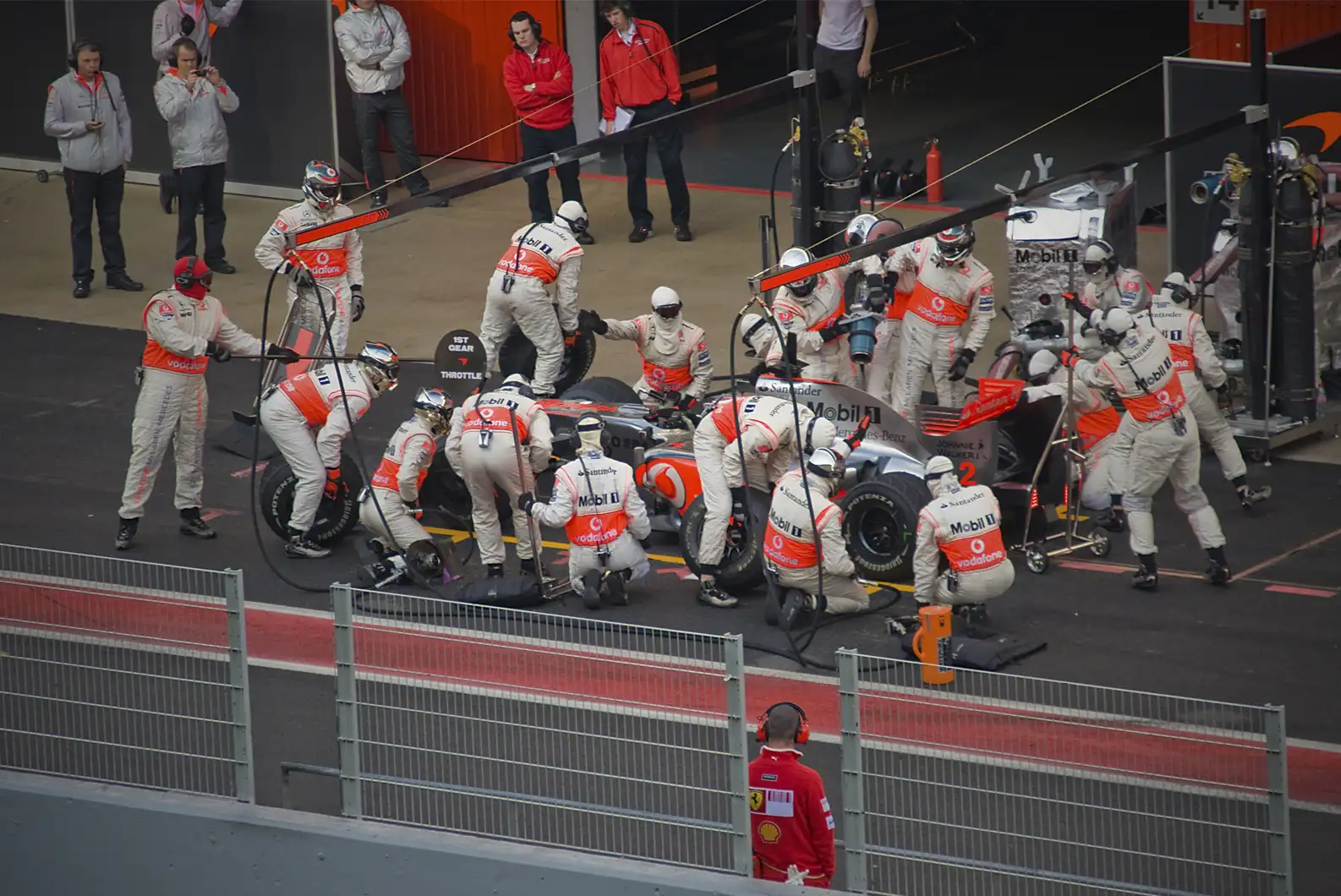
The final call comes from the pit wall. Strategy engineers, the sporting director, race engineers, and senior operations staff contribute.
Computer models calculate expected positions after each option. They consider tire pace, pit loss, traffic, Safety Car timing, and rival behavior.
However, the model cannot know everything. Rain intensity, driver confidence, and pit-lane congestion change in real time.
The race engineer communicates with the driver. The strategist compares both cars and decides the best team outcome.
The sporting or operations lead then prepares the crew. Formula 1’s official pit-stop guide says the pit wall identifies the car, tire set, and front-wing adjustment.
In a double stack, this process happens twice. The crew needs a precise first-car call and a precise second-car call.
What Data Does the Pit Wall Use?
- Gap between teammates at pit entry
- Expected stationary time for each car
- Tire condition and compound availability
- Weather radar and driver grip reports
- Safety Car or VSC status
- Traffic approaching the team’s pit box
- Expected pit-exit position
- Damage or front-wing work
- Championship and team priority
- Likelihood of the race restarting soon
The decision window may last only a few seconds. Therefore, teams prepare scenario plans before the race.
They know which driver receives priority under common conditions. They also know how much gap the second car needs.
Pre-race planning reduces debate on radio. However, unexpected damage or weather can still force a new decision.
How Do Pit Crews Prepare Tires for Two Cars?
Every tire set is assigned to one driver. The crew must stage eight fresh wheels without mixing the allocations.
The pit wall confirms both compounds. For example, the first driver may receive mediums while the second receives hards.
Supporting mechanics position the second set behind the active crew. They cannot obstruct the first stop or the fast lane.
Once the first car leaves, used wheels move away. The second set moves into the wheel-on positions.
Clear labels reduce error. Teams use driver numbers, colors, and set identifiers.
Tire blankets also remain attached until the correct moment. Removing them too early can reduce temperature.
Wet-weather double stacks add difficulty. Intermediate and wet tires may both be prepared while the team waits for the final call.
A late compound switch can force the crew to replace the staged set. This is why weather decisions sometimes look slow from the outside.
Can Both F1 Cars Be Serviced at the Same Time?
Not at separate live pit boxes. The FIA gives the team one designated pit-stop position.
The second car can wait behind the first. It cannot receive a normal racing tire change beside it in another unassigned position.
Inside the garage, both cars can be worked on during practice or between sessions. That is different from a race pit stop.
During a red flag, teams may work under the rules in designated areas. However, the exact permitted work depends on race-control instructions.
The single-position rule keeps double stacking meaningful. If each car had its own pit box, both could stop simultaneously and teammate priority would disappear.
How Double Stacking Affects the Constructors’ Championship
Double stacking is a team strategy because both cars score Constructors’ Championship points.
A driver-focused choice may protect one result but sacrifice the other. A constructor-focused choice seeks the best combined finish.
For example, losing three seconds with the second car may still preserve two points finishes. Leaving that driver out might produce one podium and one finish outside the points.
Teams also consider rivals. If both competitor cars pit, matching them can protect championship position.
Late in the season, the leading team may choose the safer double stack. A chasing team may split strategies and seek a larger swing.
Our guide to how racing championships are scored explains why the second car’s points matter.
Common F1 Double Stack Misunderstandings
“Double Stacking Means Two Cars Are Serviced Together”
No. The cars are serviced one after another at the same pit-stop position.
“The Second Driver Always Loses Five Seconds”
No. The loss can be almost zero with perfect spacing. It can also exceed ten seconds after a problem.
“The Lead Driver Must Always Pit First”
No FIA rule requires it. Track order usually creates priority, but teams may reverse the cars.
“Double Stacking Is Only Used Under a Safety Car”
No. Rain, punctures, red-flag risk, and simultaneous tire degradation can also trigger it.
“Staying Out Avoids the Double-Stack Loss”
It avoids the queue, but it may create a larger tire or Safety Car loss.
“A Driver Can Slow as Much as Needed to Create a Gap”
No. Dangerous, erratic, or unsporting slowing can produce a penalty.
F1 Double Stack Pit Stop FAQs
What is double stacking in F1?
Double stacking means both teammates pit on the same lap and are serviced one immediately after the other at the team’s single designated pit-stop position.
Why do F1 teams double stack during a Safety Car?
The Safety Car reduces pit-stop time loss and creates one valuable window. Leaving one teammate out can cost more than briefly queuing behind the first car.
Which driver gets pit-stop priority in a double stack?
The leading driver usually receives priority. However, damage, tire condition, championship needs, and strategic opportunity can change the order.
How much time does an F1 double stack cost?
A perfectly spaced stop may add almost no wait. A poor sequence can cost five to 10 seconds or more through queuing, traffic, or a slow first stop.
Conclusion: Why F1 Teams Accept the Double-Stack Risk
An F1 Double Stack Pit Stop is a calculated response to urgency. Both cars need the same pit lane, the same crew, and often the same strategic moment.
Teams prefer separated stops when possible. However, Safety Cars, Virtual Safety Cars, and changing weather can remove that option.
The second driver may wait behind the teammate. Yet that delay can be smaller than another lap on the wrong tire.
A successful double stack depends on preparation. The first car must stop accurately, the crew must work cleanly, and the release must remain safe.
The crew then has to reset immediately. Used tires move out, fresh tires move in, and the second driver must hit the same marks.
Driver priority usually follows track order. Still, teams can reverse the sequence when damage, tire condition, or championship needs demand it.
The best examples make the strategy look simple. Mercedes showed that in Australia in 2026, while Ferrari followed with another efficient sequence in China.
The failures reveal the true difficulty. Japan 2022 showed the cost of a queue, and Silverstone 2024 showed that avoiding the queue can cost even more.
Therefore, double stacking is not automatically good or bad. It is a comparison between known pit delay and expected track loss.
That decision captures Formula 1 strategy at its sharpest. The team has seconds to protect two cars, one pit box, and one championship result.
Sources and Verification
This article was checked against official FIA and Formula 1 material available on July 19, 2026. Event strategy and sporting rules can change, so official race reports and the latest FIA regulation issue remain controlling.