How Many People Work on an F1 Pit Stop?
The real answer is more interesting than “20”: twelve people handle the four wheels, then jack operators, stabilizers, release control, backups and support staff turn the stop into a two-second team operation.
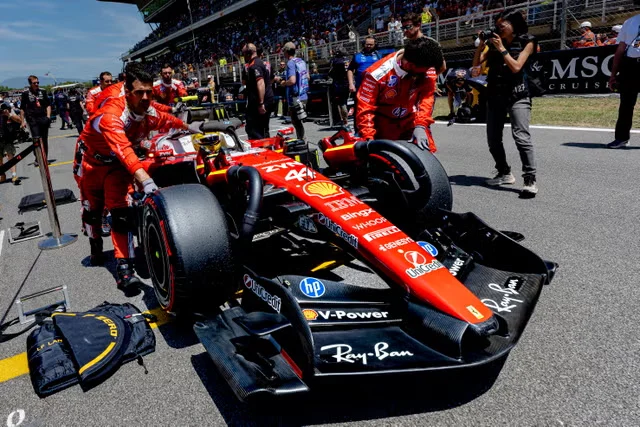
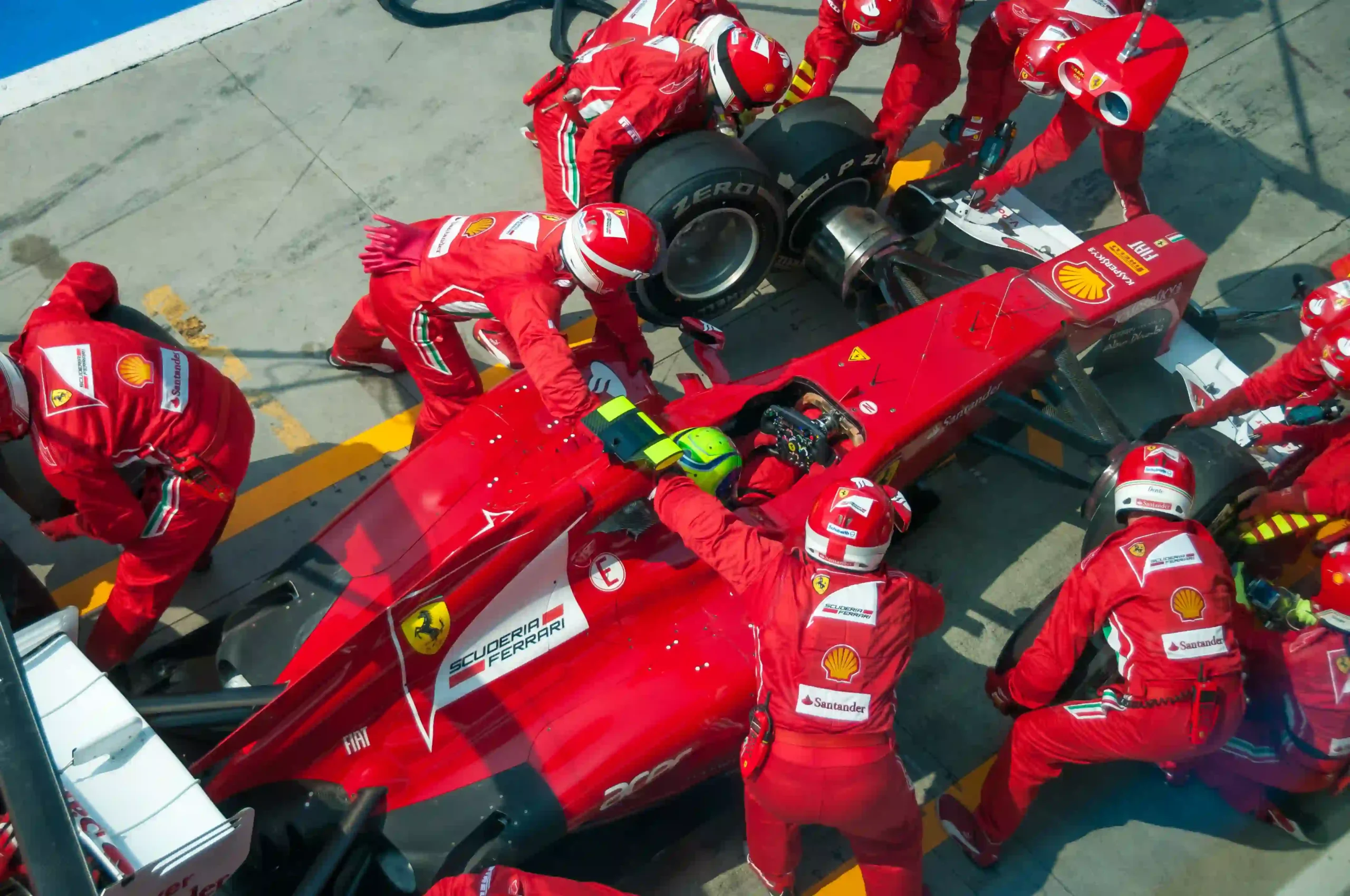
There is no single universal F1 pit-crew total. The core tyre change uses 12 people—three at each wheel—plus a front jack operator, rear jack operator, two stabilizers and additional personnel for release control, wing adjustment, backup equipment and safety. Formula 1’s 2025 Haas feature described 20 mechanics going to work during a stop.
An F1 pit stop can put roughly twenty mechanics around one car, yet every person has only a tiny slice of the job.
That division of labor is the reason the scene looks crowded. Four wheel corners must be serviced at the same time. Meanwhile, the car has to be lifted, stabilized, checked and released safely into pit-lane traffic.
However, saying “an F1 pit crew has exactly 20 people” is too simple. Formula 1 itself says teams can give different answers depending on who they count. Some totals refer only to the active mechanics around the car, while others include backups and support staff.
This guide breaks down the F1 pit crew size role by role. It explains which mechanics touch the car, who controls the release, what backups do, and why the driver belongs in the conversation.
The 2026 season adds another current wrinkle. Formula 1 now has 11 teams after Cadillac joined the grid. Each operation follows the same basic pit-stop principles, but teams organize people and backups in slightly different ways.
Is an F1 Pit Crew 20 People, 23 People, or Something Else?
The best answer is around 20 active mechanics can be involved, but there is no fixed universal total. Formula 1’s official 2025 F1 Explains feature introduced a Haas stop by saying 20 mechanics go to work.
Meanwhile, Formula 1’s technical “Anatomy of a pit stop” article warns against treating any one number as a rule. Teams can count the people involved differently. The number grows when spare jack operators, fire-extinguisher crew, analysts, physiotherapists and medical staff are included.
That is why older articles sometimes quote 22 or 23 people. They may be counting a broader operational group. Other explanations focus only on the people physically surrounding the car during a normal tyre stop.
Useful rule of thumb: 12 people are directly assigned to the four tyres. Add two main jack operators and two stabilizers, and you already have 16 hands-on roles before wing adjusters, release control, backups or safety support are considered.
For readers learning the basics, it is better to understand the roles than memorize one total. The crew works as a system, and the exact headcount can change with the team or the work required.
Our broader pit-stop explainer compares Formula 1 with other forms of motorsport and shows why F1 uses such an unusually large synchronized crew.
The Core Tyre Change Uses 12 People
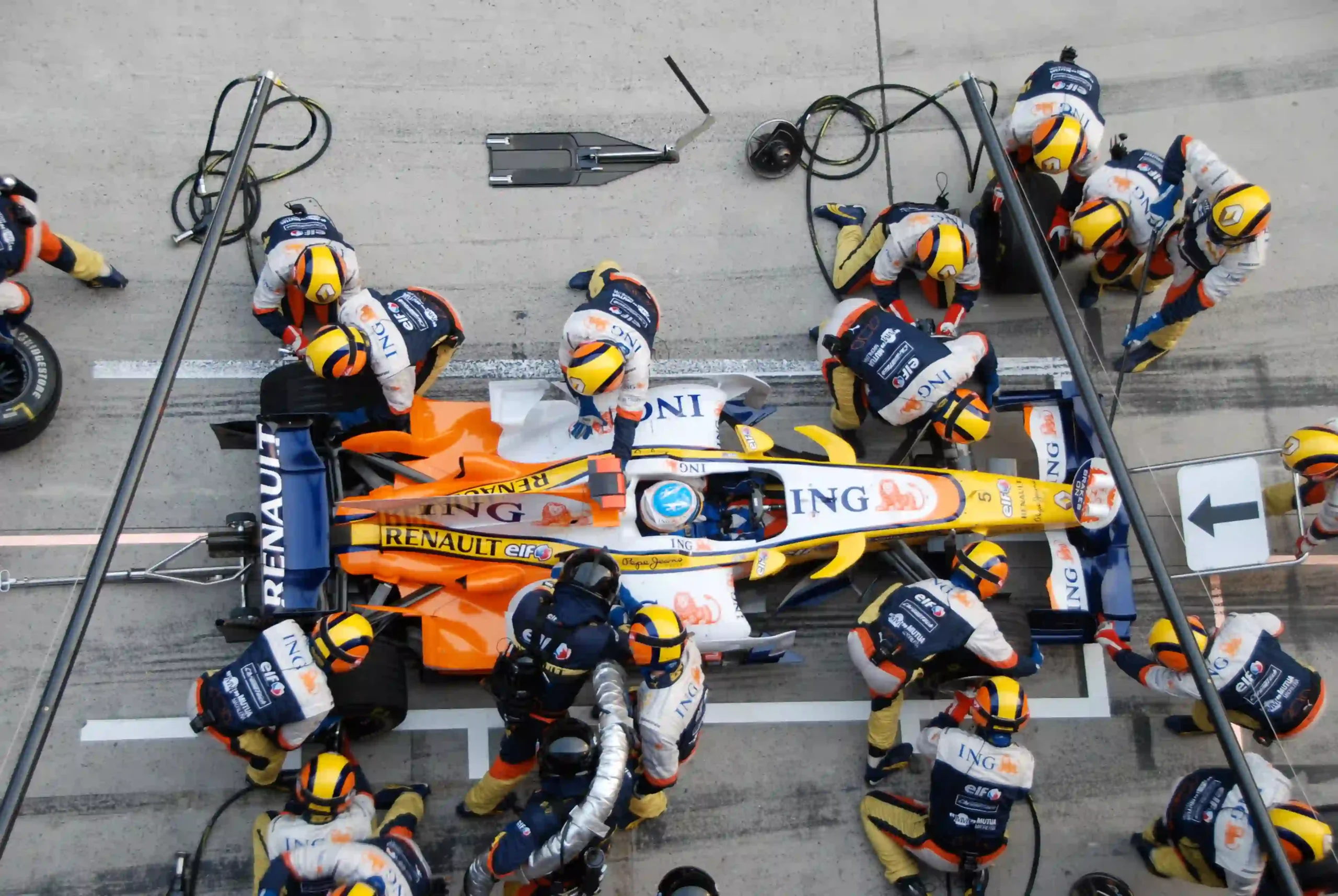
Three people normally work each wheel corner: one wheel-gun operator, one wheel-off mechanic and one wheel-on mechanic. Because the same three-role unit is repeated at all four corners, the core tyre-changing group totals 12 people.
This three-person structure is the heart of a modern F1 pit stop. It allows the wheel nut, old tyre and replacement tyre to be handled as overlapping tasks instead of one long sequence.
The gunner controls the pneumatic wheel gun. The wheel-off mechanic is already gripping the old tyre as the car stops. At the same time, the wheel-on mechanic is moving the replacement toward the axle.
Therefore, each corner behaves almost like its own miniature pit crew. The front-left corner does not wait for the rear-right. All four units work together, and the slowest necessary corner usually determines when the car can leave.
This parallel structure also explains why F1 teams practice pit stops so frequently. A fast individual is useful, but four corners must reach the same rhythm.
The wheel-gun operator
Formula 1 defines the wheel gun as the pneumatic tool that rapidly loosens or tightens the wheel nut. There is one primary gunner at each corner, so four guns can operate almost simultaneously.
Precision matters as much as power. The gunner must seat the tool correctly on the recessed nut and stay on the old wheel until it clears the axle. A misfire or poor engagement can cost more time than the rest of the stop.
The wheel-off mechanic
This mechanic removes the used tyre. Formula 1’s technical breakdown says the wheel-off member is already gripping the wheel as the car halts, nearly at the same moment the gun engages.
The task looks simple, but rear tyres are larger and heavier. That changes the body position, strength and leverage required compared with the front axle.
The wheel-on mechanic
The wheel-on mechanic brings the replacement tyre forward while the old one is leaving. They do not stand still and wait for a clear axle.
That overlap is critical. In a strong stop, Formula 1 says the new wheel can be fitted around 1.2 seconds into the stationary sequence. The gunner then returns to the captive nut to secure it.
F1 Pit Crew Roles at a Glance
| Role | Typical Count | Main Job |
|---|---|---|
| Wheel-gun operators | 4 | Release and secure one wheel nut at each corner. |
| Wheel-off mechanics | 4 | Remove the four used tyres as soon as the nuts release. |
| Wheel-on mechanics | 4 | Fit the four replacement tyres while the old wheels clear. |
| Front jack operator | 1 | Raises the nose and quick-releases the front when service is complete. |
| Rear jack operator | 1 | Moves behind the car, engages the rear lifting point and drops the rear. |
| Stabilizers | 2 | Steady the car and may clean the visor or clear debris. |
| Front-wing adjusters | As needed | Change front flap angle using preset torque drivers. |
| Crew chief / release controller | Team-specific | Checks wheel confirmation, car status and pit-lane traffic before release. |
| Backup jack / safety crew | Team-specific | Stand ready for jack failure, fire risk or abnormal service. |
| Analysts, physios, medical support | Team-specific | Prepare the crew, review stops and support performance away from the box. |
The table shows why the number changes depending on the question. If someone asks how many people change the tyres, the clean answer is 12. If they ask how many people are involved in the pit stop operation, the answer is broader.
That distinction is important for accuracy. The people physically touching the four tyres are not the entire pit crew.
Two Main Jack Operators Lift the Car
Formula 1’s glossary defines the jack man as the pit-crew member who raises the car so the tyres can be changed. A normal stop has a primary front jack operator and a primary rear jack operator.
The front operator waits directly in front of the car. The nose can contact the jack just before the car fully stops. In Formula 1’s reference 2.2-second stop, the front can be fully lifted around 0.3 seconds.
The rear operator has a more physical movement. They cannot stand behind the car as it approaches, so they begin moving and then step or run into position after the car passes.
The rear lifting cup must connect correctly on the first attempt. Formula 1 notes that modern ground-effect cars are heavy and run low, reducing mechanical leverage for the operator.
Backup jack operators can also stand ready. They are not necessarily counted in every “active crew” total, but they are part of the wider pit-stop operation.
If one wheel corner is slow, the other corners may already be finished. If the car itself is not lifted correctly, all four wheel crews are delayed. That makes the jack operators two of the highest-leverage roles in the entire stop.
Two Stabilizers Do More Than Hold the Car
Formula 1 says a pit crew typically features two stabilizers. They grab the airbox and radiator inlet areas to steady the car as it comes to rest and as the wheel work takes place.
Their job can change from stop to stop. They may wipe the driver’s visor, clear debris from radiator openings, help with a steering-wheel change or operate side jacks during unusual repairs.
That versatility is one reason it is difficult to reduce an F1 pit crew to a single fixed diagram. The standard tyre stop has a clear pattern, but damaged cars create different demands.
For example, a puncture can alter how the car sits. Front-wing damage can require extra mechanics. A nose change can turn a two-second tyre stop into a much longer repair operation.
Our guide to crashes in motor racing explains why pit crews also train for damage scenarios rather than only clean tyre changes.
Front-Wing Adjusters Join When the Car Needs Balance Changes
Not every pit stop includes a front-wing adjustment. When the driver requests a change, mechanics on either side of the nose can alter the flap angle with preset torque tools.
The adjustment happens while the tyre crews are already working. Therefore, it does not necessarily add time if both wing adjusters finish before the wheels are ready.
This is another example of parallel work. Formula 1 teams try to make every necessary action fit inside the same short stationary window.
If a larger front-wing repair is required, the stop becomes a different operation. Teams may replace the nose assembly entirely, and more crew members can become involved.
For background on why wing angle changes matter, read our downforce explainer.
Who Releases the F1 Car From the Pit Box?
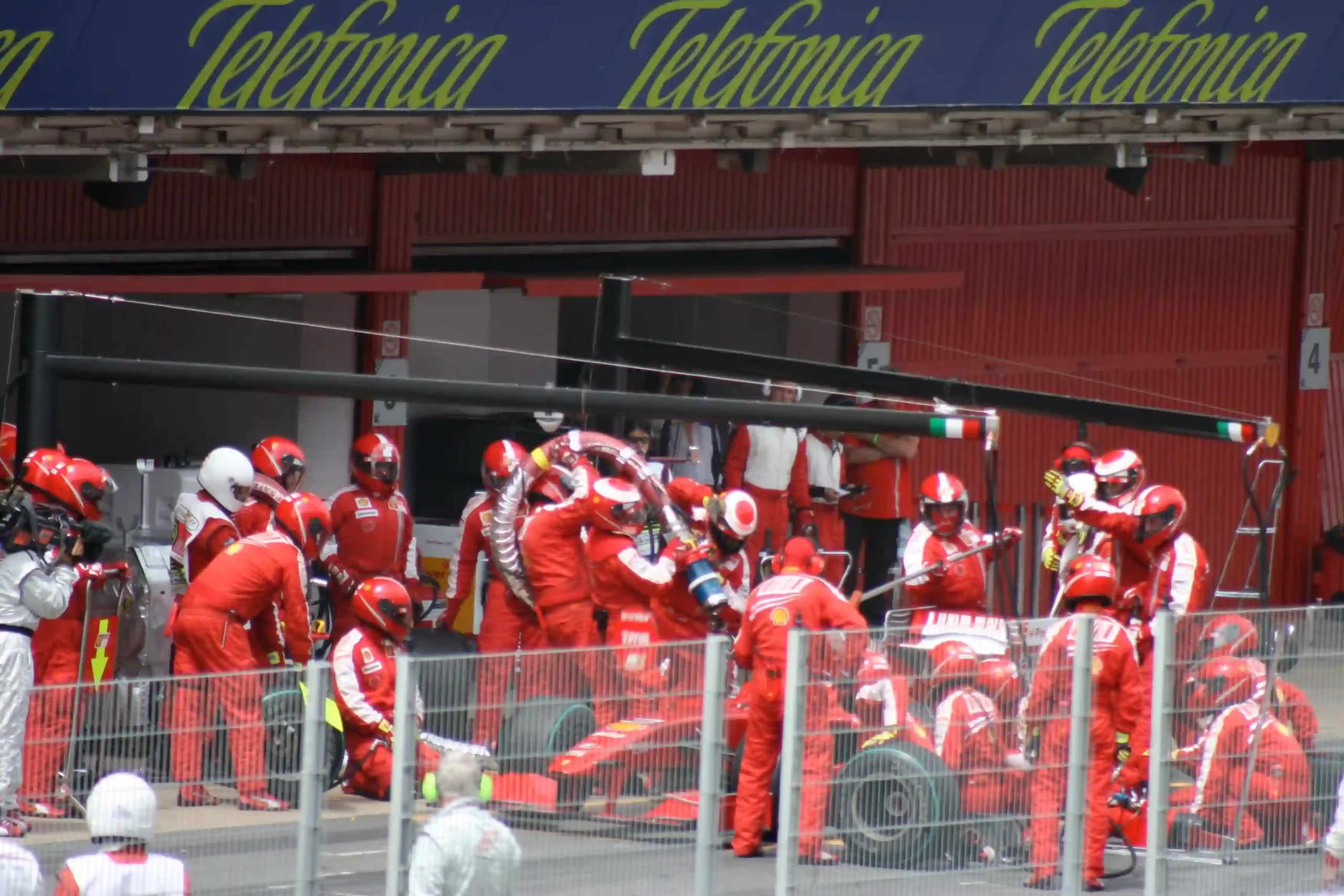
Modern F1 teams use traffic-light systems, but the final go/no-go decision remains human. Formula 1 says a senior team member—often the chief mechanic—checks wheel confirmations, the work around the car and traffic approaching in the pit lane before releasing the driver.
This role is easy to overlook because the release controller may not touch the car. However, a perfect tyre change can still end badly if the car is sent into another competitor’s path.
Wheel-gun confirmations feed through the gantry. The crew chief also looks around the car and down the pit lane. The driver gets the green signal only when the team believes the release is safe.
An unsafe release can draw a sporting penalty. Therefore, teams must balance fractions of a second against the risk of contact or forcing another car to brake.
Our dedicated unsafe release in F1 guide explains how the rule works. The F1 pit-lane speed-limit guide covers the other major safety control inside the lane.
Backup Crew and Support Staff Make the Real Team Larger
Formula 1’s pit-stop explainer specifically mentions spare jack operators and crew standing by with fire extinguishers. These people may never act during a normal stop, yet they are ready because a failure cannot wait for someone to run out of the garage.
There can also be a second crew member with “hold” authority watching the rear of the car. Their purpose is to stop a release if they see a danger the primary controller misses.
Then the wider group grows again. Analysts review video and timing. Physiotherapists warm up the crew. Medical staff monitor hydration and fitness.
This is why official Formula 1 says different teams can provide different answers when asked how many people are involved. One team may describe the people in the active box. Another may include everyone supporting the stop.
The distinction matters even more across the modern calendar. Long seasons and triple-headers force teams to rotate personnel and manage fatigue.
Are F1 Pit Crew Members Full-Time Tyre Changers?
No. Formula 1 says pit crews are drawn from the team’s mechanics and technicians. Crew members perform normal garage duties and then take specialist pit-stop positions based on skills such as strength, calmness, hand speed and reaction time.
This surprises many new fans. The person firing a wheel gun on Sunday may spend the rest of the weekend working as a mechanic or technician on the car.
Teams select people whose physical and mental traits match specific pit-stop roles. Formula 1 notes that a front jack operator benefits from quick fast-twitch response, while a gunner must remain composed when something goes wrong.
The best crew members also need adaptability. A car can stop long, short or at an angle. A gun can misfire. A wheel nut can stick. In those moments, rehearsed calm is more useful than uncontrolled speed.
For readers interested in motorsport careers more broadly, our guide on how to become a race car driver explains the wider pathway into professional racing environments.
How F1 Teams Train a Large Pit Crew to Move Like One Unit
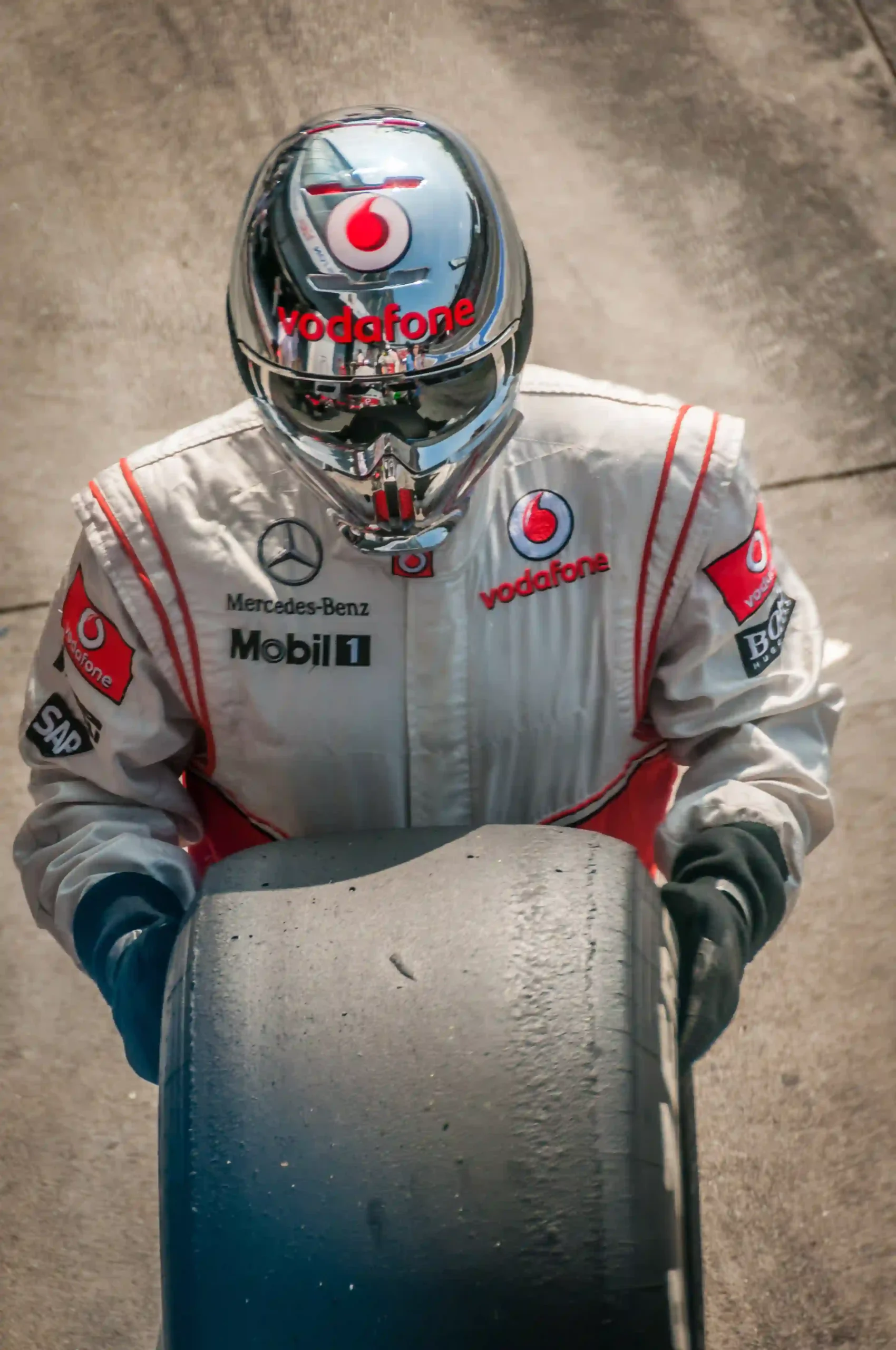
Twenty people around a car would be useless without choreography. The crew needs fixed positions, clear approach paths and a shared rhythm.
Formula 1 says teams use live stops during practice sessions and dedicated pit-stop practice. Once the cars are built, crews may rehearse every day at the circuit.
A typical dedicated session might contain eight or ten repetitions. Teams often avoid doing many more because fatigue can reduce quality.
Video and timing analysis then identify weak points. One wheel corner may consistently lag. A jack operator may need a different approach angle. A mechanic may need to move their feet to avoid crossing another person’s path.
Modern teams also build larger pit-crew squads. McLaren’s operations leadership told Formula 1 that more members are now trained in multiple positions so personnel can rotate through long seasons.
That rotation means the “pit crew” is not always exactly the same group at every Grand Prix. Teams want depth rather than one perfect lineup that becomes exhausted.
This human-performance side is closely connected to race timing. A few tenths saved repeatedly can affect an undercut or determine whether a car rejoins ahead of traffic.
The Driver Is the Most Overlooked Pit Crew Member
Formula 1’s technical feature calls the driver the pit-crew member people often forget. That is not just a figure of speech.
The crew positions tools and hands using extremely precise pit-box marks. If the driver stops too long, too short or off-center, multiple mechanics must move away from their rehearsed positions.
That can slow the jack engagement and change the reach of the wheel crews. A few centimeters matter because the whole stop may last little more than two seconds.
Teams use practice stops to grade driver accuracy. Pit boxes can include scales showing how far the car stopped from the target.
Therefore, the driver is not a passive customer. A record-quality stop begins with a controlled entry and an accurate stop.
Our pit-lane time-loss guide explains why the driver’s entry and exit also affect the much larger total race-time penalty of stopping.
Why So Many People Make an F1 Pit Stop Faster
Using more people does not automatically create speed. F1 gains time because each person receives one narrow task and performs it simultaneously with the others.
A road-car tyre change is mostly sequential. One person loosens nuts, raises one corner or the whole car, removes a wheel, brings another wheel, fits it and tightens several fasteners.
Formula 1 splits those actions among specialists. Four corners work in parallel while the car is lifted at both ends. The release controller can already be checking traffic while the final wheel confirmations arrive.
That is the same reason the sport’s best pit stops can fall below two seconds. Formula 1’s glossary notes that an F1 crew can change all four tyres in under two seconds.
If you want the wider race context, our how car racing works guide explains why stationary time matters. Our racing flags guide covers signals that can suddenly trigger pit activity.
What the 2026 Season Tells Us About Pit Crew Performance
Formula 1 has 11 teams in 2026 after Cadillac joined the championship. That adds another complete race operation to a grid where every team follows the same basic pit-stop challenge but can organize personnel differently.
The current DHL Fastest Pit Stop results through the Hungarian Grand Prix show how high the performance level remains. Racing Bulls recorded a 1.99-second award-winning stop in Hungary, while Ferrari reached 2.00 seconds in Japan.
Those numbers do not reveal the exact headcount around each car. Formula 1 does not publish one mandatory pit-crew number for every team. However, the results show that different organizations can reach almost identical two-second performance windows.
The 2026 award winners through Hungary include Mercedes, Ferrari, Racing Bulls and McLaren. Therefore, elite pit-stop execution is not limited to one team or one crew structure.
Current context: Racing Bulls’ 1.99-second Hungarian Grand Prix stop is the fastest race-winning time on Formula 1’s official 2026 DHL table through August 11, 2026.
Track position is why those tenths matter. Our grid position explainer shows why emerging ahead of a rival can be more important than having slightly fresher tyres.
For a team-specific background example, our Red Bull Racing guide covers one organization with a long reputation for emphasizing fast pit work.
What Happens When One Pit Crew Role Goes Wrong?
A large crew makes a clean stop fast, but it also creates many points where an error can delay the car. The system works only when every required task is complete.
A wheel gun misfires
The gunner may need a second attempt. The other three corners can already be finished, but the car still waits for the problem wheel.
The rear jack misses its lifting point
All four tyre crews can be delayed because the car is not fully raised. A backup rear jack can then become essential.
The driver misses the box
Several crew members must shift position at once. The error can affect the jacks, gunners and wheel carriers together.
The release lane is blocked
The mechanical stop may be complete, but the chief mechanic holds the car. Releasing into traffic risks an unsafe-release penalty.
Both team cars arrive together
The second car may have to wait behind the first. Our guide to why F1 teams double-stack cars explains why crew speed becomes even more valuable in that situation.
A Safety Car can create exactly that kind of rush. Our Safety Car and VSC explainer covers why multiple teams often pit at once.
Has the Number of People in an F1 Pit Stop Always Been the Same?
No. Pit-stop jobs have changed as Formula 1’s rules and technology changed. Refuelling eras required fuel-rig operators and extra fire precautions that are not part of a normal modern tyre-only service.
Older pit stops could also involve manual lollipop release boards and less specialized equipment. Modern crews have become more optimized around a short, parallel tyre change.
Today’s traffic-light release systems have made the old lollipop largely obsolete. Captive wheel nuts and specialized guns remove steps that once consumed time.
However, the human element remains central. Formula 1’s technical analysis says recent gains have increasingly come from training, fitness and crew organization, even as cars became heavier and wheels larger.
That makes current pit stops a useful example of motorsport evolution. The tools changed, but the biggest performance gain comes from dividing work intelligently among people.
Why the “20 Mechanics” Number Is Still Useful
Although there is no universal pit-crew total, the Haas example is useful because it shows the scale of a real modern operation. Twenty mechanics around one car sounds excessive until the roles are separated.
Twelve are consumed immediately by the four tyres. Two more lift the car. Two stabilizers bring the visible hands-on total to 16 before front-wing work and release control are considered.
Then there are backups who may never touch the car during a perfect stop. That is normal in safety-critical work. Their value appears only when the primary equipment or operator has a problem.
Therefore, “20 mechanics” works well as a practical headline number, while “there is no fixed universal total” is the more accurate technical answer.
F1 Pit Crew FAQs
How many people work on an F1 pit stop?
There is no universal total. The core tyre change uses 12 people, plus front and rear jack operators, two stabilizers and other personnel for release control, wing adjustment, backups and safety. Formula 1’s 2025 Haas feature described 20 mechanics going to work during a stop.
How many people work on each F1 wheel?
Three people normally work each wheel: one wheel-gun operator, one mechanic who removes the old tyre and one mechanic who fits the replacement. Across four wheels, that creates a 12-person tyre-changing group.
Are F1 pit crew members full-time tyre changers?
No. Formula 1 says pit crews are selected from the team’s mechanics and technicians. They perform normal garage duties and also train for specialist pit-stop positions.
Why do different sources give different F1 pit crew sizes?
They may be counting different people. Some count only the active mechanics around the car, while broader totals can include backup jack operators, safety crew, a second hold authority, analysts, physiotherapists and medical staff.
Conclusion: The Best Answer Is a Crew Breakdown, Not One Number
So, how many people work on an F1 pit stop? A modern stop can put around 20 mechanics into action, but there is no universal number that applies to every team and every situation.
The clearest fixed number is 12. Three mechanics work at each wheel: a gunner, a wheel-off mechanic and a wheel-on mechanic.
Add the front and rear jack operators plus two stabilizers, and the hands-on group is already large. Wing adjusters, release control, backup jacks and safety personnel make the operational team larger again.
Behind them are analysts, physios and medical staff who help prepare and review the crew. Meanwhile, the driver has to place the car accurately enough for every mechanic to stay on their marks.
That is why Formula 1’s own explanation avoids one rigid total. A pit stop is not one standardized headcount. It is a team-specific performance system built around common roles.
The remarkable part is not that so many people stand around the car. It is that they can all work at once without getting in one another’s way.
When the choreography is right, that large group turns a four-tyre change into a job that can take less than two seconds.
Sources
Technical and current-season details were checked against official Formula 1 material available on August 11, 2026. Crew totals are presented as team-dependent rather than as a universal regulation because Formula 1 itself makes that distinction.