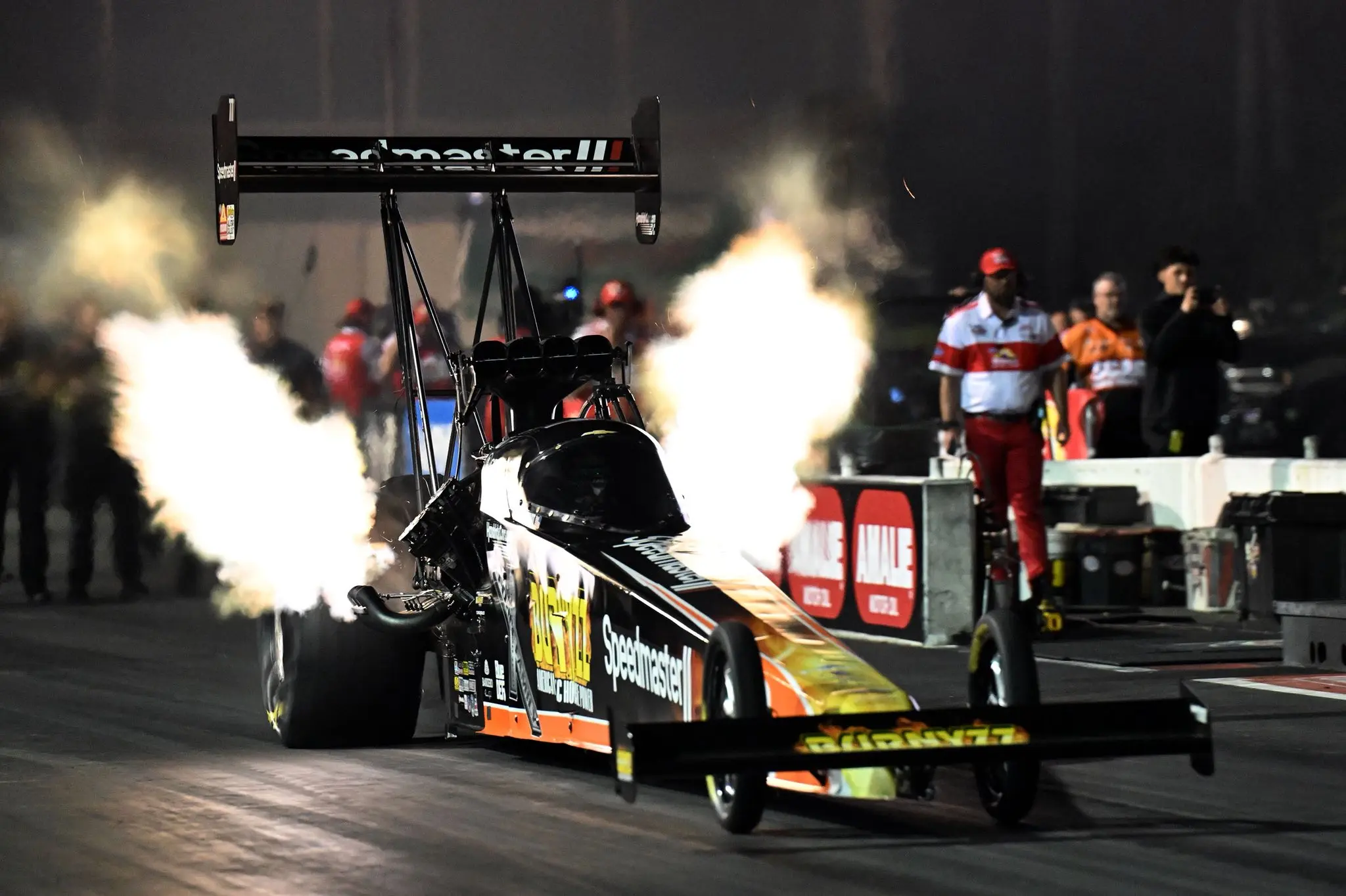
Why Do Top Fuel Engines Explode?
A Top Fuel fireball is rarely one simple explosion. It is usually a fast chain of combustion, heat, pressure, fuel and mechanical failures unfolding in less than four seconds.
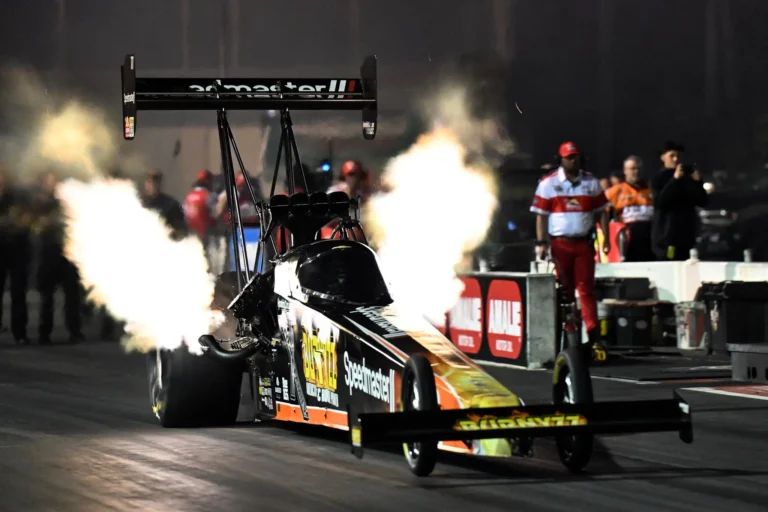
Top Fuel engines explode when extreme cylinder pressure, heat or raw nitromethane overwhelms a part or escapes its intended path. A lean cylinder may melt a piston, a rich cylinder may stop firing, a head gasket may lift, or a connecting rod may break. Oil and fuel can then reach hot headers and create the fireball fans see.
A Top Fuel engine lives through one of the most violent controlled combustion events in motorsport.
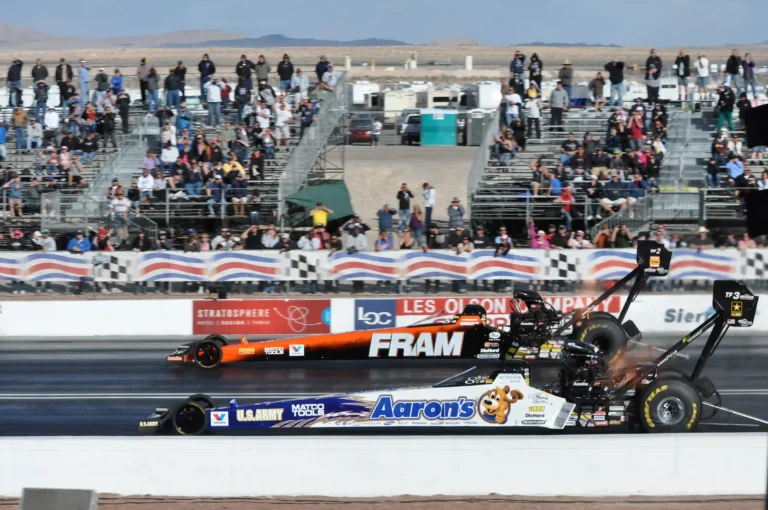
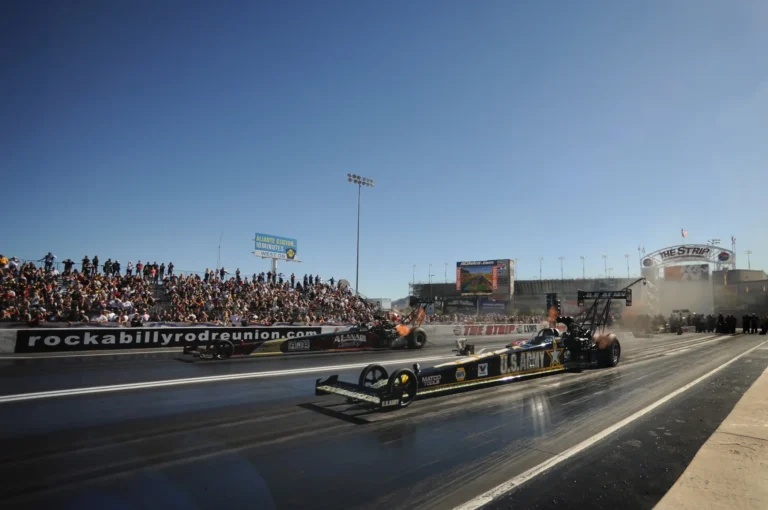
NHRA describes a modern Top Fuel dragster as an 11,000-horsepower machine. It can cover 1,000 feet in less than 3.7 seconds and exceed 330 mph.
The engine is a supercharged, fuel-injected, 500-cubic-inch Hemi-style V8. It burns up to 15 gallons of nitromethane during one run.
Those numbers explain the spectacle. However, they do not fully explain why Top Fuel engines explode.
The visible fireball usually arrives after an earlier problem. One cylinder may run lean, while another drops because it receives too much fuel.
Meanwhile, the clutch may apply more load. Tire shake can hammer the crankshaft and valvetrain.
Consequently, a small combustion problem can become a mechanical failure. Oil, raw fuel and hot metal then create the dramatic final image.
Not every burst of flame means the whole engine has detonated. Sometimes a manifold burst panel opens during a supercharger backfire.
In other cases, a head gasket fails and combustion pressure escapes. A broken connecting rod can also open the block and spray oil onto the headers.
Therefore, the correct question is not only, “Why do Top Fuel engines explode?” The better question is, “Which failure started the chain?”
This guide follows that chain from the fuel tank to the fireball. It also explains how crews contain the damage and rebuild the engine between rounds.
The Quick Answer: Pressure Starts the Problem, Fuel and Oil Create the Show
Most Top Fuel explosions begin with abnormal combustion or a mechanical part reaching its limit. Extreme cylinder pressure may lift a head gasket, a lean mixture may destroy a piston, a dropped cylinder may load the crank unevenly, or a rod may break. Escaping oil and nitromethane then ignite near the hot headers.
A Top Fuel engine is not designed to fail. It is designed to work just below failure while producing the greatest usable power.
That margin is very small. Each cylinder experiences tremendous pressure, heat and fuel flow during the run.
Moreover, the engine is connected directly to a multistage clutch. There is no conventional transmission to soften the relationship between combustion and the rear tires.
A crew chief must match the fuel curve, ignition timing and clutch application to the air and track. A setup that is safe in warm air may become too aggressive after sunset.
The answer to why Top Fuel engines explode also depends on timing. A problem at launch may involve raw fuel or a supercharger backfire.
By contrast, a failure near 1,000 feet often follows heat buildup, piston damage or the loss of several cylinders. The engine has already completed hundreds of combustion cycles under full load.
Fans often call every violent failure a detonation. However, detonation is only one form of abnormal combustion.
A fireball can follow a broken rod, lifted head gasket or ruptured oil system without classic detonation being the first cause.
Combustion Failure
A lean, rich or mistimed cylinder creates heat, misfire or uncontrolled pressure.
Mechanical Failure
A piston, rod, bearing, crankshaft, valve or fastener can exceed its load limit.
Secondary Fire
Oil and nitromethane escape onto hot engine parts and ignite in the airflow.
The explosion is often the last link, not the first. Experienced crews study which cylinder changed temperature, which plug stopped firing and when the driveshaft trace moved before the fire appeared.
Top Fuel Engine Failure Causes at a Glance
| Failure | What Starts It | What Happens Next | What Fans May See |
|---|---|---|---|
| Dropped cylinder | The mixture becomes too rich for the spark plugs to fire | Raw fuel and uneven crank loading increase | One header flame weakens or disappears; the car may slow or shake |
| Lean cylinder | Insufficient fuel, blocked nozzle or poor distribution | Temperature rises and the piston can scuff or melt | White or gray smoke, then fire if oil reaches the exhaust |
| Head-gasket failure | Cylinder pressure overcomes head clamping | Combustion escapes between the head and block | A sharp flame, smoke or violent pressure release near the engine |
| Supercharger backfire | Combustion or raw fuel ignites in the intake | Manifold pressure spikes and the burst panel opens | A flash above the engine, damaged scoop or lifted supercharger |
| Hydraulic lock | Liquid fuel remains in a cylinder | The piston tries to compress an incompressible liquid | Failure during startup, a bent rod or an engine that will not rotate |
| Connecting-rod failure | Excess pressure, fatigue, bearing damage or over-rev | The rod breaks and may exit the block | Debris, oil spray and an immediate fireball |
| Bearing or crank failure | Heat, oil loss, torsional load or sudden traction change | The bottom end seizes or breaks | Smoke, locked rear tires, fragments or fire |
| Valve-train failure | Spring, rocker, pushrod or valve failure | Combustion control is lost in one cylinder | Misfire, dropped cylinder, smoke or intake backfire |
What Makes a Top Fuel Engine So Extreme?
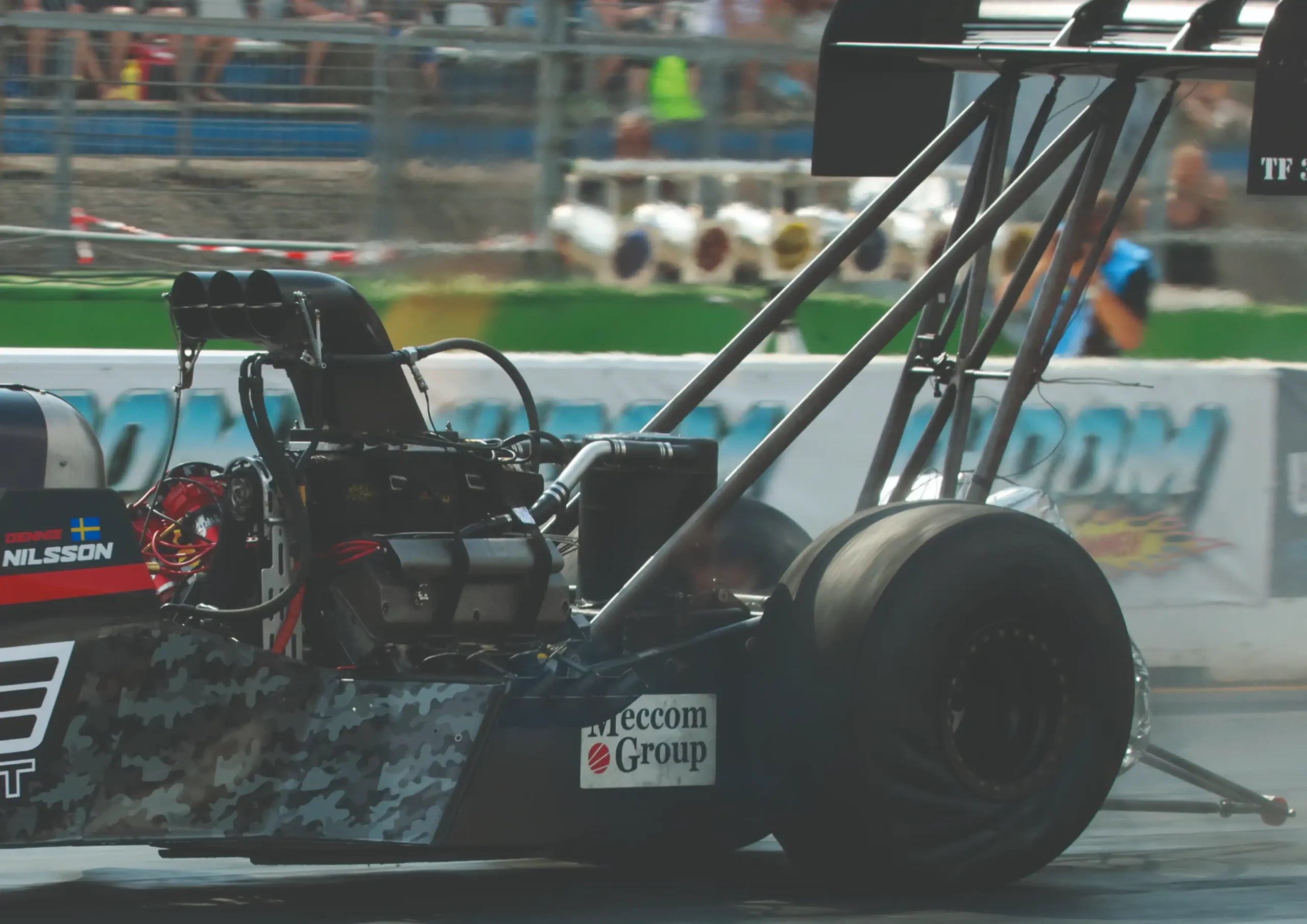
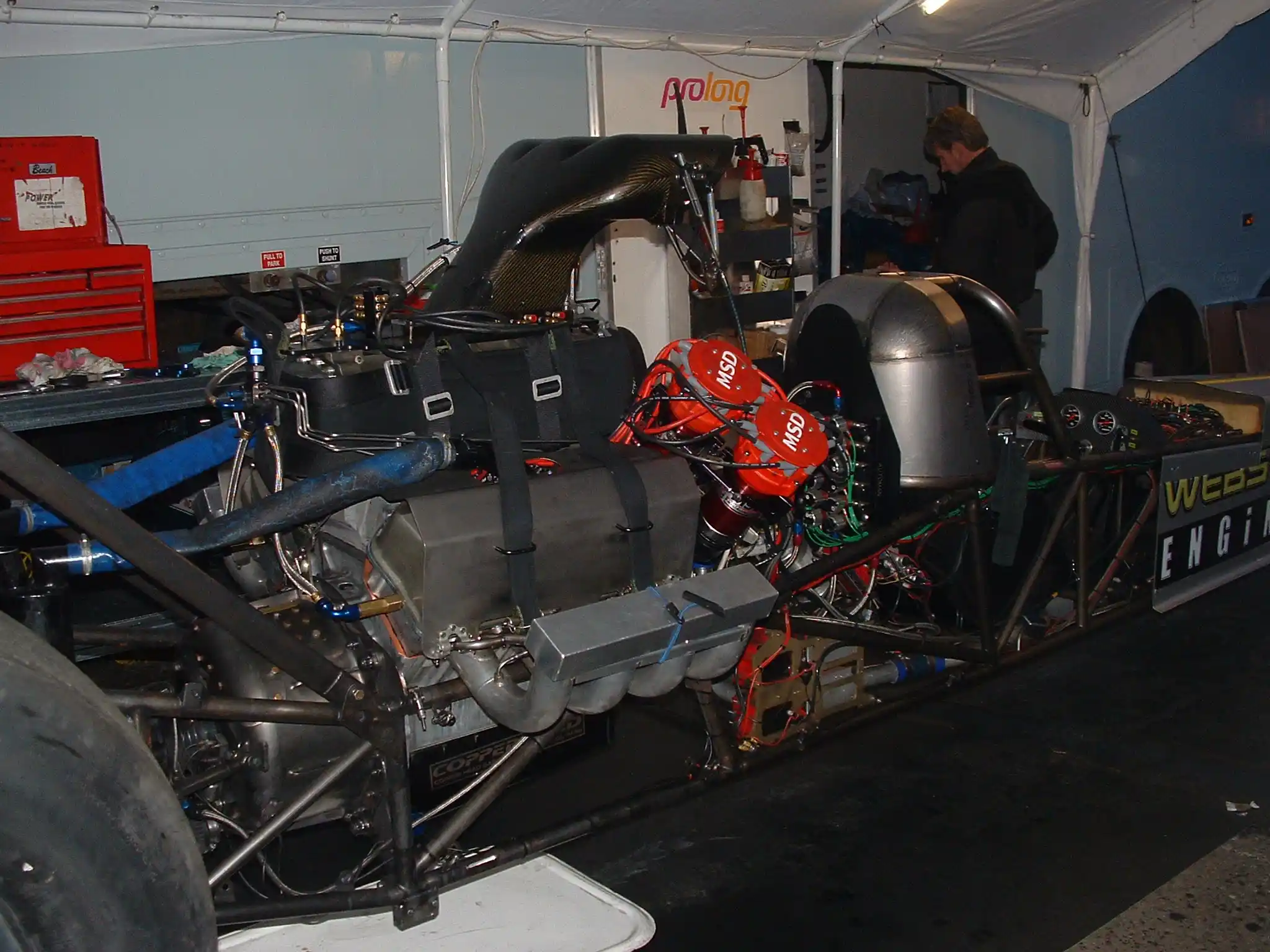
The engine combines 500 cubic inches, a large Roots-type supercharger, mechanical fuel injection, up to 90 percent nitromethane and dual magnetos. Nitromethane allows far more fuel mass to burn with a given amount of air than gasoline, so each cylinder releases enormous energy.
The engine traces its basic shape to the Chrysler 426 Hemi. Modern parts are purpose-built from billet aluminum and high-strength steel.
The block, cylinder heads, crankshaft and valve train bear little resemblance to ordinary street components. Nevertheless, the engine still follows the familiar four-stroke cycle.
Readers can review the basic process in the guide to how a four-stroke engine works.
Eight Cylinders Share One Violent Job
Each piston draws in compressed air and fuel, compresses the charge, receives ignition and pushes the crankshaft. That process repeats thousands of times during one pass.
The engine normally operates below 8,000 rpm, which sounds modest beside some racing engines. However, displacement and cylinder pressure produce extraordinary torque on every firing event.
The guide to what torque means explains why the twisting load matters as much as horsepower.
The Supercharger Consumes Serious Power
The 14-71 Roots-type supercharger moves an enormous volume of air. It also requires hundreds of horsepower to turn at racing speed.
Therefore, the crankshaft powers both the rear tires and the air pump feeding the engine. A broken belt ends the run, while an intake explosion can damage the supercharger itself.
This differs from a turbocharger, which uses exhaust energy. The site’s supercharger-versus-turbocharger guide explains the distinction.
There Is No Conventional Gearbox
A Top Fuel dragster uses a direct driveline and multistage clutch rather than a multi-speed transmission. Clutch timers progressively connect engine torque to the rear tires.
That system avoids gear changes. However, it makes clutch behavior a critical part of engine loading.
The broader role of the device appears in how a clutch works.
Why Nitromethane Creates So Much Power—and So Much Risk
Nitromethane lets the engine burn a much larger mass of fuel per cycle than gasoline. That produces huge cylinder pressure, but it also narrows the tuning window. Too little fuel can overheat a cylinder, while too much can extinguish the spark or fill the cylinder with liquid.
Gasoline needs substantial oxygen from the intake air. Nitromethane carries oxygen within its chemical structure.
As a result, the cylinder can burn far more fuel with the same airflow. More burned fuel means more heat and more pressure pushing on the piston.
The exact chemistry is complex, but the practical result is simple. Nitromethane makes enormous power because the engine processes enormous fuel mass.
NHRA limits the maximum concentration to 90 percent. The remaining mixture includes methanol and other permitted components.
Rich Is Normal, but Too Rich Drops a Cylinder
A street engine would never tolerate the visible fuel volume used by a nitro Hemi. Top Fuel combustion is intentionally rich because fuel also cools internal parts.
However, there is a boundary. Beyond it, the spark plugs cannot ignite the mixture.
That cylinder drops. The engine then runs unevenly while raw fuel continues moving through the chamber and exhaust.
Lean Is Hot Enough to Destroy Aluminum
A reduction in fuel does not merely reduce power. It removes cooling and raises combustion temperature.
Consequently, a piston crown or ring area can overheat within moments. Aluminum may scuff against the iron liner or begin to melt.
The general relationship between mixture, heat and abnormal combustion is covered in the engine-knock guide, although Top Fuel conditions are far more extreme.
Raw Fuel Is a Mechanical Threat
Gas can compress. Liquid fuel does not compress enough for a piston to complete its stroke safely.
If a cylinder fills with nitromethane, the connecting rod becomes the weak link. It can bend or break before combustion even begins.
This is why crews “back down” the engine after a run. Turning it backward lets trapped fuel drain through the exhaust valve.
Anatomy of a Top Fuel Explosion
A typical chain begins with a cylinder problem, then spreads through pressure, mechanical damage and fire. The exact order varies, but the visible blast often follows an earlier misfire, piston failure, head-gasket leak or broken connecting rod.
Air, track or hardware changes move one cylinder outside its safe mixture or ignition window.
The cylinder drops, runs lean, pre-ignites or creates excessive pressure.
A piston, gasket, rod, bearing, valve or crank component loses containment.
Oil and nitromethane reach the headers, intake or hot metal.
Airflow spreads the flame while containment systems catch oil and parts.
The sequence can take a fraction of a second. Television replay makes it appear slow enough to study.
Inside the engine, the events overlap. A piston can fail while the crankshaft continues turning and the clutch remains applied.
Meanwhile, the fuel pump still delivers a huge volume unless the system shuts off. Raw fuel can feed the flame after the original part breaks.
The Blast Does Not Always Begin in the Crankcase
Some failures happen above the cylinder heads. An intake backfire can create a pressure spike beneath the supercharger.
Other failures happen between the block and head. Combustion escapes through the gasket rather than the exhaust valve.
A bottom-end failure starts lower. A rod or crank problem opens the block and releases oil.
Data Identifies the First Link
Crews study engine rpm, driveshaft rpm, fuel pressure and acceleration. They also inspect spark plugs, bearings and piston surfaces.
One damaged part may be a result rather than the cause. Therefore, the order of evidence matters.
For example, a broken rod may follow a melted piston. Replacing only the rod would not explain why the cylinder overheated.
Dropped Cylinders: Too Much Fuel Can Stop Combustion
NHRA defines a dropped cylinder as one that runs too rich for its spark plugs to fire. The cylinder stops producing normal power, raw fuel passes through it, and the remaining cylinders place uneven loads on the crankshaft.
A dropped cylinder is one of the most recognizable Top Fuel problems. One header pipe may lose its strong flame because combustion has stopped.
The engine sound changes, and the car may pull or slow. However, the driver is moving so quickly that diagnosis happens after the run.
Why the Spark Goes Out
Each cylinder uses two spark plugs and powerful magnetos. Even that ignition energy has a limit.
If the mixture becomes too rich, fuel can wet or damage the plugs. The spark no longer establishes a stable flame.
A failed magneto lead, damaged plug or valve-train problem can create a similar result. Therefore, crews inspect both fuel and ignition.
Uneven Power Loads the Crankshaft
The crankshaft expects a repeating series of firing events. A missing event changes torsional load and engine speed.
Meanwhile, the active cylinders continue producing enormous torque. The imbalance can increase stress on rods, bearings and the crank.
One dropped cylinder may only cost the run. Several dropped cylinders can contribute to a catastrophic engine failure.
A Cylinder Can Re-Light
Raw fuel may remain in the chamber or exhaust. If ignition returns, the mixture can burn at the wrong time or in the wrong location.
That re-light can create a sudden pressure event. It may also trigger an intake backfire.
This is one reason a multiple-cylinder loss often precedes a spectacular fireball near the finish line.
Lean Mixtures, Scuffed Pistons and the Smoke Warning
A lean cylinder receives insufficient fuel for the intended airflow and ignition timing. Fuel cooling decreases, combustion temperature rises and the aluminum piston can scuff, crack or melt. Oil then leaks past the damaged piston and burns in the exhaust.
NHRA technical coverage describes piston scuffing as a thermal failure. The piston becomes too hot and damages its contact surface against the liner.
Once the seal is lost, crankcase oil enters the combustion chamber. The engine pumps that mixture through the headers.
Fans may see a dense white or gray smoke trail. That smoke is a warning that the failure has moved beyond a simple misfire.
What Makes One Cylinder Lean?
A fuel nozzle can clog or flow less than expected. A pressure problem can reduce delivery.
Air distribution also varies across the intake. Therefore, crew chiefs tune individual cylinders rather than treating the engine as eight identical holes.
Weather changes matter too. Cooler, denser air contains more oxygen and can lean the effective mixture.
The Piston Can Damage More Than Itself
Molten or broken aluminum can damage the cylinder liner, rings and valves. Debris can also move through the exhaust.
If the piston loses structural strength, the connecting rod may no longer have a controlled load. It can strike the block or cylinder head.
Consequently, a lean cylinder may become a rod failure and oil fire before the driver reaches the finish.
Oil Is Essential Until It Becomes Fuel for the Fire
Engine oil protects bearings and removes heat. The site’s engine-oil guide explains those jobs.
However, oil ignites when sprayed onto hot headers. A broken piston or rod can turn the lubricant into part of the visible fireball.
Head-Gasket Failure: When Cylinder Pressure Escapes Sideways
The head gasket seals combustion between the aluminum block and cylinder head. If cylinder pressure exceeds the clamping force of the head studs and sealing system, the head can lift slightly and the gasket path fails.
Top Fuel cylinder heads are held by massive studs and carefully controlled torque. The clamping load is far beyond ordinary automotive practice.
Yet the combustion force is also extraordinary. A pressure spike can find the smallest weak path between the block and head.
The Head Does Not Need to Fly Off
A tiny lift can open a passage for combustion gas. That high-temperature jet can cut the gasket and damage nearby surfaces.
The escaping flame may ignite oil or fuel outside the chamber. Therefore, the external blast can look larger than the original leak.
Why the Failure Can Damage the Supercharger
Abnormal pressure waves can travel through the intake. If combustion reaches the manifold, the supercharger faces a backfire.
The engine may therefore show both a gasket failure and supercharger damage. One event can cause the other.
NHRA’s slow-motion analysis of Top Fuel failures has repeatedly shown cylinder pressure escaping through head-gasket paths.
Surface Condition Matters
The block deck, head surface, gasket and sealing rings must remain flat and clean. Any damage reduces containment.
Crews inspect these parts after every pass. A small mark can become the starting point for the next failure.
Why Top Fuel Superchargers Backfire
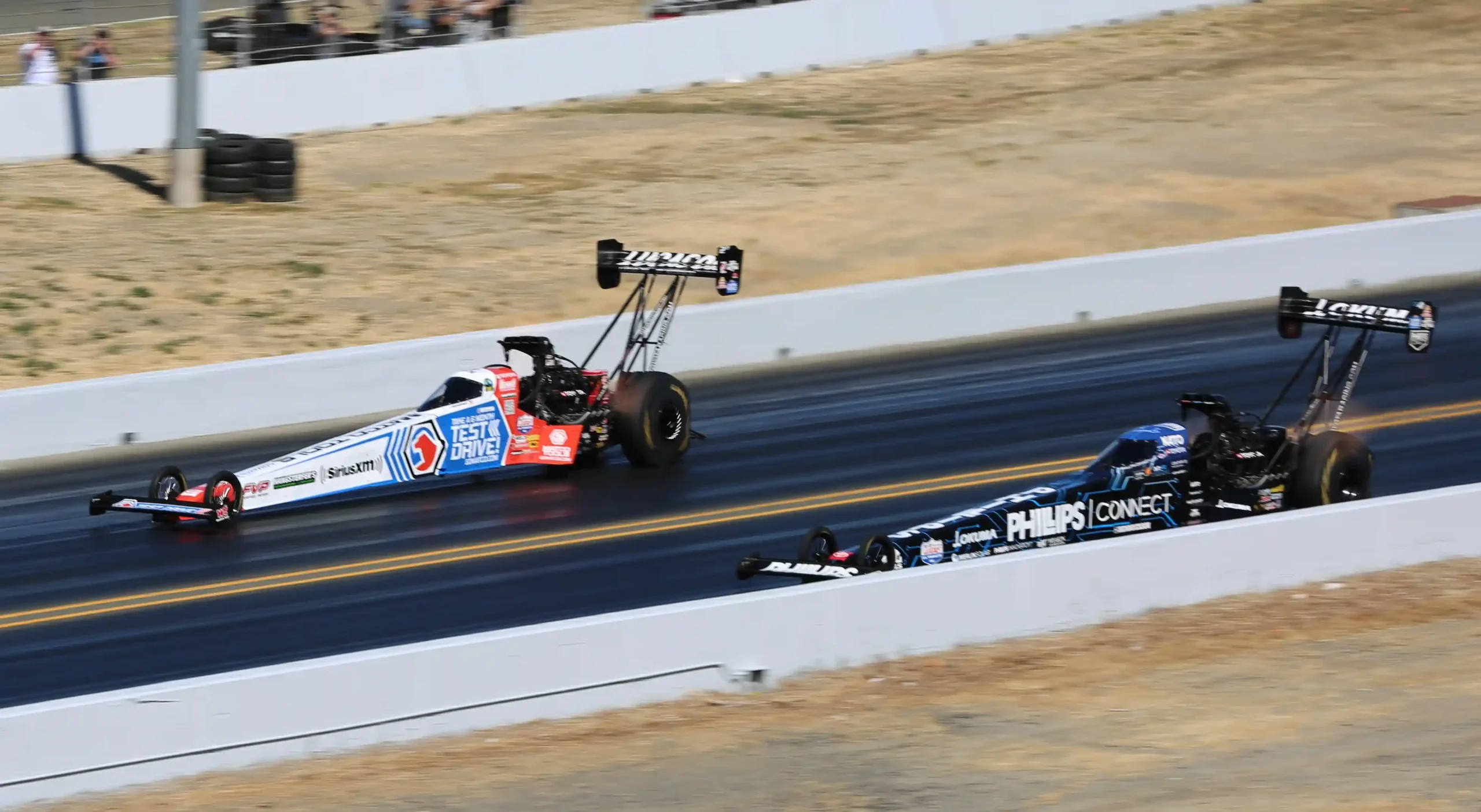
A supercharger backfire occurs when combustion or an ignitable fuel-air mixture burns in the intake manifold. Pressure rises beneath the supercharger, so mandatory burst panels vent the manifold and restraints keep the unit attached.
The preferred NHRA term is supercharger, although fans often call it a blower. It sits directly above the intake manifold.
Normally, air and fuel move downward into the cylinders. A backfire sends combustion pressure upward against that flow.
Raw Fuel Can Accumulate Above the Intake Valves
A dropped cylinder or ignition problem can leave fuel in the intake path. If another cylinder sends flame backward, that mixture can ignite.
Valve timing or valve damage can also expose the manifold to combustion. The pressure spike happens almost instantly.
Burst Panels Are Designed to Open
NHRA requires manifold burst panels meeting an SFI specification. The panel provides a planned pressure-release path.
Without it, the manifold or supercharger case could rupture more violently. Therefore, an opened panel may show that the safety system worked.
Restraints Keep the Supercharger With the Car
Supercharger restraints became mandatory for Top Fuel in the early 1980s. Straps and hardware limit upward movement during a backfire.
The injector scoop may still break, while belts and small parts can scatter. However, the heaviest assembly should remain controlled.
A backfire can also trigger automatic fuel and ignition shutdown systems in some nitro applications. That reduces the energy feeding the incident.
Hydraulic Lock: When Liquid Fuel Stops the Piston
Hydraulic lock happens when liquid nitromethane remains in a cylinder and the piston tries to compress it. Because the liquid cannot compress enough, the connecting rod may bend or break, or the engine may stop rotating.
Hydraulic lock is most likely during starting, shutdown or an abnormal fuel event. It does not require the engine to be at 330 mph.
A cylinder can collect fuel after a dropped ignition event. Fuel may also remain after the engine shuts off.
Why Crews Turn the Engine Backward
After a run, a crew member rotates the engine backward with a large wrench. NHRA calls the practice “backing it down.”
The exhaust valve sits low in the combustion chamber. Backward rotation lets liquid drain through that valve and into the header.
This simple procedure prevents fuel from becoming trapped during the next startup. It is a direct answer to one reason why Top Fuel engines explode.
Hydrolock Can Damage a Rod Without Fire
The first symptom may be an engine that refuses to turn. If the starter or crew forces rotation, the rod can bend.
A slightly bent rod may then fail under combustion load. Therefore, crews treat any suspected lock as a serious mechanical event.
Raw Fuel Must Be Handled Carefully
Nitromethane is both the power source and a hazard. Teams follow strict fuel shutoff and startup routines.
The discipline is not dramatic from the grandstands. However, it prevents a large number of potential pit-area failures.
Connecting Rods, Bearings and Crankshaft Failures
Connecting rods can fail from excessive cylinder pressure, hydraulic lock, bearing damage, fatigue, over-rev or sudden changes in driveline load. When a rod breaks, it may puncture the block and release oil directly onto the headers.
Top Fuel connecting rods join the pistons to the crankshaft. They experience compression during combustion and tension as the piston changes direction.
Aluminum rods absorb shock and help protect other parts. However, they have a controlled service life and receive frequent replacement.
Bearing Damage Removes the Oil Film
Rod and main bearings need a stable oil film. Heat, contamination or load can break that film.
Metal contact follows. The bearing may smear, seize or rotate in its housing.
Once that happens, the rod and crankshaft no longer move freely. Failure can occur within a few engine revolutions.
The Crankshaft Twists Under Firing Load
The crankshaft is not perfectly rigid. Each firing cylinder creates a torsional pulse.
Dropped cylinders change the pattern, while clutch application changes resistance at the output. These forces can combine in damaging ways.
Teams inspect journals, cracks and surface condition. A crankshaft that looks usable may still be removed because its planned service life has ended.
A Thrown Rod Creates the Classic Fireball
If a rod exits the block, oil escapes under pressure and airflow. The headers are inches away and extremely hot.
The resulting flame can surround the rear of the dragster. Meanwhile, the engine diaper attempts to hold oil and fragments below the crankcase.
This is one of the clearest examples where the mechanical break happens first and the “explosion” follows.
Clutch Timing, Tire Shake and Sudden Engine Load
The clutch does not usually explode the engine by itself, but its engagement controls engine load. If it applies too quickly, the tires can spin or shake. If traction returns suddenly, the crankshaft, rods and bearings can receive a sharp load change.
The multistage clutch progressively locks during the run. Crew chiefs tune that progression with timers and mechanical settings.
Too little clutch wastes power and raises engine rpm. Too much clutch can overpower the tires.
Tire Shake Is More Than a Handling Problem
Rear slicks can repeatedly wind up and release against the track. The vibration travels through the driveline and chassis.
That shake can damage fittings, bearings, electronics and valve-train parts. It also makes the driver’s vision blur.
The driver may lift the throttle because continued shake can break the car. Saving the engine is part of that decision.
Wheelspin Can Create an Over-Rev
When the tires lose grip, engine rpm can rise quickly. The clutch and fuel system are designed around an expected rpm curve.
An unexpected flare increases piston speed and valvetrain stress. If the tire then hooks, the engine faces an abrupt resistance increase.
Readers can compare these concepts with the general guide to engine redline.
Track Grip Changes the Safe Tune
A heavily prepared starting line can accept more clutch. A hot or marginal track requires a softer application.
Therefore, the same engine setup can survive in one lane and fail in another. Power delivery must match available grip.
Why Top Fuel Engines Often Fail Near the Finish Line
The engine has spent most of the run at maximum fuel flow, heat and cylinder pressure by the finish. Spark plugs may be deteriorating, pistons are hottest, and any dropped cylinder or bearing problem has had time to worsen.
A Top Fuel pass lasts less than four seconds. Yet the engine’s stress increases through much of that time.
The clutch applies progressively, so load rises as the car accelerates. Aerodynamic resistance also increases sharply with speed.
Meanwhile, the engine continues consuming fuel and producing heat. Small damage from earlier in the run can grow.
The Spark Plugs Live a Short, Severe Life
Plugs face pressure, heat and heavy fuel deposits. Their electrodes may erode during the pass.
Ignition quality can weaken near the finish. That change may drop a cylinder just when engine load is highest.
Shutdown Is Another Transition
The driver closes the fuel system and deploys parachutes after the finish. Engine rpm and load change quickly.
A damaged part may fail during that transition rather than during peak speed. Therefore, some fireballs appear just after the throttle closes.
Television Makes the Pattern Memorable
Finish-line cameras capture the fastest and hottest point of the run. A failure there is visually dramatic.
However, startup backfires and early-run explosions also occur. The 2026 New England incident provides a recent example.
What Is Actually Burning in a Top Fuel Fireball?
The fireball can include nitromethane, methanol, engine oil and vapors igniting around hot headers and damaged engine parts. Airflow at racing speed spreads the flame rearward and upward, making a localized mechanical failure look enormous.
The orange-yellow flame is not the same as the normal blue-white header plume seen at night. A failure releases fuel and oil outside the controlled exhaust path.
Engine oil often creates dense smoke and sustained flame. Raw nitromethane can intensify the event.
Fire Size Does Not Equal Internal Damage
A large external flame may come from fluid spray, while the block remains partly intact. Conversely, a severe internal break may create less visible fire if little oil reaches the headers.
Therefore, television appearance cannot diagnose the engine. The crew must inspect the parts.
The Airflow Shapes the Flame
At more than 300 mph, air pulls flame and smoke behind the car. The rear wing and bodywork change that path.
A Top Fuel engine sits behind the driver, so the flame generally moves away from the cockpit. Fire can still reach the driver, parachutes or rear tires.
Normal Header Flames Are Part of the Tune
Nitromethane continues burning in the exhaust. That process creates the famous flames visible during night qualifying.
Normal flames remain consistent across the header pipes. A missing or changing flame can indicate a cylinder problem.
How NHRA Contains Engine Explosions
NHRA requires a ballistic engine diaper around the oil pan, manifold burst panels and supercharger restraints. Additional systems shut off fuel and ignition, deploy parachutes, protect the driver and help the Safety Safari control fire and debris.
The Engine Diaper Catches Oil and Parts
NHRA’s glossary defines a diaper as an absorbent ballistic blanket, often made with Kevlar. It surrounds the oil pan.
The device aims to contain oil and fragments after an engine explosion. It also reduces the chance of oil reaching the rear tires or racing surface.
An oil-covered tire can remove control instantly. Therefore, containment protects both the driver and the next pair of racers.
Burst Panels Vent Intake Pressure
A mandatory manifold panel opens during a pressure spike. It sacrifices itself to protect heavier parts.
The panel does not prevent every supercharger failure. However, it gives pressure a controlled exit.
Supercharger Restraints Limit Movement
Straps and related hardware hold the supercharger down after a backfire. The scoop and belt may still fail.
Keeping the main assembly attached reduces the danger to the driver, opponent and spectators.
Fire Protection Extends Beyond the Engine
The driver wears a fire-resistant suit, gloves, boots and helmet. The cockpit includes restraints and shielding.
Fuel and ignition controls allow rapid shutdown. Parachutes slow the car while the driver keeps it away from the wall.
The general risk chain is explored in what causes crashes in motor racing.
What the Driver Does When the Engine Lets Go
The driver shuts off fuel and ignition, deploys the parachutes, keeps the car straight and moves toward a safe stopping area. Exact actions depend on the car’s systems and whether the fire or explosion triggers automatic shutdown equipment.
The first priority is control. A sudden engine failure can change acceleration, steering balance and visibility.
The driver may also face oil near the rear tires. Abrupt steering or braking can make that situation worse.
Parachutes Stabilize and Slow the Car
Top Fuel dragsters use two parachutes. Deployment creates major deceleration and helps keep the car aligned.
A fire may damage the chutes, so early deployment matters. Automatic systems can assist after certain pressure events.
The Driver Cannot Diagnose the Failure at Speed
Sound, vibration and flame may indicate trouble. However, the driver has no time to determine whether a piston or head gasket failed.
The correct response is to remove fuel and ignition energy. The crew can investigate after the car stops.
The Safety Safari Responds Immediately
NHRA’s Safety Safari follows the action with fire and recovery equipment. Crews secure the car, manage fuel and clear debris.
Track cleanup matters because oil and metal can affect later runs. A dramatic explosion may delay the session even when the driver is unhurt.
Are Top Fuel Engines Rebuilt After Every Run?
A Top Fuel engine is serviced after every run rather than treated as a sealed unit with one simple life figure. Crews remove major components, inspect data and replace parts according to condition and planned service limits.
The phrase “rebuilt after every run” is broadly accurate, but it can mislead. Teams do not necessarily discard every engine part after one pass.
Instead, they perform a rapid teardown. Cylinder heads and the oil pan commonly come off.
Pistons, connecting rods, bearings, spark plugs and valve-train parts receive inspection. Items with short service limits may be replaced even when they look undamaged.
The Crew Reads the Engine Like Evidence
Spark plug color and damage reveal mixture and heat. Piston surfaces show where combustion was strongest.
Bearings reveal oil-film condition and crank loading. The crew compares those signs with electronic data.
Consequently, a clean-looking run can still lead to major part changes. Prevention is cheaper than an explosion.
Turnaround Time Is Part of the Competition
Elimination rounds can place teams under a short service window. Every crew member has a defined task.
The engine, clutch, fuel system and chassis are serviced in parallel. One missed fastener or blocked nozzle can decide the next round.
Cost Reflects Consumable Parts
Top Fuel budgets include pistons, rods, bearings, clutch discs, tires and fuel. The car does not merely consume nitromethane.
The article on Top Fuel engine cost explains why the full operating expense is larger than one engine’s purchase price.
How Crew Chiefs Prevent Top Fuel Engine Explosions
Many failures can be reduced through conservative tuning, precise fuel distribution, component replacement and data analysis. They cannot be eliminated because the engine operates near material and combustion limits while weather and track grip change.
Fuel Flow Is Tuned Cylinder by Cylinder
The fuel system uses many nozzles and mechanical controls. Crews adjust distribution so each cylinder receives the intended amount.
A small imbalance matters because the engine burns such a large volume. The richest and leanest cylinders may determine the safe tune.
Ignition Timing Controls Pressure Rise
Earlier ignition can increase pressure and power. Too much advance can create damaging pressure before the piston reaches the correct position.
Later timing can reduce stress but also reduce performance. Crew chiefs seek the fastest safe pressure curve.
Weather Changes the Engine
Air density rises when conditions become cooler or barometric pressure improves. More oxygen can make the existing fuel setting effectively leaner.
Humidity and altitude also affect the tune. Therefore, a night session often requires different fuel and clutch decisions than an afternoon run.
Track Grip Changes the Driveline Load
A strong track accepts aggressive clutch application. However, the engine then sees more load because the tires do not spin freely.
A weak track requires reduced power delivery. Otherwise, the tires spin and engine rpm rises.
Horsepower Is Estimated Through Performance
NHRA has explained that ordinary dynamometers cannot directly handle the complete output. Engineers use torque sensors, acceleration data and modeling.
The guide to what horsepower means provides the general calculation behind the headline figure.
Engine displacement also shapes torque potential, as explained in the displacement guide.
A Current 2026 Example: Scott Farley’s Starting-Line Explosion
Yes. NHRA reported that Scott Farley’s Top Fuel dragster erupted in a spectacular starting-line explosion during the second qualifying session at the New England Nationals on June 5, 2026.
The incident occurred before a full pass developed. That detail separates it from a classic finish-line piston or rod failure.
A starting-line event can involve ignition, raw fuel, intake pressure or a part failing as the clutch and throttle sequence begins. NHRA’s report emphasized the dramatic flash seen by the crowd.
Without a complete public teardown report, it would be wrong to assign one exact failed part. The case still demonstrates that Top Fuel explosions do not all happen after several seconds of full load.
Why Current Incidents Still Matter
Modern containment and shutdown systems have improved significantly. Nevertheless, the underlying engine remains an extreme nitromethane Hemi.
Teams have better data, stronger parts and more consistent fuel. However, performance has also increased.
That balance explains why spectators still see occasional fireballs. Safety systems reduce consequences rather than making failure physically impossible.
The 2026 Championship Context
Top Fuel remains a 20-event NHRA Mission Foods Drag Racing Series category in 2026. Current race information appears in the 2026 NHRA schedule guide.
Each qualifying attempt matters because only the quickest cars reach eliminations. Consequently, teams cannot run a purely conservative setup.
The pressure to qualify, earn lane choice and win rounds keeps engines near the edge. That competitive demand is part of the answer to why Top Fuel engines explode.
Common Myths About Top Fuel Engine Explosions
Reality: A rod, piston, head gasket, oil line or supercharger backfire can create flame without classic detonation being the first event.
Reality: Teams expect to service it after every pass, but they design and tune it to finish without damage.
Reality: Fuel cools the cylinder, but too much can drop the cylinder or create hydraulic lock.
Reality: External oil and fuel spray can create a huge fire even when the initial break is localized.
Reality: Top Fuel uses no conventional multi-speed transmission. The driver can lift and shut off fuel, but cannot select a safer gear.
Reality: Diapers, restraints and panels reduce risk. Extreme failures can still damage scoops, belts, headers and nearby parts.
These myths often begin because the event happens too quickly to observe. Slow-motion video reveals the sequence, while teardown evidence confirms the cause.
General engine fundamentals remain useful. The guide to how car engines work provides a foundation before the specialized nitro details.
Top Fuel also differs sharply from normal naturally aspirated and turbocharged designs. See turbo versus naturally aspirated engines for that broader comparison.
The Failure Hierarchy: What Usually Matters Most?
There is no single universal Top Fuel explosion. The engine may fail above the heads, inside one cylinder or deep in the crankcase.
However, the patterns are consistent. Abnormal combustion creates heat or pressure, and mechanical parts carry the consequence.
The safest tune preserves all eight cylinders. It also keeps the piston, gasket and rod within their load windows.
The quickest tune approaches those windows closely. That is why crew-chief judgment remains as important as engine hardware.
Top Fuel Engine Explosion FAQs
Why do Top Fuel engines explode?
Extreme pressure, heat or raw fuel can overwhelm a part or sealing system. Common triggers include lean mixtures, dropped cylinders, head-gasket leaks, piston damage, broken rods, hydraulic lock and supercharger backfires.
What is a dropped cylinder in Top Fuel?
A dropped cylinder runs so rich that its spark plugs stop firing. It loses power, passes raw fuel and creates uneven loading on the crankshaft.
Are Top Fuel engines rebuilt after every run?
Crews tear down and inspect the engine after each pass. They commonly remove the heads and oil pan, then inspect or replace pistons, rods, bearings, plugs and valve-train parts.
How are Top Fuel engine explosions contained?
NHRA requires ballistic engine diapers, manifold burst panels and supercharger restraints. Fuel shutoffs, ignition controls, parachutes, fire-resistant clothing and the Safety Safari provide additional protection.
Conclusion: Top Fuel Engines Explode When Controlled Violence Escapes Its Boundaries
Why do Top Fuel engines explode? The simple answer is that 11,000 horsepower leaves almost no room for error.
The complete answer begins with nitromethane. It allows the engine to burn far more fuel than gasoline can support with the same airflow.
That fuel creates enormous cylinder pressure. Pistons, rods, bearings, head gaskets and crankshafts must contain every firing event.
A rich cylinder can stop firing. NHRA calls that problem a dropped cylinder.
The raw fuel then passes through the chamber, while the other cylinders continue loading the crankshaft. Several dropped cylinders can create severe imbalance.
A lean cylinder fails differently. Reduced fuel cooling raises temperature and can scuff or melt the piston.
Oil then enters the chamber and exits through the headers. That process creates the smoke that often appears before a larger fire.
Head-gasket failure provides another path. Cylinder pressure lifts the head slightly and escapes between the head and block.
The escaping flame can damage nearby parts. It can also contribute to a supercharger backfire.
Intake explosions happen when combustion reaches fuel and air beneath the supercharger. Mandatory burst panels release pressure.
Restraints then keep the supercharger attached. Those devices turn an uncontrolled event into a more controlled failure.
Hydraulic lock creates danger before the car even reaches full throttle. Liquid nitromethane cannot compress like gas.
Therefore, a fuel-filled cylinder can bend or break a connecting rod. Crews rotate the engine backward to drain trapped fuel after a run.
Bottom-end failures create many classic fireballs. A broken rod can puncture the block and release oil.
The oil reaches hot headers and ignites. Racing airflow then stretches the flame around the rear of the dragster.
Clutch timing and tire shake add mechanical stress. A sudden rpm rise or traction recovery can shock the rotating assembly.
Finish-line failures appear common because heat and load have accumulated. The spark plugs and pistons are near the end of their harshest few seconds.
However, the 2026 Scott Farley incident showed that starting-line explosions still occur. Not every failure follows the same timeline.
Modern crews reduce risk through data, precise fuel distribution and short part-service lives. They inspect the engine after every pass.
Still, racing prevents complete conservatism. A team must qualify, earn lane choice and beat another 330-mph car.
That competition keeps the tune close to the limit. The engine survives when combustion, fuel, ignition, clutch and track remain in balance.
It explodes when one part of that balance moves beyond containment. The fireball is the visible final chapter of a much faster mechanical story.
Sources and Fact-Checking
This article was checked on July 31, 2026 against official NHRA technical explanations, definitions and current race reporting. Exact failure causes can only be confirmed by the affected team’s teardown and data.
- NHRA: Top Fuel specifications, performance and nitromethane consumption
- NHRA: Top Fuel engine architecture, fuel system, supercharger, ignition and burst-panel specifications
- NHRA glossary: official definitions of dropped cylinder, clutch lockup and engine diaper
- NHRA: Scott Farley’s 2026 New England Nationals starting-line explosion