What Causes Engine Knock — and Why It’s Bad
That metallic pinging or rattling under load isn’t a quirky engine “personality” — it’s tiny fuel-air explosions hammering your pistons out of sync. Here’s exactly what causes engine knock, why it matters, and how to stop it before it costs you an engine.

What Causes Engine Knock — and Why It’s Bad
That pinging sound under load is tiny fuel-air explosions hitting your pistons out of sync. Here’s what causes it — and why it matters.
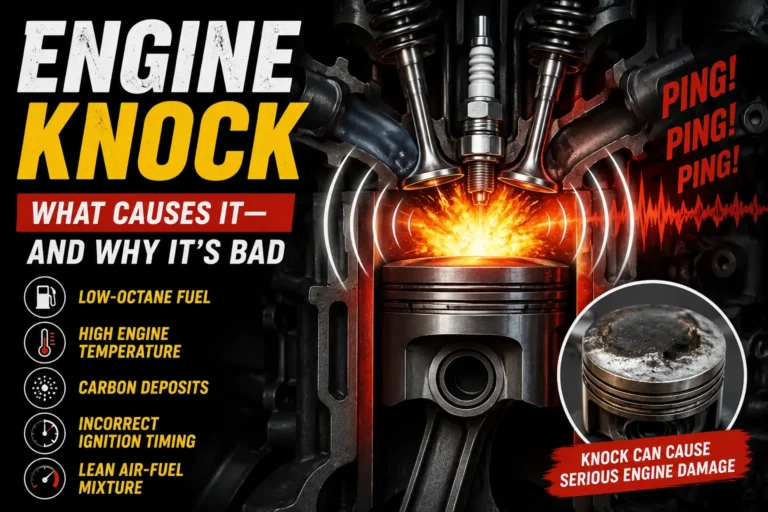
Engine knock — also called pinging, pinking, or detonation — is caused by fuel igniting unevenly or too early inside the cylinder, so more than one flame front collides instead of burning smoothly outward from the spark plug. The result is a sharp metallic rattling sound, usually loudest under acceleration or load, and it’s a sign that combustion pressure is spiking in the wrong place at the wrong time.
It’s not just an annoying noise. Left unchecked, knock hammers pistons, rings, bearings, and head gaskets with pressure spikes they were never designed for, and repeated knock can crack pistons or burn through a gasket in a surprisingly short time. Here’s exactly what’s happening inside the cylinder, what triggers it, and what to do about it.
Engine knock happens when the air-fuel mixture in a cylinder ignites in more than one place at once — either from the spark igniting normally while a separate pocket of mixture self-ignites from heat and pressure (detonation), or from the mixture igniting before the spark fires at all (pre-ignition). The colliding flame fronts create a sudden pressure spike that hits the piston like a hammer blow, producing the knocking or pinging sound. The most common triggers are low-octane fuel for the engine’s compression ratio, excessive ignition timing advance, an engine running too hot, and carbon build-up in the combustion chamber. It’s bad because those pressure spikes and heat spikes can damage pistons, rings, bearings, and head gaskets — sometimes within minutes if it’s severe.
What Engine Knock Actually Is
In a healthy gasoline engine, combustion is a controlled event. The spark plug fires near top dead centre, ignites the compressed air-fuel mixture, and a single flame front spreads smoothly outward from the plug, pushing the piston down with a steady, predictable rise in cylinder pressure. That smooth pressure curve is what an engine is designed around — every bearing, piston, and rod is sized for it.
Engine knock — properly called abnormal combustion — happens when that orderly process breaks down. Instead of one flame front spreading evenly, a second pocket of the air-fuel mixture ignites on its own, somewhere else in the cylinder, before the main flame front reaches it. When the two flame fronts collide, cylinder pressure spikes sharply and unevenly instead of rising smoothly. That collision sends a shockwave through the combustion chamber that rattles the piston, cylinder wall, and surrounding metal — and that’s the metallic “ping,” “ting,” or “knock” you hear.
It helps to separate the two related but distinct phenomena that both get lumped under “knock”:
Both are forms of abnormal combustion, and both put the engine under load it wasn’t designed for. For background on what’s supposed to happen in that cylinder in the first place, our guide on how a 4-stroke engine works is a useful companion read.
The Main Causes of Engine Knock
Knock doesn’t have one single cause — it’s the result of conditions inside the cylinder tipping past the point where the fuel can burn in a controlled way. The most common contributing factors are below, and in real engines several of them often combine at once.

1. Ignition Timing That’s Too Far Advanced
Spark timing — when the plug fires relative to piston position — is one of the most direct levers on knock. If the spark fires too early (too much “advance”), the flame front is well underway while the piston is still travelling upward on the compression stroke. Pressure and temperature in the chamber climb faster than the engine was tuned for, making it far easier for a second pocket of fuel to self-ignite. This is why a knock sensor’s first response is almost always to retard (delay) the ignition timing slightly until the knock stops.
2. Excessive Cylinder Pressure and Heat
Anything that raises the pressure or temperature inside the cylinder beyond what the fuel can handle increases knock risk. This includes a high mechanical compression ratio, an aggressive turbocharger or supercharger boost level, a hot intake charge on a warm day, or an engine that’s simply running hotter than it should due to a failing cooling system. Compress and heat any air-fuel mixture enough, and parts of it will ignite on their own — that’s the same basic chemistry a diesel engine relies on deliberately, just happening at the wrong moment in a gasoline engine.
3. Fuel Octane Lower Than the Engine Needs
Octane rating measures a fuel’s resistance to self-igniting under heat and pressure. An engine designed for high compression or high boost — and tuned accordingly — needs fuel with enough octane to resist igniting until the spark plug tells it to. Put a lower-octane fuel than the engine was designed for in the tank, and that fuel’s chemistry simply can’t hold out under the cylinder pressures the engine generates, making detonation far more likely. We cover this relationship in more detail in the next section.
4. Carbon Deposits in the Combustion Chamber
Over time, combustion leaves behind carbon deposits on piston crowns, valve heads, and chamber walls. These deposits do two unhelpful things at once: they act as insulation that traps heat, creating hot spots that can glow and trigger pre-ignition, and they physically reduce the volume of the combustion chamber, which raises the effective compression ratio — even though the engine’s actual mechanical compression hasn’t changed. Both effects push the engine closer to the conditions that cause knock.
5. A Lean Air-Fuel Mixture
A mixture that’s leaner than designed — meaning there’s more air relative to fuel than intended — burns hotter. That extra heat raises combustion temperatures across the chamber, again making self-ignition of a separate pocket of mixture more likely. Lean conditions can come from a vacuum leak, a faulty oxygen sensor feeding bad data to the engine’s fuelling, or a fuel injector that isn’t delivering enough fuel.
6. A Failing or Disconnected Knock Sensor
Modern engines are designed to tolerate occasional, mild knock by detecting it and adjusting timing in real time — but only if the knock sensor itself is working. If the sensor fails, its wiring is damaged, or the signal is misread, the engine’s computer has no way to know knock is happening and won’t pull timing to compensate. The knock then continues unchecked, which is one of the more serious causes on this list precisely because it removes the engine’s own safety net.
Fuel Quality, Octane, and Engine Knock
Octane rating is probably the most misunderstood number on a fuel pump. It does not measure how much “power” or “energy” is in the fuel, and a higher number doesn’t make a normal engine run better on its own. What octane actually measures is how resistant the fuel is to igniting under pressure and heat before the spark plug fires it deliberately.
Think of octane rating as a measure of patience. A higher-octane fuel can sit under more heat and pressure without “jumping the gun” and igniting itself — which is exactly the property a high-compression or heavily boosted engine needs.
Every engine is designed around an expected compression ratio and, for turbocharged or supercharged engines, an expected boost level. The manufacturer specifies a minimum octane rating that keeps the fuel stable under those conditions. Two scenarios then follow:
| Scenario | What Happens | Knock Risk |
|---|---|---|
| Using the manufacturer’s recommended octane | Fuel resists self-ignition long enough for the spark plug to control combustion as designed. | Normal / low |
| Using a lower octane than recommended | Fuel may self-ignite under the engine’s normal pressure and heat, before the spark fires. | Elevated |
| Using a higher octane than recommended (standard engine) | Typically no measurable benefit — the engine wasn’t designed to exploit the extra resistance. | Unchanged |
| Higher octane on a turbocharged/high-compression engine that supports it | Allows the engine’s computer to run more ignition advance and/or boost safely, often improving performance. | Lower (within tuned limits) |
The practical takeaway is simple: octane requirements aren’t a suggestion to upsell fuel, they’re a chemistry requirement tied directly to your specific engine’s compression ratio and boost pressure. Running below the minimum specified octane on a regular basis is one of the most direct ways to introduce knock — and running a higher octane than required on an engine that can’t use it generally just costs more money for no measurable gain.
The minimum octane requirement for your specific car is printed on the fuel filler door and in the owner’s manual. This is the figure that matters — not a generic rule of thumb about “premium being better.”
How to Recognise Engine Knock
Knock has a distinctive character once you know what to listen for, and it usually shows up alongside a handful of other symptoms.
Metallic Pinging or Rattling
A sharp, high-pitched “ting-ting-ting” or marble-in-a-can sound, most noticeable under acceleration, climbing a hill, or with a heavy load — when cylinder pressures are highest.
Reduced Power or Hesitation
If the engine’s computer detects knock and retards ignition timing to protect itself, you may feel a noticeable drop in responsiveness or power, especially at higher throttle.
Check Engine / Knock Warning Light
Persistent knock can trigger a diagnostic trouble code related to the knock sensor or misfire detection, illuminating the check engine light on the dashboard.
Worse Fuel Efficiency
Retarded ignition timing — whether commanded automatically to fight knock, or set incorrectly to begin with — tends to reduce how efficiently the engine converts fuel into motion.
Rising Engine Temperature
Because abnormal combustion releases heat unevenly and can be less efficient, persistent knock is sometimes accompanied by higher-than-normal coolant temperatures.
Rough Idle or Vibration
In more severe cases, especially with pre-ignition affecting one or more cylinders unevenly, the engine can develop a noticeable rough idle or vibration.
A useful, low-tech test: if the pinging sound only ever appears under acceleration or load and disappears completely at idle or light cruising, that pattern is consistent with classic knock. A noise present at all engine speeds and loads is more likely to be a different mechanical issue entirely — for context on other engine noises and how engines are built, see our explainer on how car engines work.
Why Engine Knock Is Genuinely Bad for Your Engine
It’s tempting to treat a faint occasional ping as background noise, especially because modern engines are designed to tolerate brief, mild knock without immediate damage. But knock — particularly if it’s frequent, loud, or goes unaddressed — attacks the engine in several ways at once.
Pressure Spikes Hammer the Pistons
Normal combustion produces a smooth rise and fall in cylinder pressure. Knock replaces part of that smooth curve with a sudden spike — essentially a small shockwave hitting the piston crown. Pistons are strong, but they’re not designed to absorb repeated sharp impacts on top of their normal workload. Over time, this can lead to cracking, especially around the piston crown or ring lands.
Extreme Localised Heat
Both detonation and pre-ignition can create localised hot spots far beyond what normal combustion produces. Sustained exposure to this kind of heat can erode the piston crown — in severe cases visibly burning a hole through it — and can damage exhaust valves, which already run extremely hot under normal conditions.
Damage to Bearings and the Crankshaft
The force from each combustion event is transmitted through the piston, connecting rod, and into the crankshaft bearings. A sharp pressure spike from knock translates into a sharp shock load on these bearings. Repeated shock loading can accelerate bearing wear far faster than normal operation would, eventually leading to bearing failure — one of the more expensive failures an engine can suffer.
Head Gasket Failure
The head gasket seals the cylinder head to the engine block against enormous pressure and heat. Repeated abnormal pressure spikes from knock add stress this gasket wasn’t designed to absorb, and combined with any associated overheating, this is a common pathway to head gasket failure — which then introduces its own cascade of problems, from coolant mixing with oil to a complete loss of cylinder sealing.
Mild, occasional knock that the engine’s computer corrects for is one thing. Loud, sustained, or worsening knock — especially under load — is a different situation entirely. In severe cases, the kind of damage described above doesn’t take months to develop; it can happen within minutes of continued driving. If you hear pronounced knocking that wasn’t there before, the safest response is to reduce load (ease off the throttle, avoid hills and towing) and have the engine inspected before continuing to drive it hard.
The connecting thread through all of this is that an engine’s entire design — piston strength, bearing clearances, gasket materials, cooling capacity — assumes a particular pressure and heat curve inside the cylinder. Knock breaks that assumption, and every part downstream of the combustion chamber pays some of the price.
How the Knock Sensor Protects Your Engine
Almost every modern fuel-injected engine has one or more knock sensors mounted on the engine block. At its core, a knock sensor is a piezoelectric device — a material that generates a tiny electrical signal when it’s mechanically stressed or vibrated. Bolted to the block, it’s essentially listening for the specific high-frequency vibration signature that knock produces, which is distinct from the normal vibration of healthy combustion.
This closed-loop system is why many drivers never hear knock at all, even on a borderline fuel — the ECU is quietly correcting for it in the background, usually at some cost to performance or efficiency. It’s also why a failing knock sensor is a serious issue: without that feedback loop, the ECU has no way to protect the engine from the very conditions described in the previous section.
A knock sensor is a safety net, not a licence to ignore octane requirements. Constantly relying on the ECU to retard timing to compensate for the wrong fuel means constantly giving up power and efficiency — the engine is running in a permanently defensive state instead of its intended one.
How to Prevent Engine Knock
Because knock has several distinct causes, prevention is really a checklist rather than a single fix. The good news is that most of these are straightforward maintenance items rather than expensive repairs.
- Use the manufacturer-specified octane rating, every time. This is printed on the fuel filler door and in the owner’s manual. It’s the single most direct lever you have over detonation risk.
- Keep the cooling system in good condition. A properly functioning cooling system — correct coolant level, working thermostat, clean radiator — keeps cylinder temperatures in the range the engine was designed around.
- Replace spark plugs on schedule. Worn spark plugs can develop hot spots or fire inconsistently, both of which raise the risk of abnormal combustion.
- Address carbon build-up. Carbon deposits insulate heat and raise effective compression. Following the manufacturer’s recommended maintenance — including any specified intake or injector cleaning — helps keep deposits in check.
- Fix vacuum leaks and fuelling issues promptly. A check engine light related to lean running, misfires, or oxygen sensor readings shouldn’t be ignored — these conditions can quietly push an engine toward knock.
- Don’t ignore aftermarket tuning mismatches. If an engine has been modified — higher boost, altered timing maps — fuel and cooling requirements change too. A tune that isn’t matched to the fuel being used is a common cause of knock on modified engines.
- Get persistent or worsening knock checked promptly. A single, very occasional faint ping that the ECU clearly corrects for is different from a recurring or loud knock. The latter deserves a diagnostic check rather than being driven through.
If a scan tool shows codes related to knock sensor circuits, misfires, or excessive knock retard, these point directly at the systems discussed in this guide — the knock sensor itself, individual cylinder combustion, or the ECU’s timing correction strategy. A qualified technician can use this data to pinpoint which of the causes above applies to your specific engine.
Most knock-related problems are caught early through routine attention: the right fuel, a healthy cooling system, and not ignoring small warning signs. For more on how the broader combustion process works and how engines are tuned around it, see our explainers on what engine redline actually means and turbo vs naturally aspirated engines, since boosted engines are particularly sensitive to the conditions described here.
Frequently Asked Questions
The Bottom Line on Engine Knock
Engine knock is the sound of combustion going wrong — a second flame front igniting where it shouldn’t, colliding with the main one, and sending a pressure spike through parts of the engine that were built for a smoother ride. The usual suspects are ignition timing that’s too advanced, an engine running hotter or under more pressure than the fuel can handle, octane that’s lower than the engine needs, or carbon deposits creating hot spots in the combustion chamber.
The knock sensor and engine computer act as a safety net, quietly retarding timing to protect the engine the moment they detect it. But that net has limits, and routine maintenance — the right fuel, a healthy cooling system, fresh spark plugs, and prompt attention to warning lights — is what keeps an engine operating in the smooth, predictable combustion curve it was designed around in the first place.