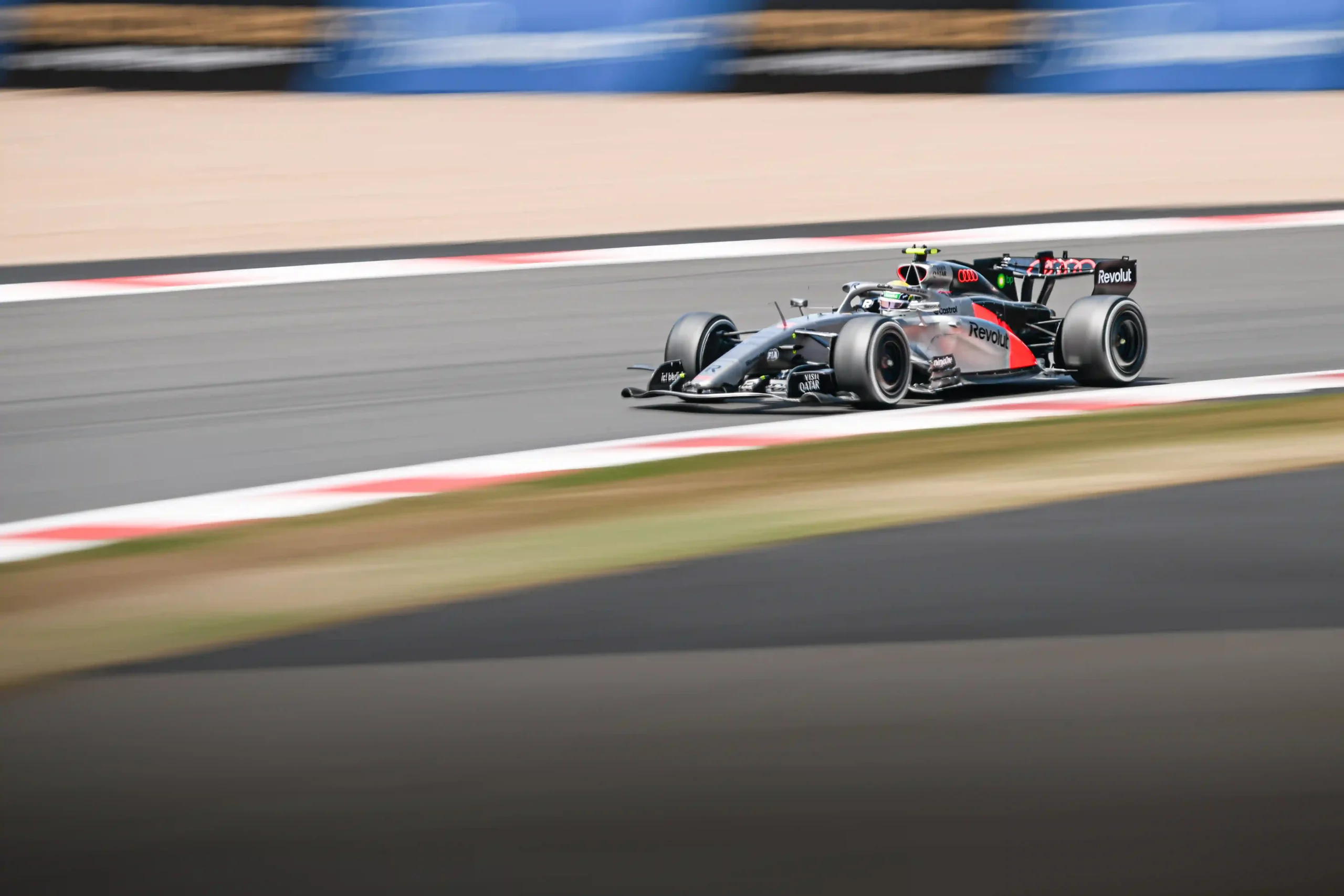
F1 vs MotoGP: Which Is Faster and More Dangerous?
MotoGP can nearly match Formula 1 at the end of a long straight. Yet an F1 car transforms braking and cornering into a completely different level of lap speed.
Formula 1 is faster around a complete circuit. MotoGP is generally more dangerous for the competitor because the rider is exposed, although both championships use advanced safety systems and race at extreme speed.
The F1 vs MotoGP comparison looks close on a speed trap and completely different on a stopwatch.
A current MotoGP bike can exceed 225 mph. In May 2026, Jorge Martin reached a new official record of 368.6 km/h, or 229 mph, at Mugello.
Formula 1 has recorded only a slightly higher peak. However, straight-line speed is the one area where a motorcycle can stay near the car.
Every braking zone changes the argument. An F1 car places four large tires on the track and loads them with aerodynamic downforce.
Therefore, it can decelerate later and carry far more speed through a corner. The bike must brake on a small front contact patch, then lean more than 60 degrees.
The danger comparison also requires care. MotoGP riders wear airbags, advanced helmets and protective leathers.
However, they do not sit inside a carbon-fiber survival cell. A fall can separate rider and motorcycle before either reaches the barrier.
Meanwhile, F1 drivers face higher mass and huge crash energy. Yet the Halo, HANS, harness, wheel tethers and deformable structures form several protective layers.
The technical picture changed again in 2026. F1 introduced Active Aero, a 350kW MGU-K and a 768kg minimum weight target.
MotoGP remained in its final 1000cc season before the 850cc reset. It also set a new speed record, then banned holeshot devices from the Dutch Grand Prix onward.
This guide compares speed, lap times, acceleration, braking, engines, aerodynamics, tires, race formats, crashes, safety and physical demands.
The Quick Answer: F1 Wins the Lap, MotoGP Carries More Personal Risk
F1 uses a four-wheel hybrid car built around downforce, braking and cornering. MotoGP uses a lightweight 1000cc prototype motorcycle whose rider must control lean angle, wheelies, slides and body position without a protective cockpit.
Formula 1 is the faster machine in every complete-lap comparison. The gap usually reaches tens of seconds at a long circuit.
MotoGP can remain close in maximum speed because the motorcycle has a tiny frontal area. A rider tucked behind the screen creates far less drag than an open-wheel car.
However, an F1 car uses four contact patches. It also creates aerodynamic grip that rises with speed.
Consequently, the F1 advantage grows through every fast corner. The car can also apply more braking force without tipping forward.
MotoGP is normally the more dangerous discipline for the person competing. The rider can be thrown into the air, slide across asphalt or face a secondary impact.
That conclusion does not make Formula 1 safe. A 768kg car striking a barrier at high speed carries enormous energy.
Instead, it reflects the difference in protection. An F1 driver remains strapped inside a tested survival structure, while the MotoGP rider becomes a moving object after many crashes.
Speed Winner
Formula 1 wins the full lap through stronger braking, direction change and aerodynamic cornering.
Top-Speed Surprise
MotoGP can approach F1’s peak because a tucked motorcycle produces very little frontal drag.
Danger Verdict
MotoGP exposes the rider more directly, although modern airbags and circuit standards have improved survival.
A speed trap rewards low drag. A lap time rewards the complete vehicle. That is why MotoGP looks close on the straight while Formula 1 disappears through the corners.
F1 vs MotoGP Comparison Table
| Category | Formula 1 in 2026 | MotoGP in 2026 | Advantage |
|---|---|---|---|
| Vehicle | Open-wheel hybrid single-seater | 1000cc prototype racing motorcycle | Different concepts |
| Minimum weight | 768kg including driver and estimated tire mass | 157kg motorcycle only; rider excluded | MotoGP for lightness |
| Power | About 1,000 combined horsepower from turbo V6 and MGU-K | Roughly 270–300 horsepower, manufacturer figures vary | F1 total output |
| Driven wheels | Two rear wheels | One rear wheel | F1 for traction area |
| Top-speed record | Widely cited 378 km/h peak | 368.6 km/h official record in 2026 | F1 narrowly |
| Lap speed | Much faster at shared circuits | Strong on straights, limited in braking and corners | F1 clearly |
| Brakes | Four carbon-carbon brake assemblies plus rear regeneration | Carbon front discs, steel rear disc and engine braking | F1 stopping distance |
| Aerodynamics | Active wings, floor and diffuser create major downforce | Winglets and fairings manage wheelies, stability and drag | F1 downforce |
| Cornering method | Four tires remain flat on track | Rider leans the motorcycle beyond 60 degrees | F1 speed; MotoGP athletic skill |
| Qualifying | Q1, Q2 and Q3 knockout format | Practice decides direct Q2 entry; Q1 and Q2 set both grids | Preference |
| Sprint format | Selected weekends | Every Grand Prix weekend | MotoGP frequency |
| Routine pit stops | Tire stops central to dry-race strategy | No normal dry stop; bike swaps in flag-to-flag conditions | Different strategy |
| Protection | Survival cell, Halo, HANS and harness | Helmet, airbag leathers, protectors and runoff | F1 occupant containment |
| Typical crash | Barrier impact, spin or wheel-to-wheel launch | Lowside, highside, slide, tumble or secondary impact | MotoGP carries more exposure |
Top Speed: MotoGP Is Much Closer Than Most Fans Expect
Formula 1 holds the higher widely cited peak at about 378 km/h. MotoGP’s official record reached 368.6 km/h in 2026, leaving only a 9.4 km/h difference between the headline figures.
The narrow top-speed gap is real, but it needs context. The records were set in different sessions, years, conditions and timing environments.
Jorge Martin’s 368.6 km/h run came during FP2 at Mugello. The Aprilia used the long straight, favorable airflow and a racing tuck.
Valtteri Bottas reached the widely cited 378 km/h figure at Baku in 2016. The F1 car benefited from a long full-throttle section and a tow.
Neither record represents normal speed at every circuit. Gearing, wings, wind, tire load and slipstream all change the number.
Why a MotoGP Bike Has So Little Drag
A MotoGP bike is narrow. The rider folds arms, shoulders and helmet behind the fairing.
Therefore, the machine punches a much smaller hole through the air. That advantage becomes important above 200 mph.
The F1 car is wider than the track position of several motorcycles. Its four exposed tires create large turbulence and drag.
Active Aero reduces that penalty in 2026. Even so, the car must carry wings and safety structures that a motorcycle does not.
Why Top Speed Does Not Decide the Faster Vehicle
A race lap includes braking, rotation and acceleration from low speed. F1 wins those phases by a much larger margin.
For that reason, top speed should be treated as one metric. The separate guide to how fast Formula 1 cars go explains the difference between a speed trap and a lap.
Same-Track Lap Times: The Real F1 vs MotoGP Test
The gap commonly reaches 25–30 seconds on a long Grand Prix circuit. At Silverstone, F1’s 2026 pole was 1:28.111, while the latest MotoGP pole available before the 2026 bike event was 1:57.233 in 2025.
Comparing different seasons is imperfect. Weather, resurfacing, layouts and tire development can all change.
However, the scale of the gap remains useful. It shows that the car gains far more than a few tenths.
| Circuit | F1 Reference | MotoGP Reference | Illustrative Gap | Important Context |
|---|---|---|---|---|
| Silverstone | 1:28.111, Kimi Antonelli, 2026 F1 pole | 1:57.233, Fabio Quartararo, 2025 MotoGP pole | 29.122 seconds | The 2026 MotoGP British GP was scheduled after this article’s July 30 update. |
| Circuit of the Americas | 1:32.510, Max Verstappen, 2025 F1 pole | 2:00.136, Fabio Di Giannantonio, 2026 MotoGP pole | 27.626 seconds | Different seasons and conditions, but the same broad Grand Prix layout. |
F1 Gains Most in Fast Direction Changes
Silverstone’s Maggotts-Becketts sequence exposes the difference. The F1 car remains loaded by downforce while changing direction rapidly.
A motorcycle must lift from one lean angle, pass through upright and fall toward the other side. Rider mass moves with the machine.
Consequently, MotoGP cannot match the car’s direction-change rate. The gap grows before the straight even begins.
COTA Shows the Braking Difference
Turn 1 at Austin rises steeply and requires heavy braking. MotoGP riders arrive at extreme speed and control rear-wheel lift.
F1 drivers can stop later because four tires share the load. The car then rotates without balancing on one narrow front contact patch.
The general racing-line principles are explained in the guide to slipstream and straight-line towing.
Acceleration: Close at First, Then F1 Pulls Away
The first sprint from rest can be close because a MotoGP bike is extremely light. However, the bike is wheelie-limited and drives through one rear tire. F1 has two driven tires and far more power, so it becomes clearly quicker as speed rises.
MotoGP’s power-to-weight ratio looks extraordinary on paper. A 157kg motorcycle with nearly 300 horsepower carries less dead mass than an F1 car.
However, the rider adds weight high above the centerline. More importantly, acceleration transfers load away from the front wheel.
Once the front begins to lift, extra engine torque no longer creates equal forward acceleration. Electronics, aerodynamics and rider control must manage the wheelie.
F1 Uses a Larger Driven Contact Area
An F1 car sends torque through two broad rear tires. The contact area is much larger than one MotoGP rear tire.
The car also keeps its nose on the ground. Weight transfer still matters, but it does not threaten a backward rotation around the rear axle.
Therefore, F1 can deploy more total power. The advantage grows strongly beyond the first few seconds.
Starts Still Demand Human Control
Neither championship allows the machine to complete the start without the competitor. The F1 driver controls clutch bite and throttle.
The MotoGP rider controls clutch release, body position and wheelie behavior. Holeshot devices once lowered the front for starts.
However, MotoGP banned those front devices from the 2026 Dutch Grand Prix onward. The decision placed more emphasis on rider control and start safety.
Engine output alone can mislead, so the guide to what torque means provides useful context.
Braking: Formula 1 Has the Decisive Advantage
Formula 1 brakes faster and in a shorter distance. Four tires, aerodynamic load and four carbon brake assemblies allow much greater deceleration without the rollover limit that affects a motorcycle.
MotoGP braking is still astonishing. Official MotoGP technical material notes that riders can slow from above 340 km/h to around 100 km/h at COTA.
Carbon front discs handle extreme heat. Riders also use engine braking and a rear brake, sometimes controlled by a thumb lever.
However, the front tire performs most of the work. The rear becomes lightly loaded and may lift from the asphalt.
A Motorcycle Can Physically Tip Forward
The braking limit is not only tire grip. It is also geometry.
Heavy deceleration transfers weight toward the front axle. If the force becomes too great, the rear wheel rises and the bike approaches a stoppie.
The rider must balance maximum pressure against stability. A bump or small steering angle can trigger a front-end loss.
F1 Downforce Adds Grip at High Speed
An F1 car creates its strongest aerodynamic load at the start of the braking zone. That load pushes all four tires into the surface.
As speed falls, downforce reduces. The driver progressively releases the pedal while turning toward the apex.
This process is precise, but the car remains far more stable than a braking motorcycle. The result is a shorter zone and a later braking point.
The concept of weight and grip is covered further in the F1 g-force guide.
Cornering: Downforce Beats Lean Angle on the Stopwatch
Formula 1 corners much faster. Four wide tires and aerodynamic downforce create several times more lateral grip than a MotoGP motorcycle can generate on two narrow, rounded contact patches.
MotoGP cornering may look more dramatic. Riders hang far from the bike and place a knee or elbow near the asphalt.
That movement lowers the combined center of gravity. It also lets the motorcycle turn at a given speed with slightly less lean.
Modern MotoGP bikes can exceed 60 degrees of lean. Yet the tire uses a small area near its edge.
The Rider Is Part of the Chassis
A MotoGP rider shifts forward under braking, hangs inside the corner and moves rearward during acceleration. Body position changes load on both tires.
Therefore, the rider is not simply a passenger giving steering commands. The body forms part of the vehicle’s mass distribution and aerodynamics.
F1 Keeps the Tire Flat
F1 tires remain broadly flat against the track. Suspension geometry manages camber as the car rolls and loads.
Downforce then adds vertical pressure without adding the same inertia as physical mass. That is the central advantage of race-car aerodynamics.
For a deeper explanation, read what downforce does.
F1 Turbo Hybrid vs MotoGP 1000cc Prototype Engine
F1 uses a 1.6-liter turbocharged V6 with a powerful MGU-K and advanced sustainable fuel. MotoGP uses naturally aspirated 1000cc four-cylinder prototype engines, usually V4s, with Yamaha moving to a V4 architecture in 2026.
Formula 1 Splits Power Between Fuel and Electricity
The 2026 F1 power unit uses an internal-combustion engine limited to about 400kW. The MGU-K can add up to 350kW in key acceleration zones.
That creates roughly 1,000 combined horsepower at maximum potential. Deployment still varies with battery state and the section of track.
The MGU-H disappeared in 2026. Energy recovery now depends more heavily on braking, lift and partial-throttle operation.
MotoGP Uses a High-Revving Naturally Aspirated Engine
The current premier-class limit remains 1000cc. Bikes use four cylinders and six-speed seamless gearboxes.
Official MotoGP explainers place output around 270–300 horsepower. Exact factory numbers remain closely protected.
Ducati, Honda, KTM and Aprilia use V4 layouts. Yamaha introduced its V4 era for 2026 after decades of inline-four identity.
MotoGP Power Is Limited by the Chassis
A bike does not always use every horsepower. Wheelies, rear spin and lean angle can force the electronics to reduce torque.
F1 also manages wheelspin, but the chassis can absorb far more power. Two rear tires and a longer wheelbase create a larger traction platform.
The combustion basics appear in the Formula 1 race-car guide.
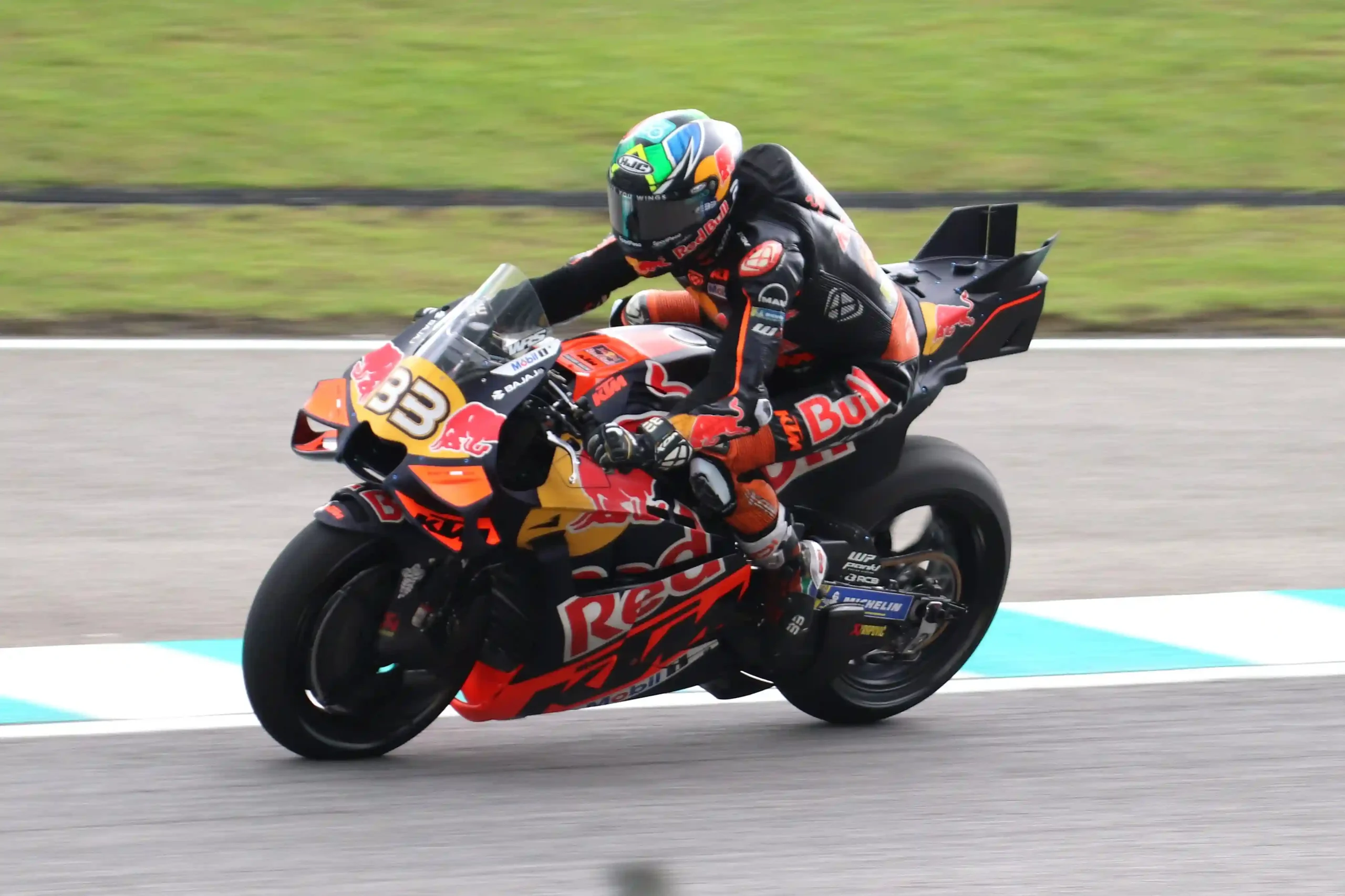
F1 Active Aero vs MotoGP Winglets and Fairings
F1 uses the front wing, floor, diffuser and rear wing to create large downforce. MotoGP aero mainly controls wheelies, front-tire load, braking stability and drag while the motorcycle changes lean angle.
F1 Uses Air as an Extra Weight
The 2026 car switches wing angles between Straight Mode and Corner Mode. Straight Mode reduces drag in designated sections.
Corner Mode restores load for braking and turning. The floor and diffuser continue creating grip beneath the car.
This approach lets F1 carry more corner speed without relying only on tire compound. It also helps the car use its stronger electrical power.
MotoGP Aero Must Work While Leaning
A motorcycle wing does not remain level. It rotates with the bike through every corner.
Therefore, engineers cannot simply copy an F1 wing. The device must remain predictable at lean, in crosswinds and during rider movement.
Front winglets keep load on the front tire under acceleration. Side and rear aero can improve braking stability and reduce wheelies.
Ride-Height Devices Changed the Airflow
Rear ride-height systems lower the motorcycle on corner exit. That reduces wheelies and changes the relationship between fairing, floor clearance and airflow.
Front holeshot devices once provided a similar launch benefit. However, MotoGP removed them from the Dutch Grand Prix in June 2026.
All ride-height systems will disappear with the 2027 regulations. That reset aims to reduce cost, improve safety and restore more control to the rider.
Tires: Four Flat Contact Patches Against Two Rounded Profiles
F1 tires are wide, flat and designed to generate maximum grip with the car upright. MotoGP tires have rounded profiles so the rider can lean, with the available contact patch moving from the center toward the edge.
F1 Uses Compound Strategy
Pirelli supplies several slick compounds, plus intermediate and full wet tires. Three dry compounds are nominated for each weekend.
In a dry Grand Prix, drivers normally use at least two slick compounds. That requirement makes tire strategy central to the race.
Front and rear tires also face different loads. Aerodynamic balance, brake temperature and traffic can change degradation.
MotoGP Splits Front Feel From Rear Traction
Michelin supplies front and rear options with different compounds and constructions. Riders often discuss front confidence as the key to lap time.
The rear tire must handle huge torque while leaned. The front must survive heavy braking and then provide precise edge grip.
Pressure rules matter because running too low can create structural risk. However, following another bike can raise front temperature and pressure.
Why a Bike Cannot Use an F1-Style Tire
A flat-profile tire would resist lean and create unpredictable transitions. A motorcycle needs a rounded cross-section to roll smoothly toward the edge.
That geometry reduces the maximum contact area. Therefore, the bike trades outright grip for the ability to lean and steer.
F1 vs MotoGP Race Format
An F1 Grand Prix usually exceeds 305km and can last close to two hours. A MotoGP Sunday race is shorter, uses a fixed lap count and has no Safety Car circulating with the field during normal competition.
Formula 1 Uses Longer Grand Prix Distance
Most F1 races cover the least number of laps exceeding 305km. Monaco uses a shorter distance because average speed is lower.
The race begins from a standing start. Safety Cars, Virtual Safety Cars and red flags can interrupt the action.
F1 cars can stop for tires several times. They cannot change cars, and race refueling remains banned.
MotoGP Runs a Saturday Sprint Every Weekend
MotoGP introduced Sprints in 2023. The Saturday race covers roughly half the Sunday distance and awards points to the top nine.
The winner receives 12 points. Sunday remains more valuable, with 25 points for victory.
F1 also uses Sprints, but only at selected events. The comparison appears in the F1 Sprint weekend guide.
MotoGP Does Not Use an F1-Style Safety Car
A slow car circulating among motorcycles would create its own risks. MotoGP instead uses flags, penalties and red flags when conditions become unsafe.
Races can restart over a reduced distance. The procedure depends on how much of the original race was completed.
MotoGP also increased grid spacing in July 2026. Riders now sit four meters apart vertically, creating 12 meters between three-rider rows.
F1 Q1, Q2 and Q3 vs MotoGP Q1 and Q2
F1 uses three knockout sessions and eliminates six cars after Q1 and Q2 in the 22-car field. MotoGP uses Friday Practice to send the fastest ten riders directly to Q2, while the fastest two from Q1 join them.
F1 Gives Drivers Several Session Windows
Q1, Q2 and Q3 reward repeated execution. A driver must survive traffic, tire warm-up and changing track conditions.
The final ten contest pole in Q3. A single deleted lap can still destroy the session.
MotoGP Makes Friday Practice Critical
The top ten in Friday afternoon Practice secure direct Q2 entry. Everyone else must pass through Q1 on Saturday.
Only the fastest two in Q1 advance. Q2 then sets the top 12 positions for both the Sprint and Sunday race.
Towing creates another strategic issue. A rider may follow a faster bike for slipstream, but the leading rider often dislikes providing the help.
Yellow Flags Can Cancel a Perfect Lap
A crash can produce yellow flags in one sector. Riders passing that zone must slow, and their lap may be canceled.
Because MotoGP Q2 lasts only 15 minutes, one interruption can remove half the useful attempts. The wider principles appear in the racing qualifying guide.
Pit Stops: Tire Change vs Flag-to-Flag Bike Swap
F1 stops routinely for tire changes, often in about two seconds. MotoGP normally completes a dry race without stopping, but riders can switch to a second motorcycle when a race is declared wet or white flags activate flag-to-flag rules.
F1 Pit Stops Are Planned Strategy
Teams select a tire window before the race. They then react to traffic, degradation and neutralizations.
A fresh tire can create an undercut. A delayed stop can create an overcut if tire warm-up is difficult.
The crew changes all four wheels and may adjust the front wing. Refueling is prohibited.
MotoGP Riders Change the Whole Motorcycle
In flag-to-flag conditions, the second bike waits with different tires and settings. The rider enters pit lane, stops at the box and jumps across.
The race continues throughout the process. Riders can change bikes more than once after flag-to-flag rules begin.
Timing is the entire strategy. A wet tire overheats on drying asphalt, while a slick can become dangerous if rain strengthens.
General pit-lane principles are covered in how racing pit stops work.
Which Is More Dangerous: F1 or MotoGP?
A MotoGP rider has no cockpit, harness or survival cell. After a crash, the rider may slide, tumble or be struck by the motorcycle or another competitor. F1 drivers face huge impact energy, but several structures remain around the body.
Danger cannot be measured only by top speed. Exposure, crash type, track design and secondary impacts matter.
A MotoGP crash often begins with a small loss of tire grip. Within a fraction of a second, the rider and motorcycle are moving separately.
An F1 crash usually keeps the driver inside the vehicle. That containment gives the safety structure time to absorb energy.
MotoGP Lowsides and Highsides
A lowside occurs when a tire loses grip and the motorcycle falls toward the inside. Rider and bike often slide in the same broad direction.
A highside begins when the rear tire slides, then suddenly regains grip. The bike can snap upright and throw the rider over the top.
Highsides can create vertical impact before the rider starts sliding. They also leave less control over the landing.
Secondary Impact Is the Greatest Motorcycle Fear
A rider may survive the first slide but remain in the racing line. Another motorcycle can arrive before the field has time to react.
Air fences and gravel reduce speed before a barrier. They cannot always prevent contact with other competitors.
F1 Carries More Vehicle Mass
An F1 car is several times heavier than a MotoGP bike and rider. A high-speed barrier strike therefore carries major kinetic energy.
However, the nose, side structures and rear crash structure are designed to deform. The survival cell should remain intact around the driver.
The broader accident causes appear in the motor-racing crash guide.
Safety Systems: Halo and Survival Cell vs Airbag Leathers
F1 drivers use a carbon-fiber survival cell, Halo, HANS, six-point harness, wheel tethers and deformable structures. MotoGP riders use certified helmets, airbag leather suits, back and chest protection, gloves, boots and motorcycle-specific runoff systems.
F1 Builds Protection Around the Driver
The monocoque forms a rigid central cell. Front, side and rear structures absorb energy outside it.
Halo protects against large debris and another vehicle. HANS limits harmful head movement during sudden deceleration.
Wheel tethers aim to keep heavy assemblies attached. Fire-resistant clothing protects during fuel or battery incidents.
The system is detailed in the Formula 1 Halo guide.
MotoGP Wears the Protection
Airbag systems became compulsory across permanent Grand Prix riders in 2018. Sensors detect an abnormal motion and inflate protection around the torso.
Modern systems can deploy in a few hundredths of a second. They protect shoulders, collarbones, chest, back and neck areas.
Leather resists abrasion. Armor spreads local impact, while boots limit ankle rotation.
The Circuit Must Suit Motorcycles
Motorcycles need long runoff because the rider cannot remain inside a vehicle. Gravel can reduce sliding speed but may also cause tumbling.
Air fences provide a softer final barrier. Track operators also cover exposed wall edges and remove dangerous obstacles.
F1 can use TecPro and tire barriers close to some corners. MotoGP often needs a larger clear area before the first hard object.
F1 Driver vs MotoGP Rider: Physical Demands
F1 creates greater sustained neck and torso g-force. MotoGP requires more whole-body movement, forearm strength, balance and repeated loading through the arms and legs. Both demand elite conditioning.
F1 Loads the Neck
High-speed corners push the helmet sideways. Heavy braking drives the body into the harness.
The driver cannot lean far to counter the force. Neck and core muscles must hold the head stable enough for precise vision.
Cockpit heat and race duration add fatigue. Steering-wheel adjustments also create mental load throughout the lap.
MotoGP Uses the Entire Body
The rider moves from side to side through every sequence. Legs grip the tank and support body weight during braking.
Forearms control the bars and front brake. Repeated pressure can contribute to arm-pump problems.
The rider also fights wind at more than 200 mph. A loose head position creates turbulence and fatigue.
Risk Changes the Mental Workload
Both competitors know that a mistake can cause injury. MotoGP riders receive more direct physical feedback from slides and bumps.
F1 drivers process higher corner speeds and more cockpit systems. Neither workload can be reduced to courage alone.
Electronics, Gearboxes and Rider Control
F1 Uses Centralized Data With Team-Specific Control
Hundreds of sensors measure temperature, pressure, acceleration and energy flow. Teams analyze live telemetry from the garage.
The driver changes brake balance, differential settings and deployment modes. Automatic gear selection remains prohibited.
MotoGP Uses a Standard ECU Platform
All teams use controlled electronics and software foundations. Manufacturers still tune torque delivery, traction control, engine braking and wheelie control.
The seamless gearbox changes ratio with minimal interruption. The rider uses foot controls rather than steering-wheel paddles.
Electronics Cannot Replace Balance
Traction control can reduce torque after slip appears. It cannot create a larger contact patch or save every front-end loss.
The rider still chooses line, lean, brake pressure and body position. Technology helps operate near the limit; it does not remove the limit.
Tracks: Why MotoGP Needs Different Safety Geometry
Shared Circuits Need Different Homologation
Silverstone, COTA, Barcelona and the Red Bull Ring host both disciplines. However, barrier placement and event preparation can change.
FIA Grade 1 approval focuses on high-performance cars. FIM Grade A approval considers motorcycle-specific runoff and rider impact paths.
F1 Can Race on More Street Circuits
Monaco, Singapore and Las Vegas place walls close to the racing line. A car can contain the driver after many impacts.
MotoGP rarely uses true street circuits because a fallen rider needs open space. The lack of runoff can turn a normal slide into a barrier impact.
Curbs Affect Two Wheels More Severely
An F1 car can attack many curbs with both inside tires. A MotoGP bike at full lean may lose grip from a small step or painted surface.
Therefore, motorcycle race direction pays close attention to curb profiles, drainage and artificial grass. The track is part of the safety system.
F1 vs MotoGP Costs and Team Scale
Formula 1 is much more expensive. Teams design complete cars, operate large factories and employ hundreds of specialists. MotoGP factory programs are still costly, but the motorcycle, staff and logistics operate on a smaller scale.
F1 Pays for a Complete Constructor Program
Each team develops the chassis and aerodynamics. Leading organizations run wind tunnels, CFD systems, simulators and manufacturing departments.
The financial regulations cap defined performance spending. However, power units, major salaries and several commercial areas sit outside parts of the cap.
Therefore, the total organization costs far more than one car. The guide to F1 car costs explains why a single price can mislead.
MotoGP Focuses Spending on a Smaller Prototype
Factories develop engines, frames, swingarms, aerodynamics and electronics. Test teams also work throughout the season.
However, the physical inventory is smaller. A motorcycle uses fewer large composite structures and requires fewer pit-stop specialists.
Satellite teams may lease factory machinery and receive different support levels. That structure keeps more teams on the grid without requiring every entrant to build an engine.
Popularity and Racing Style
Formula 1 Has the Larger Mainstream Audience
F1 has broader global commercial reach, larger team brands and more mainstream U.S. recognition. Its calendar visits several continents and major city markets.
MotoGP remains deeply popular in southern Europe and Asia. Motorcycle culture gives riders a strong connection with fans.
MotoGP Often Produces More Natural Overtaking
A motorcycle is narrow and can change line in a small space. Riders can pass through braking zones without needing a full car width.
The slipstream also matters strongly. A following rider can move out late and brake alongside.
F1 overtaking depends more on aerodynamic wake, energy deployment and tire advantage. Overtake Mode replaced DRS in 2026.
Rider Visibility Changes the Emotion
Fans can see a MotoGP rider fighting the machine. Body movement, shaking handlebars and slides remain visible.
An F1 driver works inside the cockpit, so the effort appears through onboard cameras and telemetry. The spectacle is more technical, but no less demanding.
Current premier-class context is available in the MotoGP championship guide.
What Changed in F1 and MotoGP During 2026?
F1 Introduced Active Aero and Greater Electrical Power
The 2026 F1 car became shorter, narrower and lighter on paper. The minimum target fell to 768kg.
Front and rear wing elements now change angle in specified high-speed sections. Overtake Mode gives an eligible following driver extra electrical deployment.
The MGU-K increased to 350kW, although later refinements limited output to 250kW in less critical zones. The changes aimed to protect acceleration while controlling closing speed.
MotoGP Set a New Official Speed Record
Jorge Martin reached 368.6 km/h at Mugello on May 30, 2026. The Aprilia beat the previous 366.1 km/h benchmark.
The record showed how far current aero and engine performance have moved. It also arrived in the final season before the displacement reduction.
MotoGP Removed Holeshot Devices Early
The Grand Prix Commission banned front holeshot devices from the Dutch Grand Prix. The full removal had originally been tied to 2027.
Grid spacing then increased from the German Grand Prix. Each rider position moved from three meters to four meters apart, increasing the distance between rows.
Those decisions were directly linked to start safety. They also return more responsibility to clutch and throttle control.
The 2027 MotoGP Reset Is Already Shaping 2026
Next season’s engines drop from 1000cc to 850cc. All ride-height devices will disappear, aero freedom will reduce and Pirelli replaces Michelin.
The aim is lower speed, closer racing and greater road relevance. Therefore, 2026 represents the final expression of the current high-downforce 1000cc era.
Final Score: Which Wins Each Category?
Formula 1 wins the speed argument when speed means a complete lap. It stops later, turns faster and accelerates from the apex with more usable power.
MotoGP wins the spectacle of exposed speed. The rider remains visible, mobile and physically involved at every point.
On danger, MotoGP carries the stronger personal risk. Modern safety equipment has advanced, but it cannot create a cockpit around the rider.
F1 remains dangerous because energy does not disappear. Instead, engineers build structures that manage it before it reaches the driver.
Both championships deserve respect for different reasons. F1 shows what four wheels, downforce and hybrid power can achieve.
MotoGP shows what a rider can achieve while balancing nearly 300 horsepower on two small contact patches.
F1 vs MotoGP FAQs
Which is faster, Formula 1 or MotoGP?
Formula 1 is much faster around a complete lap. MotoGP can nearly match its peak straight-line speed, but F1 brakes later and corners far faster.
Which is more dangerous, F1 or MotoGP?
MotoGP is generally more dangerous for the competitor because the rider is exposed and can separate from the bike. F1 drivers remain inside a survival cell with Halo, HANS and a harness.
Which accelerates faster, an F1 car or MotoGP bike?
The first launch phase can be close. However, the MotoGP bike is wheelie-limited, while F1 uses two driven tires and much more power, so the car becomes quicker as speed rises.
Why is F1 faster at the same track?
F1 has four large contact patches, carbon brakes and aerodynamic downforce. MotoGP must balance on two rounded tires and lean through corners, which limits braking and lateral grip.
Conclusion: Formula 1 Is Faster, but MotoGP Leaves the Rider More Exposed
The F1 vs MotoGP comparison begins with two headline speeds that appear surprisingly close.
Formula 1’s widely cited peak is about 378 km/h. MotoGP reached an official 368.6 km/h at Mugello in 2026.
However, the stopwatch tells a different story. F1 gains enormous time under braking and through every corner.
At Silverstone, the available references show a gap above 29 seconds. COTA produces a similar gap near 28 seconds.
Those comparisons come from different seasons, so they are not laboratory tests. Yet the difference is too large to explain through weather alone.
The car wins because it uses four wide tires. Aerodynamic downforce adds grip without adding the same inertia as physical weight.
The 2026 Active Aero system then reduces drag on straights. Corner Mode restores the load needed for braking and turning.
MotoGP achieves speed through another route. The motorcycle is light, narrow and extremely powerful.
A tucked rider reduces frontal area. That lets the bike approach F1 speed at the end of a long straight.
Acceleration from rest can be close. Nevertheless, the bike must control wheelies through one driven tire.
F1 has two broad rear tires and roughly 1,000 horsepower. Its advantage grows once traction is established.
Braking creates the largest mechanical difference. A motorcycle transfers most load onto one front contact patch.
The rear may lift, so geometry limits deceleration as well as grip. An F1 car shares the load across four tires.
Cornering separates the concepts further. MotoGP riders lean beyond 60 degrees and move their bodies to control the combined center of gravity.
F1 drivers remain seated while the chassis and aero generate lateral force. The car can change direction much faster.
The engines also express different philosophies. F1 combines a turbo V6, sustainable fuel and a 350kW MGU-K.
MotoGP uses a naturally aspirated 1000cc four-cylinder engine and seamless gearbox. The machine produces roughly 270–300 horsepower.
Aerodynamics now matter to both series. F1 uses a full floor, diffuser and active wings.
MotoGP uses winglets and fairings to reduce wheelies and improve stability. Those devices must also work while the bike leans.
The 2026 season delivered important changes. F1 entered a new active-aero and high-electric-power era.
MotoGP set a new speed record, then removed front holeshot devices from Assen. The starting grid also gained more spacing from Germany.
Those motorcycle changes focused on safety. The 2027 regulations will go farther with 850cc engines and a full ride-height-device ban.
Race formats remain distinct. F1 runs longer Grands Prix and uses routine tire stops.
MotoGP holds a Sprint every Saturday and usually completes dry races without stopping. Changing weather can trigger a flag-to-flag bike swap.
Qualifying applies pressure differently. F1 eliminates drivers through Q1, Q2 and Q3.
MotoGP makes Friday Practice part of the qualifying fight. Q1 then offers only two remaining places in Q2.
Safety is the most important difference. F1 surrounds the driver with carbon structure, Halo and restraints.
MotoGP places protection on the rider through airbags, leather and armor. Runoff and air fences then become vital.
Therefore, MotoGP remains more dangerous for the competitor in general terms. The rider may tumble or face another machine after the first impact.
Formula 1 can create greater crash energy, but the car is designed to manage that energy around the driver.
Neither discipline is easy, and neither competitor is simply braver. They solve different physical problems at the edge of control.
Formula 1 is the faster vehicle. MotoGP is the more exposed contest.
Together, they represent the highest levels of four-wheel and two-wheel circuit racing.
Sources and Fact-Checking
This article was checked on July 30, 2026. Current claims use official Formula 1, MotoGP and FIM material, while the same-track lap table clearly identifies comparisons drawn from different seasons.