Introduction
If you have ever driven a diesel-powered vehicle or watched a heavy truck pull a massive load, you may have wondered why diesel engines seem so strong at low speeds. Even when a diesel engine has less horsepower than a gasoline engine, it often feels more powerful when accelerating from a stop, climbing hills, or towing heavy cargo.
This strength comes from torque, the twisting force produced by an engine. While horsepower often receives the most attention in advertisements and performance discussions, torque is what gives a vehicle its ability to move heavy loads and accelerate without needing high engine speeds.
One of the most fascinating aspects of diesel engines is that they naturally produce more torque than comparable gasoline engines. This isn’t due to a single design feature but rather a combination of combustion characteristics, compression ratios, engine architecture, and operating speed.
In this article, we’ll explore exactly why diesel engines generate so much torque, how diesel combustion differs from gasoline combustion, and why diesel engines dominate industries that demand pulling power.
What Is Torque?
Before understanding why diesel engines produce more torque, we need to understand what torque actually is.
Torque is a rotational force.
Imagine using a wrench to loosen a tight bolt.
The force you apply to the wrench creates twisting motion. That twisting force is torque.
In a vehicle:
- The engine creates torque.
- The transmission multiplies it.
- The wheels use it to move the vehicle.
The more torque an engine produces, the easier it can:
- Pull heavy loads
- Accelerate from low speeds
- Climb steep hills
- Tow trailers
For a deeper understanding of torque, you can read our guide on engine torque or learn about engine fundamentals from HowStuffWorks’ engine guide.
Why Torque Matters More Than Horsepower for Heavy Work
Many people believe horsepower is everything.
In reality, horsepower and torque serve different purposes.
Think of it this way:
- Horsepower determines how quickly work gets done.
- Torque determines how much force is available to do that work.
A sports car may have enormous horsepower.
A diesel truck may have lower horsepower but substantially higher torque.
When moving heavy loads, torque is usually more important.
This explains why trucks, buses, construction equipment, ships, and agricultural machinery overwhelmingly use diesel engines.

Diesel Engines Use Much Higher Compression Ratios
One of the biggest reasons diesel engines produce more torque is their extremely high compression ratio.
Compression ratio describes how much the air inside a cylinder is squeezed before combustion occurs.
Gasoline engines typically operate between:
- 8:1 and 12:1 compression ratios
Diesel engines often operate between:
- 14:1 and 22:1 compression ratios
This means diesel engines compress air much more aggressively.
Higher compression creates:
- Greater cylinder pressure
- More efficient combustion
- Stronger force acting on the piston
The result is increased torque production.
For more information on internal combustion principles, see Encyclopaedia Britannica’s Internal Combustion Engine overview.
Diesel Fuel Contains More Energy
Another important factor is the fuel itself.
Diesel fuel contains more energy per liter than gasoline.
This means every combustion event can potentially release more energy.
Imagine two batteries:
- One small battery
- One larger battery
Both provide electricity, but the larger battery stores more energy.
Diesel fuel works similarly.
Because diesel fuel is energy-dense, it contributes to stronger combustion forces inside the cylinder.
These stronger combustion forces translate directly into greater torque.
Diesel Combustion Happens Differently
Gasoline engines use spark plugs.
The air-fuel mixture enters the cylinder and waits for a spark to ignite it.
Diesel engines operate differently.
Instead:
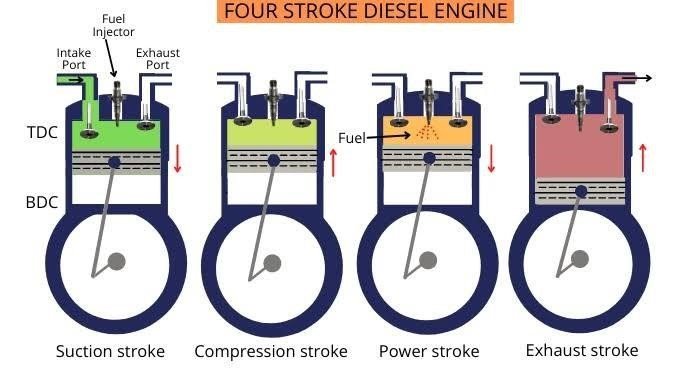
- Air enters the cylinder.
- The air is compressed intensely.
- Compression generates extreme heat.
- Diesel fuel is injected.
- The fuel ignites automatically.
This process is called compression ignition.
Because combustion occurs under very high pressure, diesel engines generate tremendous cylinder forces.
Those forces push the piston downward more strongly, increasing torque output.
Longer Stroke Creates More Leverage
Many diesel engines are designed with a relatively long stroke.
The stroke is the distance a piston travels inside the cylinder.
A longer stroke creates additional leverage on the crankshaft.
Think of opening a door.
Pushing near the hinges requires significant effort.
Pushing at the edge of the door requires much less effort because you have greater leverage.
A long-stroke diesel engine benefits from a similar mechanical advantage.
The increased leverage helps create higher torque even at low RPM.
Diesel Engines Operate at Lower RPM
One of the most noticeable differences between diesel and gasoline engines is engine speed.
Gasoline engines often rev to:
- 6,000 RPM
- 7,000 RPM
- 8,000 RPM or higher
Many diesel engines operate below:
- 4,500 RPM
At first glance, this seems like a disadvantage.
However, lower RPM actually contributes to torque-focused performance.
Instead of generating power through speed, diesel engines generate power through force.
This allows them to produce substantial torque at very low engine speeds.
Drivers often feel this as strong pulling power immediately after pressing the accelerator.
Stronger Internal Components
Diesel engines must survive extreme cylinder pressures.
As a result, manufacturers build them using heavier-duty components.
These often include:
- Stronger engine blocks
- Reinforced crankshafts
- Heavy-duty connecting rods
- More robust pistons
These stronger parts allow diesel engines to handle enormous combustion forces.
The ability to withstand these forces helps support higher torque output.
Turbochargers Enhance Diesel Torque
Most modern diesel engines use turbochargers.
Turbochargers force additional air into the engine.
More air allows:
- More fuel injection
- Larger combustion events
- Greater cylinder pressure
This significantly boosts torque production.
Diesel engines and turbochargers work particularly well together because diesel combustion thrives under high-pressure conditions.
Learn more about turbocharging technology from Garrett Motion’s Turbocharger Technology Center..
Why Diesel Engines Feel Strong at Low Speeds
Many drivers describe diesel engines as feeling “effortless.”
This sensation comes from their torque curve.
Gasoline engines often need high RPM to access peak performance.
Diesel engines usually reach peak torque much earlier.
For example:
- Gasoline engine peak torque: 4,500–6,000 RPM
- Diesel engine peak torque: 1,500–3,000 RPM
This means diesel engines produce their strongest pulling force almost immediately.
The vehicle feels powerful without needing high engine speed.
Why Trucks Depend on Diesel Torque
Heavy trucks may weigh:
- 20 tons
- 30 tons
- 40 tons or more
Moving this mass requires tremendous force.
Diesel engines provide:
- High low-end torque
- Excellent fuel efficiency
- Long service life
- Reliable operation under load
These characteristics make diesel engines ideal for commercial transportation.
Without diesel torque, hauling massive cargo loads would be significantly more difficult.
Does More Torque Mean More Horsepower?
Not necessarily.
Torque and horsepower are related but not identical.
A diesel engine may produce huge torque figures while having relatively modest horsepower.
This happens because horsepower depends on both torque and engine speed.
Horsepower=5252Torque×RPM
Diesel engines create large torque values but operate at lower RPM.
Gasoline engines often create less torque but achieve higher RPM.
As a result, horsepower numbers can be surprisingly similar.
Why Performance Cars Usually Use Gasoline Engines
If diesel engines produce so much torque, why don’t all sports cars use diesel?
The answer is RPM.
Sports cars benefit from:
- High revving capability
- Rapid throttle response
- Lightweight components
- Strong top-end power
Gasoline engines excel in these areas.
Diesel engines prioritize:
- Efficiency
- Durability
- Low-speed pulling force
These characteristics are ideal for trucks but less suited to high-performance sports cars.
Modern Diesel Technology
Today’s diesel engines are far more advanced than older designs.
Modern systems include:
- Common-rail fuel injection
- Variable geometry turbochargers
- Electronic engine management
- Advanced emissions controls
These technologies improve:
- Power output
- Fuel economy
- Emissions performance
- Drivability
Modern diesel engines can produce astonishing torque figures while remaining efficient and reliable.
Conclusion
Diesel engines produce more torque because of several engineering advantages working together.
Their high compression ratios create greater cylinder pressure, diesel fuel contains more energy, combustion occurs under intense force, and many diesel engines use long-stroke designs that provide additional leverage on the crankshaft.
Combined with turbocharging and low-RPM operation, these characteristics allow diesel engines to generate tremendous pulling power.
This is why diesel engines dominate industries that depend on strength, durability, and efficiency. From pickup trucks and commercial transport vehicles to agricultural machinery and marine applications, diesel torque makes moving heavy loads easier and more efficient.
While gasoline engines often excel at high-RPM horsepower, diesel engines remain unmatched when it comes to producing effortless low-end torque.