Introduction: The Invisible Explosions Powering Your Car
Every time a car moves, thousands of tiny explosions happen inside the engine every single minute.
That may sound dangerous, but those explosions are actually controlled with incredible precision. Modern car engines are engineered to transform burning fuel into smooth rotational motion capable of moving an entire vehicle at high speed while remaining reliable for years.
At the heart of this process is something called the 4-stroke internal combustion engine — one of the most important mechanical inventions in human history.
Even though modern engines include:
- computers,
- sensors,
- fuel injectors,
- turbochargers,
- and electronic control systems,
the core idea is surprisingly simple:
Burn fuel inside a sealed chamber, use the pressure to push a piston, and convert that movement into rotational force.
This article will explain the complete 4-stroke process step-by-step using simple language, technical accuracy, and visual diagrams designed for beginners.
The Basic Idea Behind a 4-Stroke Engine
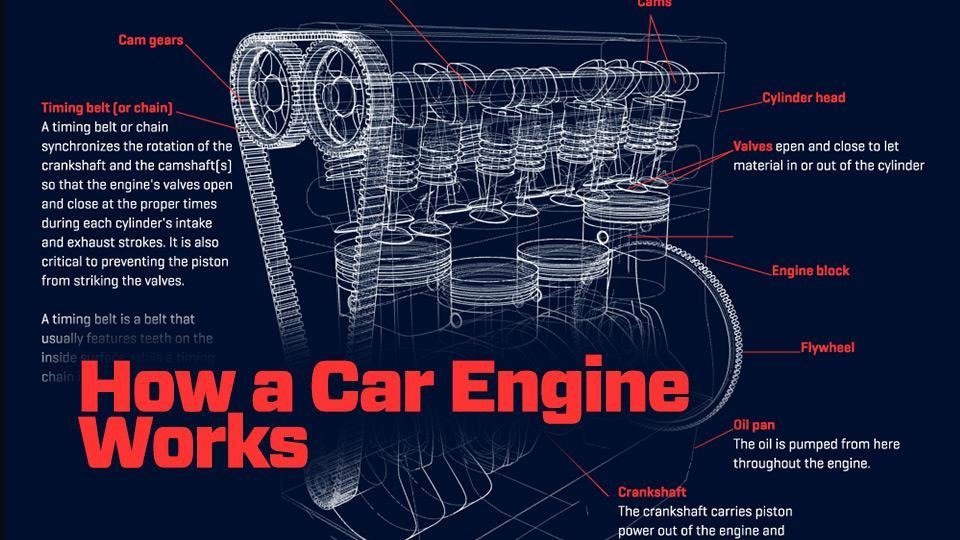
Before understanding the four strokes, we first need to understand what an engine actually does.
A car engine is an energy conversion machine.
It converts:
- Chemical energy stored in fuel,
- into heat energy through combustion,
- then into mechanical energy that turns the wheels.
The engine works because hot gases expand extremely fast.
When fuel burns inside a small sealed space:
- temperature rises dramatically,
- pressure increases,
- and expanding gases push against engine components.
The engine captures this pressure and converts it into usable motion.
The Main Parts of a 4-Stroke Engine
Before learning the cycle itself, let’s meet the key components.
Cylinder
The cylinder is the chamber where combustion happens.
It is a strong metal tube designed to survive:
- extreme heat,
- massive pressure,
- and continuous movement.
Modern engines may contain:
- 3 cylinders,
- 4 cylinders,
- 6 cylinders,
- or even 8+ cylinders.
Each cylinder acts like a miniature power plant.
Piston
Inside each cylinder is a piston.
The piston moves:
- upward,
- then downward,
- repeatedly at very high speed.
Its job is to receive force from combustion pressure.
Futuristic Engine Cylinder Diagram
Connecting Rod
The connecting rod links the piston to the crankshaft.
It transfers piston movement downward.
Think of it like a mechanical arm.
Crankshaft
The crankshaft converts straight up-and-down piston movement into spinning rotational motion.
This rotational force eventually turns:
- the transmission,
- drivetrain,
- and wheels.
Without the crankshaft, the engine would only shake up and down instead of powering the car.
Valve
Every cylinder contains two important valves:
Intake Valve
Allows fresh air and fuel into the cylinder.
Exhaust Valve
Lets burnt gases leave after combustion.
These valves open and close at extremely precise times.
Spark Plug
The spark plug creates a tiny electrical spark.
That spark ignites the compressed air-fuel mixture inside the cylinder.
The combustion that follows creates the engine’s power.
(Diesel engines work differently because they use compression ignition instead of spark plugs.)
The 4-Stroke Cycle Explained
A 4-stroke engine completes power generation in four separate piston movements called strokes.
The four strokes are:
- Intake
- Compression
- Power
- Exhaust
Then the entire process repeats continuously.
At highway speed, this cycle happens thousands of times every minute.
Stroke 1 — Intake Stroke
The intake stroke is when the engine breathes in fresh air and fuel.
The piston starts at the top of the cylinder and moves downward.
At the same time:
- the intake valve opens,
- the exhaust valve stays closed.
As the piston moves downward, it creates low pressure inside the cylinder.
Outside air rushes in carrying fuel with it.
This fills the cylinder with the air-fuel mixture needed for combustion.

Stroke 2 — Compression Stroke
Now both valves close completely.
The piston begins moving upward.
Because the air-fuel mixture is trapped inside the cylinder, the piston compresses it into a much smaller space.
Compression is extremely important because it:
- increases pressure,
- increases temperature,
- improves efficiency,
- and makes combustion far more powerful.
The compressed mixture now contains concentrated energy ready for ignition.

Stroke 3 — Power Stroke
This is the moment the engine actually creates usable power.
Just before the piston reaches the top:
- the spark plug fires,
- igniting the compressed air-fuel mixture.
The burning fuel rapidly creates:
- intense heat,
- expanding gases,
- and enormous pressure.
Since both valves are closed, the pressure can only push in one direction:
DOWNWARD.
The expanding gases force the piston down with tremendous energy.
This downward movement rotates the crankshaft and produces torque.
This is the only stroke that directly creates engine power.

Stroke 4 — Exhaust Stroke
After combustion finishes, burnt gases remain inside the cylinder.
These gases must be removed before the next cycle begins.
The exhaust valve opens.
The piston moves upward again and pushes the burnt exhaust gases out of the cylinder into the exhaust system.
Once the gases leave:
- the exhaust valve closes,
- the intake valve opens again,
- and the cycle restarts.

The Complete 4-Stroke Cycle
Here is the entire process simplified:
| Stroke | What Happens | Main Purpose |
|---|---|---|
| Intake | Air and fuel enter | Fill cylinder |
| Compression | Mixture gets squeezed | Increase power potential |
| Power | Fuel burns and pushes piston | Create usable power |
| Exhaust | Burnt gases leave | Prepare next cycle |
Why Multiple Cylinders Are Needed
One cylinder alone cannot produce smooth power.
If a car had only one cylinder:
- power would arrive in sudden bursts,
- vibration would be severe,
- and performance would feel rough.
Modern engines use multiple cylinders firing at different times.
This creates:
- smoother power delivery,
- reduced vibration,
- better efficiency,
- and higher performance.
For example:
- Inline-4 engines are common in economy cars,
- V6 and V8 engines are used in larger or high-performance vehicles.
What Controls the Timing?
Modern engines rely heavily on electronics.
The Engine Control Unit (ECU) constantly monitors:
- engine speed,
- airflow,
- temperature,
- throttle position,
- oxygen levels,
- fuel delivery,
- and ignition timing.
The ECU makes thousands of calculations every second to keep combustion:
- efficient,
- smooth,
- powerful,
- and environmentally cleaner.
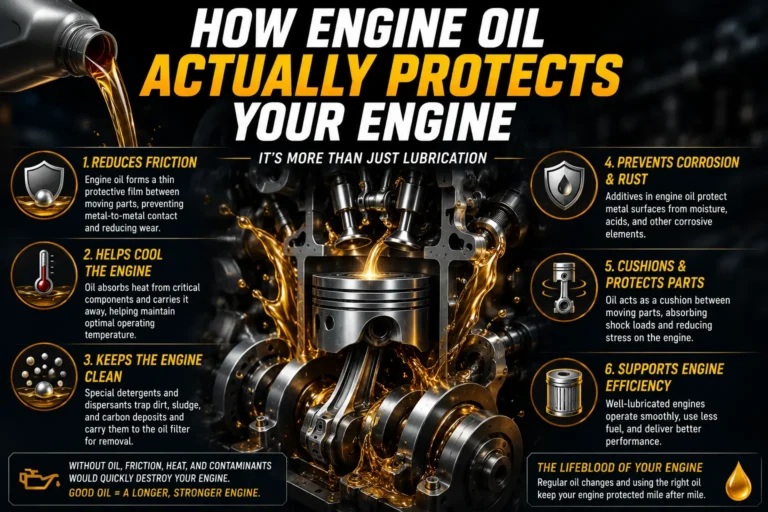
Why Engines Need Oil
Inside an engine:
- metal parts move thousands of times per minute,
- under heat and pressure.
Without lubrication, the engine would destroy itself quickly from friction.
Engine oil forms a microscopic protective layer between moving parts.
This reduces:
- friction,
- wear,
- overheating,
- and damage.
Why Engines Need Cooling
Combustion creates enormous heat.
Only a portion of fuel energy becomes movement.
Most of the energy becomes waste heat.
The cooling system circulates coolant through the engine to absorb heat and prevent overheating.
Without cooling:
- metal components could warp,
- pistons could seize,
- and the engine could fail completely.
Why 4-Stroke Engines Became So Popular
The 4-stroke design became dominant because it offers:
- good fuel efficiency,
- smoother operation,
- cleaner emissions,
- better durability,
- and reliable everyday performance.
Today, nearly every gasoline passenger car uses some variation of the 4-stroke engine cycle.
Engine RPM Explained
RPM means:
Revolutions Per Minute
It measures how fast the crankshaft rotates.
At:
- 1,000 RPM → the crankshaft spins 1,000 times every minute.
- 6,000 RPM → it spins 6,000 times every minute.
As RPM rises:
- pistons move faster,
- combustion happens more frequently,
- and the engine produces more power.
Engine Power and Torque
Two important terms describe engine performance:
Torque
The engine’s twisting force.
Torque helps:
- accelerate the vehicle,
- carry heavy loads,
- and climb hills.
Horsepower
Measures how quickly the engine can continue applying torque.
In simple terms:
- torque is strength,
- horsepower is how fast that strength can work.
The Incredible Precision of Modern Engines
A modern engine may look like a simple machine from outside.
But internally, it is an incredibly synchronized system where:
- valves open within milliseconds,
- sparks fire at exact moments,
- fuel injectors spray microscopic droplets,
- sensors constantly monitor conditions,
- and pistons move hundreds of times every second.
All while surviving:
- heat,
- pressure,
- vibration,
- and friction continuously for years.
Conclusion
A 4-stroke engine is far more than a collection of metal parts under the hood.
It is a highly refined thermodynamic machine engineered to transform controlled combustion into smooth mechanical power through extraordinary precision and synchronization.
Every second the engine runs:
- air enters,
- fuel burns,
- pressure rises,
- pistons move,
- crankshafts rotate,
- and power flows to the wheels.
Understanding the 4-stroke cycle changes the way a car is viewed forever.
The next time you hear an engine rev or feel a car accelerate, remember:
You are witnessing thousands of precisely timed combustion events working together to convert chemistry, heat, pressure, and motion into one of the most important machines ever built.
References & Further Reading
- https://auto.howstuffworks.com/engine.htm
- https://www.explainthatstuff.com/carengines.html
- https://www.britannica.com/technology/internal-combustion-engine
- https://energyeducation.ca/encyclopedia/Four-stroke_engine
- https://www.garrettmotion.com/racing-and-performance/performance-catalog/turbo-tech-101/
- https://web.mit.edu/2.61/www/Lecture%20notes/enginecycles.pdf