Cars don’t just “make power” — they convert air and fuel into controlled explosions. The way air enters the engine is where the biggest difference between turbocharged and naturally aspirated (NA) engines begins.
Think of it like breathing:
- A naturally aspirated engine breathes on its own.
- A turbo engine is like someone pushing extra air into your lungs.
That single difference changes everything: power, efficiency, driving feel, cost, and even reliability.
1. Naturally Aspirated Engine (NA) — The “Pure Breathing” Engine
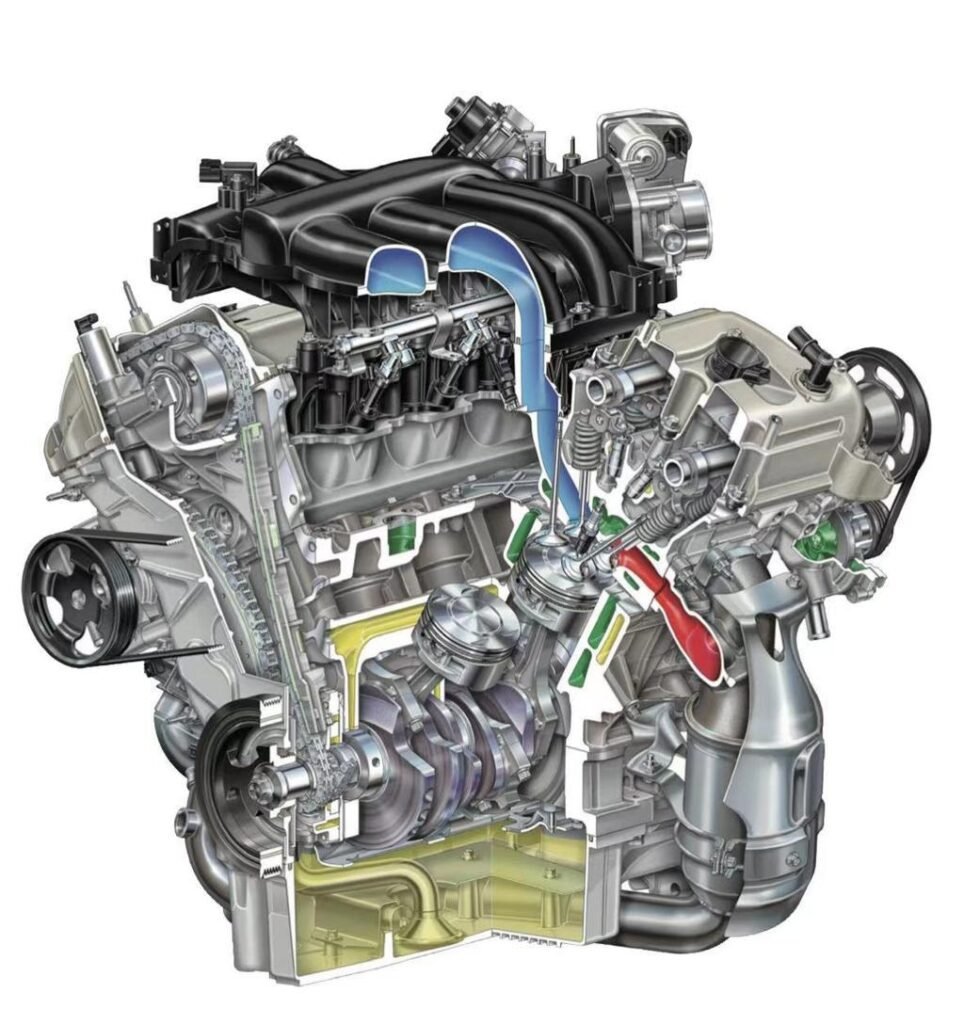
A naturally aspirated engine draws air into the cylinders using only atmospheric pressure. When the piston moves down, it creates a vacuum, and air naturally flows in through the intake.
Key idea:
No external assistance. Just physics.
How it works (simple):
- Air enters through air filter
- Throttle body controls how much air comes in
- Fuel mixes with air
- Spark plug ignites mixture
- Power is produced
What it feels like:
- Smooth and predictable power delivery
- Linear acceleration (press pedal → power increases gradually)
- No sudden “kick”
Advantages:
- Simpler design
- Lower maintenance cost
- More reliable long-term
- Better throttle response (instant feel)
Disadvantages:
- Less power from small engines
- Poor performance at high altitude
- Less fuel efficiency if pushed hard
2. Turbocharged Engine — The “Air Compression Booster”
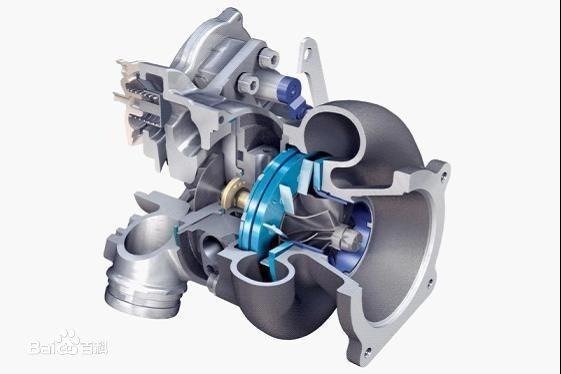
A turbocharger is a device that forces extra air into the engine using exhaust gases.
Instead of wasting exhaust energy, it reuses it.
Key idea:
More air = more fuel burned = more power.
How it works (simple):
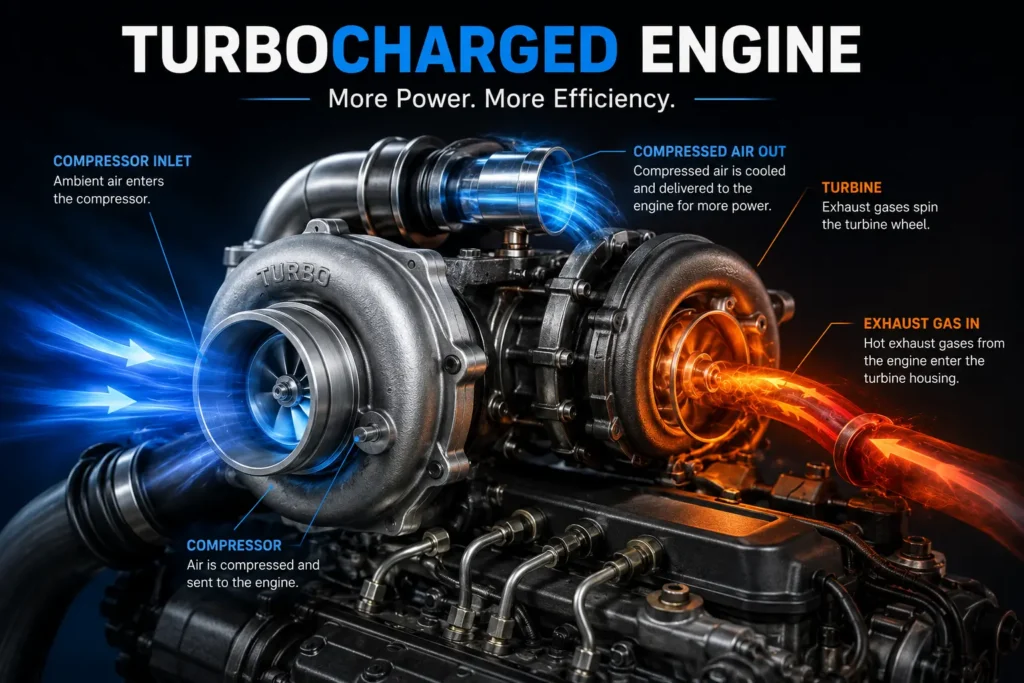
- Exhaust gases spin a turbine
- That turbine drives a compressor
- Compressor forces extra air into engine
- More air allows more fuel
- More explosion → more power
What it feels like:
- Low RPM: slightly calm or laggy
- High RPM: sudden surge of power (“kick” or boost)
This delay is called turbo lag.
Advantages:
- Much higher power from smaller engines
- Better fuel efficiency when driven gently
- Works well at high altitude
- Modern engines can be both powerful and small
Disadvantages:
- More complex system
- Higher maintenance cost
- Heat management issues
- Turbo lag (delay in response)
3. Real Difference in One Line
- Naturally aspirated = breathes freely
- Turbocharged = breathes under pressure
4. Performance Comparison (Real-World Feel)
| Feature | Naturally Aspirated | Turbocharged |
|---|---|---|
| Power delivery | Smooth & linear | Sudden & boosted |
| Engine size needed | Larger for same power | Smaller engine can do more |
| Fuel efficiency | Moderate | Often better (if driven lightly) |
| Maintenance | Easier | More complex |
| Driving feel | Predictable | Exciting but less linear |
5. Why Modern Cars Love Turbo
Car companies are moving toward turbo engines because:
- Emissions rules are stricter
- Smaller engines save fuel
- Turbo gives “big engine power” from small size
A 1.5L turbo engine today can match or beat an old 2.5L NA engine.
6. Simple Analogy (Very Important)
Imagine two ways of filling a balloon:
- NA engine: You blow air into it yourself
- Turbo engine: A machine pumps air into it
Both inflate the balloon — but one is clearly more powerful.
Conclusion :
Naturally aspirated engines are about simplicity and control, while turbo engines are about engineering efficiency and power density.
One is like a classical instrument.
The other is like a modern synthesizer — compact, powerful, and engineered for maximum output.
References :
- Turbocharger concept (technical overview):
Wikipedia – Turbocharger - Internal combustion engine basics:
Wikipedia – Internal combustion engine - Naturally aspirated engine explanation:
Wikipedia – Naturally aspirated engine