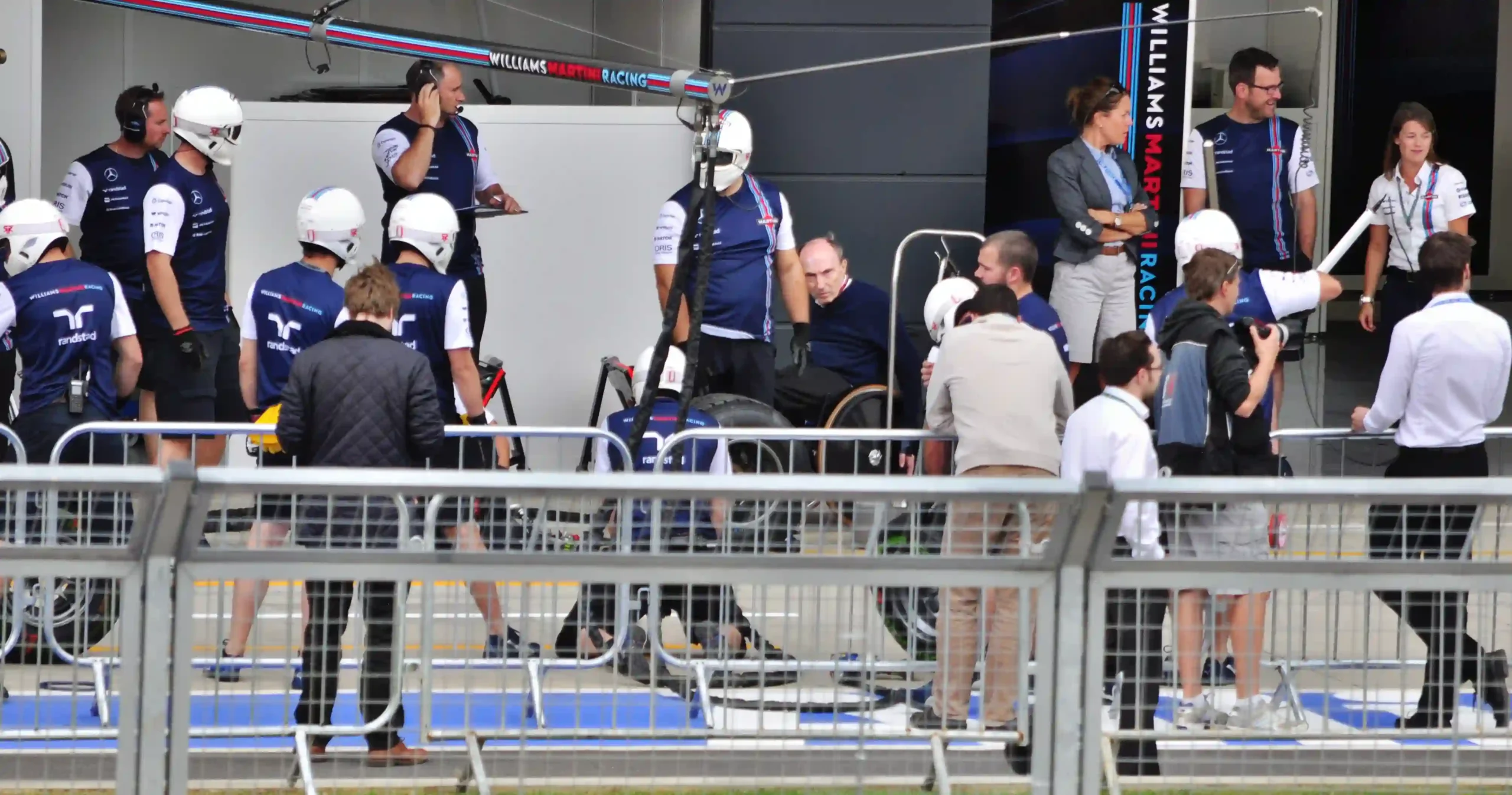
Why Do F1 Teams Practice Pit Stops So Much?
How mechanics turn 22 separate jobs into one two-second movement, why consistency beats a record, and how teams train for every failure before Sunday.
F1 teams practice because more than 20 people must complete precise movements in about two seconds. Repetition builds muscle memory, improves timing, reduces injury risk and prepares the crew for stuck wheel nuts, damaged wings, double stacks, traffic and equipment failures. Reliable execution can decide positions and championship points.
A Formula 1 pit stop looks spontaneous on television. In reality, almost every footstep, hand movement and button press has been rehearsed.
The car may remain stationary for only two seconds. However, up to 22 mechanics and controllers contribute to the stop.
Each person has a narrow task. One delayed wheel can hold the whole car, while one premature signal can create an unsafe release.
Therefore, teams repeat the sequence until movements become automatic. They also practice situations that rarely appear in a clean race.
Those drills include spare wheel guns, failed jacks, front-wing changes, penalty service and back-to-back stops for both drivers.
Practice is not endless. Official Formula 1 reporting says a typical dedicated session may contain eight to 10 repetitions.
Mercedes has described about 60 practice stops across a normal Grand Prix weekend. Meanwhile, McLaren often runs five or six standard stops plus several wildcard scenarios in a short session.
That apparent contradiction explains modern F1 pit stop practice. Teams train frequently across the week, but each burst is controlled to preserve sharpness.
Why Is Pit Stop Practice So Important in Formula 1?
A pit stop compresses dozens of coordinated actions into a few seconds. Practice allows every mechanic to arrive at the correct position, use equipment safely and react without hesitation. It also exposes weak movements before a race, where one mistake can lose positions, cause damage or trigger a penalty.
A racing driver can complete more than 50 laps during a Grand Prix. The pit crew may receive only one meaningful chance.
That imbalance makes preparation essential. Mechanics cannot use the first race stop to find their rhythm.
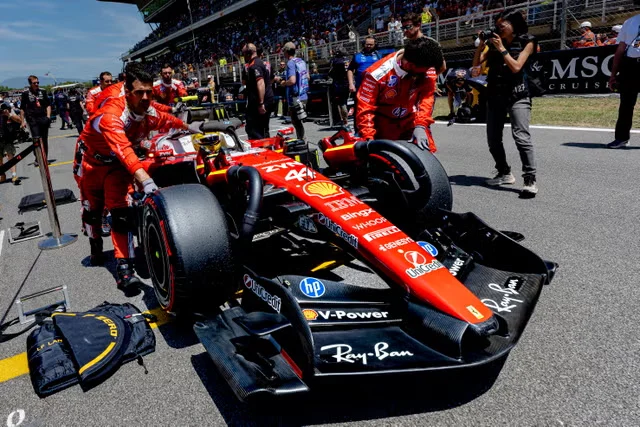
The entire sequence begins before the car arrives. Tire carriers, wheel-gun operators and jack operators move from the garage to fixed positions.
The driver then stops on narrow marks. Four old wheels must leave as four new wheels arrive.
Meanwhile, stabilizers hold the car, front-wing adjusters wait for instructions and release personnel watch traffic.
A delay at any corner delays the release. Consequently, every role must be fast enough and predictable enough for the rest of the crew.
Practice builds that predictability. Mechanics learn the pace of the people around them without needing conversation.
Modern stops are often nearly silent between crew members. Communication happened earlier through planning, role definition and repeated drills.
Our guide to how pit stops work in racing explains the full service sequence.
One Error Can Affect the Whole Race
A wheel nut that takes one extra second can move a driver behind several rivals. The loss becomes larger when the car rejoins in traffic.
A loose wheel is more serious. The driver may need to stop immediately, while the team can face a sporting penalty.
A poor release can create contact in the fast lane. Therefore, pit stop training must balance speed with control.
The crew also supports both cars. One operational weakness can hurt two drivers and the Constructors’ Championship.
Pit practice is not about making 22 people move faster independently. It is about making the slowest action reliable enough that the complete stop can happen at racing speed.
How Often Do F1 Teams Practice Pit Stops?
Teams train at the factory throughout the season and rehearse again at each circuit. A dedicated trackside session may include eight to 10 stops. Mercedes has described about 60 total practice stops across a weekend when Thursday sessions, morning drills and live practice stops are combined.
There is no single FIA-mandated training schedule. Each team designs its own program around travel, staffing and performance needs.
The bulk of selection and technique work happens before the season. Official F1 reporting describes January and February as major rig-training months.
Once racing begins, factory sessions continue between events. Trackside sessions then adapt the crew to the actual pit box.
Formula 1’s 2025 anatomy guide says crews can practice dedicated stops every day after the cars are built. A burst usually contains eight or 10 repetitions.
Mercedes gives a broader weekend total. Its official explainer describes roughly 20 stops on Thursday, about 15 on Friday morning, another 20 on Saturday and several Sunday rehearsals.
Live stops during free practice add more data. Therefore, a weekend total can be high even when each dedicated session remains short.
Why Different Teams Quote Different Numbers
Teams count practice differently. One may count only full-speed rehearsals, while another includes role rotation and live stops.
Weather also changes the plan. High heat and humidity increase physical strain.
McLaren reduced practice at the 2023 Qatar Grand Prix because the apron was extremely hot. The team then produced the 1.80-second world record during the race.
That result does not mean less training is always faster. It means training load must match human condition.
New crew members can increase the planned repetitions. Conversely, a tired crew may complete fewer stops after a late garage shift.
Do F1 Teams Practice Every Day?
Some form of training can occur through most working weeks. However, full pit stops are only one part of the program.
Williams described three weekly days of physical training and two days of pit stop practice in an official F1 feature.
Modern schedules also include mobility, reaction drills, video review and injury prevention. Therefore, “practice” does not always mean running a car into the box.
Rest is part of the plan too. Excessive repetition can dull concentration and raise injury risk.
How Many People Work on an F1 Pit Stop?
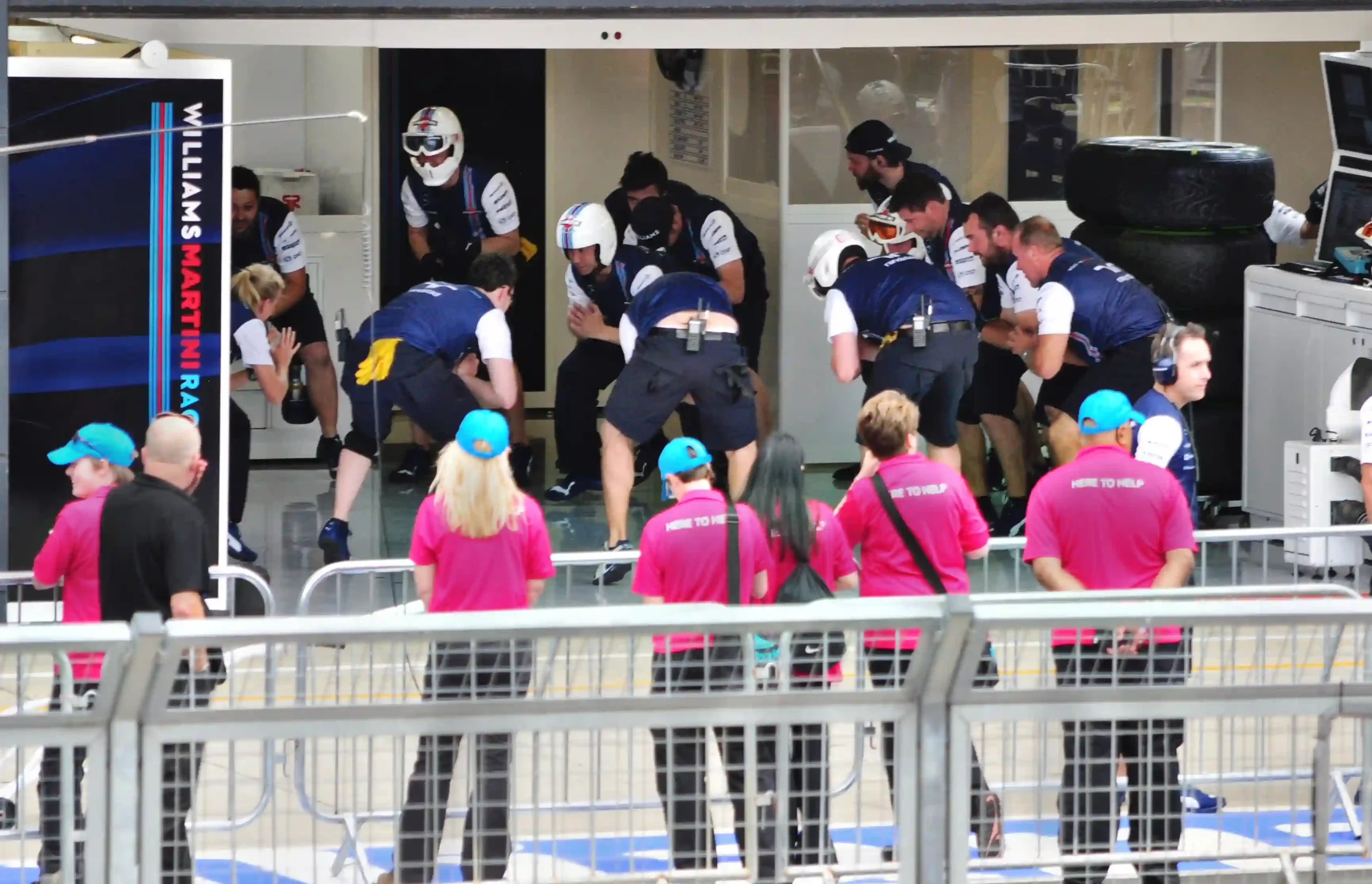
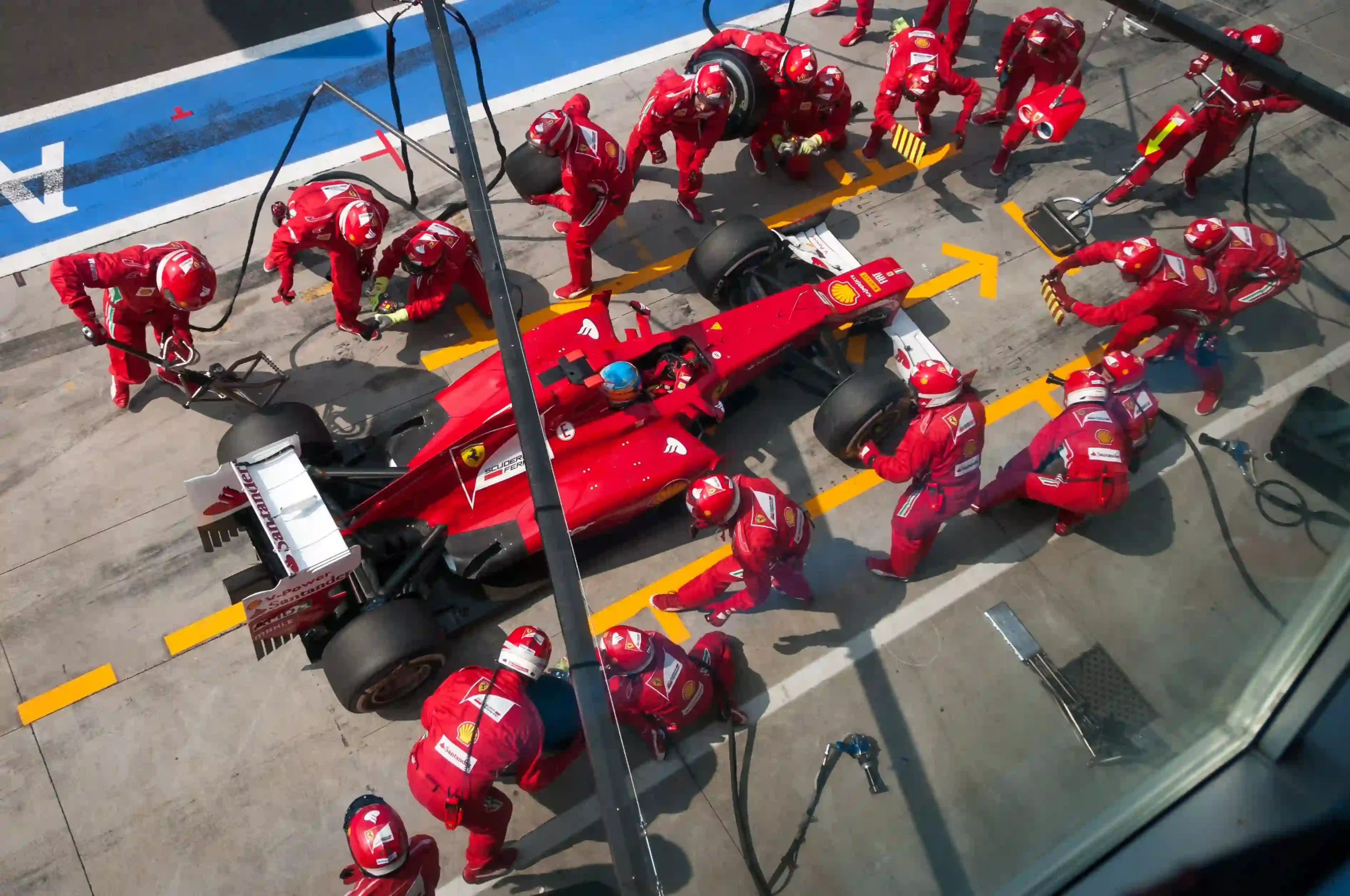
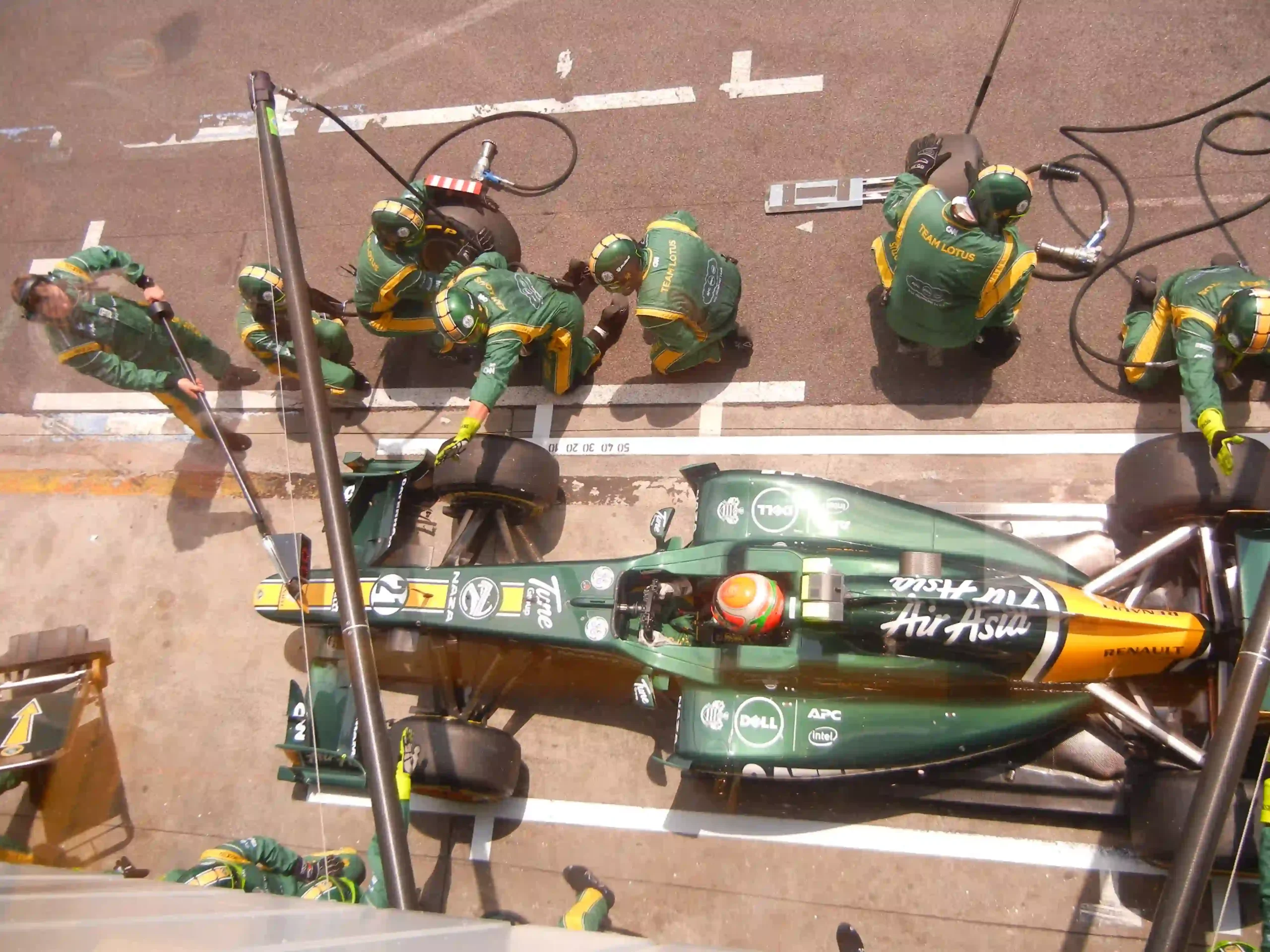
A modern tire stop can involve up to 22 people. Twelve handle the four wheels, two operate the main jacks, two stabilize the car, two adjust the front wing, backup jack operators stand ready, and release personnel monitor wheel security and traffic.
Speed comes from specialization. Each mechanic completes a small job rather than one person changing an entire wheel.
Three crew members work at each corner. One handles the wheel gun, one removes the old tire and one installs the new tire.
That creates 12 tire specialists. Meanwhile, a front jack operator and rear jack operator lift the car.
Two stabilizers control movement at the sides. Two front-wing adjusters wait near the nose.
Backup jack operators can respond to equipment failure or a double stack. Release personnel supervise the system and traffic.
Some teams describe the final count differently because specific support roles vary. However, the principle remains consistent.
| Role | Typical Number | Main Action | Why Practice Matters |
|---|---|---|---|
| Wheel-gun operators | 4 | Remove and tighten each single wheel nut | Timing and gun angle must be repeatable |
| Wheel-off mechanics | 4 | Pull away the used tires | They must clear the incoming tire path |
| Wheel-on mechanics | 4 | Fit the fresh tires | Alignment must be immediate and clean |
| Main jack operators | 2 | Lift and lower the car | The car cannot be serviced until both ends rise |
| Stabilizers | 2 | Control lateral movement | They protect wheel alignment and crew safety |
| Front-wing adjusters | 2 | Change flap settings when instructed | They must avoid delaying a no-adjustment stop |
| Backup jack operators | Up to 2 | Respond to jack failure or special situations | Rare failures require immediate substitution |
| Release oversight | 1–2 | Confirm the car is secure and the lane is safe | A premature release can cause a penalty or collision |
Are Pit Crew Members Full-Time Athletes?
Most are skilled mechanics, technicians or operational staff with other race-team duties. Pit stops are an additional high-performance responsibility.
However, their preparation resembles professional sport. Teams monitor strength, mobility, reaction time and fatigue.
The crew must perform after long working days. They also travel across a 24-race season with several triple-headers.
Consequently, role selection considers technical ability and physical suitability. A mechanic’s normal garage job does not automatically determine the pit position.
Why Crew Members Learn More Than One Role
Modern teams rotate staff to manage travel and fatigue. A fixed group cannot attend every event without performance risk.
McLaren says most of its crew members are trained in multiple positions. They retain a primary role but can switch when required.
Cross-training also improves understanding. A wheel-on mechanic learns what the gun operator needs, while a backup understands the main sequence.
Therefore, the crew behaves like a squad rather than a single permanent lineup.
How Does Muscle Memory Help an F1 Pit Crew?
Repeated drills teach each mechanic to execute the same movement without pausing to consciously plan it. That reduces reaction time and keeps the crew synchronized. Muscle memory also leaves more mental capacity for unexpected problems, such as a misaligned wheel, failed gun or car stopped off its marks.
A two-second stop is too fast for a series of verbal instructions. By the time one mechanic explained a problem, the race opportunity would be gone.
Therefore, most actions follow physical cues. The sound of the car, the jack movement and the wheel gun provide timing information.
A wheel-off mechanic knows when to pull because the nut has released. The wheel-on mechanic reads the space opening beside the hub.
Meanwhile, the gun operator follows the motion of both colleagues. The three-person corner becomes one unit.
Repeated F1 pit stop practice turns those cues into automatic responses. However, automatic does not mean careless.
Mechanics still monitor feel and sound. An unusual resistance can indicate a damaged thread or poorly seated wheel.
Why Pit Stops Can Look Slower to the Crew
Experienced crew members often say the best stops feel calm. Every action occurs in the expected order, so there is no frantic correction.
By contrast, a messy stop feels fast because people make extra movements. Those movements waste time even when they look energetic.
Practice removes unnecessary motion. A mechanic learns the shortest reliable route from waiting position to working position.
The result resembles choreography. Yet the purpose is practical rather than theatrical.
How Do F1 Crews Coordinate Without Talking?
The team agrees on procedures before the car arrives. Equipment placement, hand position and escape routes are standardized.
Lights and electronic acknowledgements handle the final release chain. Gun operators can confirm successful work through the team system.
The release controller then combines those signals with a traffic check. Consequently, the driver receives one clear instruction.
Radio communication remains important before and after the stop. During the active two seconds, movement and system signals carry most of the information.
Why Is Pit Stop Consistency More Important Than One Record?
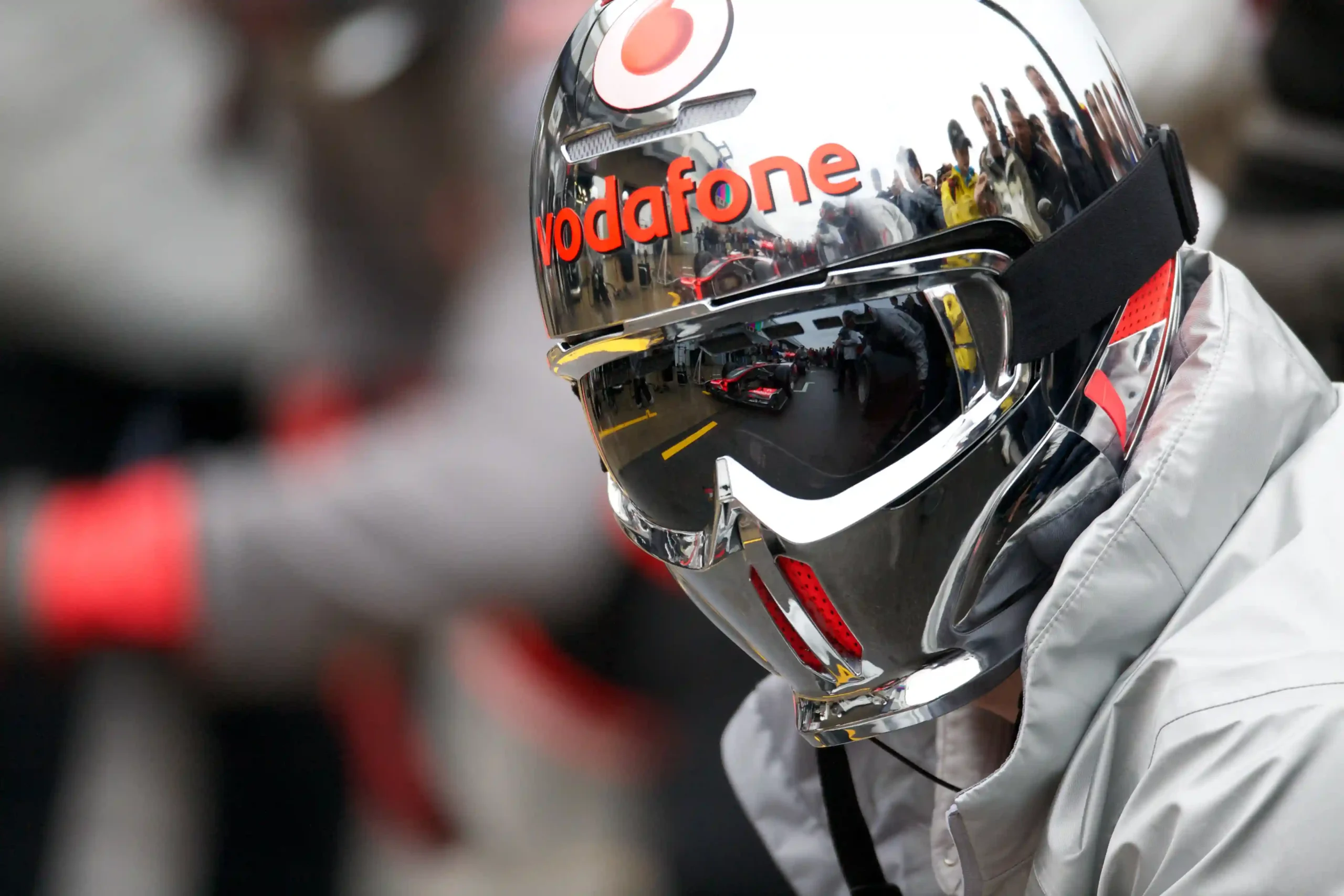
A single record stop offers little value if the next stop loses several seconds. Teams target a narrow, repeatable performance range because every driver needs reliable service. Consistency protects strategy, reduces mistakes and usually creates more championship value than chasing one exceptional time.
The fastest pit stop receives attention. The most valuable pit crew may be the one that avoids bad stops all season.
Mercedes has explained this trade-off clearly. A 1.9-second service followed by a 3.6-second stop gives back the earlier gain.
McLaren makes the same point. Its operations leadership says a world record is useless if the next stop lasts five seconds.
Therefore, practice targets a reliable process. Teams set expected ranges for each corner and for the overall service.
An occasional exceptional time can emerge from that process. However, mechanics are not asked to gamble for a record.
What Makes a Consistent F1 Pit Stop?
- A driver who repeatedly stops on the marks.
- Equipment placed in the same usable position.
- Mechanics following standardized movements.
- Clear wheel-security confirmation.
- A release process that respects pit-lane traffic.
- A crew physically fresh enough to execute under pressure.
- Backup procedures understood before a failure occurs.
Consistency does not mean every stop has the same time. Traffic, front-wing adjustments and tire condition create normal variation.
Instead, it means the team controls avoidable variation. The car should not lose time because someone improvised a basic movement.
How Much Does One Tenth Matter?
One tenth rarely decides a race by itself. Across many stops, however, small gains accumulate.
A tenth can also change the release window. Leaving just before a rival passes may save several seconds.
Conversely, chasing a tenth can create a loose wheel or missed signal. Teams therefore evaluate risk-adjusted performance.
The target is the fastest stop the crew can repeat safely, not the fastest movement physically possible once.
Where Do F1 Teams Practice Pit Stops?
Teams practice at their factories using mock pit gantries, training cars or electric mule vehicles. They also rehearse in the real pit lane during race weekends. Factory work develops technique, while trackside sessions adapt the crew to the circuit’s surface, slope, space and weather.
Factory training provides a controlled environment. Teams can repeat drills without a live session clock or neighboring cars.
Modern facilities may include a full pit gantry, marked stopping area and a representative car. Some teams use an electric mule that can enter under its own power.
Equipment developers can test new jacks, sockets and wheel-gun settings. High-speed cameras capture movement from several angles.
The factory is also where teams select the crew. Mechanics rotate through roles while coaches compare speed, accuracy and physical suitability.
January and February are particularly important. Teams establish the core lineup and integrate new equipment before the opening race.
What Is an F1 Pit Stop Practice Rig?
A practice rig recreates the working geometry of the pit box. It gives mechanics fixed reference points for the car, gantry and equipment.
The most useful rigs allow realistic wheel changes and jack operation. Some use old chassis components, while others use dedicated training vehicles.
The goal is not perfect visual realism. The important dimensions, weight and movement must feel representative.
Teams can then measure each stage without placing a current race car at unnecessary risk.
Do Teams Practice With a Real F1 Car?
Yes, especially at the circuit. Live stops during free practice use the race car and provide the most realistic data.
However, factory repetition often uses a mule or older chassis. Current cars are expensive and may be needed for assembly or development.
A training car can also be designed for repeated use. Components that do not matter to pit practice can be simplified.
Therefore, teams combine simulation with live validation. Each method solves a different training problem.
How Do F1 Teams Practice During a Grand Prix Weekend?
Yes. Teams complete short dedicated sessions before track action and perform live stops during free practice. They use the real pit box to learn surface grip, slope, garage spacing and traffic sightlines. The schedule is adjusted for heat, workload and crew fatigue.
Every circuit creates different conditions. The pit box may slope, drain covers may affect footing and the gantry can sit closer than expected.
Williams previously highlighted Spa as an example. Its box geometry and drainage required crew adjustment.
Trackside drills also test communication with the pit wall. The crew receives realistic notice as a car approaches.
Live practice stops add driver interaction. The driver tests entry speed, stopping accuracy and getaway.
Consequently, race-weekend practice is not simply factory work in another location. It verifies that the process fits the venue.
A Typical Weekend Training Pattern
| Period | Typical Focus | Possible Volume | Why It Matters |
|---|---|---|---|
| Thursday | Role rotation, standard stops and equipment checks | Mercedes has described about 20 stops | The crew learns the actual pit box before sessions begin |
| Friday morning | Short rehearsal before practice | About 15 in Mercedes’ published example | It refreshes technique after overnight work |
| Free practice | Live stops with the race car | Depends on run plan | Driver and crew timing become connected |
| Saturday morning | Race crew rehearsal and wildcard drills | About 20 in Mercedes’ example | Teams test replacements and unusual procedures |
| Sunday | Brief warm-up and final checks | Several stops, sometimes reduced | Sharpness matters, but fatigue must be avoided |
These numbers are not universal. McLaren’s official feature describes shorter sessions with five or six standard stops and several wildcard exercises.
Both approaches can be true. One source may describe a single session, while another counts the full weekend.
Why Teams Reduce Practice in Extreme Heat
Pit-stop drills are intense physical work. Mechanics wear protective clothing and move around hot tires, brakes and asphalt.
At Qatar in 2023, McLaren reduced practice because of heat on the apron. The crew remained fresh enough to set the world record during the race.
Singapore also demands caution because humidity limits cooling. A tired crew can lose coordination before a critical stop.
Therefore, coaches adjust volume just as athletic teams manage training load before competition.
How Fit Are Formula 1 Pit Crew Members?
Pit crews train core strength, upper-body power, mobility, reaction speed and movement quality. Different roles need different qualities. Teams also use physiotherapists to reduce injury risk, monitor technique and decide whether a mechanic’s body type suits another position better.
Pit crew members are not selected only by gym numbers. They need useful strength in exact positions.
A wheel-gun operator controls a powerful tool while kneeling beside a moving tire. The front jack operator must sprint, catch the nose and lift the car accurately.
Wheel carriers move heavy assemblies through a crowded space. Stabilizers work in awkward positions beside hot bodywork.
Core strength supports each task. Mobility allows mechanics to reach the hub without losing balance.
Reaction speed matters too. A mechanic may need to recognize a failed nut and switch procedure immediately.
How Does Fatigue Affect a Pit Crew?
Fatigue slows decision-making and changes movement quality. A mechanic may place a foot differently or approach the hub at a poor angle.
Those small changes create timing variation. They also increase injury risk.
Travel fatigue compounds the problem. F1 crews work long hours across several time zones.
Modern rotation programs protect performance. Fresh substitutes can be an advantage rather than a compromise.
Why Teams Use Physiotherapists During Practice
A physiotherapist can identify movements that overload wrists, knees or backs. The goal is to correct technique before pain appears.
Mercedes has described physios watching pit practice and suggesting role changes when another position better suits a person’s physique.
Injury prevention matters because replacements need training. Losing a specialist during a triple-header can weaken several events.
Therefore, fitness programs support both speed and season-long availability.
How Do F1 Teams Measure Pit Stop Performance?
Teams combine timing channels, wheel-gun sensors, suspension data, gantry signals and high-speed video. Engineers compare each corner and identify the slowest action. Video explains body movement and positioning, while sensor data shows exactly when the mechanical events occurred.
A single total time does not tell engineers what to improve. A 2.6-second stop could contain four equally average corners or one major delay.
Teams therefore divide the stop into events. They measure car arrival, jack lift, nut removal, old-wheel clearance, new-wheel fit, tightening and release.
Wheel guns provide detailed timing. Sensors in the suspension and hubs can show when the wheel becomes secure.
The gantry records acknowledgement signals. Multiple cameras show the physical reason behind each number.
McLaren’s 2025 data-science feature described every weekend stop being recorded by an array of cameras. The team combines those pictures with sensor channels.
That process lets coaches identify a front-right wheel that removed slightly later than the others. The crew can then change technique rather than simply being told to move faster.
Why Video Matters More Than a Stopwatch Alone
Telemetry shows when a delay occurred. Video can show why.
A tire carrier may have taken a longer path. A gun operator may have approached at a poor angle.
Another mechanic may have blocked the escape route by a few inches. Those details are difficult to infer from one sensor trace.
Slow-motion review makes them visible. Teams then create one or two coaching points instead of overwhelming the crew.
Do Teams Use Automated Analysis?
Yes. The data volume is too large for manual review alone. Modern systems can synchronize video and telemetry across many stops.
Engineers still provide context. A model may flag a delay, but a person decides whether it reflects technique, traffic or a planned adjustment.
Automated tools make comparison faster. They also help identify patterns that appear only after several weekends.
However, the final performance remains human. Software cannot fit the wheel during the race.
The best teams do not review only failed stops. They study clean stops for hidden variation, because a small inconsistency in practice can become a large failure under race pressure.
How Do F1 Teams Practice Pit Stop Failures?
Teams add controlled faults to practice sessions. They may use a spare wheel gun, simulate a stuck nut, fail a jack, change the nose or interrupt the release sequence. These drills teach the crew to recognize the problem and switch procedures without panic.
A standard stop is only the starting point. Races produce damaged components, poor car positioning and equipment failures.
The crew cannot predict which corner will suffer a problem. Therefore, every position needs a recovery plan.
A backup gun sits ready near each working area. Spare jack operators can replace the main equipment.
Mechanics also practice aborting the release. The car must remain stationary when any wheel is uncertain.
Wildcard drills keep sessions mentally active. McLaren has described adding nosebox changes and steering-wheel swaps after a small group of standard stops.
Mercedes also practices unusual situations such as nose changes and spare wheel-gun use. These scenarios are rare, but their cost is severe without rehearsal.
How Do Teams Practice a Stuck Wheel Nut?
The trainer can create a delayed gun signal or instruct one corner to pause. The crew must recognize that the stop has not cleared.
The main operator may retry before reaching for the spare gun. Nearby mechanics must avoid moving into the recovery path.
Release personnel hold the driver until the corner confirms security. The rest of the crew stays controlled rather than crowding the problem.
That discipline matters. Too many helpers can block the specialist and turn a small delay into a major one.
What Happens When a Jack Fails?
The car cannot receive a normal tire change while one end remains on the ground. The backup jack must enter immediately.
Front-jack failure is especially visible because the operator stands directly in the car’s path. The backup needs a clear route.
Rear-jack replacement requires access behind the diffuser and rear wing. Space is limited, especially with neighboring crews working.
Practice establishes who moves and who stays still. A recovery succeeds when only the required people react.
Why Teams Practice Front-Wing Changes
A complete nose change takes much longer than a flap adjustment. The crew must remove the damaged assembly and align the replacement.
Damage can distort mounting points or leave debris. Therefore, the ideal factory drill may still be easier than the race repair.
Practice gives mechanics a clean sequence to begin from. It also teaches tire changers how to avoid blocking the nose crew.
A team may reverse the order during a double stack if one driver needs a new wing. That decision also requires rehearsal.
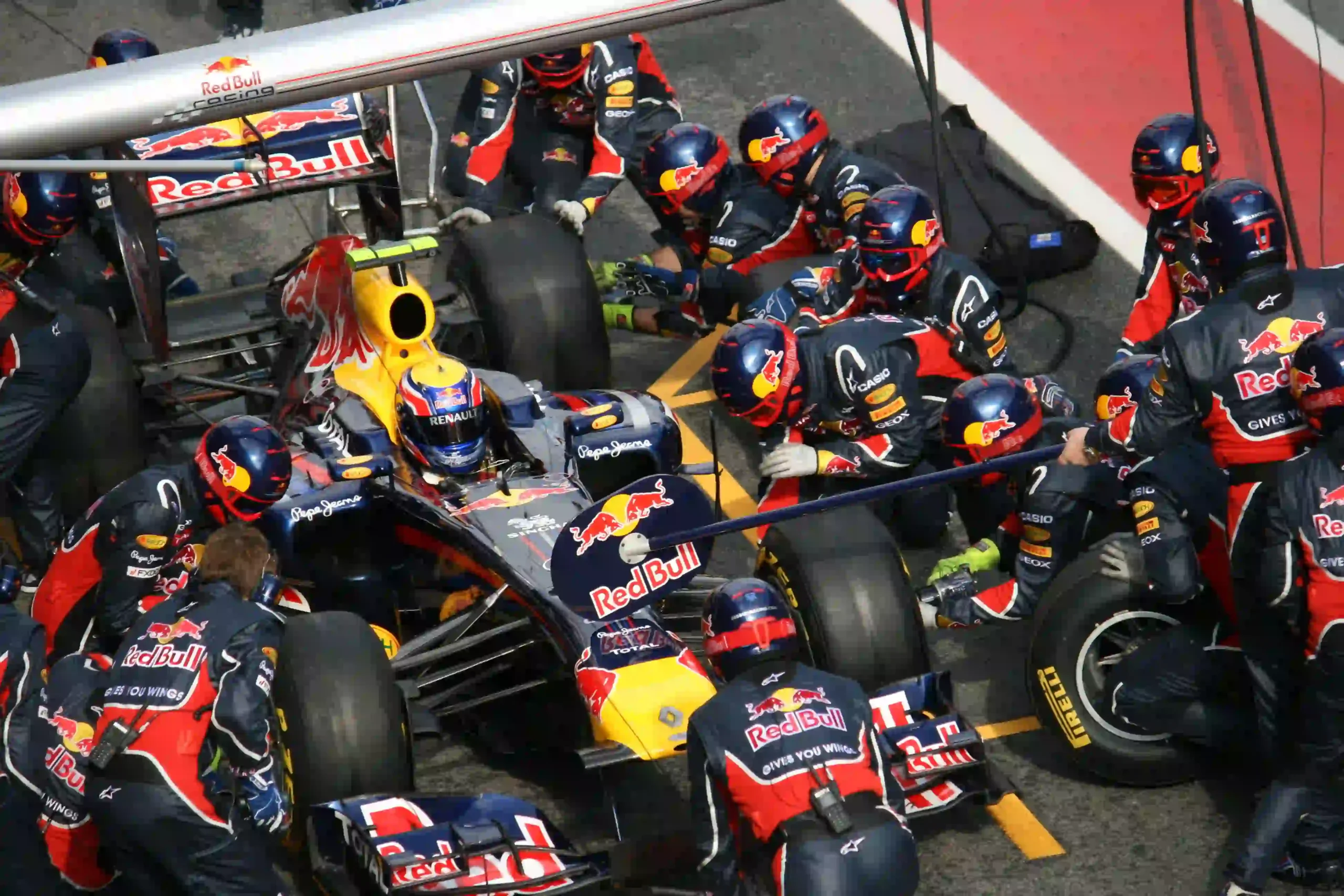
How Do F1 Teams Practice Double Stack Pit Stops?
The crew completes one stop, clears the used tires and immediately resets for the teammate. Supporting mechanics stage a second tire set while the active crew preserves the first car’s escape route. Drills focus on spacing, equipment reset and avoiding confusion between the drivers’ tire allocations.
Both team cars use the same designated stopping position. Therefore, the crew must service them one after another.
The first stop follows the normal sequence. The difficult part begins as that car drops from the jacks.
Used tires move out while the second set moves into position. Gun operators reset, and jack operators prepare for another arrival.
The first car must leave safely. Meanwhile, the second driver may already be approaching at pit-lane speed.
Practice teaches the crew to work without blocking either car. It also confirms where the second tire set can wait.
Each tire belongs to a specific driver allocation. Clear labeling prevents the wrong set from reaching the second car.
Why the Crew Must Practice the Reset
A normal stop allows time to carry used tires back into the garage. A double stack compresses that housekeeping into seconds.
Mechanics cannot throw equipment aside. Loose wheels and guns would create a hazard for both cars.
The reset must also preserve sightlines for release personnel. Traffic can pass while the crew changes configuration.
Consequently, teams practice the transition as carefully as the tire changes themselves.
Can Both Cars Be Serviced at Once?
No. The racing stop happens at one designated position. The second driver waits if the first car remains in the box.
Good spacing can remove most of that wait. A slow first stop can trap the teammate for several seconds.
Our detailed guide to F1 pit stop procedure explains why both cars share the same operational space.
Why Is Driver Stopping Accuracy Important?
The crew and equipment are positioned around fixed marks. If the driver stops too far forward, backward or sideways, every mechanic must adjust. Even a small error can add tenths, while a large miss can prevent the jacks and wheel guns from reaching cleanly.
The pit stop is a crew performance, but the driver starts it. A perfect approach places all four hubs exactly where mechanics expect.
Drivers use painted marks, garage references and the front jack operator as guides. Cockpit visibility is limited, so repetition matters.
The driver also controls the final braking phase. Locking a tire can carry the car beyond the box.
Stopping short is not safer. Mechanics must move toward the car, and the driver may need to creep forward.
Therefore, teams include the driver in live practice stops. Factory rigs cannot fully reproduce the arrival speed and braking feel.
How Much Time Is Lost if the Driver Misses the Box?
There is no fixed penalty. A small miss may add a few tenths as mechanics stretch or reposition.
A larger miss can cost several seconds. The front jack may need to move, while all four tire groups change their working angles.
The mistake can also increase injury risk. Mechanics have planned escape paths based on the correct stopping point.
Consequently, driver accuracy is included in pit-stop analysis rather than treated as a separate issue.
Why Drivers Practice Pit Entry Too
A fast stop begins before the box. The driver must brake to the pit speed limit without crossing the official line too quickly.
Braking early wastes time. Braking late can cause a speeding penalty.
The approach may also be wet, downhill or covered in rubber debris. Drivers test those conditions during practice sessions.
Our guide to F1 delta time explains how teams compare pit entry against rivals.
How Does Pit Stop Practice Improve Safety?
Teams standardize movement, maintain clear escape routes, use helmets and protective clothing, inspect equipment and practice stopping the release. Repetition helps mechanics remain predictable around a moving car. Safety personnel and physiotherapists also review technique to reduce collision and injury risk.
The pit lane combines moving cars, exposed people, heavy wheels and powerful tools. Speed must never remove control.
Mechanics wear helmets and protective clothing during live work. However, clothing cannot prevent every injury.
The first defense is predictable movement. Each person knows where colleagues will enter and leave.
The crew also practices stepping back immediately after work. Remaining beside the car increases risk as the driver accelerates.
Release procedures protect neighboring teams and drivers. The car stays in the box until wheel security and traffic clearance are confirmed.
Our unsafe release in F1 guide explains how the sporting rules protect pit-lane traffic.
Why Pit Crew Members Wear Helmets
A helmet protects against wheels, equipment and contact with bodywork. It also provides eye protection from debris.
Some mechanics work close to hot brakes and sharp aerodynamic surfaces. The car can move unexpectedly after a stall or release problem.
However, the helmet does not make poor positioning acceptable. Training remains the main safety system.
How Practice Prevents Loose Wheels
The gun operator must confirm that the nut has tightened correctly. The release system collects acknowledgements from each corner.
Practice teaches operators to distinguish a normal torque event from an abnormal one. If uncertain, they do not approve release.
The team also inspects guns, sockets, hubs and nuts. Equipment reliability is part of pit-stop performance.
A delayed safe release costs seconds. A loose wheel can end the race and endanger people.
How Do Teams Practice Serving Time Penalties?
The driver stops in the pit box, but mechanics must not touch the car during the penalty period. The team times the wait and begins service only after it expires. Practice prevents an early touch, which can mean the penalty was served incorrectly and trigger a stronger sanction.
Penalty service looks simple because the crew must initially do nothing. That restraint can be difficult when every normal instinct says to begin work.
Mechanics take their positions but keep clear of the car. A designated timer controls the start of service.
The team must know whether a front jack touching the car counts as work under the applicable procedure. Therefore, positioning is rehearsed precisely.
Once the required time expires, the normal stop begins. The driver may then lose the penalty time plus the tire-change time.
Incorrect service can create a larger penalty. Practice prevents a procedural error from multiplying the original offence.
Our guide to drive-through and stop-go penalties covers the main race sanctions.
What Is the Fastest F1 Pit Stop Record?
McLaren holds the official world record with a 1.80-second tire change for Lando Norris at the 2023 Qatar Grand Prix. The result came from a mature, consistent process rather than a reckless record attempt. Teams still value season-long reliability more than one headline time.
McLaren changed all four tires on Norris’s car in 1.80 seconds during the 2023 Qatar Grand Prix.
The time broke the previous benchmark and remains the official world record cited by Formula 1 and McLaren.
Remarkably, the crew had reduced Sunday practice because of the extreme heat. That choice protected physical freshness.
The record therefore illustrates training management. Years of repetition created the skill, while restraint preserved it for the race.
Current 2026 Fastest Pit Stop Benchmarks
Official Formula 1 results through the 2026 British Grand Prix show several teams operating close to two seconds.
| 2026 Grand Prix | Fastest Team | Official Time | What It Shows |
|---|---|---|---|
| Australia | Mercedes | 2.17 seconds | Fast execution during an early-season double-stack sequence |
| China | Ferrari | 2.29 seconds | Reliable performance remained competitive without a record time |
| Japan | Ferrari | 2.00 seconds | A clean two-second stop set the early benchmark |
| Miami | Racing Bulls | 2.08 seconds | Midfield teams can match front-running pit execution |
| Canada | Racing Bulls | 2.20 seconds | Another award showed repeatable team performance |
| Monaco | Mercedes | 2.17 seconds | Tight pit-lane conditions still allowed a sharp service |
| Barcelona-Catalunya | McLaren | 2.13 seconds | The record holder remained near the front of the field |
| Austria | Racing Bulls | 2.03 seconds | The quickest published 2026 time through Austria |
| Great Britain | Mercedes | 2.18 seconds | Different teams continued sharing weekend honors |
The table does not identify one unbeatable crew. Mercedes, Ferrari, Racing Bulls and McLaren all earned awards.
That competition reflects the value of training across the grid. Pit performance is no longer reserved for one championship team.
The Formula 1 standings show why even a small position gain matters over a full season.
What Is the DHL Fastest Pit Stop Award?
The award was established in 2015 to recognize the mechanics and operational staff behind driver performance.
Formula 1 records the fastest qualifying tire-change time at each Grand Prix. Teams collect recognition for repeated top performances.
However, the award does not replace race strategy. The fastest stop can occur for a car outside the points.
Teams still pursue it because the same skills support competitive race stops.
Why Teams Do Not Practice Until They Are Exhausted
Yes. Excess repetition can cause physical fatigue, reduced concentration and careless movement. Teams use short, focused sessions and stop when quality drops. The aim is to reinforce correct technique, not repeat a poor movement hundreds of times.
Practice creates improvement only when the movement remains accurate. A tired mechanic can begin rehearsing errors.
That is why official F1 reporting describes eight to 10 repetitions as a typical dedicated burst. The crew then reviews the session.
McLaren follows a similar principle. Five or six standard stops plus a few wildcard drills can provide enough useful work.
Heat, humidity and late garage hours can shorten the plan. The crew’s condition is treated as performance data.
Coaches also vary the work. Physical training, video analysis and mobility can improve stops without another full repetition.
Why Quality Beats Volume
One focused stop can reveal a technical issue. Ten tired stops may hide it behind inconsistent movement.
Teams therefore define a purpose before each drill. The session might test one gun setting, one substitute or one front-jack technique.
After the target is measured, the crew can stop. More repetitions are not automatically more valuable.
How Pit Stop Practice Affects the Constructors’ Championship
Both drivers score for the Constructors’ Championship. Therefore, the crew’s reliability influences the team’s combined result.
A slow stop can drop one car from sixth to ninth. That single mistake may cost several points.
A second error for the teammate compounds the damage. Across 24 races, operational consistency becomes a championship factor.
Front-running teams often invest heavily in pit equipment, training rigs, physiotherapy and analysis. At their level, a few tenths can decide podium order.
Smaller teams must balance that investment against aerodynamic development. Formula 1’s anatomy guide notes that a team may gain more lap time by improving the car.
However, current results show that midfield crews can still lead individual weekends. Racing Bulls earned several fastest-stop awards in early 2026.
Our guide to how racing championships are scored explains why both cars matter.
Common F1 Pit Stop Practice Misunderstandings
“Pit Crews Only Practice at the Track”
No. Much of the technical development and role selection happens at the factory.
“More Repetitions Always Make the Crew Faster”
No. Fatigue and poor concentration can make excessive practice harmful.
“Every Pit Crew Member Only Knows One Job”
No. Modern teams cross-train many mechanics so staff can rotate across a long season.
“The Goal Is Always a World Record”
No. Teams prioritize consistent, safe service. Records emerge when the normal process works exceptionally well.
“Only the Mechanics Determine Pit Stop Time”
No. The driver’s entry and stopping accuracy strongly affect the stationary service.
“A Fast Stop Is Automatically a Good Stop”
No. A premature release or unsecured wheel can turn a quick service into a retirement and penalty.
F1 Pit Stop Practice FAQs
Why do F1 teams practice pit stops so much?
More than 20 people must complete precise actions in about two seconds. Practice builds muscle memory, improves consistency and prepares the crew for equipment failures, damage, traffic and double stacks.
How often do F1 teams practice pit stops?
The schedule varies. A dedicated session may contain eight to 10 repetitions, while Mercedes has described roughly 60 practice stops across a complete Grand Prix weekend.
How many people work on an F1 pit stop?
Up to 22 people can contribute. Twelve handle the tires, while others operate jacks, stabilize the car, adjust the front wing and control the release.
What is the fastest F1 pit stop?
McLaren holds the official record with a 1.80-second tire change for Lando Norris at the 2023 Qatar Grand Prix.
Conclusion: Why F1 Pit Stop Practice Never Stops
F1 pit stop practice converts individual mechanics into one coordinated race unit.
The crew must complete up to 22 connected jobs in roughly two seconds. No person can pause to work out the next movement.
Repetition builds muscle memory and predictable timing. However, teams also avoid excessive practice that causes fatigue.
Factory rigs develop technique, equipment and crew selection. Trackside drills adapt the process to the real pit box.
Physical training keeps mechanics strong and mobile. Physiotherapists help protect wrists, backs, knees and shoulders through a long season.
Video and sensor data expose delays that a stopwatch cannot explain. Engineers then turn those details into focused coaching.
Failure drills are equally important. A stuck nut, failed jack or damaged nose demands a calm response.
Double stacks, penalty stops and unsafe-release risks also require rehearsal. Rare situations cannot be left to improvisation.
McLaren’s 1.80-second world record shows the upper limit of modern execution. Yet teams still value consistency over one spectacular number.
The best pit crew is not simply the crew that moves fastest once. It is the crew that delivers a safe, clean stop whenever the race demands it.
Sources
The training methods and performance data in this article were checked against official Formula 1 and team material available on July 20, 2026.