F1 Flags Explained: Yellow, Red, Blue, Green and Black Flags
Every major FIA flag, what drivers must do, how Race Control monitors compliance, and why one color can change a qualifying session or Grand Prix.
Formula 1 flags communicate track conditions and direct instructions. Yellow warns of danger, red suspends the session, blue warns of faster traffic, green means the track is clear, and black orders a driver to stop. Other flags cover mechanical danger, poor grip, slow vehicles and the end of a session.
A Formula 1 driver can travel more than 200 mph. A marshal may have only a second to deliver a warning.
That is why racing flags remain essential. Each color carries a precise instruction that drivers must recognize immediately.
Modern F1 also uses electronic light panels and cockpit lights. However, the physical flag remains part of the official signaling system.
Yellow is the most common warning. A single yellow means danger, while double yellows demand a much larger response.
Red stops the session. Blue manages faster traffic, and green marks the return to clear-track conditions.
Meanwhile, a black flag addresses one specific driver. It is among the strongest instructions Race Control can issue.
The current 2026 rules also make the driver’s duty measurable. Under double yellows in qualifying, the lap time is deleted.
Recent events show how seriously the FIA treats these signals. George Russell retained 2026 Austrian pole after a clear lift under a single yellow.
Lewis Hamilton received a reprimand for a yellow-flag infringement at the 2026 British Grand Prix. Therefore, context and telemetry both matter.
This F1 Flags Explained guide covers every major color, current rules, penalties, strategy effects and real examples.
F1 Flags Explained: Complete Formula 1 Flag Meaning Chart
Formula 1 uses several core FIA signals rather than only five colors. The main set includes yellow, red, blue, green, black, chequered, white, black-and-white, black with an orange disc, and yellow with red stripes. Safety Car and VSC boards supplement the flags.
| Flag | Meaning | What the Driver Must Do | Typical Use |
|---|---|---|---|
| Single yellow | Danger beside or partly on the track | Slow, do not overtake, prepare to change direction | Stopped car, debris or local incident |
| Double yellow | Serious danger or marshals working nearby | Slow significantly, do not overtake, prepare to change direction or stop | Blocked track or active recovery |
| Red | Session or race suspended | Slow immediately, do not overtake, return as directed | Major crash, barrier damage or severe weather |
| Blue | Faster traffic approaching | Allow the faster car to pass when required | Lapping, qualifying traffic or pit exit warning |
| Green | Track clear | Resume normal racing after the applicable line or sector | End of a yellow zone or start of track activity |
| Black | Individual stopping instruction | Stop at the pits or designated place on the next approach | Exclusion or serious breach |
| Black-and-white | Driving-conduct warning | Stop the behavior or risk a penalty | Unsportsmanlike or dangerous conduct |
| Black with orange disc | Dangerous mechanical problem | Pit on the next lap and repair the car | Loose bodywork or visible failure |
| White | Much slower vehicle ahead | Approach with caution | Damaged car, medical car or service vehicle |
| Yellow with red stripes | Grip has deteriorated | Expect oil, water or another slippery surface | Rain, fluid or surface change |
| Chequered | Session has ended | Complete the lap safely and proceed to parc fermé or pits | Race, qualifying or practice finish |
These meanings come from FIA Appendix H. Formula 1 adds championship-specific details through its sporting regulations.
For example, the FIA Appendix describes double yellows broadly. The 2026 F1 rules add automatic qualifying lap deletion.
Likewise, light panels carry the same meaning as physical flags. The driver cannot claim that one format mattered less.
Who Controls the Flags During an F1 Race?
Trackside marshals handle local signaling. Race Control coordinates major instructions such as red flags and neutralizations.
The Race Director has ultimate authority during the Formula 1 sessions. Marshals report incidents through radio and electronic systems.
However, a nearby marshal can react immediately to danger. That local speed is one reason physical flags remain important.
Our guide to Formula 1 marshals explains their wider safety role.
How Do F1 Drivers Receive Flag Warnings?
Drivers see physical flags, electronic trackside panels and cockpit lights. Their engineers also repeat critical messages over team radio.
The FIA system links marshal inputs to Race Control and the light network. Therefore, a yellow warning can appear across several channels.
Even so, the driver remains responsible. A missed radio message does not remove the duty to observe the signal.
What Is a Marshalling Sector?
A marshalling sector is the section between two FIA light panels. It is much smaller than one of the three broadcast timing sectors.
Yellow-flag duties apply within that local area. The following green flag normally marks the end of the restriction.
Modern timing lets the FIA examine speed, throttle and braking through the precise sector. As a result, enforcement is more detailed than visual judgment alone.
What Does a Yellow Flag Mean in Formula 1?
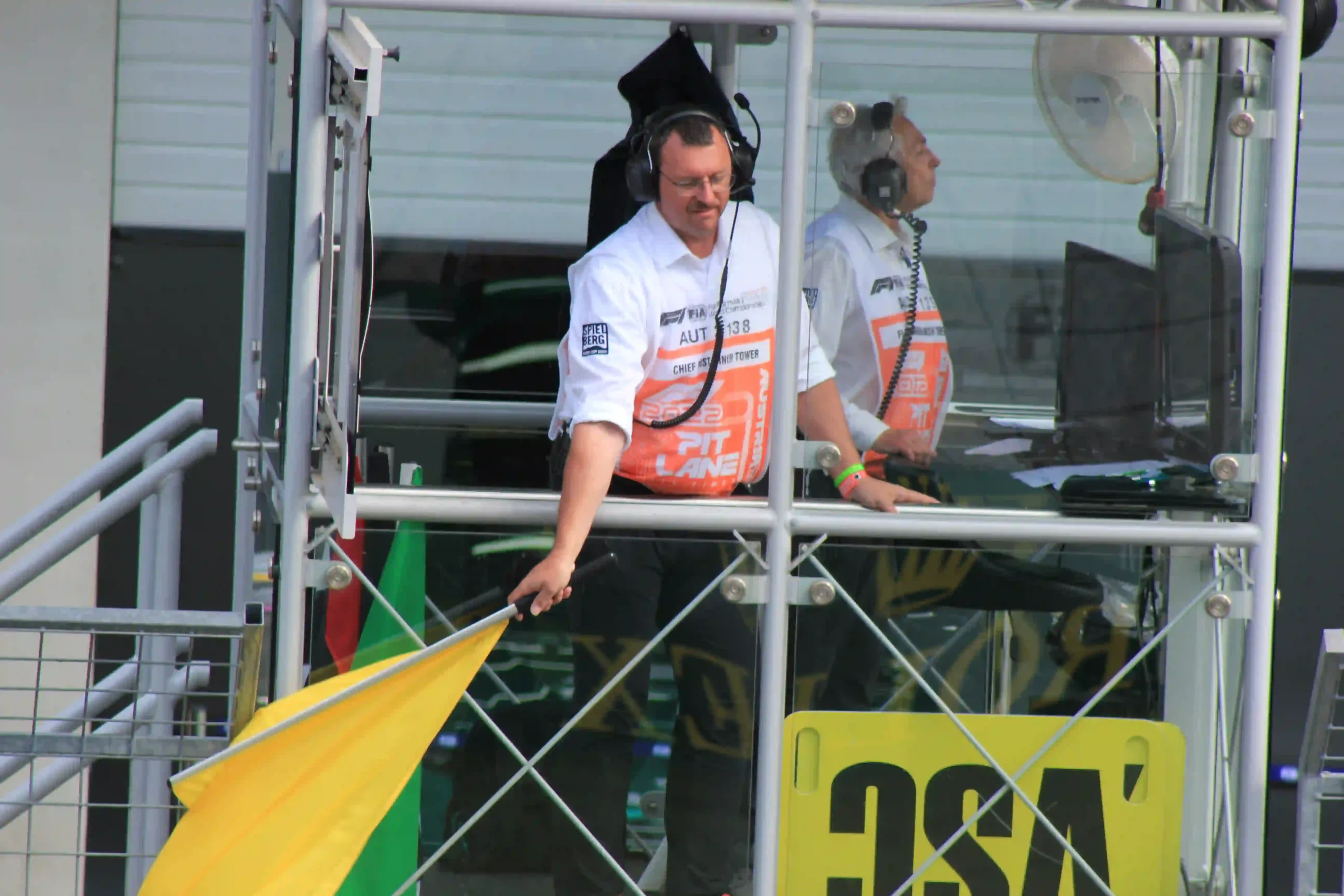
A yellow flag warns of danger. Under a single waved yellow, drivers must reduce speed, avoid overtaking and prepare to change direction. Double waved yellows require a significant reduction and readiness to change direction or stop because the track may be blocked or marshals may be working nearby.
The yellow flag appears more often than any other major F1 signal. It protects an incident without automatically stopping the session.
A marshal post before the hazard displays the warning. The restriction normally lasts until the green flag after the incident.
Overtaking is prohibited through that zone. Drivers must also show a visible response to the danger.
The FIA expects earlier braking or a noticeable speed reduction under a single yellow. Simply lifting for a moment may not be enough.
What Is the Difference Between Single and Double Yellow Flags?
A single yellow means the hazard sits beside or partly on the track. The driver should prepare to alter the racing line.
Double yellows mean the danger is more severe. The circuit may be blocked, or marshals may be beside the racing surface.
Therefore, the driver must slow significantly and be ready to stop. In qualifying, the lap should no longer be treated as competitive.
The 2026 F1 regulations make that outcome automatic. A lap through a double-yellow marshalling sector is deleted in Sprint Qualifying or Qualifying.
Can F1 Drivers Overtake Under Yellow Flags?
No. Overtaking is forbidden from the first yellow signal until the green after the incident.
However, a car with an obvious problem may create unusual circumstances. Stewards judge whether the position change was unavoidable or competitive.
The safest response is to hold position and reduce speed. A gain in the danger zone can trigger a penalty.
How Much Must a Driver Slow Under a Yellow Flag?
The regulations do not set one universal speed reduction for every single yellow. Instead, stewards examine the driver’s response.
They expect earlier braking and a discernible loss of speed. Track position, visibility and the hazard all affect the required reaction.
Double yellows have a higher standard. The driver must abandon any attempt at a meaningful lap in practice or qualifying.
What Does “Prepared to Stop” Mean?
The driver must approach at a speed that allows a complete stop if the track is blocked. That is stronger than merely being ready to steer around debris.
Marshals or recovery vehicles may be in the lane ahead. Therefore, the driver cannot rely on the normal racing line remaining open.
2026 Austrian Grand Prix: Russell’s Yellow-Flag Pole
George Russell passed a single waved yellow during Austrian Grand Prix qualifying. He lifted clearly and reported the response by radio.
Because it was a single yellow, his lap could remain valid if he slowed sufficiently. Race Control did not refer him for an investigation.
Russell kept pole position. The case showed that a single yellow does not automatically delete a lap.
2026 British Grand Prix: Hamilton’s Reprimand
Lewis Hamilton faced a post-race yellow-flag investigation at Silverstone. The stewards later issued a reprimand.
The decision did not remove his podium. However, it confirmed that yellow compliance can be reviewed after the checkered flag.
This is why F1 Flags Explained must cover telemetry as well as color. The flag starts the duty, while data proves the response.
A single yellow asks whether the driver reacted enough. Double yellows answer that question more firmly: the lap is over, and safety takes priority.
F1 Flags Explained: What Does a Red Flag Mean in Formula 1?
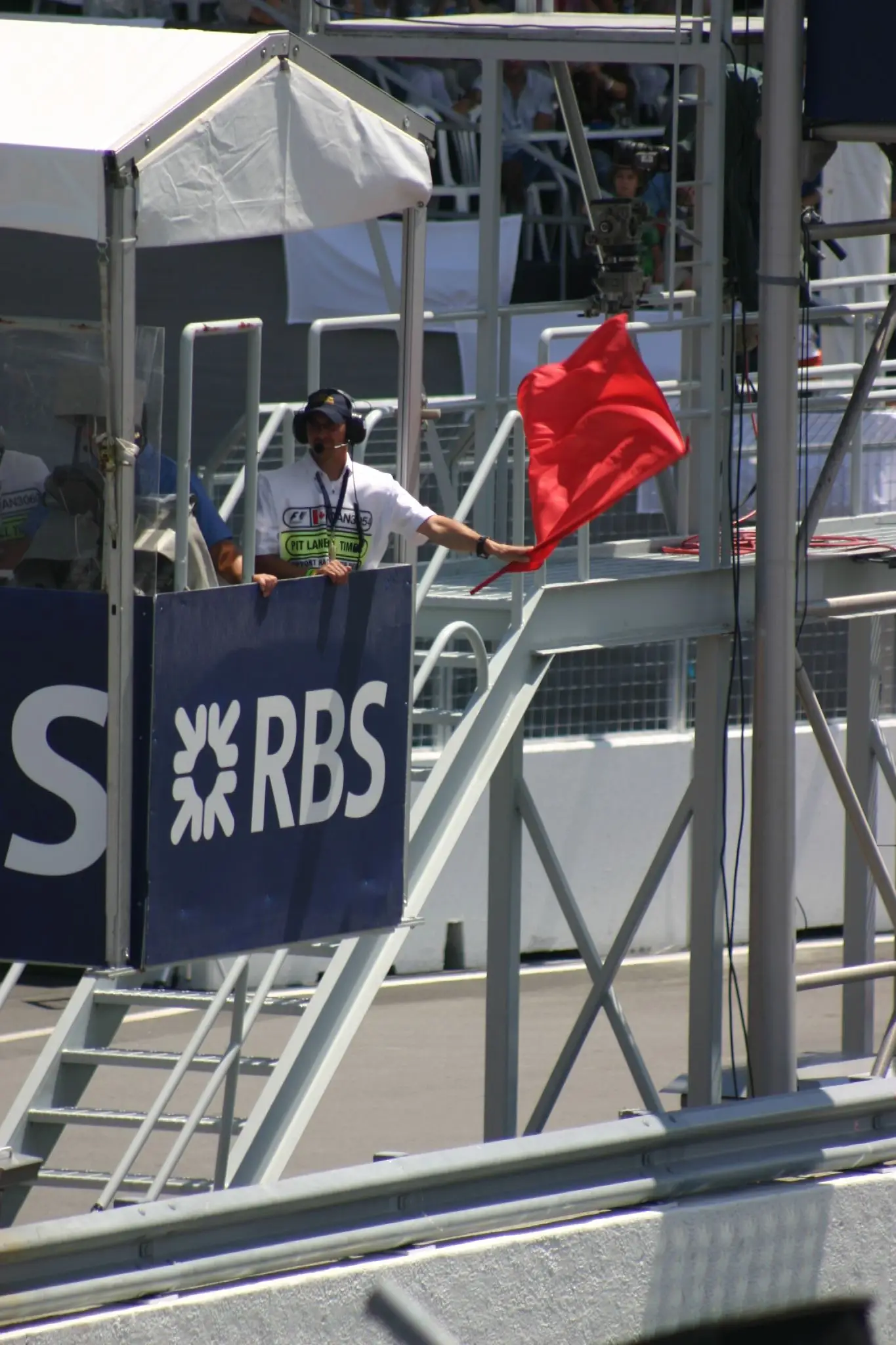
A red flag suspends the session or race. Drivers must slow immediately, stop overtaking and return to the pit lane or another instructed location. Race Control uses it for major crashes, blocked circuits, damaged barriers, severe weather or any condition that prevents safe running.
The red flag is a circuit-wide instruction. Every marshal post waves it, and electronic panels turn red.
In practice and qualifying, drivers return slowly to their garages. During a race, they form up in the pit lane as directed.
The pit exit closes. Therefore, no driver can continue circulating to create a strategic advantage.
The FIA minimum-time system also controls the return. Drivers must reduce speed in each marshalling sector.
Why Is an F1 Race Red-Flagged?
A red flag appears when a normal caution cannot protect the people involved. The track may be blocked or unsafe.
Major barrier damage is a common reason. Repairs need time and clear access for heavy equipment.
Severe rain can also make the circuit undriveable. Spray may reduce visibility even when tire grip remains acceptable.
In addition, Race Control may stop a session for a medical response. The red flag provides complete access to the incident.
What Happens Immediately After a Red Flag?
Drivers reduce speed and stop overtaking. They then follow the official route to the pit lane.
During a race, cars line up in the fast lane. The order follows the official resumption classification.
Teams wait for restart information. Meanwhile, marshals recover cars and repair the circuit.
The race timekeeping system does not simply freeze. Under the 2026 rules, suspension time is added to the maximum event time.
Can Teams Change Tires During a Red Flag?
Teams can usually change tires while the race is suspended, subject to the sporting procedure. That can create a major strategic swing.
A driver who needed a pit stop may receive fresh tires without losing track position in the normal way.
However, the exact benefit depends on the restart order and tire obligations. Teams must still comply with compound rules where applicable.
Therefore, a red flag can reward a driver who stayed out before the suspension. Rivals who already stopped may feel disadvantaged.
Can Teams Repair Cars During a Red Flag?
Some work is allowed, but it must follow the red-flag procedure. Components normally need to match the original specification.
Teams cannot use the suspension as unlimited development time. FIA officials supervise the cars and may require approval.
Damage from the incident can sometimes be repaired. Consequently, a driver who appeared out of the race may return for the restart.
Does a Red Flag Erase Race Gaps?
Yes, in practical terms. The cars form a new ordered line for the restart.
A leader’s 15-second advantage no longer exists. Track order survives, but time gaps disappear.
The restart may be standing or rolling. Either format creates a new competitive phase.
How Does an F1 Race Restart After a Red Flag?
Race Control first establishes the resumption order. The field then leaves the pit lane behind the Safety Car.
Conditions determine whether the race restarts from the grid or through a rolling procedure. Wet weather often favors a rolling restart.
For a standing restart, cars complete the preparation lap and return to the grid. The normal start-light sequence then follows.
Our guide to the F1 formation lap explains the preparation before a standing start.
Can an F1 Race Finish Under a Red Flag?
Yes. If the race cannot resume, the classification comes from an earlier completed point defined by the regulations.
The 2026 rules use the end of the penultimate lap before the lap in which the suspension signal appeared.
Points eligibility then depends on completed race distance and the championship scoring rules.
2025 Azerbaijan Qualifying: Record Six Red Flags
Baku produced a Formula 1 qualifying record in 2025. Six separate red flags interrupted the session.
Max Verstappen still secured pole. However, drivers repeatedly lost tire preparation and rhythm.
The event showed that red flags affect more than safety. They can decide who completes a final lap before the clock expires.
2026 Monaco Qualifying: Bortoleto’s Q1 Crash
Gabriel Bortoleto clipped the barrier at the Nouvelle Chicane during 2026 Monaco qualifying. Race Control stopped Q1 with red flags.
The interruption protected the recovery. It also changed tire timing for every driver waiting to return.
Street circuits increase that risk because damaged cars often remain close to the racing line.
F1 Flags Explained: What Does a Blue Flag Mean in Formula 1?
During a race, a blue flag normally warns a driver that a faster car is about to lap them. During practice or qualifying, it warns that a faster car is approaching. A stationary blue flag or flashing blue light at pit exit warns of cars arriving on the track.
The blue flag has different meanings depending on the session. It is not always an order to surrender a racing position.
During practice, the approaching car may be on a flying lap. The slower driver should avoid blocking.
During a race, the signal normally applies to a car about to be lapped. The driver must allow the leader through promptly.
At pit exit, the flag is a warning rather than a command to stop. The driver still decides whether the merge is safe.
When Must a Lapped Driver Move Aside?
The driver should allow the faster car through at the earliest safe opportunity. A straight is usually preferable.
Moving unpredictably in a corner can create more danger. Therefore, backmarkers often hold a clear line and lift.
Race Control monitors the number and duration of blue signals. Repeated delay can lead to a penalty.
Can a Lapped Car Defend Against the Leader?
No. Once the blue-flag instruction applies, the lapped car must facilitate the pass.
However, a car fighting on the same lap can defend normally. A blue flag does not decide every battle between cars of different pace.
The distinction depends on race position. Timing screens show whether the pass would create a lap difference.
What Happens if a Driver Ignores Blue Flags?
The stewards can issue a time penalty. Formula 1 has traditionally treated three successive blue signals as a serious warning threshold.
However, the sanction still depends on the delay and circumstances. A driver trapped in a narrow corner may need a safe exit first.
Team radio usually warns the driver before the situation becomes an infringement.
Why Are Blue Flags Shown in Qualifying?
Qualifying mixes drivers on fast laps, slow laps and preparation laps. Closing speeds can be very large.
The blue flag warns the slower car before the faster one arrives. Consequently, it protects both safety and competitive fairness.
Blocking can still be investigated even without a blue flag. The driver has a broader duty not to impede.
What Does the Blue Light at Pit Exit Mean?
The pit-exit blue light warns that cars are approaching on the circuit. It does not automatically close the exit.
A driver may join if the merge remains safe and legal. However, forcing an approaching car to avoid contact can create an unsafe-release investigation.
Read our guide to backmarkers in Formula 1 for the race-order context.
Blue flag rule: In practice it warns of faster traffic. In a race it normally instructs a car about to be lapped to allow the pass.
F1 Flags Explained: What Does a Green Flag Mean in Formula 1?
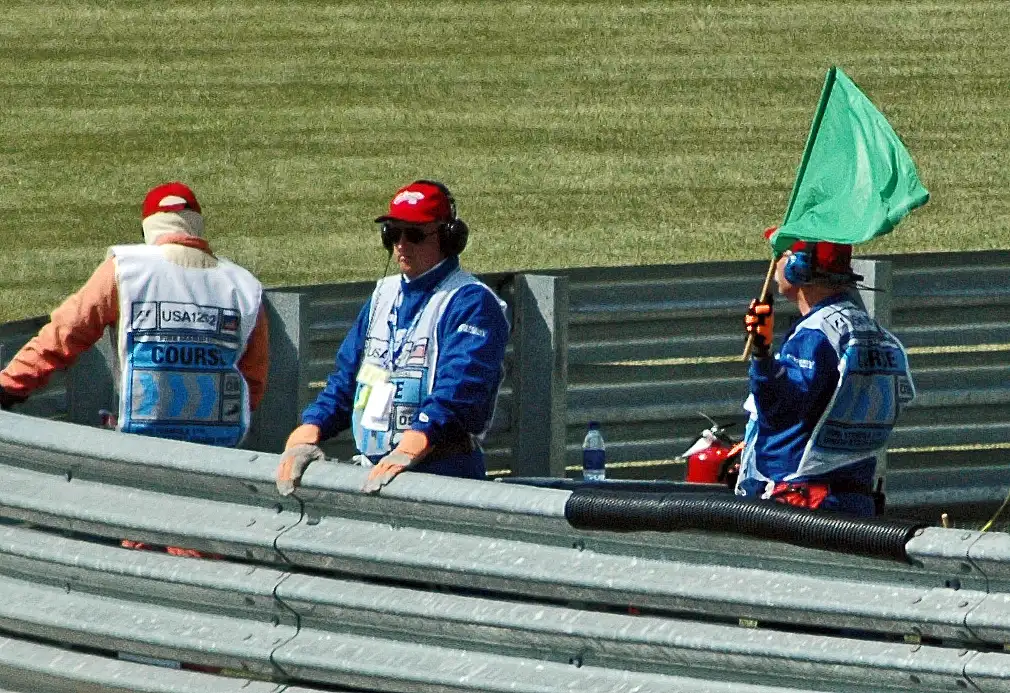
A green flag means the track is clear. It normally appears at the marshal post immediately after a yellow-flag incident. It can also signal the start of a practice session, a warm-up lap or confirmation that the grid is ready after the formation lap.
Green is the all-clear signal. It marks the end of a local danger zone.
Drivers can resume normal racing after reaching the applicable green signal. Therefore, overtaking should not restart before that boundary.
The flag also serves procedural roles. A marshal at the back of the grid confirms that the cars are stationary.
However, the Grand Prix start itself normally uses the five red lights. A waved green flag does not replace that sequence.
Does a Green Flag Start an F1 Race?
Not in the normal standing-start procedure. The start gantry controls the race.
A green flag can begin a formation or warm-up lap. It can also appear during a rolling restart procedure.
Therefore, viewers must distinguish “track clear” from “race start.” The context changes the operational meaning.
When Can Drivers Overtake After a Green Flag?
After a local yellow, overtaking resumes beyond the green flag. The driver must first leave the restricted sector.
After a VSC, green panels appear around the circuit and racing resumes immediately. The sporting rules control that specific transition.
After a full Safety Car, the control line determines overtaking. The green flag at the line supports that restart procedure.
What Does a Green Light at Pit Exit Mean?
A green pit-exit light means the lane is open. Drivers can enter the track when safe.
A red light means they must remain in the pit lane. Ignoring it can lead to severe penalties.
The blue warning light may flash at the same location when traffic approaches.
F1 Flags Explained: What Does a Black Flag Mean in Formula 1?
A black flag is an individual order to stop. It is displayed with the driver’s number and requires them to stop at the pits or another designated place on the next approach. In Formula 1, it usually reflects exclusion or a serious breach and is rarely used.
The black flag is Formula 1’s strongest individual visual instruction. It removes one car from active competition.
Only the stewards decide to show it. The team is informed immediately.
The flag should not remain displayed for more than four consecutive laps if the driver fails to comply.
Ignoring it does not make the decision disappear. It can lead to further sanctions against the driver and team.
Why Would an F1 Driver Receive a Black Flag?
A driver can receive it after disqualification, prohibited outside assistance or another serious breach.
Historic cases also involved ignoring penalties or entering the circuit illegally. The exact trigger comes from the stewards’ decision.
Modern electronic communication means teams usually receive the ruling before the driver sees the flag.
What Must a Driver Do After a Black Flag?
The driver must stop at the pit or designated location on the next approach. Continuing to race is not permitted.
The car may be directed into the garage. Officials then handle the classification and any further investigation.
Can a Driver Appeal a Black Flag?
The underlying stewards’ decision may be subject to the normal review or appeal framework. However, the driver must obey the flag immediately.
A team cannot keep racing while it argues the case. Safety and sporting control require compliance first.
2024 São Paulo Grand Prix: Hülkenberg’s Rare Black Flag
Nico Hülkenberg spun at the Senna Esses during the wet 2024 São Paulo Grand Prix. Marshals helped his Haas rejoin.
Formula 1 rules treated that outside assistance as a breach. Race Control issued the black flag.
His race ended immediately. The case became the most recent clear example of the flag’s modern use.
Black Flag vs. Race Disqualification
A black flag communicates an immediate stopping order during the session. A disqualification can also be imposed after the finish.
Therefore, not every disqualified driver sees a black flag. Technical checks often happen after the car has already finished.
Our guide to appeals in Formula 1 explains the later legal process.
F1 Flags Explained: What Is the Black-and-White Flag?
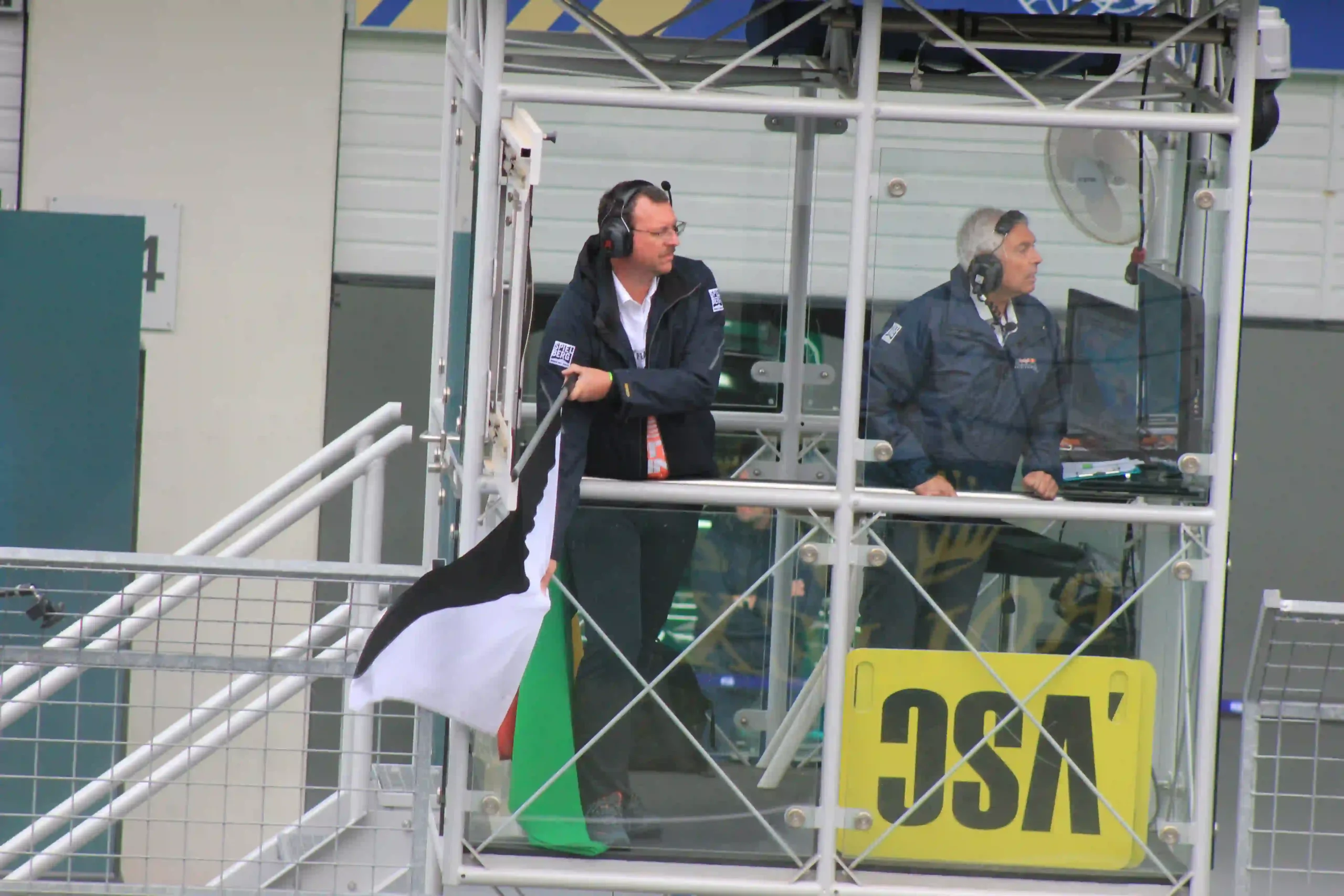
The diagonally divided black-and-white flag is a driving-conduct warning. It is shown once with the driver’s number after unsportsmanlike behavior or an action that may attract a penalty if repeated. It is similar to a formal final warning rather than an automatic time penalty.
This flag addresses behavior rather than a mechanical fault. It tells the driver that the stewards have noticed the conduct.
Examples can include excessive weaving, forcing another car off track or repeated driving beyond acceptable limits.
The warning may prevent an immediate penalty. However, repeating the behavior can trigger a sanction.
Is the Black-and-White Flag a Penalty?
Not by itself. It is an official warning attached to the driver’s number.
Nevertheless, it becomes part of the incident record. A repeat offense can produce a time penalty or stronger action.
Race Control may also issue radio warnings before using the flag. The precise sequence depends on the conduct.
Black-and-White Flag vs. Black Flag
The black-and-white flag says, “change your driving.” The black flag says, “stop competing.”
That difference is fundamental. One preserves the driver’s race, while the other ends it.
F1 Flags Explained: What Is the Black-and-Orange Flag?
The black flag with an orange disc warns that a car has a mechanical problem likely to endanger its driver or others. Displayed with the car number, it requires the driver to pit on the next lap. The car may return only after officials accept the repair.
Fans often call this the “meatball flag.” The nickname comes from the orange circle on the black background.
The message is mechanical rather than disciplinary. Race Control believes the car itself may be unsafe.
Loose bodywork is a common trigger. A damaged wing or mirror can detach and strike another car.
Fluid leaks, smoke or a dragging component can also justify the signal. The driver must return before the problem grows.
Must a Driver Pit for the Meatball Flag?
Yes. The driver must stop at the pit on the next lap.
The team can repair the fault. However, the chief scrutineer must be satisfied before the car rejoins.
Ignoring the instruction creates a safety breach. It can lead to stronger penalties or exclusion.
Why Is Damaged Bodywork So Dangerous?
F1 aerodynamic pieces are light and stiff. At high speed, a loose element can become dangerous debris.
Damage can also change the car’s balance without warning. A cracked front wing may fail under braking load.
Therefore, Race Control can act before the component fully separates. Prevention is safer than waiting for debris.
Black-and-Orange Flag vs. Team Radio Instruction
Teams often know about damage through telemetry or video. They may call the driver in before Race Control acts.
The official flag removes any choice. Once shown, the driver must pit under the FIA instruction.
Our guide to F1 bodywork explains why small components matter at racing speed.
F1 Flags Explained: What Does a White Flag Mean in Formula 1?
A waved white flag warns that a much slower vehicle is ahead in the marshal sector. That vehicle could be a damaged F1 car, medical car, recovery vehicle or another service vehicle. Drivers should approach carefully and expect a large speed difference.
The white flag is easy to misunderstand because other racing series use it differently.
In Formula 1, it does not mean the final lap. The checkered flag ends the session.
Instead, white warns about closing speed. A service vehicle may travel far slower than an F1 car.
Drivers remain responsible for avoiding it. Therefore, the signal can appear before a local yellow if conditions develop quickly.
Does the White Flag Mean the Last Lap?
No. NASCAR commonly uses white for the final lap, but FIA Formula 1 does not.
This difference matters for U.S. viewers. Motorsport flag meanings are similar across series, but not universal.
Always read the signal in the championship’s own rules.
What Vehicles Can Trigger a White Flag?
- A damaged F1 car returning slowly to the pits.
- A medical or rescue vehicle on the circuit.
- A recovery truck moving under controlled conditions.
- A course car during practice or preparation.
- Cars stopping for practice starts after a session.
The signal does not always mean the session is neutralized. However, the driver must expect a major speed difference.
F1 Flags Explained: What Does the Yellow-and-Red Striped Flag Mean?
The stationary yellow-and-red striped flag warns that grip has deteriorated beyond the flag point. Oil, water or another surface change may make the track slippery. Drivers should adjust speed, braking and steering because tire grip can change suddenly.
This signal addresses the surface rather than a specific obstruction. The racing line may look clear but offer less grip.
Appendix H recommends displaying it for at least four laps, unless the surface returns to normal sooner.
A following green flag is not required. Therefore, drivers use track conditions and later messages to judge improvement.
What Can Cause a Slippery-Surface Flag?
Oil or coolant from a damaged car can create a narrow slick line. Rain can also wet one part of the circuit first.
Dust, gravel or cleaning material may reduce grip. Moreover, a resurfaced patch can behave differently from surrounding asphalt.
The flag tells drivers to expect a change before they feel it through the steering wheel.
Why Is It Stationary Rather Than Waved?
The flag describes a continuing condition rather than immediate moving danger. A stationary display is easier to distinguish from yellow.
However, the surface may still cause a crash. Drivers must treat the warning seriously.
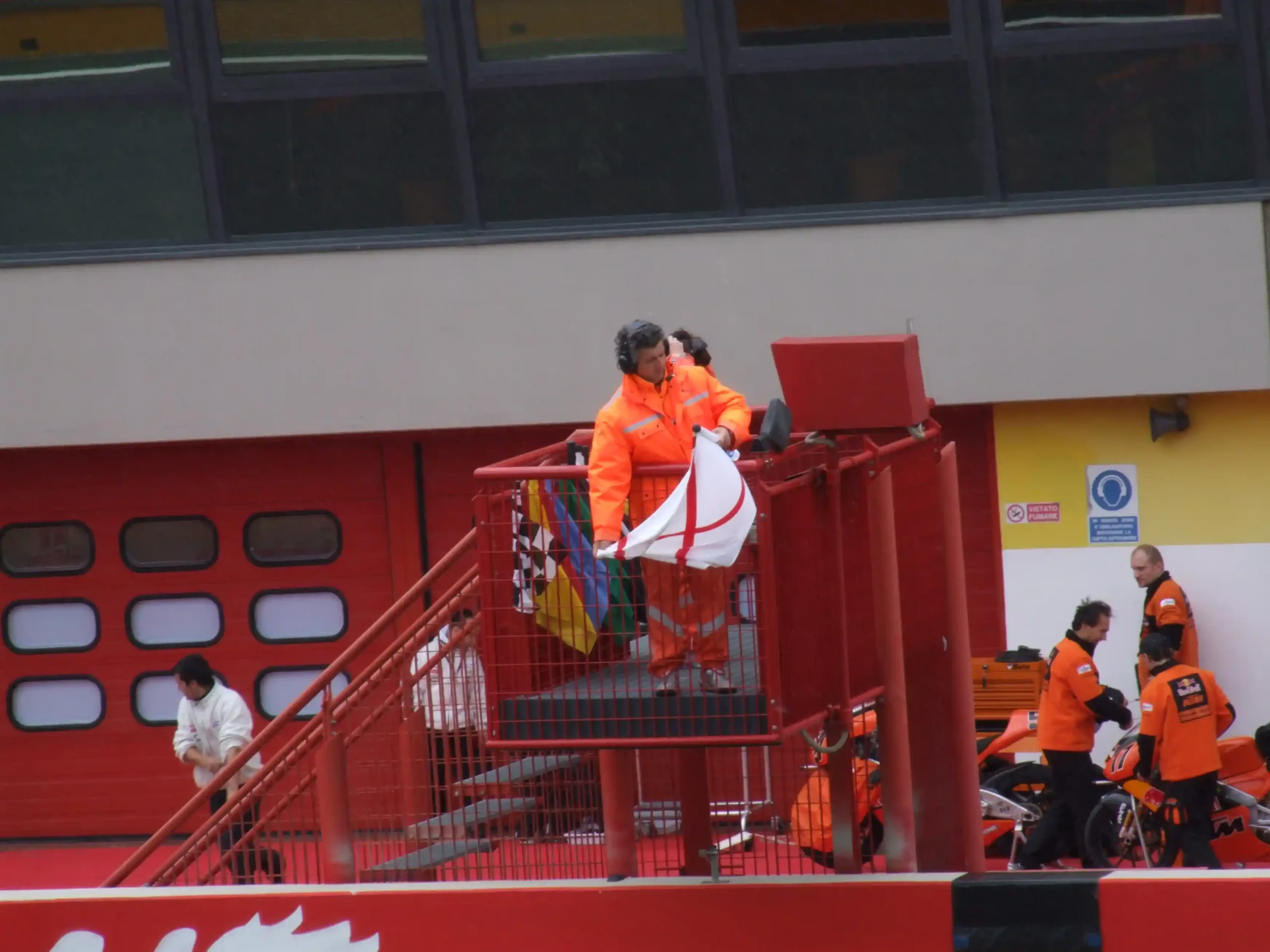
F1 Flags Explained: What Does the Chequered Flag Mean?
The black-and-white chequered flag is the end-of-session signal. It appears at the control line when the race leader completes the scheduled distance, or when practice or qualifying time expires. Drivers then finish safely and proceed to the pits or parc fermé.
The chequered flag is the most familiar symbol in racing. Yet its timing still follows detailed rules.
In a Grand Prix, the leader receives it after completing the scheduled race distance. Every following car finishes when crossing the line afterward.
In qualifying, drivers already on a timed lap can usually complete it after the clock reaches zero. However, they cannot start another lap after the flag.
The flag continues until every competing car crosses the control line.
What Happens if the Chequered Flag Is Shown Early?
The race is deemed to have finished when the leader last crossed the line before the signal.
Therefore, an accidental early flag can shorten the official result. The remaining physical laps do not restore the scheduled distance.
If the signal is shown late, the race is still considered finished when it should have ended.
Can a Driver Continue Racing After the Flag?
No. The competition has ended for that car. Drivers must reduce speed and return without unnecessary delay.
They also enter parc fermé conditions. Teams cannot perform normal work before post-session checks.
Our guide to how racing laps are counted explains why each car finishes on the lap it crosses the line.
Why Do Drivers Collect Rubber After the Race?
Drivers often pick up discarded tire rubber on the cool-down lap. The extra material can increase the car’s measured weight.
However, they must remain within official instructions. The car then proceeds directly to parc fermé.
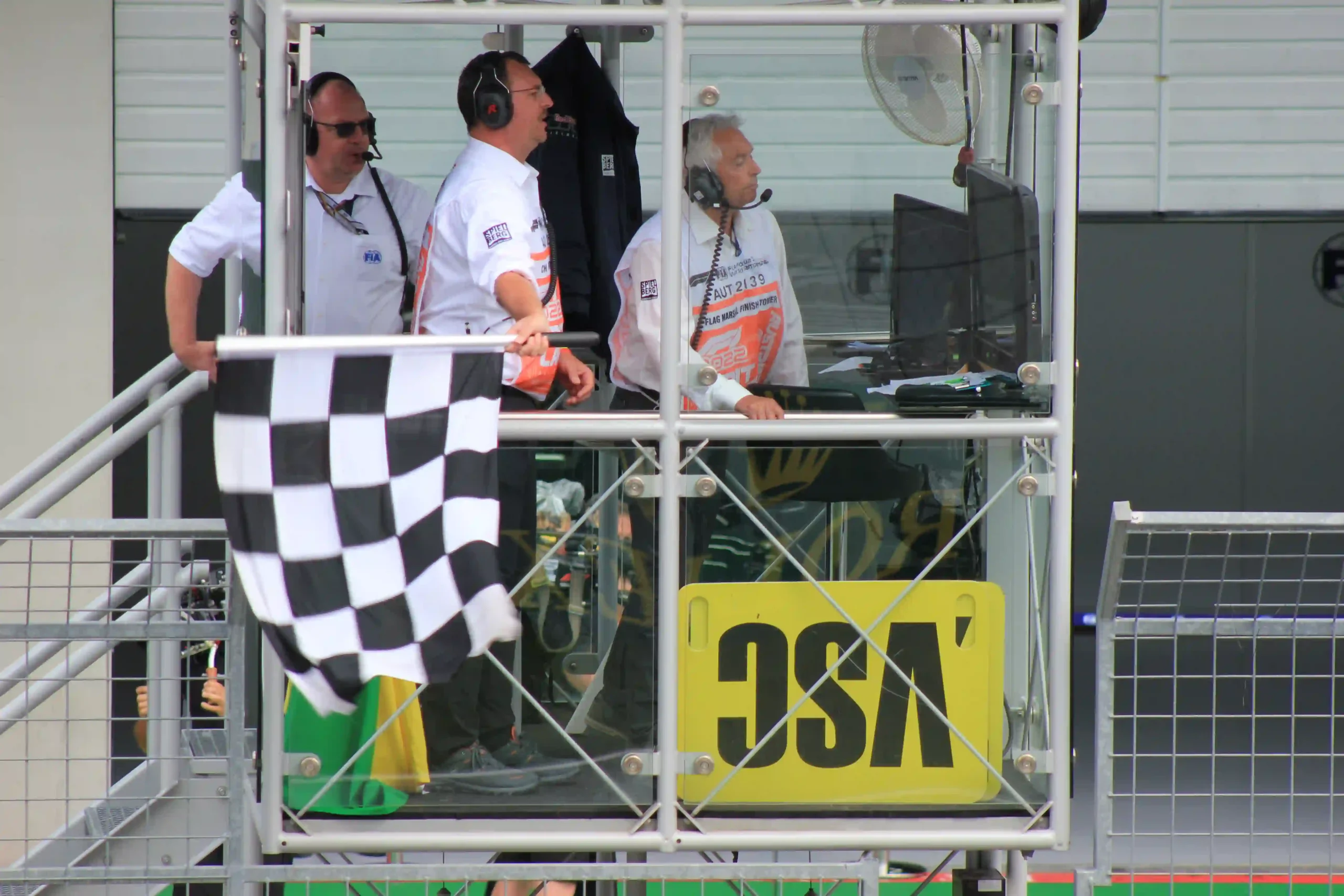
F1 Flags Explained: How Do Electronic Light Panels Work?
Electronic panels supplement physical flags rather than making them irrelevant. FIA rules state that panel signals carry the same meaning as flags. The network improves visibility, links to Race Control and can send matching warnings to cockpit lights, especially at night or in poor weather.
Modern Formula 1 uses a connected marshalling system. Trackside posts communicate incidents to Race Control.
Electronic panels then display the relevant color or message. Cockpit LEDs can repeat yellow, blue and red warnings.
The panels improve consistency around long circuits. They also remain highly visible at night.
However, physical flags provide redundancy. A power, communication or panel failure should not remove the local warning.
Do Light Panels Have the Same Legal Meaning?
Yes. The 2026 Formula 1 Sporting Regulations explicitly state that trackside light signals have the same meaning as flags.
Therefore, a driver cannot ignore a yellow panel because no cloth flag was visible. The instruction remains official.
What Appears on the Driver’s Steering Wheel?
Cockpit lights warn of major track states. The dashboard may also show text such as yellow, red, SC or VSC.
The engineer repeats important information by radio. Nevertheless, the driver must process the signal while controlling the car.
Can a Marshal Display the Wrong Flag?
Human error is possible. Race Control can correct the signal through radio and electronic systems.
Drivers should still react to an apparent danger. Slowing briefly is safer than assuming the flag is wrong.
Stewards later examine the official display timing. That determines whether an alleged infringement occurred.
Why Physical Flags Still Matter
A marshal can see conditions that a camera misses. The person may react before Race Control receives the full picture.
Flags also provide a backup when visibility or electronics fail. Their simple color language works across teams and nationalities.
Our overview of racing flag systems compares Formula 1 with other categories.
F1 Flags Explained: What Penalties Apply for Ignoring Flags?
Stewards can issue reprimands, lap-time deletions, grid drops, time penalties, drive-throughs, stop-and-go penalties or disqualification. The sanction depends on the flag, danger, speed, advantage and whether the driver repeated the behavior. Double-yellow qualifying laps are automatically deleted under the 2026 rules.
Flag penalties are not one-size-fits-all. The same color can cover very different levels of danger.
Stewards examine telemetry, video, timing and radio. They compare the driver’s speed with previous laps and nearby cars.
Safety consequences matter heavily. Failing to slow near marshals usually receives stronger treatment than a brief procedural mistake.
| Possible Infringement | Likely Evidence | Possible Consequence |
|---|---|---|
| Insufficient slowing under single yellow | Throttle, braking, speed trace and onboard video | Reprimand, grid penalty or time penalty |
| Competitive lap through double yellows | Sector timing and telemetry | Automatic lap deletion plus possible further action |
| Overtaking in a yellow zone | Timing loops and video | Time penalty, grid drop or stronger sanction |
| Ignoring red flag return procedure | Minimum-time data and track position | Grid penalty, time penalty or disqualification |
| Repeatedly ignoring blue flags | Marshal signals and time lost by leader | Time penalty |
| Ignoring black-and-orange flag | Official display and team communication | Exclusion or strong sporting penalty |
| Ignoring black flag | Flag display and continued laps | Further disciplinary action |
Why Are Double-Yellow Laps Deleted?
The rule removes ambiguity. A driver cannot improve while claiming to have slowed enough.
It also protects marshals. Every qualifying driver knows that the lap no longer has sporting value.
Therefore, the safest response is to abandon the attempt and prepare for the next lap.
Can a Flag Penalty Be Applied After the Race?
Yes. Hamilton’s 2026 British Grand Prix reprimand came after a post-race review.
The official result can change after the checkered flag. Time penalties may move a driver down the classification.
Technical and sporting evidence remains available through the FIA systems.
Can a Flag Infringement Affect Championship Points?
Absolutely. A grid drop can reduce scoring chances, while a race penalty can remove positions.
In a close championship, one caution mistake can matter months later. Drivers therefore treat visual signals as part of performance.
Our guide to how racing championships are scored explains the points effect.
F1 Flags Explained: How Flags Change Race and Qualifying Strategy
Flags can delete a qualifying lap, close a pit window, create a free tire change or end a session before a driver improves. Teams therefore monitor every marshal sector. Yellow flags affect immediate pace, red flags reset timing and strategy, while blue flags shape traffic management.
Flags are safety tools first. However, their timing changes competition.
A yellow during qualifying can destroy one driver’s final attempt. Rivals who crossed the sector earlier keep their laps.
A red flag can help a damaged car return after repairs. It can also give drivers fresh tires without a normal pit-stop loss.
Blue-flag traffic affects leaders too. A backmarker can cost several tenths in a corner even when moving aside correctly.
How Yellow Flags Affect Qualifying
Track evolution usually makes later laps faster. Therefore, a late yellow can lock in an unexpected grid.
Drivers at the front of the queue may finish before the incident. Those behind must slow or abandon the lap.
This makes pit-exit timing critical. Teams seek clean space while avoiding the risk of missing the final window.
Read our F1 qualifying guide for the Q1, Q2 and Q3 format.
How Red Flags Affect Tire Strategy
A red flag stops the field in order. Teams can often fit another tire set during the suspension.
That may remove the need for a green-flag stop. However, rivals who stopped earlier already paid the time cost.
The restart also creates cold-tire risk. A fresh compound may offer more grip but require careful preparation.
How Blue Flags Affect the Leader
The leader still loses time while navigating backmarkers. A cooperative pass may cost only a fraction.
A poorly timed encounter can cost more. The leader may catch the slower car at a narrow chicane.
Teams predict traffic using timing data. They can adjust pit-stop timing to return into clean air.
How Green Flags Create Restart Opportunities
The transition to green releases stored tire and battery performance. Drivers prepare before the restriction ends.
Under a VSC, the exact green timing can create small gains. Under a local yellow, the following car may attack immediately after the sector.
How Black-and-White Warnings Change Racecraft
A driver who receives the warning must reduce risk. Another aggressive move may trigger a penalty.
Rivals know this. They may apply pressure and force the warned driver into another difficult defense.
The flag itself does not choose the winner. Its timing changes which plans remain available, and the fastest team response often decides the result.
F1 Flags Explained: Flags During Safety Car and VSC Periods
During a full Safety Car, marshal posts display waved yellow flags and SC boards while light panels show “SC.” During a VSC, panels show “VSC,” with yellow warnings still used near the incident. Green signals mark the return to racing under the specific restart procedure.
A full Safety Car does not replace yellow flags. The entire circuit remains under caution.
Double yellows can continue near the incident. Drivers must respect both the Safety Car delta and the local danger.
Under a VSC, every driver follows minimum sector times. The incident area may still carry double yellow flags.
Therefore, the local duty can be stricter than the general neutralization pace.
Our Safety Car guide explains the full neutralization procedure.
F1 Flags Explained: Common Flag Misunderstandings
“One Yellow Means a Driver Can Keep Pushing Normally”
No. The driver must show a clear speed reduction and prepare to change direction.
“Double Yellows Only Mean Lift Off the Throttle”
No. Drivers must slow significantly and prepare to stop. A qualifying lap is deleted.
“A Red Flag Means the Race Is Over”
Not necessarily. The session is suspended and may restart.
“Blue Flags Always Order a Driver to Move Over”
During practice, they warn of faster traffic. During a race, they normally apply to lapping.
“Green Starts Every Formula 1 Race”
No. The normal Grand Prix start uses red lights.
“The Black-and-Orange Flag Is a Penalty”
It is primarily a mechanical safety instruction. The car must pit for repairs.
“White Means the Final Lap”
Not in Formula 1. White warns of a much slower vehicle ahead.
“Electronic Panels Are Only Advisory”
No. They carry the same meaning as the corresponding physical flag.
F1 Flags Explained: How Formula 1 Flags Differ From NASCAR Flags
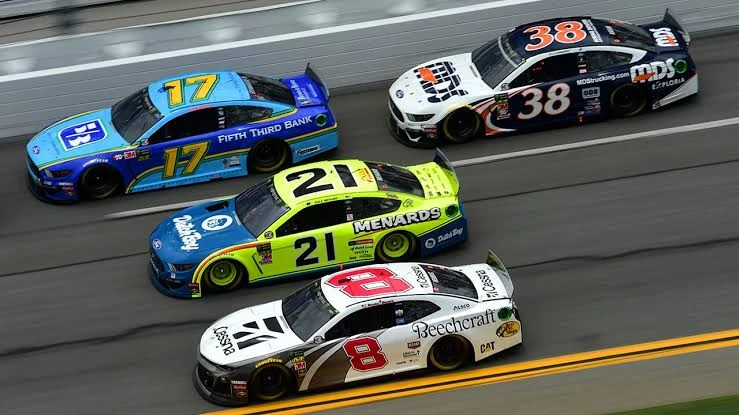
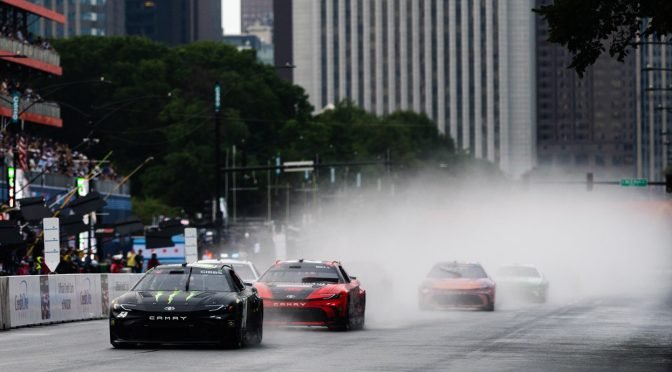
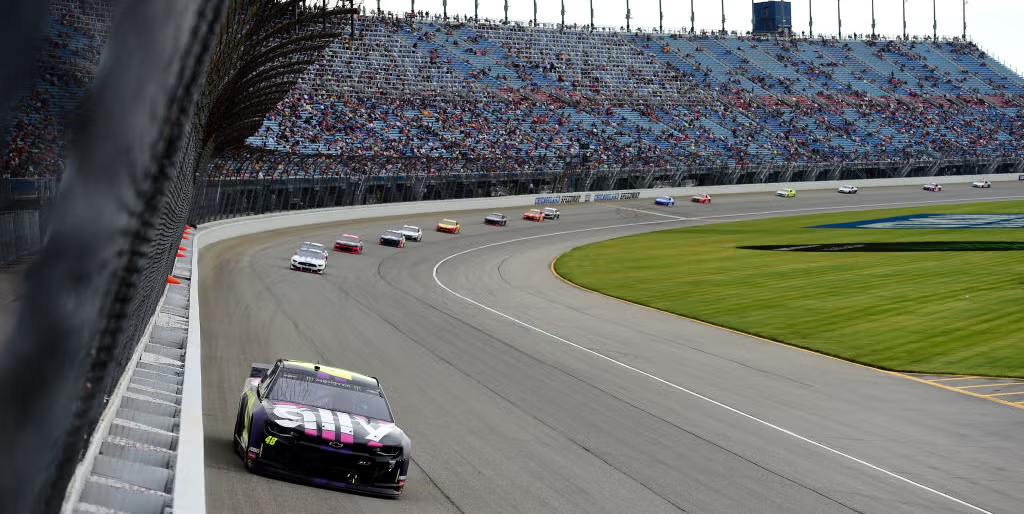
Many colors share broad safety meanings, but the systems are not identical. Formula 1’s white flag warns of a much slower vehicle, while NASCAR uses white for the final lap. F1 also relies heavily on local marshal sectors, electronic panels and FIA-specific individual warning flags.
U.S. fans often arrive with NASCAR flag knowledge. Most of the basic language feels familiar.
Yellow means caution, red stops competition, and the checkered flag marks the finish. However, important details differ.
NASCAR commonly uses a full-course yellow and pace car. Formula 1 can use a local yellow, VSC or full Safety Car.
The white flag is the clearest difference. NASCAR uses it for the final lap, while F1 uses it for slow traffic.
Blue flags also carry stronger lapping expectations in Formula 1. NASCAR leaders often negotiate traffic without the same compulsory move-over procedure.
Are FIA Flag Meanings Used in Other Series?
Many FIA championships use the Appendix H system. Formula 2, Formula 3 and endurance racing therefore share most meanings.
However, championship rules add specific procedures and penalties. A driver must know the series regulations, not only the color.
F1 Flags Explained: Which Flag Is the Most Serious?
The two flags address different situations. A red flag stops the entire session for safety. A black flag targets one driver and orders them to stop. For the individual driver, black is usually more severe because it ends participation. For the event, red signals the greater circuit-wide danger.
Flag severity depends on perspective. Red indicates that normal track activity cannot continue safely.
Black means one competitor cannot continue. Therefore, it has the strongest direct sporting effect on that driver.
Double yellow may carry the most urgent immediate driving instruction. The driver must be ready to stop near people or a blocked track.
The black-and-orange flag also addresses immediate mechanical danger. Ignoring it can create debris or loss of control.
Which Flag Creates the Biggest Strategy Change?
A red flag usually creates the largest reset. It erases gaps, permits a restart and can change tire decisions.
A yellow during final qualifying may have a larger effect on the starting grid. Timing determines which drivers completed laps first.
Therefore, strategic importance depends on the session and moment.
F1 Flags Explained FAQs
What do the flags mean in Formula 1?
F1 flags give drivers safety information and instructions. Yellow warns of danger, red stops the session, blue warns of faster traffic, green marks a clear track and black orders a driver to stop.
What is the difference between single and double yellow flags?
A single yellow requires slowing and readiness to change direction. Double yellows require a significant reduction and readiness to stop because the danger is more serious.
What does a blue flag mean in Formula 1?
During a race, it normally warns a driver that a faster car is about to lap them. During practice or qualifying, it warns that faster traffic is approaching.
What does a black flag mean in Formula 1?
A black flag, shown with the car number, orders that driver to stop at the pits or another designated place on the next approach.
F1 Flags Explained: Conclusion
F1 Flags Explained starts with a simple rule. Every color demands an immediate response.
Yellow warns of danger. A single yellow requires a clear reduction, while double yellows demand readiness to stop.
The 2026 regulations make qualifying enforcement especially clear. Any lap through a double-yellow sector is deleted.
Red suspends the entire session. Drivers slow, stop overtaking and return to the pit lane under FIA timing control.
Blue manages faster traffic. Its meaning changes between practice, qualifying, the race and pit exit.
Green marks clear conditions. However, it does not replace the normal red-light Grand Prix start.
The black flag targets one driver and orders a stop. Hülkenberg’s 2024 São Paulo exclusion showed that it remains active.
Black-and-white warns about driving conduct. Black with an orange disc warns about dangerous mechanical damage.
White means a much slower vehicle lies ahead. It does not mean the final lap in Formula 1.
The yellow-and-red striped flag warns of reduced grip. Oil, water or another surface change may lie beyond the post.
Finally, the chequered flag ends the session. Showing it early can even shorten the official race result.
Electronic panels and cockpit lights now reinforce every signal. Yet physical flags remain a vital local safety layer.
Recent 2026 cases involving Russell and Hamilton show how telemetry supports enforcement. Drivers must prove that they reacted.
At Formula 1 speed, a flag is not decoration. It is a precise instruction that protects lives and controls the competition.
Sources
The flag definitions, current regulations and recent examples in this article were checked against FIA and official Formula 1 material available on July 20, 2026.