What Does Cockpit Mean In F1? Formula 1 Cockpit Explained
In F1, the cockpit is the area inside the chassis where the driver sits and controls the car. It includes the seat, steering wheel, pedal box, harness, headrest, cockpit padding, and safety structures around the driver.
The Formula 1 cockpit is tiny, hot, complex, and incredibly strong. It is both the driver’s workplace and the strongest safety zone on the car.

What Does Cockpit Mean in F1 is a simple question, but the answer goes far beyond “driver seat.” The cockpit is where the driver becomes part of the car.
Formula 1’s official glossary defines the cockpit as the area within the chassis where the driver sits. However, modern F1 cockpit design is also about safety, ergonomics, control layout, and extraction.
This topic connects directly with F1 monocoque, the Halo in F1, F1 headrest, and HANS in F1.
Think of the cockpit as the driver’s command centre. It must fit the driver perfectly, protect them in a crash, and give them instant control at extreme speed.
What Is The Cockpit In A Formula 1 Car?
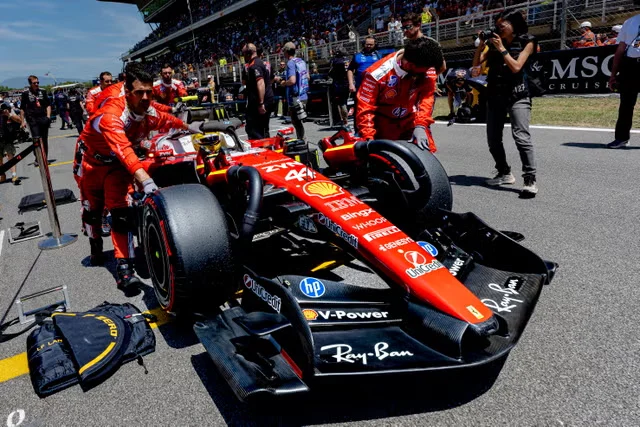
The cockpit in a Formula 1 car is the open area where the driver sits. It is placed inside the main chassis structure, known as the monocoque or survival cell.
The driver does not sit upright like in a road car. Instead, the seating position is reclined, narrow, and low. This helps packaging, centre of gravity, and aerodynamics.
Although it looks open from above, the cockpit is heavily protected. The driver sits inside a strong carbon fibre shell, surrounded by padding and safety systems.
Race analyst view: The F1 cockpit is not built for comfort first. It is built for control, protection, weight saving, and lap time.
What Is Inside An F1 Cockpit?
An F1 cockpit contains the seat, steering wheel, pedal box, harness, headrest, cockpit padding, radio controls, and many driver interface systems.
The steering wheel is the main control centre. It handles gear shifts, radio, brake balance, differential settings, energy deployment, DRS, pit limiter, and display pages.
The pedals sit far forward. The driver’s feet are ahead of their hips, while the knees are slightly bent. Therefore, each driver needs a custom seat and pedal position.
| Cockpit Part | Main Purpose | Why It Matters |
|---|---|---|
| Seat | Fits driver body shape | Improves control and safety |
| Steering wheel | Controls car systems | Allows adjustments at speed |
| Pedal box | Throttle and braking input | Matches driver leg length |
| Harness | Restrains the driver | Protects during impacts |
| Headrest and padding | Supports head and cockpit edge | Reduces injury risk |
The cockpit also connects with the airbox, F1 bodywork, brake balance, and the ECU.
How Does An F1 Cockpit Protect The Driver?
A modern Formula 1 cockpit protects the driver through several layers. The most important layer is the carbon fibre monocoque, also called the survival cell.
Formula 1 explains that the driver sits inside the monocoque. Key parts such as the engine and suspension attach to it, so it must be strong and light.
The survival cell uses carbon fibre and Kevlar layers to resist penetration and absorb crash energy. In addition, FIA rules require static and impact tests on the survival cell and cockpit structures.
FIA technical regulations include cockpit rim, cockpit side, cockpit floor, and survival cell tests. These tests are designed to ensure the structure does not fail under defined loads.

What Is The Halo In An F1 Cockpit?
The Halo is the protective structure around and above the cockpit opening. It helps protect the driver’s head from large impacts and flying debris.
The FIA made the Halo a mandatory safety device in modern Formula 1. At first, some fans disliked the look. However, its value became clear after several major crashes.
FIA guidance says the Halo must withstand 125 kN from above and 125 kN from the side without failure of the survival cell or mountings. That makes it one of the strongest parts of the car.
Formula 1 also says the Halo has prevented severe injuries in incidents including Lewis Hamilton and Max Verstappen at Monza in 2021 and Zhou Guanyu’s Silverstone crash in 2022.
For deeper reading, see Halo in F1 cars, Kevlar in F1 cars, Nomex in F1, and FIA in Formula 1.
Why Is The F1 Cockpit So Small?
The F1 cockpit is small because every millimetre matters. A narrower cockpit helps aerodynamic packaging and reduces unnecessary weight.
However, teams cannot make the cockpit unsafe or impossible to exit. The driver must still fit properly, control the car, and climb out quickly after a crash.
Each seat is custom-moulded. Drivers sit in foam or moulding material so the team can create a seat that supports the hips, back, shoulders, and legs.
The cockpit also has to work with G-force, car handling, ERS, and Energy Store demands.
Why Is The Steering Wheel Removable?
The F1 steering wheel is removable because the cockpit is too narrow for easy entry and exit with the wheel attached.
The driver removes the wheel before climbing out. After exiting, the wheel is normally replaced so marshals can move or steer the car if needed.
In an emergency, fast extraction matters. Therefore, the removable steering wheel is both a control system and an access feature.
How Has The Formula 1 Cockpit Changed Over Time?
Early Formula 1 cockpits offered far less protection. Drivers sat in lighter, simpler structures with fewer crash protections.
The carbon fibre monocoque changed that direction. Formula 1 highlights McLaren’s MP4/1 from 1981 as the first F1 car with a carbon fibre monocoque.
Later, safety systems improved further. Headrests, HANS devices, cockpit padding, side-impact structures, stronger survival cells, and the Halo all changed cockpit safety.
Moreover, cockpit technology also evolved. Steering wheels became complex control hubs, while sensors and telemetry made the driver’s environment more connected to the pit wall.
Final Verdict
The cockpit in F1 means the area inside the chassis where the driver sits and controls the car. It is small, open, and tightly packaged.
However, it is also one of the safest areas of the car. The survival cell, Halo, headrest, harness, cockpit padding, and FIA crash tests all protect the driver.
For beginners, the answer is simple. The F1 cockpit is the driver’s seat area. For serious fans, it is a carbon fibre safety cell, command centre, and performance tool in one.
FAQs About Cockpit In F1
What does cockpit mean in F1?
In F1, cockpit means the area inside the chassis where the driver sits and controls the car.
What is inside an F1 cockpit?
It includes the seat, steering wheel, pedals, harness, headrest, padding, radio controls, and driver display systems.
Why is the F1 cockpit open?
Formula 1 is an open-wheel, open-cockpit category by tradition and regulation. However, the Halo now adds head protection around the opening.
How safe is an F1 cockpit?
A modern F1 cockpit is very safe due to the survival cell, Halo, HANS device, harness, padding, and FIA crash-test rules.
Can every driver fit in an F1 cockpit?
Drivers vary in size, so teams customise seats and pedal positions. However, car design and minimum cockpit rules also matter.
Why is the steering wheel removable in Formula 1?
The steering wheel is removable so the driver can get in and out of the narrow cockpit quickly and safely.