G Force In F1 Vs Fighter Jet: Which Pushes The Body Harder?
Fighter pilots usually experience higher sustained G-force, often up to 9G in modern jets such as the F-16. Formula 1 drivers usually face lower peak numbers, but they endure repeated 4G to 6G loads through braking, cornering and acceleration across every lap.
Both jobs punish the human body. However, an F1 car and a fighter jet hurt the driver or pilot in very different directions.

G Force in F1 vs Fighter Jet is a better comparison than it first sounds. Both machines change direction violently. Both use aerodynamics. Both demand extreme fitness.
However, the forces are not the same. Formula 1 drivers mainly fight side-to-side and forward-back loads. Fighter pilots mainly fight vertical positive G that pulls blood away from the brain.
This topic connects directly with G-force in F1, G-force in F1 vs fighter jet, car handling, and grip.
According to the Formula 1 glossary, g-force is gravitational force acting on a person or object. In racing, that force appears when the car brakes, accelerates or corners.
What Is G-Force?
G-force is how heavy your body feels during acceleration. At 1G, you feel normal body weight. At 5G, your body effectively feels five times heavier.
In motorsport, this happens when a car changes speed or direction. Therefore, the driver feels forces while braking, turning and accelerating.
In aviation, the forces can run through the body from head to foot. That is why high positive G can affect blood flow, vision and consciousness.
Race analyst view: F1 hurts the neck and core repeatedly. Fighter jets threaten blood flow to the brain during sustained vertical G.
F1 Vs Fighter Jet G-Force Comparison
Fighter jets win the peak sustained G-force comparison. The U.S. Air Force F-16 fact sheet says the aircraft can withstand up to nine Gs with full internal fuel.
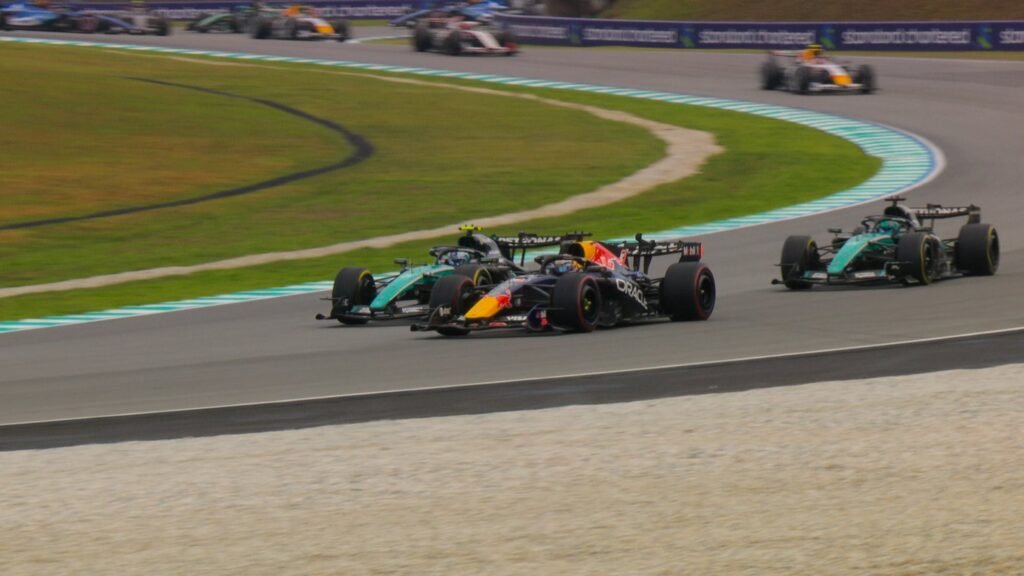
Formula 1 cars usually generate lower numbers. However, F1 loads arrive lap after lap. A driver may experience heavy braking, quick direction changes and high-speed corners hundreds of times in a race.
| Machine | Typical High-G Situation | Human Challenge |
|---|---|---|
| Formula 1 car | 4G to 6G in braking and fast corners | Neck load, core strain, breathing rhythm and precision |
| Fighter jet | Up to 9G in hard manoeuvres | Blood pooling, vision loss, G-LOC risk and anti-G technique |
| F1 impact case | Crash forces can be far higher | Survival cell, Halo, HANS and crash structures matter |
| Jet combat case | Sustained high-G turns | Pilot endurance and G-suit support become critical |
How Much G-Force Do F1 Drivers Experience?
Formula 1 drivers can experience around 4G to 6G in heavy braking and fast corners. In one official 2017 Formula 1 analysis, Hamilton peaked at 6.5G through Turn 11 at Albert Park.
Most of that load is lateral or longitudinal. Lateral G pushes the driver sideways. Longitudinal G throws the body forward under braking or backward under acceleration.
Mercedes-AMG Petronas explains that lateral G-force pushes drivers toward the side of the car during cornering. This is why F1 drivers build strong necks.
This links with brake balance, the racing apex, chicanes in F1, and oversteer and understeer.
How Many Gs Can Fighter Pilots Withstand?
Modern fighter pilots can train for very high G loads. In aircraft such as the F-16, the jet may structurally handle up to 9G.
However, the pilot is often the real limit. The FAA acceleration guide explains that rapid G onset can degrade performance and lead to unconsciousness if the body cannot maintain blood flow to the head.
That is the key difference. A fighter pilot may face higher G, but they use G-suits, breathing techniques and straining manoeuvres to stay conscious.

What Happens To The Human Body Under High G-Force?
Under high G, blood and soft tissue move according to the direction of force. In a fighter jet pull-up, blood can move away from the head.
First, the pilot may see greyout or tunnel vision. Then blackout can follow. If it continues, G-induced loss of consciousness can occur.
In F1, the danger is different. The driver’s head is pulled sideways, forward and backward while the hands still need perfect steering control.
For safety context, read about Halo in F1 cars, HANS in F1, F1 headrests, and the F1 cockpit.
Why Do Fighter Pilots Wear G-Suits But F1 Drivers Do Not?
Fighter pilots wear G-suits because positive G can pull blood toward the lower body. The suit squeezes the legs and abdomen to help keep blood moving upward.
F1 drivers do not face the same vertical G problem in normal driving. Instead, they use tight belts, shaped seats, headrests, cockpit padding and neck strength.
Moreover, a G-suit would not solve the main F1 problem. The driver needs freedom to breathe, steer, brake and react while side loads attack the neck.
Which Is Physically More Demanding?
A fighter jet is more dangerous from a consciousness point of view. Sustained 9G can become a medical problem within seconds.
However, F1 is more repetitive. The driver fights G-force every lap while judging tyres, braking points, steering angles, radio calls and traffic.
Therefore, the fairest answer is this: fighter jets have higher G peaks, while F1 delivers more frequent precision punishment.
This connects with F1 bodywork, F1 diffusers, downforce, and clean air in F1.
Final Verdict
In a straight G-force contest, the fighter jet wins. A modern fighter such as the F-16 can reach up to 9G, and pilots train specifically to survive that load.
However, Formula 1 should not be underrated. F1 drivers take brutal repeated G loads while maintaining millimetre-level precision at racing speed.
For beginners, the answer is simple. Fighter pilots face higher sustained G. F1 drivers face lower peak G, but they endure it constantly while racing wheel-to-wheel.
FAQs About G Force In F1 Vs Fighter Jet
Which experiences higher G-force, F1 or fighter jets?
Fighter jets usually experience higher sustained G-force, especially during 7G to 9G manoeuvres.
How many Gs do Formula 1 drivers experience?
F1 drivers commonly experience around 4G to 6G in heavy braking and fast corners.
Can F1 drivers withstand fighter jet G-forces?
Some may tolerate short high-G exposure, but fighter pilots train with G-suits and anti-G techniques.
Why do F1 drivers have strong neck muscles?
They need strong necks because cornering and braking forces pull the head sideways and forward.
Can G-force make you pass out?
Yes. High positive G can reduce blood flow to the brain and cause G-LOC.
Why do F1 drivers not wear G-suits?
F1 forces are mostly lateral and longitudinal, not the same head-to-foot positive G faced by fighter pilots.