How F1 Sprint Weekends Work in 2026: Format, Qualifying and Points
One practice session, two qualifying sessions, two races and 33 points per driver. Here’s how the F1 Sprint format works, why it’s different from a normal Grand Prix weekend, and why Singapore’s first Sprint matters so much for the 2026 title.
How F1 Sprint Weekends Work: 2026 Guide
Format, Sprint Qualifying, points and the six 2026 Sprints.
Most Formula 1 weekends follow a familiar rhythm: three practice sessions, qualifying on Saturday, the Grand Prix on Sunday. Six weekends a year are different. On a Sprint weekend, practice is cut to a single hour, there are two qualifying sessions instead of one, and there are two races that pay championship points.
This guide explains how F1 Sprint weekends work in 2026: the schedule, how Sprint Qualifying differs from normal qualifying, the points, the rules on car changes, and how the format has evolved since 2021. The timing is no accident: this weekend’s Singapore Grand Prix is the first Sprint ever held at Marina Bay, and the last of the season.
What Is an F1 Sprint?
An F1 Sprint is a short race of about 100 kilometres, roughly a third of a Grand Prix, held on the Saturday of selected weekends. It usually lasts around half an hour, with a one-hour time limit. There’s no mandatory pit stop, so teams normally run the whole distance on one set of tyres. As Motor Sport puts it, that makes it “a simple, flat-out dash”.
The Sprint is a standalone event. Its result doesn’t set the grid for Sunday’s Grand Prix, which has its own qualifying session. The top eight finishers score points, which count towards both the drivers’ and constructors’ championships, but a Sprint win doesn’t count as a Grand Prix win in the record books.
The idea is to make every day of the weekend matter. A normal weekend has two competitive sessions, qualifying and the race. A Sprint weekend has four: Sprint Qualifying, the Sprint, Grand Prix qualifying and the Grand Prix. That means more racing for fans at the track and watching at home, and less time for teams to fine-tune their cars in practice.
F1 Sprint Weekend Schedule vs a Normal Weekend
The easiest way to understand the format is to put the two weekends side by side:
| Day | Normal weekend | Sprint weekend |
|---|---|---|
| Friday | Practice 1, Practice 2 | Practice 1 (60 min), Sprint Qualifying |
| Saturday | Practice 3, Qualifying | Sprint, Grand Prix Qualifying |
| Sunday | Grand Prix | Grand Prix |
| Competitive sessions | 2 | 4 |
| Practice time | 3 hours | 1 hour |
With only one hour of practice, teams have to get their set-up close to right almost immediately. That’s why Sprint weekends often produce surprises: a team that arrives with a car that suits the track has a big advantage, and one that gets it wrong has very little time to recover.
Parc fermé: when teams can change the car
Parc fermé rules stop teams making significant set-up changes once a car has qualified. On a Sprint weekend there are two separate parc fermé periods: the first runs from Sprint Qualifying to the end of the Sprint, and the second from Grand Prix qualifying to the Grand Prix. In between, after the Sprint, teams can adjust the set-up. In the early Sprint years, the car was locked from Friday all the way to Sunday.
How F1 Sprint Qualifying Works
Sprint Qualifying uses the same knockout idea as normal F1 qualifying: three sessions, with the slowest drivers eliminated after each of the first two. The differences are that the sessions are shorter and the tyres are fixed.
| Session | Length | Tyres | Eliminated |
|---|---|---|---|
| SQ1 | 12 min | New mediums | Slowest 6 |
| SQ2 | 10 min | New mediums | Slowest 6 |
| SQ3 | 8 min | Softs | Top 10 set the order |
For comparison, normal Grand Prix qualifying runs 18, 15 and 12 minutes, and drivers can choose their tyres. With only one set allowed per session in Sprint Qualifying, there’s no second run to fix a mistake. One lock-up or a lap deleted for track limits and a driver can be out. Teams also get one fewer set of tyres for the whole weekend: 12 sets instead of 13.
The fastest driver in SQ3 starts the Sprint from first place. Whether that’s called pole position is a matter of debate: officially, F1 counts only Grand Prix pole positions in its records.
One hour of practice, one set of tyres per session, no second chances. A Sprint weekend punishes teams that arrive unprepared.
F1 Sprint Points in 2026
The Sprint pays points to the top eight finishers on a simple sliding scale. Added to the Grand Prix, it makes a Sprint weekend worth up to 33 points to one driver, compared with 25 on a normal weekend.
| Position | Sprint | Grand Prix | Weekend Total |
|---|---|---|---|
| 1st | 8 | 25 | 33 MAX |
| 2nd | 7 | 18 | 25 |
| 3rd | 6 | 15 | 21 |
| 4th | 5 | 12 | 17 |
| 5th | 4 | 10 | 14 |
| 6th | 3 | 8 | 11 |
| 7th | 2 | 6 | 8 |
| 8th | 1 | 4 | 5 |
| 9th | — | 2 | 2 |
| 10th | — | 1 | 1 |
Notice how flat the Sprint scale is. Winning a Sprint is worth only one point more than finishing second, so drivers fighting for a title often avoid big risks on Saturday. The real prize is Sunday, where the gap between first and second is seven points. MotoGP takes the opposite approach, with a Sprint every weekend and 12 points for the winner; our guide to how racing championships are scored compares the systems.
How the F1 Sprint Format Has Changed Since 2021
The Sprint has been rebuilt almost every season since it was introduced. The main changes:
The Sprint is far from universally loved. Some drivers dislike losing practice time, and some fans feel it dilutes the Grand Prix. But it has stayed, and according to Motor Sport, F1 plans to expand to ten Sprints in 2027.
The 2026 F1 Sprint Calendar and Results
F1 and the FIA confirmed six Sprint weekends for 2026, with Montreal, Silverstone and Zandvoort new to the rotation (Silverstone returning for the first time since hosting the very first Sprint in 2021) and Singapore staging one for the first time.
| Round | Venue | Dates | Sprint Winner |
|---|---|---|---|
| 1 | Shanghai, China | 13–15 Mar | George Russell |
| 2 | Miami, USA | 1–3 May | Lando Norris |
| 3 | Montreal, Canada | 22–24 May | George Russell |
| 4 | Silverstone, Great Britain | 3–5 Jul | Kimi Antonelli |
| 5 | Zandvoort, Netherlands | 21–23 Aug | George Russell |
| 6 | Singapore THIS WEEK | 9–11 Oct | Saturday 10 October |
One pattern stands out: George Russell has won three of the five Sprints, while championship leader Kimi Antonelli has won one. Russell has been the stronger Saturday racer all year, which makes Singapore’s Sprint his best chance of a points swing. For Silverstone, see our coverage of British GP Sprint Qualifying.
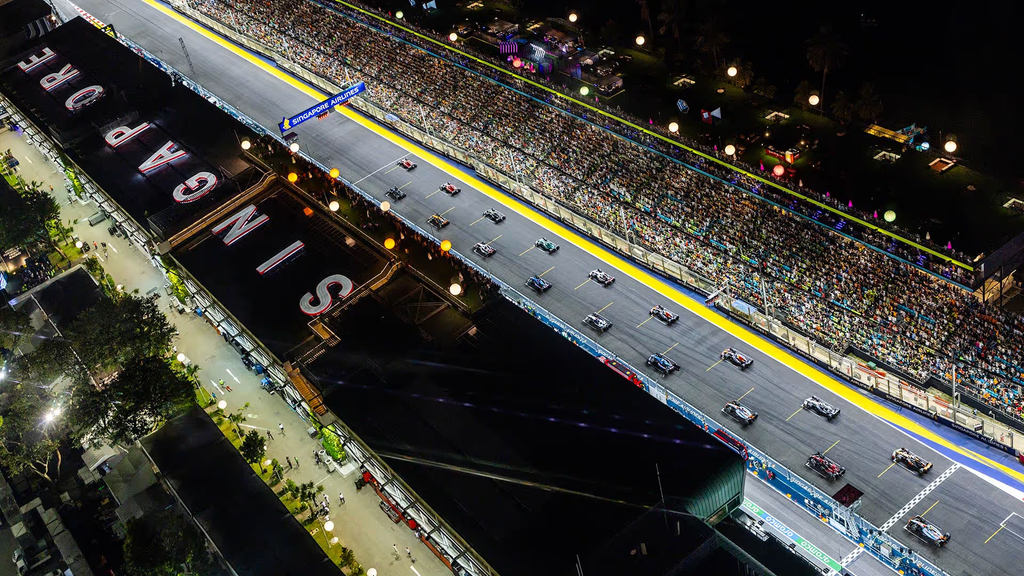
Why the Singapore Sprint matters for the title
Antonelli leads Russell by 84 points after Russell’s retirement at Sepang. With the Sprint, Singapore offers 33 points to each driver, more than any other remaining round. The Sprint starts at 17:00 local time on Saturday 10 October (10:00 UK, 05:00 US Eastern), with Grand Prix qualifying at 21:00 and the race at 20:00 on Sunday. F1’s forecast gives a 40% chance of rain on Saturday.
If Russell wins both races and Antonelli scores nothing, the gap falls to 51. If Antonelli does the double, it grows to 117, putting a title decision in Austin within reach. Our analysis of whether Russell can still catch Antonelli has every scenario, and our guide to how to watch F1 in the USA covers the Apple TV coverage. The latest points are in our F1 standings.
F1 Sprint Weekends — FAQ
Four sessions that count, and no time to waste
A Sprint weekend squeezes a Grand Prix weekend into fewer, higher-stakes sessions: one hour of practice, two qualifying sessions and two races. For teams it’s a test of preparation. For drivers in a title fight, it’s 33 points instead of 25.
Singapore’s first Sprint is on Saturday 10 October. Follow World of Speed for the result and updated standings.