How Car Engines Work: The Ultimate Beginner’s Guide
Thousands of controlled explosions a minute, turned into motion. This complete beginner’s guide explains exactly how a car engine works — the four-stroke cycle, every major part, engine layouts and the systems that keep it alive.
How Car Engines Work: Beginner’s Guide
The four-stroke cycle, every major part, and the systems that keep an engine alive — explained simply.
Every time you hear an engine start, you’re listening to one of humanity’s cleverest inventions: a machine that turns tiny, controlled explosions of fuel into smooth, usable motion — thousands of times a minute, for years on end, reliably enough that we barely think about it. It sounds like magic, but the underlying idea is beautifully simple once someone explains it clearly.
This is that explanation. Whether you’re a curious new motorsport fan, a first-time car owner or just someone who’s always wondered what’s happening under the bonnet, this ultimate beginner’s guide breaks down exactly how a car engine works — from the fundamental idea, through the famous four-stroke cycle, to every major component and the support systems that keep it running. No engineering degree required.
The Basic Idea: Turning Fire Into Motion
At its heart, a car engine does one thing: it converts the chemical energy stored in fuel into mechanical energy that turns the wheels. The technical name is an internal combustion engine — “internal combustion” because the fuel is burned inside the engine itself, rather than in an external furnace like an old steam locomotive.
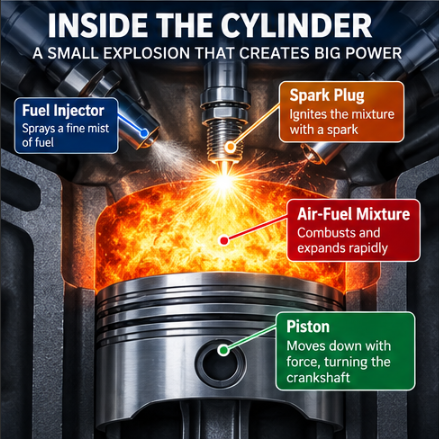
The trick is this: when you burn a tiny amount of petrol mixed with air in a sealed space, it expands violently and extremely fast — effectively a small, controlled explosion. If you trap that expanding gas above a piston that’s free to move, the explosion shoves the piston down with real force. Do that thousands of times a minute, in several cylinders, and connect those pistons cleverly to a rotating shaft, and you have continuous, usable rotational power. That’s the whole idea in one paragraph.
Imagine popping a balloon inside a bicycle pump, with the plunger free to move. The burst of air would slam the plunger outward. Now imagine doing that automatically, hundreds of times a second, and converting each push into a turn of a wheel. That’s essentially an engine: a machine for harnessing lots of tiny, perfectly-timed explosions and smoothing them into rotation.
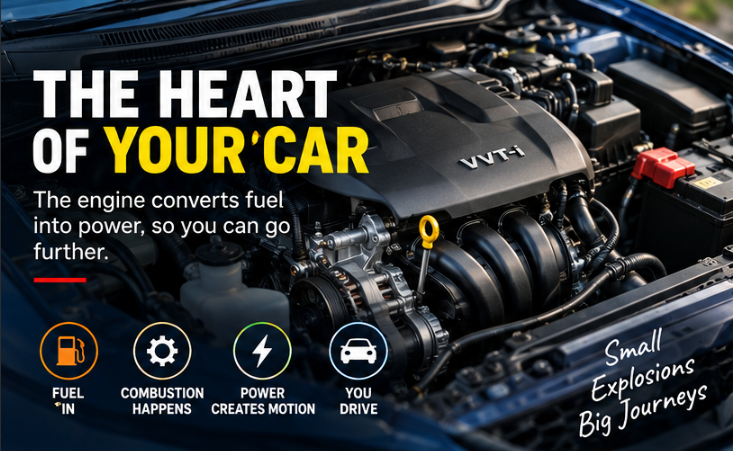
The two big challenges an engine solves are timing (making the fuel burn at exactly the right moment) and conversion (turning the straight-line push of a piston into the round-and-round spin a wheel needs). The rest of this guide is really just a detailed look at how engineers solved those two problems — starting with the elegant sequence at the core of it all.
The Four-Stroke Cycle — The Heart of It All
Almost every car on the road uses a four-stroke engine, so named because each cylinder repeats a cycle of four distinct movements (“strokes”) of the piston. Mechanics have a memorable nickname for the four stages: “suck, squeeze, bang, blow.” Let’s walk through each one — this is the single most important thing to understand about how an engine works.
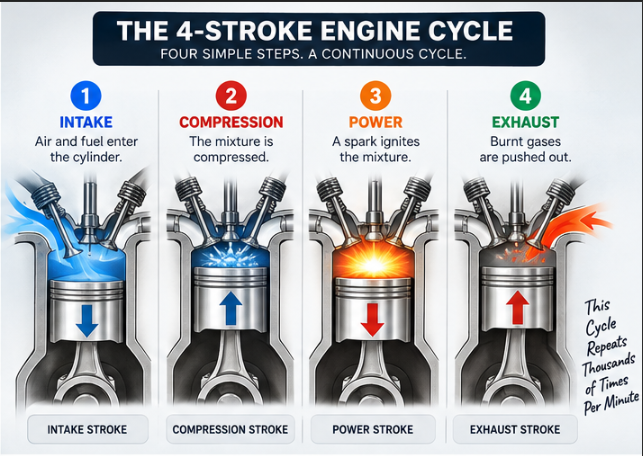
Astonishingly fast. At a typical motorway cruise, an engine might turn at 2,500 RPM (revolutions per minute). Because a four-stroke cycle takes two full crankshaft revolutions, that’s over 1,000 complete cycles per cylinder, per minute — around 20 per second. A revving race engine at 15,000 RPM is completing this four-stage dance roughly 125 times a second in each cylinder. The precision required is extraordinary.
What about diesel and two-stroke engines?
A diesel engine uses the same four strokes but skips the spark plug — it compresses the air so hard that it becomes hot enough to ignite the fuel on its own when injected. That higher compression is why diesels produce more low-end pulling power, or torque, as we explain in our guide to why diesel engines make more torque. A two-stroke engine combines the stages into just two piston movements, making it simpler and lighter but less efficient — more common in small machines and older motorcycles than modern cars. Our dedicated four-stroke deep-dive goes further still.
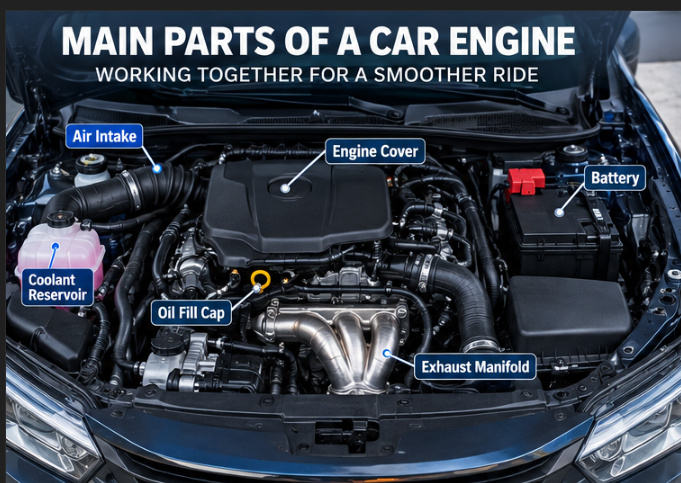
The Main Parts of an Engine
Now that you understand the cycle, let’s meet the parts that make it happen. You don’t need to memorise all of these, but knowing the main players makes everything click into place.
| Part | What it does |
|---|---|
| Cylinder | The tube where combustion happens and the piston slides up and down. |
| Piston | The plunger pushed down by the explosion; the part that captures the power. |
| Connecting rod | The arm linking the piston to the crankshaft. |
| Crankshaft | Converts the piston’s up-down motion into rotation — the key genius part. |
| Valves | Doors that let fuel-air in (intake) and burnt gas out (exhaust). |
| Camshaft | A spinning shaft with lobes that open and close the valves at the right moments. |
| Spark plug | Fires the spark that ignites the mixture (petrol engines only). |
| Engine block | The big metal casting that houses the cylinders and holds everything together. |
| Cylinder head | Sits on top of the block, containing the valves, spark plugs and combustion chambers. |
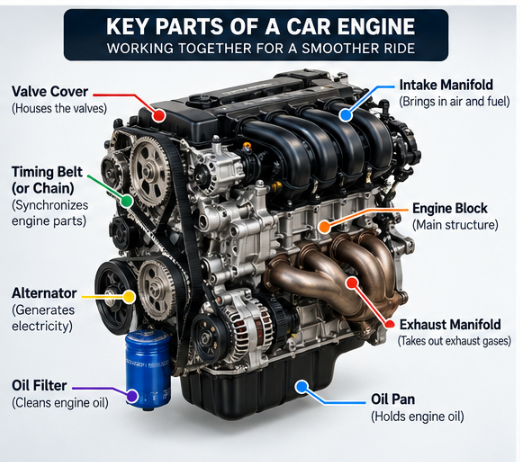
The crankshaft: the cleverest part
If one component deserves special attention, it’s the crankshaft. The pistons move in straight lines — up and down — but a wheel needs to spin in a circle. The crankshaft solves this beautifully: each piston connects, via its connecting rod, to an offset “crank” on the shaft, exactly like the pedals on a bicycle. As the piston pushes down, it forces the crank to rotate, just as your leg pushing down on a pedal turns the bike’s crank in a circle. Multiply that across several pistons firing in sequence, and the crankshaft spins smoothly and continuously.
Think of pedalling a bike. Your legs move up and down (roughly), but the pedals convert that into the round motion that drives the chain. An engine’s pistons and crankshaft work on exactly the same principle — straight-line push in, rotation out. Once you see the crankshaft as the engine’s “pedals,” the whole machine suddenly makes sense.
Valves and the camshaft: perfect timing
For the cycle to work, the valves must open and close at precisely the right instants — intake open during the suck stroke, both closed during squeeze and bang, exhaust open during blow. The camshaft handles this. It’s a rotating shaft with egg-shaped lobes (cams) that press the valves open as they spin, timed perfectly to the crankshaft via a belt or chain. This synchronisation is why you’ll sometimes hear about “cam timing” or a “timing belt” — get it wrong and the engine simply won’t run.
Engine Layouts: Why V8, Inline-4, Flat-6?
Engines are described by how many cylinders they have and how those cylinders are arranged. You’ve heard the terms — “four-cylinder,” “V8,” “flat-six” — and now they’ll make sense. The arrangement affects an engine’s power, smoothness, size and even its sound.
| Layout | Arrangement | Typically found in |
|---|---|---|
| Inline / Straight | Cylinders in a single row | Most everyday cars (inline-4) |
| V configuration | Two rows in a “V” shape | Performance & larger cars (V6, V8) |
| Flat / Boxer | Two rows lying flat, opposed | Porsche, Subaru |
| W configuration | Effectively two Vs joined | Rare, high-end (W12, W16) |
More cylinders, more power (usually)
As a rough rule, more cylinders means more power and smoother running, but also more weight, complexity and fuel consumption. A small city car might use a three- or four-cylinder engine for efficiency; a muscle car or supercar might use a V8, V10 or V12 for outright power. The “V” arrangement lets engineers pack more cylinders into a shorter space than a long inline row would allow, which is why big engines are almost always Vs.
The number and arrangement of cylinders — plus the firing order — gives each engine its distinctive sound. The deep burble of a V8 and the high-pitched scream of a V12 come from different numbers of cylinders firing in different sequences. We break down exactly why in why a V8 sounds different from a V12, and compare every common layout in V6 vs V8 vs V10 vs V12 vs V16.
Turbochargers: forcing in more air
You’ll often hear an engine described as “turbocharged” or “naturally aspirated.” A naturally aspirated engine draws in air at normal atmospheric pressure. A turbocharged engine uses a turbine — spun by the exhaust gases — to force extra air into the cylinders. More air means more fuel can be burned, which means more power from the same size engine. It’s one of the most common ways to boost performance, and we cover the trade-offs in turbo vs naturally aspirated engines.
The Support Systems That Keep It Alive
The combustion cycle is the star of the show, but it can’t happen without a supporting cast of systems working constantly in the background. Here are the five that matter most.
The exhaust system
The fifth key system handles what comes out. After the burnt gases leave the cylinder, the exhaust system channels them safely to the rear of the car. Along the way, the catalytic converter chemically cleans up harmful pollutants, and the muffler (silencer) reduces the noise. In performance and racing cars, the exhaust is carefully designed to let gases escape as freely as possible, because a smoother exhaust flow actually helps the engine breathe and make more power.
The remarkable thing about an engine isn’t any single system — it’s that all of them operate in perfect coordination, thousands of times a minute, for years. Fuel and air arrive in exact proportion, the spark fires to the millisecond, coolant and oil flow constantly, and spent gases exit cleanly. When your car starts first time on a cold morning, that’s dozens of systems executing flawlessly in the half-second before you’ve even noticed.
How Racing Engines Are Different
Here’s the exciting part for motorsport fans: a Formula 1 or NASCAR engine works on the exact same four-stroke principle as the engine in a family hatchback. Suck, squeeze, bang, blow. The difference is that racing engineers have pushed every single element to the absolute limit of what physics and materials allow.
| Aspect | Road car engine | Racing engine |
|---|---|---|
| Redline (max RPM) | ~6,500 RPM | 15,000+ RPM (F1) |
| Lifespan | 150,000+ miles | A few races, then rebuilt |
| Priority | Reliability & economy | Maximum power & low weight |
| Materials | Cast iron / aluminium | Exotic alloys, titanium |
| Tuning | Set for daily driving | Optimised per circuit |
A racing engine spins far faster, produces vastly more power for its size, and is built from lightweight exotic materials — but it trades away the longevity and comfort a road engine needs. An F1 engine screaming to 15,000 RPM is completing that four-stroke cycle around 125 times a second in each cylinder, an almost incomprehensible feat of precision engineering. NASCAR’s V8s, as we cover in how fast NASCAR cars go, take a different approach — big, powerful and built to endure 500-mile races.
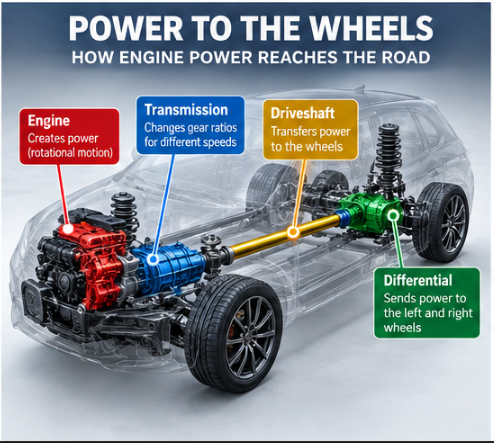
The internal combustion engine is evolving. Hybrid systems add electric motors for extra power and efficiency; fully electric cars replace the engine entirely with motors and batteries. But even in an electrified future, understanding how the combustion engine works remains essential to understanding over a century of automotive and motorsport history — and the vast majority of vehicles still on the road today. Curious about the electric side? See what Formula E is and how it compares to F1.
Frequently Asked Questions
You now understand the machine that changed the world
The internal combustion engine is one of the most transformative inventions in human history, and now you know how it works: fuel and air burned in sealed cylinders, pistons driven down by controlled explosions, and a crankshaft turning that motion into the rotation that moves a car. Everything else — the layouts, the turbochargers, the support systems, the roaring race engines — is a variation on that one elegant idea.
Next time you start your car, or hear a field of race cars thunder past, you’ll know exactly what’s happening inside: the four-stroke cycle repeating thousands of times a second, dozens of systems working in perfect harmony, turning fire into motion. It’s a genuinely remarkable thing — and it’s no longer a mystery to you.
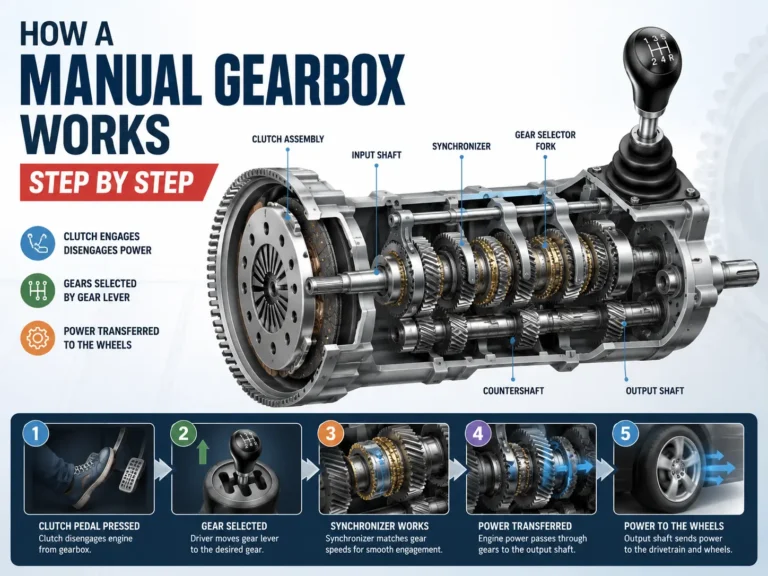
Want to go deeper? Our companion guides on the four-stroke cycle, turbocharging, engine layouts and how gearboxes work will take your understanding further still.