What Is Hybrid Power in NASCAR? (And Does NASCAR Actually Have It?)
Short answer: NASCAR’s Cup Series does not run hybrid power today — it uses a naturally-aspirated V8, and 2026 actually raised the horsepower. But the full story of NASCAR and hybrid is far more interesting. Here’s everything explained.
What Is Hybrid Power in NASCAR?
Does NASCAR actually run hybrids? The honest answer — and the full story behind it.
“Hybrid power in NASCAR” is one of the most searched — and most misunderstood — topics in the sport. With Formula 1, the World Endurance Championship and even NASCAR’s own sister series IMSA all running hybrid systems, it’s a completely reasonable assumption that NASCAR does too. But the reality is more surprising, and the full story is genuinely fascinating.
This in-depth, beginner-friendly guide answers it properly: what hybrid power actually is, whether NASCAR uses it (and the honest answer may surprise you), why so many fans think it does, the long saga of NASCAR’s repeatedly delayed hybrid plans, and what the future realistically holds for electrification in stock car racing. No prior knowledge needed.
The Short Answer: Does NASCAR Have Hybrid Power?
No — the NASCAR Cup Series does not currently use hybrid power. As of the 2026 season, every car in NASCAR’s top division is powered by a traditional, naturally-aspirated V8 engine with no electric motor, no battery and no hybrid assistance of any kind. In fact, NASCAR moved in the opposite direction for 2026, increasing horsepower to 750 at many tracks — a celebration of raw combustion power, not a step toward electrification.
NASCAR Cup cars run a 5.86-litre naturally-aspirated V8 — no hybrid. The current Next Gen car was deliberately designed to accept a hybrid system in the future, and NASCAR has repeatedly discussed and delayed adding one. It has even built and tested a fully electric prototype. But as things stand in 2026, hybrid power in NASCAR is a possibility being explored, not a reality on track. Anyone telling you NASCAR “is hybrid” is mixing it up with F1, WEC, or NASCAR’s sister series IMSA — all of which genuinely are.
That’s the direct answer. But the why — why NASCAR designed for hybrid, kept promising it, and then went the other way — is the actually interesting part, and it tells you a lot about where the whole sport is heading. Let’s build it up properly, starting with what “hybrid power” even means.
What Is Hybrid Power, Exactly?
Before we talk about NASCAR specifically, let’s nail the concept. A hybrid powertrain combines two sources of power: a traditional internal combustion engine (the petrol/gasoline engine) and one or more electric motors fed by a battery. The two work together — sometimes the engine drives the car, sometimes the electric motor adds a boost, and sometimes both push at once.
Where does the electricity come from?
This is the clever part, and it’s the same principle in a road-going hybrid as in a racing one. The battery isn’t plugged in — it’s charged while the car drives, mostly through a process called regenerative braking. When the car brakes, the electric motor runs in reverse as a generator, capturing energy that would normally be wasted as heat and storing it in the battery. That stored energy is then redeployed as an extra power boost when the driver accelerates.
A hybrid still has a petrol engine at its core, with electric power assisting it — it never needs plugging in. A full EV (electric vehicle) has no combustion engine at all, running purely on battery power. When people ask about “hybrid NASCAR,” they almost always mean the first type: keeping the V8 but adding an electric boost. NASCAR’s separate EV prototype is the second type — and a very different conversation.
Why racing series add hybrids
Motorsport has embraced hybrids for two reasons. First, performance: that recovered braking energy is essentially free extra horsepower, deployed at the perfect moment for overtaking. Second, and increasingly the bigger driver, relevance: as road cars electrify, manufacturers want to go racing with technology that mirrors what they sell. A brand building hybrid road cars gets more marketing value from racing a hybrid than a pure combustion dinosaur. Hold onto that second point — it turns out to be the single most important factor in NASCAR’s hybrid story.
| Term | What it means |
|---|---|
| Hybrid | Combustion engine + electric motor working together |
| Full EV | Battery and electric motors only, no engine |
| Regenerative braking | Recovering braking energy to recharge the battery |
| KERS / ERS | Kinetic/Energy Recovery System — the racing name for hybrid boost |
| 48V system | A “mild hybrid” — modest electric assistance, simpler than a full hybrid |
| Parallel hybrid | Engine and motor both drive the wheels; the layout NASCAR designed for |
What NASCAR Actually Runs in 2026
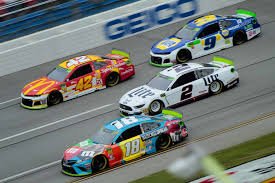
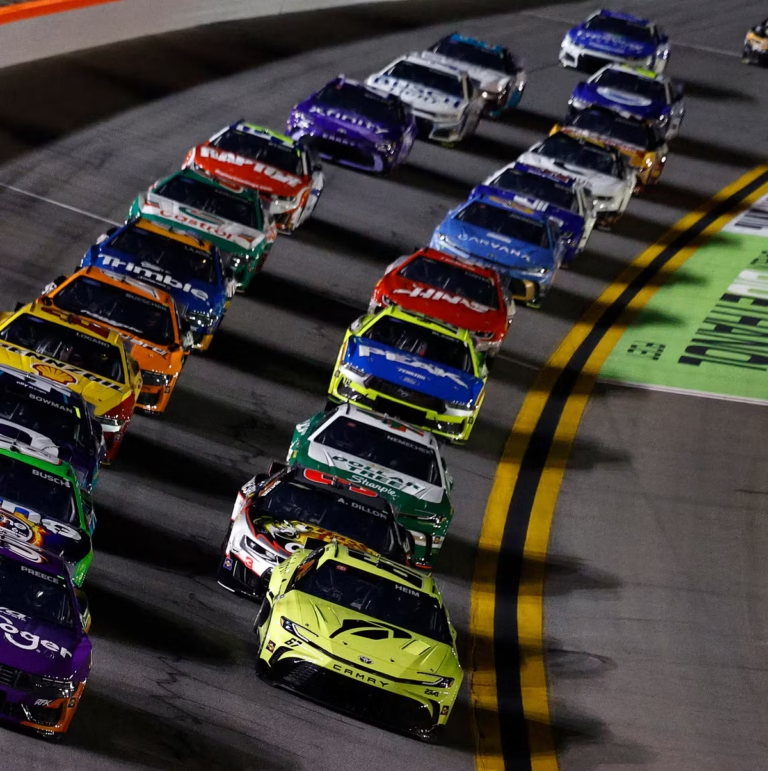
Here’s the reality on the grid today. Every NASCAR Cup Series car — the “Next Gen” car introduced in 2022 — is powered by a 5.86-litre (358 cubic inch) naturally-aspirated V8 engine. Each manufacturer builds its own version: the Chevrolet R07, the Ford FR9 and the Toyota TRD Phase-14. These are pushrod V8s, a fundamentally traditional design, running on Sunoco Green E15 sustainable race fuel.
“Naturally aspirated” simply means the engine breathes air at normal atmospheric pressure — no turbocharger, no supercharger, and crucially no hybrid or electric assistance. It’s about as far from a hybrid as a modern race engine gets, and that’s very much by design: the roar of 40 combustion V8s is central to NASCAR’s identity and its fans’ emotional connection to the sport.
Far from adding electrification, NASCAR’s headline change for 2026 was a horsepower increase. At 17 select tracks — short ovals under 1.5 miles and all road courses — the Cup cars now produce 750 horsepower, up from the baseline of 670. NASCAR President Steve O’Donnell announced the boost in response to years of demand from drivers and fans for more raw power. This is the exact opposite of a hybrid transition: more combustion, more noise, more of the throttle-control challenge that fans wanted back.
| Spec | NASCAR Cup Next Gen (2026) |
|---|---|
| Engine | 5.86 L (358 cu in) V8 |
| Aspiration | Naturally aspirated |
| Hybrid system | None |
| Manufacturers’ engines | Chevrolet R07 · Ford FR9 · Toyota TRD Phase-14 |
| Horsepower (2026) | 670 baseline / 750 at 17 tracks |
| Fuel | Sunoco Green E15 (sustainable, 98 octane) |
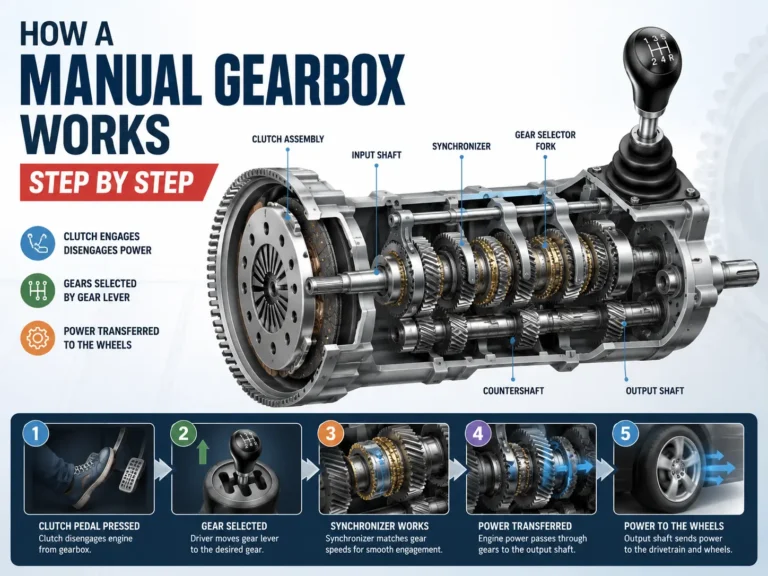
| Transmission | 5-speed sequential manual transaxle |
Why So Many Fans Think NASCAR Is Hybrid
If NASCAR isn’t hybrid, why is “hybrid power in NASCAR” searched so often? Because there are several genuinely good reasons to assume it is. The confusion is completely understandable — here’s where it comes from.
1. Almost every other major series IS hybrid
Formula 1 has run hybrid power units since 2014. The World Endurance Championship’s top Hypercar class is hybrid. And — this is the big one — IMSA, which NASCAR itself owns and sanctions, introduced hybrid systems in its top GTP prototype class in 2023. When the company that runs your favourite stock car series also runs a hybrid sports car championship, assuming the crossover is natural.
2. The Next Gen car was marketed as “hybrid-ready”
When NASCAR launched the Next Gen car in 2022, officials repeatedly and publicly stressed that it had been “future-proofed” to accept a hybrid system. Its modern architecture — an independent rear suspension and a transaxle — was specifically chosen so an electric motor could be bolted on later without redesigning the V8. Fans heard “designed for hybrid” and reasonably assumed hybrid had arrived.
3. NASCAR kept publicly promising it
For years, senior NASCAR figures openly targeted hybrid introduction. Former NASCAR President Steve Phelps stated on multiple occasions that a hybrid component was coming, at one point targeting 2024. Those dates came and went without a hybrid car ever racing, but the headlines they generated stuck in fans’ memories.
4. NASCAR built a very real electric prototype
In July 2024, NASCAR unveiled a genuine electric prototype — a modified Next Gen chassis producing a peak of 1,300 horsepower with regenerative braking, developed with all three manufacturers. It has been demonstrated at races, including a standing-start display in Chicago, and tested at Martinsville. Seeing an electrified NASCAR on track, even as a one-off demo, understandably cements the belief that the technology has arrived.
All four of those things are true — and none of them means the Cup Series races with hybrid power. IMSA hybrids, a “hybrid-ready” chassis, delayed promises and a demo EV prototype are all real, but the cars that line up for the Daytona 500 and every points race remain pure combustion V8s. The gap between “NASCAR is exploring electrification” and “NASCAR races hybrids” is exactly where the confusion lives.
The Saga of NASCAR’s Delayed Hybrid Plans
NASCAR’s relationship with hybrid power is a long story of intention repeatedly meeting delay. Understanding it explains why the technology is simultaneously “always coming” and “never here.”
Will NASCAR Ever Go Hybrid? The Realistic Future
So will hybrid power ever actually arrive in NASCAR? The most likely answer is: maybe, and only if a new manufacturer demands it. The reasoning behind NASCAR’s hybrid decision has shifted decisively from “we should electrify to stay relevant” to “we’ll electrify if it brings a new brand into the sport.”
The manufacturer angle — the real deciding factor
NASCAR currently has three manufacturers: Chevrolet, Ford and Toyota. Attracting a fourth — names like Honda and Hyundai have been linked — is a major strategic goal. And reporting suggests those potential entrants have signalled they’d only join if the series offers a “compelling narrative” involving hybrids or sustainable fuels that matches their road-car technology. NASCAR has itself pointed out that its IMSA series attracted new manufacturers after introducing hybrids in 2023.
This is the crux of it. NASCAR is unlikely to add hybrid power just for its own sake — the current V8 formula is popular and the 2026 horsepower boost proves fans want more combustion, not less. But if adding a hybrid system is the price of landing a fourth manufacturer, the maths changes entirely. Industry reporting has floated a possible 2026–27 window for hybrids if a new automaker arrives — otherwise, the timeline pushes further out.
How a NASCAR hybrid would actually work
If it does happen, the engineering is already sketched out. Because the Next Gen car was future-proofed, a hybrid would most likely be a parallel system: the existing V8 stays, and an electric motor is added to the transaxle to provide a boost, fed by a battery charged through regenerative braking. A simpler “mild hybrid” using a 48-volt system — recycling braking energy to power accessories or provide modest assistance — has also been discussed as a lower-cost entry point. Either way, the V8 soundtrack fans love would likely survive.
The alternative paths: fuel and hydrogen
Crucially, hybrid isn’t NASCAR’s only route to a greener future — and possibly not even its preferred one. The sport already runs Sunoco Green E15 sustainable fuel, and executives have repeatedly emphasised a “long, long road ahead for the combustion engine,” whether powered by sustainable fuel or even hydrogen. NASCAR’s R&D centre is actively testing hydrogen combustion alongside hybrids. It’s entirely possible NASCAR keeps its V8 and greens it through fuel rather than electrification.
| Series | Hybrid status | Notes |
|---|---|---|
| Formula 1 | Hybrid since 2014 | Full ERS energy recovery |
| WEC (Hypercar) | Hybrid | Top class electrified |
| IMSA (GTP) | Hybrid since 2023 | NASCAR-sanctioned |
| Formula E | Full electric | No combustion at all |
| NASCAR Cup | Not hybrid | NA V8; hybrid-ready chassis |
The contrast in that table is the whole story in miniature: NASCAR is the major outlier among top-tier championships, still proudly combustion-powered while the rest of motorsport has electrified to varying degrees. Whether it stays that way depends less on technology and more on business — specifically, on who NASCAR is trying to bring through the door.
Frequently Asked Questions
The bottom line on NASCAR and hybrid power
If you came here wondering how NASCAR’s hybrid system works, the genuine answer is that there isn’t one — not yet, and possibly not for years. NASCAR’s Cup Series remains defiantly, deliberately combustion-powered, running naturally-aspirated V8s that got more powerful in 2026, not electrified. In an era where nearly every other major championship has gone hybrid or electric, NASCAR stands almost alone.
But “not yet” isn’t “never.” The Next Gen car was built to accept hybrid power, NASCAR has tested electric prototypes, and the door remains open — most likely to be walked through only if a new manufacturer makes hybrid the price of entry. Until then, the sport is greening itself the way it prefers: through sustainable fuel and the enduring roar of the V8.
Understanding that gap — between what NASCAR has designed for and what it actually races — is the key to understanding one of the most interesting questions in modern motorsport. And now you do.