Mid-Ohio INDYCAR 2026 Strategy Analysis
Two Stops, Three Stops & Caution Timing
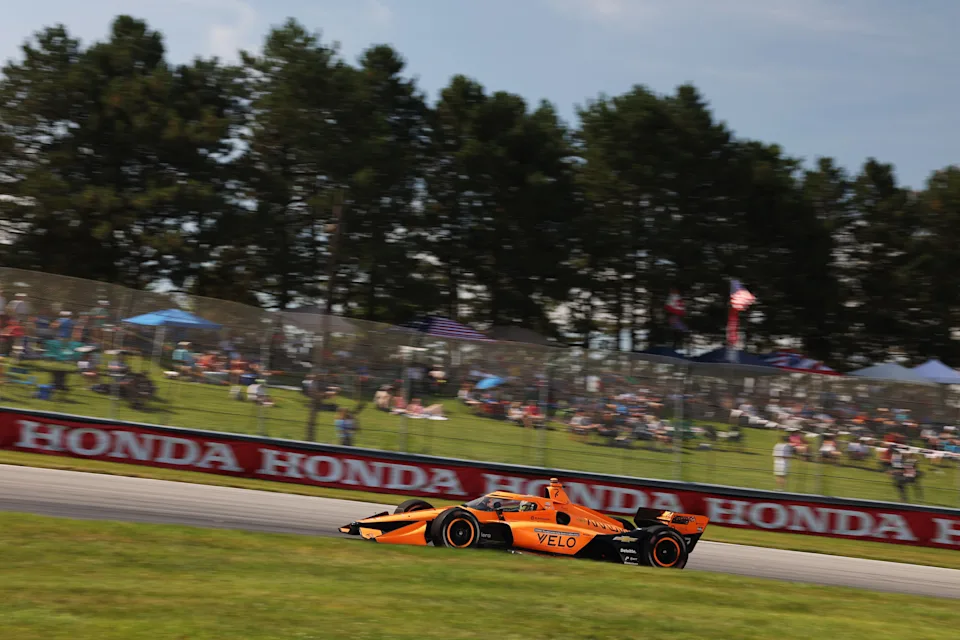
Christian Lundgaard on pole from an Arrow McLaren front-row lockout. Alex Palou starting eighth. Scott Dixon penalised to 23rd. The Honda Indy 200’s strategy picture has never been more volatile going into race morning.
Mid-Ohio 2026 Strategy Analysis
Two Stops, Three Stops & Caution Timing
Lundgaard on pole, Palou P8, Dixon P23. Full strategy breakdown for the Honda Indy 200.
Saturday’s qualifying session at Mid-Ohio Sports Car Course didn’t just produce a starting grid — it produced the conditions for one of the most strategically unpredictable races of the 2026 NTT INDYCAR Series season. Christian Lundgaard claimed pole for Arrow McLaren after a 2-hour 33-minute lightning delay, setting a lap of 1:04.839 to lead an all-McLaren front row ahead of teammate Pato O’Ward. Meanwhile, championship leader Alex Palou committed a costly error in the Round of 12, qualifying eighth — his first failure to claim pole in six events. Scott Dixon, the defending race winner with seven career victories at this circuit, was penalised for impeding Romain Grosjean and starts 23rd on the grid.
Mid-Ohio is an 85-lap, 2.258-mile, 13-turn natural terrain road course that rewards tyre management, clean air, and precise pit-stop timing. With three viable strategic options — the aggressive three-stop, the fuel-conservative two-stop, and the caution-dependent hybrid — and a championship fight at a critical juncture, this is a race where strategic calls will matter as much as pace. This deep-dive examines every relevant scenario in full, from fuel loads and stint windows to the caution timing variables that have defined this event’s recent history.
Race Context: Why Mid-Ohio 2026 Is a Strategy Race Above All
The Mid-Ohio Sports Car Course is defined by its natural terrain layout carved into the rolling hills of North Central Ohio. Its 13 turns span a sequence of fast sweepers, tight chicanes, and elevation changes that place a unique demand on tyres: rear-tyre degradation is high through the constant-radius turns, while front tyres suffer under the heavy braking zones at Turn 2 and the Keyhole. The result is a circuit that genuinely punishes overdriving — teams that push too hard in the opening laps of each stint consistently find themselves losing time in the final 8–10 laps before a mandatory stop.
Mid-Ohio’s caution history is another critical factor. The event has averaged 2.8 full-course yellows per race over the past five years, creating strategic opportunities that can completely invalidate the planned pit window. When a yellow falls with between 15 and 25 laps to go on any stint, it collapses the natural advantage of cars on fresh rubber — a key reason why high-track-position strategies at this circuit often outperform on-paper pace comparisons.
On a 2.258-mile lap, INDYCAR cars at Mid-Ohio can run approximately 28 laps on a full fuel load under normal race conditions without the benefit of yellow-flag conservation. This means an 85-lap race divides neatly into three stints of ~28 laps for a three-stop strategy, or requires teams to use more fuel-efficient engine modes to stretch stints to 30–32 laps for a two-stop. The choice between these modes — and when to make it — is one of the most consequential decisions of race morning.
The weather factor cannot be dismissed in 2026. Practice sessions ran in soaring temperatures on Friday and Saturday morning, with track surfaces reaching scorching levels. Lundgaard himself noted in Practice 2 that the team “found some issues in balance that we didn’t have yesterday, because I think the tires were overheating yesterday.” Tyres that overheat rapidly through the long, medium-speed sweepers of the back section burn their performance window in the first 10–12 laps of a stint — dramatically shortening the effective fuel window for teams running aggressive setups.
Starting Grid Analysis — How Track Position Shapes Strategy
| Pos | Driver | Team / Car | Best Lap | Gap |
|---|---|---|---|---|
| 1 | C. Lundgaard | Arrow McLaren #7 Chev | 1:04.839 | Pole |
| 2 | P. O’Ward | Arrow McLaren #5 Chev | 1:04.864 | +0.025s |
| 3 | W. Power | Andretti Global #26 Honda | 1:04.877 | +0.038s |
| 4 | D. Malukas | Team Penske #12 Chev | 1:04.908 | +0.069s |
| 5 | C. Rasmussen | Ed Carpenter Racing #21 Chev | 1:05.216 | +0.377s |
| 6 | R. VeeKay | Juncos Hollinger #76 Chev | 1:05.409 | +0.570s |
| 7 | J. Newgarden | Team Penske #2 Chev | — | Q12 |
| 8 | A. Palou | Chip Ganassi Racing #10 Honda | — | Q12 mistake T1 |
| 23 | S. Dixon | Chip Ganassi Racing #9 Honda | — | Penalty — interference |
Track position defines strategy at Mid-Ohio more acutely than at almost any other road course on the IndyCar calendar. The circuit offers very limited overtaking opportunities — Turn 1’s braking zone after the short pit straight is genuinely the only place where clean, committed overtaking regularly occurs. Turn 4 and the Keyhole occasionally produce passes, but these are exception rather than rule. Therefore, where a driver starts on Sunday has a direct and calculable effect on what strategy their team can realistically execute.
Arrow McLaren’s front-row lockout gives Lundgaard and O’Ward the rarest commodity in INDYCAR road racing: the freedom to pit when the strategy dictates, rather than when traffic forces them to. A driver starting from position 12 or worse must build enough of a gap, or time their stop to a yellow flag, to avoid losing more positions in the pits than they can realistically recover on track. Arrow McLaren’s problem in recent events has been converting track position from qualifying into race wins — O’Ward in particular has scored front-row starts without victories in three of his last five road course starts. That pattern is the storyline Arrow McLaren most needs to break on Sunday.
Firestone Tyre Compounds at Mid-Ohio 2026
Firestone brings two compounds to every INDYCAR road and street course event: the harder Primary (black sidewall) and the softer Alternate (red sidewall). At Mid-Ohio, the performance difference between the two compounds is typically 0.8–1.2 seconds per lap in favour of the Alternate — but the degradation rate on the red tyre through the long, medium-speed sweepers of the back section can erode that advantage to near-zero within 15 laps in hot conditions.
Practice sessions in 2026 ran in unusually high temperatures. Lundgaard specifically flagged tyre overheating in Practice 2. When track temperatures exceed 50°C, the Alternate tyre’s effective life window at Mid-Ohio compresses from ~20 laps to approximately 12–15 laps before the rear falls off sharply. This has a profound effect on strategy: it makes the three-stop, shorter-stint plan more viable, and puts significant risk on anyone attempting to extend an Alternate stint beyond 18 laps in the heat of Sunday afternoon.
Tyre Requirement Rules at Mid-Ohio
INDYCAR mandates that all drivers must use both the Primary and Alternate compounds during the race. There is no fixed number of stints or minimum stint length mandated beyond that — teams have full freedom in how they mix the compounds across their stops. Consequently, the compound-use requirement becomes a chess match: a team that can time one of their Alternate stints to coincide with a safety car, minimising the time penalty of pitting, gains a disproportionate advantage over rivals who are forced to pit under green.
The data from Road America two weeks ago is directly relevant here. Lundgaard’s winning strategy at Road America involved using the Alternate compound during a period when rivals were on Primary tyres, running in clear air and exploiting the pace delta before his own tyre degradation forced a stop. Strategy director Kyle Moyer built that Road America plan around caution timing — the same skill set Arrow McLaren will lean on at Mid-Ohio.
The Two-Stop Strategy: When Fuel Conservation Wins
A two-stop strategy at Mid-Ohio requires teams to run their cars in a more fuel-efficient engine mode, typically sacrificing approximately 0.3–0.4 seconds per lap of raw pace to stretch each stint by 3–5 laps beyond the natural fuel window. On an 85-lap race, this is achievable if the car stays in clean air — but almost any significant stint on the Alternate compound in hot conditions will defeat the strategy by forcing a third stop due to tyre condition rather than fuel.
The fundamental case for a two-stop strategy rests on pit-time arithmetic. Each INDYCAR pit stop at Mid-Ohio costs approximately 22–25 seconds in raw pit-lane time. That means a third stop relative to a two-stopper costs the car that runs it roughly 22–25 seconds in absolute time — the equivalent of overtaking and pulling away from a rival by half a second per lap across 50 laps. That is a very large hill to climb on a circuit where passing is difficult and clean air is rare outside the top five.
For a driver starting from pole like Lundgaard, the two-stop is almost always the default play. Arrow McLaren won at Mid-Ohio in 2023 with O’Ward on a two-stop, exploiting a caution that fell perfectly to avoid the third stop that rivals needed. The problem for Arrow McLaren in 2026 is the heat factor. If Sunday afternoon track temperatures reach 55°C or above — which is entirely plausible in early July in Ohio — the Alternate tyres may not survive 30 laps without a significant pace cliff, forcing Arrow McLaren to either accept slow final laps or abandon the two-stop plan mid-stint.
“We’re in a good spot. We’re going in one direction. I feel like the speed is in the car and it was there yesterday as well.”
Christian Lundgaard — Post-Practice 2, Mid-Ohio, July 4, 2026 · Source: RACERWho benefits most from the two-stop in Sunday’s specific grid order? Will Power in P3 is the most interesting case. Power is one of the most efficient fuel managers in IndyCar history and one of the series’ most accomplished qualifiers. If he can stay with the Arrow McLaren pair through the first stint without significantly overworking his Alternate tyres, he has the pace and the track position to run a two-stop and put genuine pressure on both McLarens late in the race. Power’s 110th career podium at Road America — where he managed a three-stop race from fifth and benefited from race control’s caution timing — demonstrates exactly the kind of execution he’ll need.
The Three-Stop Strategy: Why Back-Markers Have the Most Freedom
The three-stop strategy at Mid-Ohio is not inherently inferior to the two-stop — it is simply the plan that produces the right answer under different conditions. Specifically, it pays off when at least one caution falls in a position that eliminates or reduces the time lost in the third pit stop. Road America two weeks ago taught the entire INDYCAR paddock this lesson with unusual clarity: Lundgaard’s four-stop strategy from last place beat a field of two and three-stoppers because caution timing eliminated much of the pit-loss penalty on his extra stop.
Three stops at ~22.5 seconds each = ~67.5 seconds of pit loss. For a three-stop to beat a two-stop on pure time, the three-stopper must recover that ~22.5-second deficit purely on pace — roughly 0.27 seconds per lap faster over 85 laps than the two-stopper. At Mid-Ohio, where Alternate tyre advantage is ~0.8–1.2 sec/lap for the first 12–15 laps but near-zero by lap 25, the three-stop cannot recover the deficit on pace alone.
However, if even one caution eliminates a stop penalty, the arithmetic changes instantly. A caution during which a three-stopper takes their final stop = ~0 seconds of net pit-loss for that stop. The strategy is transformed from deficit recovery to strategic neutral with fresher tyres.
For drivers starting outside the top 10, particularly those like Scott Dixon starting 23rd, the three-stop is essentially the only viable plan. Dixon cannot realistically start 23rd, pit twice under green at optimal windows, and emerge near the front of a mid-Ohio race where overtaking is so limited. His only path to a strong result runs through caution periods — exactly the kind of race-day chaos he exploited in his iconic recovery from 22nd in 2014, which remains one of the most discussed strategic drives in Mid-Ohio history.
Dixon’s Recovery Template: 2014 vs 2026
When Dixon started 22nd at Mid-Ohio in 2014 and won, the key elements were: a caution-heavy race that allowed him to cycle to the front through pit-stop timing, exceptional pace in clear air once he emerged near the lead, and a Chip Ganassi Racing strategy team willing to take calculated risks on his behalf. The 2026 situation is structurally similar. Dixon starts 23rd — one position further back than 2014. He is the defending winner of this race. He has seven career victories at this circuit, more than any other driver in history. And now, with his departure from Chip Ganassi confirmed, this is almost certainly his final Mid-Ohio start for the team that made him a legend.
The emotional weight of that context does not change the arithmetic. But it does mean Ganassi will likely build Dixon’s strategy around maximum aggression: multiple early stints on Alternate tyres, pit under every caution available, and trust Dixon’s extraordinary racecraft to close the gap to the front once the strategic picture clarifies in the second half.
“It doesn’t matter where we start as we usually get good results by producing good race cars. But we don’t want to make it so hard on ourselves.”
Christian Lundgaard on Mid-Ohio approach after Road America win · Source: Pit Debrief, June 2026Caution Timing: The Factor That Decides Mid-Ohio Every Year
No race in INDYCAR is more susceptible to caution-driven strategy swings than a natural terrain road course. Mid-Ohio’s tight Turn 2 braking zone, the compressed traffic at the Keyhole, and the run through the Carousel have all produced incidents in multiple recent editions. Furthermore, the circuit’s physical layout — with limited run-off and spectator gravel traps that require crane extraction — means cautions at Mid-Ohio tend to last longer than at purpose-built facilities, typically running 4–6 laps before the restart.
The Critical Yellow Zones: When a Caution Changes Everything
The data from Road America provides the clearest recent example of caution timing’s power. There were five cautions for a total of 11 laps in that 55-lap race. Three of them fell inside the strategic windows described above — and each one shifted the race lead. At the same time, 17 penalties were issued across the weekend including eight cars caught entering the pits when the lane was closed during a yellow. That kind of enforcement environment puts maximum pressure on pit-call execution, because the cost of a mis-timed pit entry under yellow is not just lost time — it is a grid-drop penalty that sends a driver to the back of the field.
At mid-Ohio, the pit lane is long enough that cars entering the lane before the pit-entry line can be scored as “pitting under red” (when the lane is closed) if the yellow is displayed at a specific point on the circuit. Strategy teams must therefore track not just where their car is on the track when a yellow is displayed, but whether the car has already physically crossed the pit entry cone. This judgement call — in real time, under pressure — is one of the highest-stakes decisions in INDYCAR race engineering. Arrow McLaren’s Kyle Moyer made it correctly twice at Road America. Doing it again at Mid-Ohio would be a remarkable repeat.
Driver-by-Driver Strategy Scenarios
Christian Lundgaard (#7 Arrow McLaren) — P1
Lundgaard’s optimal strategy is a two-stop with Alternate-Primary-Alternate compound order. Starting from pole in clean air gives Arrow McLaren full control over their stint length. If they can execute Stint 1 on Alternate tyres for 27–30 laps without overheating, pit under green around lap 28–30, run a conservative Primary stint through the middle of the race, and then close on fresh Alternates — the pace advantage in the final 20 laps should be decisive. The key risk is the first stint in heat. If the Alternates degrade faster than expected, Lundgaard will be forced into either a very short first stop (increasing the chance of needing a third stop) or a slow final stage of Stint 1 that allows O’Ward or Power to put pressure on before the first stop.
Pato O’Ward (#5 Arrow McLaren) — P2
O’Ward’s strategy is a mirror of Lundgaard’s, with one critical variable: if Lundgaard pits first, does O’Ward stay out to take the effective lead? This team-internal dynamic has created friction in previous Arrow McLaren races and is likely to be managed carefully by the team. The more interesting scenario is if a yellow falls while one McLaren is on old tyres and the other is on fresh rubber — forcing Arrow McLaren to choose which driver to sacrifice track position for. Based on this season’s dynamics, the team will likely favour Lundgaard’s strategy over O’Ward’s in a conflict scenario.
Alex Palou (#10 Chip Ganassi Racing) — P8
Palou’s championship lead of 60 points over David Malukas means he arrives in Budapest — sorry, Lexington, Ohio — as a driver who can afford to race conservatively and still extend his advantage. His mistake in qualifying places him in a structural disadvantage: starting eighth, he will almost certainly need a caution to avoid pitting under green at a time that loses him relative positions. Ganassi’s response will likely be to split strategy with Dixon. If Dixon takes an early stop on Lap 15–18 to restart his race, Palou stays out longer in clean air to maximise his pace advantage on Alternate tyres. That gives Ganassi information from both cars about how the race is unfolding before committing Palou’s second stop.
Palou leads the championship 374 points to Malukas’s 314. David Malukas starts fourth. If both finish as they qualify — Palou P8, Malukas P4 — Palou loses net points relative to his rival. For the first time in several rounds, a competitor starting ahead of the champion has a direct opportunity to genuinely reduce the gap on Sunday. Palou’s strategy team will be acutely aware of where Malukas is at every point in the race.
David Malukas (#12 Team Penske) — P4
Malukas arrives at Mid-Ohio after his second consecutive runner-up finish at Road America, continuing one of the most compelling consistency runs of the 2026 season. Starting fourth gives him a flexible strategic position: close enough to the front to run a clean two-stop, but outside the direct slipstream battles that will complicate Arrow McLaren’s opening laps. Penske’s strategy team has been reliably strong on fuel-window management in 2026, and Malukas’s instinctive race-craft on road courses — a genuine surprise given expectations of his oval-course background — gives him a legitimate shot at his first INDYCAR win on a day when the championship leader starts eighth and both McLarens will be busy managing their internal competition.
Scott Dixon (#9 Chip Ganassi Racing) — P23
The 2014 template is clear, but 2026 is not 2014. Dixon is 45 years old, on his way out of the team that made him one of the sport’s greatest champions, and starting from a grid position that requires everything to go right strategically. Ganassi will likely commit Dixon to a sequence of short Alternate stints — 18–22 laps each — pitting under every caution regardless of whether the timing is ideal, and trusting Dixon’s extraordinary tyre-management skills to pull out enough relative lap time in clean air to make the recovery viable. The emotional resonance of this being potentially his final Mid-Ohio start with Chip Ganassi adds a dimension to the day that pure strategy analysis cannot fully capture.
| Driver | Grid | Likely Strategy | Key Risk | Win Probability |
|---|---|---|---|---|
| C. Lundgaard | P1 | 2-stop Alt/Pri/Alt | Tyre heat in Stint 1 | High |
| P. O’Ward | P2 | 2-stop Alt/Pri/Alt | Team internal conflict | High |
| W. Power | P3 | 2-stop Pri/Alt/Pri | Final stint pace | Medium |
| D. Malukas | P4 | 2-stop Alt/Pri/Alt | McLaren pace gap | Medium |
| A. Palou | P8 | Hybrid — caution dependent | Yellow timing vs. Malukas | Medium |
| S. Dixon | P23 | 3-stop — aggressive Alt use | Caution frequency | Low-Medium |
Championship Standings & What Mid-Ohio Means for the Title
| Pos | Driver | Team | Points | Gap to Leader |
|---|---|---|---|---|
| 1 | Alex Palou | Chip Ganassi Racing | 374 | Leader |
| 2 | David Malukas | Team Penske | 314 | -60 |
| 3 | Kyle Kirkwood | Andretti Global | 313 | -61 |
| 4 | Christian Lundgaard | Arrow McLaren | 297 | -77 |
| 5 | Pato O’Ward | Arrow McLaren | 257 | -117 |
This is the first race in the 2026 season where the championship dynamics have directly forced Palou into a compromised grid position relative to his closest rival. Malukas starting fourth versus Palou’s eighth means the Penske driver has a genuine opportunity to score a higher race finish and collect more points than the championship leader for only the second time in nine rounds. Lundgaard winning this race would also close the gap in the standings to 52 points — a number that, with Road America and Portland still to come (both circuits that favour Lundgaard’s road-course strengths), would make the title race look dramatically different than it does right now.
Mid-Ohio represents the first of three consecutive natural road courses on the IndyCar schedule — Mid-Ohio, then Portland, then Laguna Seca. This stretch of the calendar was identified by Lundgaard himself before the Road America race as his best chance to build championship momentum. He has now turned that identification into action with his Road America win and a Mid-Ohio pole. If he can turn the pole into a win, the title race — currently looking like Palou’s to lose — becomes genuinely open for the first time in 2026.
- INDYCAR.com — Official 2026 Honda Indy 200 at Mid-Ohio event page
- RACER — Lundgaard Takes IndyCar Pole at Mid-Ohio
- RACER — Lundgaard tops second Mid-Ohio IndyCar practice
- Motorsport.com — Mid-Ohio qualifying results, starting lineup
- Inside Track Motorsport News — Lundgaard Road America win (strategy reference)
- Motorsport Week — Road America race recap and strategy analysis
- Read Motorsport — Lundgaard Mid-Ohio title test preview
- Pit Debrief — Lundgaard quotes, Road America strategy breakdown
Strategy conclusion: who has the winning hand?
Arrow McLaren arrived at Mid-Ohio having already executed one of the boldest caution-driven strategy recoveries of the 2026 season at Road America, and they’ve backed it up with pole and a front-row lockout. On paper, Lundgaard and O’Ward have every tool required to convert that advantage into a race win: the best grid position, a strategy team that is willing to take risks, and the track-position benefit that makes the two-stop viable from P1.
The storyline that could undo all of it: heat, tyres, and one yellow at the wrong moment. Mid-Ohio’s caution history means no grid advantage is safe once the race goes full-course yellow at an inconvenient time. Palou starting eighth with 60 points of championship margin, Dixon starting 23rd with seven wins at this track and nothing left to lose at Chip Ganassi — these are not passive background characters. In any race where cautions fall between laps 25 and 45, both of them become serious factors.
The honest strategy verdict for Mid-Ohio 2026: Lundgaard is the favourite, Palou is the danger, and Dixon is the wildcard that every strategy team has written into their models. Whatever happens on Sunday at Lexington, Ohio, it is unlikely to be boring.