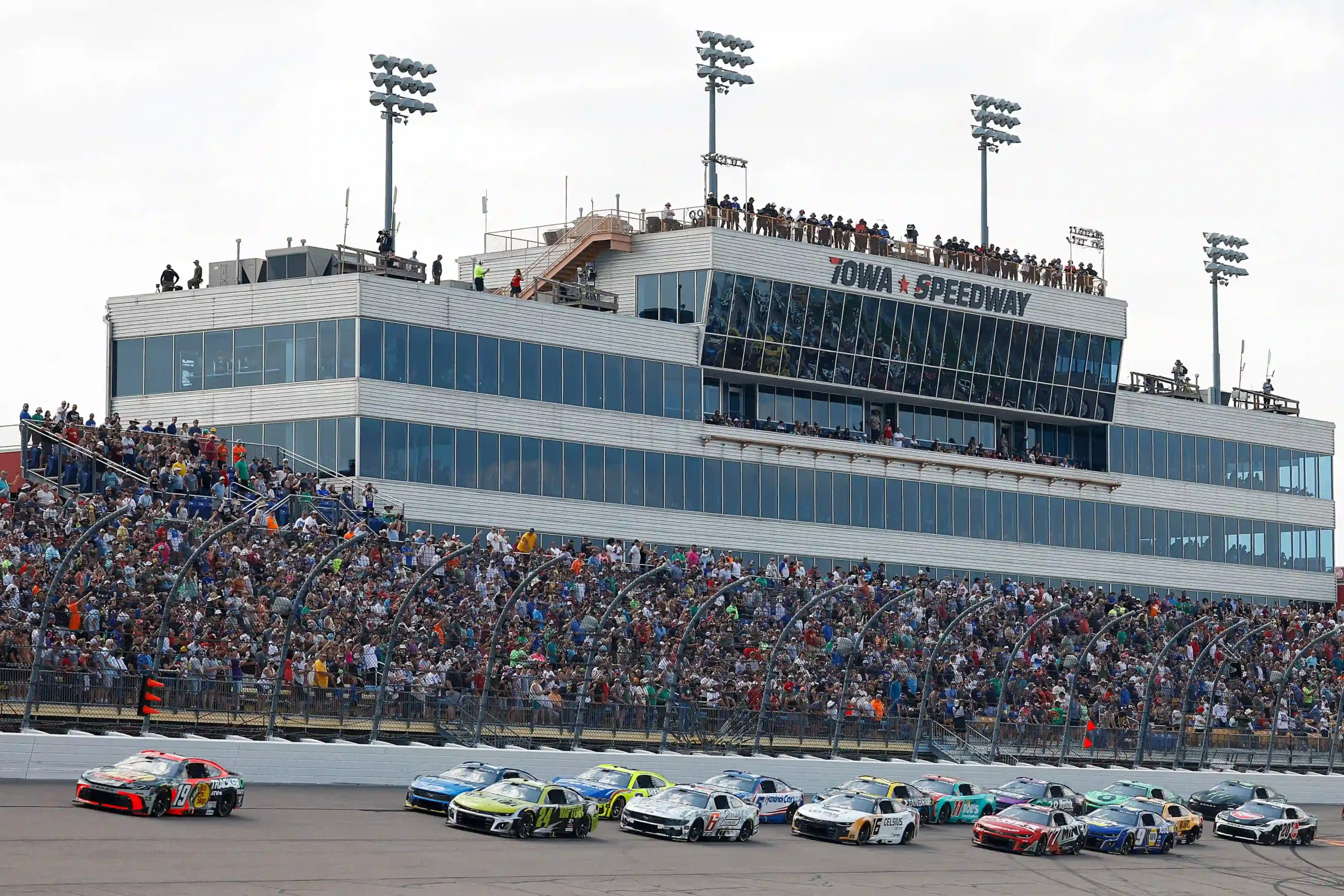
Iowa NASCAR 2026 Qualifying Results
and Starting Grid
Ryan Blaney claimed pole at Iowa with a 23.474-second lap at 134.191 mph. Here is the complete 36-car qualifying order, speeds, gaps, grid analysis and what the front row meant for the Iowa Corn 350.
Ryan Blaney won pole for the 2026 Iowa Corn 350 Powered by Ethanol at Iowa Speedway, putting the No. 12 Menards/Pennington Ford at the front of the NASCAR Cup Series starting grid. NASCAR Statistics recorded Blaney’s quickest lap at 23.474 seconds and 134.191 mph.
Kyle Larson qualified second, only 0.018 seconds behind. Joey Logano was third with the same displayed 23.492-second lap time and 134.088-mph speed. Brad Keselowski completed an all-Ford-heavy first four apart from Larson’s Chevrolet, while Tyler Reddick placed the fastest Toyota in fifth.
The official sheet contains 36 qualifiers, every lap time and every speed. This article uses that complete order and keeps the qualifying result separate from later race performance, while also explaining how the grid shaped Sunday’s 350-lap contest.
Who won pole for the Iowa NASCAR race in 2026?
Ryan Blaney won pole for the 2026 Iowa Corn 350 at Iowa Speedway. The No. 12 Menards/Pennington Ford recorded a 23.474-second lap at 134.191 mph. Kyle Larson qualified second, 0.018 seconds back, while Joey Logano took third with the same displayed 23.492-second time as Larson.
The first number that jumps from the Iowa NASCAR 2026 qualifying results is the margin. Blaney did not have a huge cushion. Larson and Logano were both only eighteen thousandths of a second away, and Keselowski was just 0.029 seconds from pole.
That is a tiny window on any oval. At Iowa, where a qualifying lap lasts a little more than 23 seconds, the smallest steering correction or throttle hesitation can move a car several grid spots. The official sheet shows exactly that compression. The first 10 cars were separated by only 0.121 seconds.
The full field was tight as well. Cole Custer’s 36th-place lap was 24.004 seconds, only 0.530 seconds slower than Blaney. Therefore, the entire 36-car field fit inside just over half a second.
Front Row and Top Three: Blaney Beats Larson and Logano
Blaney’s pole carried extra weight because Iowa has already been a productive track for him. He won the inaugural Cup race at the speedway in 2024, so the No. 12 arrived with a proven baseline for this unusual short oval. Pole added another Iowa milestone to that record.
Larson’s second place was almost indistinguishable on the stopwatch. The timing sheet lists Larson and Logano at exactly 23.492 seconds to three decimal places. Larson received the second position on the official classification, while Logano was third.
Keselowski then arrived only 0.011 seconds behind that pair. His 23.503-second lap meant the top four were covered by 0.029 seconds. In practical terms, the front two rows were decided by less time than a quick blink.
Iowa qualifying was not a case of one car being comfortably clear. It was a four-car fight compressed into twenty-nine thousandths of a second.
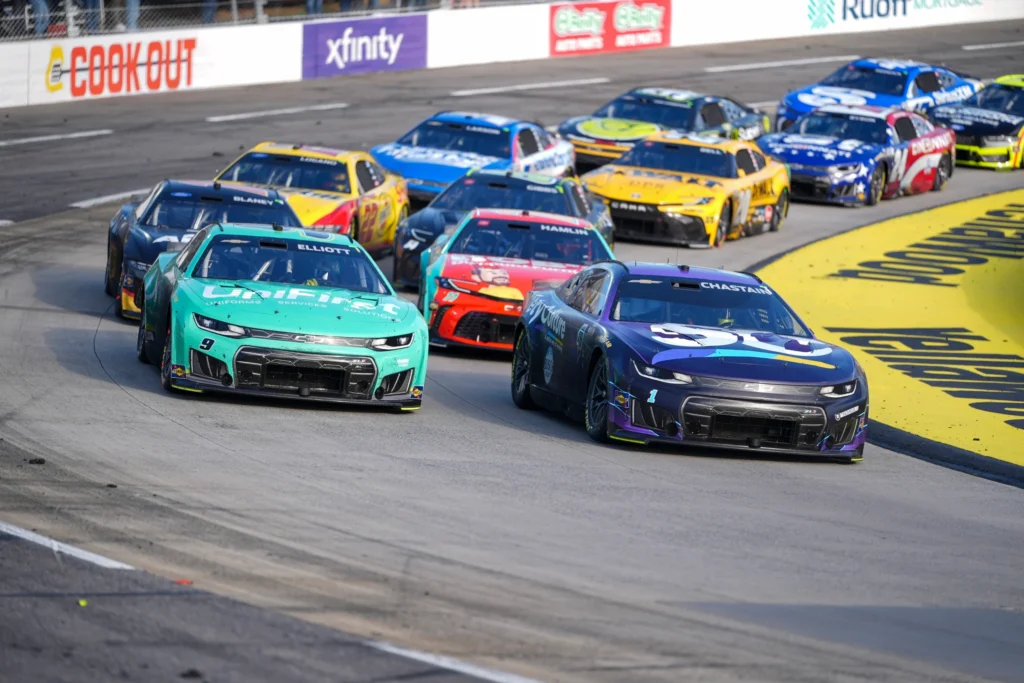
Reddick gave Toyota its first appearance in fifth at 23.523 seconds. Ty Gibbs followed in sixth, while Austin Dillon matched Gibbs’ displayed 23.545-second time in seventh. Connor Zilisch, Ross Chastain and Erik Jones completed the top 10.
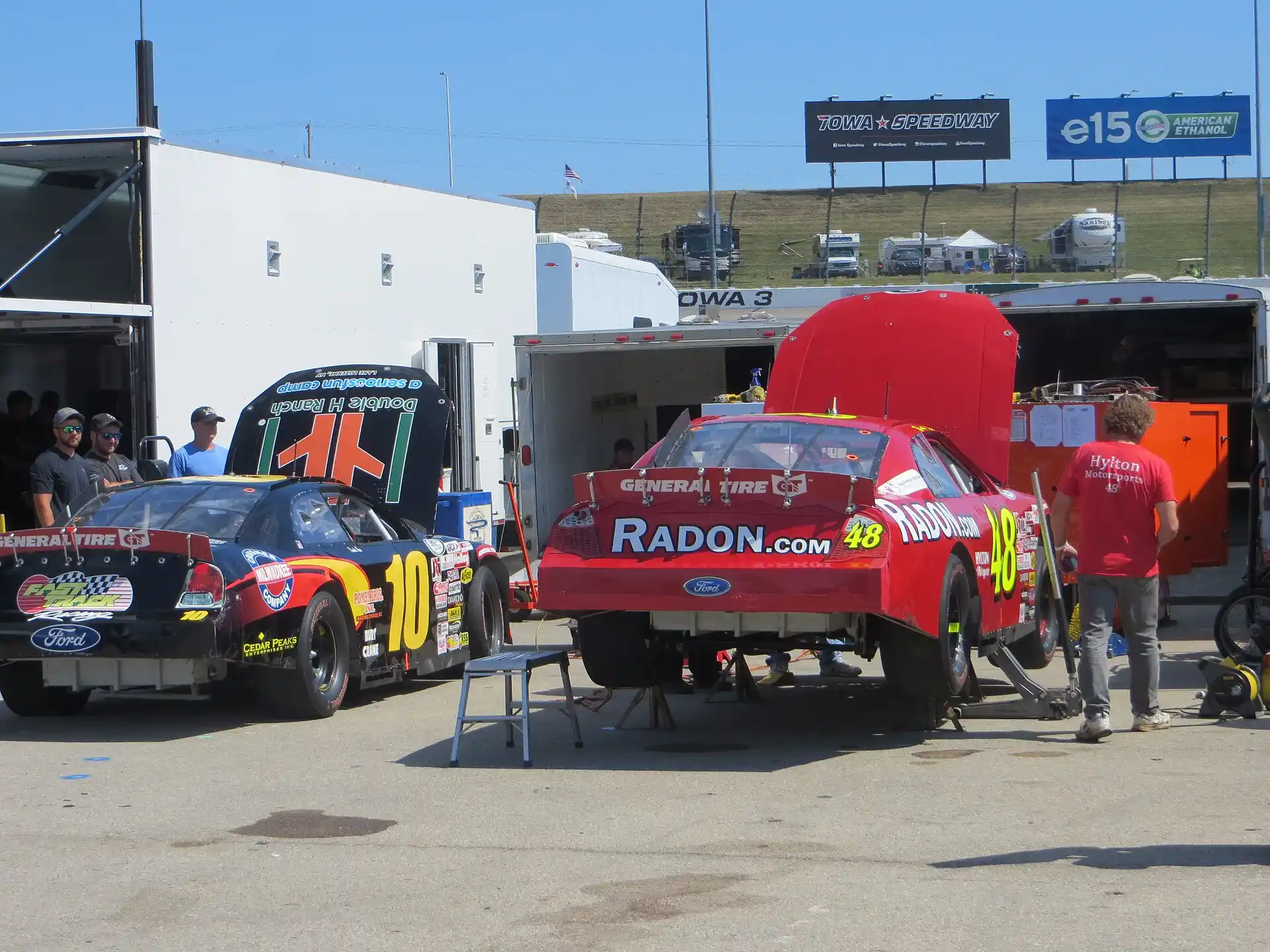
Full Iowa NASCAR 2026 Qualifying Results and Starting Grid
The table below follows the official NASCAR Statistics time-trial order. It is the cleanest way to read the Iowa NASCAR starting grid because it keeps the driver, car number, primary sponsor, manufacturer, lap time and speed together.
The “Gap” column is measured from Blaney’s 23.474-second pole lap. Austin Hill carries the “(i)” designation because he was ineligible for Cup Series driver points, while Connor Zilisch is marked with the rookie symbol on the source sheet.
| Pos | Car | Driver | Primary Sponsor | Make | Time | Speed | Gap | Note |
|---|---|---|---|---|---|---|---|---|
| 1 | #12 | Ryan Blaney | Menards/Pennington | Ford | 23.474s | 134.191 mph | — | Pole |
| 2 | #5 | Kyle Larson | HendrickCars.com | Chevrolet | 23.492s | 134.088 mph | +0.018s | |
| 3 | #22 | Joey Logano | Shell Pennzoil | Ford | 23.492s | 134.088 mph | +0.018s | |
| 4 | #6 | Brad Keselowski | Trimble | Ford | 23.503s | 134.025 mph | +0.029s | |
| 5 | #45 | Tyler Reddick | SupplyHouse | Toyota | 23.523s | 133.911 mph | +0.049s | |
| 6 | #54 | Ty Gibbs | SiriusXM | Toyota | 23.545s | 133.786 mph | +0.071s | |
| 7 | #3 | Austin Dillon | Get Bioethanol | Chevrolet | 23.545s | 133.786 mph | +0.071s | |
| 8 | #88 | Connor Zilisch # | Roto-Rooter | Chevrolet | 23.550s | 133.758 mph | +0.076s | |
| 9 | #1 | Ross Chastain | Busch Light Farming | Chevrolet | 23.566s | 133.667 mph | +0.092s | |
| 10 | #43 | Erik Jones | Dollar Tree | Toyota | 23.595s | 133.503 mph | +0.121s | |
| 11 | #71 | Michael McDowell | Delaware Life | Chevrolet | 23.598s | 133.486 mph | +0.124s | |
| 12 | #2 | Austin Cindric | Freightliner | Ford | 23.599s | 133.480 mph | +0.125s | |
| 13 | #21 | Josh Berry | Menards/Master Force Tools | Ford | 23.602s | 133.463 mph | +0.128s | |
| 14 | #38 | Zane Smith | Patriot Mobile | Ford | 23.617s | 133.378 mph | +0.143s | |
| 15 | #4 | Noah Gragson | Long John Silver's | Ford | 23.625s | 133.333 mph | +0.151s | |
| 16 | #47 | Ricky Stenhouse Jr. | NOS Energy | Chevrolet | 23.643s | 133.232 mph | +0.169s | |
| 17 | #34 | Todd Gilliland | Love's Travel Stops | Ford | 23.653s | 133.175 mph | +0.179s | |
| 18 | #77 | Carson Hocevar | Zeigler Auto Group | Chevrolet | 23.655s | 133.164 mph | +0.181s | |
| 19 | #24 | William Byron | Raptor | Chevrolet | 23.662s | 133.125 mph | +0.188s | |
| 20 | #19 | Chase Briscoe | Bass Pro Shops | Toyota | 23.663s | 133.119 mph | +0.189s | |
| 21 | #42 | John Hunter Nemechek | Pye-Barker Fire & Safety | Toyota | 23.663s | 133.119 mph | +0.189s | |
| 22 | #20 | Christopher Bell | DeWalt | Toyota | 23.674s | 133.057 mph | +0.200s | |
| 23 | #97 | Shane van Gisbergen | Red Bull | Chevrolet | 23.682s | 133.012 mph | +0.208s | |
| 24 | #33 | Austin Hill (i) | Cheddar's Scratch Kitchen | Chevrolet | 23.687s | 132.984 mph | +0.213s | |
| 25 | #16 | AJ Allmendinger | Camper Inn RV | Chevrolet | 23.701s | 132.906 mph | +0.227s | |
| 26 | #23 | Bubba Wallace | Hardee's | Toyota | 23.709s | 132.861 mph | +0.235s | |
| 27 | #17 | Chris Buescher | Body Guard | Ford | 23.718s | 132.811 mph | +0.244s | |
| 28 | #35 | Riley Herbst | Monster Energy | Toyota | 23.729s | 132.749 mph | +0.255s | |
| 29 | #11 | Denny Hamlin | Progressive Insurance | Toyota | 23.762s | 132.565 mph | +0.288s | |
| 30 | #48 | Alex Bowman | Ally | Chevrolet | 23.777s | 132.481 mph | +0.303s | |
| 31 | #10 | Ty Dillon | Sea Best | Chevrolet | 23.802s | 132.342 mph | +0.328s | |
| 32 | #9 | Chase Elliott | NAPA Auto Parts | Chevrolet | 23.819s | 132.247 mph | +0.345s | |
| 33 | #7 | Daniel Suarez | Cal Ripken Sr. Foundation | Chevrolet | 23.848s | 132.087 mph | +0.374s | |
| 34 | #51 | Cody Ware | Costa Oil Filters | Chevrolet | 23.870s | 131.965 mph | +0.396s | |
| 35 | #60 | Ryan Preece | Kroger/Force Factor | Ford | 23.964s | 131.447 mph | +0.490s | |
| 36 | #41 | Cole Custer | HaasTooling.com | Chevrolet | 24.004s | 131.228 mph | +0.530s |
The official document lists one qualifying round and shows each driver’s fastest recorded lap, speed, lap number, number of laps completed, gap to the fastest time and gap to the next position. Most drivers recorded two laps; several posted only one.
Blaney’s advantage looked small at the top, but the gaps stayed narrow well into the field. Michael McDowell in 11th was only 0.124 seconds off pole. Austin Cindric was 0.125 back, and Josh Berry was 0.128 behind.
Even 20th-place Chase Briscoe sat just 0.189 seconds behind Blaney. Briscoe’s position is especially interesting because he held the official Iowa Cup qualifying record entering the 2026 session. His 2025 mark remained untouched despite the field being packed tightly together.
Christopher Bell qualified 22nd at 23.674 seconds. Denny Hamlin was 29th, Alex Bowman 30th and Chase Elliott 32nd. Those positions gave several major names a much harder Sunday starting point than the leading Ford and Chevrolet entries.
What the 2026 Iowa Qualifying Results Tell Us
Ford controlled the sharp end without sweeping it
Ford placed Blaney first, Logano third and Keselowski fourth. That gave the manufacturer three of the first four positions. However, Larson’s Chevrolet prevented a Ford lockout of the first two rows.
The wider top 10 was more balanced. Chevrolet placed four cars inside the first 10, while Ford and Toyota each placed three. Therefore, the result did not point to a single manufacturer owning every route around Iowa.
Across all 36 starters, Chevrolet had 17 cars, Ford 10 and Toyota nine. That distribution matters when reading the lower half of the table. A larger Chevrolet presence naturally creates more Chevrolet entries in the middle and back rows.
Larson and Logano produced the most unusual line on the sheet
Two drivers rarely attract this much attention for identical displayed times. Larson and Logano were both credited with 23.492 seconds and 134.088 mph. Yet the official order placed Larson second and Logano third.
For readers, the important point is not to recalculate or reorder the result. NASCAR Statistics is the classification of record used here. Therefore, Larson is the outside front-row starter and Logano owns the inside of Row 2.
The top 10 fit inside 0.121 seconds
Erik Jones qualified 10th with a 23.595-second lap. That was only 0.121 seconds slower than Blaney. Such a narrow window puts more pressure on execution because one small mistake can turn a potential front-row lap into a fifth-row start.
Ty Gibbs and Austin Dillon provide another example. Both were listed at 23.545 seconds and 133.786 mph. Gibbs was sixth and Dillon seventh. Connor Zilisch then arrived only 0.005 seconds later in eighth.
Bell, Hamlin and Elliott had work to do
Three high-profile names started well outside the front half. Bell qualified 22nd, Hamlin 29th and Elliott 32nd. On a short oval, that means traffic becomes part of the race plan immediately.
Starting deep changes the first-stage calculation. A driver must move forward without overusing the tires, while the leaders can settle into cleaner air. That is why readers should pair qualifying data with pit-stop strategy and short-oval driving technique rather than treating grid position as the whole story.
Iowa rewards a clean starting position, but tire management, restarts, traffic and pit timing can overturn the grid. The 2026 race provided a clear example: the winner did not start from pole.
Iowa Speedway Qualifying Record: Why Blaney Did Not Break It
The NASCAR Statistics sheet lists Chase Briscoe as the Iowa Speedway Cup qualifying record holder. His 2025 lap was 23.004 seconds at 136.933 mph. Blaney’s 2026 pole came at 23.474 seconds and 134.191 mph.
That makes the 2026 pole 0.470 seconds slower than the record lap. The speed difference was 2.742 mph. In percentage terms, Blaney’s lap time was roughly two percent slower than Briscoe’s record mark.
That gap does not make Blaney’s pole less legitimate. Qualifying speed changes with tire specification, track temperature, rubber, weather, setup direction and the amount of grip available at that exact moment. A pole only requires beating the field in the session being contested.
In fact, the compressed 2026 field makes the pole more interesting. Blaney was not chasing an isolated record lap. He was trying to beat 35 rivals who were all packed into a half-second window.
| Benchmark | Driver | Year | Time | Speed | Difference |
|---|---|---|---|---|---|
| Track record | Chase Briscoe | 2025 | 23.004s | 136.933 mph | — |
| 2026 pole | Ryan Blaney | 2026 | 23.474s | 134.191 mph | +0.470s |
If you are new to timed sessions, our guide to how racing drivers qualify explains why one short run can decide the starting order. The related pole-position explainer covers what the first grid slot means once the race begins.
How the Iowa Qualifying Session Was Structured
The NASCAR Statistics document labels the session “Qualifying Round: 1.” Its columns show the fastest time, speed, which lap produced that time, total laps, gap to the fastest driver and gap to the next driver.
Blaney’s fastest lap came on Lap 2 of two. Larson and Logano set their best times on Lap 1. Keselowski, Dillon, Zilisch, Chastain, Hocevar, John Hunter Nemechek and several others were listed with only one completed timed lap on the sheet.
This matters because the first lap and second lap can behave differently at Iowa. A driver may need the opening circuit to build tire temperature and confidence. However, an aggressive first effort can already be the better lap if the second run loses grip.
The official NASCAR event schedule placed Cup practice and qualifying on Saturday, Aug. 8. NASCAR’s credential schedule listed practice from 1:05 to 1:55 p.m. local time and qualifying from 2:10 to 3:00 p.m. local time. The time-trial sheet itself was issued at 4:06 p.m. Eastern.
For a broader view of the weekend, see our Iowa NASCAR 2026 event guide and Iowa practice results analysis. Those pieces help connect the timed lap to long-run behavior.
What Happened to the Qualifiers in the Race?
The grid was important, but Sunday proved why qualifying cannot be treated as a finishing-order forecast. Ty Gibbs started sixth and won the Iowa Corn 350. Christopher Bell started 22nd and climbed all the way to second.
Blaney converted pole into third place. More importantly, he led a race-high 129 laps and won Stage 1. Therefore, the No. 12’s qualifying speed did translate into genuine race pace even though it did not produce the victory.
Larson’s second-place start had a very different outcome. He was classified 33rd after completing 332 laps. Logano started third and finished 14th, while Keselowski started fourth and finished 27th.
Reddick’s fifth-place start ended almost immediately. He completed only three laps and was classified 36th after an accident. Meanwhile, Gibbs used the sixth starting spot as a platform for the winning run and led the final 20 laps.
Bell’s drive is the strongest argument against reading too much into a poor Saturday position. He started 22nd, won Stage 2, led 108 laps and finished second by only 0.253 seconds. That is a huge recovery on a track where every row costs distance at the green flag.
For the complete Sunday order, see our NASCAR race-winner coverage. Readers following the championship can also use the 2026 NASCAR points standings to see how Iowa changed the bigger picture.
Why the first rows still mattered
Blaney’s early control was not accidental. Starting first gave him clean air and the freedom to choose his line without immediately fighting through traffic. He led the opening 93 laps, a direct example of how pole can simplify the first stage.
However, Iowa’s racing surface allows different lines to develop as a run continues. Traffic, tire falloff and pit cycles then change which lane works best. That is why a fast qualifying setup must still survive a much longer race window.
Our guides to how laps are counted, racing flags and how car racing works provide useful background if you are reading a NASCAR classification for the first time.
Why Iowa Speedway Makes Qualifying So Sensitive
Iowa Speedway is a 0.875-mile paved oval in Newton, Iowa. The short lap is the first reason the field compresses. When the whole lap takes about 23 to 24 seconds, a tenth of a second represents a meaningful percentage of total lap time.
The second factor is rhythm. Iowa’s corners demand a clean transition from entry to center and then back to throttle. If a driver turns too aggressively, the front tires can scrub speed. If the car will not rotate, the driver must wait before committing to throttle.
That makes qualifying a balance exercise rather than a simple top-speed run. The best car is the one that carries enough entry speed without asking too much from the tire. Blaney’s 134.191-mph average captured that balance better than anyone else on Saturday.
For more context, our NASCAR speed guide explains why average lap speed changes dramatically between short ovals, intermediates and superspeedways. Iowa’s headline number is lower than a Daytona or Indianapolis qualifying speed, but the precision required is just as serious.
Race setup creates another compromise. A team can chase a single fast lap and gain grid position, yet Sunday requires tire life and stability over repeated laps. The Iowa strategy guide looks at tires, fuel and pit timing in more detail.
Five Qualifying Storylines Worth Remembering
1. Blaney added another strong Iowa chapter
His history at Iowa already included the inaugural 2024 Cup victory. Two years later, he returned to the front of the grid. That combination shows the No. 12 has repeatedly found speed at this track across different weekends.
2. Larson missed pole by only 0.018 seconds
Second place often looks comfortable on a results list. It was not comfortable here. Larson was less than two hundredths from taking the first starting position, and his official speed was only 0.103 mph below Blaney’s.
3. Logano matched Larson’s displayed time
The equal 23.492-second figure is one of the distinctive details of this session. It also reinforces why the official classification should always be used for the final grid rather than re-sorting rounded times.
4. Gibbs started close enough to attack
Sixth was not pole, but it kept Gibbs near the front. That mattered on Sunday. He did not need to spend the first half of the race recovering from deep traffic, and he eventually converted that starting position into the victory.
5. Bell proved a poor grid spot was recoverable
Bell’s 22nd-place qualifying result could have buried his day. Instead, he drove through traffic, won the second stage and finished runner-up. Iowa therefore produced both sides of the qualifying argument: clean air helped Blaney lead early, while race pace allowed Bell to overcome a weak start.
That balance is one reason short ovals remain compelling. Starting position matters, but it never closes the story. The race still asks drivers to manage tires, traffic, restarts and pit-road execution over hundreds of laps.
Iowa NASCAR 2026 Qualifying FAQ
Conclusion: Blaney Earned Pole in One of Iowa’s Tightest Windows
The Iowa NASCAR 2026 qualifying results were defined by tiny margins. Ryan Blaney’s 23.474-second lap earned pole, but Larson and Logano were only 0.018 seconds away on the displayed timing sheet. Keselowski was 0.029 seconds from the top, and the first 10 cars fit inside 0.121 seconds.
The complete starting grid also showed that qualifying speed and race performance can diverge. Blaney led more laps than anyone and finished third, while sixth-place starter Ty Gibbs won. Bell came from 22nd to second, proving that Iowa still gives a strong race car opportunities to recover.
For the record book, however, Saturday belongs to Blaney. He put the No. 12 Ford first on the 36-car grid and added a Busch Light pole to an Iowa résumé that already included a Cup victory.
Sources
Primary timing and event data used for this article: