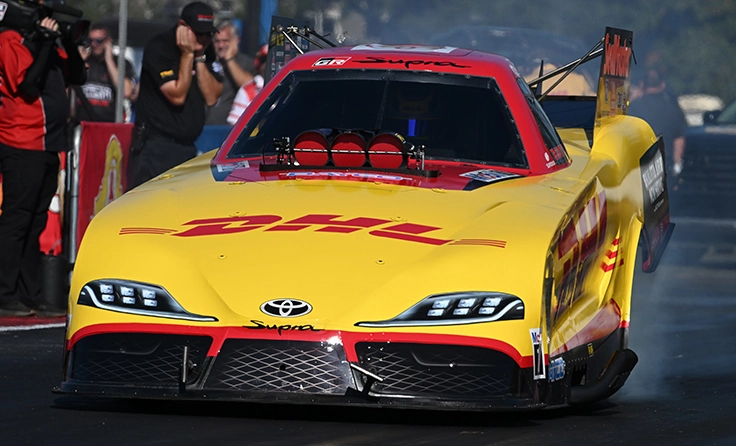
NHRA Northwest Nationals 2026 Funny Car Results
J.R. Todd converted the No. 1 qualifier into his first victory of 2026, survived a .002-second semifinal and beat Austin Prock after a final-round red light.
The NHRA Northwest Nationals 2026 Funny Car results delivered a pole-to-win performance, a razor-thin semifinal and a final decided before the cars reached the Christmas Tree’s green light. J.R. Todd defeated Austin Prock at Pacific Raceways with a 3.941-second pass at 334.90 mph.
Prock left .005 second too early. Therefore, the final ended with an immediate red-light foul. Todd still completed a strong run and earned his first victory of the 2026 season.
The DHL Toyota driver defeated Jeff Arend, Jordan Vandergriff and Matt Hagan before the final. His victory completed a Kalitta Motorsports nitro sweep with Top Fuel teammate Doug Kalitta.
J.R. Todd won Funny Car. He ran 3.941 seconds at 334.90 mph after Austin Prock left .005 second before the green light.
Seattle Funny Car Results at a Glance
| Category | Driver / result | ET / margin | Speed / note |
|---|---|---|---|
| Winner | J.R. Todd | 3.941 | 334.90 mph |
| Runner-up | Austin Prock | Red light | -.005 reaction |
| No. 1 qualifier | J.R. Todd | 3.885 | 335.73 mph |
| Low ET of eliminations | Jack Beckman | 3.858 | Round 1 |
| Closest race | Todd over Hagan | .002 sec. | Semifinal |
| Mission Challenge winner | Daniel Wilkerson | 3.924 | 327.98 mph |
The 37th annual Muckleshoot Casino Resort NHRA Northwest Nationals ran from July 24 through July 26 in Kent, Washington. It was the 12th event in the 20-race Mission Foods NHRA Drag Racing Series season.
Todd qualified first with a 3.885 at 335.73 mph. He was also the only Funny Car driver to reach the 3.80s during Q3.
Beckman produced the quickest pass of Sunday eliminations. His 3.858 in round one defeated Gibbons and reset the event’s Funny Car low elapsed time.
J.R. Todd
Qualified first, won four rounds and snapped a 23-race winless streak.
Austin Prock
Reached his second final of the season but fouled by .005 second.
Jack Beckman
Set Sunday’s quickest Funny Car time during the opening round.
J.R. Todd vs. Austin Prock: Final-Round Result
| Driver | Reaction | ET | MPH | Result |
|---|---|---|---|---|
| J.R. Todd | Green light | 3.941 | 334.90 | Winner |
| Austin Prock | -.005 | Foul | — | Runner-up |
What a -.005 reaction time means
A negative reaction time means the car moved before the green light. Prock crossed that limit by five thousandths of a second.
In NHRA eliminations, a red light produces an automatic loss. Consequently, Todd did not need to outrun Prock at the finish line.
Todd still made a championship-quality pass
Todd completed the run in 3.941 seconds at 334.90 mph. That number matched the strong 3.90-second pace the DHL Toyota showed throughout Sunday.
The clean pass also mattered emotionally. Todd had reached several promising positions during the season but had not converted one into a Diamond Wally.
The win ended a 23-race drought
Todd’s previous national-event victory came in early 2025. The Seattle result ended a 23-race winless stretch.
It was his 23rd career victory and his first Pacific Raceways win in Funny Car. Todd had already won the event in Top Fuel during 2015.
Todd joined a small cross-class group
By winning Seattle in both nitro classes, Todd joined Tommy Johnson Jr., Ron Capps, Del Worsham and Prock. Each has won the Northwest Nationals in Top Fuel and Funny Car.
J.R. Todd defeated Austin Prock with a 3.941 at 334.90 mph. Prock red-lit by .005 second, making Todd the winner immediately.
Funny Car Round 1 Results
| Winner | Opponent | RT | ET | MPH | Race note |
|---|---|---|---|---|---|
| Paul Lee | Chad Green | .066 | 3.938 | 324.36 | Green smoked the tires at the hit |
| Austin Prock | Daniel Wilkerson | .067 | 4.899 | 269.46 | Both lost traction; Prock recovered first |
| Jack Beckman | Tim Gibbons | .078 | 3.858 | 333.49 | Low ET of the event; Gibbons ran a career-best 4.019 |
| J.R. Todd | Jeff Arend | .076 | 3.906 | 335.82 | No. 1 qualifier led from the start |
| Dave Richards | Alexis DeJoria | .116 | 4.540 | 269.89 | Richards recovered better in a tire-smoking race |
| Matt Hagan | Blake Alexander | .063 | 3.936 | 326.00 | Hagan won by .0278 second |
| Cruz Pedregon | Ron Capps | .122 | 3.914 | 330.63 | Points leader Capps shook the tires |
| Jordan Vandergriff | Spencer Hyde | .055 | 3.913 | 327.19 | Vandergriff ended Hyde’s day after a clean launch |
Beckman opened with the quickest pass of eliminations
Beckman ran 3.858 at 333.49 mph against Gibbons. His .078 reaction time also beat Gibbons’ .123.
Gibbons recorded a career-best 4.019 at 307.02 mph. It was his first 300-mph run, but Beckman’s pass was more than sixteen hundredths quicker.
Todd controlled his first pairing
Arend made his best run of the weekend at 4.019. However, Todd left first and ran 3.906 at 335.82 mph.
The No. 1 qualifier won by .1352 second. Moreover, his time secured lane choice against Vandergriff.
Pedregon removed the points leader
Capps reacted first against Pedregon. His car then shook the tires just after launch and never recovered.
Pedregon ran a weekend-best 3.914 at 330.63 mph. Capps slowed to 5.812 and suffered his second consecutive first-round loss.
The result immediately opened the standings. Beckman, Todd, Vandergriff and Hagan all had opportunities to reduce Capps’ lead.
Hagan won the best clean side-by-side race
Alexander ran a weekend-best 3.946 at 326.00 mph. Hagan answered with a 3.936 at the same speed.
Hagan also left first, .063 to .080. His total winning margin was .0278 second.
Vandergriff continued his Sonoma momentum
Vandergriff entered Seattle after winning the Sonoma Nationals. He ran 3.913 at 327.19 mph to defeat Hyde.
Hyde lost traction and slowed to 4.397. Although Vandergriff advanced, Todd’s quicker 3.906 gave the pole sitter quarterfinal lane choice.
Lee, Prock and Richards survived difficult races
Green smoked the tires immediately against Lee. Lee completed a 3.938 and advanced without pressure.
Wilkerson also lost traction at the hit. Prock later encountered his own tire spin, but he pedaled the car to a 4.899 win.
Richards and DeJoria both smoked the tires. Richards recovered sooner and won with a 4.540, securing lane choice over Prock.
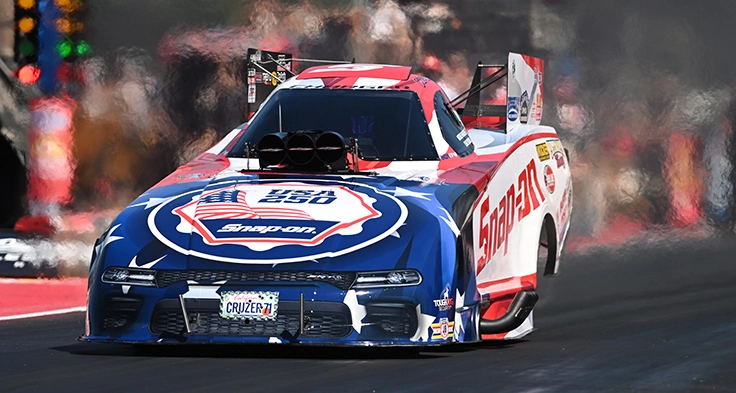
Funny Car Quarterfinal Results
| Winner | Opponent | RT | ET | MPH | Round detail |
|---|---|---|---|---|---|
| Austin Prock | Dave Richards | .066 | 4.065 | 270.48 | Parachute deployed near 400 feet; Richards had already lifted |
| Matt Hagan | Paul Lee | .067 | 3.930 | 322.19 | Second consecutive 3.93-second pass |
| Jack Beckman | Cruz Pedregon | .078 | 3.899 | 330.72 | Quickest pass of the round; earned semifinal lane choice |
| J.R. Todd | Jordan Vandergriff | .054 | 3.939 | 334.40 | Todd chased down Vandergriff after the 800-foot mark |
Todd chased down Vandergriff
Vandergriff gained a .012-second starting advantage. He remained ahead through the early portion of the run.
Todd’s Toyota carried stronger second-half performance. He passed Vandergriff around 800 feet and won with a 3.939 at 334.40 mph.
Vandergriff’s 3.981 was competitive, but Todd’s finish-line speed was more than 15 mph higher. The final margin was .0302 second.
Prock advanced with the parachute deployed
Prock’s parachute came out near 400 feet. He continued pulling it down the track and finished in 4.065 seconds.
Richards had already lost traction before the 330-foot marker. Therefore, Prock’s unusual run was still enough to advance.
Hagan remained consistent
Hagan produced his second straight 3.93-second run. His 3.930 defeated Lee’s clean 4.002.
The result sent Hagan to another semifinal and gave him lane choice over Todd. Hagan’s team had reached at least the semifinals in 171 of 387 career starts at that point.
Beckman earned lane choice against Prock
Beckman ran 3.899 at 330.72 mph against Pedregon. It was the quickest quarterfinal pass.
Pedregon slowed to 4.134 after losing traction. Beckman’s performance created a favorable semifinal position, but reaction time would later reverse the result.
The final four were Todd, Hagan, Prock and Beckman. Todd was the only driver still carrying the No. 1 qualifying position.
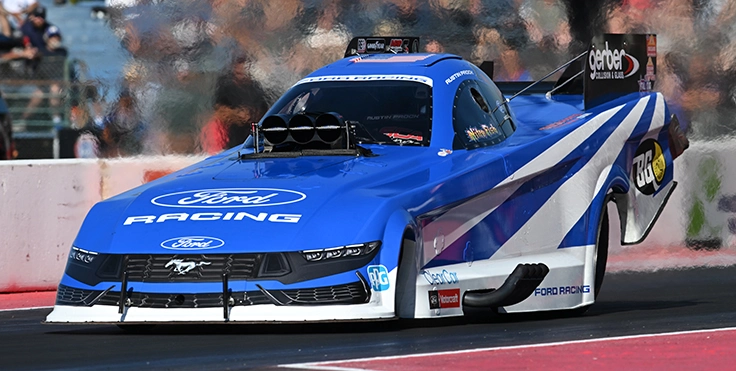
Funny Car Semifinal Results
| Winner | Opponent | Winner ET | Opponent ET | Decision | Race note |
|---|---|---|---|---|---|
| J.R. Todd | Matt Hagan | 3.91 | — | .002 sec. | Todd kept a wandering Toyota ahead of Hagan |
| Austin Prock | Jack Beckman | 3.937 | 3.918 | Holeshot | Prock’s .046 light beat Beckman’s .076 |
Todd defeated Hagan by .002 second
Todd’s Toyota moved around the lane, while Hagan experienced tire spin. Neither driver had a perfectly controlled run.
However, Todd kept the yellow nose ahead at the finish. His 3.91 won by only .002 second.
At Funny Car speed, two thousandths represents a very small physical distance. It was the closest race in the class during the event.
The win was Todd’s first against Hagan in three 2026 meetings. It also moved him into the 51st final of his career.
Prock defeated Beckman on a holeshot
Beckman ran the quicker elapsed time, 3.918 to Prock’s 3.937. Normally, that advantage would decide the race.
Prock reacted in .046 second. Beckman reacted in .076, giving Prock three hundredths at the starting line.
Beckman’s car was .019 second quicker down the track. Yet Prock’s .030 starting advantage was larger, so the Mustang reached the finish first.
This is the definition of a holeshot victory. The driver with the slower elapsed time wins because of a superior reaction time.
Seattle’s semifinals showed both edges of Funny Car racing: Todd survived by .002 at the finish, while Prock won his race before the cars reached 60 feet.
J.R. Todd’s Four-Round Winning Path
| Round | Opponent | Todd ET | MPH | Margin | Key detail |
|---|---|---|---|---|---|
| Round 1 | Jeff Arend | 3.906 | 335.82 | .1352 sec. | Led from the starting line |
| Quarterfinal | Jordan Vandergriff | 3.939 | 334.40 | .0302 sec. | Passed Vandergriff near 800 feet |
| Semifinal | Matt Hagan | 3.91 | — | .002 sec. | Closest Funny Car race of the event |
| Final | Austin Prock | 3.941 | 334.90 | Red light | Prock left .005 second early |
The DHL team raced the conditions
Todd’s crew did not chase the quickest number in every round. Instead, the team adjusted to cloud cover, sunlight and a changing racing surface.
The strategy produced four win lights. Todd’s 3.906 opener was clean, while the 3.939 quarterfinal carried enough top-end power to catch Vandergriff.
The semifinal demanded driver control
Todd later said he believed the team might be in trouble against Hagan. The Toyota moved around, and Todd was not satisfied with his reaction.
Still, he kept the car in the groove and reached the finish first. That ability separated a difficult run from an elimination loss.
The final removed the season’s largest pressure point
Todd had enjoyed a competitive season without a victory. Several opportunities had slipped away, while clutch-disc issues affected the summer stretch.
Seattle removed that burden. The team left with the No. 1 qualifier, the trophy and third place in the standings.
The result was Todd’s first Seattle Funny Car win
Todd’s 2015 Northwest Nationals victory came in Top Fuel. Eleven years later, he added the Funny Car title.
That cross-class record fits Todd’s career. He remains one of the modern era’s most accomplished drivers in both nitro categories.
How Todd Converted the No. 1 Qualifier
| Pos. | Driver | ET | MPH |
|---|---|---|---|
| 1 | J.R. Todd | 3.885 | 335.73 |
| 2 | Jack Beckman | 3.890 | — |
| 3 | Alexis DeJoria | 3.900 | — |
| 4 | Matt Hagan | 3.903 | — |
| 5 | Chad Green | 3.908 | 327.59 |
| 6 | Daniel Wilkerson | 3.924 | — |
| 7 | Cruz Pedregon | 3.926 | 325.61 |
| 8 | Spencer Hyde | 3.929 | — |
Todd took the lead during Q3 with a 3.885 at 335.73 mph. It was the session’s only 3.80-second pass.
Beckman answered with a 3.890 during Q4. However, he missed Todd’s number by five thousandths.
The pole was Todd’s 17th career No. 1 qualifier. More importantly, it placed him opposite Arend in the first round and on the preferred side of the ladder.
Thirteen Funny Cars qualified in the three-second range. The entire 16-car field ran 4.10 or quicker, making Seattle one of the season’s deeper fields.
The pole did not make Sunday easy
Vandergriff had won the previous event. Hagan was a four-time champion, and Prock was the defending Seattle winner.
Therefore, Todd’s route remained demanding despite the first position. He needed performance, top-end speed and race-day control to convert it.
J.R. Todd qualified No. 1 with a 3.885 at 335.73 mph. He became the only professional low qualifier to win the Seattle event.
Funny Car Mission #2Fast2Tasty Challenge
Wilkerson defeated Beckman in a tire-smoking semifinal. Prock advanced past Vandergriff in the other pairing.
In the final, Wilkerson ran a weekend-best 3.924 at 327.98 mph. Prock lost traction, giving Wilkerson his first Mission Challenge title.
The bonus race also contributed to qualifying. Wilkerson’s 3.924 placed him sixth in the final order.
Prock received an immediate rematch during Sunday’s opening round. This time, both cars struggled, but Prock recovered and advanced.
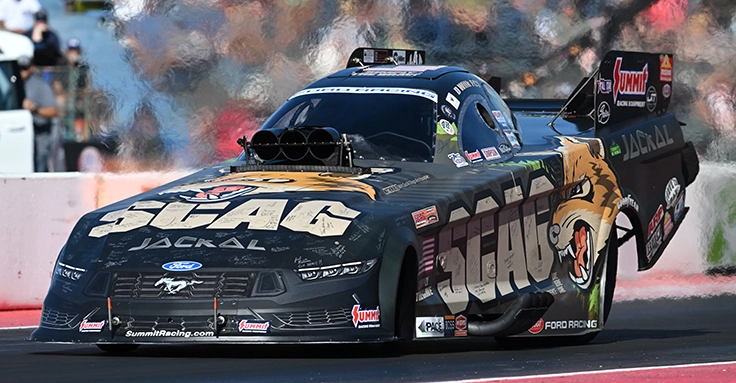
Funny Car Standings after Seattle
| Pos. | Driver | Points | Gap |
|---|---|---|---|
| 1 | Ron Capps | 884 | Leader |
| 2 | Jack Beckman | 847 | -37 |
| 3 | J.R. Todd | 842 | -42 |
| 4 | Jordan Vandergriff | 830 | -54 |
| 5 | Matt Hagan | 820 | -64 |
| 6 | Chad Green | 703 | -181 |
| 7 | Austin Prock | 687 | -197 |
| 8 | Alexis DeJoria | 685 | -199 |
| 9 | Spencer Hyde | 578 | -306 |
| 10 | Daniel Wilkerson | 577 | -307 |
Capps retained the lead despite another early exit
Capps left Seattle with 884 points. His first-round loss prevented him from adding elimination-round points beyond Sunday’s opener.
Even so, Beckman’s semifinal loss and the remaining results kept Capps first. His advantage over Beckman was 37 points.
Todd moved into third
Todd’s qualifying points and four round wins lifted him to 842. He ended the weekend 42 points behind Capps.
That is slightly more than two normal elimination rounds. Consequently, Todd entered the next event as a direct regular-season title contender.
Vandergriff and Hagan remained close
Vandergriff held fourth with 830, while Hagan had 820. The first five drivers were separated by only 64 points.
Seattle therefore tightened the group even though Capps retained a measurable lead. One poor race or one event win could reorder several positions.
Prock gained points but remained seventh
Prock reached the final for the second time in 2026 and the 34th time in his career. The result raised his total to 687.
He remained seventh, two points ahead of DeJoria. However, the Seattle performance confirmed the Tasca operation had recovered from its difficult start.
Ron Capps led with 884 points after Seattle. Beckman was 37 behind, Todd was 42 behind and the top five were separated by 64.
Kalitta Motorsports Completed a Nitro Sweep
Kalitta defeated Leah Pruett in the Top Fuel final with a 3.677 at 338.43 mph. Todd then secured the Funny Car trophy.
The two victories created only the second nitro sweep in Kalitta Motorsports history. Team founder Connie Kalitta saw both primary nitro entries win at the same event.
The sweep also carried championship value. Kalitta moved within five points of the Top Fuel lead, while Todd moved within 42 points in Funny Car.
Both results came through different race patterns. Kalitta won a fully contested final, while Todd benefited from Prock’s red light.
However, each driver needed three earlier round wins to reach that opportunity. The final outcome did not reduce the work required through the ladder.
What Decided the Seattle Funny Car Race
Reaction time decided Prock’s last two races
Prock’s .046 reaction won the semifinal despite a slower elapsed time. His -.005 reaction then lost the final before the green light.
The contrast was striking. Three hundredths of starting-line advantage created one win, while five thousandths beyond the legal limit created the loss.
Todd’s top-end speed won the quarterfinal
Vandergriff gained the starting advantage and remained competitive through the early incrementals. Todd’s car became stronger in the second half.
The 334.40-mph finish allowed Todd to pass Vandergriff near 800 feet. It was one of the clearest examples of finish-line power during the event.
The weather created an aggressive track
Round one began with 65-degree air and an 83-degree track. Cloud cover gave the teams more grip than they had during warmer Friday sessions.
Beckman used those conditions to run 3.858. Yet several teams still smoked the tires because the engines produced more power in the cooler air.
Clean runs were valuable, not automatic
Lee, Hagan, Beckman, Todd, Pedregon and Vandergriff produced clean opening passes. Others needed to pedal or shut off.
That split shaped the quarterfinal ladder. Drivers who avoided major damage also gave their crews a cleaner turnaround before the next round.
Todd’s crew resisted unnecessary risk
The DHL team raced each opponent and track condition rather than pursuing a headline ET. Todd’s round times remained competitive without requiring a record-setting run.
That approach became especially important in the semifinal. A controlled recovery was worth more than a perfect-looking pass that failed to reach the finish.
Five Funny Car Takeaways from Pacific Raceways
1. Todd became a central championship contender
Third place and a 42-point gap put Todd within immediate reach of Capps. The victory also removed the pressure of a winless season.
2. Capps’ lead can no longer absorb repeated early losses
Capps remained first, but two consecutive first-round defeats allowed four rivals to close within 64 points.
3. Beckman had the quickest car but not the trophy
Beckman ran 3.858 in round one and 3.918 in the semifinal. Prock’s reaction time prevented the quicker semifinal pass from advancing.
4. Prock’s recovery is real
The Tasca Ford reached a fourth consecutive semifinal and a second 2026 final. Seattle continued the team’s rebound from a difficult opening stretch.
5. The Kalitta Motorsports sweep changed two title races
Kalitta and Todd both moved close to their respective leaders. The organization left Seattle with trophies and increased championship leverage.
NHRA Northwest Nationals 2026 Funny Car Results FAQ
Conclusion: Todd Converted Seattle Speed into a Championship Win
The NHRA Northwest Nationals 2026 Funny Car results belonged to J.R. Todd. He qualified first, won four rounds and ended a 23-race victory drought.
The final ended through Prock’s red light, but Todd’s weekend was much larger than that single moment. He chased down Vandergriff, survived Hagan by .002 second and completed another 3.90-second run for the trophy.
Prock’s runner-up confirmed the Tasca Ford’s improvement. His holeshot against Beckman was one of the event’s most impressive driver performances, even though the final reaction crossed the limit.
Capps retained the points lead, but Todd moved to third and only 42 points back. Beckman, Vandergriff and Hagan also remained close.
Finally, Todd’s victory joined Kalitta’s Top Fuel win to create a rare Kalitta Motorsports nitro sweep. Seattle rewarded speed, reaction time and the ability to manage imperfect runs.
Sources & Official References
- NHRA — official Funny Car first-round timing
- NHRA — official Funny Car quarterfinal timing
- NHRA — Sunday round-by-round eliminations report
- NHRA — winner report, final result and post-race context
Exact first-round and quarterfinal numbers come from NHRA timing pages. Semifinal and final figures follow NHRA’s official race reports. Points use the post-Seattle unofficial standings published by NHRA.