Nürburgring DTM 2026 Strategy Analysis: Pit Stops, Safety Cars & Changing Conditions
The Nürburgring Sprint track turns DTM strategy into a fight over seconds: when to pit, how to protect tyre temperature, what a Safety Car does to the window, and why Sunday’s second stop creates a very different race from Saturday.
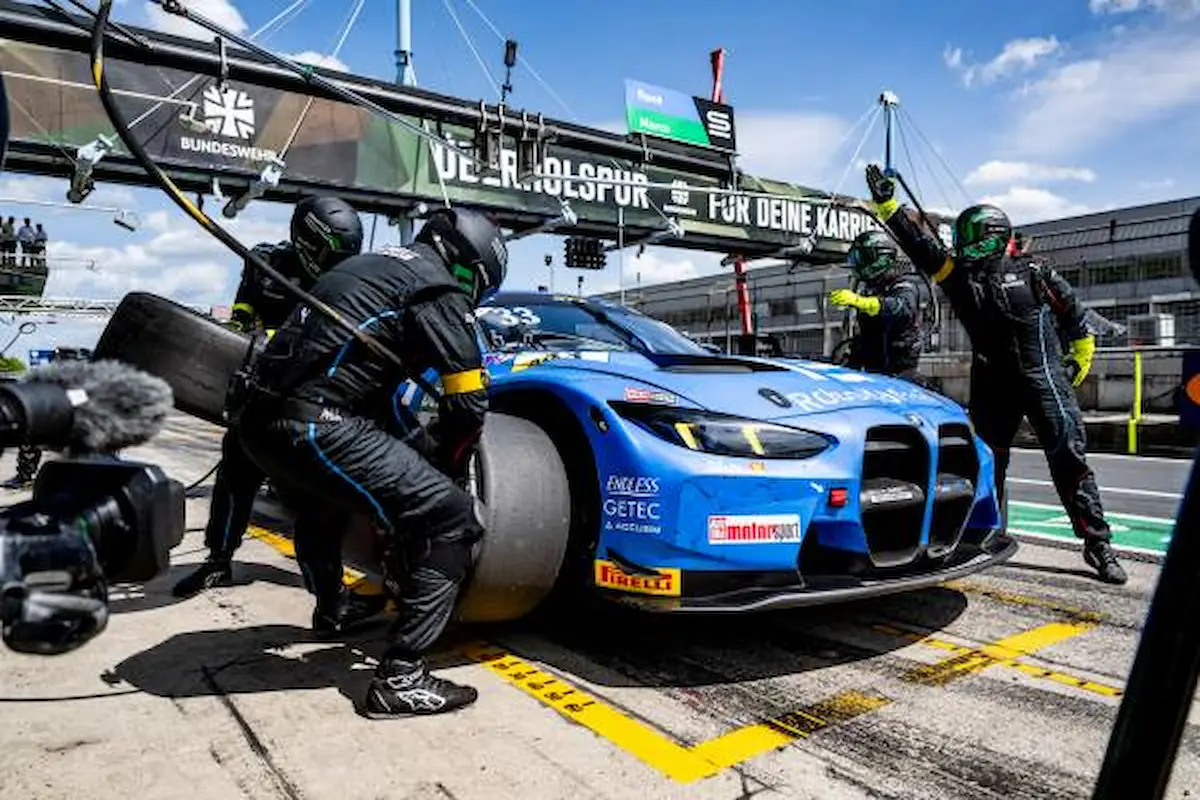
A DTM race can be lost in the pits even when the tyre change itself is fast. At the Nürburgring, the bigger question is often what happens in the lap before the stop and the lap after it.
The 2026 format gives teams several strategic levers. Saturday retains one mandatory tyre-change stop, while Sunday uses two. The established performance pit-stop window runs from minutes 20 to 40, and race control can move the window if a Safety Car or Full Course Yellow disrupts the sequence.
The Nürburgring adds its own pressure. DTM uses the 3.629 km Sprint track, so traffic returns quickly after a stop. Cold tyres can cost position immediately, while a short neutralization can compress gaps that took half a race to build.
What Is the Best Nürburgring DTM 2026 Strategy?
The best strategy is to protect track position while keeping flexibility around the mandatory stop window. On Saturday, teams must judge whether fresh tyres create enough pace for an undercut. On Sunday, the second stop adds another decision point. Safety Car, FCY, traffic and changing grip can all move the ideal stop away from the theoretical fastest lap.
The quickest-looking strategy is not always the fastest race strategy. A team can gain one second through an aggressive early stop and then lose three seconds by rejoining behind a slower group. Therefore, the pit wall has to model traffic as carefully as tyre degradation.
This is especially important at the Nürburgring Sprint track. The lap is short, so the field circulates back to pit exit quickly. A car that leaves the pits on cold Pirellis may have only a handful of corners before a warm-tyred rival arrives.
For readers who want the basics first, our pit-stop explainer covers the mechanics. The GT3 race car guide explains the machinery used in modern DTM.
DTM Mandatory Pit Stop Rules: Why the Window Shapes the Race
DTM’s performance pit stop is built around an official window, historically from the 20th to the 40th minute. All four tyres are changed and there is no minimum stationary time. The race director can alter the window when a Safety Car or Full Course Yellow affects the race.
The key word is “window.” Teams cannot simply pit whenever they want and expect the stop to satisfy the mandatory requirement. The rules deliberately force strategy into a defined part of the race.
That creates a trade-off. An early stop gives fresh tyres sooner, which may help an undercut. However, it also creates a longer final stint. A later stop preserves fresher rubber for the closing phase, but the driver must survive longer on the original set.
DTM’s performance stop also has no minimum stationary time. Therefore, crew execution matters. A team that changes all four tyres cleanly can gain track position without needing extra on-track pace.
Why Saturday and Sunday are strategically different
Saturday uses one mandatory tyre change. Sunday uses two. That single rule change creates a completely different race.
On Saturday, the main decision is when to use the one compulsory stop. Once the driver exits the pits, the team usually knows the rest of the race shape. On Sunday, one stop does not finish the strategic work. The second tyre change creates another chance to attack, defend or recover from traffic.
| Factor | Saturday | Sunday | Strategic effect |
|---|---|---|---|
| Mandatory tyre changes | 1 | 2 | Sunday creates two moments where track position can change in the pits. |
| Main focus | Protect or attack around one window | Sequence both stops efficiently | Sunday rewards flexibility and traffic reading. |
| Undercut risk | High | High, twice | A bad rejoin can hurt one entire phase of the race. |
| Safety Car effect | Can reshape one window | Can reshape either strategic phase | Sunday is more exposed to neutralization timing. |
| Tyre warm-up | One key out-lap | Two key out-laps | Cold-tyre performance matters more on Sunday. |
That difference is visible in 2026 race classifications. Saturday results normally show one stop, while Sunday classifications show two. For example, the 2026 Norisring winner Nicki Thiim made one stop in Race 1 and two in Race 2. Similar two-stop patterns appear across other 2026 Sunday results.
If you want a broader explanation of why changing the number of stops changes race structure, see our race timing guide.
Undercut vs Overcut at the Nürburgring
An undercut means pitting before a rival, fitting fresh tyres and using the extra grip to produce a faster out-lap. If the time gained is greater than the rival’s remaining on-track advantage, the earlier-stopping car can move ahead when the rival finally pits.
The undercut works only when the new tyres are faster quickly. That sounds obvious, but tyre warm-up can make the calculation difficult. If a fresh set needs half a lap to reach its best grip, the driver may not gain enough time immediately.
At the Nürburgring, that problem is magnified by traffic. A driver can have perfect tyre warm-up and still lose the undercut by rejoining behind two slower cars. Therefore, teams track the gaps behind as closely as the gap to the car ahead.
How a clean-air undercut works
When the overcut is stronger
An overcut means staying out longer. It works when the car on old tyres still has strong pace, or when the early stopper rejoins in traffic.
Track position can also make the overcut attractive. If the driver is already in clean air, there is little reason to give that up until the pit wall knows the exit gap is safe.
Changing conditions can strengthen the overcut even more. If rain is approaching, staying out may allow a driver to combine the mandatory stop with a switch to the correct weather tyre. Pitting one lap earlier for slicks can create an unnecessary second decision almost immediately.
Our undercut and overcut explainer uses Formula 1 examples, but the core time-gap logic applies directly to DTM.
Safety Car and Full Course Yellow: The Two Neutralizations Teams Must Read Correctly
A Safety Car compresses the field and can reduce the relative time cost of a pit stop. However, DTM’s mandatory-stop rules still apply. Race control may adjust the pit window when a Safety Car or Full Course Yellow disrupts it, so teams must follow timing messages rather than assume the original window remains unchanged.
Safety Car and Full Course Yellow are both neutralizations, but strategically they are not identical.
A Safety Car gathers the field. Gaps that took many laps to build can disappear. That is good news for a driver who was 10 seconds behind and bad news for the leader who had created the 10-second margin.
Full Course Yellow generally freezes the race at a controlled speed without bunching the field in the same way. Therefore, the relative gaps are more stable. However, pit-entry rules can make FCY strategically restrictive.
Why a Safety Car can make a stop “cheaper”
When the field circulates slowly behind the Safety Car, a car in the pits can lose less race time relative to cars still on track. That is the classic cheap-stop effect.
However, a cheap stop is only useful if it satisfies the mandatory rules and does not drop the car into a worse traffic queue. Teams also need to consider the restart. Fresh tyres are valuable, but cold tyres can be vulnerable when the field accelerates together.
FCY can close the obvious strategy door
Recent 2026 DTM strategy guidance has emphasized that pit entry can close under Full Course Yellow, which removes the obvious “cheap stop” reaction. When FCY interrupts a mandatory window, race control can extend that window and publish a revised closing time.
That means teams cannot simply assume an FCY is an invitation to pit. Engineers have to watch the official messages for the revised opening and closing times.
Safety Car may create a cheap-stop opportunity because the field is compressed. Full Course Yellow can instead close pit entry and force the team to wait. The correct reaction depends on the exact race-control message, not just the yellow status shown on television.
What happens if neutralization begins inside the stop window?
The race director has authority to move the window. That prevents a driver from being unfairly trapped by a caution that arrives exactly when the mandatory stop should be completed.
From a strategy perspective, this means the pit wall must keep two clocks in mind: the original window and the revised race-control clock. Missing the revised deadline can be more damaging than losing a place on track.
For background on caution procedures, see our Safety Car guide, racing flags explainer and Safety Car and VSC comparison.
Changing Conditions: Why the Nürburgring Can Punish a Perfect Dry Strategy
Changing weather changes the value of every pit-stop decision. A team may delay a stop to wait for rain, stay on slicks while a shower passes, or switch early if standing water appears. The critical factor is crossover time: the moment when one tyre type becomes faster than the other.
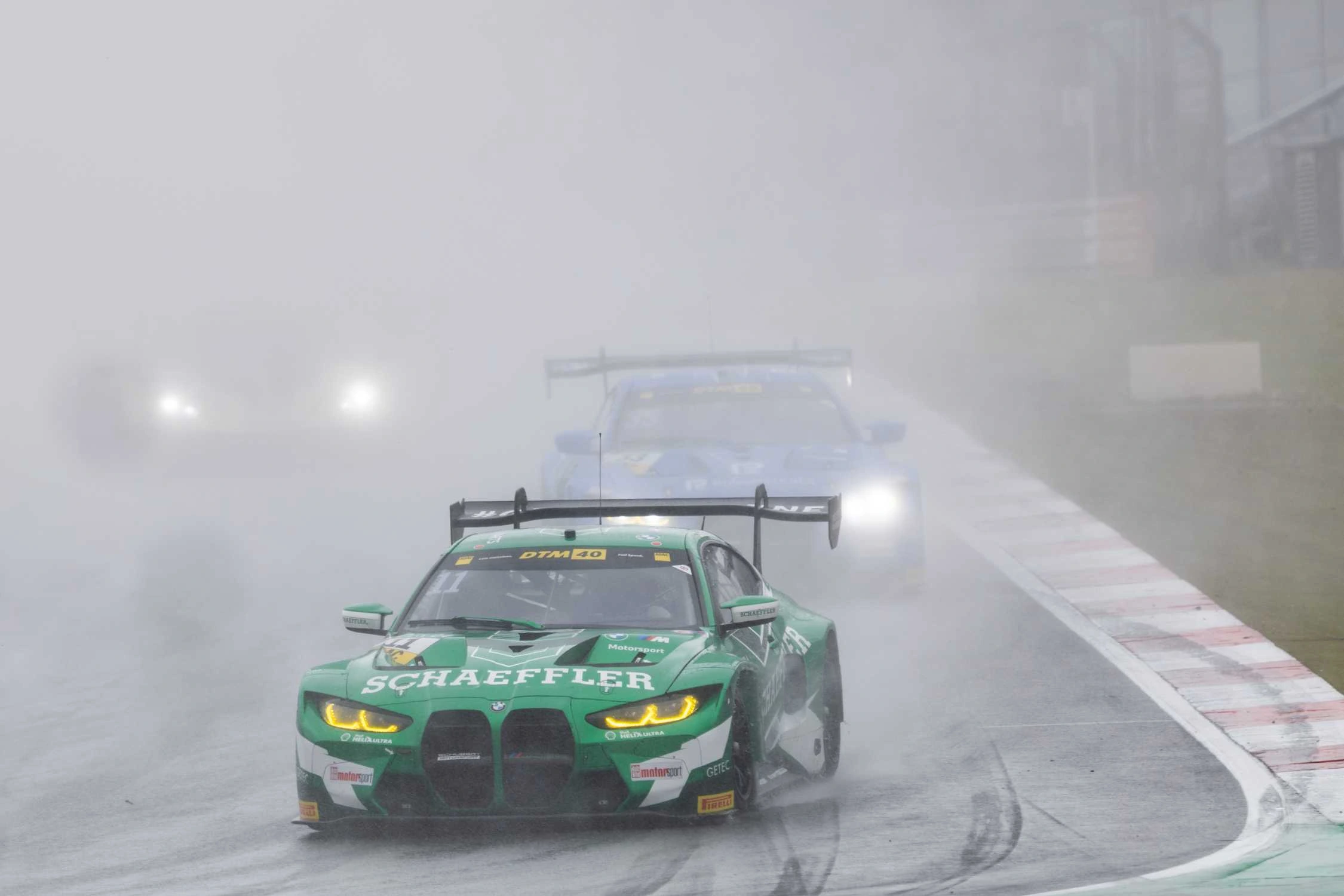
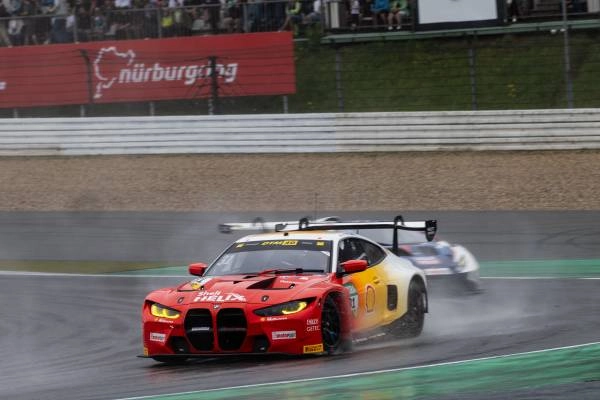
The Nürburgring’s Eifel location has a long reputation for variable conditions. DTM has raced there in heavy rain before, including the wet 2024 weekend. That history matters because it shows how quickly a dry strategy can become irrelevant.
Weather strategy is not simply “wet equals wet tyres.” The difficult phase is the transition.
Scenario 1: light rain on a mostly dry track
Slicks can remain faster when only part of the lap is damp. Switching too early to wet tyres can overheat them on dry sections.
However, staying on slicks increases risk. Braking distances grow quickly on wet asphalt, and the driver may lose several seconds in one lap if the rain intensifies.
Scenario 2: heavy rain arrives suddenly
Once standing water appears, the decision becomes more straightforward. Wet tyres gain a large safety and performance advantage.
Yet traffic still matters. If several cars pit together, crews must execute under pressure. A car delayed in the lane can lose more time than it gained by making the correct tyre choice one lap earlier.
Scenario 3: the track is drying
A drying race is often harder than a wet race. The fastest line may become dry while the rest of the circuit remains damp. Slick tyres can become dramatically faster, but the first driver to switch has to survive a low-grip out-lap.
That is where driver confidence becomes strategic data. Some drivers can generate tyre temperature quickly without sliding. Others need longer. The pit wall should not treat every car and driver combination as identical.
Crossover timing matters more on a short lap
Because the Sprint track is only 3.629 km, teams receive new lap-time evidence quickly. If one car changes tyres and suddenly gains two seconds, rivals can react sooner than they could on a long circuit.
The downside is that the field also reaches pit entry quickly. Engineers may have only seconds to make the call before the driver passes the commitment line.
In changing conditions, compare sector times rather than only full laps. A wet-tyre car may gain heavily in one soaked sector and lose on a drying section. The trend across sectors tells the pit wall whether the crossover is real or temporary.
Cold Tyres After a Stop: The Hidden Cost of a Fast Pit Stop
A pit crew can execute a brilliant tyre change and still expose the driver on the out-lap. Fresh tyres do not automatically provide peak grip at pit exit.
Cold rubber changes braking confidence, steering response and traction. The driver needs to build temperature without sliding the tyre surface. Too much aggression can overheat the surface while the carcass remains below the ideal range.
This is why the undercut depends on more than the stopwatch in the pit lane. A fast stop followed by a cautious out-lap may be slower overall than a slightly slower stop with immediate tyre performance.
Why the Nürburgring increases the risk
The Sprint circuit has little time for a gentle warm-up. Rivals appear quickly, and the technical sections demand confidence almost immediately.
A driver rejoining side-by-side with a rival on warm tyres is especially vulnerable. The warm-tyred car can brake later and accelerate more confidently. Therefore, teams often prefer a clear pit-exit gap even if it means delaying the stop by one lap.
Grip is the foundation of this calculation. Our grip explainer and car handling guide explain why temperature changes the driver’s confidence so quickly.
Sunday’s Two-Stop Race Creates the Biggest Strategy Puzzle
DTM’s race format keeps one mandatory stop on Saturday and uses two mandatory tyre changes on Sunday. The second Sunday stop creates another undercut opportunity, another cold-tyre out-lap and another chance for Safety Car timing to change the race.
The second stop is not just an extra tyre change. It changes how the entire race is planned.
On Saturday, a team can commit to an undercut and then spend the remainder of the race protecting the position. On Sunday, that same early move may only solve the first third of the strategic problem.
Split the race into three phases
A simple way to understand Sunday is to divide it into three stints: start to Stop 1, Stop 1 to Stop 2, and Stop 2 to the finish.
Each phase has a different target. The first stint is about maintaining position and keeping options open. The middle stint often determines whether the second stop becomes offensive or defensive. The final stint is where the strategy must convert into track position.
The second stop creates strategic counterplay
If a rival undercuts at Stop 1, the race is not over. The leading team can change the timing of Stop 2.
For example, it can extend the middle stint to create fresher tyres for the finish. Alternatively, it can stop early again to cover track position. The right choice depends on tyre degradation and traffic.
This extra counterplay is why Sunday classifications across 2026 show two stops for the leading cars. The format was created to make the second race more strategically dynamic, and that goal is obvious in how many different pit sequences become possible.
Safety Car between the two stops is the nightmare scenario
A team can complete Stop 1 perfectly and then see the entire advantage disappear behind a Safety Car. The field compresses, and cars that delayed the next stop may gain a cheap opportunity.
Therefore, Sunday strategy needs more contingency plans than Saturday. The pit wall must know what to do if neutralization arrives before Stop 1, between the stops or after Stop 2.
Why Track Position Matters So Much on the Nürburgring Sprint Layout
Strategy only works if the driver can use the position it creates. At the Nürburgring, track position is valuable because the short layout gives traffic a large influence on lap time.
A faster car stuck behind a slightly slower GT3 may lose the exact two or three seconds needed for an undercut. The following driver also uses more tyre while trying to stay close enough to attack.
Clean air is a strategic resource
Teams often talk about “clean air” as if it were an aerodynamic luxury. In strategy terms, it is also predictable lap time.
A driver in clear track can brake where expected, use the full racing line and control tyre temperatures. A driver in traffic has to react to the car ahead. Therefore, two cars with identical tyre life can produce different lap times simply because one has space.
Our slipstream guide explains the straight-line benefit of following another car. However, the same following position can create compromises in braking and corner entry.
Why pit exit is one of the most important places on the track
Before calling a stop, engineers estimate where the car will rejoin. This is the pit-loss calculation.
The goal is not merely to exit ahead of one rival. It is to exit into a gap large enough to let the driver warm the tyres and attack.
If the predicted rejoin is behind a group of three cars, the team may stay out. One extra lap on older tyres can be faster than three laps trapped in traffic.
Grid position changes how aggressive the strategy must be
A driver starting second usually wants a different race from a driver starting 14th.
The front-row car can cover rivals and protect clean air. The midfield car may need an aggressive early stop to escape traffic. Therefore, there is no single “best” Nürburgring strategy for the entire grid.
For more on starting position, see our grid-position explainer and pole-position guide.
What Previous Nürburgring DTM Races Teach About Strategy
Previous seasons give useful examples, even though the exact cars and race rules change.
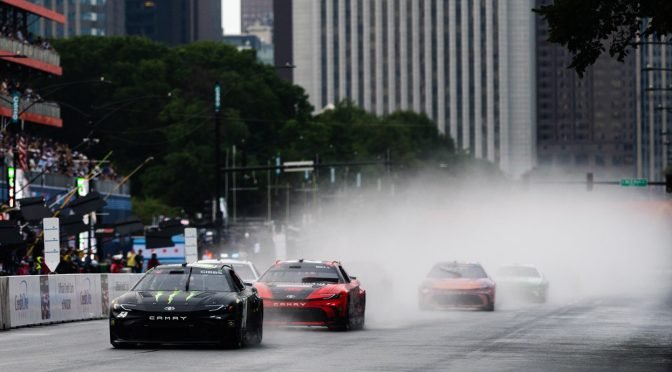
In the 2024 Nürburgring DTM weekend, heavy rain created a very different strategic environment from a normal dry sprint. Cars raced through large amounts of spray, which made tyre choice, visibility and Safety Car timing central to the result.
The 2025 Nürburgring round also highlighted pit-stop timing. A later stop can leave a driver with fresher tyres for the closing laps, while an earlier stop can create track position if the out-lap is strong.
The strategic lesson is not that every Nürburgring race rewards a late stop. It is that the circuit gives teams enough variation in traffic, tyre state and weather for several strategies to work.
That is why copying the leader’s stop is not always the safest move. If the chasing car has different tyre wear or a different pit-exit gap, matching the leader can lock in the same disadvantage instead of creating a new opportunity.
Five Strategy Scenarios That Can Decide Nürburgring DTM 2026
1. Leader pits early to cover an undercut
This is the classic defensive call. The leader stops as soon as a close rival does, preventing the rival from using fresh tyres for several clear laps.
The downside is lost flexibility. Once the leader reacts, the team no longer controls the timing. A later Safety Car may then help drivers who stayed out.
2. Midfield driver pits at the first legal opportunity
This can work if the driver is trapped behind slower traffic. Fresh tyres plus clean air may create a much larger gain than simply following the queue.
However, the pit wall must confirm the rejoin gap. Pitting early into another traffic group defeats the purpose.
3. Rain begins during the mandatory window
This is the most difficult decision. Teams have to judge whether the rain will become strong enough to require wet tyres.
If the answer is yes, delaying the stop can combine the mandatory tyre change with the weather switch. If the rain is only brief, staying on slicks may save an unnecessary stop.
4. Safety Car arrives immediately after a rival pits
The rival who stopped under green may suddenly lose strategic value because the rest of the field can stop at a lower relative time cost.
This is one of the cruelest parts of race strategy. The original call can be correct based on all available information and still become wrong seconds later.
5. Sunday Safety Car falls between Stop 1 and Stop 2
This is the scenario with the most strategic branches. Some cars will have newer tyres. Others will still need their second stop. The field will also be compressed.
The pit wall must decide whether to use the neutralization for Stop 2, delay for better tyre life, or protect track position. One choice can change several positions at once.
Nürburgring DTM 2026 Strategy FAQs
Conclusion: Nürburgring Strategy Is About Timing the Whole Race, Not Just the Pit Stop
The biggest mistake when analyzing DTM strategy is to focus only on the stationary pit-stop time. The tyre change matters, but the surrounding laps matter more.
On Saturday, one mandatory stop creates a direct undercut-versus-overcut battle. The ideal call depends on tyre pace, traffic and the pit-exit gap.
Sunday is more complex because two mandatory stops split the race into three strategic phases. A team can win the first pit cycle and still lose the race in the second.
Safety Car and Full Course Yellow add another layer. A Safety Car compresses the field and can make a stop relatively cheaper. FCY can instead close pit entry and force teams to wait for revised race-control instructions.
Then there is the Nürburgring itself. The 3.629 km Sprint layout circulates traffic quickly, which makes clean air extremely valuable. Cold tyres are exposed almost immediately, while a bad rejoin can destroy a theoretically perfect undercut.
Changing weather is the final wildcard. A shower can move the crossover point in a single lap. A drying line can reward the first driver brave enough to switch back to slicks. In both cases, the team that reads the trend first gains the advantage.
Therefore, the best Nürburgring DTM 2026 strategy is not a fixed lap number. It is a flexible plan built around track position, tyre temperature, traffic, neutralization risk and the exact moment the circuit changes.
Sources
Strategy rules and event details were checked against official DTM/ADAC material and 2026 DTM results pages. Historical Nürburgring examples are used only to illustrate how wet conditions and pit timing can affect GT3 racing.