What Is Bargeboard In F1? Formula 1 Bargeboard Explained
A bargeboard in F1 is a vertical aerodynamic bodywork piece placed between the front wheels and sidepods. It directs turbulent airflow around the car, helps control vortices, supports sidepod and floor performance, and improves aerodynamic efficiency.
The bargeboard looks like a small carbon-fibre blade. However, in Formula 1 aerodynamics, that blade can decide how cleanly the rest of the car receives air.

What is bargeboard in F1 is a useful question because this part sits in one of the dirtiest airflow zones on the car. The front tyres, front wing, suspension arms and nose all disturb the air before it reaches the sidepods.
A Formula 1 bargeboard is placed there to manage that mess. It is not a power part, braking part or suspension part. It is pure aerodynamic bodywork.
This topic connects directly with F1 bodywork, downforce, F1 diffusers, and clean air in F1.
In simple words, the bargeboard helps the car decide where the air should go next.
What Does Bargeboard Mean In Formula 1?
A bargeboard in Formula 1 means a vertical aerodynamic element between the front wheels and sidepods. It helps direct airflow around the car.
The name sounds strange because it does not describe the job very well. In practice, it is an airflow-management panel.
Older F1 cars often had very complex bargeboard zones. These included slots, teeth, turning vanes, small winglets and vortex-generating edges.
Race analyst view: Bargeboards are not about one big downforce number. They are about making the air arriving at the floor, sidepod and diffuser more useful.
Where Is The Bargeboard Located On An F1 Car?
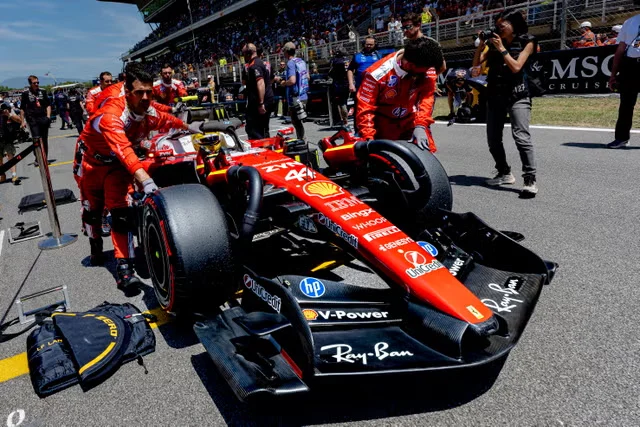
The bargeboard sits behind the front wheels and in front of the sidepods. That location is crucial because the airflow there is already disturbed.
The front wheel creates a large wake. Meanwhile, the front wing produces vortices and pressure changes. The bargeboard tries to sort that flow before it reaches the middle of the car.
That is why bargeboards link with endplates in F1, DRS, the Coanda Effect, and the F1 airbox.
How Do Bargeboards Work In F1?
Bargeboards work by turning, separating and energising airflow. They can push turbulent air away from sensitive surfaces or guide useful air toward the floor and sidepods.
They also help create vortices. A vortex is a spinning airflow structure. When managed well, it can help seal the floor edge or keep flow attached downstream.
However, a bad bargeboard design can make drag worse. It can also send turbulent air into the wrong area and hurt diffuser performance.
| Bargeboard Job | What It Does | Why It Matters |
|---|---|---|
| Airflow direction | Guides air around the sidepod | Improves downstream aero quality |
| Vortex control | Creates useful rotating airflow | Can support floor-edge sealing |
| Wake management | Handles front-wheel turbulence | Protects the floor and diffuser |
| Drag control | Reduces messy flow losses | Improves aerodynamic efficiency |
When Were Bargeboards Introduced In F1?
Bargeboards became part of F1’s aerodynamic language in the 1990s. Over time, teams turned simple panels into complex carbon-fibre sculptures.
By the late 2010s, the bargeboard zone was one of the most detailed areas of an F1 car. It often looked chaotic, but each small cut and edge had a job.
Racecar Engineering has described the bargeboard as one of the most complicated aerodynamic devices because it can contain many small carbon-fibre parts.

Why Were Bargeboards Removed And Why Did They Return?
The 2022 Formula 1 regulations simplified many aerodynamic surfaces. The goal was to reduce outwash and make cars easier to follow.
Racecar Engineering explained that the 2022 rules limited the number of aerodynamic devices and pushed teams toward a defined flow field and wake pattern.
Therefore, the old maze of bargeboards disappeared. The focus shifted toward ground-effect floors, floor fences and cleaner bodywork.
From 2026, Formula 1 describes in-washing bargeboards as part of the new aerodynamic solution. The idea is to help prevent out-washing turbulent air behind the car.
How Do Bargeboards Affect Downforce And Dirty Air?
Bargeboards do not work alone. Their effect depends on the front wing, floor edge, sidepod inlet, diffuser and rear bodywork.
If they guide air well, the floor can create more stable downforce. If they fail, the diffuser may receive weak or turbulent flow.
That is why a bargeboard is not simply a small plate. It is part of the complete aerodynamic chain from the nose to the rear wing.
This connects with bottoming out in F1, F1 car monocoque, autoclave use in F1 cars, and the FIA.
Bargeboard Vs Sidepod: What Is The Difference?
A bargeboard is an aerodynamic guide. A sidepod is a larger bodywork structure that usually contains cooling inlets and radiators.
The bargeboard sits ahead of the sidepod and helps prepare the airflow. The sidepod then uses that air for cooling and aerodynamic shaping.
So, the two parts work together. However, they are not the same component.
Do Modern F1 Cars Still Need Bargeboards?
Modern F1 cars need controlled airflow more than ever. The exact shape and legal freedom change with each regulation era.
Under the 2022 ground-effect concept, teams relied heavily on floors, floor fences and edge details. In 2026, the rules bring back a defined bargeboard role to influence front-wheel wake.
The purpose stays the same. Teams want useful air near the floor and sidepods, while reducing harmful turbulence for following cars.
Final Verdict
A bargeboard in F1 is a vertical aerodynamic bodywork piece between the front wheels and sidepods. It directs airflow, manages turbulence and supports the car’s wider aerodynamic platform.
Old bargeboards became extremely complex because teams used them to control vortices and condition flow around the car. However, modern rules changed how much freedom teams have in that area.
For beginners, the answer is simple. A bargeboard guides air. For serious fans, it is one of the clearest examples of how Formula 1 turns messy airflow into lap time.
FAQs About Bargeboard In F1
What is a bargeboard in F1?
It is a vertical aerodynamic bodywork piece between the front wheels and sidepods.
What does a bargeboard do on an F1 car?
It directs airflow, manages turbulence and helps the floor, sidepods and diffuser work better.
Where is the bargeboard located?
It sits behind the front wheels and ahead of the sidepods.
Why were bargeboards removed in 2022?
The 2022 rules simplified aerodynamic devices to control wake and help cars follow more closely.
Are bargeboards back in F1?
Formula 1 describes bargeboards returning from 2026 as part of the new aerodynamic concept.
Is a bargeboard the same as a sidepod?
No. A bargeboard guides airflow ahead of the sidepod. The sidepod is a larger bodywork and cooling structure.