Hungarian Grand Prix 2026: Full Schedule, Race Timetable, TV Coverage & Streaming Guide
Every session time, every broadcaster, and everything you need to follow Formula 1’s tightest, twistiest European round before the summer break begins.
Hungarian Grand Prix 2026: Full Schedule, Race Timetable, TV Coverage & Streaming Guide
Every session time and broadcaster for F1’s last European round before the summer break.
The Hungarian Grand Prix 2026 takes place July 24–26 at the Hungaroring near Budapest, marking the 40th running of the event and Round 13 of the 2026 FIA Formula One World Championship. It’s also the final race before the summer shutdown, traditionally giving the weekend a last-day-of-school intensity as every team pushes hard before the factories close.
This guide covers everything you need: the full confirmed session schedule, time zone conversions for every major region, every broadcaster by country, a complete circuit breakdown of the tight and technical Hungaroring, and the championship context heading into Budapest.
Hungarian Grand Prix 2026 — Full Weekend Schedule
The Hungarian Grand Prix 2026 follows the standard three-practice format. There is no Sprint race at the Hungaroring this year. Friday opens with two practice sessions, Saturday brings a third practice plus qualifying, and Sunday is race day with a 70-lap, 306.6 km Grand Prix distance.
| Day | Session | Local (CEST) | Duration | Type |
|---|---|---|---|---|
| Fri 24 Jul | Free Practice 1 | 13:30–14:30 | 60 min | FP1 |
| Fri 24 Jul | Free Practice 2 | 17:00–18:00 | 60 min | FP2 |
| Sat 25 Jul | Free Practice 3 | 12:30–13:30 | 60 min | FP3 |
| Sat 25 Jul | Qualifying (Q1/Q2/Q3) | 16:00–17:00 | ~60 min | QUALI |
| Sun 26 Jul | Hungarian Grand Prix | 14:00–~16:00 | 70 laps | RACE |
The Hungarian GP keeps its traditional three-practice-session format. There’s no Sprint race scheduled here in 2026. Always confirm exact times via the official Formula 1 website in the 24 hours before each session, since support races on the same weekend can occasionally cause minor adjustments.
The Hungaroring’s compact, twisting layout makes Friday practice especially valuable. Therefore, FP2 — run in conditions closer to Sunday’s afternoon heat — tends to be the most representative session for predicting race pace. For background on how these sessions fit together, see our how race timing works guide.
Why the Friday-to-Sunday Gap Matters More in Hungary
Most circuits reward teams who nail their setup on Friday and simply refine it through the weekend. Hungary is different. Track temperatures climb steadily across the three days, and the surface itself rubbers in more dramatically here than at almost any other venue on the calendar. Consequently, a car that feels balanced in Friday’s cooler evening session can behave very differently by Sunday afternoon, when the asphalt is baking under direct July sun.
This is precisely why qualifying position carries outsized weight at the Hungaroring. Overtaking is genuinely difficult through the circuit’s tight middle sector, so a strong Saturday translates almost directly into Sunday track position. Teams know this, and as a result, Saturday’s qualifying hour often produces some of the most committed, all-or-nothing laps of the entire season. For a closer look at how that single qualifying hour actually unfolds, our F1 qualifying explained guide breaks down the Q1, Q2, and Q3 elimination format in detail.
Hungarian GP 2026 Start Times by Time Zone
The Hungarian Grand Prix race starts at 14:00 local time on Sunday July 26 — a comfortable early-afternoon slot for European fans and a reasonable morning watch in the Americas. Below is the conversion for every major market across all sessions.
| Session | CEST (Local) | BST (UK) | ET (US East) | PT (US West) | IST (India) |
|---|---|---|---|---|---|
| FP1 — Fri | 13:30 | 12:30 | 07:30 | 04:30 | 17:00 |
| FP2 — Fri | 17:00 | 16:00 | 11:00 | 08:00 | 20:30 |
| FP3 — Sat | 12:30 | 11:30 | 06:30 | 03:30 | 16:00 |
| Qualifying — Sat | 16:00 | 15:00 | 10:00 | 07:00 | 19:30 |
| 🏁 Race — Sun | 14:00 | 13:00 | 08:00 | 05:00 | 17:30 |
Late July in Budapest regularly sees air temperatures above 35°C, with track surfaces reaching 60°C. That heat directly affects tyre degradation and cooling strategy — worth keeping in mind when watching how teams manage their cars across the 70-lap distance.
How to Watch the Hungarian Grand Prix 2026 — TV & Live Stream
Geo-restricted streams accessed via VPN can violate broadcast agreements and platform terms of service. F1 TV Pro is the safest legitimate option for fans without a dedicated local broadcaster.
For a deeper guide on watching Formula 1 across devices, see our full F1 live stream guide and where to watch Formula 1 overview.
The Hungaroring — Circuit Guide
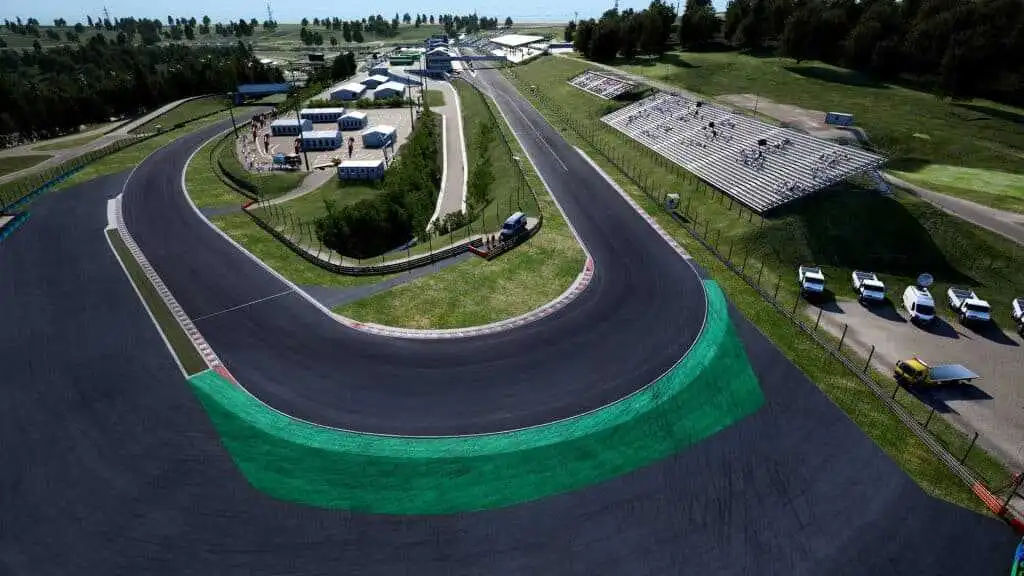
Work began on the Hungaroring in 1985, and the track was race-ready in under a year. It hosted its first Grand Prix in 1986, becoming the first Formula 1 venue behind the Iron Curtain. The circuit sits in a natural valley near Mogyoród, just outside Budapest, with hillside grandstands giving spectators a view of almost the entire lap.
The Hungaroring’s lack of long straights has earned it frequent comparisons to a karting circuit. Teams therefore run Monaco-level downforce, and a well-balanced chassis is typically rewarded over raw horsepower. Turn 1 is the primary overtaking zone after a long braking area, aided by a DRS zone on the pit straight. However, the tight, twisting nature of the remaining corners makes subsequent passing extremely difficult — strategy and qualifying position matter enormously here.
Lewis Hamilton has won at the Hungaroring eight times — double the tally of any other driver in the race’s history, and a record that may stand for years.
Michael Schumacher’s 1998 win for Ferrari remains one of the track’s defining strategic masterclasses — a three-stop gamble that overturned a front-row McLaren lockout. More recently, Lando Norris won the 2025 edition for McLaren. For more circuit-specific strategy concepts, see our guides on what is downforce and how pit stops work in racing.
Corner-by-Corner: What Makes the Hungaroring So Demanding
The lap begins with a long run down to Turn 1, the fifth-longest start-line straight on the entire calendar at 472 metres. That length matters, because it’s genuinely the best — and for some cars, the only — overtaking opportunity all lap. Drivers who qualify poorly know exactly where their race will be decided, and exactly how narrow that window actually is.
From there, the Hungaroring tightens immediately. Turn 4 is a fast, downhill right-hander that tests a car’s mechanical balance under load, rewarding drivers who can carry speed through a blind compression without unsettling the rear axle. Furthermore, the Turn 11-12 chicane near the end of the lap demands total commitment — a moment’s hesitation here costs more time than almost anywhere else on the circuit, since the corners that follow offer little opportunity to recover lost momentum.
Hungary also has an unusually rich history of first-time winners. Damon Hill broke through here in 1993, Fernando Alonso followed in 2003, Jenson Button claimed his maiden win in soaking 2006 conditions, Heikki Kovalainen triumphed in 2008, and Esteban Ocon added his name to that list in 2021. Therefore, the Hungaroring has built a reputation as a circuit that occasionally rewards opportunism over pure pace — a pattern worth remembering heading into 2026.
Championship Context Heading Into Hungary
The Hungarian Grand Prix carries unique weight on the calendar because of its position: it’s the final round before Formula 1’s mandatory summer shutdown. Teams traditionally bring their last significant aerodynamic updates of this phase of the season to Budapest, since any development gains made here will be banked for weeks before the championship resumes. Therefore, Hungary often becomes the round where the true competitive order of the season’s middle stretch becomes clear.
For the latest standings heading into the weekend, see our F1 2026 championship standings page, and for a breakdown of how the points system works across a season, our F1 points system explained guide is a useful primer. Teams arriving with momentum from the British Grand Prix carry it directly into this round — see our British Grand Prix 2026 schedule for the prior round’s context.
What a Strong Hungary Weekend Actually Buys a Team
Beyond the points on offer, a good result in Budapest carries psychological weight that extends well into the summer break. Drivers and engineers spend three weeks away from the paddock between Hungary and the next round, and a strong final impression tends to shape morale, sponsor conversations, and internal team confidence heading into the second half of the season.
Moreover, because Hungary so often punishes overtaking-dependent strategies, it tends to favour teams with genuinely balanced cars rather than those relying on raw straight-line speed. Consequently, the result here can be read as a fairer reflection of true competitive order than rounds at power-sensitive circuits like Monza or Baku. Fans wanting to understand how that competitive order is actually calculated across a full year should also read our guide on how racing championships are scored, which explains the mechanics behind every points table referenced in this piece.
FAQ — Hungarian Grand Prix 2026
One last thing before the lights go out
The Hungarian Grand Prix has a habit of rewarding patience over raw speed, and 2026 looks unlikely to break that pattern. With its tight, karting-style layout and a long history of strategic upsets — from Schumacher’s three-stop gamble in 1998 to countless one-stop surprises since — Budapest tends to punish teams who arrive overconfident.
This is also the last European round before the summer shutdown, meaning every team has extra incentive to leave Hungary with answers rather than questions. Whether you’re watching on Sky Sports, ESPN, or F1 TV Pro, set your alarms using the table above — and expect a race that rewards the team that gets its tyre strategy right under that brutal Hungarian summer heat.