Tokyo Formula E 2026: Full Schedule, Race Times, TV Coverage & Streaming Guide
The official Tokyo E-Prix timetable in JST and U.S. time zones, broadcaster and streaming details, the Tokyo Big Sight street circuit, plus the verified story of a dramatic night-race double-header.
The 2026 TDK Tokyo E-Prix brought Formula E into a new visual era in Japan. Rounds 14 and 15 of the 2025/26 ABB FIA Formula E World Championship were staged on Saturday, July 25 and Sunday, July 26, with both races beginning at 20:05 in Tokyo. For a U.S. audience, that translated to an early-morning 7:05 a.m. ET start on both race days.
This guide preserves the official Tokyo Formula E 2026 schedule, the television and streaming plan, and the useful time-zone conversions American viewers needed. Because the weekend has now been completed, it also records the major verified changes and results: Sunday practice was washed out, Dan Ticktum won Round 14 with a last-lap move, and Nyck de Vries mastered mixed conditions to win Round 15.
Broadcaster information below reflects Formula E’s official event listings for the Tokyo weekend. Replay and on-demand availability can change after an event, so viewers returning after race day should check the listed broadcaster or Formula E’s official video pages for current access.
Tokyo Formula E 2026: the quick answer
The Tokyo E-Prix was the penultimate event weekend of Formula E’s 2025/26 season. It contained two championship races rather than one, which made the timing more important than a normal single-race weekend. Round 14 ran on Saturday, July 25. Round 15 followed on Sunday, July 26.
Formula E scheduled both races for 20:05 Japan Standard Time. Tokyo does not use daylight saving time, while the United States was on summer daylight time in July. Therefore, the race start converted to 7:05 a.m. Eastern, 6:05 a.m. Central, 5:05 a.m. Mountain and 4:05 a.m. Pacific.
What time did the 2026 Tokyo E-Prix start?
Both Tokyo races were scheduled for 20:05 JST on July 25 and July 26. In the United States, that was 7:05 a.m. ET, 6:05 a.m. CT, 5:05 a.m. MT and 4:05 a.m. PT. In the United Kingdom, the official listing was 12:05 p.m. BST.
The event was also notable because Formula E promoted it as Tokyo’s first night-race double-header. That changed the atmosphere around Tokyo Big Sight and created a later local start than fans had seen at the venue before. It also produced convenient lunchtime viewing in Britain but a sunrise-style schedule for much of the United States.
Full Tokyo Formula E 2026 schedule and U.S. race times
The official timetable began with Free Practice 1 on Friday evening in Tokyo. Saturday featured practice, qualifying and Round 14, while Sunday repeated that structure for Round 15. However, the weather changed the final day’s program: heavy rain delayed and then cancelled Free Practice 3.
The table below keeps the original scheduled times because those are the times viewers searched for and broadcasters planned around. The status column shows what actually happened. Be careful with Friday and Saturday date changes in North America, particularly in Central and Pacific time.
| Session | Date in Tokyo | JST | ET | CT | PT | BST | Status |
|---|---|---|---|---|---|---|---|
| Free Practice 1 | Fri, Jul 24 | 19:00 | 06:00 Fri | 05:00 Fri | 03:00 Fri | 11:00 | Completed |
| Free Practice 2 | Sat, Jul 25 | 13:30 | 00:30 Sat | 23:30 Fri | 21:30 Fri | 05:30 | Completed |
| Round 14 Qualifying | Sat, Jul 25 | 15:40 | 02:40 Sat | 01:40 Sat | 23:40 Fri | 07:40 | Completed |
| Round 14 Race | Sat, Jul 25 | 20:05 | 07:05 Sat | 06:05 Sat | 04:05 Sat | 12:05 | Ticktum won |
| Free Practice 3 | Sun, Jul 26 | 13:30 | 00:30 Sun | 23:30 Sat | 21:30 Sat | 05:30 | Cancelled: rain |
| Round 15 Qualifying | Sun, Jul 26 | 15:40 | 02:40 Sun | 01:40 Sun | 23:40 Sat | 07:40 | Completed |
| Round 15 Race | Sun, Jul 26 | 20:05 | 07:05 Sun | 06:05 Sun | 04:05 Sun | 12:05 | De Vries won |
Race start times at a glance for U.S. viewers
For East Coast fans, the Tokyo Formula E 2026 race time was early but manageable compared with many Asian events. Qualifying began at 2:40 a.m. ET on both race days, then the race followed more than four hours later. That gap gave viewers a choice: watch qualifying live overnight, or wake for the race and catch the qualifying result first.
West Coast viewers faced the toughest schedule. Saturday qualifying began at 11:40 p.m. PT on Friday night, which actually paired neatly with a late-evening watch. The race itself then started at 4:05 a.m. PT. Sunday followed the same pattern across Saturday night and Sunday morning.
Tokyo was a double-header. Each championship round had its own qualifying session and its own race, so Saturday and Sunday functioned as separate competitive race days rather than one race stretched across the weekend.
Tokyo Formula E 2026 TV coverage and streaming in the USA
Formula E’s official U.S. viewing guide listed every Tokyo session live on Roku Sports Channel. That included practice, both qualifying sessions and both E-Prix races. For fans searching specifically for a Tokyo Formula E TV channel in the United States, Roku Sports Channel was therefore the main answer for the 2026 event.
Formula E also listed Free Practice 1, Free Practice 2 and Free Practice 3 for live streaming on its official YouTube channel. In practice, Sunday’s FP3 never took place because heavy rain forced its cancellation. Qualifying and the races were not listed as U.S. YouTube streams in the official Tokyo broadcaster guide.
How the official Formula E app complemented the broadcast
A stream shows the race, but Formula E’s live service added data that can be easy to miss on television. The championship promoted live timing with a real-time interactive track map and the ability to follow a chosen driver through the sessions. It also carried session reports, standings, results, interviews and trackside reaction.
That combination mattered in Tokyo because energy strategy and ATTACK MODE timing repeatedly changed the order. A driver could appear to lose positions while activating a power mode, yet still be on the stronger strategy several laps later. Following live timing alongside the video feed made those swings easier to understand.
Can you still watch the Tokyo E-Prix after the live weekend?
Formula E publishes race highlights and, in many territories, full-race video through its official digital ecosystem. However, on-demand rights and replay windows vary by country. Therefore, this article does not promise that a specific full replay will remain available indefinitely on the same service that carried the event live.
For viewers arriving after July 26, the most reliable starting points are Formula E’s official Tokyo event pages, its video section, and the broadcaster that held rights in your country. In the United States, also check Roku’s current Formula E listings. For a broader viewing explainer, see World of Speed’s how to watch Formula E guide.
Where Tokyo Formula E was shown outside the United States
Formula E’s Tokyo broadcaster plan was deliberately wide because the event ran at a favorable evening time in Japan and lunchtime in Europe. Rights differed by market, so a service available in one country could be blocked in another. The official listings below are the safest way to understand where the 2026 Tokyo E-Prix was carried.
| Region | Qualifying / Race | Practice / Digital notes |
|---|---|---|
| Japan | J Sports 1; J Sports On Demand | Free practice listed on Formula E YouTube |
| UK & Ireland | ITVX; TNT Sports; HBO Max | ITVX carried qualifying and races free-to-air; practice also on YouTube |
| Canada | TVA Sports; TSN+ | Practice listed on Formula E YouTube |
| Australia | Stan Sport | All sessions; practice also listed on YouTube |
| India | SonyLIV; Sony Sports Ten 5 | Practice listed on Formula E YouTube |
| France | L’Equipe.fr; Eurosport 1 | Discovery+/Max carried sessions; practice on YouTube |
| Germany | DF1; SportBILD; Eurosport 1 | Discovery+/Max carried sessions; practice on YouTube |
| Spain | Teledeporte; RTVE Play; MARCA; Eurosport 1 | Discovery+/Max; practice on YouTube |
| China | BiliBili, Huya, Sina, Tencent, WeChat, Youku; GDTV Sports/CCTV Sports for key sessions | Practice also listed on YouTube |
| Pan-Southeast Asia | SPOTV NOW | Weekend coverage and highlights; practice also listed on YouTube |
In Japan, the official event guide named J Sports 1 and J Sports On Demand for qualifying and both races. That was particularly important for local fans because the 20:05 start pushed the main competition deeper into the evening. Free practice remained the easiest session to access through Formula E’s YouTube stream.
British viewers had one of the strongest packages. Formula E listed qualifying and both races live and free-to-air through ITVX, with TNT Sports also carrying sessions and HBO Max providing the full weekend. Since each race began at 12:05 p.m. BST, the Tokyo event landed in a straightforward lunchtime slot in the UK.
The services above are the official listings for the July 2026 Tokyo weekend. Streaming rights, replay windows and channel placement can change after the event or between Formula E rounds.
Tokyo E-Prix circuit guide: racing around Tokyo Big Sight
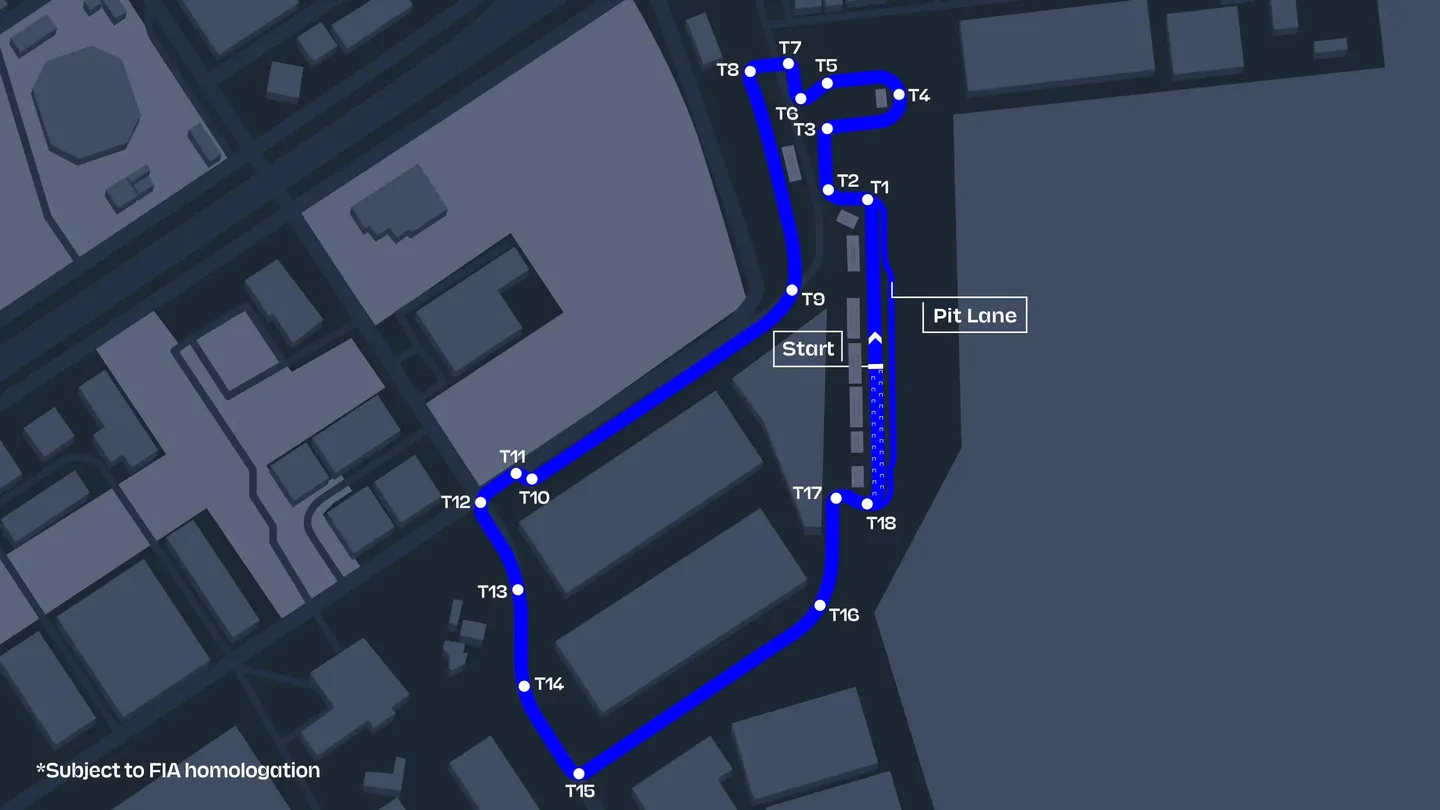
The Tokyo E-Prix uses a temporary street circuit around the Tokyo Big Sight convention center on the city’s waterfront. Formula E listed the 2026 layout at 2.575 kilometers with 18 turns. The lap runs anti-clockwise and combines three more open straight sections with a dense sequence of street-circuit corners.
The venue is not a simple stop-and-go track. Formula E’s circuit guide described high-speed sections as well as intricate corner sequences, while the narrow walls leave little margin for a misjudged move. Changes introduced since Tokyo’s Formula E debut were intended to reduce bumps and improve the racing surface.
Where were the main passing opportunities?
Turn 1 was one of the clearest conventional overtaking chances because drivers arrived after a meaningful run at speed. Yet street-circuit racing rarely allows a driver to rely on one braking zone alone. Energy state, tire temperature, track position and ATTACK MODE can all change whether a move is sensible.
Formula E placed the ATTACK MODE activation zone at Turn 4 on the driver’s right. Taking that line costs normal racing position because the car must leave the quickest route through the corner. The benefit comes afterward, when the temporary power increase can be used to recover places or build an advantage.
Why the first Tokyo night race mattered
Moving the main races to 20:05 did more than change television times. Track temperature, visibility, lighting and the rhythm of a race day all shifted later. The waterfront setting also gave Formula E a much stronger night-time visual identity, with illuminated city infrastructure framing the Gen3 cars.
Then the weather added another variable. Friday practice was wet, while heavy rain disrupted Sunday badly enough to erase FP3 entirely. Qualifying took place on a drying circuit, and the second race began after more rain. As a result, engineers had to work with less dry-running information than they would normally want.
Tokyo’s 2026 schedule looked simple on paper: practice, qualifying and a night race on both days. The weather turned Sunday into a setup gamble instead.
What viewers needed to know about Formula E race strategy
Formula E can look chaotic if you watch only the position tower. The championship is designed around energy management, temporary power boosts and strategic trade-offs. Tokyo demonstrated all three. Drivers who appeared to surrender track position could later gain it back when their power mode or energy target became favorable.
Qualifying: groups followed by head-to-head Duels
Formula E qualifying first divides the field into groups, then advances the fastest drivers into head-to-head Duels. The knockout sequence eventually produces a final for pole position. That format means a driver needs repeated clean laps rather than one isolated peak lap.
On Saturday, Jake Dennis took pole for Andretti. On Sunday, Edoardo Mortara responded for Mahindra and claimed his fourth pole of the 2025/26 season. Formula E reported that the result tied the all-time record for most poles in a single campaign.
ATTACK MODE changed the order in both races
ATTACK MODE requires a driver to leave the conventional racing line through an activation zone. Once activated, it temporarily gives the car more performance. The timing matters because activating can cost places immediately, while waiting too long can leave too little race distance to exploit the extra power.
Round 15 offered a textbook example. Nyck de Vries activated ATTACK MODE on Lap 28 and used the extra performance to move forward, eventually passing Oliver Rowland for the lead. Nick Cassidy and Jake Dennis also made large late gains as the track dried and their strategic picture improved.
PIT BOOST added another strategic layer
The Tokyo weekend also used Formula E’s rapid-charging PIT BOOST system. A stop can temporarily shuffle the order, so the leader on the road is not always the strategic leader. In Round 14, Dan Ticktum combined an early PIT BOOST strategy with ATTACK MODE and emerged in a strong net position.
That is why a Formula E broadcast is best watched with energy percentages and activation indicators in mind. The timing tower tells you where a driver is. Strategy tells you whether that position is sustainable.
For a broader explanation of how a Formula E weekend works, World of Speed’s 2026 Formula E race-weekend guide is a useful companion.
What actually happened at the 2026 Tokyo E-Prix
A schedule and TV guide is most useful before a race, but an accurate article should not pretend the event is still in the future. Tokyo has now been run. The weekend produced two different winners, severe Sunday rain and a major shift in the championship fight before the London finale.
Dan Ticktum wins
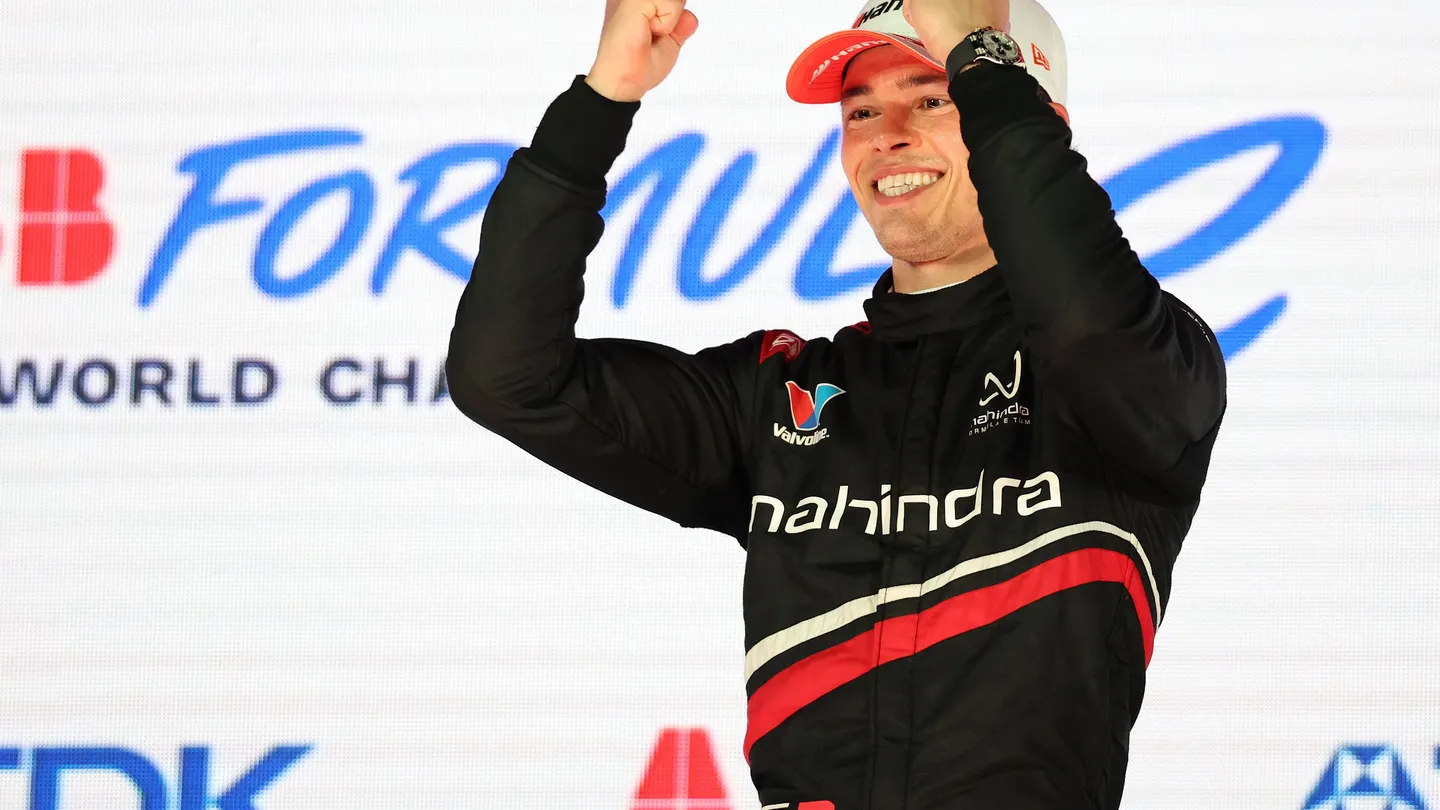
Nyck de Vries wins
Round 14: Ticktum took it at the end
Jake Dennis started the first Tokyo night race from pole, but Dan Ticktum was the driver celebrating at the finish. Ticktum had started sixth and used PIT BOOST and ATTACK MODE aggressively. The strategy brought him into contention, although Dennis later recovered the lead.
The race then turned on energy at the very end. Dennis had to lift while energy-critical, and Ticktum attacked through the penultimate corner on the final lap. He completed the pass and won for CUPRA KIRO. Dennis finished second, while Nick Cassidy completed the podium for Citroën Racing.
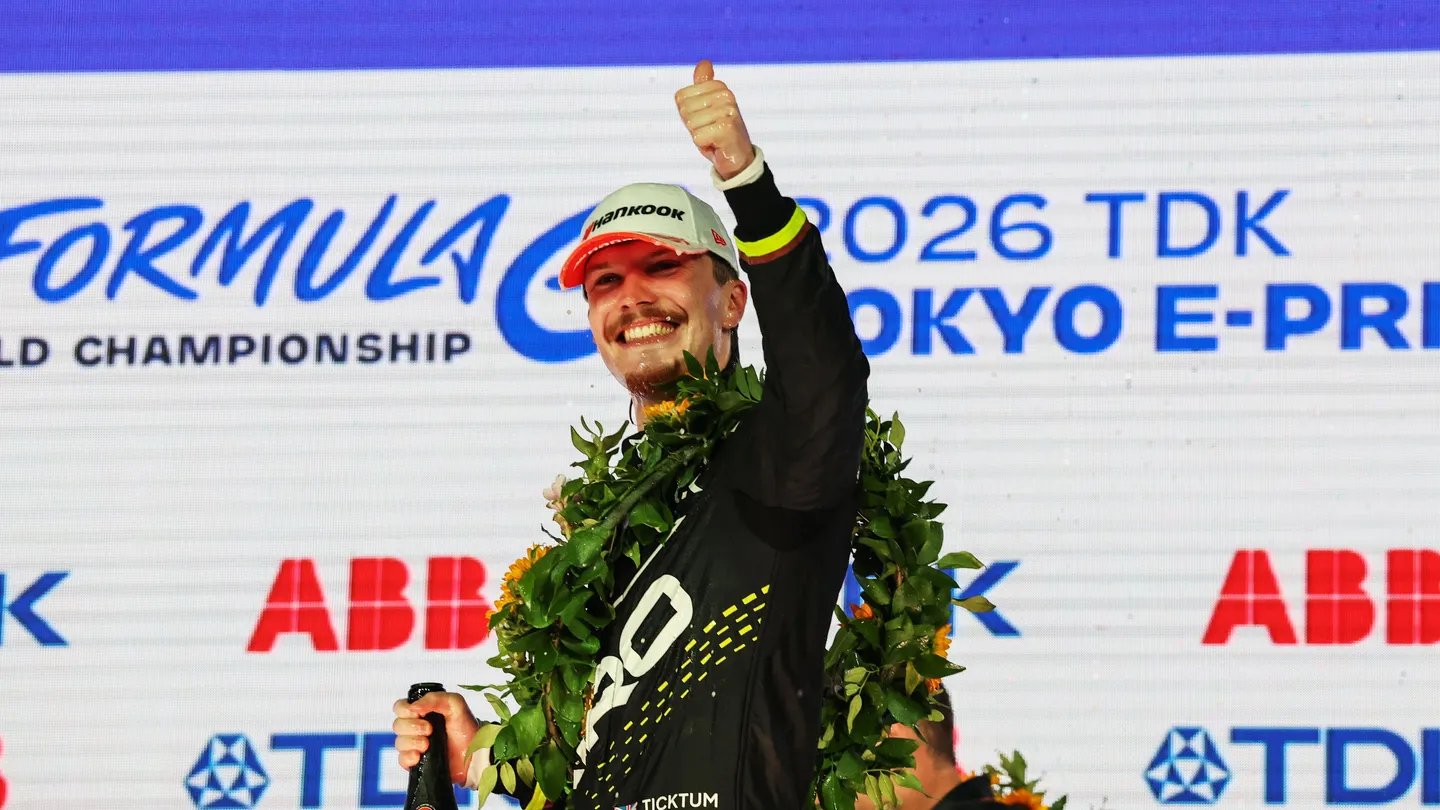
The result reinforced a season in which Formula E had been producing a wide spread of winners. More importantly for the championship, Dennis scored heavily while several rivals had more difficult days. Tokyo was beginning to compress the title fight rather than settle it.
Sunday morning: heavy rain cancelled FP3
Free Practice 3 was scheduled for 13:30 JST on Sunday, but the weather made running unsafe. Formula E delayed the session and then cancelled it because of heavy rain. Qualifying remained scheduled for 15:40 local time.
That cancellation mattered because teams lost their final practice window before qualifying and the race. The circuit then dried for qualifying, forcing drivers to find grip while conditions changed from lap to lap. Mortara handled that best and secured pole for Mahindra.
Round 15: de Vries made the drying-track gamble work
Sunday’s race began in mixed conditions after another spell of rain. Mahindra set Nyck de Vries’s car with a drying track in mind. He started fifth, stayed in the strategic fight, and used ATTACK MODE at the right moment to move through the leaders.
De Vries reached Oliver Rowland and passed for the lead during his Lap 28 charge. Behind him, Cassidy came from 13th to second, while Dennis climbed from 17th to third. Their progress showed how quickly the competitive order changed once the circuit came toward the drier setups.
A late collision involving Edoardo Mortara and Joel Eriksson blocked the circuit and caused a red flag. The field eventually restarted for a final rolling-start lap, but de Vries stayed in control and secured his second victory of the season for Mahindra.
Tokyo reshaped the title fight and sealed a manufacturers’ crown
Dennis left Tokyo as the Drivers’ World Championship leader. Mitch Evans was only two points behind, while Pascal Wehrlein sat just five points off the lead. That left the drivers’ championship open heading into the London finale on August 15 and 16.
One championship was settled in Japan. Porsche secured the 2025/26 Manufacturers’ World Championship at Round 15. The manufacturer benefited not only from its factory operation but also from Porsche-powered customer teams, including the Ticktum victory for CUPRA KIRO and Dennis’s double podium for Andretti.
Best way to follow a Tokyo Formula E weekend from the U.S.
Tokyo is one of those Formula E rounds where American viewing depends heavily on your coast. Eastern viewers can treat the race as an unusually early Saturday and Sunday sports event. Pacific viewers are effectively choosing between staying up late for qualifying and waking before dawn for the race.
Eastern Time: prioritize the 7:05 a.m. race starts
For ET viewers, both races began at 7:05 a.m. Qualifying at 2:40 a.m. was much less convenient, so many fans could reasonably skip it live and check the grid before the race. Practice 2 and 3 were scheduled at 12:30 a.m. ET, although Sunday’s FP3 was cancelled.
Central Time: watch the date rollover
The races began at 6:05 a.m. CT. More confusingly, practice at 13:30 JST converted to 11:30 p.m. Central on the previous calendar day. That is an easy detail to miss when a timetable lists only the Tokyo date.
Mountain and Pacific: qualifying became a late-night session
Mountain viewers had a 5:05 a.m. race start, while Pacific viewers had 4:05 a.m. The more appealing live slot was qualifying: 11:40 p.m. PT on the previous night. A West Coast fan could therefore watch qualifying before bed, then decide whether the race justified an early alarm.
The same time-zone logic is useful for future Tokyo editions even when the exact schedule changes. Always convert every session individually rather than converting only the race. An Asian race weekend often crosses the date line for U.S. evening sessions.
Why Tokyo matters on the Formula E calendar
Formula E is built around major-city racing, and Tokyo is one of the clearest examples of that philosophy. The circuit places a world championship beside a recognizable exhibition and waterfront district rather than on a remote permanent track. That setting gives the series a direct link to urban electric mobility, one of the ideas that has shaped Formula E from its beginning.
The Japanese market also matters to the championship technically and commercially. Nissan is a major Formula E manufacturer and races at home in Tokyo. In 2026, reigning champion Oliver Rowland was part of the Sunday lead fight before de Vries’s ATTACK MODE charge changed the race.
Tokyo’s place late in the season raised the stakes further. Only the London double-header remained afterward. Therefore, every missed point in Japan carried more weight than it would at the opening round, and the small gaps between Dennis, Evans and Wehrlein made strategy failures particularly expensive.
The night-race format also gave the event a distinct identity. Formula E already has several visually dramatic city venues, but Tokyo under artificial lighting combined that urban character with unpredictable weather and a compact street circuit. The 2026 races showed why a schedule guide can quickly become a strategy story.
Tokyo Formula E 2026 FAQ
Conclusion: Tokyo delivered more than a schedule change
The Tokyo Formula E 2026 schedule centered on two 20:05 JST races, which meant 7:05 a.m. starts for U.S. Eastern viewers and 4:05 a.m. starts on the West Coast. Roku Sports Channel was Formula E’s listed U.S. home for every session, while free practice was also scheduled for the championship’s YouTube channel. Japan’s qualifying and race coverage was listed on J Sports 1 and J Sports On Demand.
Those basic viewing facts only tell part of the story. The first Tokyo night-race double-header produced a last-lap Saturday winner, a rain-cancelled Sunday practice, a drying-track strategy race and a new championship leader. Dan Ticktum and Nyck de Vries split the victories, while Porsche secured the Manufacturers’ World Championship before the season moved to London.
For future Tokyo editions, always check the newest Formula E timetable and broadcaster page because channel rights and session times can change. For the 2026 event itself, the schedule, time-zone conversions and coverage details above reflect the championship’s official Tokyo listings and the verified outcome of the completed weekend.
Sources
- 01
- 02
- 03
- 04Formula E — Round 15 report: de Vries wins in Tokyo
Official Sunday race report, championship impact and weather context.