Tokyo E-Prix 2026 Preview: Championship Contenders, Track Guide & Predictions
Formula E reached Tokyo with four races left, a new championship leader, two nighttime races around Tokyo Big Sight and almost no room for a strategic mistake.
The Tokyo E-Prix 2026 preview began with a championship that had changed shape in a single weekend. Pascal Wehrlein arrived in Japan leading the Drivers’ Championship after overturning Mitch Evans’ advantage in Shanghai. Evans remained only nine points behind, while Oliver Rowland, Jake Dennis and several other race winners were still close enough to turn a strong Tokyo double-header into a title launchpad.
This was also not a normal return to Tokyo. Formula E scheduled its first night races in the Japanese capital, placing two 8:05 p.m. local starts under the floodlights around Tokyo Big Sight. The visual spectacle was obvious, but the competitive effect mattered more: cooler track temperatures, a changing grip level, limited overtaking space and two races in two days made setup compromise and clean execution central to the weekend.
The guide below uses the championship picture immediately before Tokyo, official event timings and published circuit specifications. It explains who had the strongest case, where overtaking was likely, how ATTACK MODE and PIT BOOST could change the order, and which drivers offered the most convincing combination of pace, efficiency and recent form.
Pascal Wehrlein led Mitch Evans by nine points after Shanghai, but Tokyo offered two full scoring races and as many as 58 championship points across the weekend. The title lead was therefore valuable, not comfortable.
Tokyo E-Prix 2026 Schedule and U.S. Start Times
The 2026 event ran as a two-race weekend. Free Practice 1 opened the meeting on Friday evening in Tokyo. Saturday and Sunday then followed the same basic pattern: an afternoon practice, qualifying in the late afternoon and a nighttime race. For viewers in the United States, the 8:05 p.m. Japanese start translated to an early-morning broadcast.
| Session | Tokyo time | Eastern Time | Pacific Time |
|---|---|---|---|
| Free Practice 1 | Fri, 7:00 p.m. | Fri, 6:00 a.m. | Fri, 3:00 a.m. |
| Round 14 qualifying | Sat, 3:40 p.m. | Sat, 2:40 a.m. | Fri, 11:40 p.m. |
| Round 14 race | Sat, 8:05 p.m. | Sat, 7:05 a.m. | Sat, 4:05 a.m. |
| Round 15 qualifying | Sun, 3:40 p.m. | Sun, 2:40 a.m. | Sat, 11:40 p.m. |
| Round 15 race | Sun, 8:05 p.m. | Sun, 7:05 a.m. | Sun, 4:05 a.m. |
The early U.S. start made live viewing easier on the East Coast than the qualifying hour suggested. Formula E’s official broadcaster guide remained the correct reference because rights and streaming platforms differ by country and may change during a season. The series also provided live timing through its app and website, while practice sessions were made available through Formula E’s digital channels in many regions.
Championship Contenders Arriving in Tokyo
Shanghai transformed the standings. Wehrlein scored pole and victory in Round 12, then left China with the championship lead after Evans failed to finish Round 13. The official post-race report put Wehrlein nine points ahead of Evans. Jaguar still led Porsche in the Teams’ Championship by 243 points to 237, while Porsche held a much larger advantage in the Manufacturers’ table, 384 to 334.
| Rank | Driver | Team | Points | Tokyo case |
|---|---|---|---|---|
| 1 | Pascal Wehrlein | Porsche | 141 | Championship leader; Shanghai winner |
| 2 | Mitch Evans | Jaguar TCS Racing | 132 | Proven street-race closer; needed response |
| 3 | Oliver Rowland | Nissan | 114 | Reigning champion and home-team leader |
| 4 | Jake Dennis | Andretti | Top five | Strong recent pace and Porsche efficiency |
| 5 | António Félix da Costa | Jaguar TCS Racing | Contender | Round 12 runner-up; strategic threat |
Pascal Wehrlein: the favorite with the clearest pressure
Wehrlein entered Tokyo as the logical championship favorite because he held the points lead and drove a Porsche package that had repeatedly shown strong energy efficiency. His Shanghai victory was not a lucky interruption. He took pole, controlled the race and collected 28 points on a weekend when several rivals lost ground. That combination—qualifying speed plus usable energy in traffic—is exactly what a tight street circuit demands.
The pressure came from the small size of the lead. Nine points is less than the difference between first and fourth in one race. A poor qualifying group, contact at the first corner or an untimely Safety Car could erase it before Saturday night ended. Wehrlein’s task was therefore to attack without turning the first Tokyo race into a must-win gamble.
Mitch Evans: the rebound candidate
Evans had led by 19 points before Shanghai and left China nine behind. The swing made Tokyo psychologically important. Jaguar’s car had been competitive across several circuit types, and Evans has a long record of delivering on street tracks where confidence under braking matters. His weakness entering Tokyo was not basic pace; it was the championship cost of a non-finish at the wrong moment.
Tokyo’s narrow layout rewarded the kind of decisive late-braking passes Evans is willing to attempt, but it also punished impatience. A sensible prediction placed him near the front while recognizing that Jaguar’s two-car title ambitions could complicate tactical calls if da Costa ran in the same group.
Oliver Rowland and Nissan: the emotional home threat
Rowland arrived third on 114 points, 27 behind Wehrlein. That gap was meaningful but far from terminal with four races remaining. He also carried the strongest local narrative. Nissan had won at home in 2025, and Rowland’s ability to qualify near the front around Tokyo was already established. The 2026 night-mode livery added attention, but the sporting question was efficiency: could Nissan protect enough energy while staying within striking range?
For Rowland, Tokyo was the weekend to reduce the championship to a three-way fight. Two podiums would do more than one high-risk win followed by a zero. His home-race knowledge, braking precision and ability to attack on low grip made him a serious favorite even when Porsche and Jaguar looked stronger on season-long numbers.
Jake Dennis: the outsider nobody could ignore
Dennis and Andretti had produced one of the season’s clearest statements in Sanya, where Dennis led teammate Felipe Drugovich home in a one-two. Andretti also used Porsche power, giving Dennis access to an efficient package and a team that had become increasingly sharp at controlling track position. Tokyo’s qualifying Duels offered him an obvious path: start in the first two rows, stay out of midfield contact, then force the title leaders to make the aggressive moves.
Edoardo Mortara, da Costa and the spoiler group
Not every likely winner needed to be a title leader. Edoardo Mortara had shown front-running form during the season, while da Costa arrived after a second place in Shanghai’s first race. Nick Cassidy, Nyck de Vries and Dan Ticktum also represented exactly the kind of threat that makes Formula E predictions unstable. A driver outside the top three can win by timing ATTACK MODE well, saving one extra percentage point of usable energy and avoiding the incident that traps the favorites.

Tokyo Street Circuit Guide
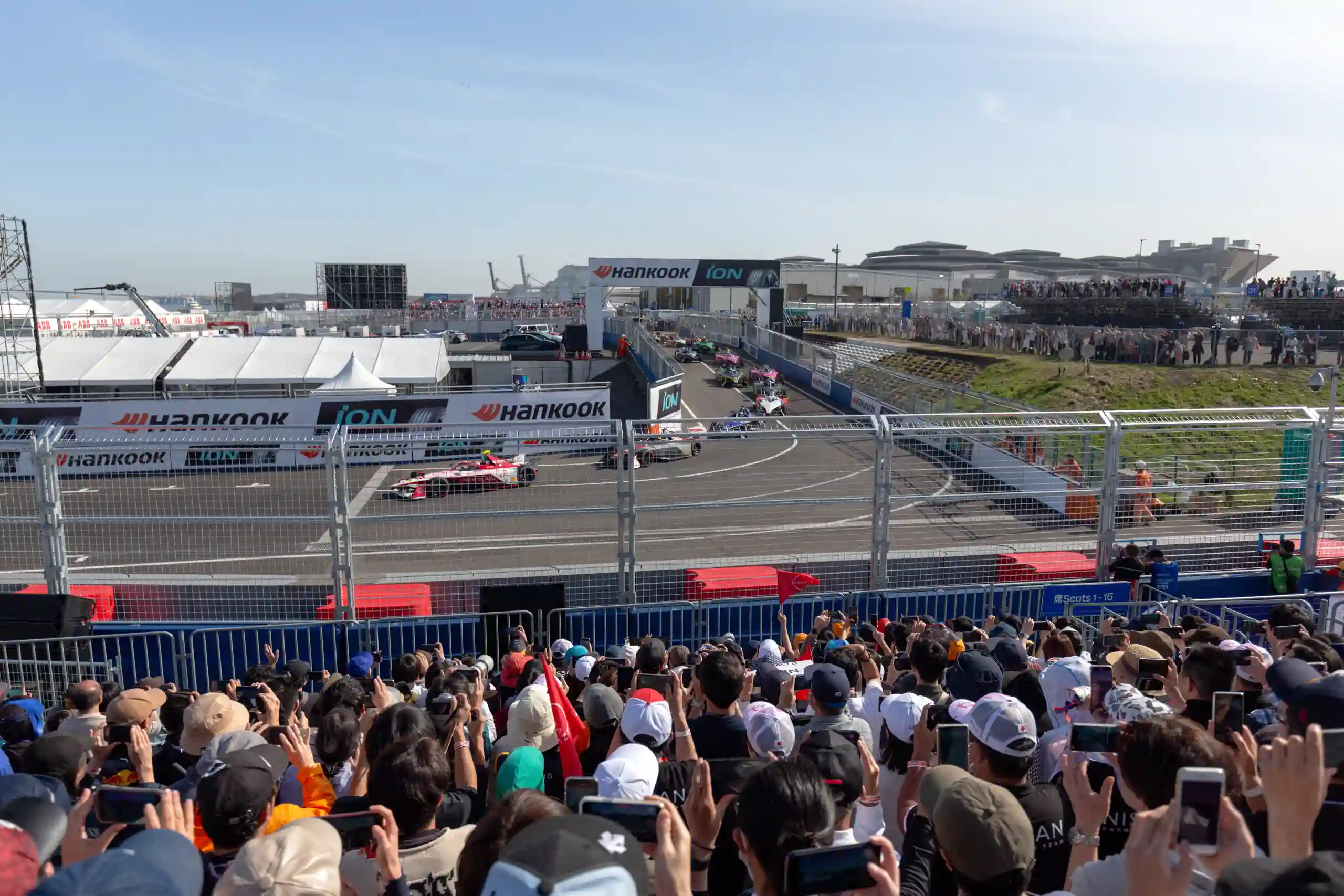
The Tokyo Street Circuit loops around the Tokyo International Exhibition Centre, better known as Tokyo Big Sight, in the Ariake waterfront district. Formula E lists the track at 2.582 kilometers—about 1.604 miles—with 18 turns. It is a purpose-built temporary circuit, so the surface combines permanent roads, patches, painted markings and bumps that are rarely uniform from one corner to the next.
Sector 1: immediate commitment
The opening sequence places a premium on launch traction and clean positioning. Because the field arrives tightly packed, the first major braking zone can create both opportunity and damage. Drivers starting on the dirty side must manage wheelspin, while those on the inside need to avoid locking a front tire and becoming a roadblock. A car that rotates quickly at low speed can gain several tenths here without using extra energy.
Middle sector: rhythm and regeneration
The technical middle portion is where a driver builds lap time through consistency rather than one dramatic corner. Short accelerations are followed by braking events that contribute to energy recovery. The fastest race car is not necessarily the car that deploys the most energy on every straight; it is the one that regenerates efficiently, remains stable under braking and allows the driver to repeat the same lift-and-coast points in traffic.
Final sector: the pass must be prepared early
Overtaking at Tokyo is difficult because many corners are narrow and the following car loses time when it cannot place its front wheels in clean air. The best moves are usually prepared one or two corners earlier. A driver may accept a slightly slower entry, protect energy, get a cleaner exit and arrive at the next braking zone with enough overlap to make the pass legitimate.
Yes, but Tokyo is not a circuit where cars can pass everywhere. The strongest opportunities come after a good exit onto a longer acceleration zone, during ATTACK MODE speed differentials, or when a rival is energy-limited. Track position remains unusually valuable.
Why the night race changed the setup problem
A nighttime start meant the track would cool after qualifying. Teams therefore had to avoid building a car that worked only in the warmer afternoon session. Cooler asphalt can reduce initial grip and make tire preparation harder, especially on a single qualifying lap. It can also reduce thermal stress over the race distance. The ideal compromise was a car that generated front-tire response quickly without overheating the rear axle during repeated acceleration.
That balance explains why qualifying predictions were uncertain. A driver could look ordinary in practice, then find the correct tire window in the Duels. Formula E’s group-and-knockout format makes execution essential: the top four from each group advance to head-to-head Duels, and one minor error can turn a potential pole lap into a midfield start.
For readers comparing the system with Formula 1, see our guides to how racing drivers qualify, F1 qualifying and grid position in racing. Formula E uses a different format, but the basic reward is identical: clean air and control of the first strategic phase.
Race Strategy: ATTACK MODE, PIT BOOST and Energy
Energy management comes before tire degradation
Formula E uses a single all-weather Hankook tire rather than the soft-medium-hard compound ladder familiar to Formula 1 fans. That does not make tires irrelevant. Drivers still manage temperature, pressure and surface condition, especially when the track evolves between daylight qualifying and a night race. However, the central strategic currency is usable electrical energy.
Drivers save energy by lifting before the braking zone, coasting, maximizing regeneration and avoiding unnecessary wheelspin. The challenge is doing that without surrendering track position. At Tokyo, a driver who saved too visibly could invite an attack; a driver who defended every corner could spend the energy needed for the final laps.
ATTACK MODE: position loss now, performance later
ATTACK MODE requires a driver to leave the normal racing line and pass through activation loops. The temporary loss can be expensive on a narrow track. Once active, however, the extra power creates overtaking opportunities and can help a driver escape a group. The ideal activation point depends on traffic, remaining energy, Safety Car probability and whether rivals have already completed their own activations.
A front-runner may activate early to avoid being trapped by a later caution. A midfield driver may wait for open space. The worst outcome is not merely losing a position in the activation zone; it is rejoining behind a slow group and wasting the additional power while boxed in.
PIT BOOST: a 30-second, 600 kW tactical reset
Formula E’s PIT BOOST format adds a mandatory mid-race stop at selected races. The car receives a 30-second, 600 kW charge worth roughly 10 percent energy, or 3.85 kWh. The stop can only be taken inside a specified state-of-charge window, usually below 60 percent and above 40 percent, and operational restrictions prevent every teammate from stopping simultaneously.
If applied to a Tokyo race, PIT BOOST would turn the pit window into a traffic-management contest. Stopping early can provide clean air but exposes the driver to a Safety Car. Stopping late can protect against neutralization but risks queuing or losing time behind cars running longer. The strategic idea is closer to an undercut and energy reset combined than a traditional Formula 1 tire stop.
The winning package combines qualifying position, efficient regeneration, disciplined ATTACK MODE timing and enough energy for the final two laps. Pure one-lap speed is useful, but a car that cannot follow closely or recover energy under braking will struggle to convert pole into victory.
Safety Cars can erase a careful energy advantage
A Safety Car compresses the field and reduces the energy needed to complete laps at racing speed. Race control may adjust the usable-energy target or add time depending on the regulations in force. Strategically, the neutralization can reward a driver who has already completed an activation or pit requirement, while punishing someone waiting for a clean window.
Tokyo’s concrete walls increase the chance that a small incident becomes a Full Course Yellow or Safety Car. The leading teams therefore needed two plans: the ideal green-flag sequence and a shortened sequence that could be executed immediately after an interruption.
The two-race weekend changes risk tolerance
Because Tokyo hosted Rounds 14 and 15, teams had to think beyond Saturday. Contact that damages a chassis or suspension can compromise Sunday practice and qualifying. A championship contender running sixth late in Round 14 might reasonably bank points rather than attempt a low-percentage move. A driver outside the title race can take the opposite approach and attack for a podium.

Tokyo E-Prix 2026 Predictions
Predictions for Formula E should be treated differently from predictions in a series with stable tire compounds and long permanent circuits. Tokyo’s walls, qualifying groups, energy targets and possible neutralizations create a wide outcome range. The most useful approach is to identify drivers with several independent ways to win.
Pascal Wehrlein
The safest overall pick. He combined championship momentum, Porsche efficiency and proven qualifying speed. A clean first two rows start made him the driver most likely to control the strategic shape.
Mitch Evans
The strongest rebound pick. Jaguar had the pace and Evans had the street-circuit aggression, but he needed to avoid turning the Shanghai disappointment into an overly risky opening race.
Oliver Rowland
The high-upside home favorite. Nissan’s local knowledge and Rowland’s braking confidence created a genuine pole and podium route even if season-long efficiency favored Porsche.
Qualifying prediction
Wehrlein, Rowland, Dennis and Mortara were the strongest pole-position candidates on paper. Wehrlein had the most complete momentum profile, Rowland had the home-race motivation and proven Tokyo speed, Dennis had shown one-lap pace in Sanya, and Mortara had repeatedly demonstrated that he could place a car at the sharp end when the tire window was narrow.
Race winner prediction
The primary prediction was Wehrlein for one victory across the double-header, with Evans and Rowland the most likely alternatives. A separate race winner from outside the top three remained highly plausible because the two-race format rewards teams that adapt overnight. Dennis was the preferred dark horse, while da Costa was the strategic outsider most likely to benefit from a disrupted energy race.
Championship prediction after Tokyo
The championship leader after the weekend was likely to be either Wehrlein or Evans, but the bigger prediction was compression rather than separation. With two races in London still to come, Tokyo was more likely to create a three- or four-driver final-round fight than to settle the title. Rowland needed a large score to stay attached; Dennis needed at least one podium; Wehrlein and Evans needed to avoid a zero.
Tokyo was not the weekend to prove who had the fastest car. It was the weekend to prove who could protect a title campaign while racing inches from concrete walls under the lights.
Drivers to watch beyond the favorites
Dan Ticktum’s raw speed made him a candidate whenever qualifying placed him near the front. Mortara’s tactical experience gave Mahindra a realistic route to a podium. Nick Cassidy remained dangerous in any race where energy conservation became decisive, and Nyck de Vries had the race intelligence to climb when others spent too much energy early.
What would count as a successful weekend?
- Wehrlein: leave Tokyo still leading, with at least one podium and no non-score.
- Evans: recover the championship lead or reduce the gap while avoiding contact.
- Rowland: outscore both leaders and keep the title deficit within one race win.
- Dennis: convert Andretti’s recent pace into a podium and join the final title group.
- Jaguar: protect the Teams’ Championship lead over Porsche.
- Porsche: use Wehrlein and Müller to pressure Jaguar while extending the Manufacturers’ advantage.
Readers building broader Formula E context can also visit our guides to what Formula E is, how Formula E racing works, Formula E car speed, ATTACK MODE, Formula E versus Formula 1, Formula E car cost, Formula E teams, the Formula E schedule, how to watch Formula E, the 2026 season preview, the 2026 race-weekend guide, and our Shanghai E-Prix preview.
Tokyo E-Prix 2026 FAQ
Conclusion
The 2026 Tokyo E-Prix brought together every ingredient that makes Formula E unpredictable: a championship lead of only nine points, two races on consecutive nights, a narrow street circuit, qualifying Duels, energy targets and strategic systems that can change the order in seconds.
Wehrlein arrived with the strongest position, but Evans, Rowland and Dennis all had credible routes into the title fight. The circuit favored precision more than bravado. Drivers needed to qualify well, regenerate efficiently, time ATTACK MODE around traffic and remain flexible when a Safety Car or PIT BOOST window changed the original plan.
The clearest prediction was therefore not a guaranteed winner. It was that Tokyo would reward the team that made the fewest operational mistakes. On a circuit where passing is difficult and the walls are close, one clean qualifying lap and one well-timed strategic decision can be worth more than a weekend of raw pace.
Sources
- Formula E: Preview—Two in Tokyo at night
- Formula E: Tokyo track map and official session timings
- Formula E: Official Tokyo circuit page
- Formula E: Shanghai Round 13 report and pre-Tokyo standings context
- Formula E: PIT BOOST explained
- Formula E: Nissan Tokyo night-mode livery announcement
- Wikimedia Commons: Tokyo E-Prix photography and licensing