Magny-Cours GT World Challenge Europe 2026: Full Schedule, Race Timetable, TV Coverage & Streaming Guide
Every official session time in CEST, ET and PT, plus the confirmed free stream, live-timing details, Sprint Cup format, track analysis, entry-list storylines and a concise update from the completed French doubleheader.
The Magny-Cours GT World Challenge Europe 2026 weekend brought a record-size Sprint Cup entry to one of France’s most exacting racing circuits. The public race program ran from Friday, July 31 through Sunday, August 2, with an official paid test on Thursday. For U.S. viewers, the two headline races started at viewer-friendly times: 3:05 p.m. ET on Saturday and 9:30 a.m. ET on Sunday.
The confirmed global viewing option was the free GT World YouTube broadcast, also embedded through the championship’s official watch-live page. Qualifying and both races were carried live, while the same official page supplied multilingual feeds and live timing. This guide preserves the complete schedule for replay viewing and future reference, while also explaining what each session meant.
The competitive weekend ran July 31–August 2, 2026 at Circuit de Nevers Magny-Cours. A two-hour official test took place Thursday, July 30. Race 1 began at 9:05 p.m. local time on Saturday, while Race 2 started at 3:30 p.m. local time Sunday.
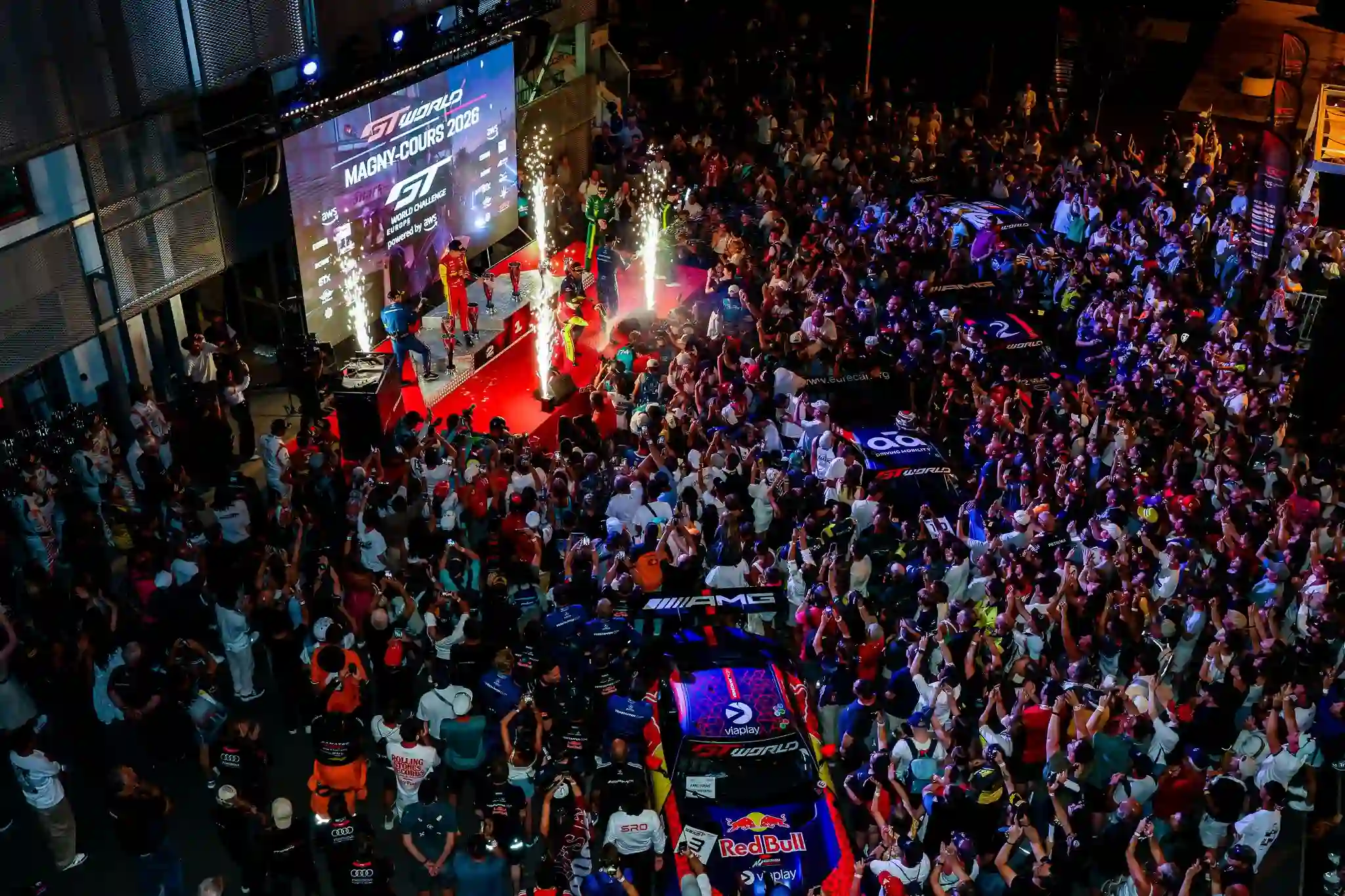
The event has concluded. Jules Gounon and Dani Juncadella won Saturday night’s Race 1 for Mercedes-AMG Team Verstappen Racing. Bastian Buus and Ricardo Feller answered on Sunday by winning Race 2 for Lionspeed GP Porsche, ahead of the Silver Cup Team WRT BMW and Rutronik Racing’s Lamborghini.
Magny-Cours GT World Challenge Europe 2026 at a Glance
Magny-Cours was the sixth event on the overall 2026 GT World Challenge Europe calendar and the third Sprint Cup meeting after Brands Hatch and Misano. It arrived at a decisive point in the campaign: teams had completed the early-season sprint races, the endurance opener at Paul Ricard and Monza, and the CrowdStrike 24 Hours of Spa. The French weekend therefore combined the urgency of a short race with the strategic pressure of an established championship fight.
The organizer announced a record 45-car Sprint Cup entry. That number mattered because Magny-Cours is not a wide, low-risk circuit where traffic naturally spreads out. Its heavy braking zones, narrow sequences and lap-time sensitivity make positioning critical. A driver who lost a few tenths in qualifying could find several cars inserted between the crew and its main title rival.
Although the main event branding covered July 31 through August 2, the official detailed timetable began on Thursday, July 30 with a two-hour test. Friday contained the serious setup work. Saturday paired split qualifying with the atmospheric night race. Sunday repeated the qualifying process before an afternoon finale.
Night-race pressure
Race 1 started at 9:05 p.m. local time, placing the pit-stop phase and finish under evening light. That made Friday’s FP2 especially relevant.
A fresh qualifying reset
Sunday brought a separate qualifying session and a new grid. Teams could not rely on Saturday’s result to protect their position.
Different strengths, one BoP window
BMW, Mercedes-AMG, Ferrari, Porsche, McLaren, Aston Martin, Audi and Lamborghini machinery all appeared on the entry list.
Full Magny-Cours 2026 Schedule and U.S. Race Times
The table below focuses on GT World Challenge Europe sessions. Magny-Cours used Central European Summer Time, or CEST, which was six hours ahead of Eastern Daylight Time and nine hours ahead of Pacific Daylight Time during the event.
Friday’s opening practice block needs one explanation. The official detailed timetable reserved the first 40 minutes, from 1:30 to 2:10 p.m. local time, for Bronze and Silver drivers. The all-driver Free Practice 1 segment then ran from 2:10 to 2:50 p.m. The championship’s condensed event page displayed 1:30 p.m. as the FP1 start because that was the beginning of the combined block.
| Day | Session | Local time (CEST) | Eastern time (ET) | Pacific time (PT) | Coverage |
|---|---|---|---|---|---|
| Thu., July 30 | Official paid test | 1:45–3:45 p.m. | 7:45–9:45 a.m. | 4:45–6:45 a.m. | Timing / reports |
| Fri., July 31 | Bronze & Silver drivers’ practice | 1:30–2:10 p.m. | 7:30–8:10 a.m. | 4:30–5:10 a.m. | Live timing |
| Fri., July 31 | Free Practice 1 | 2:10–2:50 p.m. | 8:10–8:50 a.m. | 5:10–5:50 a.m. | Live timing |
| Fri., July 31 | Free Practice 2 — night | 8:40–10:00 p.m. | 2:40–4:00 p.m. | 11:40 a.m.–1:00 p.m. | Live timing |
| Sat., Aug. 1 | Qualifying 1 — Group A | 2:55–3:05 p.m. | 8:55–9:05 a.m. | 5:55–6:05 a.m. | Live stream |
| Sat., Aug. 1 | Qualifying 1 — Group B | 3:10–3:20 p.m. | 9:10–9:20 a.m. | 6:10–6:20 a.m. | Live stream |
| Sat., Aug. 1 | Race 1 | 9:05–10:05 p.m. | 3:05–4:05 p.m. | 12:05–1:05 p.m. | Live stream |
| Sun., Aug. 2 | Qualifying 2 — Group A | 10:50–11:00 a.m. | 4:50–5:00 a.m. | 1:50–2:00 a.m. | Live stream |
| Sun., Aug. 2 | Qualifying 2 — Group B | 11:05–11:15 a.m. | 5:05–5:15 a.m. | 2:05–2:15 a.m. | Live stream |
| Sun., Aug. 2 | Race 2 | 3:30–4:30 p.m. | 9:30–10:30 a.m. | 6:30–7:30 a.m. | Live stream |
Time-zone note: All U.S. conversions use daylight-saving time in effect on July 30–August 2, 2026. ET means EDT and PT means PDT. The official timetable remained subject to sporting changes, delays and safety-car disruptions.
Race 1 started Saturday at 3:05 p.m. ET and 12:05 p.m. PT. Race 2 started Sunday at 9:30 a.m. ET and 6:30 a.m. PT. Both races were scheduled for one hour.
TV Coverage and Streaming: How to Watch Magny-Cours 2026
The most important broadcast fact for a U.S. audience was simple: the confirmed live option did not require a cable subscription. GT World Challenge Europe stated that its 2026 races were available free on the GT World YouTube channel without regional restrictions. The championship’s event preview specifically confirmed live coverage of Qualifying 1, Race 1, Qualifying 2 and Race 2 from Magny-Cours.
The official watch-live page also embedded the English broadcast and offered German, French and Italian alternatives. That was useful for viewers who preferred a local-language commentary feed or wanted to keep the main video on one device while following live timing on another.
GT World YouTube
The race broadcasts were free and globally available. The channel also served as the natural place to find replays, highlights and qualifying uploads after the live window.
Watch-live page and live timing
The championship’s event page combined the video player with timing data. This made it easier to follow class positions, pit cycles, gaps and cars that were outside the television director’s immediate focus.
Was Magny-Cours shown on a U.S. TV channel?
The official event information clearly confirmed free online streaming, but it did not identify a dedicated U.S. linear television channel for the Magny-Cours weekend. That distinction matters. A generic TV-guide page can describe the championship’s wider broadcast partnerships without guaranteeing that one specific race will appear on a particular American cable network.
For that reason, the dependable answer for U.S. fans was the official digital feed. Viewers did not need to search for an unconfirmed channel listing or rely on a third-party stream. The free GT World broadcast carried the sessions that shaped the grids and both one-hour races.
Which sessions were confirmed live?
- Qualifying 1: Saturday, beginning at 8:55 a.m. ET.
- Race 1: Saturday at 3:05 p.m. ET.
- Qualifying 2: Sunday, beginning at 4:50 a.m. ET.
- Race 2: Sunday at 9:30 a.m. ET.
Friday practice was best followed through official timing and session reports unless a specific practice stream appeared on the GT World channel. This is an important difference between “selected sessions may be streamed” and a confirmed event broadcast. The official Magny-Cours preview guaranteed the two qualifying broadcasts and two races.
How to watch the replay without seeing the result
Because the Sunday qualifying session began before sunrise for much of the United States, many fans were always likely to watch on demand. The cleanest method was to open the GT World channel’s event playlist or videos tab and search by session name rather than opening a results page. Race uploads normally use clear titles such as “Race 1” or “Race 2,” which helps viewers avoid spoilers in a written report.
Do not assume that every support race used the same stream URL as the GT3 sessions. FFSA GT and FFSA Tourisme were also advertised for live coverage, but viewers should select the session title shown on the official GT World channel.
What Each Magny-Cours Session Meant
Two hours to establish a baseline
The paid test ran from 1:45 to 3:45 p.m. local time. Teams could work through ride-height, damper, aero-balance and tire-pressure plans before the competitive weekend. The fastest lap went to the Garage 59 McLaren of Dean MacDonald and Marvin Kirchhöfer, but the more valuable information was usually hidden in long-run consistency and driver feedback.
Track learning and driver-specific preparation
The first 40 minutes were limited to Bronze and Silver drivers. That protected meaningful seat time for crews whose non-professional or developing drivers needed extra laps. The all-driver FP1 segment followed immediately. Mercedes-AMG Team Verstappen Racing topped the published FP1 order with a 1:37.190.
The race-lighting rehearsal
FP2 ran from 8:40 to 10:00 p.m., almost matching the light conditions expected for Saturday’s race. Rain shortened the useful running and Jamie Day’s Walkenhorst Aston Martin led the session. Even with limited representative laps, teams could assess visibility, brake temperatures and how quickly the track surface changed after sunset.
Twenty minutes of total qualifying, divided by group
Group A and Group B each received 10 minutes. Jules Gounon set the fastest Group A time at 1:36.023 for the #3 Mercedes-AMG Team Verstappen Racing entry, while the 2Seas Motorsport Mercedes-AMG led Group B. Gounon’s mark earned the overall Race 1 pole.
A one-hour sprint under changing light
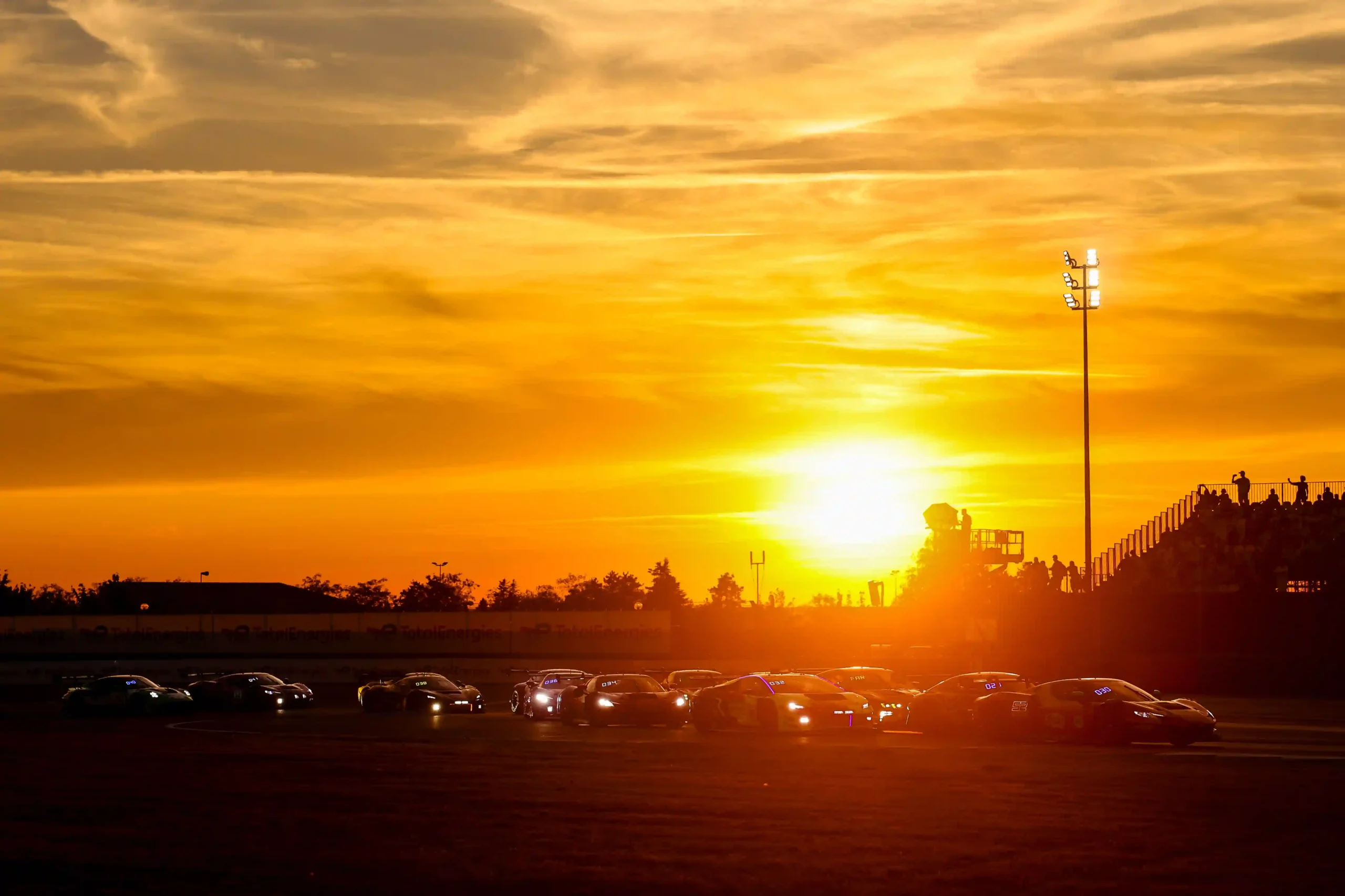
Race 1 began at 9:05 p.m. local time after the grid presentation and formation lap. The timing compressed the visual transition from sunset toward darkness into a flat-out GT3 race. The low sun, reflective windscreens and cooler tire behavior created a different problem from the Sunday afternoon race.
A complete reset, not an extension of Saturday
Kelvin van der Linde initially set the fastest time in the #32 Team WRT BMW, but his laps were deleted for a technical infringement involving overboost. Nicki Thiim therefore inherited pole for Comtoyou Racing with a 1:36.154. The episode showed why provisional timing should never be treated as the final grid.
Warm-track grip and a separate strategic contest
Race 2 started at 3:30 p.m. local time. The warmer afternoon surface changed the tire and balance picture from Saturday night, while the separate qualifying result created a new traffic order. Lionspeed GP converted the opportunity into victory with its #80 Porsche.
Magny-Cours did not simply host the same race twice. Saturday rewarded teams that understood the evening transition; Sunday demanded a new qualifying execution and a different tire-temperature plan.
How the GT World Challenge Europe Sprint Cup Format Worked
Magny-Cours was a Sprint Cup event, not an Endurance Cup round. That changed almost every strategic priority. Each car used a two-driver crew, and the weekend awarded two separate race opportunities rather than one long contest. A mistake on Saturday could hurt badly, but it did not automatically destroy Sunday because the field qualified again.
Why qualifying was split into Group A and Group B
GT World Challenge Europe expanded its use of split qualifying sessions to manage very large grids. At Magny-Cours, each qualifying segment lasted 10 minutes. Group A contained Silver and Bronze Cup runners, while Group B contained Pro and Gold Cup cars. The separate runs reduced traffic compared with sending the entire field onto the circuit at once.
That did not make qualifying easy. Ten minutes gives a driver little room to recover from a red flag, traffic, a deleted lap or a tire warm-up mistake. The car must leave the garage at the right moment, create enough space, bring the Pirelli tire into its window and complete the lap before the session disappears.
Why Race 1 and Race 2 had separate grids
Each race used its own qualifying result. Qualifying 1 established Saturday’s order, while Qualifying 2 created Sunday’s grid. This rewards complete crews rather than one exceptionally fast driver. Both members need to deliver because each qualifying session and each race places the car in a fresh competitive situation.
The pit stop was part of the sprint, not a pause from it
A one-hour GT3 race is long enough for a mandatory driver change to reshape the order but short enough that every pit-lane second matters. Teams rehearse the approach, braking point, belt change, seat adjustment and release repeatedly. A crew can gain positions without passing on track if its drivers enter cleanly, complete the change without delay and rejoin into usable space.
The opposite is also true. A car that leads the first stint can lose control of the race through a slow change, a blocked pit box, a penalty or poor traffic timing. That is why Sprint Cup racing often appears stable in the opening phase and then changes sharply around the stop sequence.
How the class system added a second race inside the race
The field contained Pro, Gold, Silver and Bronze Cup entries. All competed in the same overall race, but each class also had its own result and points battle. This creates layered pressure. A Silver Cup crew may be fighting for an overall top-10 finish while also protecting a class lead. A Bronze Cup car may choose a lower-risk move if the class points are more valuable than one uncertain overall position.
Magny-Cours Track Guide: Why This Circuit Tests GT3 Cars
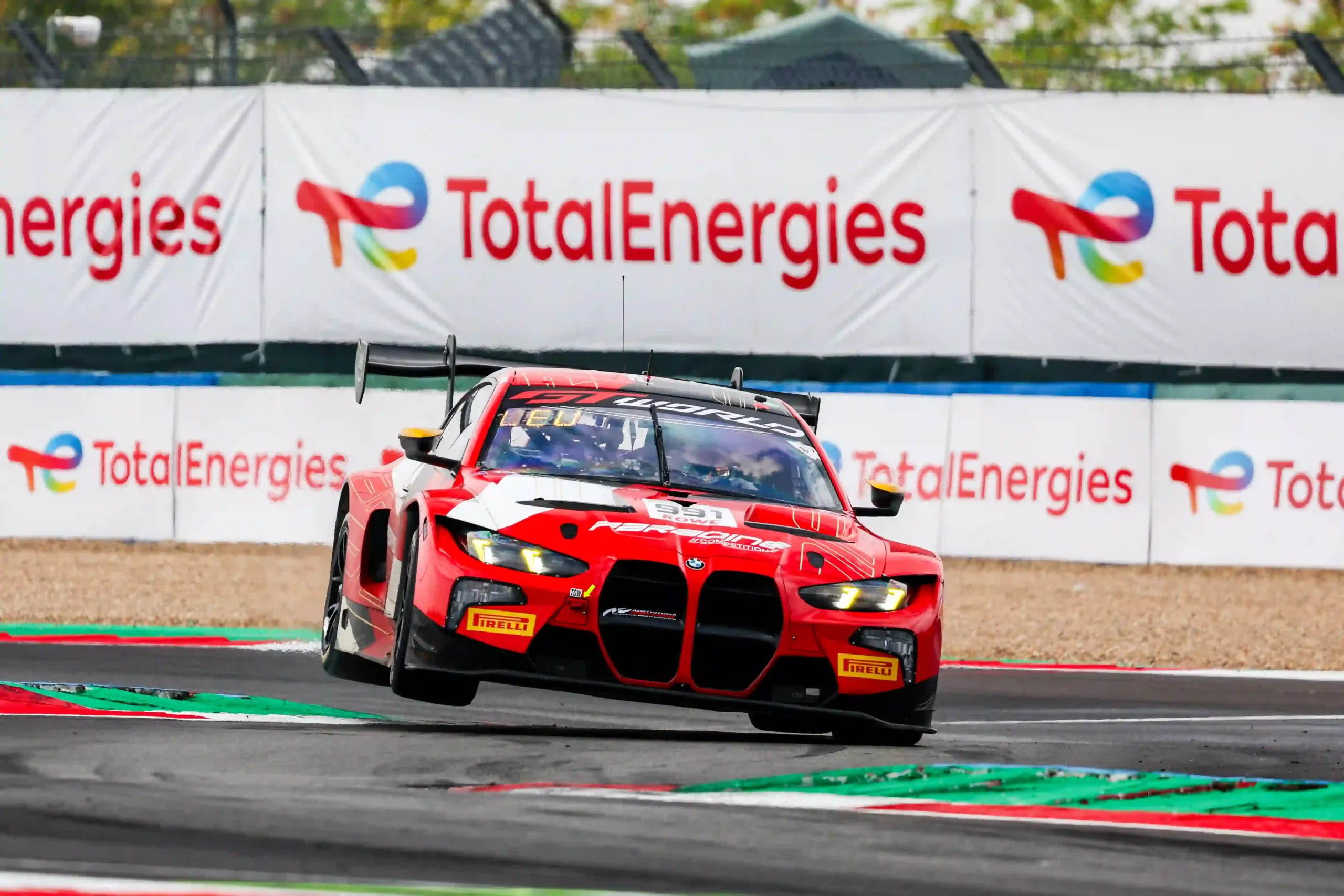
The Grand Prix circuit at Nevers Magny-Cours measures approximately 4.411 kilometres, or 2.741 miles. It is best known internationally for hosting the French Formula 1 Grand Prix from 1991 through 2008, but its character suits GT3 racing in a different way. The circuit combines high-speed commitment, slow corner rotation and major braking events inside a relatively compact lap.
Turn 1 and the opening direction changes
The lap begins with a fast opening section where aerodynamic confidence matters. A GT3 driver wants a stable front axle without making the rear nervous over the direction change. Because the cars are closely balanced by performance regulations, a small confidence advantage can become a real lap-time difference. The driver who can commit earlier often carries speed through more than one corner.
Adelaide: the clearest overtaking opportunity
The Adelaide hairpin follows a long acceleration zone and creates the circuit’s most obvious braking attack. It rewards straight-line efficiency, braking stability and the ability to place the car on the inside without locking the front tires. In a large field, the approach also becomes a traffic-management problem. A driver may be attacking one car while defending from another, with class leaders caught in the same group.
Outbraking a rival is only half the job. The car must still rotate and launch cleanly from the slow corner. A deep move that compromises the exit can leave the attacker vulnerable immediately afterward.
Nürburgring and the middle sector
The quicker changes of direction reward a platform that responds accurately without sliding. Excess understeer costs speed and forces the driver to wait before applying power. Too much oversteer overheats the rear tire and makes the car inconsistent. Teams therefore search for a balance that remains predictable across a stint rather than chasing one spectacular qualifying lap.
Imola, Château d’Eau and the final sector
The later part of the lap asks the car to brake, change direction and generate traction repeatedly. Château d’Eau is especially important because a driver must rotate the car at low speed without losing the rear. The final sequence then determines the run onto the start-finish straight and can decide whether a rival remains close enough to attack at Adelaide.
Why the night race changed the engineering problem
Saturday’s race started after 9 p.m. local time. The lower ambient and track temperatures affected tire warm-up, pressure growth and brake cooling. A setup that felt sharp in afternoon qualifying could become less responsive during the opening laps of the race. Teams needed to anticipate the temperature fall rather than simply copy their daylight settings.
Visibility also influenced traffic judgment. Headlights, reflective bodywork and a low evening sky change the visual references around braking zones. Experienced drivers usually adapt quickly, but the effect becomes more significant when more than 40 GT3 cars arrive at the same corner.
Magny-Cours offers overtaking, but a 45-car entry means every lost grid position increases the chance of being trapped behind a different class battle. Clean air helps tire management, pit-window flexibility and the ability to control the race rather than react to it.
Entry List Highlights and Teams to Watch
The official entry list showed the breadth of modern European GT3 racing. It included Pro teams chasing the overall win, ambitious Silver pairings, Gold Cup combinations and Bronze Cup crews balancing professional speed with amateur-driver requirements. The entry also contained several of the sport’s most recognizable names.
Mercedes-AMG Team Verstappen Racing
The #3 Mercedes-AMG paired Dani Juncadella with Jules Gounon. The project carried the Verstappen Racing name, but its immediate competitive strength came from two proven GT professionals and a mature Mercedes-AMG platform. Gounon arrived with clear one-lap speed and converted it into Race 1 pole before the crew delivered the team’s first overall GT World Challenge victory.
Team WRT’s four-car BMW presence
Team WRT entered multiple BMW M4 GT3 EVOs across different classes. The #32 Pro car of Charles Weerts and Kelvin van der Linde was central to the Sprint Cup title fight. The #46 paired Valentino Rossi with Max Hesse, while Amaury Cordeel and Jordan Pepper shared the #31. Matisse Lismont and Ignacio Montenegro carried the Silver Cup challenge in the #30.
The depth mattered because data from several cars can accelerate setup learning. One crew may explore a different mechanical balance or tire preparation path, giving the team a broader comparison than a single-car operation can produce.
Lionspeed GP Porsche
Ricardo Feller and Bastian Buus shared the #80 Porsche 911 GT3 R. The pair had already demonstrated winning Sprint Cup pace and came to France after contributing to Lionspeed’s remarkable Spa success. Their Magny-Cours weekend finished with the strongest possible response: victory in Race 2.
Ferrari’s multi-team attack
Ferrari 296 GT3 EVO entries appeared with Emil Frey Racing, AF Corse and Kessel Racing. The Pro field included Matteo Cairoli and Konsta Lappalainen for Emil Frey, while Thomas Neubauer and Arthur Leclerc formed AF Corse’s #50 crew. Ferrari’s strength was not limited to one class; the manufacturer also had Gold, Silver and Bronze representation.
Aston Martin, McLaren, Audi and Lamborghini
Comtoyou Racing and Walkenhorst Motorsport represented Aston Martin with several Vantage AMR GT3 EVO entries. Garage 59, Optimum Motorsport and CSA Racing carried McLaren’s 720S GT3 EVO challenge. Saintéloc and Tresor Attempto fielded Audi R8 LMS GT3 EVO II machinery, while Rutronik Racing and VSR brought the new Lamborghini Temerario GT3.
Rutronik’s #96 Lamborghini, shared by Luca Engstler and Patric Niederhauser, finished third in Race 2. That podium gave the new car a high-profile result in a field where the established brands had years of setup knowledge.
| Car | Team | Drivers | GT3 model | Class | Why it mattered |
|---|---|---|---|---|---|
| #3 | Mercedes-AMG Team Verstappen Racing | Jules Gounon / Dani Juncadella | Mercedes-AMG GT3 EVO | Pro | Race 1 winner |
| #32 | Team WRT | Charles Weerts / Kelvin van der Linde | BMW M4 GT3 EVO | Pro | Defending Sprint champions |
| #46 | Team WRT | Valentino Rossi / Max Hesse | BMW M4 GT3 EVO | Pro | Major fan interest |
| #80 | Lionspeed GP | Bastian Buus / Ricardo Feller | Porsche 911 GT3 R EVO | Pro | Race 2 winner |
| #96 | Rutronik Racing | Luca Engstler / Patric Niederhauser | Lamborghini Temerario GT3 | Pro | Race 2 podium |
| #30 | Team WRT | Matisse Lismont / Ignacio Montenegro | BMW M4 GT3 EVO | Silver | Second overall in Race 2 |
| #7 | Comtoyou Racing | Nicki Thiim / Kobe Pauwels | Aston Martin Vantage AMR GT3 EVO | Pro | Inherited Race 2 pole |
| #50 | AF Corse | Thomas Neubauer / Arthur Leclerc | Ferrari 296 GT3 EVO | Pro | Fourth in Race 2 |
Support Races and the Full Magny-Cours Weekend
The GT3 races sat at the top of a busy French national program. The organizer promoted a total of 17 races across the weekend, which meant the track rarely stayed quiet once the public schedule began.
The support package included the Championnat de France FFSA GT and Alpine Elf Cup Series, the French F4 Championship, Porsche Carrera Cup France, the FFSA Touring Car Championship and the MitJet Trophy France. Each category added a different type of racing: multi-class GT4 competition, junior single-seaters, one-make Porsche racing, touring cars and compact silhouette racers.
For spectators at the circuit, the support races were not filler. They shaped track evolution, deposited rubber, created cleanup delays and gave fans continuous action between the GT World Challenge sessions. They also offered a broader view of the French motorsport ladder, from developing single-seater drivers to experienced GT competitors.
Pit walks, autograph sessions and the night atmosphere
The official timetable included pit walks and autograph sessions during the Saturday and Sunday lunch breaks. Saturday’s GT3 grid presentation began at 8:30 p.m. local time, followed by the formation lap at 9 p.m. A night pit walk and track walk was scheduled after Race 1, extending the event beyond the podium.
The circuit’s practical information also promoted camping, track tours and fan activities. These details explain why the Magny-Cours weekend worked as more than two isolated one-hour races. The event was designed as a three-day motorsport festival, with the Saturday night race acting as its visual centerpiece.
What Happened at Magny-Cours: 2026 Weekend Update
This article is primarily a schedule and viewing guide, but the race weekend has now finished. A short results update keeps the guide accurate for readers arriving after the live broadcasts and helps replay viewers understand which sessions are available.
Race 1: Gounon and Juncadella deliver Verstappen Racing’s breakthrough
Jules Gounon started from pole and controlled the opening phase in the #3 Mercedes-AMG. The crew entered the pit cycle with enough margin to execute the driver change without surrendering control, and Dani Juncadella completed the victory. It was Mercedes-AMG Team Verstappen Racing’s first overall GT World Challenge win.
Boutsen VDS won the Gold Cup with Gilles Magnus and Robin Knutsson. Team WRT’s Matisse Lismont and Ignacio Montenegro continued their Silver Cup form, while Winward Racing’s Rinat Salikhov and Marvin Dienst took Bronze Cup honors after a penalty changed the class result.
Race 2: Lionspeed GP wins as a Silver Cup BMW finishes second overall
Bastian Buus and Ricardo Feller won Sunday’s 34-lap race in the #80 Lionspeed GP Porsche. The #30 Team WRT BMW of Matisse Lismont and Ignacio Montenegro finished only 2.120 seconds behind, combining Silver Cup victory with an exceptional second place overall.
Rutronik Racing completed the podium with Luca Engstler and Patric Niederhauser in the Lamborghini Temerario GT3. AF Corse’s Thomas Neubauer and Arthur Leclerc finished fourth, followed by Eastalent Racing’s Audi.
Gounon / Juncadella
Mercedes-AMG Team Verstappen Racing converted pole position into its breakthrough overall victory in Saturday night’s race.
Buus / Feller
Lionspeed GP Porsche won Sunday’s race by 2.120 seconds over the Silver Cup-leading Team WRT BMW.
The key lesson from the two races
Magny-Cours rewarded two different strengths. Race 1 went to the crew that controlled the event from pole under evening conditions. Race 2 went to a Porsche pairing that managed a more volatile contest and kept enough pace to hold off a Silver Cup car operating at the front of the overall field.
The results also reinforced the depth of the 2026 grid. Mercedes-AMG, Porsche, BMW and Lamborghini occupied the two overall podiums, while Ferrari, Audi, McLaren and Aston Martin remained competitive across the top positions and class battles.
Why Magny-Cours Still Matters in European Motorsport
Motorsport at Magny-Cours began with Jean Bernigaud’s effort to create a permanent “motor stadium” in the region. A kart track opened in 1960, followed by a car and motorcycle circuit. The facility expanded through the 1960s and 1970s before the old Jean Behra layout was replaced by a new circuit built to Formula 1 standards.
The modern venue opened in 1989 and hosted its first Formula 1 French Grand Prix in 1991. The event remained there through 2008. That history gives Magny-Cours instant recognition, but the circuit’s modern value extends beyond nostalgia. It continues to host major international and national championships, including GT racing, superbikes and historic events.
GT World Challenge Europe first visited the circuit in its current era in 2020. The championship returned in 2021, 2022, 2024, 2025 and 2026. The repeat visits show that the venue works particularly well for Sprint Cup competition: qualifying is important, traffic creates pressure, and the circuit offers enough braking zones for genuine racing.
The 2026 night race added another layer to that legacy. Rather than trying to recreate Formula 1’s past, the event used the circuit in a way that suited modern GT3 racing—large grids, accessible streaming, multiple classes and a compact weekend built around two intense one-hour contests.
Magny-Cours GT World Challenge Europe 2026 FAQ
Final Takeaway: Magny-Cours Delivered a Complete Sprint Cup Test
The Magny-Cours GT World Challenge Europe 2026 weekend placed qualifying precision, pit-stop execution and traffic management under maximum pressure. The official program stretched from Thursday’s test to Sunday’s Race 2, but the core viewing schedule was straightforward for U.S. fans: qualifying and Race 1 on Saturday, then early qualifying and a 9:30 a.m. ET race on Sunday.
The free GT World stream made the event accessible without a cable package, while official live timing gave viewers the class detail that television cannot always show. On track, Mercedes-AMG Team Verstappen Racing won the night race and Lionspeed GP Porsche won the Sunday finale, giving the French round two distinct stories rather than one repeated outcome.
That combination—historic circuit, record entry, two separate grids and free worldwide coverage—is why Magny-Cours remains one of the most useful Sprint Cup weekends for understanding modern GT3 racing.
Sources & Official References
- GT World Challenge Europe — official Magny-Cours event page, timetable and results hub
- SRO — 2026 Magny-Cours official detailed timetable, version 1
- GT World Challenge Europe — official streaming and live-timing page
- GT World Challenge Europe — 45-car event preview and broadcast information
- GT World Challenge Europe — official 2026 Magny-Cours entry list
- GT World Challenge Europe — official Race 1 report
- GT World Challenge Europe — official Race 2 classification
- Circuit de Nevers Magny-Cours — official circuit history
Schedule information reflects the official detailed timetable published for the event. Motorsport timetables can change because of weather, incidents or sporting decisions. Results information was updated after Race 2 on August 2, 2026.