Portland INDYCAR 2026 Track Guide: Festival Curves, Passing Zones & Pit Strategy
Portland International Raceway looks simple on a map. It is not. The lap is short, the braking zones are crowded, the track is flat, and one mistake at the Festival Curves can turn a clean race into damage control.
Portland International Raceway is one of those circuits where lap time and raceability pull in different directions. A qualifying lap rewards precision and momentum. A race stint demands patience, tire management and a willingness to give up one corner to win the next. The track is short enough that traffic arrives quickly, yet the obvious overtaking zones are limited enough that teams cannot treat pit strategy as an afterthought.
The 2026 OnlyBulls Grand Prix of Portland ran Aug. 7-9, with the NTT INDYCAR SERIES race scheduled for 110 laps and 216.04 miles. Alex Palou won from second on the grid after Felix Rosenqvist started from pole. That race offered a current example of what Portland usually rewards: clean execution, correct tire timing, strong exits and the ability to use pit cycles to create track position when passing becomes difficult.
What is the Portland INDYCAR track?
Portland International Raceway is a permanent, relatively flat road course in Portland, Oregon. INDYCAR lists the 2026 event at 1.967 miles, while the series’ own descriptive copy rounds the traditional layout to 1.964 miles. The course has 12 turns, a long front straight, the tight opening Festival Curves, a flowing middle sector, the important Turn 7 braking zone, a fast back section and a three-corner final sequence that sends the cars back toward the front straight.
Its length is part of its personality. With competitive laps under a minute, a driver can lose several positions without making a dramatic mistake. A half-second delay behind a slower car matters more here than at a four-mile circuit because the field compresses quickly. That is also why qualifying has real value. If you want a broader explanation of how starting position shapes race tactics, see our guide to grid position in racing.
Portland is unusually compact for a top-level road course. The lap combines a very tight first chicane, long acceleration zones, fast direction changes and only a few reliable passing points. That makes track position, tire timing and clean exits more important than the circuit’s simple map suggests.
What are the Festival Curves at Portland International Raceway?
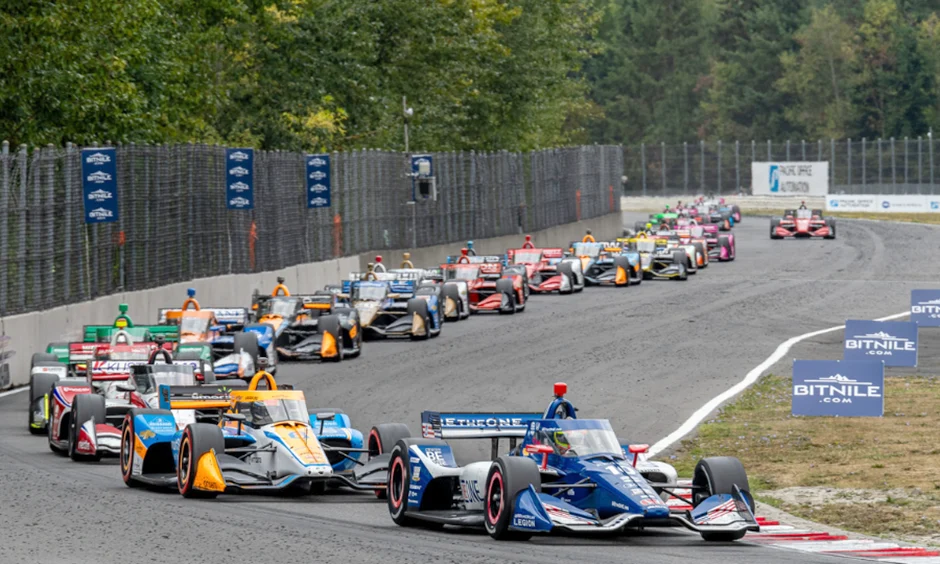
The Festival Curves are the opening chicane at the end of Portland’s front straight. Drivers arrive at very high speed, brake hard, turn right for Turn 1 and then immediately change direction for the much tighter left at Turn 2. Turn 3 follows as the cars accelerate away. That sequence is the circuit’s most famous piece of asphalt because it is where ambition, braking stability and traffic all collide.
Will Power described the Turn 1 approach as a long, difficult braking zone from high speed. His explanation is useful because it shows why the corner is not a simple “brake late and take the inside” move. A driver on the inside for Turn 1 can become vulnerable through Turn 2. A driver who attacks around the outside of Turn 1 may gain the preferred inside line for the left-hander. In other words, the pass is often a two-corner negotiation, not a one-corner lunge.
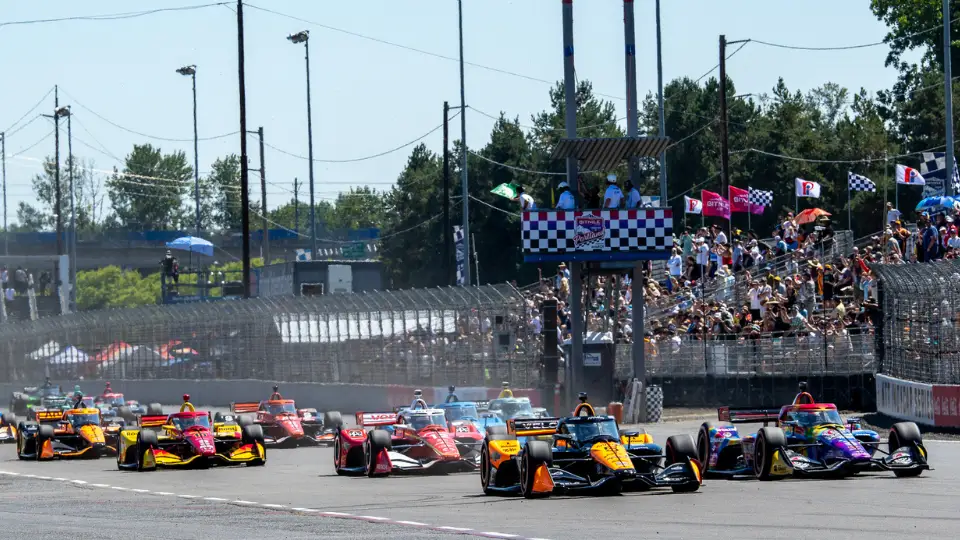
The geometry also makes the opening lap especially risky. Twenty-plus cars arrive together with cold tires, heavy fuel and slightly different braking references. The field fans out, yet the road narrows into a chicane that cannot comfortably accept every car at once. A driver can make a perfectly reasonable braking decision and still find the apex occupied by another car. That is why Portland starts often feel more like a survival test than a normal first corner.
Why Turn 2 matters as much as Turn 1
Turn 1 gets most of the attention because it is the first braking point. Turn 2 often decides whether the move actually works. If the attacking driver parks the car at Turn 1 and cannot rotate it for the left, the defender can cross back and reclaim position. If the attacker keeps enough speed to complete the direction change, the exit toward Turn 3 becomes the reward.
That exit is important beyond the pass itself. Turn 3 is effectively a launch into the flowing right-hand section that follows. A compromised Turn 2 can leave a driver vulnerable even after appearing to complete the overtake. Portland therefore punishes “hero braking” without an exit plan. This is a good practical example of why mechanical grip and traction can be more valuable than a few extra miles per hour at the end of a straight.
At Portland, a good pass into Turn 1 is not finished until the car is stable, rotated and accelerating out of Turn 2.
Where are the best passing zones at Portland IndyCar?
The two most reliable overtaking areas are the Festival Curves at Turns 1-2 and the braking zone for Turn 7. INDYCAR’s official circuit description highlights both. It also mentions the final three-turn complex as an area where position can change. However, the character of those opportunities is different.
Turns 1-2 — Festival Curves
The longest obvious approach and the biggest braking commitment. Side-by-side racing can continue through the direction change, so positioning one corner ahead matters.
Turn 7
A hard-braking right-hander after a flowing section. A strong Turn 6 exit can create the run needed to attack, but both cars lose time if the move becomes too defensive.
Turns 10-12
Passing is harder here, yet the sequence produces mistakes. Understeer, tire pickup or running wide can open the door before the main straight.
Pit cycle
Portland often creates more position changes through in-laps, out-laps and tire offsets than through clean side-by-side moves in the middle of the lap.
Turn 7: Portland’s second true braking attack
Turn 7 is critical because the car arrives after a section where rhythm matters. A driver who exits Turn 6 well can open the corner and brake later. A driver defending into Turn 7 has to decide how much entry speed to sacrifice. The catch is that the corner feeds a fast back section. If the attacker forces both cars to slow too much, they may lose several tenths to everyone behind.
Power called Turn 7 the most obvious passing place after Turn 1. He also stressed that it is easy to carry too much speed because the corner’s camber gives confidence. That is a classic Portland trap. The grip encourages a late attack, but a rear wheel on the dirt at exit destroys the acceleration phase. If you are learning racecraft terms, our explainer on out-braking another driver describes the basic technique behind these moves.
Can drivers pass in the final complex?
Yes, but usually because the car ahead has made an error or is on badly worn tires. Turns 10, 11 and 12 behave almost like one extended corner. The driver has to keep the front tires alive, avoid running onto the dirty edge of the track and unwind the steering early enough to use the full width on exit. If the car ahead pushes wide at Turn 11, a following driver can get a better run onto the main straight and set up Turn 1.
This is where racecraft becomes connected. The “pass” may happen at Turn 1, but it starts three corners earlier. The following car needs to stay close without overheating the front tires, get a cleaner exit, use the draft and then deploy attack tools efficiently. For the aerodynamic side of that sequence, see our guide to slipstreaming.
Portland IndyCar track layout explained, corner by corner
| Section | What the driver needs | Main risk | Race effect |
|---|---|---|---|
| Turns 1-2 | Stable braking, rotation, patience | Lockup, contact, chicane congestion | Best overtaking area |
| Turns 3-5 | Momentum and balanced platform | Scrubbing speed | Builds gap for next sector |
| Turn 6 | Clean exit and track width | Running wide | Sets up Turn 7 attack |
| Turn 7 | Late but controlled braking | Over-commitment at exit | Second-best passing point |
| Turn 8 / back section | Low drag without losing stability | Poor deployment or dirty air | Builds speed to Turn 9 |
| Turn 9 | Confidence and downforce | Front-end washout | Qualifying differentiator |
| Turns 10-12 | Front grip, patience, early throttle | Understeer, marbles, grass | Controls main-straight speed and pit entry |
Turns 3-5: Portland’s rhythm section
After the chicane, the track opens. Turn 3 is taken with far less drama than Turn 1, then Turns 4 and 5 flow together. The challenge is to avoid asking too much from the tire. A driver who attacks every apex independently can scrub speed. The faster method is to treat the right-hand sequence as one long arc and place the car so the road’s crown and camber help rather than fight the chassis.
That matters in qualifying because Portland’s lap is so short. You do not have many high-value corners where a driver can find four or five tenths. Instead, the lap is built from small gains. A cleaner line through this section can be worth the difference between advancing and being eliminated in a tight qualifying group. Our general guide to how racing drivers qualify explains why tiny track-position and traffic decisions matter so much in short sessions.
Turns 8-9: speed rises, confidence matters
Portland’s back section is faster than the circuit’s average speed would suggest. Turn 8 is more bend than traditional corner, while Turn 9 asks the driver to commit at speed. This is one reason teams do not simply trim away every bit of wing to chase straight-line performance. They still need a stable car for Turn 9 and for the final sector.
The trade-off is familiar across open-wheel racing. Less wing reduces drag, but it also removes confidence and tire support in fast corners. More wing helps the driver attack Turn 9 and the final complex, but too much can make a car harder to pass with on the straights. For a broader technical primer, see what downforce is and why race cars need it.
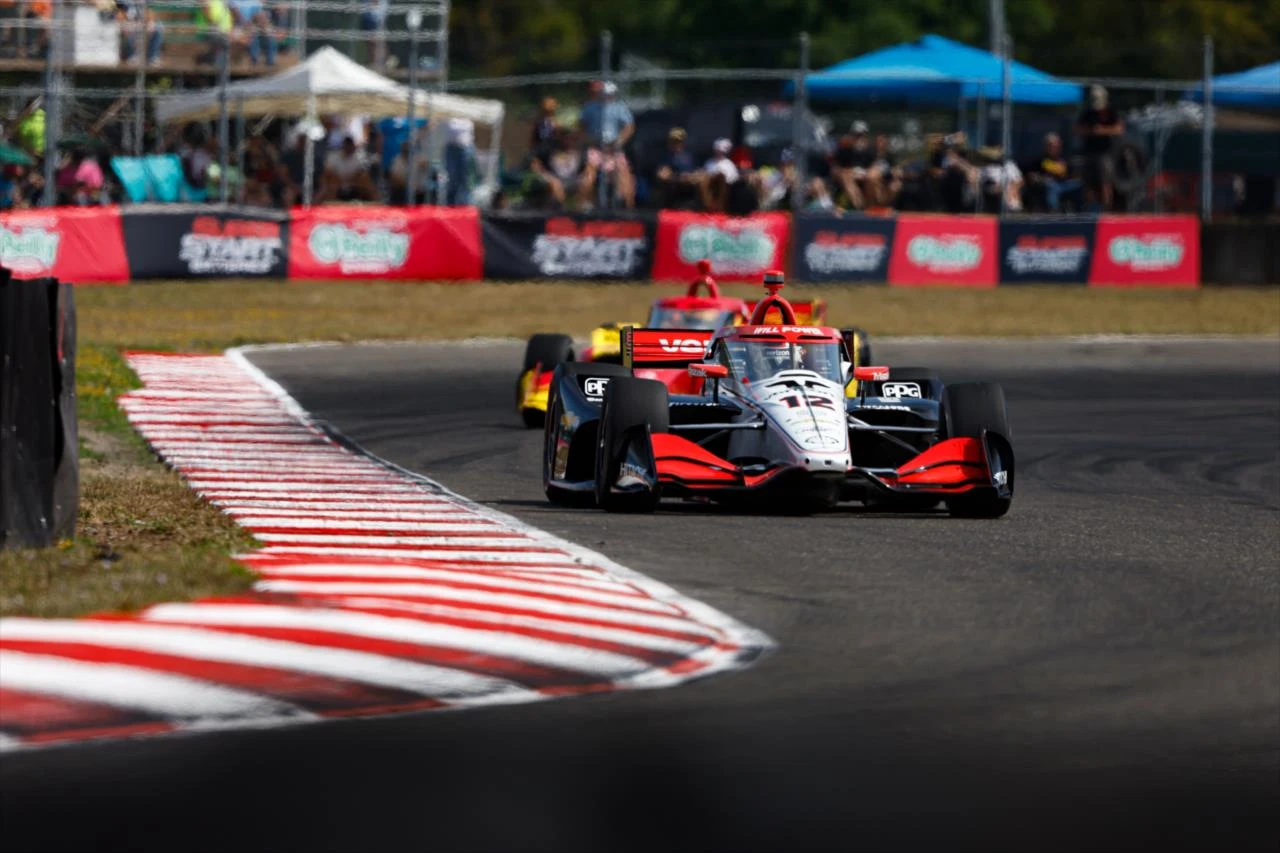
Turns 10-12: the lap finishes before the timing line
The last complex decides the speed a car carries onto the front straight. If the front tires start to slide, the driver has to wait longer before committing to throttle. That delay continues all the way down the straight. In a race, it can be the difference between defending comfortably and having to cover the inside into Turn 1.
Pit entry adds another layer. The pit lane entrance sits around the Turn 12 exit. A driver on an in-lap wants to carry speed deep into the final arc, then bleed enough speed to make pit entry without losing unnecessary time. That makes the final corner not only a lap-time corner, but also part of the pit strategy equation.
What setup does an IndyCar need at Portland?
A competitive Portland setup has to work in contradictory situations. The car needs stability when braking hard into Turn 1 and Turn 7. It needs enough front response to rotate through the chicane and the final complex. It needs rear traction when the driver gets back to power. It also needs aerodynamic confidence through the faster middle and back sections.
That balance makes Portland a handling circuit more than a pure top-speed circuit. A car that is fast in a straight line but nervous under braking will lose the advantage at the first major stop. A car with too much understeer may look stable early in a stint but struggle badly once the front tires lose their peak grip. If you want the fundamentals behind those sensations, our car handling explainer is a useful companion.
Front-end bite versus rear stability
The driver wants the nose to change direction quickly in Turns 1-2 and 10-12. However, an overly aggressive front can make the rear unstable during trail braking. That is especially dangerous at Turn 1, where the car arrives fast and still has to change direction immediately after the first apex.
Teams therefore chase a platform that rotates without becoming nervous. Mechanical setup, differential behavior, tire pressures and aerodynamic balance all play a role. There is no single Portland setup because driving style matters. A driver who attacks braking zones may prefer more rear security. A driver who builds speed through the corner may accept a livelier rear if it gives a sharper front.
Why tire temperature can change the car in traffic
Following another IndyCar reduces clean airflow across the front wing and can raise tire temperatures. At Portland, that can be frustrating because a driver may be close enough to pressure the car ahead but not close enough to pass. The front tires then slide more, especially in the final complex, and the follower loses the exact exit needed to attack Turn 1.
That is why drivers sometimes drop back by a few car lengths rather than sit directly in dirty air. They are not giving up. They are trying to recover the front tires, build a better exit and create one strong attack. It is a useful reminder that race pace is not just “go as fast as possible every corner.” Sometimes the fastest route to a pass is temporarily driving slower.
What is the best pit strategy for Portland IndyCar?
There is no fixed “best” Portland strategy before the green flag. The correct plan changes with caution timing, tire degradation, weather, fuel targets and where a driver sits in traffic. However, Portland has a consistent strategic theme: clean air is extremely valuable. If a driver cannot pass on track, the pit sequence becomes the next overtaking opportunity.
The 2026 race demonstrated this clearly. Rosenqvist started from pole with Palou alongside him. After the first stint developed, Rosenqvist stopped before Palou. Palou stayed out one extra lap and emerged ahead after the cycle. From there, the No. 10 car used clean air and tire performance to build control of the race. It was a practical Portland overcut: stay out, deliver a strong in-lap, stop cleanly and use the timing gap to reverse the order.
Teams compare tire falloff against the time lost in traffic. If fresh tires are much faster, an undercut can work. If the leading car still has pace and clear air, staying out can create an overcut. Cautions can erase both plans, so teams also protect fuel flexibility whenever possible.
Undercut: pit first and use fresh tires
The undercut is simple in theory. A driver pits before the rival, takes fresh tires and uses the extra grip to produce a faster out-lap. If the rival pits a lap later, the first car may already have gained enough time to jump ahead. Portland can reward this when tire performance drops sharply and pit exit traffic is light.
The risk is traffic. A driver can pit onto fresh tires and immediately catch a slower car. The theoretical advantage disappears. This is why teams study gaps throughout the field before making the call. Our guide to how pit stops work in racing covers the mechanics and timing logic in more detail.
Overcut: stay out and protect track position
The overcut works when the driver staying out can still produce fast laps. Portland’s short lap means one clean lap in free air can be powerful. If the rival who pitted early gets held up, the car that stays out may gain the position even with slightly older tires. That was one of the important strategic patterns in the 2026 race.
Overcutting is not passive. The driver has to deliver immediately. A slow in-lap, a lockup entering pit lane or a poor pit stop can erase the advantage. The crew also has to release the car into a useful gap. At Portland, pit strategy is therefore an execution contest as much as a spreadsheet problem.
Primary and alternate Firestone tires
INDYCAR road-course weekends use primary and alternate Firestone compounds. The alternates are generally designed to offer more grip but can have different degradation characteristics. The primaries usually provide a more durable baseline. Teams must think about both mandatory compound use and the best point in the race to exploit the faster tire.
The key word is crossover. At the start of a stint, an alternate may be significantly quicker. As it ages, the gap can shrink or reverse. A driver who is attacking may want the extra grip immediately. A leader protecting track position may prefer the predictability of the primary. The best choice also depends on which compound rivals have available late in the race.
Fuel saving can create a second strategy race
Fuel strategy at Portland is not always obvious from the television picture. A driver may look slow because the team is asking for a target that extends the stint by one or two laps. If that extra range removes a pit stop or opens a caution window, the lost lap time can be repaid instantly.
The opposite can also happen. A driver may push hard early to create a gap, accepting a shorter stint because track position is worth more than fuel economy. This is why Portland can split the field into different races even when everyone is on the same lap. One group is maximizing pace. Another is maximizing stint length. A caution can make either approach look brilliant.
Full-course cautions: the strategy reset button
Portland has enough runoff and enough error-prone zones that cautions always matter to strategy. A full-course yellow can close gaps, allow drivers to pit at a lower relative cost and transform a race that looked settled. It can also trap drivers who stopped seconds before the yellow.
The 2026 race featured one full-course caution after Graham Rahal went into the tire barriers near Turn 11 and continued. Because the rest of the event stayed relatively controlled, the long green-flag phases made the pit cycles especially important. To understand what happens operationally when a race is neutralized, see our explainer on safety cars and caution periods.
What the 2026 Portland race taught us about the track
Alex Palou’s 2026 victory was not built on one spectacular dive-bomb. It was built on the exact details Portland rewards. Rosenqvist controlled the opening phase from pole. Marcus Ericsson briefly moved ahead of Palou. Then the race shifted through stint length, pit timing and tire performance. Palou’s team found the decisive advantage through the first major green-flag cycle and then managed the race from the front.
RACER reported that Palou led 60 of the 110 laps and won by 4.2 seconds over Rosenqvist, with Will Power third. The top three starters became the top three finishers, although the order changed. That detail is important. Portland was not impossible to race on. The positions changed because the faster strategic package created the opportunity.
Rinus VeeKay finished fourth and Kyle Kirkwood fifth. Christian Lundgaard climbed from 25th to ninth, showing that passes and recovery drives are possible deeper in the field. Yet once the leaders settled into strong pace, the race became more about controlling the tire and pit sequence than trading positions every lap.
| 2026 takeaway | What happened | Why it matters for future Portland races |
|---|---|---|
| Pole was not enough | Rosenqvist led early but Palou jumped him through pit-cycle execution. | Qualifying helps, but clean in-laps and pit timing can reverse the order. |
| Tire offsets mattered | Primary and alternate phases changed relative pace during stints. | Compound timing can be more powerful than a marginal top-speed gain. |
| Traffic punished leaders | Backmarkers influenced gaps late in stints. | Short lap length means traffic arrives quickly and can destroy an undercut or overcut. |
| Turn 11 remained a danger point | Rahal’s off caused the race’s full-course caution. | The final complex keeps strategic risk alive even in an otherwise clean race. |
That result also added another Portland win to Palou’s record after earlier victories at the venue. More importantly for this track guide, it reinforced the circuit’s central lesson: the best Portland race car is not simply the car that can brake latest into Turn 1. It is the car that remains balanced over a stint and gives the strategist multiple options.
Why Portland has such a distinctive IndyCar history
Portland International Raceway opened in 1961 on land connected to the former city of Vanport, which was destroyed by flooding in 1948. Indy-style open-wheel racing first came to the venue in 1984, when Al Unser Jr. won. The circuit later produced one of the most famous road-course finishes in American open-wheel history.
In 1997, Mark Blundell beat Gil de Ferran by only 0.027 seconds, with Raul Boesel just 0.055 seconds behind the winner in a three-wide finish. INDYCAR still references that event when describing Portland. It is a fitting piece of history for a place where the final corner and main straight are so strategically connected.
The modern NTT INDYCAR SERIES returned to Portland in 2018. Since then, the track has remained a useful contrast to newer street circuits and giant natural-terrain venues. It is compact, old-school and unforgiving without relying on walls around every corner. For readers building a wider picture of the championship, our IndyCar racing guide and IndyCar schedule page cover the series beyond Portland.
How to read a Portland IndyCar race like a strategist
- Watch the gap behind each contender before a pit stop. A six-second gap to clean air can be more valuable than staying directly behind the leader.
- Check which tire compound is on each car. A driver closing rapidly may be using a temporary alternate-tire advantage.
- Watch Turn 12 exits. A car that repeatedly understeers there is likely to become vulnerable into Turn 1.
- Look for traffic on the in-lap. One slower car can swing a pit cycle.
- Do not judge the strategy until the stop sequence completes. A driver running third on track may already be the virtual leader.
Those five cues make Portland much easier to follow. The circuit may not deliver constant passing at the front, but it gives informed viewers plenty to watch. Pit timing, tire crossover and traffic management create a second race underneath the obvious one.
If a caution appears, reset the picture. Ask who has already stopped, who still owes a compound, who has fuel flexibility and who has clean tires remaining. Then follow the restart into the Festival Curves, where the whole strategic advantage can disappear in one braking zone. For fundamentals such as race distance and how completed laps are recorded, see how laps are counted in racing and our guide to racing flags.
Frequently Asked Questions
Conclusion: Portland is a strategy track disguised as a short sprint
Portland International Raceway is easy to underestimate. It is short, flat and visually simple compared with many modern road courses. Yet its racing problems are complex. The Festival Curves demand judgment. Turn 7 demands commitment. Turn 9 needs aerodynamic confidence. The final complex punishes front-tire weakness. Then the short lap brings traffic back into the picture before the strategist has time to relax.
For drivers, the key is to connect corners rather than attack them in isolation. For engineers, the goal is a car that brakes cleanly, rotates without destroying the rear and protects the front tire over a stint. For strategists, the challenge is to recognize when track position is worth more than fresh rubber and when one extra lap in clean air can beat a rival who pitted first.
The 2026 race was a modern example. Felix Rosenqvist had pole and early control. Alex Palou and Chip Ganassi Racing used pace, tire timing and a clean pit sequence to turn second place into victory. That is Portland in one race: the obvious passing zones matter, but the decisive move may happen while the leader is already in pit lane.
The one thing to remember about Portland
If you only watch Turn 1, you will miss half the race. The Festival Curves create the headlines, but Portland is usually decided by the quality of the exits, the condition of the tires and the lap on which the strategist chooses to stop.