2026 IndyCar Schedule:
Dates, Tracks, TV Channels & Live Coverage
Every race date, every circuit, every TV channel. The complete 2026 NTT IndyCar Series calendar with broadcast times, streaming options, and what to watch for at each round.
2026 IndyCar Schedule: Dates, Tracks & TV Guide
Every race date, every circuit, how to watch — the complete 2026 IndyCar Series season guide.
The 2026 NTT IndyCar Series calendar is 17 rounds across three circuit types — temporary street circuits, permanent road courses, and high-speed ovals — stretching from early March in St. Petersburg, Florida, to a September finale at a superspeedway oval. The series runs under a new exclusive media rights deal with FOX Sports, which means every single points race is now on the flagship FOX network. That is the biggest broadcast change in the sport’s recent history, and it fundamentally simplifies the question most fans ask every Sunday morning: what channel is IndyCar on?
This guide covers the complete calendar race by race, the FOX broadcast schedule and how to stream without cable, how IndyCar race weekends are structured across different circuit types, the key championship storylines to follow, and the answers to every practical question a fan watching in 2026 might need.
The Complete 2026 IndyCar Schedule
The 2026 calendar is one of the most physically demanding schedules in global open-wheel racing. Drivers must master three fundamentally different driving disciplines across the season — the tyre management and mechanical grip demands of permanent road courses, the rhythm and commitment of high-banked oval superspeedways, and the stop-start aggression of temporary street circuits where the barriers are centimetres away and one mistake ends your race before it begins. No other major single-seater series on earth asks this of its competitors.
The season opens at St. Petersburg — IndyCar’s traditional curtain-raiser on the Gulf Coast street circuit — and builds through spring and into summer, with the centrepiece Indianapolis 500 anchoring the May calendar slot it has held for over a century. The championship reaches its conclusion in September, giving teams and broadcasters a clean run ahead of the NFL broadcast season.
Season Opener: Firestone Grand Prix of St. Petersburg, March · Centrepiece: Indianapolis 500, May · Season Finale: September. All 17 races broadcast on the main FOX network with practice and qualifying on FS1/FS2. For live race coverage as events happen, see our IndyCar race today live page and our updated IndyCar schedule hub.
The 110th Indianapolis 500: The Race That Defines the Sport
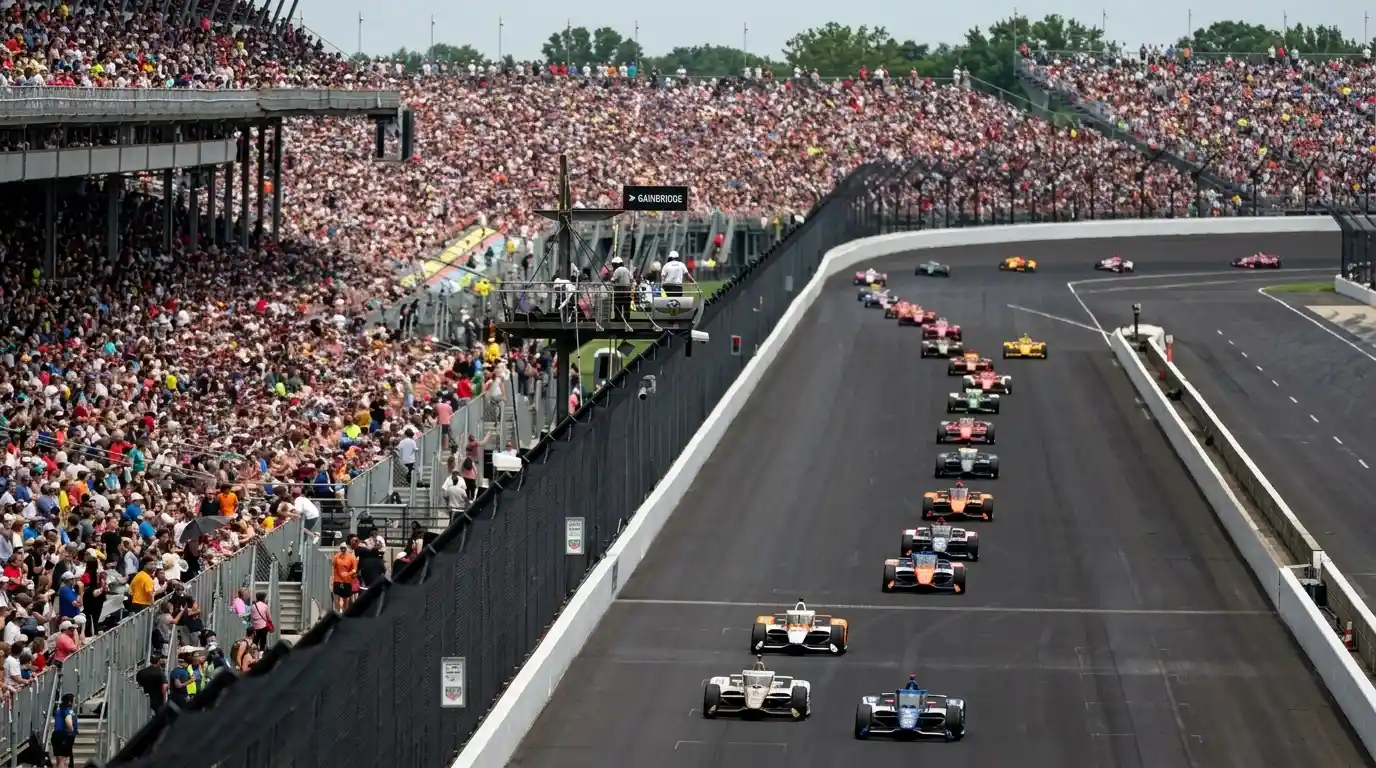
The Indianapolis 500 is not simply round five of the IndyCar championship. It is the largest single-day sporting event on earth by attendance, the race that still defines what it means to win in American open-wheel racing, and the event that attracts a television audience dwarfing every other round on the calendar. The 110th edition in 2026 carries the full weight of that history while running under a completely new broadcast arrangement — for the first time in the FOX Sports era, the entire race is on the flagship FOX network from green flag to chequered.
The Month of May at Indianapolis
What casual fans sometimes don’t grasp is that the Indianapolis 500 is not a race weekend in the conventional sense — it is a month. The IndyCar programme at Indianapolis Motor Speedway in May begins with practice sessions in the first week, builds through Carb Day and qualifying across successive weekends, and culminates with race day on the Sunday of Memorial Day weekend. That month of preparation is unique in motorsport. No other race on the calendar demands — or commands — this kind of extended commitment from teams, drivers, and fans.
Qualifying at Indianapolis is its own spectacle. The four-lap qualifying run on the 2.5-mile oval, where average speed over two laps determines your grid position, is conducted across a weekend format unlike anything else in the series. The fastest 12 from an initial qualifying session advance to Fast 12, then the fastest six run again in the Firestone Fast Six to determine pole position. Pole at Indianapolis matters to a degree it simply doesn’t at most circuits — running at the front on a 2.5-mile oval, leading early laps and controlling the draft, is a strategically significant advantage. Our Indy 500 practice results page and the Indianapolis 500 winners archive cover the historical and current-season dimensions in detail.
Circuit: Indianapolis Motor Speedway, 2.5-mile high-banked oval · Race distance: 500 miles (200 laps) · Typical average speed: 220–230mph on the straightaways · Attendance: Approximately 285,000–300,000 (largest single-day sporting event on earth) · Broadcast 2026: FOX Network, live national coverage · All-time wins record: A.J. Foyt, Al Unser, Rick Mears — 4 wins each. For an in-depth look at the all-time records, our most Indianapolis 500 wins ever archive piece has the full history, including the Mario Andretti connection documented in our Mario Andretti archive.
The Hybrid Era Arrives at Indianapolis
The 2026 Indy 500 is the first to feature the series’ new hybrid power unit architecture. The Honda and Chevrolet turbocharged 2.2-litre twin-turbo V6 engines that have powered the Dallara DW12 are now supplemented by an energy recovery system — a push-to-pass MGU-K that deploys electrical power over short windows, giving drivers a tool for overtaking and defending that is entirely new to the oval environment. Managing the hybrid system’s energy storage and deployment in a 500-mile oval race at average speeds approaching 230mph is a genuinely new engineering challenge, and the teams that solve it most intelligently in the opening laps of practice will carry a meaningful advantage into race day.
2026 IndyCar TV Schedule: The Complete Broadcast Guide
The most significant off-track development in the 2026 IndyCar season is the media landscape. Beginning with the 2025 contract and running fully into 2026, IndyCar signed an exclusive television rights deal with FOX Sports. Every championship points race is now broadcast on the main FOX network — not a cable channel, not a streaming-only platform, but the free-to-air network available to anyone in the country with a television set. It is the most accessible broadcast arrangement the series has had in a generation, and it matters enormously for how new fans find the sport.
| Session Type | Broadcaster (US) | Platform | Notes |
|---|---|---|---|
| Race (All Rounds) | FOX | Free-to-air network | Every points race — no cable required |
| Practice Sessions | FS1 / FOX Sports App | Cable / Streaming | Full session coverage with technical commentary |
| Qualifying | FS1 / FS2 | Cable / Streaming | Fast Six shootout gets flagship FS1 treatment |
| Indianapolis 500 Qualifying | FOX | Free-to-air network | Moved to FOX given the event’s scale |
| UK & Ireland | Sky Sports F1 | Cable / Sky Go app | Full race and pre/post race analysis |
| Canada | TSN / RDS | Cable / Streaming | French-language coverage via RDS |
The FOX deal is not just a broadcast agreement — it is a statement of intent. Placing every IndyCar race on the most-watched network in North America puts the series in front of audiences that have never seen an IndyCar compete. That is how you grow a sport, not maintain it.
What the FOX Broadcast Looks Like in Practice
FOX’s IndyCar production is built around the visual spectacle of the cars — drone cameras pursuing individual battles, onboard cameras capturing the confined violence of an oval draft, live telemetry overlays showing throttle and braking inputs. The network brought significant resources to the series when the deal was signed, and the production quality difference versus the previous NBC/Peacock era is immediately visible in the graphics package, the camera coverage of pit lane, and the depth of the pre-race show.
For practice and qualifying, FS1 carries the full session from start to finish. This matters because qualifying in IndyCar — particularly the Fast Six format and the Indy 500’s four-lap qualification runs — is genuinely compelling standalone content, not just a grid-determination exercise. The commentary team dedicated to qualifying tends to be more technically focused than the race broadcast team, which suits the format well. For fans comparing formats with other series, our F1 qualifying explainer and the how racing drivers qualify guide provide useful cross-series context.
How to Watch IndyCar in 2026 Without Cable
Cord-cutting has changed how most sports fans consume live racing, and the FOX deal actually makes IndyCar one of the easiest major motorsport series to watch without a traditional cable package. Here is the honest breakdown of every option, from completely free to full-featured streaming service.
For most fans: a $25–40 digital OTA antenna (free races every Sunday) plus the free INDYCAR app (live timing during all sessions) covers 90% of what you need at minimal cost. Add YouTube TV if you want FS1 qualifying and don’t want to miss any session. The OTA antenna delivers better picture quality than any cable or streaming service because there’s no compression between the broadcast tower and your TV.
How IndyCar Race Weekends Work
One of the things that distinguishes IndyCar from Formula 1 or NASCAR is how differently a race weekend runs depending on the type of circuit. A street circuit weekend in St. Petersburg operates on a fundamentally different schedule to an oval weekend in Iowa, and both differ from a permanent road course weekend at Mid-Ohio. Understanding the format helps you plan when to tune in for each session.
Road Course & Street Circuit Weekend
Oval Weekend (Short Oval)
Track Spotlights: What Makes Each Venue Different
St. Petersburg is the traditional season opener and one of the series’ best street circuits. Tight barriers, a tricky chicane section, and a long pit straight where drivers can lock up and lose positions make it a circuit that rewards both mechanical precision and brave overtaking decisions. The warm Florida weather can catch out teams with tyre warm-up issues in the opening laps — it’s the first race of the year and no team truly knows where they stand until the cars are actually on track under race conditions.
Long Beach is the glamour race of the street circuit calendar. The combination of a long seafront straight, multiple heavy braking zones, and the punishing concrete barriers of the stadium section produces consistently dramatic racing. It also draws F1-level celebrity attendance and media coverage, making it one of the highest-profile single weekends outside Indianapolis. For a broader comparison of how IndyCar and F1 differ at these types of circuits, our IndyCar vs F1 comparison is worth reading alongside the schedule.
Mid-Ohio in July is the midsummer physical test. The flowing natural terrain track has no power steering on the IndyCar, which means drivers are physically working hard across fast sweeping corners for the full race distance. Combined with July heat and humidity in Ohio, it is genuinely one of the most demanding events of the year on a driver’s body. Our Road America results and recap covers how the same group of drivers handled the similar demands of the Wisconsin road course the weekend before.
Road America in Elkhart Lake, Wisconsin, is the longest circuit on the calendar at 4.048 miles per lap. Four miles of genuine road course challenge including the ultra-fast carousel sequence that has no equivalent on any other IndyCar venue. Fuel strategy and pit stop timing matter enormously on a track this long — the gap between a well-timed undercut and a poorly timed pit window is larger here than anywhere else on the schedule. For how the undercut works strategically across different series, our overcut and undercut explainer covers the concept clearly.
2026 Championship Storylines: Who to Watch
The championship battle is what gives the schedule its week-to-week narrative. Individual race results matter, but the championship story that runs underneath them — who is gaining ground, who is losing it, which team found pace at this type of circuit, which driver struggled on the oval rounds — is what keeps the series compelling over a 17-race season.
Alex Palou has established himself as the most consistently competitive IndyCar driver of his generation. His ability to convert qualifying pace into championship points — grinding out top-five finishes even on weekends where pure race pace isn’t quite there — is what separates him at the top of the standings. The Chip Ganassi Racing operation behind him is the most technically sophisticated in the paddock, and on circuits like Mid-Ohio and Road America where setup detail matters more than raw horsepower, that advantage is measurable.
Josef Newgarden is the most natural oval racer on the grid. His back-to-back Indianapolis 500 victories represent the clearest demonstration of his racecraft under pressure — he is at his most dangerous in the closing stages of a race when tyres are degrading and strategic options are narrowing. His partnership with Team Penske, the most decorated organisation in IndyCar history, gives him resources and infrastructure that few other drivers can match. The question for 2026 is whether the Penske package can match Ganassi’s recent dominance on road and street courses.
Pato O’Ward is the driver that neutrals most enjoy watching. The Mexican’s throttle-first, late-braking driving style creates overtaking moves that stand out in replay packages for weeks after an event. He is the Arrow McLaren team’s clearest championship asset and the driver whose name most frequently appears in Formula 1 transfer speculation — which has made his relationship with the McLaren group particularly complex and publicly discussed.
Scott Dixon is the greatest road course driver in the series’ modern era and at 45 continues to provide the baseline against which every rival measures their performance. His data and his ability to find lap time on technical permanent road circuits is something team-mates and rivals have studied for years without being able to fully replicate it. For broader context on how IndyCar’s current stars compare to the series’ all-time greats, our IndyCar drivers guide provides the full picture.
Fans crossing over from NASCAR often ask whether IndyCar has a charter system. The answer is no — IndyCar uses a Leaders Circle programme instead, which awards financial distributions to the top 22 full-time entries based on the previous season’s final championship standings. It is not a franchise guarantee and it does not reserve starting spots in the Indianapolis 500, but it provides critical operational funding for teams that consistently field competitive entries. It is a meaningfully different commercial structure to NASCAR’s charter model, reflecting IndyCar’s smaller field sizes and open-entry Indy 500 tradition.
Frequently Asked Questions
Why 2026 is a genuinely significant year for IndyCar
Three things converge in 2026 that make this season worth paying attention to even if you haven’t followed the series closely before. The FOX broadcast deal puts every race on the most accessible platform in the country. The new hybrid power unit architecture changes how teams approach strategy on every circuit type, introducing variables that take time to fully understand. And the championship battle at the front — Palou defending, Newgarden resurgent, O’Ward pushing for the title he hasn’t yet won — has genuine depth across 17 rounds.
The 110th Indianapolis 500 in May is the obvious entry point for new viewers. But the calendar around it — St. Pete’s street circuit intensity in March, Long Beach’s glamour in April, the tactical battles of the summer oval programme, the West Coast road course swing to close the season — is strong enough that the Indy 500 is the beginning of the story, not the whole of it.
Bookmark the IndyCar schedule hub, download the INDYCAR app for live timing, and set up your FOX broadcast for the March season opener. The 2026 NTT IndyCar Series is ready.