Most Indy 500 Wins of All Time:
The Records, the Legends & the History
Four drivers share the record at four victories each. Nobody has ever reached five. Here’s the complete breakdown of who won the most, why it’s so hard to repeat, and how the teams and engines fit into the story.
Most Indy 500 Wins:
Records, Legends & History
Four drivers share the record at four wins each. The complete story of who rules the Brickyard.
The Indianapolis 500 is universally recognised as the most prestigious race in global motorsport — “The Greatest Spectacle in Racing.” Winning it once guarantees a driver racing immortality, their face forever etched onto the iconic Borg-Warner Trophy. Winning it multiple times elevates a driver from champion to absolute legend.
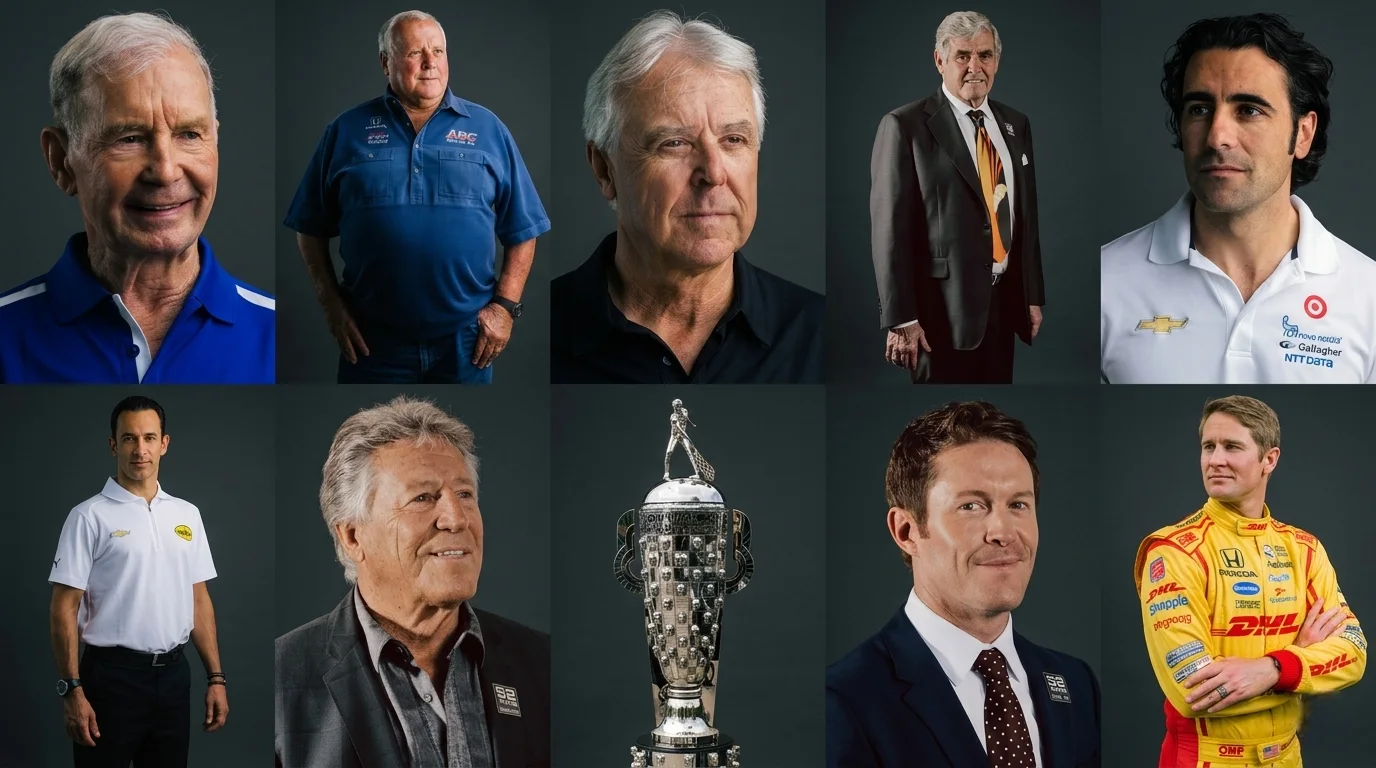
The record stands at four victories, a benchmark shared by just four men in 113 years of racing: A.J. Foyt, Al Unser Sr., Rick Mears, and Helio Castroneves. No driver has ever won five. The sheer rarity of that club — and the impossibility of the fifth win — tells you everything about how brutal the Brickyard really is. This is the complete record: who holds it, how they got there, and what the historical data reveals about the greatest race in the world.
Who Has the Most Indy 500 Wins in History?
The record for most Indianapolis 500 victories stands at four, shared equally by A.J. Foyt, Al Unser Sr., Rick Mears, and Helio Castroneves. That four-way tie at the top is itself a remarkable statistical fact: in over 113 runnings of the race, no driver has managed to go further. The Indy 500 has been contested since 1911, and the five-win threshold remains as untouched today as it was when Foyt first joined the club in 1977.
Understanding why no one has reached five wins requires understanding what makes this race uniquely unforgiving. Racing 200 laps at speeds exceeding 220 mph leaves no margin for error across 500 miles. A $10 sensor failure, a slow pit stop timed by a fraction of a second, or a poorly-timed caution flag can instantly ruin the most dominant performance. The four-win legends had everything go right four times each. Going right five times — in a sport this brutally random — may simply be beyond what probability allows.
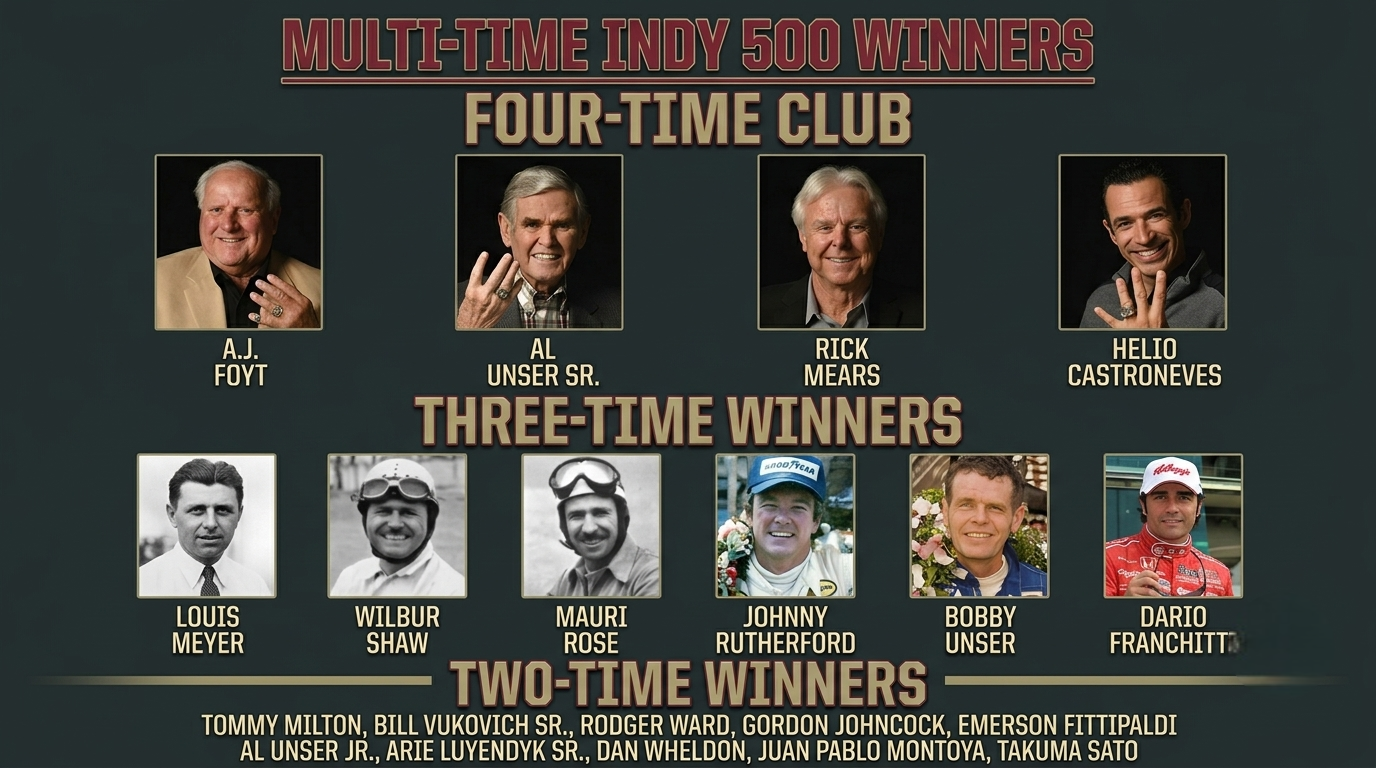
The four-win club spans three distinct eras of technology. Foyt conquered a period when front-engine roadsters were giving way to rear-engine aerodynamic machines — he won in cars that look nothing like each other. Mears dominated the ground-effects era of the 1980s. Castroneves’ four victories include both a pre-spec-chassis period and the modern Dallara parity era, where 30 cars can be separated by fractions of a second. Each man had to adapt to a fundamentally different version of the race. That adaptability, more than any single technical skill, is what defines the Brickyard elite.
The Indianapolis 500 is part of the IndyCar Series, America’s premier open-wheel championship. Unlike Formula 1, IndyCar uses a spec-chassis format — every team runs the same Dallara tub — which levels the playing field significantly and makes the driver and strategy variables more decisive. For a broader comparison, see our IndyCar vs F1 breakdown.
The Elite 4-Time Indy 500 Winners Club
The four-time winners club is the most exclusive fraternity in all of motorsport. What separates these drivers from the outstanding champions who won twice or three times isn’t just talent — it’s longevity across radically different conditions, the ability to win in cars built to completely different engineering philosophies, and the capacity to perform under the accumulating weight of expectation that follows every previous victory.
The original four-time winner and the template for Brickyard greatness. Foyt’s 1964 victory is historically significant as the last time a front-engine roadster won before the rear-engine revolution made them obsolete overnight. A tough, old-school racer built on grit and mechanical intuition, he won across three different decades — a feat of adaptability that no analysis fully captures. His career as an owner, after his driving days, continued to shape the Indy 500 for decades further.
The patriarch of the most successful family dynasty in Indianapolis history and the master of patience. His 1987 victory is the stuff of genuine legend: he entered the month without a drive, was drafted in at the last moment to pilot a year-old backup car that had been on display in a hotel lobby, and outlasted heavily favoured modern machinery to win. His final victory also makes him the oldest Indy 500 winner in history at 47 years and 360 days old — a record that still stands.
If Foyt was the gritty pioneer and Unser the consistent survivor, Rick Mears was the absolute master of precision. The definitive smooth operator — known for his fuel-saving techniques, deep oval strategy knowledge, and an ability to extract maximum lap time while minimising tyre and mechanical stress. Mears also holds the all-time record for most Indy 500 pole positions at six, meaning he regularly had the fastest car in qualifying and converted it to race victories at an extraordinary rate. His 1991 duel with Michael Andretti remains one of the greatest late-race battles in the event’s history.
The only member of the four-win club who is still active in racing, and the man who brought the record emphatically into the modern era. Castroneves announced himself by winning his first two Indy 500 starts back-to-back — an astonishing debut — and his famous “Spider-Man” fence-climbing celebration became one of motorsport’s defining images. His 2021 victory at the age of 46, driving for Meyer Shank Racing rather than a factory team, demonstrated that veteran drafting mastery and experience trump youth in the modern spec-chassis era.
The four-win record has stood since 1991. In over thirty years of racing, nobody has come close to breaking it — a statistic that defines how difficult this race truly is.
Has Anyone Won the Indy 500 Five Times?
No driver has ever won the Indianapolis 500 five times. As of 2025, the five-win threshold remains entirely untouched. Every year it is discussed, every year a driver with three or four wins lines up on the grid, and every year the Brickyard refuses to cooperate.
The primary reason is mathematical. In the early decades of the race, well-funded teams with technical advantages could lap the field — dominance was achievable through superior machinery. Today’s Dallara spec-chassis era ensures parity so tight that 30 cars are routinely separated by fractions of a second in qualifying. In that environment, any combination of a 10-second pit stop discrepancy, a slow pit lane exit, a debris-triggered caution at the wrong moment, or a minor mechanical issue can eliminate even the most dominant car on the day. Winning four times means threading that needle four times. Five is an order of magnitude harder.
Both Al Unser Sr. and Helio Castroneves entered multiple Indy 500s as defending champions at four wins. Unser led laps in subsequent races but couldn’t convert. Castroneves — the only active four-time winner — has lined up every year since 2021 knowing a fifth win would stand as the most extraordinary individual achievement in the history of the event. The Brickyard has answered each attempt with mechanical misfortune or strategic bad luck. That’s the race.
The mechanical failure rate over 500 miles is immense. Unlike a sprint race of 90 minutes where a dominant car can mask its unreliability, the Indy 500 demands endurance on a scale that exposes every weakness. Teams understand this better than anyone — which is why preparation intensity at Indianapolis is unlike anything else in motorsport. Even so, chance remains a decisive variable, and no amount of preparation eliminates it entirely.
Indy 500 Multiple Winners: 2-Time and 3-Time Champions
Below the four-win club sits a highly distinguished group of repeat winners whose achievements define specific eras. Three wins at Indianapolis places you in a class of only six men across the entire history of the race.
Drivers with 3 Indy 500 Victories
| # | Driver | Victory Years | Era | Notable Context |
|---|---|---|---|---|
| 3W | Louis Meyer | 1928 · 1933 · 1936 | Early | First driver to win three times; started the milk-drinking tradition |
| 3W | Wilbur Shaw | 1937 · 1939 · 1940 | Early | Won three of four consecutive years — including a back-to-back |
| 3W | Mauri Rose | 1941 · 1947 · 1948 | Early | Won back-to-back in 1947–48; gap caused by World War II |
| 3W | Bobby Unser | 1968 · 1975 · 1981 | Golden | Brother of Al Unser Sr.; third member of the famous Unser family dynasty |
| 3W | Johnny Rutherford | 1974 · 1976 · 1980 | Golden | Dominated the mid-1970s with McLaren; known as “Lone Star JR” |
| 3W | Dario Franchitti | 2007 · 2010 · 2012 | Modern | Premier modern-era three-time winner; exceptional fuel conservation strategy |
Dario Franchitti stands out as the defining three-time winner of the contemporary era. His victories were built not on outright speed but on an uncanny ability to read a race — managing fuel loads, timing caution periods, and conserving tyres in a way that consistently brought him to the front when rivals were running low or making unplanned stops. He won three Indy 500s in six seasons, a run of dominance that established him as one of the best strategic racers the Brickyard has seen in the modern period.
Back-to-Back Indy 500 Winners
Winning the race once is a career-defining achievement. Defending the title the very next year is a statistical anomaly. In the entire history of the event, only six drivers have ever won consecutive Indianapolis 500s:
| Driver | Consecutive Wins | Context |
|---|---|---|
| Wilbur Shaw | 1939 – 1940 | First driver to successfully defend the title |
| Mauri Rose | 1947 – 1948 | Post-war resumption of racing; dominated with equipment advantage |
| Bill Vukovich | 1953 – 1954 | Was leading 1955 when killed in a crash — likely headed for three in a row |
| Al Unser Sr. | 1970 – 1971 | PJ Colt-Ford; dominant in both editions with same team |
| Helio Castroneves | 2001 – 2002 | Won his first two Indy starts — the most remarkable debut in race history |
| Josef Newgarden | 2023 – 2024 | Most recent back-to-back winner; Team Penske’s latest Brickyard chapter |
This list is painfully short because momentum guarantees nothing at Indianapolis. Mechanical unpredictability and the brutal dynamics of oval drafting mean a defending champion can find themselves in the wall on lap 10 the following year. Winning in consecutive seasons requires a perfect alignment of car reliability, track conditions, and psychological focus that is genuinely rare to replicate.
The two-win category adds another remarkable layer of international and American talent to the story. Drivers like Tommy Milton, Bill Vukovich, Rodger Ward, Gordon Johncock, Emerson Fittipaldi, Al Unser Jr., Arie Luyendyk, Dan Wheldon, Juan Pablo Montoya, Takuma Sato, and most recently Josef Newgarden (2023, 2024) have all conquered the 500 twice. The full roster of Indy 500 all-time records stretches across every era of the sport.
Indianapolis 500 Winners: Key Milestones by Year
To understand the full legacy of the race, you have to trace the milestone victories that changed the record books. The table below covers the key landmark results across 113+ years — not every winner, but the moments that defined the historical arc of the event.
| Era | Year | Winning Driver | Notable Milestone |
|---|---|---|---|
| Early | 1911 | Ray Harroun | Inaugural winner; invented the rearview mirror to race solo |
| Early | 1922 | Jimmy Murphy | First driver to win from the pole position |
| Early | 1936 | Louis Meyer | First to win three times; started the post-race milk-drinking tradition |
| Early | 1940 | Wilbur Shaw | First ever back-to-back champion (1939–1940) |
| Early | 1952 | Troy Ruttman | Youngest Indy 500 winner — 22 years and 80 days old |
| Golden | 1961 | A.J. Foyt | Foyt’s first victory — the beginning of the greatest Brickyard career |
| Golden | 1965 | Jim Clark | First rear-engine car to win; confirmed the end of roadster supremacy |
| Golden | 1977 | A.J. Foyt | First driver in history to win four Indianapolis 500s |
| Golden | 1987 | Al Unser Sr. | Oldest winner (47yrs); ties Foyt’s four-win record from a hotel-lobby car |
| Golden | 1991 | Rick Mears | Ties the four-win record; his sixth and final pole at Indianapolis |
| Modern | 2001 | Helio Castroneves | Wins on his Indy 500 debut; Spider-Man celebration becomes iconic |
| Modern | 2008 | Scott Dixon | Dixon’s only win, but begins the era of his record laps-led dominance |
| Modern | 2012 | Dario Franchitti | Third modern-era win; cements him as the best strategic racer of his generation |
| Modern | 2021 | Helio Castroneves | Ties the all-time record with his fourth win at age 46 |
| Modern | 2024 | Josef Newgarden | Most recent back-to-back champion; Team Penske’s 20th Indy 500 victory |
The table above captures the milestone moments, but the full Indy 500 winners list encompasses every one of the 113+ individual runnings. From Ray Harroun’s 74.602 mph average speed in 1911 to modern cars exceeding 220 mph, the technical evolution of the race is staggering — yet the fundamental drama of 200 laps on the 2.5-mile oval remains completely unchanged. You can explore the broader history of famous racers through the World of Speed museum’s driver archive.
Most Indy 500 Wins by Team and Engine Manufacturer
Behind every legendary driver is an engineering operation that made the win possible. At Indianapolis, team excellence is not optional — it is the prerequisite. The margin between winning and finishing third is so thin that the organisational depth of the pit crew, the precision of the fuel strategy, and the pre-month engineering preparation are as important as the driver’s talent in the car.
Team Penske: The Dominant Force in Indy History
No team comes close to Team Penske’s Indianapolis 500 record. Founded by Roger Penske — “The Captain” — the organisation has accumulated an astonishing 20 Indy 500 victories. From Mark Donohue’s first triumph in 1972 through to Josef Newgarden’s back-to-back heroics in 2023 and 2024, Penske has demonstrated a consistency of excellence at this specific race that defies conventional sporting logic. Twenty victories across five decades, through multiple engine supplier changes, different drivers, and different chassis generations — it is the most dominant record any team holds in any single race in motorsport history.
20 Indianapolis 500 victories. Three of the four-time winners (Mears, Unser Sr. in some wins, Castroneves) have been Penske drivers. The organisation’s attention to detail — preparation that begins months before May — has made them the benchmark for Indianapolis racing. This is what pit stop execution and race strategy looks like when elevated to its highest level.
Other Major Team Dynasties
| Team | Indy 500 Wins | Notable Drivers | Era Peak |
|---|---|---|---|
| Team Penske | 20 | Mears, Castroneves, Newgarden | 1972–Present |
| Chip Ganassi Racing | 6 | Dixon, Franchitti, Ericsson | 2000s–Present |
| Andretti Global | 6 | Various Andretti family drivers | 1990s–Present |
| Lou Moore Racing | 5 | Rose, Vukovich | 1940s–1950s |
| Meyer Shank Racing | 2 | Castroneves (2021), Palou | 2020s |
Engine Manufacturers: Offenhauser, Honda, and Chevrolet
The powerplants pushing these cars have their own intense battle for supremacy. The historical crown belongs to Offenhauser — the legendary “Offy” engine accumulated an extraordinary 27 victories between the 1930s and 1970s. Its rugged four-cylinder design was nearly unbreakable over 500 miles, perfectly suited to the endurance demands of the Brickyard when reliability was the supreme competitive virtue.
In the modern era, the Indy 500 battle is Chevrolet versus Honda. Chevrolet has frequently been paired with Team Penske’s organisational excellence to deliver outright terminal speed and qualifying advantage, while Honda has countered with fuel efficiency and long-run race pace, powering Ganassi and Andretti to Victory Lane. The balance between qualifying speed and race-day drivability — often the difference between the two manufacturers’ philosophies — remains the defining technical narrative in modern Indy 500 strategy.
The manufacturer wars at Indianapolis echo similar battles in other series. The F1 power unit story has its own parallel rivalries — for context, see how the Energy Recovery System and ERS architecture define competitive outcomes in Formula 1, or how the entire engine equation is changing with the new teams entering F1 for 2026.
Indy 500 Records Beyond Wins
While winning is the ultimate measure, Indianapolis rewards statistical dominance in other dimensions — laps led, pole positions, and outright speed records — that reveal greatness in drivers who never reached the four-win pinnacle.
| Record | Holder | Figure | Context |
|---|---|---|---|
| Most Career Laps Led | Scott Dixon | 677 laps | Surpassed Al Unser Sr. (644); one win despite two-decade front-running dominance |
| Most Pole Positions | Rick Mears | 6 poles | Six fastest qualifiers in his career — the clearest measure of one-lap pace |
| Fastest Race Average | Arie Luyendyk | 185.981 mph | Set in 1990 — the all-time race speed record for 500 miles |
| Closest Finish | Al Unser Jr. vs Goodyear | 0.043 sec | 1992 — the narrowest margin in the history of the event |
| Youngest Winner | Troy Ruttman | 22 yrs, 80 days | Won in 1952 — a record that has stood for over 70 years |
| Oldest Winner | Al Unser Sr. | 47 yrs, 360 days | The 1987 hotel-lobby-car victory — experience over everything |
| First Winner | Ray Harroun | 74.602 mph avg | 1911 inaugural race — also invented the automotive rearview mirror |
Scott Dixon’s laps-led record deserves particular attention. He has dominated lap-for-lap at Indianapolis across a two-decade career to a degree that surpasses the actual four-time winners in terms of raw pace — yet converting that pace to a win has happened only once (2008). This statistical anomaly makes him one of the most fascinating cases in all of motorsport: the most dominant front-runner in the history of a race with only one victory to show for it. The Brickyard is indifferent to what you deserve.
Ray Harroun’s 1911 victory did more than launch the race — it changed automotive history. He dispensed with the standard riding mechanic (whose job was to watch for traffic) and instead bolted a mirror above his cockpit. That innovation became the rearview mirror that is now standard on every car on the planet. The Indy 500 has served as a proving ground for automotive technology from its very first running. For broader automotive history, the American muscle car archive and the Mickey Thompson land speed attempt show how racing and road car development have always been intertwined.
Greatest Indy 500 Drivers of All Time — Ranked
Ranking the greatest Indianapolis 500 drivers requires looking beyond win totals alone. A driver who won once from 27 starts in one era might be statistically more impressive than a driver who won twice from 10 starts in a different one. What follows is a ranking that weighs wins, era difficulty, statistical dominance across all metrics, and the objective historical impact of each career on the race itself.

Frequently Asked Questions
The number that defines the Indianapolis 500
Four. That’s how many times you have to win the most difficult 500-mile race in the world to reach the absolute pinnacle of the sport’s history. And four is where the record has sat, immovable, since Rick Mears crossed the line in 1991. In more than three decades since, drivers with generational talent, perfect machinery, and flawless preparation have tried to move it. The Brickyard has said no every time.
What the Indianapolis 500 record reveals about motorsport is more profound than any win total suggests. It tells you that greatness in racing is not guaranteed by talent or machinery or even by having already won. It can be taken from you by a debris-triggered yellow flag, by a tyre that lasts 22 laps instead of 25, by rain, by a rival who stops one lap before you at exactly the right moment. The four-time winners won more than their share of those coin flips. Nobody has won five. That gap — between four and five — is the defining distance in the sport.
Updated results, current IndyCar standings, and coverage of every race are at worldofspeed.org throughout the season.