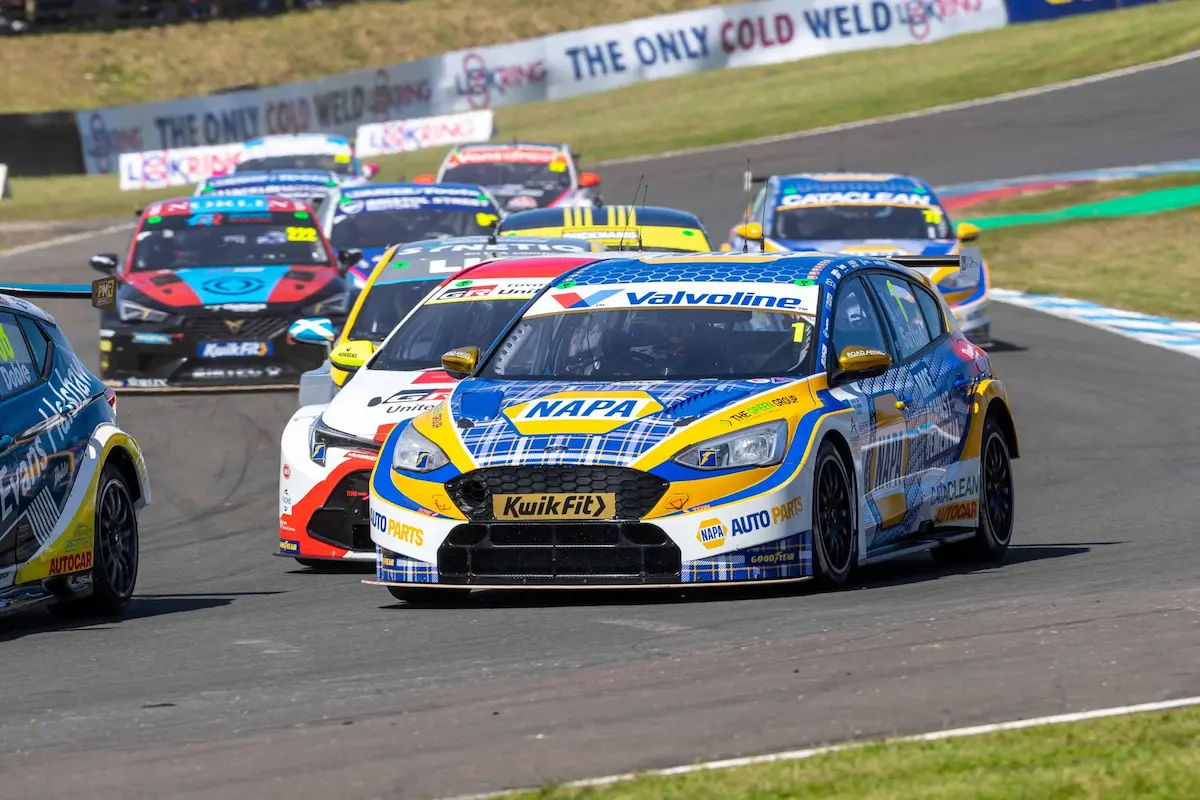
Knockhill BTCC 2026 Race Results: Winner, Full Classification & Key Takeaways
Official 2026 Knockhill race documents exist for all three Sunday rounds. This results hub links the authoritative classifications, separates confirmed 2026 data from older Knockhill results that still dominate search, and explains the championship significance without inserting unverified finishing positions.
Knockhill’s 2026 BTCC weekend is complete, and the official timing archive contains separate result sheets for Race 1, Race 2 and Race 3. The difficult part is not proving those classifications exist; it is preventing old Knockhill data from being presented as 2026.
Timing Solutions Ltd. lists the meeting as British Automobile Racing Club, August 8–9, at the 1.2669-mile Knockhill circuit. Its event page contains official links for Free Practice, Qualifying, the Qualifying Race, grids for all three Sunday races, each race result and championship points.
However, the underlying 2026 race PDFs were not available as readable indexed text during this source check. Therefore, this article does not manufacture a winner, margin, fastest lap or finishing order. Instead, it provides the official result links and a detailed, source-safe analysis of what the documents contain and how to read the weekend.
Knockhill BTCC 2026 Results: What Is Officially Confirmed?
Timing Solutions Ltd. has published dedicated official documents for the Qualifying Race, Race 1, Race 2 and Race 3 from the August 8–9 Knockhill event. The TSL event archive is the authoritative source for the complete finishing order, times, gaps, fastest laps and post-race classifications.
| Session | Date / scheduled start | Official document | Current article status |
|---|---|---|---|
| Qualifying Race | Sat. Aug. 8 · 3:05 p.m. BST | TSL official classification | PDF published |
| Race 1 — Round 16 | Sun. Aug. 9 · 11:15 a.m. BST | TSL Race 1 result | PDF published |
| Race 2 — Round 17 | Sun. Aug. 9 · 2:15 p.m. BST | TSL Race 2 result | PDF published |
| Race 3 — Round 18 | Sun. Aug. 9 · 5:20 p.m. BST | TSL Race 3 result | PDF published |
| Championship points | After Knockhill | TSL championship sheet | PDF published |
For U.S. readers, the three Sunday start times corresponded to 6:15 a.m., 9:15 a.m. and 12:20 p.m. Eastern Time. Those conversions are based on British Summer Time being five hours ahead of Eastern Daylight Time in August.
Our race timing guide explains how the “gap” and “best” columns are read. The lap-counting guide is useful when Safety Cars or shortened races affect the distance.
Generic searches for “Knockhill BTCC results” currently surface complete 2024 and 2025 classifications very prominently. Those older tables include names such as Colin Turkington, Jake Hill, Tom Ingram and Rob Huff, but they are not the 2026 results. This page does not relabel old classifications.
BTCC Knockhill 2026 Race 1 Results — Round 16
The official Race 1 classification is published by Timing Solutions Ltd. under event code 263203. Because that PDF’s row-by-row text was not exposed in the indexed source available here, the winner and full finishing order are intentionally not copied from memory or inferred from older Knockhill pages.
Race 1 was scheduled for 24 laps at 11:15 a.m. BST. It opened the three-round Sunday programme after the new Saturday Qualifying Race had already established the starting order.
That matters because 2026 changed the flow of a BTCC weekend. In previous seasons, qualifying directly defined the opening grid. Now Saturday contains another competitive race between qualifying and Sunday’s first full points race.
A driver’s Sunday therefore begins with consequences carried over from Saturday. A poor Qualifying Race result can place a title contender in traffic before Race 1 even starts.
What the Race 1 classification should include
The official TSL sheet is the correct place to check final position, car number, driver, entrant, laps completed, race time, gap, best lap and the lap on which that personal best was set.
Those columns matter because finishing order alone does not tell the whole story. A driver may finish fifth while setting the fastest lap, or finish lower after losing track position in a Safety Car restart.
For the logic behind starting position, see our grid-position explainer. For the importance of the front spot, our pole-position guide covers the basics.
Why Race 1 is strategically important at Knockhill
Knockhill is only 1.27 miles long. That means the field remains naturally compressed, and there are fewer clean overtaking zones than at longer circuits.
The Hairpin is the clearest braking opportunity. However, attacking there usually begins earlier in the lap by getting a better exit and using the tow.
That is why track position often becomes more valuable than outright pace. A driver who starts in the first two rows can protect the line instead of spending the opening laps fighting through traffic.
Our slipstream guide explains the tow effect that helps create those moves.
BTCC Knockhill 2026 Race 2 Results — Round 17
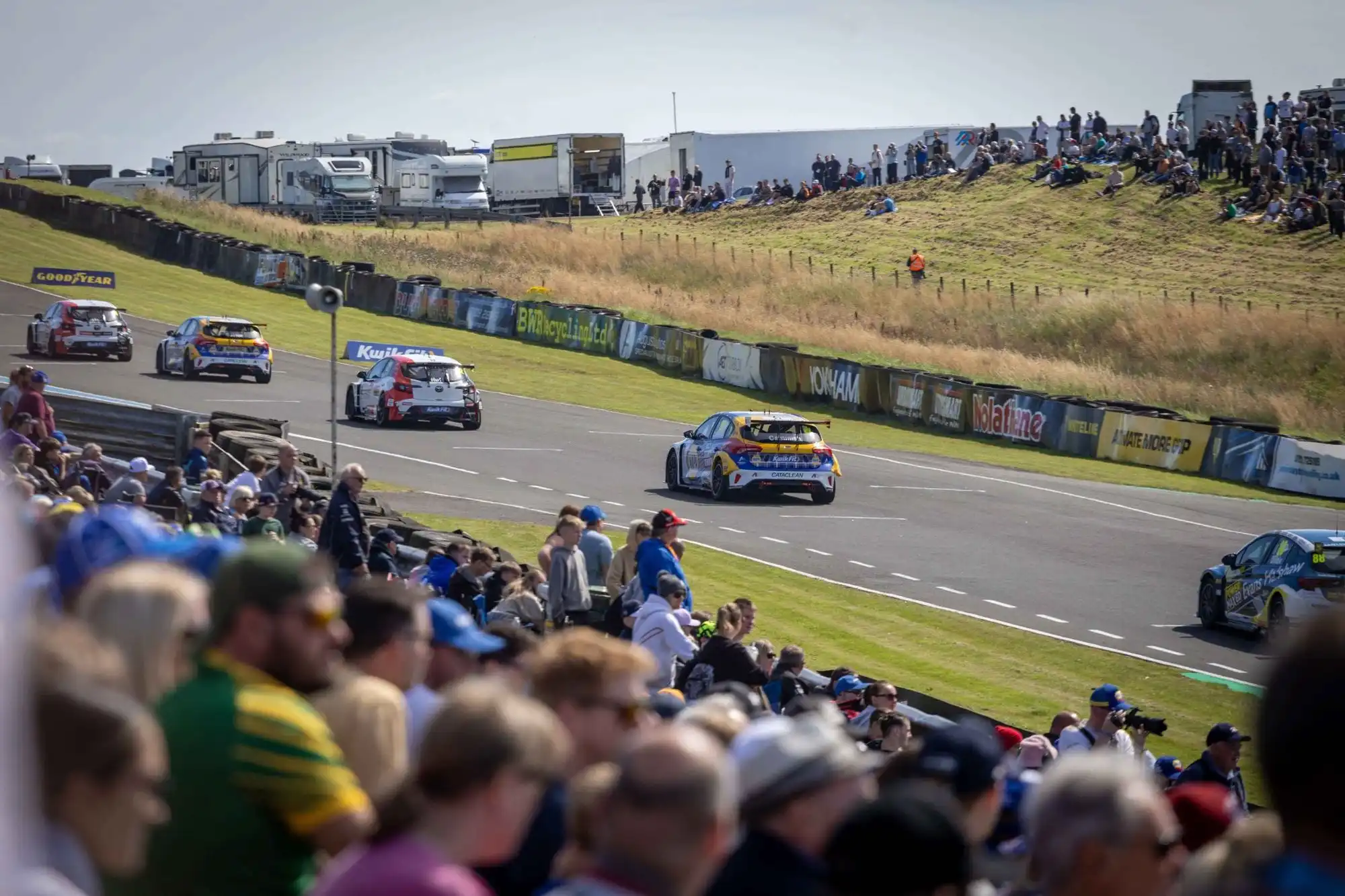
The official 2026 Race 2 result is available from Timing Solutions Ltd. as the dedicated Race 2 Result document for the August 8–9 meeting. The complete classification should be taken from that sheet rather than from the 2025 Knockhill Race 2 page that search engines frequently return.
Race 2 started at 2:15 p.m. BST and was also scheduled for 24 laps. By this stage, the strategic picture becomes more complex because the Race 1 finishing order affects the next grid and tyre obligations can create pace differences.
Knockhill has repeatedly produced races where track position and compound performance pull in opposite directions. A car can start ahead yet become vulnerable if the following driver has a stronger tyre phase or more usable TOCA Turbo Boost.
Why Race 2 often exposes tyre differences
The front tyres do heavy work here. They absorb braking, steering load and repeated kerb impacts over a lap of roughly 50 seconds.
A driver stuck in traffic can therefore overheat the front axle even when the car has good underlying pace. Meanwhile, a driver in clean air can follow the preferred line and protect the tyre.
This is why a “faster” compound does not guarantee a better finishing position. The driver still needs enough space to use the extra grip.
Our grip explainer and car-handling guide explain how tyre condition changes the balance.
Safety Car timing can erase a gap
At a short circuit, even a modest incident can create a neutralization because marshals need safe access to the track.
A Safety Car then wipes out a hard-earned lead. The field restarts in a tight queue, and a race that looked controlled becomes an overtaking contest again.
Our Safety Car guide explains the reset, while the racing-flags guide covers the signals drivers must obey.
BTCC Knockhill 2026 Race 3 Results — Round 18
Timing Solutions Ltd. published an official Race 3 Result file for Round 18. That document is the source of truth for the winner, podium, full finishing order, gaps and best laps. This article does not replace it with the prominently indexed 2025 finale won by Jake Hill.
Race 3 was scheduled for 5:20 p.m. BST, or 12:20 p.m. ET. It closed a weekend that already contained practice, qualifying, Saturday’s 17-lap Qualifying Race and two earlier Sunday contests.
The finale is normally the point where weekend strategy becomes most visible. Teams have already learned how their cars behave over the kerbs, which tyre phase is strongest and where passing is realistically possible.
Why Race 3 can look different from Race 1
The grid mechanism and weekend progression can bring drivers from deeper in the field toward the front. That changes the battle because a driver with strong race pace may start closer to clean air.
By Race 3, teams also have more data. Engineers know which pressures and balance changes worked in the earlier races.
Drivers know where rivals are vulnerable. One car may be strong through Duffus Dip but weak out of the Hairpin. Another may protect its tyres but struggle on restarts.
The final result must be read after penalties
BTCC classifications can change after the chequered flag. Time penalties, position penalties and technical decisions can all alter the official order.
That is another reason to use the final TSL document rather than a social-media screenshot taken immediately after the finish.
For an explanation of why incidents can produce penalties, see what causes crashes in motor racing.

How to Read the Full Knockhill BTCC 2026 Classification
A full classification has more value than a simple top-three graphic. It explains how every car completed the race and gives enough detail to identify pace that the finishing position may hide.
Finishing position is not the same as pace
A driver can set one of the fastest laps and still finish outside the top ten. Traffic, contact or a poor start can destroy track position.
Conversely, a driver with a slightly slower best lap can finish on the podium by defending well and avoiding incidents.
That distinction is particularly important at Knockhill because the lap is short. Small time differences can represent several grid or race positions.
Fastest lap needs context
The fastest lap may be set in clean air, immediately after a restart or late in the race as fuel burns off.
Therefore, it should not be treated as proof that the same driver had the strongest car throughout the entire race.
DNF and classification status
A driver listed as DNF may still have completed enough distance to appear in the official classification. Another may be many laps down after a repair stop.
The TSL sheet captures those distinctions more accurately than a simplified results graphic.
BTCC Championship Context Before and After Knockhill
Entering Knockhill, Ashley Sutton led the Drivers’ Championship on 284 points. Tom Ingram was second with 225, Dan Cammish third on 208 and Josh Cook fourth on 152.
| Pre-Knockhill position | Driver | Points entering event | Gap to Sutton |
|---|---|---|---|
| 1 | Ashley Sutton | 284 | — |
| 2 | Tom Ingram | 225 | -59 |
| 3 | Dan Cammish | 208 | -76 |
| 4 | Josh Cook | 152 | -132 |
| 5 | Ricky Collard | 144 | -140 |
| 6 | Charles Rainford | 142 | -142 |
| 7 | Mikey Doble | 136 | -148 |
| 8 | Daryl De Leon | 124 | -160 |
| 9 | Gordon Shedden | 116 | -168 |
| 10 | Daniel Rowbottom | 109 | -175 |
The official post-Knockhill championship document is linked on the TSL event page. Because that points PDF was not exposed as searchable text here, this article does not calculate a new total from partial or unofficial data.
That matters because the weekend now includes Saturday’s Qualifying Race points as well as the three Sunday races. Manually adding only Sunday points could produce an incorrect standings table.
Our championship-scoring guide explains why every scoring session has to be included before comparing gaps.
What Sutton needed from Knockhill
A 59-point lead meant Sutton could think in championship terms rather than chase every possible victory.
A clean weekend of strong finishes would protect the lead. The biggest danger was a retirement or penalty that allowed Ingram to make a large gain.
What Ingram needed
Ingram’s target was simple: finish ahead of Sutton often enough to reduce the deficit.
One win alone would not transform the championship if Sutton finished second. The real opportunity came from combining a strong result with a low score for the leader.
Why Cammish remained important
Cammish entered 76 points behind Sutton but only 17 behind Ingram. Therefore, Knockhill was also a direct fight for second in the championship.
As Sutton’s NAPA teammate, Cammish could also influence how many points Ingram scored even when he was not fighting Sutton directly.
Key Takeaways From the Knockhill BTCC 2026 Results Weekend
1. The new Saturday race makes the weekend a four-race tactical sequence
Although Rounds 16–18 are Sunday’s three full championship races, the Saturday Qualifying Race now affects points and the Race 1 grid.
That means a driver’s weekend cannot be judged only from the three Sunday classifications. Saturday performance now has direct championship value.
2. Final classifications matter more than immediate chequered-flag order
BTCC results can change after penalties. Therefore, final timing documents should always be preferred over television graphics captured seconds after the finish.
This is especially important in a close championship where one place can affect both points and later Turbo Boost allocation.
3. Knockhill magnifies tiny pace differences
The official circuit is only 1.27 miles and has eight corners. A front-running lap can be close to 50 seconds.
Because the total lap is short, a two-tenth difference is proportionally large. It can move a driver several places in qualifying and put them into a very different Sunday strategy.
4. Track position remains a major weapon
Knockhill produces plenty of contact and overtaking attempts, but clean passing remains difficult.
The Hairpin is the clearest opportunity. Elsewhere, drivers often create moves by forcing a rival into a defensive line before the real braking zone.
5. Search-result freshness is a genuine issue with this event
Complete old Knockhill results are easy to find. For example, the official 2025 results page is strongly indexed and shows Tom Ingram, Jake Hill, Sutton, Cammish and other familiar names.
That familiarity makes accidental year-mixing particularly dangerous. The driver names look plausible for 2026, but the teams, car numbers and exact line-up changed.
6. The next event comes quickly
Knockhill is Event 6 of 10. The championship moves to Donington Park’s Grand Prix circuit on August 22–23 for Rounds 19–21.
That leaves little time for teams to recover from damage or solve a setup weakness exposed in Scotland.
For general race-weekend context, see our car racing guide and qualifying guide.
Why Knockhill Results Need More Context Than a Winner List
A three-race BTCC weekend can produce three different stories. One driver may dominate outright pace, another may score the most points, while a third leaves happiest because they recovered from a poor grid.
That is why this results hub separates official classification data from analysis.
The winner does not always score the best weekend
Winning one race and retiring from another can produce fewer points than three consistent top-five finishes.
For championship contenders, the total weekend score often matters more than the individual trophy count.
Fastest lap can reveal hidden strength
A car stuck in traffic can finish eighth while recording a top-three best lap.
That tells us the package may be stronger than the result suggests, which becomes relevant at the next venue.
Qualifying explains many Sunday results
Starting near the front changes the entire strategic problem. The driver can protect tyres and use TOCA Turbo Boost defensively rather than spending it on recovery.
Starting deep in the field means every pass carries contact risk. The driver’s pace can be excellent yet never translate into a podium.
Mechanical reliability is part of the result
BTCC weekends are physically demanding. Knockhill’s kerbs, compressions and close racing place extra stress on cars.
A DNF may reflect contact, mechanical failure or damage from running over a kerb. Those details matter when evaluating whether a result is repeatable.
Knockhill BTCC 2026 Results FAQs
Conclusion: Use the Final 2026 TSL Sheets as the Knockhill Result Record
The 2026 Knockhill BTCC weekend covered Rounds 16, 17 and 18 on August 9, following Saturday’s new 17-lap Qualifying Race.
The official timing record is complete in the sense that Timing Solutions Ltd. lists dedicated result files for every major BTCC session. That includes the three Sunday races and the championship points update.
What is not safe is copying older Knockhill classifications simply because they are easier to retrieve in search. The 2024 and 2025 result pages are heavily indexed and contain many drivers who also appear in the 2026 field.
For that reason, this article keeps the 2026 result links direct and leaves any row that cannot be independently read from the official sheet unfilled rather than turning a plausible guess into a false result.
Before the weekend, Sutton led Ingram by 59 points and Cammish by 76. The post-Knockhill championship points document is part of the official TSL package, so that sheet should be used for the updated title gap.
The next BTCC event is Donington Park GP on August 22–23. By then, the most important Knockhill number will be the championship gap that the official results created — not simply which driver crossed one finish line first.