Formula DRIFT Seattle 2026 Preview:
Championship Contenders, Track Guide & Predictions
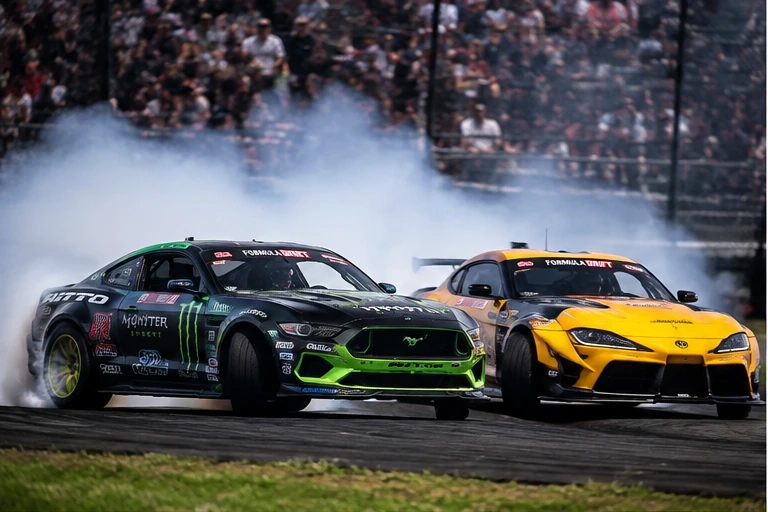
Round 6 sends the Formula DRIFT PRO Championship back to Evergreen Speedway for the Throwdown. James Deane arrives as the points leader, several rivals are close enough to change the title picture, and the Seattle course remains one of the most demanding tandem layouts on the calendar.
Formula DRIFT Seattle 2026 was scheduled as Round 6 of the PRO championship, with competition at Evergreen Speedway on August 21–22. The meeting arrives after the Indianapolis round was canceled because of severe weather, leaving the title fight unusually concentrated at the front. James Deane leads the preliminary championship table, followed by Aurimas Bakchis, Branden Sorensen, Jack Shanahan and Conor Shanahan.
This preview is framed from the pre-event point of view: it uses the standings, form and Seattle history available before the Throwdown, then explains why Evergreen’s drift configuration can upset a conventional championship prediction. Because the event has now been completed, the source section at the end also provides the official result page for readers who want to compare the forecast with the final outcome.
Why Formula DRIFT Seattle 2026 Matters
The Seattle round carries more weight than a normal mid-season stop because the championship has lost one scheduled event to weather. Formula DRIFT canceled Round 5 at Indianapolis after storms caused flooding at the facility, so the teams arrived in Seattle with the championship table effectively frozen after Stafford. That made Evergreen a major opportunity for drivers who wanted to close the gap to James Deane before the late-season run through Las Vegas and Long Beach.
Formula DRIFT’s preliminary standings before Seattle put Deane first on 150 points, Aurimas Bakchis second on 129, Jack Shanahan third on 110, Branden Sorensen fourth on 108 and Conor Shanahan fifth on 106. Dylan Hughes was sixth on 88 and Fredric Aasbo seventh on 86. The order says a lot about the season: the first five drivers were tightly compressed relative to the points available in one main event.
That compression changes the meaning of a Seattle result. A driver does not necessarily need to win to improve the championship position. Advancing through the bracket and avoiding an early elimination can be almost as important for a title contender whose closest rivals are all within one or two rounds of each other.
Why the canceled Indianapolis round matters
Indianapolis was supposed to be Round 5, but Formula DRIFT canceled the PRO competition because of inclement weather and flooding. Ford Racing’s Seattle preview noted that Deane had qualified fourth and Ben Hobson twelfth before the cancellation. That means those qualifying performances did not become a normal Seattle-style points haul, and it left the standings unusually unchanged going into Round 6.
For teams, the break also created a longer preparation window. Instead of carrying the typical fatigue and repair burden from a previous weekend directly into Seattle, drivers and crews had more time to rebuild, test and refine their cars. That is particularly useful at Evergreen, where small balance changes can have large consequences during tandem transitions.
Formula DRIFT 2026 Championship Standings Before Seattle
The following is the championship picture entering Seattle, using the official preliminary table after the completed Stafford round. Indianapolis did not produce normal PRO championship results because the event was canceled.
| Pos. | Driver | Points | Seattle outlook |
|---|---|---|---|
| 1 | James Deane | 150 | Defends championship lead |
| 2 | Aurimas Bakchis | 129 | 21-point gap |
| 3 | Jack Shanahan | 110 | 40 points off the lead |
| 4 | Branden Sorensen | 108 | 42 points off the lead |
| 5 | Conor Shanahan | 106 | 44 points off the lead |
| 6 | Dylan Hughes | 88 | Needs a major bracket run |
| 7 | Fredric Aasbo | 86 | High upside at Seattle |
| 8 | Ryan Tuerck | 64 | Outside top-five title fight |
Deane’s advantage was significant but not overwhelming. A 21-point lead over Bakchis can disappear quickly in a bracket-based championship, especially if the leader suffers a bad qualifying run and an early elimination while a rival reaches the final. The Shanahan brothers and Sorensen also had enough points to turn one successful weekend into a serious move up the table.
The interesting secondary battle was between Jack Shanahan, Branden Sorensen and Conor Shanahan. They were separated by only four points from third through fifth. That means Seattle’s bracket could reshape the order almost immediately. A strong qualifying score could improve a driver’s seeding, but the main event still requires clean tandem execution against another driver who may be equally fast.
Formula DRIFT Seattle Track Guide: Evergreen Speedway
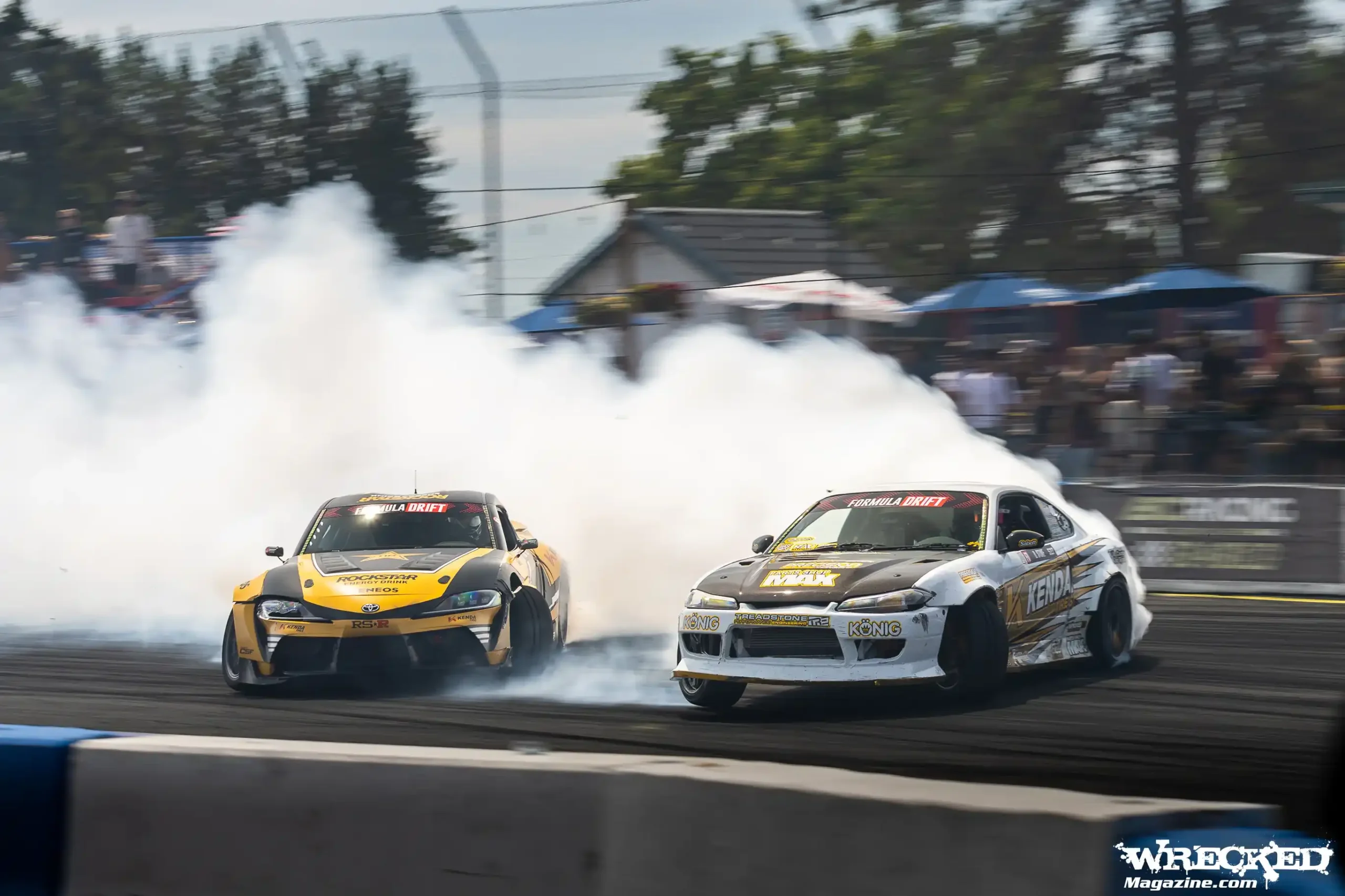
Formula DRIFT Seattle is held at Evergreen Speedway in Monroe, Washington. The speedway sits on the Evergreen State Fair Park grounds and is a multi-layout facility with a 5/8-mile paved outer oval, several smaller paved layouts, a figure-eight course and a 3/4-mile road course. The Formula DRIFT competition uses a dedicated drift configuration rather than simply running the entire oval or road course.
Evergreen has a long-running drift culture in the Pacific Northwest. The track describes itself as a home for grassroots drifting and a Formula Drift ProAm affiliate venue, with drivers coming from Washington, Oregon, British Columbia and beyond. That local familiarity matters because the surface, wall proximity and sequence of transitions are not random features to a professional driver; they form the foundation of the Seattle challenge.
Seattle is about commitment before it is about angle
A drift car can produce enormous angle, but Formula DRIFT judges still care about line, speed, initiation, fluidity and commitment. The 2026 judging regulations explain that average angle is calculated across the course and scaled to the field’s maximum, while zones reward the driver’s ability to fill designated areas without under- or over-running them.
That means a driver cannot simply throw the car sideways and hope the smoke creates a winning impression. The professional objective is controlled aggression: enter the initiation zone early enough, create the required angle, fill the outer zones, transition smoothly and keep speed while the rear tires are operating at the limit of available grip.
The outer wall changes the psychology of the course
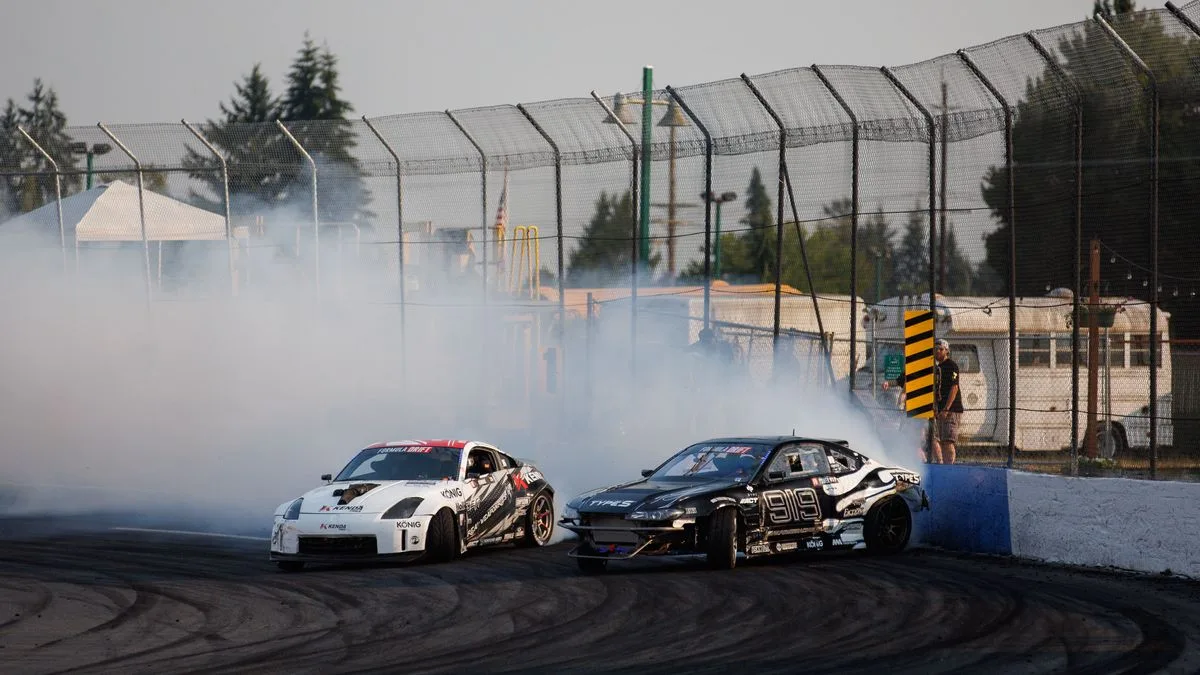
Evergreen’s drift environment has historically been famous for its walls. Formula DRIFT’s own Seattle reporting has repeatedly emphasized how the course has evolved to encourage a smoother arc and higher momentum. In 2025, the series widened the course through Outer Zones 2 and 3 to let drivers draw a smoother line while maintaining speed. The transition and finish were then refined overnight.
That history matters for the 2026 preview because it shows what the course rewards. A setup that simply makes the car easy to rotate may not be enough. The best package has to maintain speed while making the car predictable near the wall. A small loss of steering or throttle control can force the driver to lift, reducing the run’s competitive value even if the car still looks dramatic.
Why the chase run is difficult at Seattle
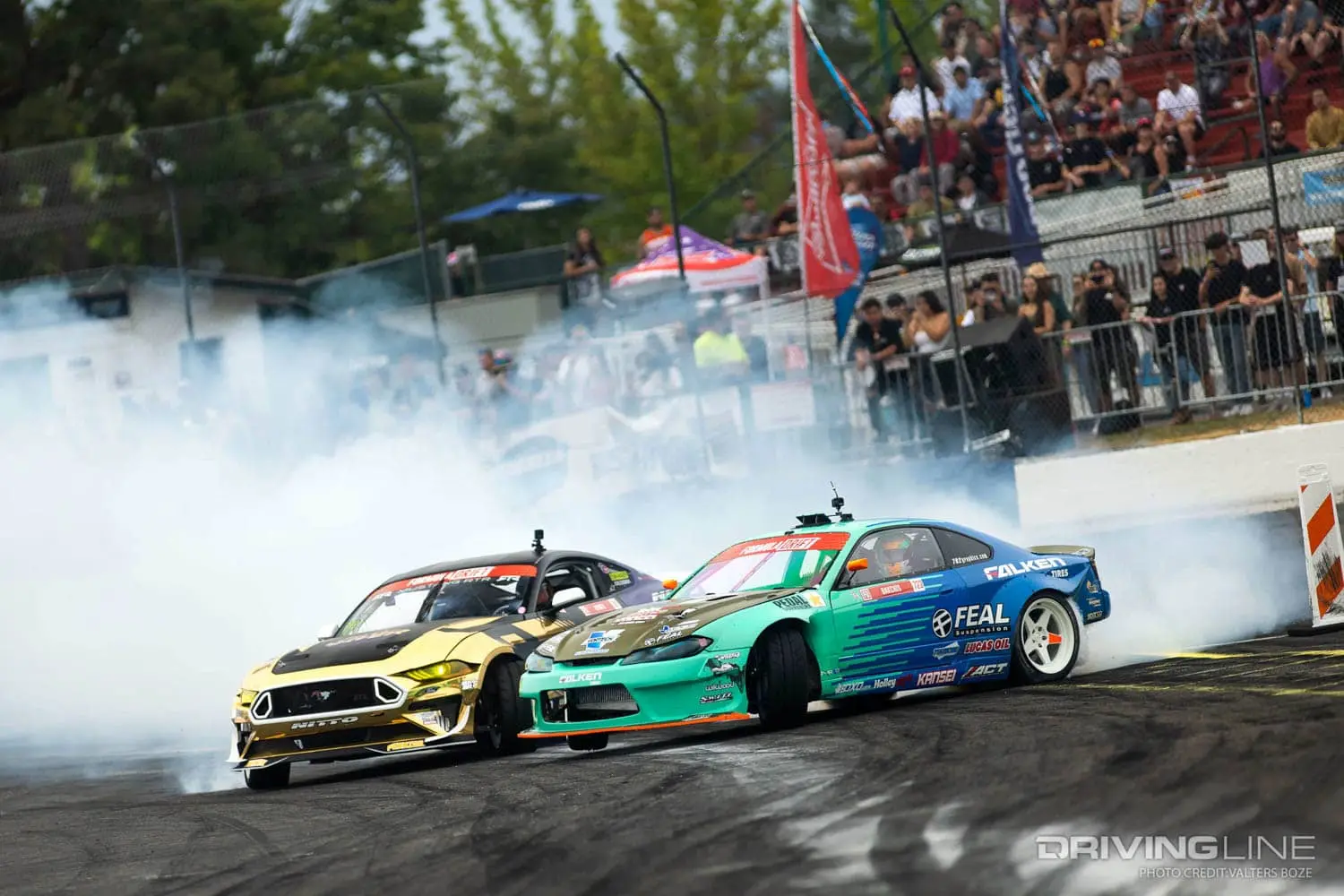
In tandem, the lead driver defines the line while the chase driver must mirror the same trajectory and stay close. Evergreen’s fast sections make small mistakes expensive. If the chase car hesitates on initiation, it may lose proximity immediately. If it attacks too aggressively, it can out-drive the lead car and create a separation or angle mismatch.
That is why Seattle often favors drivers with excellent throttle control. The challenge is not keeping a car sideways; it is maintaining the right amount of sideways movement while predicting what the other driver will do one moment later.
How Formula DRIFT Seattle 2026 Competition Works
Formula DRIFT competition begins with qualifying. Drivers are judged on their individual runs, then move into tandem battles. The 2026 judging regulations divide performance into elements including line, angle, initiation, fluidity and commitment. In an outer zone with a wall, for example, the vehicle must fill the defined space accurately; underfilling or overfilling can produce a deduction.
Qualifying is about repeatable precision
A qualifying lap is not a conventional fastest-lap contest. The driver is trying to produce a clean, complete demonstration of the course. That makes the first-run problem different from a road race. A driver can have plenty of horsepower and still qualify poorly if the car struggles to settle at initiation or the line drifts away from the scoring zones.
Seattle’s Friday schedule gives teams a substantial block for practice and warm-up before PRO qualifying from 7:15 p.m. to 9:45 p.m. Pacific. For Eastern Time viewers, that is 10:15 p.m. Friday to 12:45 a.m. Saturday. The late session rewards crews that can keep the tires in the correct operating window and make small setup changes without chasing the car’s behavior.
The Top 32 is where predictions start to break
Once the field enters tandem competition, qualifying reputation becomes secondary. The driver has to respond to another car. A perfect solo run does not guarantee a perfect chase run. Conversely, a driver who was not spectacular in qualifying can advance if the tandem style fits the car better than expected.
The Top 16 is the real championship pressure point
The later bracket concentrates the strongest drivers and creates the highest cost for mistakes. The Seattle schedule gives the Top 16 its own 7:00–10:00 p.m. Pacific window on Saturday, which translates to 10:00 p.m.–1:00 a.m. ET. For U.S. viewers, this is the session to prioritize if the goal is to see the championship contenders face the deepest field.
Qualifying
Individual judged runs establish the bracket order and test the car’s line, angle and consistency.
Top 32
Tandem battles begin. The chase driver must match speed and line while staying close.
Top 16 → Final
The surviving drivers fight through the bracket until the final Seattle winner is decided.
Formula DRIFT Seattle 2026 Championship Contenders
James Deane — the benchmark
Deane entered Seattle with the strongest statistical case. He led the official preliminary championship standings on 150 points and was chasing a sixth Formula DRIFT title after winning his fifth in 2025. Ford Racing’s Seattle preview also pointed to an important piece of history: Deane finished second at Evergreen in 2025, a result that helped him build the championship campaign that ended with his fifth title.
Deane’s value at Seattle is his consistency under pressure. He does not need a wild qualifying score to be a threat. His best route is to establish a high-confidence line, stay near the wall without forcing the car into an unnecessary correction, and let the tandem battles create opportunities. His greatest advantage is that he has already shown he can convert Seattle pace into a championship result.
Aurimas Bakchis — the closest title challenger
Bakchis entered Round 6 second in the championship with 129 points. He is only 21 points behind Deane, giving him the clearest mathematical opportunity to leave Seattle as the leader. The Feal Suspension / GT Radial / Subimods Subaru BRZ is a platform that rewards precision, and Bakchis has already shown he can win at high-pressure events.
The key for Bakchis is qualifying. If he can put the BRZ near the front of the bracket, he reduces the chance of meeting a championship rival too early. That does not guarantee anything, but in a one-on-one format the value of avoiding the hardest possible first battle is significant.
Jack Shanahan — the quiet threat
Jack began the weekend on 110 points, just two points ahead of Sorensen. His 2026 campaign had included a strong fourth-round performance in Connecticut, where he finished second. That matters because Seattle rewards drivers who can make small adjustments and then commit to the course.
Jack’s championship position means he can attack without needing to protect a huge lead. If he qualifies well and avoids the early bracket traps, he has a real path toward a Seattle win and a large points move.
Branden Sorensen — momentum and consistency
Sorensen was fourth on 108 points before Seattle and had been identified by Formula DRIFT as a major threat in the 2026 title race. He also finished third at Seattle in the completed event, confirming that the pre-event concern was justified. For a preview, the key reason to rate him highly is his ability to stay competitive across different course characteristics rather than relying on a single type of layout.
Conor Shanahan — the proven Seattle closer
Conor started fifth on 106 points, just four behind his brother Jack and two behind Sorensen. He had already won the opening round at Long Beach and brought a Toyota GT86 program that Formula DRIFT had described as immediately competitive. That combination makes him a genuine Seattle favorite: strong season-start form, a winning car and a driver comfortable in high-pressure tandem competition.
Fredric Aasbo — the local-event specialist
Aasbo was seventh in the championship entering Seattle on 86 points, but the raw number understates his Seattle relevance. He is a three-time PRO champion and has extensive experience at Evergreen. His route to victory requires a clean qualifying run and a bracket that does not expose the inconsistencies that had affected parts of his season.
Ben Hobson — the breakout candidate
Hobson is particularly interesting because Ford Racing highlighted his fourth-place finish at Stafford as the best PRO result of his career. Seattle offered him an opportunity to turn that breakthrough into a repeat performance. A driver with confidence rising mid-season can be dangerous in a bracket where one clean pair of tandem runs can move him into the next stage.
| Driver | Pre-Seattle points | Why Seattle matters |
|---|---|---|
| James Deane | 150 | Defends the championship lead and seeks another Seattle breakthrough |
| Aurimas Bakchis | 129 | Closest title challenger with a chance to take P1 |
| Jack Shanahan | 110 | Can jump multiple positions with a deep bracket run |
| Branden Sorensen | 108 | One of the season’s strongest emerging championship threats |
| Conor Shanahan | 106 | Round 1 winner with pace to turn Seattle into another title swing |
| Fredric Aasbo | 86 | Experience and Seattle history make him a dangerous upset pick |
Formula DRIFT Seattle 2026 Strategy: What Could Decide the Winner?
Tire temperature is the first hidden variable
Drift competition depends heavily on a narrow tire operating window. A car that produces enormous power but cannot keep the rear tires predictable will be difficult to judge well. Seattle’s surface, weather and time of day can alter how quickly the tires reach that window, which is one reason practice and qualifying matter so much.
Horsepower is useful only when the driver can deploy it
Formula DRIFT cars can produce extraordinary power, but more power can also make the chassis harder to manage. The driver needs enough throttle authority to control angle and speed through transitions. A conservative setup that allows repeatable throttle application can outperform a higher-powered car that constantly needs corrections.
Initiation speed affects the entire run
The beginning of the run is a prediction problem. The driver needs to create angle quickly, establish the correct line and carry enough momentum into the first major zone. A weak initiation can be difficult to recover because the chase driver is immediately forced to reduce proximity or compensate for a line change.
Transition control is the difference between speed and usable speed
The transition is where many good cars lose the run. A fast transition that produces a large correction can hurt line and fluidity. The best Seattle setup is one that allows the driver to change direction decisively while keeping the car settled enough to hit the next zone.
Wall proximity is worth performance only when it is controlled
Evergreen’s walls create spectacular footage, but the judge is looking for accuracy. The 2026 judging regulations state that outer zones are evaluated according to how completely the vehicle fills the defined zone. That means a driver does not get a free bonus simply for getting close to a wall; the run needs to fill the zone correctly and avoid an overrun or under-run.
Formula DRIFT Seattle 2026 Predictions
The right way to predict Formula DRIFT is not to treat the championship standings like a conventional road-racing grid. A drift event has a bracket structure, and an excellent driver can lose on one close call. The prediction therefore needs three layers: championship form, Seattle suitability and bracket risk.
Prediction No. 1 — James Deane reaches the final rounds
Deane is the safest deep-run prediction because he leads the championship, has Seattle experience and has already finished second at Evergreen. His objective should be to avoid mistakes rather than manufacture a spectacular qualifying number. If he places well enough to avoid an unnecessarily difficult first tandem battle, the championship leader should be in the Top 8 conversation.
Prediction No. 2 — Conor Shanahan is the strongest win candidate
Conor gets the slightly more aggressive win pick. He won Round 1 at Long Beach, entered Seattle only 44 points off the championship lead and had already shown that the Jerry Yang Racing Toyota GT86 could compete immediately. His driving style is well suited to a course that rewards commitment without sacrificing line.
Prediction No. 3 — Bakchis is the driver most likely to change the championship lead
Bakchis is only 21 points behind Deane. A deep run combined with an early exit for the leader could completely change the table. He is therefore the most important driver to follow from a title perspective even if he is not the pick for the event win.
Prediction No. 4 — Sorensen is a podium-level threat
Sorensen’s 108 points placed him within striking distance of both Shanahan brothers. His pace and consistency make a podium more realistic than a surprise one-run victory, and a podium would also move him deeper into the championship fight.
Prediction No. 5 — Qualifying could decide more than expected
At Evergreen, qualifying is especially valuable because a strong position can reduce early bracket pressure. The driver who begins with confidence can approach the first tandem more naturally, while a lower seed may face a championship-caliber opponent immediately. That does not mean the top qualifier will win, but it increases the probability of reaching later rounds.
Conor Shanahan
Best overall win case: strong season start, proven tandem pace and a Toyota package already capable of winning.
James Deane
Most dependable deep-run case because he leads the championship and finished second in Seattle in 2025.
Fredric Aasbo
Three-time champion with extensive Evergreen experience and enough car control to exploit a chaotic bracket.
Best pre-event call: Conor Shanahan has the strongest win profile, James Deane is the safest championship pick, and Aurimas Bakchis is the driver most capable of converting Seattle into a title lead.
What Championship Scenario Should Fans Watch?
Deane arrived with 150 points and Bakchis with 129. That 21-point margin is small enough to matter because a main-event victory can create a large swing in a single weekend. The more interesting battle, however, was behind them: Jack Shanahan, Sorensen and Conor Shanahan were separated by only four points.
That means Seattle had two title stories. The first was whether Bakchis could close the gap to Deane. The second was whether the three drivers from third through fifth could reshuffle the order. A driver does not have to win to gain championship momentum if the closest rival loses early.
Scenario A: Deane wins
This is the simplest outcome. A Seattle victory would increase his championship advantage and force Bakchis to respond in the final rounds. It would also reinforce the case that Deane’s title defense is following the same pattern as the 2025 campaign: consistent pressure and strong execution when the championship requires it.
Scenario B: Bakchis wins and Deane exits early
This is the biggest championship swing. Bakchis could take a large chunk of the gap immediately, while the points available to Deane would be limited. The psychological effect would also be important because the championship would start to move from “Deane protecting a lead” to “Deane defending against a direct rival.”
Scenario C: One Shanahan dominates the bracket
If Jack or Conor wins, the title fight becomes even tighter behind the top two. A strong win could move one of the brothers into second or third and create a new strategic layer for the final rounds. Their family rivalry also adds an unusual dynamic: two drivers in closely related championship positions can meet in a bracket without being able to help one another.
What Makes Formula DRIFT Seattle Difficult?
- High-consequence walls: proximity creates performance opportunity but leaves less room for correction.
- Linked transitions: the driver’s line in one section affects the next zone.
- Judged accuracy: a dramatic run can still lose points if the vehicle misses the required zone.
- Tire management: repeated high-angle runs change tire behavior quickly.
- Tandem pressure: the chase driver has to predict and mirror another driver’s line in real time.
The fifth point is the one that separates Formula DRIFT from a normal qualifying session. A driver can know the perfect line in isolation and still lose when another car is producing a different rate of initiation or transition. Successful Seattle drivers therefore need a strong internal reference for the course while remaining flexible enough to adapt to the lead car.
How to Watch Formula DRIFT Seattle 2026
The official Seattle schedule placed PRO qualifying on Friday from 7:15–9:45 p.m. Pacific, Top 32 on Saturday from 2:30–5:30 p.m. Pacific and Top 16 from 7:00–10:00 p.m. Pacific. In Eastern Time, those windows were 10:15 p.m.–12:45 a.m., 5:30–8:30 p.m. and 10:00 p.m.–1:00 a.m., respectively.
| Session | Pacific | Eastern | Why watch |
|---|---|---|---|
| PRO Qualifying | 7:15–9:45 PM Fri | 10:15 PM–12:45 AM | Sets the bracket |
| Top 32 | 2:30–5:30 PM Sat | 5:30–8:30 PM | First tandem eliminations |
| Top 16 | 7:00–10:00 PM Sat | 10:00 PM–1:00 AM | Main championship window |
| Trophy ceremony | 10:15–10:45 PM Sat | 1:15–1:45 AM | Final podium |
Formula DRIFT’s live hub was the official event streaming destination. The series also announced a broadcast relationship with RACER Network for live programming, while continuing to make most coverage free. For viewers searching for the “Formula DRIFT Seattle 2026 live stream,” the safest route is the official Formula DRIFT live page and broadcast guide rather than unofficial reposts.
Related Motorsport Guides
- How Does F1 Qualifying Work?
- F1 Qualifying Explained
- What Is Grid Position in Racing?
- How Race Timing Works
- How Racing Drivers Qualify
- How Racing Championships Are Scored
- What Is Grip in Racing?
- What Is Downforce?
- What Is a Slipstream?
- How Car Racing Works
- How Racing Flags Work
- What Is Pole Position?
- Mustang Museum
- Northwest Motorsports Hall of Fame
Formula DRIFT Seattle 2026 Preview FAQ
Conclusion: The Best Formula DRIFT Seattle 2026 Prediction
Formula DRIFT Seattle 2026 was never going to be decided by horsepower alone. The Throwdown came into the weekend with a compressed championship battle behind James Deane, an unusually long break after the canceled Indianapolis round, and a venue that punishes even small errors in tandem.
Deane had the strongest championship case. The reigning five-time champion led the standings, finished second at Evergreen in 2025 and was chasing a sixth title. Bakchis had the clearest opportunity to change the points lead. Jack Shanahan, Branden Sorensen and Conor Shanahan were close enough to change the second half of the title order in one weekend. Aasbo and Hobson gave the field additional upset potential.
My pre-event winner pick was Conor Shanahan because of his proven 2026 winning form, the competitive Toyota GT86 package and the need for a driver who can combine commitment with line discipline. Deane was the safer podium prediction, while Bakchis was the most important championship threat.
The final lesson from Seattle is broader than one event. Formula DRIFT is a judged discipline built around precision, and Evergreen exposes the difference between a car that can make smoke and a car that can make a complete run. Line, angle, initiation, fluidity, commitment and tandem proximity all matter. The driver who combines those elements most consistently is the one most likely to leave Seattle with the points that matter.
Sources & Official References
- Formula DRIFT — Seattle 2026 Official Event Schedule
- Formula DRIFT — 2026 PRO Standings
- Formula DRIFT — Seattle 2026 PRO Results
- Formula DRIFT — 2026 Sporting Regulations
- Formula DRIFT — 2026 Judging Regulations
- Formula DRIFT — 2026 Competition Schedule Announcement
- Formula DRIFT — 2025 Seattle Round Report
- Ford Racing — Formula DRIFT Seattle Preview
- Evergreen Speedway — Track Information
- Evergreen Speedway — Drift Program
Images: DrivingLine, Wrecked Magazine and DriveSpark News. The photographs are historic Seattle Formula DRIFT images and are used for venue and event context; they are not represented as 2026 race-day photographs.