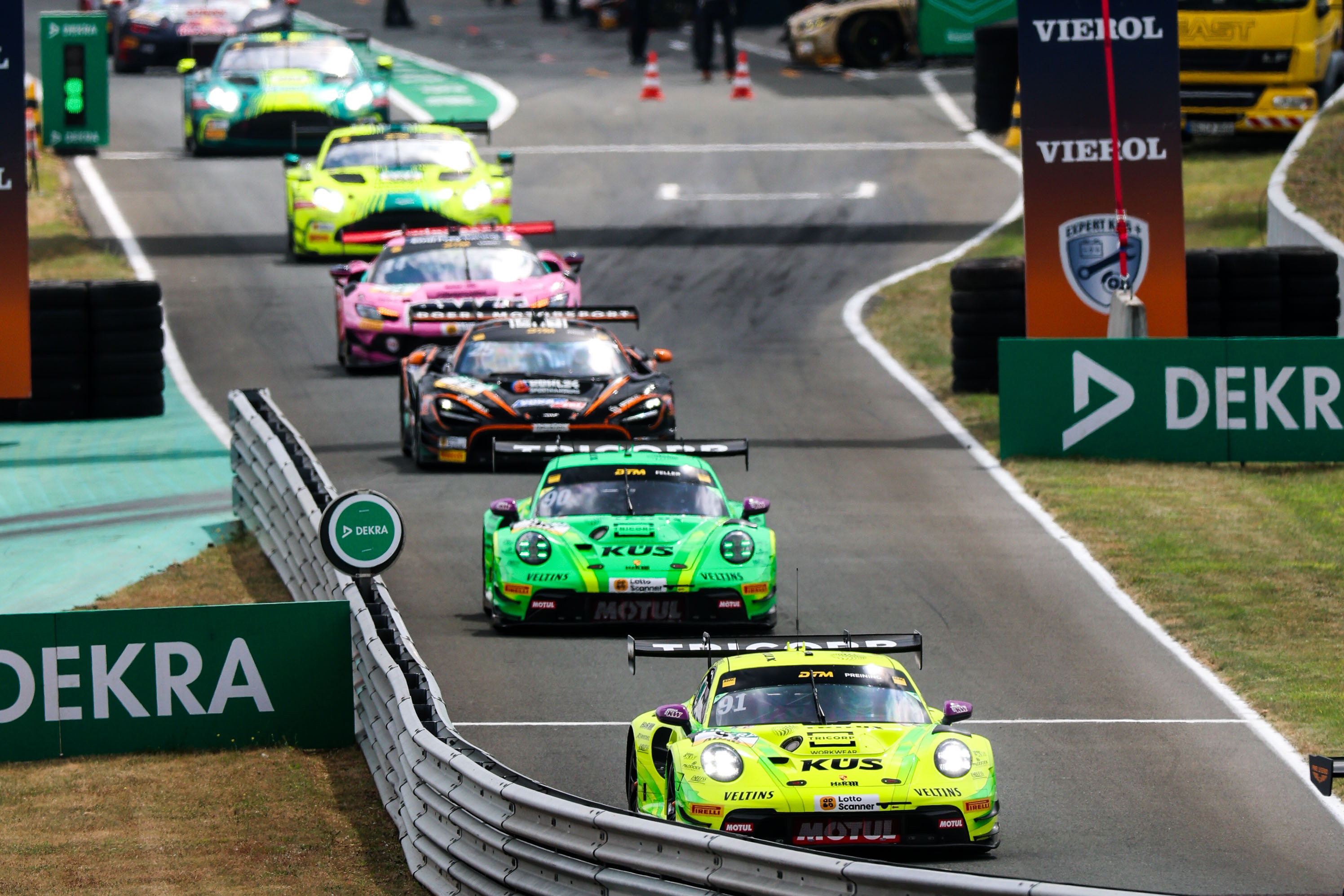
Oschersleben DTM 2026 Practice Results: FP1, FP2 Times & Team Pace Analysis
Thomas Preining swept both sessions, Ricardo Feller completed two Manthey Porsche one-twos, and Lamborghini closed to within 0.091 seconds as qualifying simulations compressed the field.
Who was fastest in Oschersleben DTM practice?
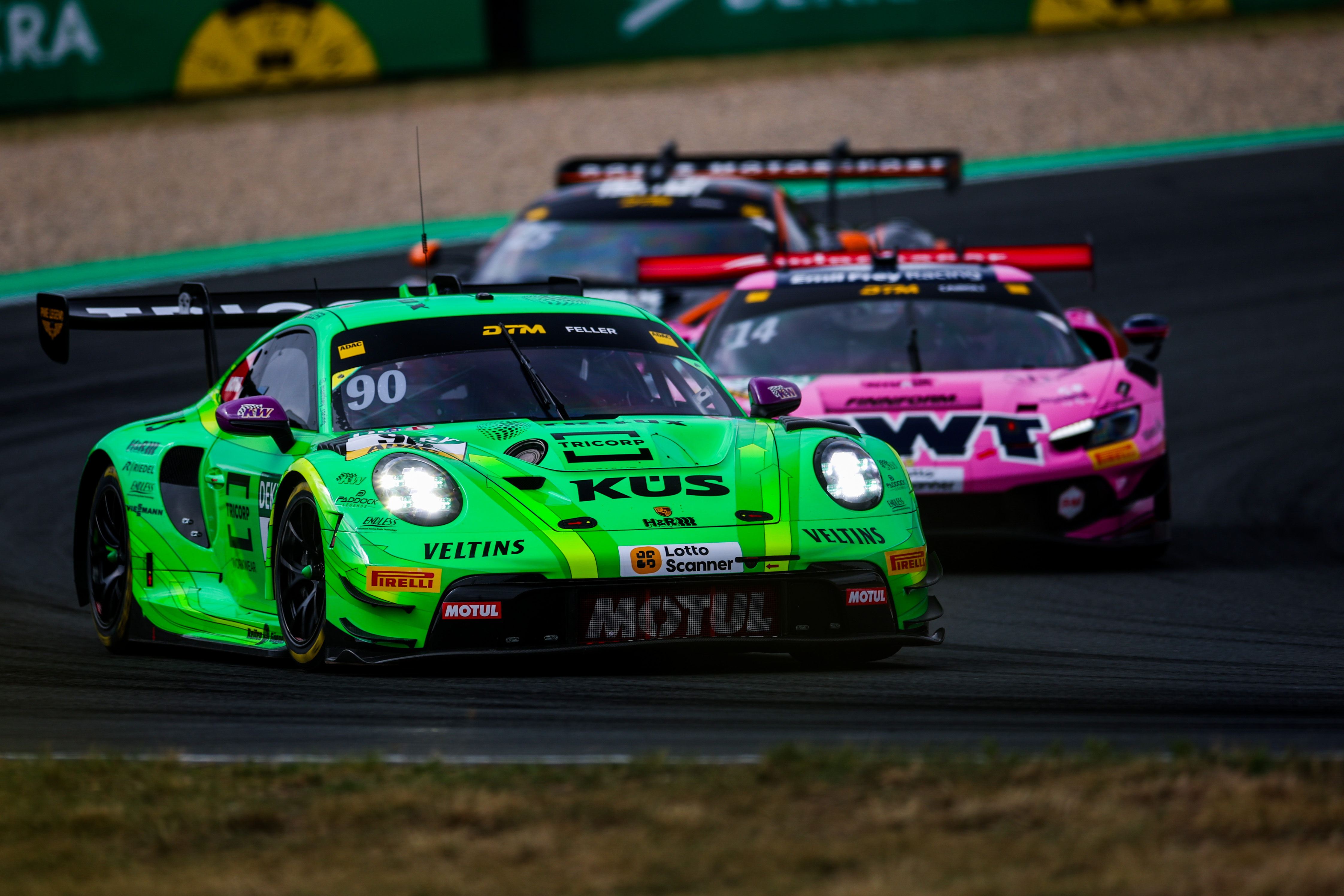
Thomas Preining topped both Oschersleben DTM 2026 practice sessions for Manthey. The Porsche driver led FP1 with a 1:22.493, then improved to 1:22.425 in FP2. Team-mate Ricardo Feller finished second twice, completing a Manthey one-two in both sessions.
The Oschersleben DTM 2026 practice results delivered the clearest Friday statement of the season from Manthey Porsche.
Preining did not lead through one isolated lap. Instead, he topped the morning session and repeated the result during the afternoon qualifying simulations.
Feller followed in second both times. Therefore, the pattern carried more weight than a single late-session flyer.
Lamborghini supplied the nearest opposition. Mirko Bortolotti placed third in FP1, while Luca Engstler moved to third in FP2.
Mercedes-AMG also showed depth. Three of its cars reached the FP1 top six, and four finished inside the FP2 top ten.
However, practice classifications do not reveal every fuel load or stint average. This analysis separates verified lap-time evidence from reasonable inference.
Oschersleben DTM 2026 Practice Results at a Glance
Friday practice opened the second half of the 2026 DTM season. The championship arrived in the Börde region for races nine and ten.
Preining led FP1 after completing 30 laps, the highest total among the session’s leading runners. His 1:22.493 displaced Feller near the end.
In FP2, all drivers moved to fresh Pirelli slicks during the final 15 minutes. That turned the closing phase into a qualifying rehearsal.
Auer led briefly for Mercedes-AMG. However, Preining responded with 1:22.425 roughly two minutes before the session ended.
Feller then moved within 0.081 seconds. Engstler followed only 0.010 seconds behind Feller.
Consequently, the first three cars represented two manufacturers but were separated by less than one tenth.
Strongest headline
Manthey placed both Porsches first and second in FP1 and FP2. No rival team matched that repeated two-car result.
Closest challenger
Lamborghini put Bortolotti third in FP1 and Engstler third in FP2. Its new Temerario GT3 looked immediately competitive.
Deepest chasing group
Mercedes-AMG lacked the outright benchmark, yet several cars remained inside half a second of Preining.
The public result sheets provide best laps, gaps and completed laps. They do not provide complete fuel-corrected long-run averages. Therefore, this article treats qualifying pace as strongly evidenced and race pace as provisional.
DTM Oschersleben FP1 Results: Preining Leads a Manthey One-Two
Who topped Oschersleben DTM FP1 in 2026?
Thomas Preining topped FP1 with a 1:22.493 after 30 laps. Ricardo Feller finished second, 0.179 seconds behind, while Mirko Bortolotti placed third for Lamborghini at +0.251 seconds.
FP1 ran in cool conditions, with the official DTM report citing an ambient temperature of about 17 degrees Celsius.
The first session focused on balance and setup work around Oschersleben’s tight layout. Therefore, lap count mattered alongside outright speed.
Preining’s 30 laps gave Manthey a substantial working sample. Only Engstler and Baert came close with 29 laps.
Feller’s second place confirmed that the Porsche advantage was not confined to one side of the garage. Moreover, both cars sat more than two tenths clear of the best Mercedes-AMG.
Bortolotti’s third place established Lamborghini as the first non-Porsche threat. Engel, Auer and Gounon then formed a three-car Mercedes group from fourth to sixth.
| Pos. | Driver | No. | Team | Car | Laps | Best time | Gap |
|---|---|---|---|---|---|---|---|
| 1 | Thomas Preining | #91 | Manthey Racing | Porsche 911 GT3 R (992.2) | 30 | 1:22.493 | — |
| 2 | Ricardo Feller | #90 | Manthey Racing | Porsche 911 GT3 R (992.2) | 26 | 1:22.672 | +0.179 |
| 3 | Mirko Bortolotti | #19 | TGI Team Lamborghini by GRT | Lamborghini Temerario GT3 | 22 | 1:22.744 | +0.251 |
| 4 | Maro Engel | #80 | Mercedes-AMG Team Ravenol | Mercedes-AMG GT3 Evo | 27 | 1:22.858 | +0.365 |
| 5 | Lucas Auer | #22 | Mercedes-AMG Team Landgraf | Mercedes-AMG GT3 Evo | 26 | 1:22.887 | +0.394 |
| 6 | Jules Gounon | #48 | Mercedes-AMG Team Mann-Filter | Mercedes-AMG GT3 Evo | 21 | 1:22.972 | +0.479 |
| 7 | Ben Dörr | #25 | Dörr Motorsport | McLaren 720S GT3 Evo | 28 | 1:23.019 | +0.526 |
| 8 | Luca Engstler | #130 | Red Bull Team Abt | Lamborghini Temerario GT3 | 29 | 1:23.033 | +0.540 |
| 9 | Nicki Thiim | #7 | Comtoyou Racing | Aston Martin Vantage AMR GT3 Evo | 26 | 1:23.311 | +0.818 |
| 10 | Matteo Cairoli | #14 | Emil Frey Racing | Ferrari 296 GT3 Evo | 23 | 1:23.326 | +0.833 |
| 11 | Thierry Vermeulen | #69 | Emil Frey Racing | Ferrari 296 GT3 Evo | 24 | 1:23.344 | +0.851 |
| 12 | Finn Wiebelhaus | #64 | HRT Ford Performance | Ford Mustang GT3 Evo | 27 | 1:23.428 | +0.935 |
| 13 | Tom Kalender | #84 | Mercedes-AMG Team Landgraf | Mercedes-AMG GT3 Evo | 26 | 1:23.521 | +1.028 |
| 14 | Kelvin van der Linde | #3 | Schubert Motorsport | BMW M4 GT3 Evo | 27 | 1:23.718 | +1.225 |
| 15 | Marco Wittmann | #11 | Schubert Motorsport | BMW M4 GT3 Evo | 26 | 1:23.803 | +1.310 |
| 16 | Bastian Buus | #29 | Land-Motorsport | Porsche 911 GT3 R (992.2) | 27 | 1:23.948 | +1.455 |
| 17 | Arjun Maini | #36 | HRT Ford Performance | Ford Mustang GT3 Evo | 28 | 1:24.027 | +1.534 |
| 18 | Timo Glock | #16 | Dörr Motorsport | McLaren 720S GT3 Evo | 25 | 1:24.105 | +1.612 |
| 19 | Marco Mapelli | #10 | Red Bull Team Abt | Lamborghini Temerario GT3 | 26 | 1:24.259 | +1.766 |
| 20 | Nicolas Baert | #8 | Comtoyou Racing | Aston Martin Vantage AMR GT3 Evo | 29 | 1:24.489 | +1.996 |
What the FP1 order showed
The top six contained two Porsches, one Lamborghini and three Mercedes-AMGs. That distribution suggested a clear leading group.
Ben Dörr put McLaren seventh, only 0.526 seconds from the benchmark. Engstler followed 0.014 seconds behind him.
Thiim, who entered Oschersleben as championship leader, placed ninth. His Aston Martin sat 0.818 seconds behind Preining.
BMW, Ford and the second McLaren remained outside the top 13. However, FP1 often rewards teams that deploy fresh tires at the most favorable moment.
As a result, the morning order should not be read as a final qualifying forecast. It did establish Manthey’s early control.
DTM Oschersleben FP2 Results: Porsche Stays Ahead as the Field Compresses
Who was fastest in Oschersleben DTM FP2?
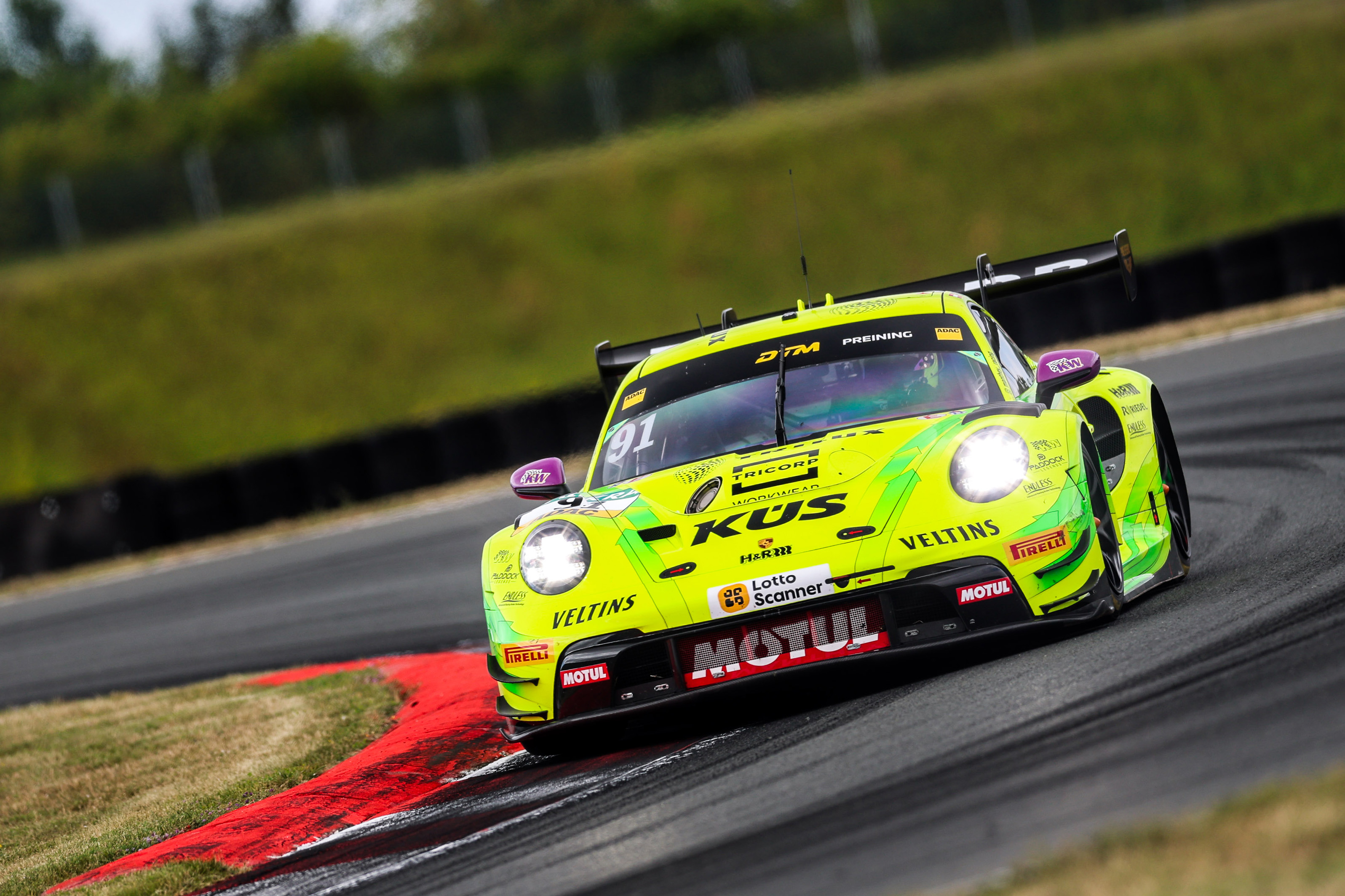
Thomas Preining set the fastest FP2 time at 1:22.425. Ricardo Feller was second at 1:22.506, while Luca Engstler placed third at 1:22.516. Only 0.091 seconds covered the top three.
FP2 delivered the more relevant single-lap picture. The official report states that every driver switched to fresh Pirelli slicks with 15 minutes remaining.
That common tire phase reduced some uncertainty. Teams were effectively rehearsing the qualifying sequence.
Auer initially led the fresh-tire runs. Yet Preining reclaimed first place near the end.
Feller’s deficit fell from 0.179 seconds to 0.081. Therefore, the two Manthey cars became even more closely matched.
Engstler produced the largest front-running step. He improved by 0.517 seconds from FP1 and missed second place by only 0.010.
Bortolotti remained fifth, while Auer moved to fourth. Engel and Gounon completed another strong Mercedes cluster in sixth and seventh.
| Pos. | Driver | No. | Team | Car | Laps | Best time | Gap |
|---|---|---|---|---|---|---|---|
| 1 | Thomas Preining | #91 | Manthey Racing | Porsche 911 GT3 R (992.2) | 22 | 1:22.425 | — |
| 2 | Ricardo Feller | #90 | Manthey Racing | Porsche 911 GT3 R (992.2) | 25 | 1:22.506 | +0.081 |
| 3 | Luca Engstler | #130 | Red Bull Team Abt | Lamborghini Temerario GT3 | 20 | 1:22.516 | +0.091 |
| 4 | Lucas Auer | #22 | Mercedes-AMG Team Landgraf | Mercedes-AMG GT3 Evo | 18 | 1:22.664 | +0.239 |
| 5 | Mirko Bortolotti | #19 | TGI Team Lamborghini by GRT | Lamborghini Temerario GT3 | 23 | 1:22.741 | +0.316 |
| 6 | Maro Engel | #80 | Mercedes-AMG Team Ravenol | Mercedes-AMG GT3 Evo | 20 | 1:22.806 | +0.381 |
| 7 | Jules Gounon | #48 | Mercedes-AMG Team Mann-Filter | Mercedes-AMG GT3 Evo | 21 | 1:22.882 | +0.457 |
| 8 | Ben Dörr | #25 | Dörr Motorsport | McLaren 720S GT3 Evo | 23 | 1:22.943 | +0.518 |
| 9 | Marco Wittmann | #11 | Schubert Motorsport | BMW M4 GT3 Evo | 20 | 1:23.053 | +0.628 |
| 10 | Tom Kalender | #84 | Mercedes-AMG Team Landgraf | Mercedes-AMG GT3 Evo | 20 | 1:23.096 | +0.671 |
| 11 | Thierry Vermeulen | #69 | Emil Frey Racing | Ferrari 296 GT3 Evo | 19 | 1:23.115 | +0.690 |
| 12 | Matteo Cairoli | #14 | Emil Frey Racing | Ferrari 296 GT3 Evo | 21 | 1:23.134 | +0.709 |
| 13 | Marco Mapelli | #10 | Red Bull Team Abt | Lamborghini Temerario GT3 | 17 | 1:23.161 | +0.736 |
| 14 | Timo Glock | #16 | Dörr Motorsport | McLaren 720S GT3 Evo | 22 | 1:23.195 | +0.770 |
| 15 | Kelvin van der Linde | #3 | Schubert Motorsport | BMW M4 GT3 Evo | 22 | 1:23.208 | +0.783 |
| 16 | Nicki Thiim | #7 | Comtoyou Racing | Aston Martin Vantage AMR GT3 Evo | 23 | 1:23.245 | +0.820 |
| 17 | Arjun Maini | #36 | HRT Ford Performance | Ford Mustang GT3 Evo | 24 | 1:23.354 | +0.929 |
| 18 | Bastian Buus | #29 | Land-Motorsport | Porsche 911 GT3 R (992.2) | 20 | 1:23.596 | +1.171 |
| 19 | Finn Wiebelhaus | #64 | HRT Ford Performance | Ford Mustang GT3 Evo | 21 | 1:23.658 | +1.233 |
| 20 | Nicolas Baert | #8 | Comtoyou Racing | Aston Martin Vantage AMR GT3 Evo | 23 | 1:23.970 | +1.545 |
The field became meaningfully tighter
The FP1 top-ten spread was 0.833 seconds. FP2 reduced that number to 0.671 seconds.
The full-field spread also fell from 1.996 seconds to 1.545. Consequently, qualifying promised small margins and a high cost for minor errors.
Mercedes placed four cars inside the top ten. Ferrari moved both cars to 11th and 12th, separated by 0.019 seconds.
BMW made a clear step through Wittmann. He improved by 0.750 seconds and rose from 15th to ninth.
Mapelli and Glock also gained more than nine tenths. Those improvements show why FP2 carried more predictive value than the opening session.
FP1 vs FP2: Who Improved and What Changed?
Preining improved by 0.068 seconds, a modest gain compared with several midfield drivers. That matters because he already led FP1.
Feller found 0.166 seconds and reduced his gap to his team-mate. Meanwhile, Engstler gained more than half a second.
Bortolotti’s best lap changed by only 0.003 seconds. However, his relative position remained competitive because the field compressed around him.
Wittmann, Mapelli and Glock produced the largest visible improvements. Each moved closer to the front after a difficult FP1.
A large gain can mean that the FP1 lap was unrepresentative. Therefore, improvement should be read beside final position. Mapelli gained the most time but finished 13th, while Preining gained little because he began from the front.
Manthey Porsche Pace Analysis: The Strongest Friday Package
Why was Manthey Porsche fastest at Oschersleben?
The verified evidence points to a broad setup window rather than one lucky lap. Preining and Feller finished first and second in both sessions, and both improved during the shared fresh-tire phase in FP2.
Manthey’s strongest evidence was repetition. Both drivers achieved the same top-two order twice.
Preining also combined speed with mileage. His 30 FP1 laps were the session’s highest total.
Oschersleben’s slow and medium-speed corners reward traction, braking stability and confidence over curbs. Preining described the circuit as winding, tight and frequently driven in low gears.
That description fits the rear-engine Porsche’s strengths when the setup window is correct. However, the classification alone cannot isolate which corner types produced the advantage.
Feller’s proximity provided the decisive team clue. A one-car result can come from driver execution, traffic or tire timing.
Two cars occupying the same positions across separate sessions suggest stronger underlying performance. Therefore, Manthey entered qualifying as the clearest single-lap favorite.
Was the Porsche advantage only a qualifying simulation?
The strongest public evidence concerns new-tire pace. The official report clearly identifies the final FP2 phase as a qualifying rehearsal.
Public classifications do not publish complete long-run averages. Therefore, claims of dominant race pace would go beyond the available data.
Still, Preining’s high FP1 lap count suggests that Manthey completed meaningful setup work before the qualifying run. That supports confidence, not proof.
The safest conclusion is precise: Manthey owned Friday’s best verified single-lap package and showed no obvious reliability or balance concern.
Lamborghini Pace Analysis: Engstler and Bortolotti Apply Pressure
Lamborghini split its strongest results between two drivers. Bortolotti placed third in FP1, while Engstler reached third in FP2.
That pattern showed depth across different teams. Engstler drove for Red Bull Team Abt, while Bortolotti represented TGI Team Lamborghini by GRT.
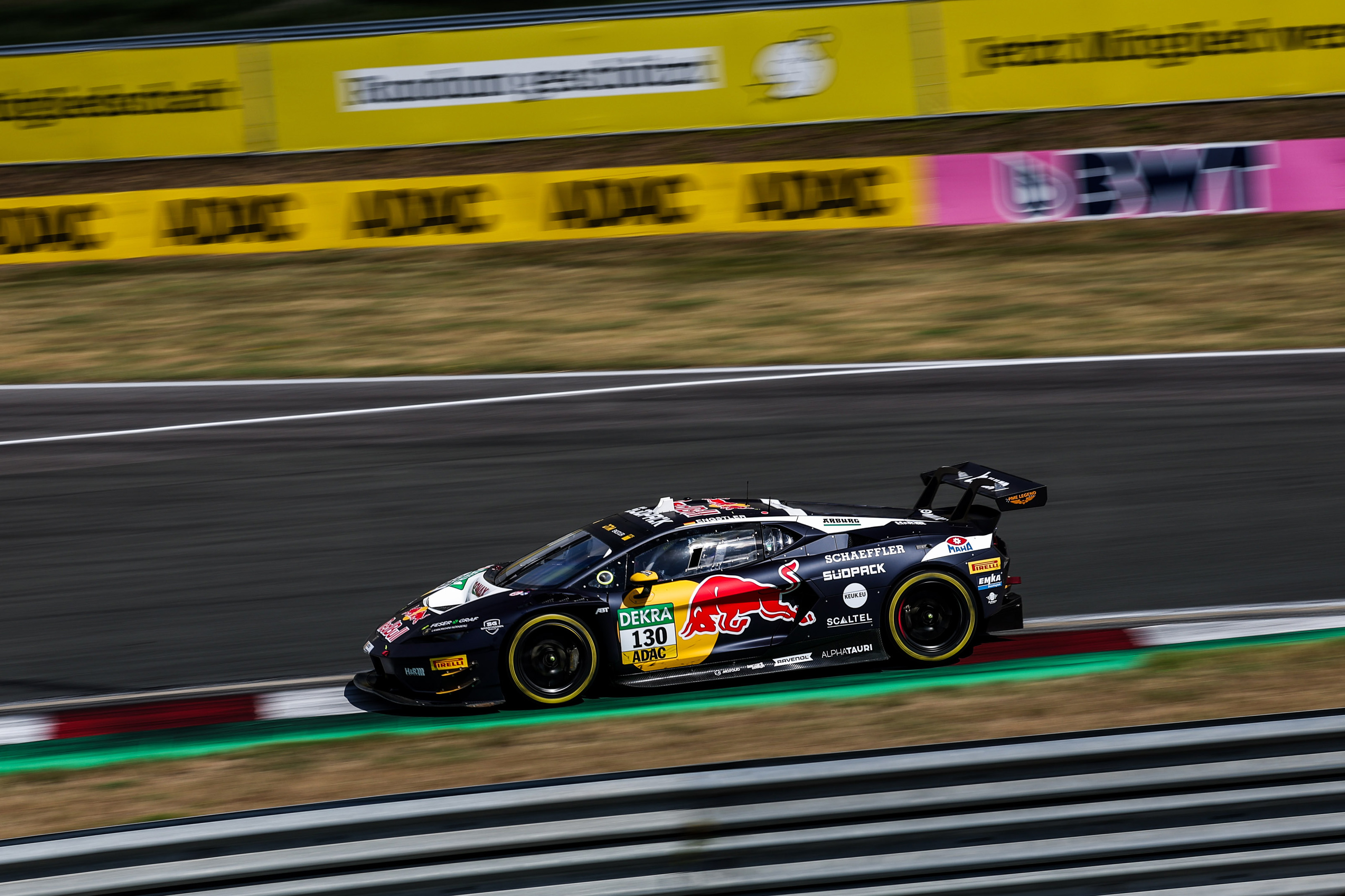
Engstler’s FP2 lap was particularly important. His 1:22.516 sat only 0.091 seconds behind Preining.
Moreover, he missed Feller by one hundredth. That made Lamborghini the only manufacturer within a tenth of the benchmark.
Bortolotti’s day looked less dramatic but remained stable. His FP1 and FP2 best laps differed by only three thousandths.
As a result, the two Lamborghini references suggested two useful qualities: Engstler had a sharp fresh-tire peak, while Bortolotti maintained front-five pace across both sessions.
What the new Temerario result meant
The 2026 field introduced the Lamborghini Temerario GT3 to DTM competition. Oschersleben’s compact layout offered a useful test of braking and low-speed rotation.
Two cars inside the FP2 top five showed that the platform could operate near the front. However, Mapelli finished 13th in the second Abt car.
Therefore, the manufacturer picture was strong but not uniformly dominant. Driver setup and tire execution still created large differences.
Mercedes-AMG Pace Analysis: Depth Without the Friday Benchmark
Mercedes-AMG produced the deepest top-ten presence. Auer finished fourth in FP2, ahead of Engel in sixth, Gounon in seventh and Kalender in tenth.
In FP1, Engel, Auer and Gounon had already filled fourth through sixth. Consequently, the manufacturer stayed consistently close.
Auer briefly led the FP2 qualifying simulation. That showed the car could generate competitive tire performance before the final Porsche laps arrived.
Nevertheless, the best Mercedes finished 0.239 seconds behind Preining. In a compressed DTM field, that gap was significant.
Mercedes’ advantage was optionality. Multiple teams and drivers occupied the same performance band.
That depth often matters during a race weekend because weather, traffic or a small setup change can elevate one car. However, Friday did not support calling Mercedes the outright qualifying favorite.
Porsche had the highest peak and the strongest two-car confirmation. Lamborghini had the nearest individual challenger. Mercedes had the broadest top-ten coverage. Those are three different strengths, and the timing sheets support each one.
Oschersleben DTM Manufacturer Pace Ranking After FP2
The table below ranks each manufacturer by its fastest FP2 representative. It does not average every car.
Therefore, it measures peak qualifying-style performance rather than total manufacturer consistency.
| Manufacturer | Best FP2 time | Fastest driver | Gap | Friday interpretation |
|---|---|---|---|---|
| Porsche | 1:22.425 | Thomas Preining | — | Manthey placed first and second in both sessions. |
| Lamborghini | 1:22.516 | Luca Engstler | +0.091 | Engstler and Bortolotti put two Temerarios inside the FP2 top five. |
| Mercedes-AMG | 1:22.664 | Lucas Auer | +0.239 | Four AMGs filled fourth, sixth, seventh and tenth. |
| McLaren | 1:22.943 | Ben Dörr | +0.518 | Dörr stayed seventh in FP1 and eighth in FP2. |
| BMW | 1:23.053 | Marco Wittmann | +0.628 | Wittmann gained 0.750 seconds from FP1. |
| Ferrari | 1:23.115 | Thierry Vermeulen | +0.690 | Both Emil Frey cars sat just outside the top ten. |
| Aston Martin | 1:23.245 | Nicki Thiim | +0.820 | The pre-weekend points leader slipped from ninth to 16th. |
| Ford | 1:23.354 | Arjun Maini | +0.929 | Maini improved strongly, but the Mustangs remained outside the top 16. |
McLaren and BMW led the next group
Dörr held eighth in FP2 after finishing seventh in FP1. That gave McLaren a stable lead over the midfield group.
Wittmann moved BMW to ninth after a major improvement. Van der Linde, however, remained 15th.
Ferrari placed its cars 11th and 12th. The pair’s narrow 0.019-second separation suggested comparable setup performance.
Aston Martin and Ford sat farther back. Thiim’s slide from ninth to 16th made his FP2 result one of the day’s most notable setbacks.
Why Motorsport Arena Oschersleben Magnifies Small Pace Differences
The official DTM practice report used the 3.667-kilometer configuration. The circuit contains many tight corners and frequent low-gear sections.
Its short lap compresses the field numerically. A two-tenths deficit can cost several grid positions.
The venue’s official data lists 14 corners, split evenly between left and right. Therefore, a car needs balanced tire use across both sides.
Heavy braking into the opening complex creates an obvious passing opportunity. However, the rest of the lap rewards rhythm and exit speed.
Track position matters because the circuit is narrow and overtaking is difficult. As a result, Friday’s qualifying simulations carried unusual importance.
Readers can explore the wider principles in World of Speed’s guides to grip, car handling and downforce.
How close were the practice times to circuit records?
DTM lists a GT3 qualifying record of 1:21.347, set by Preining. His 2026 FP2 time was 1.078 seconds slower.
The official GT3 race lap record is 1:22.629. Preining’s practice benchmark was 0.204 seconds faster, although practice laps do not replace a race record.
This comparison shows the tire and fuel difference between sessions. Qualifying still offered a substantial performance step beyond Friday practice.
Pirelli Tire Preparation and the FP2 Qualifying Simulation
Every driver switched to fresh Pirelli slicks with 15 minutes remaining in FP2. That shared timing created the most useful direct comparison.
Still, cars did not necessarily begin their flying laps in identical traffic or tire temperatures. Oschersleben’s short lap makes traffic management difficult.
A driver may need to create space during the out lap. However, driving too slowly can reduce tire temperature.
The next lap then depends on hitting the correct pressure and surface temperature window. Small preparation errors can cost several tenths.
That helps explain why the final order changed quickly. Auer led first, then Preining, Feller and Engstler improved late.
For a broader explanation of how timing screens capture these changes, see how race timing works.
A fresh-tire qualifying simulation answers a different question from race pace. It reveals peak grip and setup confidence. It does not show how quickly the same car loses performance across a long run.
What Friday Practice Suggested—and What the Weekend Later Confirmed
Because this article was updated after the event, the practice signal can be checked against later results without changing the original Friday data.
Preining converted the strongest practice package into pole position and a Race 1 victory. That confirmed Manthey’s single-lap advantage and race execution.
Engstler finished second in Race 1, validating Lamborghini’s position as the closest Friday challenger. Engel and Auer followed in third and fourth.
Race 2 then produced a first DTM victory for the Lamborghini Temerario through Bortolotti. Therefore, Friday’s front group accurately identified the weekend’s two strongest manufacturers.
However, Feller’s practice form did not translate into the same race result. That difference illustrates why pit stops, traffic and race incidents remain decisive.
The practice data was informative, not deterministic. It correctly identified pace but could not predict every outcome.
Championship context entering the weekend
Thiim arrived as points leader after a strong Norisring weekend. Engel and Auer followed within striking distance.
Friday placed Thiim ninth in FP1 and 16th in FP2. Meanwhile, both Mercedes title rivals stayed inside the front group.
That made Aston Martin’s lack of FP2 pace strategically important. It also increased pressure on qualifying, where track position shapes the entire race.
How to Read a DTM Practice Classification Like an Analyst
- Start with repeated results. Manthey’s two one-twos carried more weight than one isolated best lap.
- Check the tire phase. FP2’s fresh-slick run offered the clearest qualifying comparison.
- Use lap counts carefully. More laps suggest useful work, but they do not reveal fuel load or tire age.
- Compare team-mates. Similar cars help separate package strength from one driver’s execution.
- Watch the field spread. A 0.671-second top ten means small errors create large position changes.
- Do not invent long-run pace. Without lap-by-lap averages, race-pace rankings remain provisional.
World of Speed’s guides to how laps are counted, racing flags and pit stops provide useful context for the sessions that followed.
Oschersleben DTM 2026 Practice FAQs
Who was fastest in Oschersleben DTM practice in 2026?
Thomas Preining led both Friday sessions for Manthey Porsche. He set 1:22.493 in FP1 and improved to the day’s best time of 1:22.425 in FP2.
Who finished second in Oschersleben FP1 and FP2?
Ricardo Feller finished second in both sessions. He was 0.179 seconds behind in FP1 and only 0.081 seconds behind in FP2.
Which manufacturer was closest to Porsche in FP2?
Lamborghini was closest. Luca Engstler placed third at +0.091 seconds, while Mirko Bortolotti put another Temerario GT3 in fifth.
Did practice prove that Porsche had the best race pace?
No. The public results prove outstanding single-lap pace and strong team consistency. They do not publish complete fuel-corrected stint averages, so race-pace claims must remain cautious.
Conclusion: Manthey Owned Friday, but Lamborghini and Mercedes Stayed Close
The Oschersleben DTM 2026 practice results produced a clear headline. Thomas Preining led FP1 and FP2, while Ricardo Feller finished second twice.
That repeated Manthey one-two made Porsche the strongest verified Friday package. It combined pace from both cars with a successful fresh-tire qualifying simulation.
Lamborghini remained the nearest threat. Bortolotti took third in FP1, and Engstler ended FP2 only 0.091 seconds from the lead.
Mercedes-AMG lacked the final tenth needed to challenge Preining. However, four cars inside the FP2 top ten gave the manufacturer valuable depth.
The midfield also tightened. FP2’s top ten sat inside 0.671 seconds, while the entire 20-car field was covered by 1.545 seconds.
Therefore, the margins were too small for overconfident predictions. One imperfect out lap, traffic encounter or tire-preparation error could transform the grid.
Friday did reveal several reliable truths. Manthey had the highest peak, Lamborghini had the closest challenger, and Mercedes had the broadest front-running group.
Later results supported that reading. Preining won Race 1, while Bortolotti delivered the Temerario’s first DTM victory in Race 2.
Still, practice analysis remains most useful when it respects its limits. Best laps show qualifying potential, not every race variable.
The final verdict is simple. Porsche controlled the Oschersleben practice day, but the 0.091-second Lamborghini gap ensured the weekend was never a one-man contest.
Sources & Verification
FP1 and FP2 times, lap counts, session context, circuit details and later weekend outcomes were checked against official DTM/ADAC material and the published event classifications. The article distinguishes verified best-lap data from analytical inference.