What Makes a Good F1 Track? Layout, Overtaking and Strategy Explained
Why the best circuits combine corner rhythm, braking zones, width, elevation, tire demands and strategic uncertainty—and why a spectacular layout can still produce a poor race.
A good F1 track blends fast and slow corners, elevation, wide braking zones, multiple racing lines and enough tire stress to create strategic choices. It should challenge drivers without making following impossible. Moreover, it must meet FIA safety standards while preserving consequences for mistakes.
A famous corner does not automatically create a great Formula 1 race. The whole lap must work as one connected system.
The best circuits ask different questions. One sector rewards low drag, while another demands downforce and confidence.
Meanwhile, the race needs places where a following car can stay close, gain speed and complete a pass.
A long straight helps. However, it becomes far more useful when the previous corner allows a clean exit.
The braking zone also matters. A short lift into a fast bend rarely creates a genuine passing chance.
By contrast, a wide hairpin after heavy braking can support several lines. Therefore, the fight may continue through the corner.
Strategy adds another layer. Tire degradation, pit-lane loss and Safety Car probability determine whether teams can attack with different plans.
The 2026 cars add a fresh consideration. Overtake Mode has replaced DRS, while active aerodynamics use Corner and Straight modes.
Consequently, modern circuit analysis must consider electrical deployment as well as drag reduction.
The Core Formula for a Good Formula 1 Track
An exciting F1 circuit creates setup compromises, offers at least one strong overtaking sequence, punishes poor exits, changes tire performance across a stint and gives drivers room to race without making errors consequence-free.
Great circuits usually balance five qualities: rhythm, raceability, strategy, difficulty and identity.
Rhythm describes how corners connect. A strong sequence feels deliberate rather than random.
Raceability concerns following and passing. The track must offer more than one isolated braking zone.
Strategy comes from tire wear, pit-lane time and neutralization risk. Driver difficulty comes from speed, precision and changing grip.
Finally, identity makes the circuit memorable. Elevation, scenery, history or an unusual corner sequence can provide it.
Driver Challenge
Fast direction changes, blind crests and technical braking reward precision and confidence.
Raceability
Clean exits, long acceleration zones and wide corners give drivers realistic passing choices.
Strategic Depth
Tire wear, pit loss and changing conditions create more than one competitive route.
A Great Lap and a Great Race Are Not the Same Thing
Suzuka delivers one of Formula 1’s finest qualifying laps. Its first sector demands constant commitment.
However, overtaking can be difficult. The narrow layout and fast corners make following harder.
Monza offers fewer corner types. Yet its long straights and heavy braking create strong passing opportunities.
Therefore, circuit quality depends on the question. Drivers may love one track while strategists prefer another.
Why Balance Matters More Than Maximum Difficulty
A circuit can be brutally hard without producing close racing. Monaco proves that distinction.
The streets demand absolute precision. Nevertheless, modern cars have little room to pass.
A strong championship needs both tests. Still, the best all-round tracks combine difficulty with tactical freedom.
What FIA Grade 1 Standards Actually Require
Grade 1 is the FIA’s highest circuit licence level. It covers the fastest modern cars and is required for Formula 1 competition. Approval considers layout, barriers, runoff, medical facilities, pit infrastructure, race control and detailed inspection.
The FIA does not prescribe one perfect shape. Appendix O says the plan is not subject to a fixed layout formula.
However, the FIA may recommend changes for competition quality or practical need.
New permanent circuits should be at least 12 meters wide. In addition, the starting grid should be at least 15 meters wide.
That width should continue through the exit of the first corner. This supports safer starts and more side-by-side space.
Appendix O also limits a straight to two kilometers. It recommends that new circuits should not exceed seven kilometers.
Moreover, designers should preferably place at least 250 meters between the start line and first corner.
| FIA Design Point | 2026 Guidance | Why It Matters |
|---|---|---|
| New permanent track width | At least 12 m | Provides margin for line choice, overtaking and recovery. |
| Starting-grid width | At least 15 m through first-corner exit | Reduces start congestion and allows several approach lines. |
| Maximum straight | 2 km | Controls extreme speed while allowing useful acceleration. |
| Recommended new-circuit length | No more than 7 km | Balances variety, marshal coverage and event operation. |
| Start to first corner | Preferably at least 250 m | Creates space for a launch and braking contest. |
| Pit entry and exit | Should avoid the racing line | Reduces unsafe speed differences and strategic interference. |
Safety Standards Do Not Guarantee a Good Race
A circuit can satisfy every safety requirement and still produce limited overtaking.
The licence proves suitability for the cars and event. It does not award entertainment points.
Consequently, a designer must think beyond compliance and study real racing trajectories.
Runoff Is a Racing Design Choice Too
Runoff protects drivers when they lose control. Appendix O allows grass, sealed surfaces, gravel and energy-absorbing barriers.
However, the surface changes the penalty for mistakes. Asphalt often permits recovery with limited damage.
Gravel can stop the car more effectively. Yet it may end a race after a small error.
The best solution depends on speed, angle and available land. Therefore, one runoff type cannot suit every corner.
Why Corner Variety Creates a Better F1 Circuit
The strongest layouts include slow traction corners, medium-speed balance tests and fast aerodynamic bends. They also vary radius, camber and direction. This mix forces setup compromise and tests braking, rotation, traction and high-speed confidence.
A circuit with only hairpins becomes repetitive. A circuit with only fast bends may become impossible to follow through.
Corner variety gives engineers a harder setup problem. More importantly, it prevents one car strength from dominating every sector.
Slow Corners Test Mechanical Grip
Slow corners reduce aerodynamic load. Therefore, suspension, tire grip and traction become more important.
A strong exit can begin an overtaking sequence. The driver behind needs to accelerate earlier and carry speed onto the straight.
Medium-Speed Corners Reveal Balance
These bends expose understeer and rear instability. They also demand smooth steering.
Medium-speed corners often generate tire energy. Consequently, they can shape degradation over a long stint.
Fast Corners Create Spectacle and Commitment
High-speed bends show what an F1 car can do. Eau Rouge, Pouhon and Suzuka’s 130R deliver that drama.
However, fast corners create turbulent wake. A following driver may lose front grip and drop back.
Therefore, a good circuit should not place every passing zone after a long fast sequence.
Changing Radius Adds Line Choice
A constant-radius corner often produces one obvious path. A changing-radius corner can create different entries and exits.
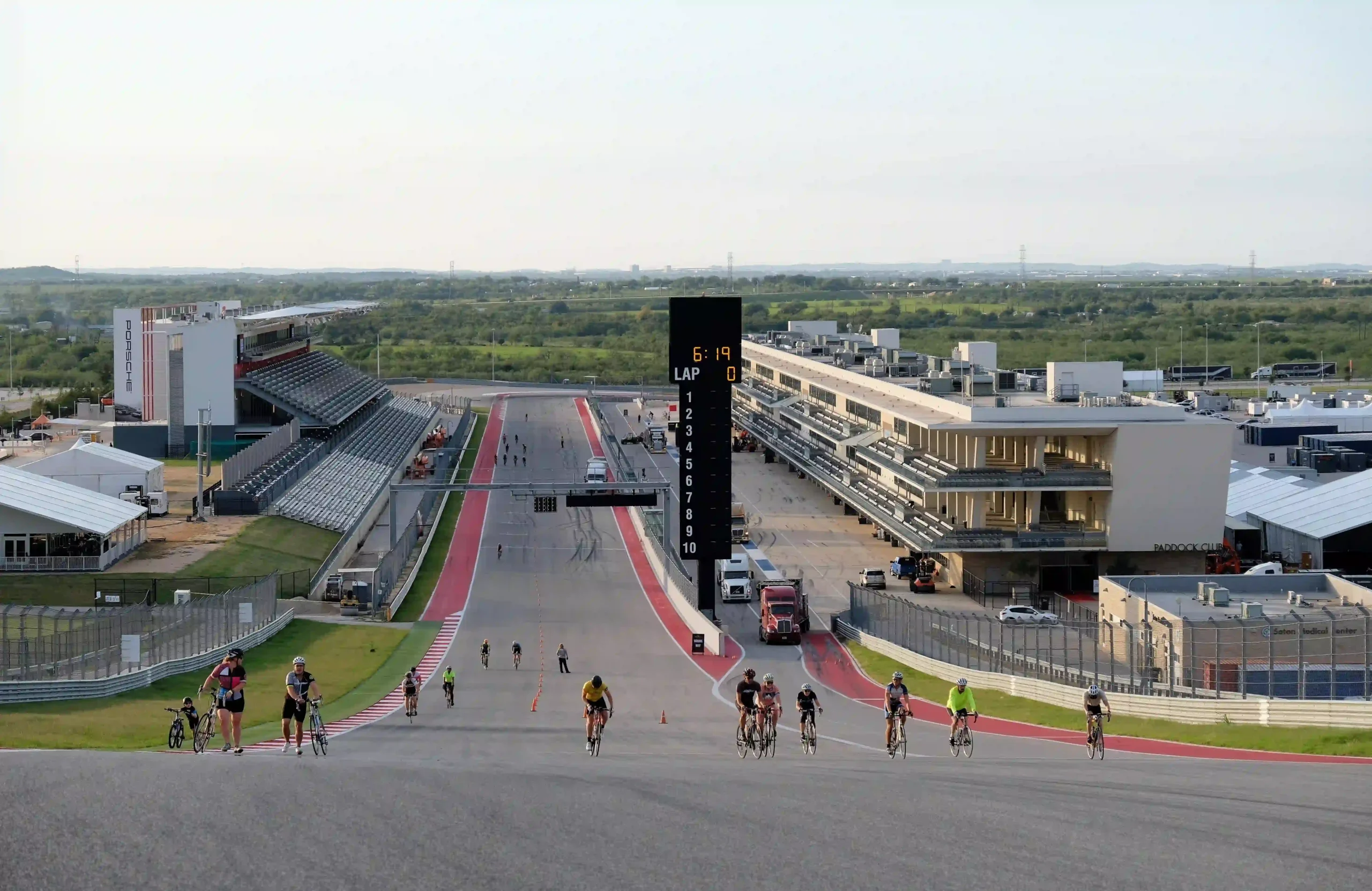
Turn 1 at COTA is wide and tightens toward the apex. Drivers can attack from several angles.
The corner then drops downhill. As a result, the fight can continue rather than ending at the braking point.
What Makes a Good Overtaking Zone?
A strong overtaking zone starts with a corner that the following car can exit closely. It then needs enough acceleration distance, a strong speed difference, heavy braking, sufficient width and a corner shape that lets both cars continue safely.
Overtaking is a chain. The braking zone is only the final link.
First, the following car must stay close through the previous corner. Dirty air can break that connection.
Next, the driver needs traction. Wheelspin or understeer can erase the chance before the straight begins.
The straight then provides time to close. Finally, the braking zone must create a meaningful speed reduction.
Long Straights Need the Right Corner Before Them
A long straight after a fast aero-sensitive bend may disappoint. The following car loses time before acceleration starts.
By contrast, a slow final corner lets the driver control the gap with mechanical grip.
Therefore, many successful passing zones begin after a hairpin or low-speed turn.
Heavy Braking Creates a Decision
Braking from very high speed to a slow corner gives the attacking driver time to move.
It also creates several braking references. A late dive and an early switchback can both work.
Monza’s first chicane is the extreme example. Cars arrive near maximum speed and slow dramatically.
The Corner Must Support the Exit
A pass that ends at the apex can feel artificial. The best corners allow the defender to fight back.
COTA Turn 1 and Interlagos’s Senna S can continue the battle downhill.
That second phase creates better racing than a simple stop-and-turn hairpin.
Overtaking Quantity Is Not the Only Measure
Twenty easy passes may create less tension than five difficult ones.
A good circuit produces uncertain outcomes. The defender should have a realistic counter.
Our guides to slipstreaming and clean air and dirty air explain the approach.
How Track Width Changes Formula 1 Racing
Track width gives drivers room to choose different braking points and corner lines. Wider entries support attacks, while wide exits let cars remain side by side. However, excessive width can make the intended racing line unclear.
Width matters most at corner entry, apex and exit. A circuit may be broad overall but narrow exactly where passing happens.
The FIA recommends at least 12 meters for new permanent circuits. The starting grid should be wider.
Still, useful width matters more than raw width. Painted runoff does not always provide a legal racing line.
Wide Entries Create Multiple Braking Lines
The attacker can choose the inside. Meanwhile, the defender can brake later on a wider arc.
This geometry creates crossover moves. One car wins the apex, while the other prepares the exit.
Wide Exits Keep the Fight Alive
A narrow exit forces one car to surrender. A broad exit can preserve overlap.
That matters in linked corners. The outside car may become the inside car at the next turn.
Can a Track Be Too Wide?
Yes. Huge paved areas can weaken visual direction and encourage track-limit disputes.
Drivers may search for tiny gains beyond the intended line. Consequently, officials need white lines, sensors and penalties.
Our guide to F1 track limits covers that problem.
Why Elevation Makes an F1 Track Better
Elevation changes alter braking distance, grip, visibility and car load. Uphill braking gives drivers more confidence, while downhill braking increases instability. Crests hide apexes, and compressions increase load. Together, these effects create character.
Flat circuits can still be excellent. However, elevation gives designers another tool.
COTA’s climb to Turn 1 makes the braking point difficult to judge. The wide corner then falls away.
Spa’s Eau Rouge and Raidillon sequence compresses the car before a steep climb. Drivers approach a blind crest at high speed.
Interlagos mixes downhill braking with a long climb to the finish. Therefore, setup and energy deployment change across the lap.
Uphill Braking Encourages Attacks
Gravity helps slow the car. Drivers can brake later and carry confidence into the corner.
The approach to COTA Turn 1 uses this effect. The climb also increases the visual drama.
Downhill Braking Creates Instability
The car takes longer to slow. The front tires can lock more easily.
Consequently, drivers make more errors. A good downhill zone offers runoff and enough width for recovery.
Blind Crests Reward Commitment
A driver cannot see the full exit. Therefore, memory and confidence matter.
However, blind crests require careful safety design because a stopped car may be hidden.
Track Surface, Camber and Tire Behavior
The asphalt decides how much grip the tires can create. It also controls heat and wear.
A rough surface increases mechanical grip but may accelerate degradation. A smooth surface can reduce wear yet make warm-up difficult.
Why Surface Roughness Matters
Microscopic texture bites into the rubber. Therefore, the tire generates grip and heat.
However, aggressive texture pulls rubber from the tread. Teams may need shorter stints.
Camber Changes the Loaded Tire
Positive banking supports the car. Drivers can use more speed and sometimes run side by side.
Off-camber corners remove support. Consequently, the car slides toward the outside.
Zandvoort uses pronounced banking to create different lines. Interlagos uses natural camber changes through its infield.
Track Evolution Changes the Weekend
Rubber builds on the racing line. Grip therefore improves through practice and qualifying.
Rain can wash that rubber away. A support race may also lay different compounds.
As a result, teams must update setup and tire expectations continuously.
Why One Racing Line Can Hurt Overtaking
The main line becomes cleaner and more rubbered. The outside line collects dust and tire debris.
An attacker then has less grip exactly where the pass must happen.
Our guide to tire marbles explains the dirty side.
What Makes an F1 Track Strategically Interesting?
A strategic F1 track creates competing tire plans. Degradation must be high enough to reward fresh rubber, while pit loss must not make stops impossible. Weather, traffic, Safety Cars and undercut strength should also change the best option.
Strategy becomes interesting when teams disagree. One obvious plan produces little tension.
A strong circuit gives teams reasons to choose track position, tire life or fresh-rubber speed.
Tire Degradation Creates a Crossover
Old tires lose pace. At some point, a pit stop becomes faster despite the time lost in the lane.
The exact crossover depends on compound, fuel load, temperature and traffic.
If degradation is almost zero, teams protect track position. If it is extreme, everyone may stop together.
The Undercut Needs Tire Warm-Up
A driver pits first and uses fresh tires to gain time. This is the undercut.
It works best when new tires warm quickly. A short out-lap and clear traffic help.
However, slow warm-up can favor the overcut. The driver staying out uses warm tires for one more lap.
Our guide to the undercut and overcut explains both tactics.
Traffic Can Destroy the Fastest Strategy
A driver may have fresh tires but rejoin behind slower cars. Passing them costs time and tire life.
Therefore, a track with difficult overtaking increases the value of track position.
At Monaco, the pit window often matters more than raw tire pace. At Spa, the long lap creates different choices.
Weather Adds Uncertainty
Rain does not need to cover the whole circuit. Spa can be wet in one sector and dry in another.
Teams must judge tire timing with incomplete information. Consequently, driver feedback becomes decisive.
The best strategic circuits do not simply wear out tires. They make the timing of a stop uncertain. Teams should gain something and risk something with every choice.
How Pit-Lane Time Loss Shapes the Race
A short pit-lane loss makes extra stops more attractive. A long loss rewards track position and tire conservation. The ideal strategic track keeps one-stop and two-stop plans close enough that teams can choose either.
Pit loss includes entry, speed-limited travel, the stationary stop and exit.
The garage work may last around two seconds. However, total loss can exceed 20 seconds.
Track layout controls much of that number. A short pit lane can encourage aggressive tire use.
Pit Entry Should Not Disturb the Racing Line
Appendix O says entry and exit should avoid interfering with the racing line.
This improves safety. It also prevents a pitting driver from blocking a car staying on track.
A Long Pit Lane Can Freeze Strategy
If an extra stop costs too much, teams stretch the tires.
That can create tire management rather than flat-out racing. However, it may also produce late vulnerability.
Safety Cars Change the Calculation
A Safety Car slows the field. Therefore, the relative cost of a pit stop drops.
Tracks with frequent incidents give teams more incentive to delay a stop.
Our guides to pit stops and Safety Car and VSC rules explain the timing effects.
How the 2026 Rules Changed Track Design Analysis
Yes. Overtake Mode replaced DRS in 2026. A driver within one second at the detection point receives an additional electrical deployment profile for the following lap. Long straights still improve the effect because the speed advantage has more time to build.
DRS opened the rear wing to reduce drag. The 2026 system uses electrical energy instead.
Overtake Mode allows extra energy recovery and an additional power profile. The driver can use it strategically across the following lap.
Meanwhile, active aerodynamics switch between Corner and Straight modes in designated zones.
Therefore, a circuit can support high downforce in corners while reducing drag on straights.
Why Long Straights Still Matter
Extra electrical power creates a speed difference. A longer acceleration period gives that difference time to grow.
However, the attacking driver still needs a clean corner exit. Energy cannot recover a large traction loss instantly.
Why Detection-Point Placement Matters
The driver must be within one second at the detection point.
If that point follows an aero-sensitive sector, the trailing car may struggle to qualify. Therefore, placement influences effectiveness.
Can Overtake Mode Fix a Poor Layout?
No. It can assist the approach, but it cannot widen a narrow corner or create a missing braking zone.
A poor passing sequence remains poor. Technology works best when the geometry already supports racing.
What About Monaco?
Monaco remains a special case. Its streets are 3.337 kilometers long and extremely narrow.
For 2026, Straight Mode was not used there for safety reasons. Overtake Mode remained available, but space still limited passing.
Our guide to F1 DRS history explains the previous system.
Are Street Circuits Good for Formula 1 Racing?
Street circuits provide atmosphere and visual identity. Walls sit close, and mistakes carry immediate costs.
However, narrow roads and 90-degree corners can limit line choice.
Street-Circuit Strengths
- Strong city identity and scenery
- Close walls reward precision
- Incidents can create strategic uncertainty
- Low-grip surfaces evolve quickly
Street-Circuit Weaknesses
- Narrow entries restrict overtaking
- Short straights limit closing speed
- One racing line becomes dominant
- Runoff and recovery access are constrained
Why Monaco Is Still Valuable
Monaco offers a unique qualifying challenge. No permanent circuit creates the same pressure.
Moreover, its history connects modern F1 to the championship’s earliest years.
Yet race quality often depends on strategy, weather or incidents rather than normal overtaking.
How Modern Street Tracks Improve Passing
Designers use longer straights, wider braking zones and large corner entries.
Baku and Las Vegas follow that model. However, long straights alone cannot guarantee close racing.
Real F1 Tracks and What They Teach Designers
| Circuit | Length | Design Strength | Main Limitation |
|---|---|---|---|
| Spa-Francorchamps | 7.004 km | Elevation, long straights, fast corners and setup compromise. | Weather and the long lap can create uneven conditions. |
| Circuit of the Americas | 5.513 km | Wide Turn 1, elevation, fast Esses and heavy Turn 12 braking. | Some linked corners spread the field before passing zones. |
| Suzuka | 5.807 km | Rhythm, figure-eight layout and high-speed driver challenge. | Narrow width and fast corners make overtaking difficult. |
| Interlagos | 4.309 km | Short lap, elevation, camber and a strong Senna S passing zone. | Traffic and weather can crowd qualifying sessions. |
| Monza | 5.793 km | Long straights and major braking zones reward racecraft. | Limited corner variety. |
| Monaco | 3.337 km | Precision, history and unmatched identity. | Modern car size and narrow streets limit passing. |
Spa: The Setup-Compromise Benchmark
Spa has long straights in the first and third sectors. The middle sector rewards downforce.
Teams therefore choose between qualifying grip and raceable straight-line speed.
COTA: A Strong Modern Template
COTA combines borrowed ideas without feeling like a simple copy.
Turn 1 is uphill and wide. Turns 3 through 6 form a fast direction-change sequence.
The long back straight then leads to heavy braking at Turn 12. Consequently, the lap tests both driving and racing.
Suzuka: A Driver’s Track With Passing Limits
Suzuka’s first sector rewards rhythm more than aggression.
One missed apex damages several following corners. Therefore, qualifying feels exceptionally demanding.
However, the same fast sequence can separate cars before the main overtaking zone.
Interlagos: Short, Busy and Strategically Volatile
Interlagos packs many features into 4.309 kilometers.
The Senna S creates an immediate passing contest. The infield then tests traction and camber response.
Finally, the uphill run rewards exit speed and energy use. Weather often adds another variable.
What Makes an F1 Track Good for Fans?
A circuit can produce excellent television while frustrating spectators at the venue.
Fans need sightlines, screens, access and a sense of speed.
Natural Bowls Improve Visibility
Interlagos allows some grandstands to see several sections.
COTA’s elevation also creates broad views. By contrast, forest circuits may hide much of the lap.
Corner Variety Helps Spectators Choose
Some fans want braking action. Others want high-speed commitment.
A varied layout provides both. Therefore, ticket locations offer different experiences.
Atmosphere Comes From More Than Layout
History, local support and access matter. Monza’s park, Suzuka’s fan culture and Interlagos’s energy add value.
A technically excellent circuit can still feel sterile without strong spectator engagement.
Why Do Some F1 Tracks Produce Processional Races?
Processional races often combine narrow width, short braking zones, fast aero-sensitive corners, one dominant racing line, low tire degradation and high pit-stop loss. When track position is too valuable, drivers cannot attack without taking an unreasonable risk.
A poor race rarely has one cause. Car performance, tire selection and weather also matter.
However, several layout problems repeatedly reduce action.
The Cars Cannot Follow Through the Final Corner
The trailing car loses front grip. It then exits the corner too far behind.
The straight may look long on a map. Yet the pass is already lost.
The Braking Zone Is Too Short
A slight lift creates little opportunity to move alongside.
The defender also has fewer mistakes to make. Therefore, the attacker needs a large speed difference.
Only One Line Has Grip
Rubber and clean asphalt favor the normal line. The attacking route stays dusty.
Consequently, the driver attempting a pass locks a tire or runs wide.
Strategy Cannot Overcome Track Position
Fresh tires are useful only when the driver can pass.
If overtaking remains impossible, teams extend the stint and wait. The race becomes a queue.
Passing Aid Becomes Too Strong
The opposite problem also exists. An overwhelming speed advantage can remove defense.
A good aid should create overlap, not finish the pass before braking begins.
How Engineers Judge a Track Before the Weekend
Teams divide the circuit into corner speeds, straights, braking events and traction zones.
They then model downforce, drag, tire energy and electrical deployment.
Fast corners increase downforce value. Long straights increase drag sensitivity.
Slow corners, curbs and traction zones test suspension and differential settings.
Long loaded corners raise temperature and wear.
Heavy stops influence cooling, stability and overtaking potential.
Long straights and elevation change battery use and recharge.
Engineers assess where a driver can follow, attack and defend.
Setup Compromise Is Usually Healthy
A circuit should prevent one obvious configuration. Spa is valuable because every choice has a cost.
More downforce improves the middle sector. However, it can leave the car vulnerable on the straights.
Qualifying Setup Can Hurt the Race
A car optimized for one lap may struggle in traffic.
Therefore, teams consider overtaking and defense when choosing wing levels.
Our guides to downforce, brake balance and car handling explain the setup tools.
Can a Circuit Be Redesigned to Improve Racing?
Yes, but small changes can create unexpected effects.
Widening a corner may improve line choice. However, it can also increase minimum speed and reduce braking.
Change the Corner Before the Straight
This is often more effective than extending the straight.
A slower, wider exit can help the following car stay close and accelerate earlier.
Increase Braking Severity Carefully
A tighter corner creates a larger deceleration. Yet it may interrupt the circuit’s rhythm.
Designers must preserve character while adding raceability.
Use Banking to Support Multiple Lines
Progressive banking can make different radii competitive.
Zandvoort’s modernized corners use this concept. Still, tire behavior and dirty air determine whether drivers exploit it.
Do Not Remove Every Consequence
Large asphalt runoff improves recovery. However, it can make mistakes visually meaningless.
Gravel, grass or carefully placed deterrents can restore consequence. Safety analysis must come first.
Test With Realistic Simulations
The FIA reviews circuit projects and may require simulations. Designers should model racing lines, not only geometric centerlines.
Appendix O explicitly notes that the actual trajectory matters. Therefore, a corner’s drawn shape does not tell the whole story.
What Makes a Good F1 Track FAQs
What makes a good F1 track?
A good track combines corner variety, elevation, braking zones, usable width, tire stress and strategic uncertainty. It should challenge drivers while still allowing cars to follow and race.
What makes an F1 track good for overtaking?
The following car needs a clean exit, enough acceleration distance, a strong speed difference, heavy braking and room to remain alongside.
Why do some F1 tracks produce processional races?
Narrow layouts, fast aero-sensitive corners, short braking zones, one dominant line and low strategic variation can make track position too powerful.
Has DRS been replaced in Formula 1?
Yes. Overtake Mode replaced DRS in 2026. Eligible drivers receive extra electrical deployment after staying within one second at the detection point.
Conclusion: The Best F1 Tracks Balance Challenge and Choice
Understanding what makes a good F1 track starts with balance.
The lap needs fast, medium and slow corners. Each type should test a different part of the car.
However, driver challenge alone is not enough. The circuit must also support close racing.
A strong overtaking sequence begins before the straight. The following car needs a clean exit.
Next, the straight must provide time to close. Heavy braking then creates the final opportunity.
Track width lets drivers choose different lines. A wide exit can keep the battle alive.
Elevation adds braking difficulty, blind crests and changing loads. It also gives the circuit identity.
Surface texture and camber shape tire behavior. Therefore, they influence both lap time and strategy.
A strategic track creates more than one competitive plan. Tire degradation and pit loss must remain in balance.
The FIA’s Grade 1 standards provide the safety and operational foundation.
New permanent circuits should generally be at least 12 meters wide. Starting grids should be wider through Turn 1.
Still, compliance does not guarantee a classic race. Designers must understand the racing trajectory and car wake.
The 2026 regulations changed the overtaking tool. Overtake Mode replaced DRS, while active aero added Straight and Corner modes.
Yet technology cannot rescue a circuit with no passing geometry.
Spa succeeds through compromise and elevation. COTA mixes modern raceability with driver challenge.
Suzuka delivers a magnificent lap, although passing remains difficult. Interlagos compresses drama into a short layout.
Monaco proves that history and difficulty can preserve value even when overtaking is limited.
Therefore, no single circuit represents perfection. The best calendar contains different types of good track.
A truly great layout gives drivers several ways to be fast and several ways to race.
Sources and Verification
This article was checked against official FIA and Formula 1 material available on July 23, 2026. This is a static source list and contains no interactive verification feature.