British Grand Prix 2026 Race Results: Winner, Full Classification & Championship Implications
Charles Leclerc wins at Silverstone ahead of George Russell and Lewis Hamilton. The complete FIA finishing order, fastest lap, penalties, strategy analysis and post-race championship picture.
Leclerc wins at Silverstone. Full FIA classification, race analysis, fastest lap, penalties and updated standings.
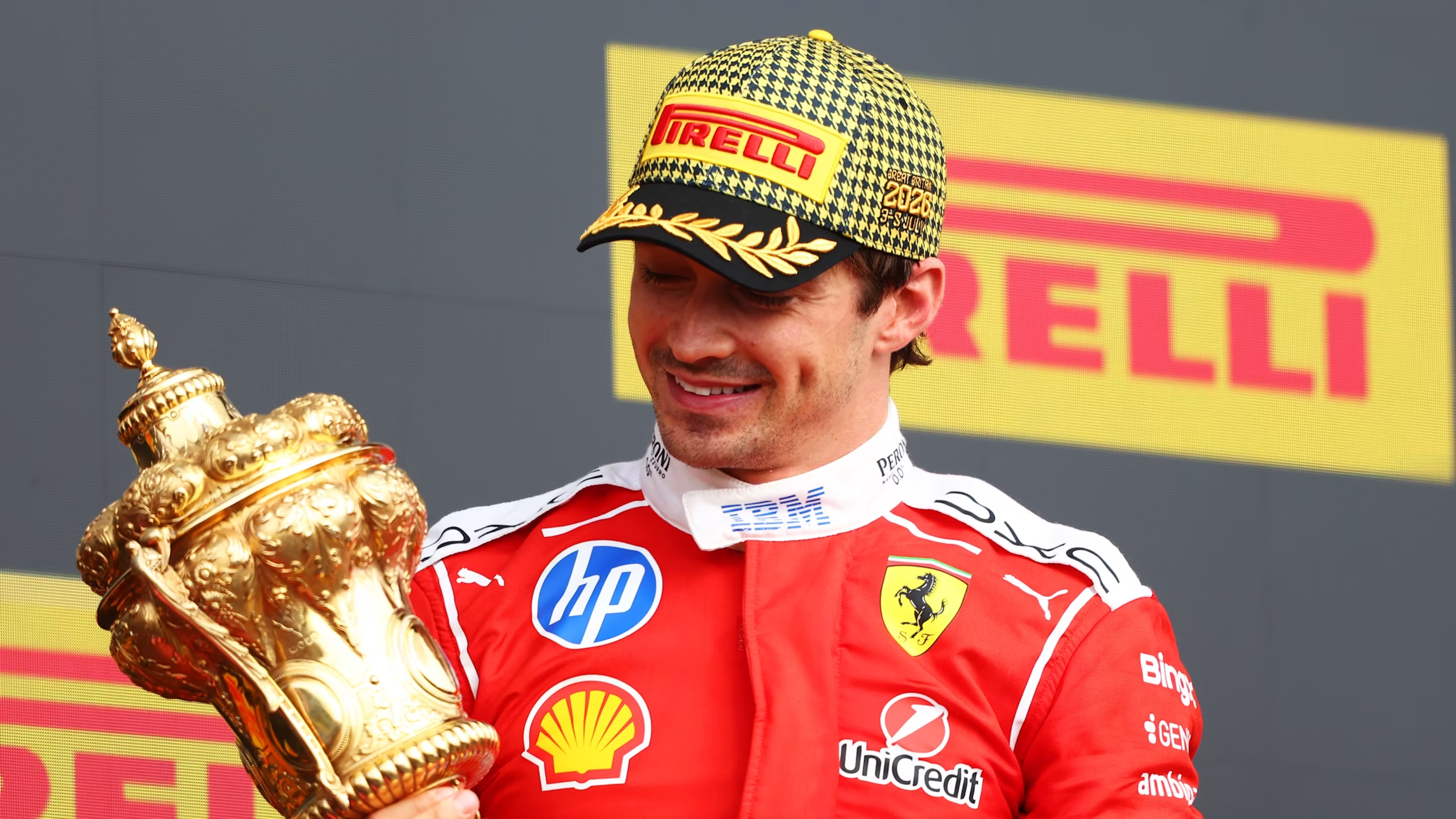
Charles Leclerc won the 2026 British Grand Prix, converting a front-row start into a controlled Ferrari victory on an afternoon that changed shape several times before finishing behind the Safety Car. George Russell placed second for Mercedes, only 0.427 seconds behind in the official classification, while Lewis Hamilton completed the podium in the second Ferrari.
The headline result tells only part of the Silverstone story. Kimi Antonelli started from pole, won Saturday’s Sprint and led the middle phase of the Grand Prix after extending his first stint. A left-front wheel-shield problem then damaged his car’s behaviour and forced repeated stops. Max Verstappen crashed at Stowe on lap 48, triggering the Safety Car that compressed the field and allowed Russell to jump Hamilton by staying on track while Ferrari fitted fresh tyres.
The final British Grand Prix 2026 results also contain important details that disappeared from the provisional order. Carlos Sainz received a one-lap penalty for overtaking the Safety Car and fell to 17th. Antonelli’s five-second track-limits penalty left him 15th. The official FIA classification lists three retirements: Verstappen, Alexander Albon and Nico Hulkenberg.
This report uses the final FIA classification and championship points documents, rather than an early live-timing screen. It covers the complete 22-driver finishing order, the decisive race phases, Ferrari and Mercedes strategy, every major penalty, the fastest lap, Driver of the Day and the effect on both championship tables.
Who Won the British Grand Prix 2026?
Charles Leclerc won at Silverstone for the first time.
The Ferrari driver completed 52 laps in 1 hour, 27 minutes and 11.335 seconds. George Russell finished 0.427 seconds behind, with Lewis Hamilton 0.772 seconds from the winner. Because the race ended under the Safety Car, those small official gaps reflect the controlled finish rather than the leaders’ true pace difference before the final caution.
Leclerc’s launch decided the opening argument. He started second, reacted cleanly and drove past polesitter Antonelli before the first sequence of corners. Hamilton also cleared the Mercedes, briefly creating a Ferrari one-two. From there, Leclerc managed the medium tyres, held a gap of several seconds and avoided the technical and strategic problems that destabilised almost every direct rival.
It was Leclerc’s first Grand Prix win of the 2026 season, his first British Grand Prix victory and the ninth win of his Formula 1 career. It also ended a victory drought stretching back to 2024. Ferrari’s pace had appeared stronger through the weekend, particularly after Hamilton led Friday practice and Sprint Qualifying, but Leclerc was the driver who assembled the complete Sunday performance.
Leclerc also won the fan-voted Driver of the Day award. That vote reflected more than the final classification. He controlled the race through two Virtual Safety Car periods, handled the hard compound after his only scheduled stop and remained calm when Antonelli cut the gap shortly before the Mercedes problem emerged.
Charles Leclerc won the 2026 British Grand Prix for Ferrari. George Russell finished second and Lewis Hamilton third. Kimi Antonelli set the fastest lap, while Max Verstappen, Alex Albon and Nico Hulkenberg were classified as retirements.
For the build-up that preceded the result, see the British Grand Prix predictions, the Silverstone weekend schedule and the detailed British GP strategy analysis.
British GP 2026 Full Race Classification
The table below follows the FIA’s final race classification published after the stewards completed the main post-race decisions. It therefore differs from the order shown immediately at the chequered flag, most notably because Sainz received a one-lap penalty.
| Pos | Driver | Team | Laps | Time / Gap | Fastest Lap | Pts |
|---|---|---|---|---|---|---|
| 1 | Charles Leclerc Winner | Ferrari | 52 | 1:27:11.335 | 1:32.871 · L43 | 25 |
| 2 | George Russell | Mercedes | 52 | +0.427 | 1:32.489 · L36 | 18 |
| 3 | Lewis Hamilton | Ferrari | 52 | +0.772 | 1:32.309 · L25 | 15 |
| 4 | Lando Norris | McLaren | 52 | +1.149 | 1:32.625 · L45 | 12 |
| 5 | Isack Hadjar | Red Bull | 52 | +1.598 | 1:32.268 · L40 | 10 |
| 6 | Liam Lawson | Racing Bulls | 52 | +2.023 | 1:33.648 · L45 | 8 |
| 7 | Arvid Lindblad | Racing Bulls | 52 | +2.214 | 1:33.632 · L29 | 6 |
| 8 | Gabriel Bortoleto | Audi | 52 | +2.413 | 1:33.650 · L30 | 4 |
| 9 | Franco Colapinto | Alpine | 52 | +3.229 | 1:34.281 · L25 | 2 |
| 10 | Pierre Gasly | Alpine | 52 | +3.445 | 1:34.179 · L44 | 1 |
| 11 | Oscar Piastri | McLaren | 52 | +4.014 | 1:32.917 · L42 | 0 |
| 12 | Oliver Bearman | Haas | 52 | +5.245 | 1:34.455 · L31 | 0 |
| 13 | Esteban Ocon | Haas | 52 | +5.512 | 1:34.792 · L43 | 0 |
| 14 | Sergio Perez | Cadillac | 52 | +7.403 | 1:35.520 · L44 | 0 |
| 15 | Kimi Antonelli 5-sec penalty | Mercedes | 52 | +8.005 | 1:31.777 · L37 | 0 |
| 16 | Valtteri Bottas | Cadillac | 52 | +8.162 | 1:35.893 · L31 | 0 |
| 17 | Carlos Sainz Penalty lap | Williams | 51 | 1 lap | 1:32.734 · L51 | 0 |
| 18 | Fernando Alonso | Aston Martin | 51 | 1 lap | 1:35.827 · L50 | 0 |
| 19 | Lance Stroll | Aston Martin | 51 | 1 lap | 1:37.232 · L41 | 0 |
| 20 | Max Verstappen DNF | Red Bull | 46 | Crash | 1:32.101 · L40 | 0 |
| NC | Alexander Albon DNF | Williams | 43 | Retired | 1:33.867 · L42 | 0 |
| NC | Nico Hulkenberg DNF | Audi | 36 | Mechanical | 1:33.433 · L36 | 0 |
The race ended under the Safety Car. Leclerc’s 0.427-second margin over Russell and the tightly packed gaps behind are timing-line intervals at a controlled finish, not evidence that the first 19 cars were separated by only a few seconds at racing speed. Our race-timing explainer covers the difference.
British GP 2026 Race Recap: How the Silverstone Result Unfolded
A Ferrari launch changed the race immediately
Silverstone began in sunny, warm conditions, and all 22 drivers selected the medium compound. That uniform choice removed one obvious strategic variable from the opening laps. The first decisive difference came from execution. Leclerc launched cleanly from second, while Antonelli could not protect the inside line into the opening complex. Hamilton also moved ahead of the Mercedes, transforming a Mercedes pole into a Ferrari one-two within seconds.
The start was not clean for everyone. Piastri reported damage after contact in the opening exchanges and stopped at the end of lap one, switching to hard tyres and losing track position. Albon locked his front-left while attempting an inside move on Bearman at Turn 6, hit the Haas and sent the British driver into a spin. The stewards judged Albon wholly responsible and issued a 10-second penalty.
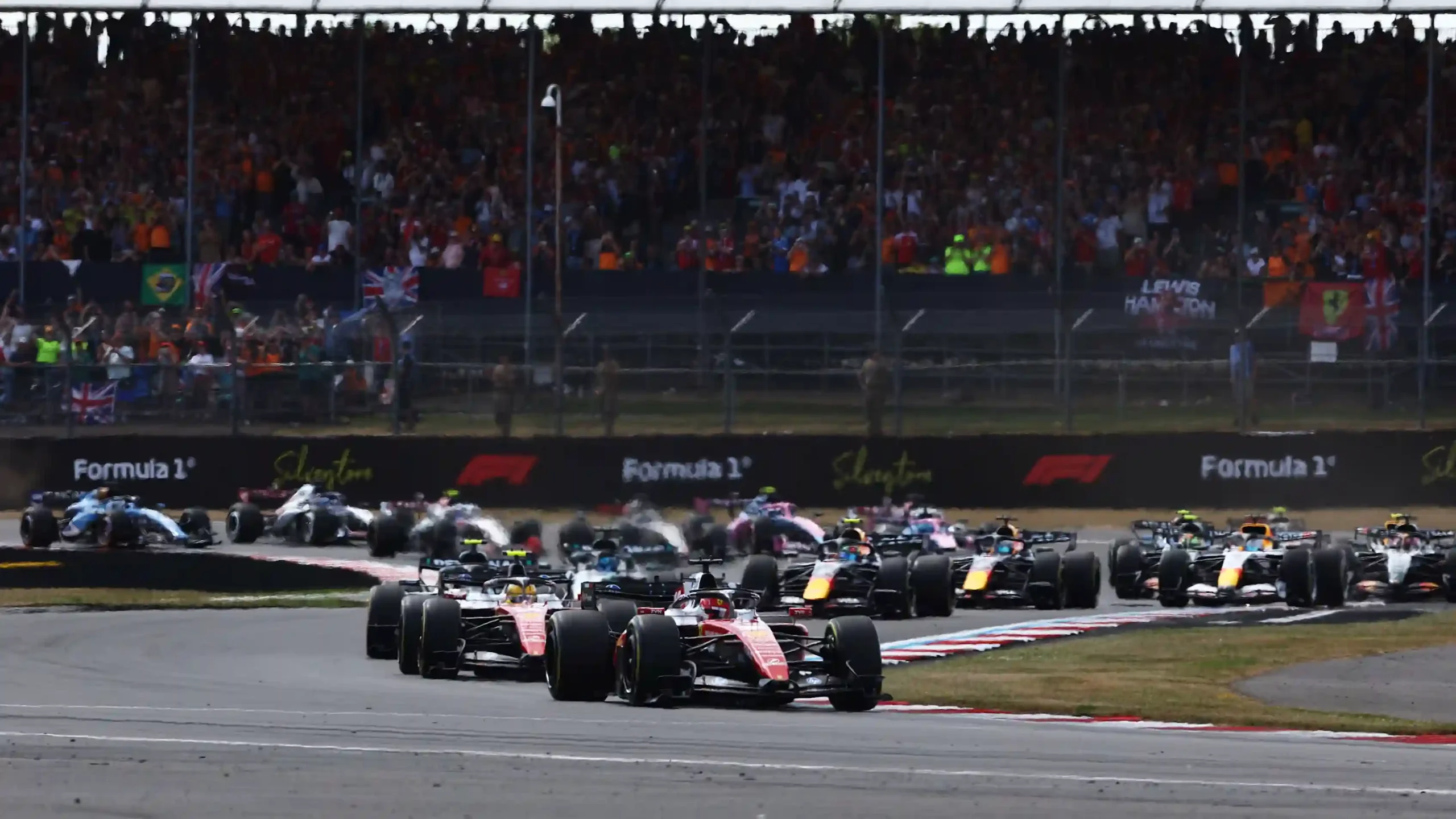
Hamilton’s strong getaway came with a cost. The stewards found that the Ferrari moved after the third red light illuminated and before the start signal. The movement was small, but the regulation treats movement in that interval as a false start. Hamilton received the standard five-second penalty and served it during his first pit stop.
Antonelli recovered speed, but Leclerc kept control
Antonelli did not allow the poor opening lap to define his race. He followed Hamilton closely, then passed at Copse on lap 11 and began to reduce Leclerc’s four-second advantage. Behind them, Russell, Verstappen, Hadjar and Norris formed the next strategic group. Verstappen reported unhappy downshifts but still found enough performance to pass Russell during lap 17 before making an early stop for hard tyres.
The leading Ferrari remained stable. Leclerc did not need to respond immediately to Red Bull because Antonelli stayed out and Hamilton carried a penalty. The first Virtual Safety Car arrived on lap 22 for an unusual reason: a marshal had to recover an umbrella near the track. Only a small number of drivers could exploit the timing for a cheaper stop.
Hamilton stopped shortly after the VSC phase, served his five seconds and rejoined in sixth. Leclerc stopped on lap 26 for hard tyres and emerged second, 17 seconds behind Antonelli, who had not yet visited the pits. The apparent Mercedes lead therefore depended on the timing of Antonelli’s stop rather than a genuine on-track margin.
Hamilton and Russell produced Silverstone’s best wheel-to-wheel sequence
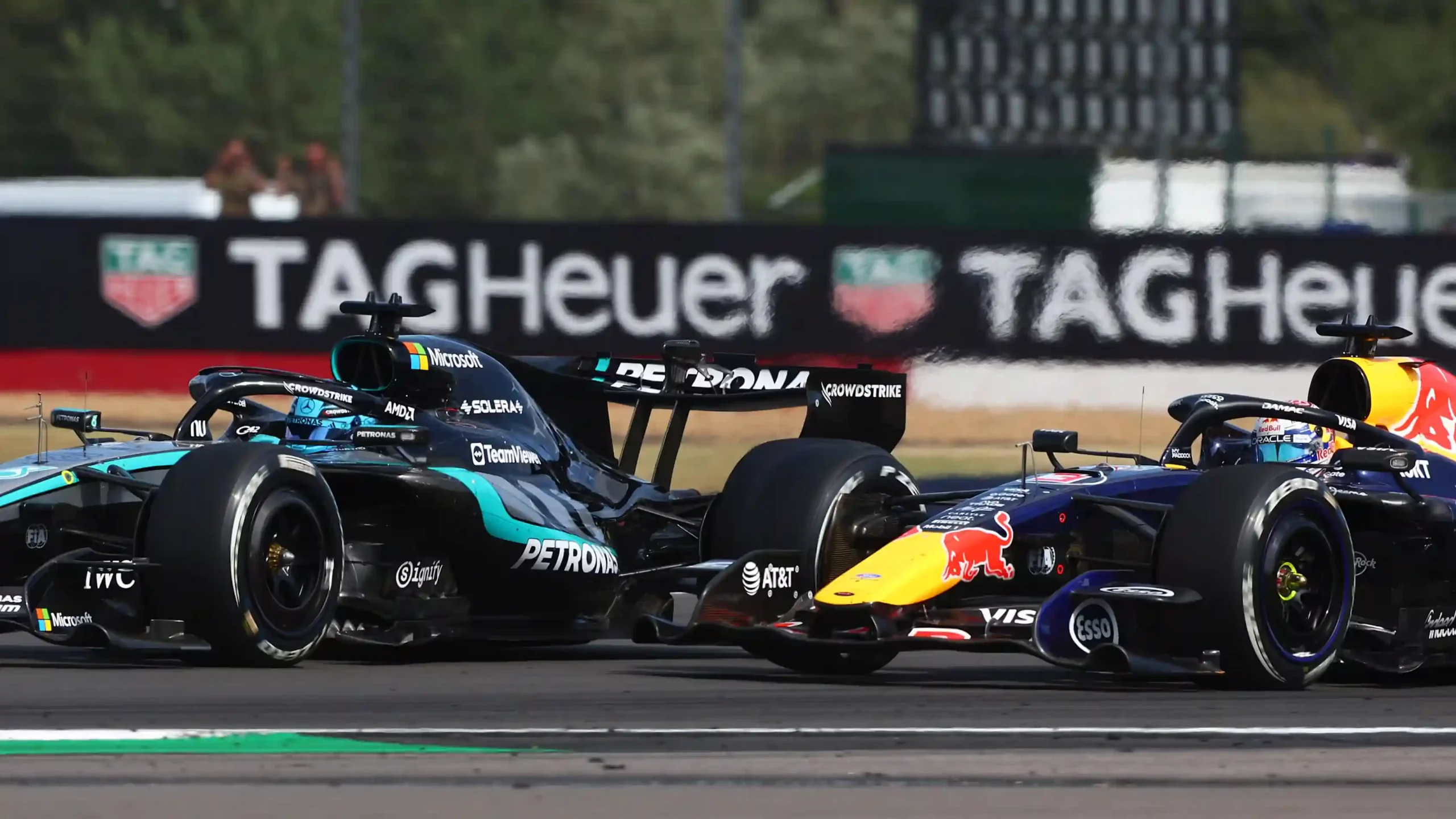
The most sustained battle among the front runners came between the two British drivers. Hamilton attacked Russell around lap 30, passed, lost the position again and tried once more through Brooklands, Copse and the high-speed section. Their exchange showed the importance of positioning and energy deployment under the 2026 rules. Neither driver could simply complete a pass and disappear; each had to defend the next sequence.
Russell then learned that his car had a slow puncture. Mercedes delayed only briefly before bringing him in on lap 35 for another set of hard tyres. One lap later Antonelli finally stopped from the lead. He returned to the circuit seven and a half seconds behind Leclerc, with enough pace to suggest that the Grand Prix still had a competitive final phase.
The second Virtual Safety Car and Antonelli’s failure
Hulkenberg stopped with a mechanical problem on lap 39, first producing yellow flags and then a Virtual Safety Car. Verstappen, Norris and Hadjar pitted. Ferrari kept Leclerc on track, protecting the lead and avoiding a stop that might have exposed him to traffic when racing resumed.
Antonelli had reduced Leclerc’s lead to 3.1 seconds by lap 41 when his race unravelled. He reported that something had broken and that the car would not turn properly. Mercedes suspected a left-front wheel-shield failure. The team changed the front wing and tyres, then brought him in again to remove the damaged part. Those stops dropped the pole-sitter from a potential victory fight into the lower points positions.
The mechanical problem was compounded by a five-second track-limits penalty. Antonelli had already received the black-and-white flag and then exceeded the limit again. His fastest lap remained the best of the race, but the final classification placed him 15th after the penalty was applied.
Verstappen’s Stowe crash created the final Safety Car
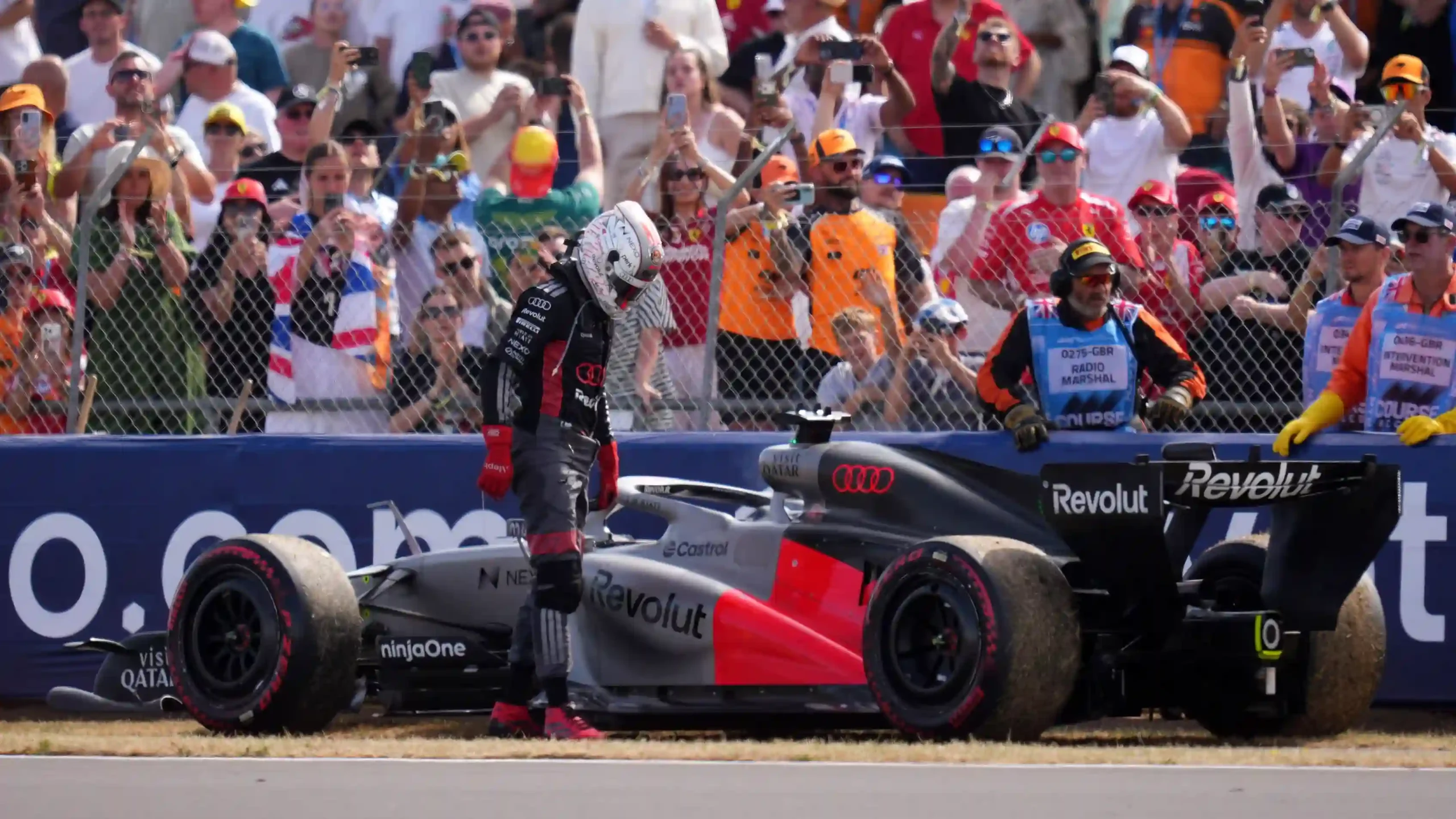
With Leclerc holding a large advantage over Hamilton, the remaining question appeared to concern the lower podium positions. Verstappen changed that on lap 48. The Red Bull ran off at Stowe and became stranded in the gravel, forcing Race Control to deploy the Safety Car.
Ferrari stopped both Leclerc and Hamilton for fresh tyres. Mercedes left Russell out. That decision promoted Russell above Hamilton into second place, because the field had slowed and the order could not be recovered before the chequered flag. The Safety Car stayed out for the remaining laps, so there was no sprint restart.
Leclerc therefore won without facing a final attack. Russell secured second despite his puncture-affected race, and Hamilton retained third. The finish felt compressed and slightly unfinished, but the strategic choices were rational. Mercedes protected track position; Ferrari protected Leclerc’s victory and gave Hamilton fresher tyres in case the race restarted.
British Grand Prix 2026 Strategy Analysis
Pirelli expected a largely one-stop race, and the opening tyre choice confirmed that forecast. Every driver started on the medium compound. With no alternative starter creating an offset, the strategic contest centred on the timing of the move to hard tyres, the risk of an undercut and the two Virtual Safety Car interruptions.
Control the lead
Leclerc extended the medium stint to lap 26, took the hard tyre and stayed out during the second VSC. The plan prioritised clean air and avoided reacting to every move behind.
Split the timing
Russell stopped after a slow puncture, while Antonelli extended to lap 36. The long first stint briefly created a race-winning position before the wheel-shield problem.
Tyres versus position
Russell stayed out and gained second. Ferrari stopped Hamilton, losing track position but covering a possible restart with fresh tyres.
Why Leclerc’s race was stronger than it looked
Leclerc did not set the fastest lap and did not lead every tour, yet he controlled the strategic centre of the race. His advantage allowed Ferrari to ignore Verstappen’s early hard-tyre stop. Later, the team could leave him out during the Hulkenberg VSC because Antonelli still had to prove that his Mercedes could close the final gap and pass on track.
The key was consistency. Leclerc protected the front-left medium tyre through Silverstone’s high-speed corners, then produced enough pace on the hard compound to remain out of undercut range. When Antonelli reached his fastest phase, the Ferrari had already completed the required stop and held track position.
Did Ferrari cost Hamilton second place?
Hamilton was running second when Verstappen crashed, but Ferrari pitted him while Russell remained on track. In the final classification that choice placed Russell ahead. However, a team cannot know with certainty that a Safety Car will remain deployed until the chequered flag. Had the race restarted, Hamilton would have had fresh tyres and Russell would have defended on an older set.
The decision therefore exchanged guaranteed track position for restart performance. Mercedes took the opposite side of the trade and gained second because the restart never came. That outcome does not automatically make Ferrari’s process wrong. It shows why Safety Car strategy must be judged against the information available at the moment rather than only the final order.
To understand the underlying concepts, read how pit stops work, what a Safety Car does and how slipstreaming affects overtaking.
Silverstone was not won by the most aggressive pit call. It was won by the driver who created enough pace and tyre life to keep every strategic option open.
Penalties, Incidents and DNF List
Lewis Hamilton: five seconds for the false start
The FIA stewards reviewed video, timing and onboard footage and found that Hamilton’s car moved before the start signal. The movement was limited, but the regulation does not require a large jump. Any movement after the specified red-light stage and before the start signal constitutes an infringement. Hamilton served the five-second penalty during his first stop and still recovered to the podium.
Hamilton: post-race reprimand for the yellow flag
Hamilton was also investigated for failing to slow sufficiently for a single yellow flag at Turn 9 on lap 38. The stewards noted several mitigating circumstances: he entered the sector before the yellow appeared, received the steering-wheel warning late and had just completed a battle with Verstappen. They still found no discernible reduction in speed, but issued a driving reprimand rather than a time penalty. His third place remained intact.
Alexander Albon: 10 seconds for hitting Bearman
Albon attempted an inside pass at Turn 6, locked the front-left wheel and understeered into Bearman’s rear-left tyre. The contact spun the Haas. The stewards ruled that Albon was not fully in control from corner entry to the apex and was wholly responsible. Williams later retired the car after running additional laps to gather data.
Kimi Antonelli: five seconds for track limits
Antonelli’s mechanical trouble did not remove the obligation to remain within the track limits. He exceeded the allowed number of offences and received five seconds. Because the field finished under the Safety Car, even a small penalty had a significant effect on the tightly compressed final order. The adjustment placed him 15th.
Carlos Sainz: a rare one-lap penalty
Sainz’s case was the most unusual. During the late Safety Car procedure, Williams instructed him to overtake when “lapped cars may now overtake” was displayed. Because of Silverstone’s pit-lane geometry, Sainz was not officially a lapped car at the relevant timing reference and was not included in the list authorised to pass. He gained a lap to which he was not entitled.
The stewards acknowledged the unusual layout and the team’s confusion, but Williams accepted that it had made two errors. The resulting one-lap penalty moved Sainz from the provisional midfield order to 17th in the final classification.
Retirements: Verstappen, Albon and Hulkenberg
- Max Verstappen: crashed into the gravel at Stowe on lap 48, causing the race-ending Safety Car.
- Alexander Albon: retired after 43 laps following an early collision, penalty and a compromised race.
- Nico Hulkenberg: stopped with a technical problem after 36 laps, triggering the second Virtual Safety Car.
The difference between yellow flags, a Virtual Safety Car and a full Safety Car is explained in our racing-flags guide. The wider causes of contact and loss of control are covered in what causes racing crashes.
Podium Analysis: Leclerc, Russell and Hamilton
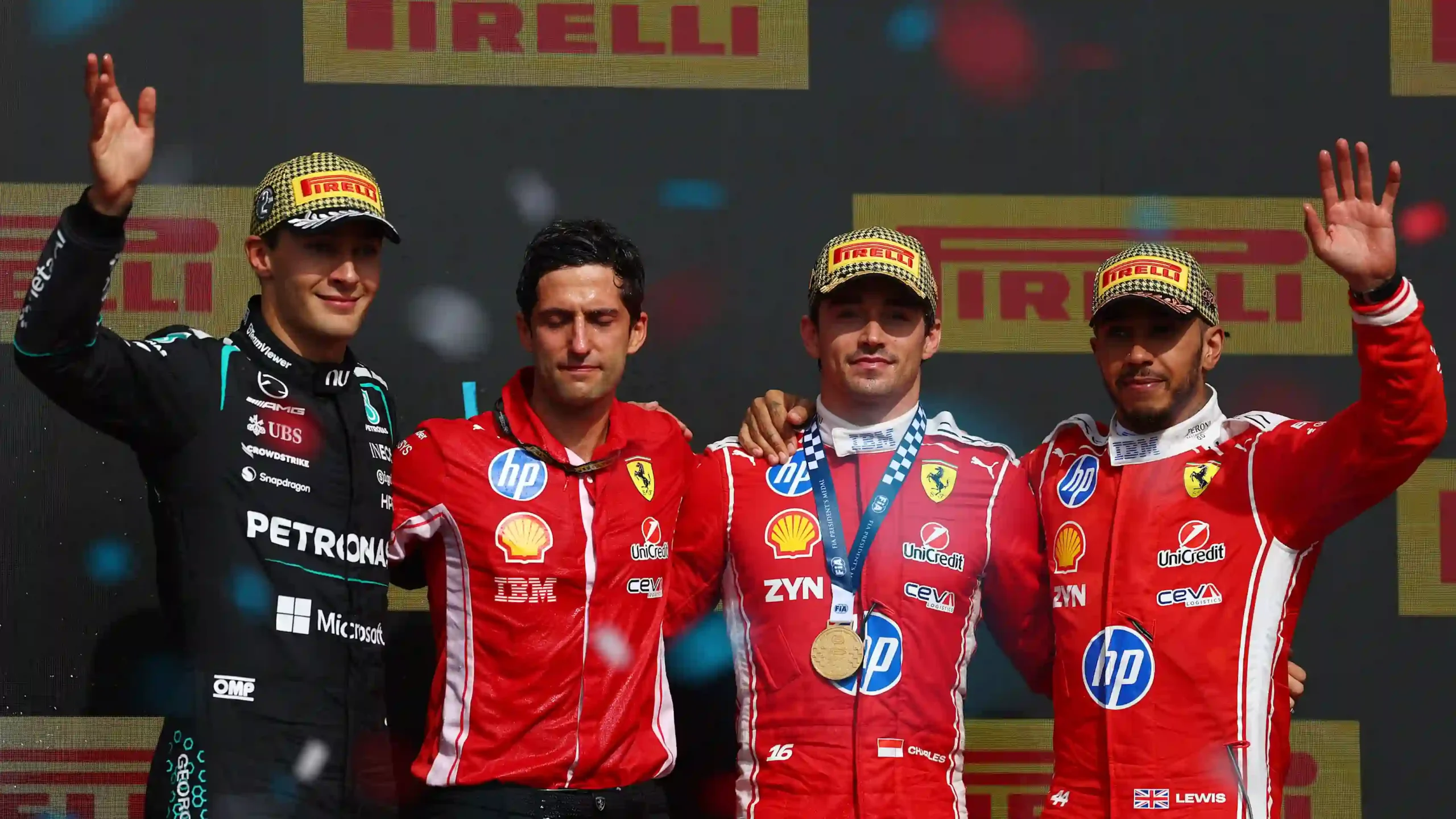
Charles Leclerc: the cleanest complete weekend when it mattered
Leclerc did not own every session. Hamilton took Sprint pole, Antonelli won the Sprint and then secured Grand Prix pole. Yet Sunday rewarded the Ferrari driver who made no decisive error. He won the launch, controlled the first stint, stopped at the correct point and kept enough pace in reserve when Antonelli closed.
The victory also changed Ferrari’s internal season narrative. Hamilton had won at Barcelona and entered Silverstone ahead in the championship. Leclerc’s 25-point result, combined with his first Silverstone win, prevented the season from becoming a one-sided story inside Maranello. He remains behind Hamilton in points, but the performance proved that he can still convert the SF-26’s stronger weekends.
George Russell: second place built from damage limitation
Russell’s race contained a slow puncture, repeated battles with Hamilton and Verstappen, and a late strategic gamble. Second place was not the result of controlling the race. It was the result of remaining close enough to benefit when Antonelli failed, Verstappen crashed and Ferrari stopped Hamilton.
That matters in a championship. Russell scored 18 Grand Prix points while leader Antonelli scored none. Across the Sprint weekend, Russell cut the deficit from 40 points before the event to 25 afterward. He did not need to beat Antonelli on raw pace to produce a major title swing.
Lewis Hamilton: penalty, overtakes and another home podium
Hamilton’s first-lap speed was clear, but the false-start penalty forced him to recover five seconds through pace and track position. He passed Antonelli off the line, fought Russell through some of Silverstone’s fastest corners and later overtook Verstappen on the Wellington Straight.
The late stop cost him second in the final order, but the podium remained valuable. Hamilton left Silverstone with 147 points, only seven behind Russell and 32 behind Antonelli. Ferrari also scored 51 points across the Sprint and Grand Prix, its largest weekend haul of the year to that point.
Silverstone’s overtaking zones depend on aerodynamic load and energy deployment. Read what downforce is and why grid position matters for more technical context.
Fastest Lap, Pole Position and Driver of the Day
Kimi Antonelli
1:31.777 on lap 37 at an average speed of 231.077 km/h. It was his sixth DHL Fastest Lap Award of the season.
Kimi Antonelli
1:28.111 in qualifying, 0.175 seconds faster than Leclerc. The result followed his Sprint victory earlier on Saturday.
Charles Leclerc
The fan vote went to the race winner after his first Silverstone victory and first Grand Prix win of 2026.
Antonelli’s weekend remains one of the clearest examples of how Formula 1 rewards complete execution. He won the Sprint, took pole and set the fastest race lap, yet left Sunday without Grand Prix points because of a component failure and track-limits penalty. The F1 qualifying guide and pole-position explainer describe how Saturday performance shapes the grid without guaranteeing the race result.
Championship Implications After the British Grand Prix
The British Grand Prix changed the title race without changing the championship leader. Antonelli remains first, but his advantage over Russell fell to 25 points. Hamilton is now only seven behind Russell, while Leclerc’s victory moved him to 108 points and strengthened Ferrari’s constructors’ challenge.
2026 Formula 1 Drivers’ Championship — Top 10
| Pos | Driver | Team | Points | Gap to Leader |
|---|---|---|---|---|
| 1 | Kimi Antonelli | Mercedes | 179 | Leader |
| 2 | George Russell | Mercedes | 154 | −25 |
| 3 | Lewis Hamilton | Ferrari | 147 | −32 |
| 4 | Charles Leclerc | Ferrari | 108 | −71 |
| 5 | Lando Norris | McLaren | 97 | −82 |
| 6 | Oscar Piastri | McLaren | 82 | −97 |
| 7 | Max Verstappen | Red Bull | 76 | −103 |
| 8 | Isack Hadjar | Red Bull | 52 | −127 |
| 9 | Pierre Gasly | Alpine | 42 | −137 |
| 10 | Liam Lawson | Racing Bulls | 39 | −140 |
2026 Constructors’ Championship
| Pos | Constructor | Points | Gap to Leader |
|---|---|---|---|
| 1 | Mercedes | 333 | Leader |
| 2 | Ferrari | 255 | −78 |
| 3 | McLaren | 179 | −154 |
| 4 | Red Bull | 128 | −205 |
| 5 | Alpine | 60 | −273 |
| 6 | Racing Bulls | 59 | −274 |
| 7 | Haas | 21 | −312 |
| 8 | Williams | 11 | −322 |
| 9 | Audi | 6 | −327 |
| 10 | Aston Martin | 1 | −332 |
| 11 | Cadillac | 0 | −333 |
What the result means for Mercedes
Mercedes lost the Grand Prix but protected a large constructors’ lead. Russell’s second place softened Antonelli’s zero, and the team still left Silverstone with 333 points. The more serious development concerns the drivers’ title. Antonelli’s 40-point pre-race cushion fell to 25 after the full Sprint weekend. Russell and Hamilton are now within one normal race win plus a small additional swing.
What the result means for Ferrari
Ferrari was the weekend’s biggest championship winner. Leclerc and Hamilton scored 40 Grand Prix points, while their Sprint results lifted the team’s event total to 51. Ferrari reduced Mercedes’ advantage to 78 points. That remains a meaningful margin, but it is not secure across a 24-round season with multiple Sprint weekends.
Ferrari also gained an internal two-driver threat. Hamilton sits third in the standings and Leclerc fourth. If the SF-26 maintains the balance shown at Silverstone, Mercedes will have to defend both championships rather than manage only Antonelli’s lead.
McLaren’s difficult home result
Norris scored 12 points in fourth, but Piastri’s first-lap damage limited him to 11th. McLaren remains third on 179 points, exactly matching the combined points total of its two drivers. The team is 76 behind Ferrari and 154 behind Mercedes. Silverstone therefore strengthened the case that McLaren needs cleaner weekends before it can re-enter the constructors’ fight.
Red Bull loses ground despite Hadjar’s fifth place
Hadjar delivered 10 points, but Verstappen’s crash removed a likely top-six finish. Red Bull now has 128 points, 51 behind McLaren. Verstappen is seventh in the drivers’ standings, 103 behind Antonelli. A late-season championship recovery would require not only improved pace but a long sequence of near-perfect reliability and execution.
The midfield winners
Racing Bulls scored 14 Grand Prix points through Lawson and Lindblad, one of the strongest team results outside the leading four organisations. Audi earned four through Bortoleto despite Hulkenberg’s retirement. Alpine added three with Colapinto and Gasly, keeping a one-point advantage over Racing Bulls in fifth.
Follow the evolving tables through the Formula 1 standings hub. Our championship-scoring guide explains how race and Sprint points combine.
The FIA championship-points document issued on July 5 stated that the tables were subject to notices of intention to appeal by McLaren and Red Bull. The figures above reproduce the FIA-published standings from that document.
How the Sprint Weekend Shaped the British GP Result
Silverstone used the Sprint format, which reduced the teams to one practice session before Sprint Qualifying. Hamilton took Sprint pole by 0.011 seconds over Antonelli, giving Ferrari an early indication that the car could compete for the main event.
Antonelli then won Saturday’s Sprint ahead of Hamilton and Norris. The result added eight points to his championship total and demonstrated strong race pace. Later that day he took Grand Prix pole in 1:28.111, beating Leclerc by 0.175 seconds. In pure Saturday performance, Antonelli was the weekend’s benchmark.
The Sprint format also limited the time available to study long-run tyre behaviour and refine setup. That did not directly cause Antonelli’s mechanical failure, but it increased the value of Friday data and made Ferrari’s stable Sunday balance more important. The 2026 F1 schedule identifies the remaining Sprint rounds, while the 2026 driver guide tracks the expanded 22-car field.
What Comes Next After Silverstone?
Formula 1 takes one weekend off before returning for the Belgian Grand Prix at Spa-Francorchamps from July 17 to 19. Spa will test a different compromise: low drag for the long full-throttle sections, confidence through Eau Rouge and Raidillon, and enough downforce for the middle sector.
Mercedes arrives with both drivers in the championship top two. Ferrari carries the momentum of a 51-point Silverstone weekend. McLaren needs a cleaner race, while Red Bull must understand the shifting issue Verstappen reported before his crash. See the Belgian Grand Prix guide for the next round.
British Grand Prix 2026 Results FAQ
Conclusion: A Ferrari Win That Reopened Both Championships
Silverstone changed the direction of the 2026 season
Leclerc’s victory was convincing because it combined speed with restraint. He won the start, protected the tyres and kept the race under control when the strategy windows opened. The late Safety Car reduced the official gaps, but it did not create the Ferrari win.
Russell’s second place was equally important for the championship. Antonelli still leads, yet the margin is only 25 points after a weekend in which the Italian won the Sprint, took pole and set the fastest lap. Hamilton is only seven points behind Russell, giving Mercedes and Ferrari three realistic drivers at the front of the standings.
Ferrari’s 51-point weekend reduced the constructors’ deficit to 78. Mercedes remains the benchmark over the full season, but Silverstone proved that the title race is not settled. The next question is whether Ferrari can reproduce the SF-26’s high-speed balance at Spa.
Official Sources
Document 84, published after the stewards completed the final classification.
Document 85, containing the official post-Silverstone points tables.
Used for the race chronology, pit sequence, incidents and team decisions.
Confirms Antonelli’s 1:31.777 on lap 37.
Explains the evidence and the standard penalty applied.
Explains why Sainz was not entitled to overtake the Safety Car.
Official confirmation of the Driver of the Day award.
Official qualifying recap and front-row order.